How to Avoid Boring Brainstorm Meetings with Danny Warshay

Danny Warshay explains why traditional brainstorms fail and how to fix them: use diverse teams, break mental fixedness, and try structured techniques like silent idea generation before group discussion. Chris Dean shows how to move from ideas to real solutions by testing hypotheses with actual customers and building a minimal viable product.
Chapters
What comes to mind when you hear the word brainstorm? Do you picture someone at a whiteboard with a group of people all shouting out their ideas at once? There's got to be a better way. How can any leader make their brainstorms more productive and more fun? From the Ramsey Network, this is the EntreLeadership Podcast, where we help business leaders grow themselves, their teams, and their profits. I'm your host, George Campbell, and today's episode is all about how to get the most out of your brainstorm meetings. Our first guest today is Danny Warshay. He's an entrepreneur who has co-founded and sold multiple companies. He's also a professor of entrepreneurship at Brown University with a new book out called See, Solve, Scale: How Anyone Can Turn an Unsolved Problem into a Breakthrough Success. And today, we're gonna talk about how to keep brainstorm meetings from being boring and unproductive so that your team can solve problems. We'll also talk about how to structure those brainstorm meetings and some techniques that you can use to make them more productive. In our second conversation, I sit down with Ramsey leader Chris Dean. He's gonna talk about how to take those brainstorm ideas and then test them to see which ones resonate with your customers. Up first, my conversation with Danny Warshay. Danny, thanks so much for being on the podcast.
My pleasure, George, really happy to be here.
So you're a really smart person. I don't think I could get into Brown, let alone teach there, but you know.
Well, if I could break it to you, I went to Brown, but I don't know that I would get into Brown. Brown these days either. So we would be— we'd be connected and doing something else together then.
Yeah, absolutely. So you've been teaching at Brown now for over 17 years as a professor of entrepreneurship. You've seen a lot of things, and you've also been in the trenches. You haven't just been on the education side. You've done this stuff. Tell us about your entrepreneurial journey.
Sure. Exactly right. I always say that teaching entrepreneurship is a participation sport, not a spectator sport. And so, uh, you're right, for most of my career I've been doing entrepreneurship. In fact, that started when I was an undergraduate student at Brown. I was studying history, and I'm a big proponent of liberal arts for doing just about anything, and especially entrepreneurship. And I fell into this opportunity to be part of the leadership team of a startup software company, and that was a little unusual because I didn't know anything about computers. And I didn't have any business experience, but the technical folks on the team I knew quite well, and they thought I was smart and organized and capable, and they invited me to participate. And we built that company up with some support from Brown, and we sold it to Apple. This was in the late '80s, and to my students these days, I have to clarify that there were computers in the '80s. Of course, you know that. That set me on the path of what I've done throughout most of my career of starting or co-founding, and then building, and then harvesting startup companies in a very wide range of fields. I have a little bit of traditional business background. I went to Harvard Business School. I have an MBA from Harvard. I worked at Procter& Gamble in brand management, but most of my career, as you say, I've spent Doing entrepreneurship in a wide range of different startup ventures. Wow.
I mean, that's, that's quite the resume. Very impressive stuff. I'm hoping you can give us just a bit of all the wisdom that you've gathered over the years today. And we're mostly focusing on communication and meetings, because that's a big part of being a leader, is communicating things to the team, having productive meetings. And a lot of people, when they think of the word When people hear the word brainstorm, they don't always get super excited. It can feel kind of cheesy, and you picture, you know, a guy at the whiteboard. Why are brainstorms frequently not productive and boring?
Well, I knew that this was the topic that you wanted to talk about, and I was very excited to do it, not because I'm an advocate of brainstorms per se, which are kind of, you know, chaotic, unbridled, not structured, discussions about anything that happens to come into your mind, hence the word brainstorm. So I hate to break it to you, but brainstorming as that is described is not effective. It's not useful for helping people to be more creative, be innovative, be entrepreneurial. And in my teaching though, I teach a whole variety of approaches that are effective. I know this from my own entrepreneurship experience. I know it from my own teaching experience. I know it because I'm a professor of entrepreneurship at Brown, and everything I teach needs to be grounded in academic research. And I'm happy to share at least a few highlights. And then, as many of my students have been after me, I've written and published a book called See, Solve, Scale: How Anyone Can Turn an Unsolved Problem into a Breakthrough Success. And in that book, I dive very deeply into a number of these methodologies that I'm happy to at least highlight today with you.
Oh, that's awesome. Well, we're here for it. So talk to us about the best way to even structure this brainstorm meeting, because like you're talking about, it can just be unbridled chaos, and the loudest people in the room are usually leading it, and they're throwing all the ideas out there, and there's usually some folks who have some brilliant ideas but feel like they're stuck in a quiet space because they don't want to try to interrupt and get their voice heard, and so that can be a very stressful environment that isn't productive. What have you found is the best way to actually structure the meeting before it actually happens so that it's productive and fun?
I'll tell you the secret for what's the most important factor that can lead to a successful outcome in something creative or innovative or entrepreneurial where you're looking to solve a problem. And that's less about the process and much more about who's engaged in the process. And the truth is that the most successful teams tend to be the most diverse and the most inclusive. Diverse writ large— that's race, gender, background, experience, introverts and extroverts, uh, people who are more analytical, people who are more artistic. The more diverse, the better. And part of the team should engage people who are gonna be involved in the product or process later on once you've created it. And that's related to an adage that a good friend of mine and collaborator, Bob Johnston, has coined, which is, people support what they help to create. So the most important factor here happens before you're even engaged in any kind of creative process. It's about how you're formulating the team.
Well, that's a good reminder to start there. So let's say you get the right people in the room, you feel good about this, what's the next step you need to take? before you actually jump into sharing ideas?
Well, I love that question because not only is there a fun answer to that, but there's really good research, academic evidence for how you need to break what you call, what we might call mental fixedness, our brains being stuck looking at or thinking about or digesting one way. And in order to be creative or problem-solving or innovative or entrepreneurial, You have to free your brain from that fixedness. And I'll give you a quick example. There's a really good research study from 2 psychologists at Harvard, Langer and Piper. And they did what seems like a pretty simple experiment to demonstrate the shift of mindset and how it can have big impact. They divided groups into 2 teams. One team was handed a pencil, a piece of paper, and a rubber band. And the instructions were, you're going to do some tasks and you're going to make some mistakes. And they were told, this is a pencil, this is a piece of paper, this is a rubber band. And only 3% of that group figured out that you could use the rubber band as an eraser to erase some of your mistakes. The second group was same scenario. They were told, here's a pencil, Here's a piece of paper. And when they were handed the rubber band, the little shift was, and this could be a rubber band. Not this is, this could be. That's all it took to break their fixedness because 40% of that group realized that the rubber band could actually be an eraser.
Wow.
And so sometimes it doesn't take much to break your mental fixedness around a table or in a creative group. But you have to take time in the beginning to acknowledge that we're biased and we're probably focused on one way of thinking about a problem, and we need to free ourselves in order to do that. And when I share with you another technique a little later on, I'll emphasize how that can also break your fixedness. But once you have the right people around the table, you have to take a couple minutes to acknowledge we're biased and we can break our bias, break our mental fixedness, By being conscious of it.
Yeah. Well, you know, as you kind of grow up in the education system, you tend to want to get the right answer, right? That's what we're trained to do. And so in a room where you're sharing ideas, you don't want to have the bad idea, quote unquote, where everyone goes, that's stupid, that's wrong. And so that can be a scary thing. And creating that environment that is inclusive where everyone's voice can be heard and we're not here to shame anyone, we're here to solve a problem, that's so important. So in your teaching, you talk about this idea of nominal group technique. That is a That's a $10 word for a guy like me. How do you sum that up and what are the benefits for it?
So Nominal Group Technique, I want to be clear, I didn't invent it, but I use it a lot in my teaching and in my own entrepreneurship. It's detailed in my book. You can also just Google Nominal Group Technique. It's a really brilliant approach to doing exactly what you just said, to creating a structured environment where everybody can feel comfortable to contribute. In whatever way they are used to or whatever new way they want to contribute. And it tends to help people who are both introverts and maybe still very capable of contributing. I won't describe it in explicit detail, but in short, it provides an environment where you're doing some work together as a group. And we all can imagine why there's good confluence of, or synergy of different thinking patterns, different experiences, where a group together can work on a problem. But really important is to recognize that often breakthroughs don't happen with, you know, 10 people talking at once or working on the problem all at once. And so it also leaves time for individually people in the group to work on the problem. And so there's a little bit of time working individually, there's a little bit of time working as a group, and it tends again to appeal to both extroverts and introverts who are part of that diverse team that you've assembled around the table. So that's kind of a shorthand way of describing not so much the explicit detail of nominal group technique, but why it's so important. And my students use it every semester in their venture teams. And they rave about it, and they tell me how it's often what has been responsible for producing the kind of breakthrough ideas they have, leveraging both introverts and extroverts.
Yeah, that's powerful. I was in a recent brainstorm meeting, and one of the ways we did this was we had sticky notes, and instead of going, hey, who's got ideas? Start shouting them out. Instead, they said, hey, we're gonna take 5 minutes in silence, you're gonna write all the ideas on sticky notes, and then we're gonna take them, we're gonna stick them on the board in different categories, and then as a group, we discussed all of them, and so it gave those people who, maybe need some time to process and don't want to be the loudest in the room, but they still were able to get their voice heard. And so that's, I think, an example of how the nominal group technique can be used in the real world.
It is. And that's a way of, again, engaging and including people from your diverse team who may not be the ones who shout the loudest. Often I find they're the ones who contribute the most. So there's a number of other strategies that, if it's okay, I'll just quickly mention, which are worth thinking about and are outlined in more detail in the book, and I think are really useful now that we've got a diverse and inclusive kind of environment. We've set the right tone by breaking our mental fixedness. We've established the ground rules so that some of the work you do is together in a team. Often much of the work you do is at least preliminarily As an individual. Some of the adages that I would describe as a mental stretch to help you structure some of what comes next is— one that I absolutely love is diverge before you converge. And this is often what people resist. There's a problem, there's a question on the table, people want to rush to solve it and be done with it. And as a result, they tend to be too narrow in their approach. And so I encourage everybody to diverge first and come up with all sorts of ideas that may or may not be feasible. In fact, the adage again that I attribute to my friend Bob Johnston is, it is far easier to make an innovative idea feasible than a feasible idea innovative.
Hmm.
And if you think about it, that makes sense. And so initially, when you're diverging, think of a lot of ideas because quantity tends to work in your favor. And don't worry about judging them against the criteria of, is this going to work? Do we have budget for this? Can the technology be advanced enough for actually for us to accomplish this? Do we have the right people on the team? There will be all sorts of room for skepticism. But those often diminish the momentum you might have regarding ideas that on their face may not actually seem or be feasible, but might lead you to a breakthrough that you wouldn't see if you were too hung up on feasibility. And so that's again one of the problems I see in just sheer brainstorming. People have a limit on the way they think about these things and they get too narrow too quickly. So diverge before you converge is definitely one of the most important adages to have in mind.
That's powerful.
A second one is lateral thinking, which means it's, you know, the adage is that you can't dig a new hole by digging the same hole deeper. And so sometimes people are constrained by, well, this is the way we do things at this company or organization. And so I'm just going to kind of try to expand or dig deeper in one narrow location. And instead, again, maybe consistent with the first adage, diverge before you converge, think laterally, move to different ways of thinking about the problem rather than just trying to dig deeply in one particular area.
That's good. You got any other strategies here? I love a good strategy. These are all brilliant. I'd be writing it down, but I'm focused on this conversation. I'll have to go back and listen.
And one, maybe a third one after diverge before you converge and think about lateral thinking is embrace wildcard ideas. And again, Bob Johnson and Doug Bate, who work in this field a lot with me, they often start off the discussion by saying, we want you to include at least one and maybe several ideas that are just on their face kind of crazy, ridiculous, the kind of ideas that you said before would get people to laugh. In fact, what they often advise people somewhat jokingly is come up with ideas, at least a few, that are immoral, illegal, or would get you fired. And I think that is probably good guidance, not that they want you to break the law or do anything immoral, but they want something on your list that is on its face going to be absurd. And why is that? Well, it might be that on, on a second glance, they're not quite as absurd as you think. And often those push-the-envelope ideas are really useful, maybe on their own merit. But even if they aren't the ideas that you pursue, they will push your thinking beyond your near-term limitations so that you'll embrace things that you might not have if you were just too conservative about the way you approach things. So when I assign my students to do this in the early stages of a course— in fact, my students this semester at Brown just did this, they came up with a portfolio of ideas to solve problems— I require that they have at least one, and ideally several, again, wildcard ideas, ideas that are just on their face crazy and absurd, and it's not uncommon sometimes for students to eventually pursue them because they realize they're not quite as wild card as they might have seen in the beginning.
Wow, that's really, really good. And I've seen that where someone says the crazy idea, but then they go, you know what, that's crazy, but it does make me think about this, and that leads you to the actual solution, and it can be way more innovative than if we all just sat there scared to share the crazy idea.
Can I share an example of that?
Oh, please.
That I think is a really good illustration of exactly what you just said, George. So there's a really good story about General Foods. They needed to refresh something in their candy line, and they had a consultant working with them, and they were just too tentative. They were too conservative about the way they were thinking, and The consultant required them to come up with a wildcard idea. And so the wildcard idea somebody shouted out was talking candy. And at first everybody laughed. How absurd, how ridiculous to think about the concept of talking candy. And the dynamic you just described is exactly what happened. Somebody said from the technical group said, you know, we can't actually do talking candy, but we have a sugar formulation. That when you put it in your mouth, it starts to crackle and pop. And you might guess that that eventually turned out to be the candy product Pop Rocks. And so exactly the dynamic you just described was really important. It's a technique that I think is one of the best techniques for this kind of creativity, innovation, and entrepreneurship exercise when you're trying to solve a problem. It's called Systematic Inventive Technique. Boy, if you thought Nominal Group Technique was a mouthful, Systematic Inventive Technique is— That's a $15 word. What's that?
That's a $15 word. You upped it.
$15, exactly. It is counterintuitive because it is a very structured approach. It involves 5 templates or creative patterns that you might use in order to solve a problem or create a new product or service. It's brilliant. It is not one that is well known or widely used in entrepreneurship, but it is why I highlight it in my book. It's again called Systematic Inventive Technique, and it is, in my experience, the most breakthrough approach to use in these kinds of creative and innovative and entrepreneurship settings.
Wow.
Well, Danny, I feel like I got a free course there on entrepreneurship. Please don't send me the tuition bill for that. I don't want to know how much it is at Brown, but you are incredible.
The good news is you don't have to pay the tuition. You can just pay the, the amount it costs to buy the book. That's much cheaper. Which is far less than a semester's worth of tuition. But See, Solve, Scale is a book that is designed to do exactly that. It's designed to teach people all the rudiments of the entrepreneurial process that I've been teaching at Brown for all these years.
Well, I'm super excited to see how it helps so many leaders and entrepreneurs out there solve problems that so desperately need to be solved so they can help people out there. So I appreciate your time and your wisdom and love having you on the podcast. Thanks, Danny.
My pleasure, George. Thanks for having me.
Thanks so much, Danny, for that free mini-course on brainstorm meetings. Lots of great techniques and strategies that you all can use before your next brainstorm session. So let's say you came up with what you think are some great ideas. Well, how do you know if those ideas are actually great? You've gotta test them to find out. And to talk about that, I sit down with Chris Dean, our Executive Director of Content Marketing here at Ramsey Solutions. Chris has led lots of brainstorm meetings, and he's gonna show us how to validate ideas before you launch them into the world. He'll also share a way that any leader can start testing those ideas without needing a huge marketing budget. Enjoy my conversation with Chris Dean. Chris, welcome to the podcast. This your first time?
This is, George. Thanks.
Longtime listener, first-time guest.
Absolutely. Thanks for having me.
I'll go easy on you.
Thank you. Thank you.
So we've, we've worked together in the past quite a bit, and you were the first guy I thought of when it came to this very topic, which is how to test ideas that come out of a brainstorm. And you've been a part of a lot of these strategic initiatives here at Ramsey, a lot of great brainstorm meetings. You've led a lot of great brainstorm meetings. How do you know that an idea will resonate with your customer as you come up with these ideas?
Yeah, you know, it actually starts with the brainstorm session, and so the first thing we do when we go in there is that we put the problem that we're trying to solve on the board, the customer problem, and so that really aligns everybody in the room about, you know, around a common goal, and it keeps us from getting sidetracked on kind of those bad ideas that don't really help anything, and so it just kind of keeps us aligned, and then there's like a mindset shift that we have to make. You know, we have to kind of figure out that Hey, we are usually not our customers, and so if we kind of go in there with like, hey, I have this idea to solve this problem, and whether it's a product or a service or a piece of content, and the rationale is like, well, I think we should do it because I want it, therefore they would want it, it's probably an opportunity to kind of check yourself and say, hey, are we thinking about the customer here?
Hmm.
But once we've kind of said all of that, and we're in there, and we're brainstorming, the whole point here is to come up with ideas that is gonna actually address the problem. And so what we're doing is we're coming up with hypotheses. Remember back from science class and the whole scientific method?
Oh yeah, I got PTSD here, man.
Yeah, I know.
Go easy.
Yeah, and you thought you were done with it, but we brought it back. And so we're coming up with hypotheses to test, right? To kind of figure out how we can inch into solving this problem. And we need to base those hypotheses based in something real, not just this gut feeling. Now, a lot of us have a really good gut feeling, and we've been spending a lot of time with the customer, and that's valid. I'm not saying it's like throw it out the door. But we need to really find the data that can really inform these hypotheses. And so what we're talking about is if you have a sales team, that's a great opportunity to chat with them to see, hey, what are the customers complaining about? What are the opportunities? You can look at your website analytics and figure out, hey, where are people spending time? Where are they not spending time? And then you can do some competitive analysis to kind of go in there and see, you know, what is the competition doing that maybe we're not doing? And it's not like, hey, just because they're doing it means that we need to do it, but all you're trying to do is gather some data to make an informed hypothesis to test so that we can solve the problem.
So that way it's not just the strongest opinion in the room wins.
That's right.
It's we're going in with all this data, and then we're looking at the board going, that's the problem we said we were solving, so this route makes the most sense.
Absolutely. For every idea, you need to ask, why is that an idea?
Ooh, that's good. So after you've got the meeting, you've got the idea, you've validated this, what's the next step to— before you take it to market? We're not quite ready yet. How do you know it's ready?
Yeah, you want to get it in front of a customer as soon as possible. And so what we're talking about here is we've used this term a lot, like minimal viable product or a skateboard. It's something that's just good enough to get out there so that you can get some real feedback on it. So, but we're not— what we're not doing is we're not doing this like final shiny product that's like that we spent a year on and saying like, hey, we made this thing, how do you like it? Because then we're setting ourselves up for failure, right? Because we haven't gotten any feedback. So again, we're getting something out there that's good enough to get some feedback on. And I found that this is probably the hardest thing for business owners to kind of come to grips with, because when it comes to interacting with customers, you know, we all want to put our best foot forward. You know, we want that thing to be really buttoned up and be proud of it before we show it to the customer. But that might not serve the customer. And so what I would, you know, kind of challenge you to do is find that subgroup of your customers that are super fans, that are super users, and bring them in and kind of invite them to get give some feedback on some of these ideas. And then you're entering into a partnership with some of your customers, which is a really cool thing. And that way, you know, you start this process of like getting feedback, making the idea better, getting some more feedback, making the idea better. And that process never stops. You know, if you ever get to this situation where you're like, okay, it's perfect, nobody touch it, then it's probably another red flag to say, hey, listen, this— we need to continue to iterate. This thing might go stale and our competition's gonna catch us.
Yeah.
So you're getting that feedback from them, and if you're asking for feedback, you better be prepared for them to say, hey, listen, I don't really like this. This is not what I want. And that is like very valuable information because that's going to save you a lot of heartache and a lot of money going out and doing something that they just don't want. So you go back to the drawing board, redefine the problem, and start the ideation process.
Yeah, it always hurts to have someone call your baby ugly.
It does indeed.
The truth hurts.
Yeah, it does.
But we need it to move forward, to improve, and to help our customers.
That's right.
That's awesome.
We're going to fail, but we're going to fail fast and get the right thing.
Fail fast and often.
That's right.
And I've seen our team in the lobby here at Ramsey Solutions talking to visitors who are big fans, talking about super fans, and they love being included in the process.
Oh my gosh, they love it.
It feels so exclusive and cool. Like, wow, that's cool. You want my opinion and it actually shapes this product. And it's not perfect. They're just showing them something on an iPad or a laptop.
That's right.
What do you think about this? What would you change? And I love that kind of Really getting integrated with the customer and not just getting in a room with people who aren't the customer to decide what the customer really wants.
Absolutely. Absolutely.
So do you have a story of maybe start to finish what this process looked like here at Ramsey? Yeah.
Why don't we talk about The Fine Print, which is a podcast that we launched?
This is not a paid pitch, but I appreciate it.
Absolutely. It's a podcast we launched last summer that George Campbell hosts, and you're a massive part of this, right? And so when we, when we set out, the problem that we were trying to solve was, hey, we have these podcasts and we would, we really wanna reach more white space with these podcast platforms. And so that was kind of the problem that we've identified. And then we looked to see, hey, what data and information do we have to kind of start ideating? And so we had a lot of listener surveys from some of our existing podcasts that we have here at Ramsey, and we really started to kind of piece together what a, what a target customer looks like. That allowed us to say, What, what is that customer listening to? And so, you know, from a listening standpoint, and based on that information, what we found was that our target audience was listening to narrative-based podcasts, and that was not necessarily something that we did. And so that gave us a direction to point to, but we weren't done there. We didn't just go out and make the thing, right? Then we did a survey. And so we surveyed our target audience to get a little bit more information. We wanted to know what topics they wanted to listen to. We wanted to know what's the kind of formats they wanted. So anyway, we're gathering a little bit more information so that we can create that pilot. And then, but then we're still not done. So that pilot, we had the thing made. And so then we invited, you know, our users to come and listen to it, like our target audience. And if you remember, they were very, you know, open and very helpful there. And we made some pretty substantial changes based on that feedback. And then, you know, we launched it. But the cool thing about this is that every episode that we put out, as you well know, is user-tested. And so we are constantly trying to improve that thing so that we can speak better to the user.
Yeah. And it worked. We've had about a million downloads so far, which is absolutely mind-blowing for an 11-episode season. And your team was a huge part of that, making sure that we were making a product people actually wanted that was going to help them.
Absolutely. Big team involved in that. Oh yeah.
And I want to get to this as we wrap here. A lot of leaders listening, they don't have the big team, they don't have an entire content marketing arm or research team. Let's say I'm a small business owner, I'm a leader, I've got 3 people on my team, I don't have a big marketing budget. How can I step into this validating ideas on a bare-bones budget?
Yeah, it's really what you're trying to do is get in front of your target customer and start a conversation. And so however you can do that is the right way. And we talked a lot about the sales team. You know, the sales team is a great opportunity not only to get information about your customer, but maybe you have an idea that your sales team kind of feels comfortable maybe asking their customer about because, again, they are talking to them every day. Again, go after those super users, find those people, bring them in and have that conversation with them. If you have a new product feature or service idea, get that feedback from them. That's free. They're already your customer and they want to do that. You can also, there's a lot of tools out there. Some of them are very expensive, some of them are not too expensive like SurveyMonkey. You can get some pretty entry-level packages to kind of test into, to really kind of step, put your toe into that water of testing. And then the last thing I would say is if you know who your target demographic is, who your current customer is, find out where they are and go to them. A great opera— like something that we did last week was we found— we went to LinkedIn and we found what our target demographic was and like they were into a certain group there. And so we joined that group and that way we were able to get a lot of information and even pull that audience. And so it's really all about getting in front of the customer and having that conversation with them to understand what are their pain points and how can you best help them.
So it's all about talking to the customer regardless of how much money you have to do the marketing and do all the surveying. You've got to be engaged with your customers' pain points and what they're wanting.
Yes, absolutely.
Well, Chris, I love the way you've led our team through many projects and continually, you know, listen to the customer to make life-changing content for our fans. Appreciate you being on the podcast.
Thanks, George. Thanks for having me.
Thanks so much, Chris. Let me tell you firsthand, that guy knows how to throw a mean brainstorm meeting. Now, some of the most important brainstorming you'll do is in strategic planning sessions, and these sessions can be a game changer as you do the work of accomplishing your vision. So our team created a resource for you to guide you through the before, during, and after of a strategic planning session, and it's creatively titled The EntreLeaders Guide to Strategic Planning. I know, took a lot of brainstorming to get there, sadly. Head to the show notes to get your link to this free guide. Hope you enjoyed today's episode of the show. If you did, I want to challenge you to share this with 3 people on your team or in your circle. And if you really enjoyed it, leave us a review and tell us what you love about it. And there's one guy in particular who would love to hear what you think about this podcast, and his name is Tim, and he's the producer. He wants to know what you like, what you don't like, and what improvements we should make. Your input helps shape what you hear on this podcast. That's pretty cool. So go ahead and use the link in the show notes to connect with our producer, Tim. If you want to keep up with us on social media, you can follow us @EntreLeadership. This episode was produced by Tim Hull, edited by Jacob Harrison, and mixed and mastered by Will Rutter. I'm your host, George Campbell, and on behalf of the entire ENTRE leadership team, thanks for listening. Until next time, keep learning and keep leading.
More from Danny




Changing Habits and Lifestyle Through the Entrepreneurial Process with Danny Warshay: PYP 315

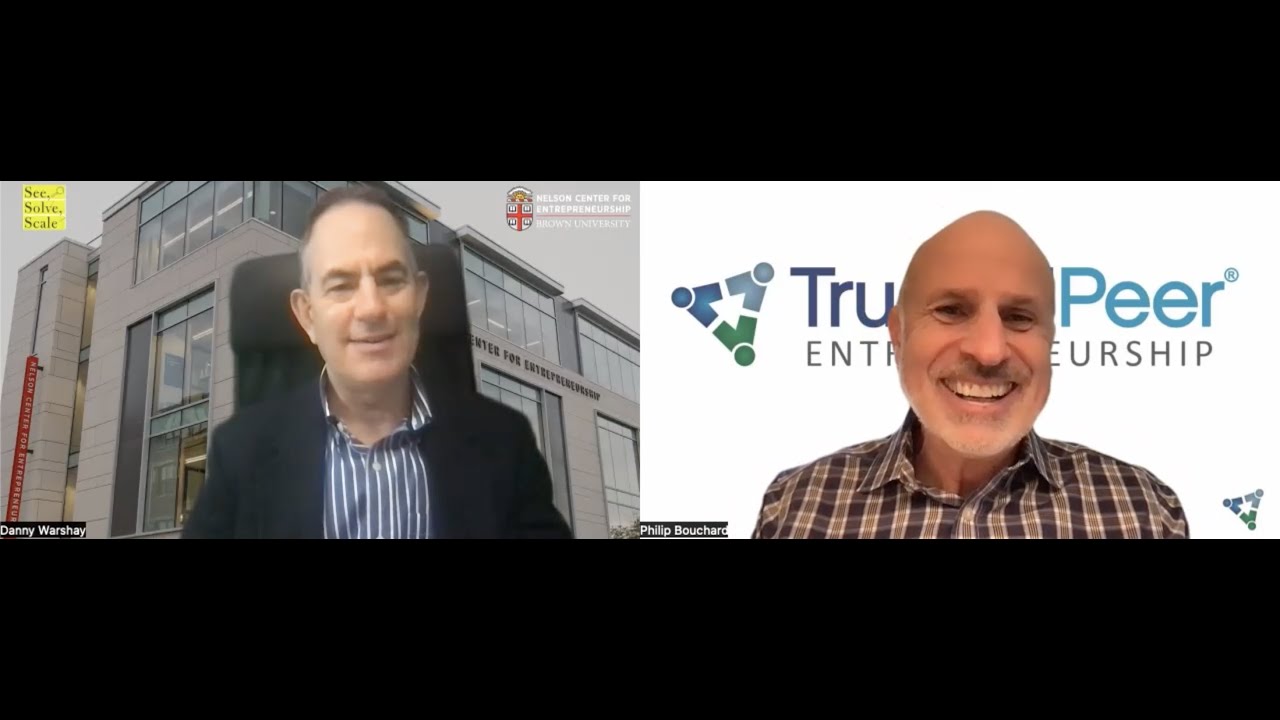
Interview with Danny Warshay, Brown University, Director of the Nelson Center for Entrepreneurship


