See, Solve, Scale with Danny Warshay

Danny Warshay, a Brown University professor, explains his three-step entrepreneurship framework: see the problem, solve it iteratively, scale the solution. He highlights three student ventures tackling healthcare, from a device to capture debris during heart surgery to a nonprofit shipping prosthetics to Vietnam. Diverse teams outperform homogeneous ones, and scarcity often sparks better innovation than abundance.
Chapters
Today's episode of Care Talk is sponsored by Provider Solutions and Development. We all know that it's very difficult to recruit physicians and advanced practice clinicians. Supply is tight and getting tighter, with a 124,000 physician shortage expected by 2034. Thankfully, PS&D has reimagined recruitment in order to address these challenges head-on. They offer commitment, not commissions, quality, and not quotas. It's no surprise that partner organizations around the country have partnered with PS&D to improve recruitment, retention, and workforce productivity. Check it out for yourself, info.psdconnect.org/caretalk. Welcome to Care Talk, America's home for incisive debate about healthcare business and policy. I'm David Williams, President of Health Business Group.
And I'm John Driscoll, the CEO of CareCentrix. David, yet another Ivy League friend of yours? Did you just— did everyone you go to school with and meet on the street turn out to be an Ivy League professor?
Well, John, you're a preparation-aged guy yourself as a Harvard undergraduate and grad student. So I don't think we're gonna—
I don't—
I think it's the pot calling the kettle black or whatever metaphors we want to mix around there. However, I would also say that's not the most welcoming way to welcome our guest. Yes, he's the author of See, Solve, Scale, Professor Danny Warshay from Brown University, which is part of the Ivy League, John. He's also executive director of the Nelson Center for Entrepreneurship. So the answer is yes, he's also an entrepreneur, not just a, you know, not just a professor.
Well, we're not going to hold your background with Danny against him. Welcome, Danny.
Thank you so much, John and David. It's a pleasure to be here today.
So, Danny, I mean, why are you teaching entrepreneurship at Brown University? Does Brown University have a business school?
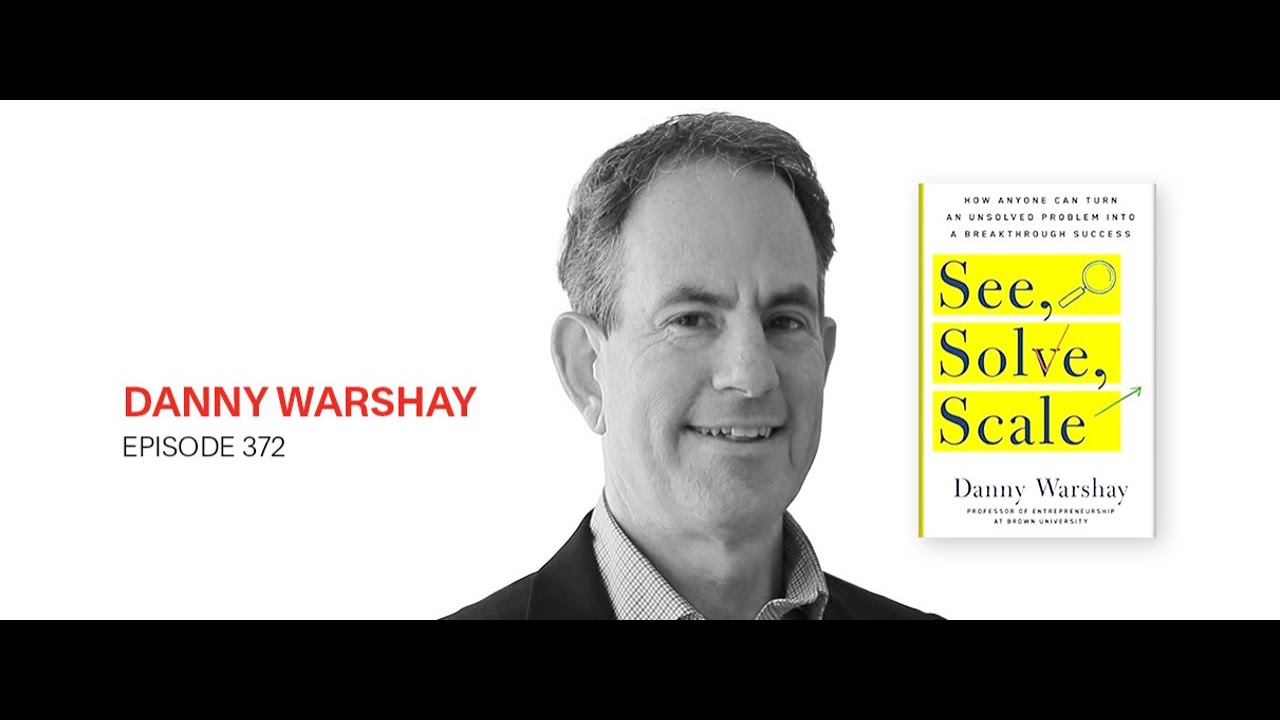
It does not. Isn't that interesting? Yeah, the way I had to think about entrepreneurship about 17 years ago when I got an unexpected tap on the shoulder to come be a professor at Brown was a little bit different. You're right. When we were— when you and I were at Harvard Business School, we thought about entrepreneurship, if we thought about it at all, through the lens of business. And you're right. When I had to think about how do you define entrepreneurship at dominantly a liberal arts institution like Brown, I realized that entrepreneurship is a structured process for solving problems. And as a result, it doesn't necessarily need to lead to something commercial. And it could appeal to a very wide range of students who study just about anything. And so that was how I defined it, a structured process for solving problems. My appointment actually is in the engineering school. I had— they had to find someplace for me. And I thought, well, imagine you've probably heard the phrase entrepreneurial spirit. I heard that phrase back then and I thought, well, I don't know what it would mean to teach a spirit. So you must— I must be charged to teach something a little bit more rigorous. And I realized, imagine in the engineering school, if we were charged to build a— charged to teach people how to build a bridge, we wouldn't say, you know, just go out there and teach the bridge-building spirit. And if the bridge falls down and the cars and the trucks crash to earth. Just go out there and have more spirit. So, no, I thought of this 3-step approach, just like in every bridge-building process, you can distill fundamental principles. I realized in entrepreneurship, you could distill some fundamental principles into a coherent process too. And so, that's the basis of what I've been teaching at Brown for 17 years. It's the basis for what we teach and espouse at the Nelson Center for Entrepreneurship. And it's the basis for this book called See, Solve, Scale: How Anyone Can Turn an Unsolved Problem into a Breakthrough Success.
So, David, you may not realize it, but Brown has the oldest engineering program in the Ivy League. So of course, they're going to be early on to hire a history student to become their head of entrepreneurial studies. I mean, it just makes sense that Bram would be a breakthrough— show breakthrough interest in entrepreneurship. But Danny, as we talked about before, your interest in entrepreneurship, most people think of entrepreneurship as just the private sector. You have sort of a more unconventional view of the typical kind of EE, electronic engineering, business school software entrepreneur investor, that your kind of view of entrepreneurship seems a bit more broad than the way most people think about entrepreneurship.
You're right. And in fact, if you think about entrepreneurship the way I just defined it, a structured process for solving problems, it yields opportunities that stretch across every kind of problem that students and others might gravitate toward solving. Solving. And the result could be, and in many cases is, something commercial, a business. But it also can be a nonprofit. It can be in a research lab. It can be a social venture. It can be in government. We need problem solvers of all kinds in all different kinds of contexts. And I've known through the 17 years that I've been teaching at Brown and in workshop formats all over the world that this see-solve-scale rigorous approach tends to resonate with people who are looking at all sorts of different kinds of problems. And then the outcome may be a business, as I say, but it can also take the form of different kinds of entities. I think as a result, at Brown at least, we've engaged lots and lots and lots of different kinds of students who come from different backgrounds, who study different kinds of who gravitate to different kinds of problems to solve. And that's a little bit different from what you might find in other really good places that tend to focus, as you say, on finance or tech. They teach really well, but their focus tends to be a little bit more narrow.
Well, John, I think, you know, so Brown is a liberal arts school, but there's a little asterisk, which is engineering, as far as I know, and I went to a liberal arts school without an engineering school, is not liberal arts. However, we'll let that one slide. But Brown does have a medical school. And so I'm wondering if there are any, you know, any kind of anything that you have to say there in terms of any key lessons about how these apply to, you know, healthcare innovation and entrepreneurship?
Well, David, I mean, for the most part, things in healthcare are see, charge for it, and then scale, as opposed to see, solve, scale. So it'll be interesting to see how Danny tries to crack that one.
Yeah, don't prompt the witness. Do they have a law school? I forget.
We do not have a law school. We only— we do have a medical school. We also have School of Public Health. So lots of students and faculty and practitioners as well who are capitalizing on this opportunity to learn about this CSolve scale method that we're teaching through the Nelson Center and to have big impact at the patient level, at the industry level, in other ways. For example, I talk a lot about the value of diversity and inclusion among form— when you form a venture team. And one of the best examples I use and that I talk about briefly in the book is a med device company that's come out of our center called Embonet. And they discovered a problem during open-heart surgery, which, you know, others had known too, which was that open-heart surgery can release a lot of debris, embolic debris into your bloodstream. And if it gets up to your brain, it can cause a stroke. really dangerous circumstance. The best part about this example is how diverse this team was. It was 2 Brown Medical School students, 2 biomedical engineers, and I'd say maybe the secret sauce was a textile student from the Rhode Island School of Design, which abuts Brown's campus. And they figured out a new way to develop a mesh to insert into the bloodstream during open-heart surgery that would collect that embolic debris in a way much better than previously had been attempted and would radically reduce the incidence of stroke during open-heart surgery. So a lot of that has to do with this C-Solve skill method, finding and validating an unmet need in the earliest stages, solving it on an iterative level, which is— Where they are in the process now, you know, it takes a long time to adhere to FDA regulations to put anything in a human body. And eventually their intention is to scale to the point where they can save lives among patients who are experiencing open-heart surgery. So that's one example, which I really like because it touches on this dynamic that we call accidental collisions, where the center brings together people like medical students and engineers and RISD students to coalesce around a problem and figure out a good solution.
You know, there's a lot that's said about diversity and equity inclusion in healthcare. A lot of times it seems like it's just kind of either lip service or it's just a good thing to do.
How can you say that? I mean, come on, David.
You're a skeptic. A skeptic is healthy, John. A cynic is unhealthy. That's what I learned in liberal arts, actually, on my first day of school. But Danny, you actually say that this is really important, diversity and inclusion, and that it really does lead to better solutions, and that actually you shouldn't work with people that are all similar, that you already know. And also, if I think about, like, if I look at the examples in the book and the testimonials you have, It really has a diverse set of people that are represented much more than, you know, I think from our business school experience.
Yeah, well, I'm happy that shows when you've read the book because I care a lot about it. It is absolutely a priority of what we're doing at the Nelson Center. I'm very clear even in the very first part of the introduction of the book to state the really sad statistics. About how few women and people of color have been included in the field of entrepreneurship, especially among venture-backed startups. Only 2.3% are women. Only 1.5% are Latinx founders. Only 1% are Black founders. That's terrible. It means that we are— lots of those people are being neglected, ignored, and let's face it, discriminated against. And so for that reason alone, it's good to talk about diversity and inclusion. But I include a much broader definition, a much broader reach, and demonstrate with really good academic research that the best, highest-performing venture teams are those that are both diverse and included. And that means, you know, when you think of a diverse team, you think about being invited to the dance. When you think about an inclusive team, you think of asking people to dance. And I share some really good research from Frances Frei and Anne Morris, Harvard Business School research, which demonstrates that actually if all you do is recruit a diverse team, you are probably only drawing on where they tend to overlap. And that's a small part of what they all potentially could bring to the table. Those teams underperform homogeneous teams. That's a really sad thing because homogeneous teams overlap in much bigger areas. The place where teams really thrive and shine is where you have both diverse and inclusive teams, where you invite people to share their authentic selves and bring to the table all of what they have potential to bring. And that's where we try to emphasize at our center. And it's what I've shared in the book to illustrate not only to recruit a diverse team, but also to recruit one and engage them in an inclusive way.
Well, and Danny, to your point, that all of the research, not just at Harvard, where you guys both seem to do a lot of reading, that shows that diverse and inclusive teams at a senior level vis-à-vis public companies almost always outperform not diverse, non-inclusive teams. And it has been a robust and resilient statistic across Europe, across the industrialized world. But I wanted to just probe a little bit around kind of the people who listen to our podcast typically are interested in healthcare. And I think you've got a really intriguing idea in terms of like sort of landscape thinking and then sort of engineering for a future state and then thinking back and planning because a lot of what's wrong in healthcare is what we've got right now. And if we don't think of the landscape from a future state perspective, We're never going to escape the short-term thinking and sort of the almost the firmly backward thinking we have in healthcare, which has got us locked into 19th and 20th century models in the 21st century. Could you give us some guidance out there for entrepreneurs who are looking to sort of think about new things and how they then turn that into practice through one of the ideas that you have in your book?
Sure. I appreciate your asking that. And that deals a lot with this 3rd step in the process, scale. How are you going to envision an opportunity to have big long-term impact? I was leading a workshop this morning, a corporate workshop. I do a lot of these for established companies who have lots of resources and are stymied because they can't get out of their own way. They're thinking so much about near-term execution. They suffer from incrementalism. We're just going to move the needle a little bit to the point where we can eke out a little bit more profit or better earnings per share, and they don't have the ability to think long-term and envision a completely different scenario. I benefited from some good tutelage from an innovation expert named Bob Johnston, who is a colleague of mine. We teach together in various places. And I adapted a technique that he invented called the landscape metaphor exercise. And we don't have time to dig into it in too much detail, but in short, It gets you out of that near-term incrementalism and forces you to envision the world that you might want to influence many years into the future. It may be 10, 20, 50 years into the future, and then guides you to invent and plan backwards so that to begin with, you free your mind up from the mental fixedness associated with focusing only on the near term. And gets you at least to think creatively and innovatively about what a world could look like way beyond. And then again, to get more detailed and eventually executional helps you invent backwards rather than just taking incremental steps from this day forward. And it's a solution approach that I've used in many contexts, including in healthcare, that helps people get out of their own way.
John, I think even, you know, with this sort of instruction, you might even be able to, you know, make somewhat of a difference. I don't want to, you know, I don't want to overpromise, but it sounds like you could, you could get there. Well, one of the things, Danny, that you talk about in the book is about the value of scarcity. And I think where John was going when he was talking about, you know, say, see, solve, scale in healthcare. First, in healthcare, there's a lot of charging. And in the US healthcare system, you know, we spend twice as much per person as anywhere else. So scarcity We have not had. We've also had problems. I mean, how does— how do you think about scarcity and how does it relate to what we see in the US healthcare system?
Well, I talk about these 2 polar opposites, which sound counterintuitive: the benefits of scarce resources, where it works to your advantage, especially early in the process of seesaw scale, to have fewer resources, and the opposite end of the spectrum, the burdens of abundant resources. Where it's a disadvantage to have too many resources, whether that's pedigree or experience or training or funding or maybe government reimbursement, because you tend to be conservative. You tend to protect those resources and protect those models, and it gets in the way. Whereas when you have scarce resources, you have no choice but to rely on other people's resources and partner with them. That yields usually more diverse teams. whose benefit we just talked about. In the healthcare world, I think you're right. We have more resources in this country in the healthcare sector than in most. And yet other countries, other patients in other places have figured out ways to be innovative in ways that we wouldn't because we just think we have all the resources in the world. I'll mention one which I think is related to this topic. That's a relatively new venture launched from the Nelson Center called MetaCircle. 2 students, one a former student of mine who didn't know anything about the healthcare field. I think his benefits of scarce resources were very clear. And an engineer who was doing the first step of the process, the seed stage, where she was doing some bottom-up research at a couple of healthcare facilities. And she noticed that the garbage bins were overflowing with medicines, prescriptions that were just being thrown out. Talk about abundant resources. And they realized that a lot of those medicines were oral chemotherapy, which are really expensive and which many people in this country, too, can't afford. They developed a whole model for reclaiming perfectly good oral chemotherapy pills and having them recertified and then putting them back through a distribution model and figuring out a way to be paid for them in a way that's sustainable. They are reclaiming lots of otherwise going-to-waste medicines. They're just starting with oral chemotherapy. They're going to move on to others. These were students who nothing— who knew nothing about this field. And again, the benefit of scarce resources for them was They didn't know any better. They, they could reinvent a whole model because they weren't aware of the way it was supposed to work. They faced some real challenges in terms of regulatory challenge and otherwise, but they're overcoming those. They've raised recently $1.5 million in a seed round and they're off and running. So all sorts of good examples of where we have too much in our ecosystem for healthcare and otherwise sometimes to recognize the opportunity to do better. And it takes people who don't know as much, don't have that expertise, have no resources in front of them to realize that there are indeed new and innovative ways to reinvent the approach to distributing certain kinds of healthcare resources.
Yes, David, I mean, we have plenty of scale in healthcare. We're just not seeing and solving very frequently. And that's maybe what Danny's going to help us do. That's an amazing example, Danny. And If you look at the way we handle all forms of medical equipment in this, it's a use-and-dispose culture, which makes no sense. And the rest of the world is actually reusing even basic instruments in surgery in a way that we don't. I mean, there's enormous waste. And I, again, I think it—
Go.
I'm sorry. I'll share a real quick related example. Another student team, a team that won our first Brown Venture Prize competition called Penta, a former student of mine named Trang from Ho Chi Minh City, Vietnam, exactly to your example, realized that there's lots of landmine victims throughout Vietnam and also related and close-by neighboring Asian countries who don't have lower limb prosthetics, and that for some reason the FDA won't allow us in this country to reuse lower limb prosthetics So she said, I'm gonna collect as many as I can get. I'm gonna ship them to Ho Chi Minh City. I'm gonna quality control them, distribute them to patients who need lower limb prosthetics. And it's just taken off to the point where, again, it's in demand throughout Asia. They were the winners, not only— they were the winners of our first Brown Venture Prize competition. And to the point earlier, they're a 501 nonprofit. I didn't even know that. It didn't make any difference. All I cared was that they saw a problem, they were able to solve it on a small scale, and that they developed a real solid sustainability model that would help them scale and have impact over the long term. So I think that's another good example of exactly the dynamic you're talking about, where in this country we're cavalier. Oh, your lower limb prosthetics don't work for you anymore? Let's just junk them, throw them out. We have so many resources we can afford to do that. Whereas most of the world doesn't live in that kind of resource-rich environment. And as a result, leave it to Trang to figure out a new resource-constrained way of inventing a new approach.
John, I just have one more question, so I'll tee mine up and then you can follow on. So, Danny, I mean, how much of a role, given all this, how much of a role can entrepreneurs play in US healthcare reform?
Boy, I mean, I'm totally biased, of course, but I don't know another role that anybody—
You are.
I am totally biased. Yes. Otherwise, I wouldn't be teaching this. Sometimes people ask me a funny question. Can you teach entrepreneurship? Yes. What would I be doing for the last 17 years? But yeah, I know from over 3,000 students, many of whom are in the healthcare sector, that that's what we're relying on in order to see problems, to solve them on a small scale, and to scale the solution. I don't know any other way. I'm sure there are, and those people are equally biased. But my approach of, you know, this structured approach that anybody can learn, they can master, and then they can apply. And then all the examples, only a couple of which I've mentioned and others of which are in the book, are really good illustrations of the idea that in some ways I think there's no better sector for entrepreneurship to have impact. And I think we are really dependent on entrepreneurs to be able to do that, which is why I like what I do in terms of teaching at Brown and elsewhere around the world at the Nelson Center and also through this book. By the way, I'll say that the idea of a book wasn't even my idea. It was my students who came to me and they said, You're not doing the third step of this process. You're not scaling. And I said, oh, how interesting. You're right. And how nice for the students to become the teacher. What should I do? And they said, you should write a book. And so their, their point was lots of the world needs this approach. And I know that at least part of what they were thinking of was how broken in some cases our healthcare industry is, and they need some help.
So, David, I don't know why you took so much time to invite Danny on. I actually think entrepreneurship is sort of necessary for healthcare. And you were, I know, kind of difficult about bringing on the idea. But I actually think Danny makes a really important point.
Well, he does. You know, I'll just say it's the same problem. You know, he hadn't written the book. I mean, it can scale on our podcast as well. But I think it's very good that Danny's given us, you know, the C-Solve Scale book summary here. I still recommend reading it, you know, as we, as we have done, but the summary is helpful. It's a great handbook for entrepreneur advice. And yeah, I mean, we'll invite him on again, John. We won't wait another, you know, X number of— he said years, I could say decades, you know, before, before bringing him back on again. So is that your final question? Yes. Final answer.
I'm honored to be here. Well, I'm happy to come back. And I will say that The approach in the book is that reading the book or listening to it— I also narrated the audio version, which was an experience in itself— is designed to just be the first part of a relationship that people will form, maybe with me, but at least with each other as fellow readers, fellow listeners, fellow problem solvers. And so there is a LinkedIn group called C-Solve Scale, which is getting started. There's just a small group to begin with. A couple hundred people. But what's interesting for your purposes is they're from all over the world, and a whole bunch of them are looking at healthcare challenges. So I encourage the two of you to join that group too, because I think you'll have a lot to offer, and you'll probably learn from some others who are there about how they're using this approach, this structured approach to solving problems, to innovate, to change, to improve a lot of aspects of the healthcare industry.
Excellent. Well, that's it for yet another edition of Care Talk. I'm David Williams, President of Health Business Review.
And I'm John Driscoll, the CEO of CareCentrix. If you liked what you heard or you didn't, please leave us a comment and subscribe on your favorite service. Thanks, Danny.
More from Danny


Changing Habits and Lifestyle Through the Entrepreneurial Process with Danny Warshay: PYP 315
Interview with Danny Warshay, Brown University, Director of the Nelson Center for Entrepreneurship


The Pissed-Off Entrepreneur: How to Turn Problems into Opportunities: Danny Warshay on PYP 513