How to See, Solve, Scale with Danny Warshay
Danny Warshay teaches a three-step entrepreneurship framework: See unmet needs through research, Solve with systematic creativity, Scale sustainably. He shares how Tide discovered liquid detergent through packaging ethnography and how Casper disrupted mattresses by not knowing the industry, arguing entrepreneurship is a learnable skill, not a talent.
Chapters
Hey, it's Rachel Cook, your Modern Mentor, and today I'm joined by Danny Warshay, Executive Director of the Nelson Center for Entrepreneurship And professor of the practice at Brown University and author of the new book, See, Solve, Scale. If you've ever had an aspiration of entrepreneurship or you just wanna be more innovative in your day job, then today's conversation is for you. Danny and I talk about how incredible ideas actually come from a structured process. We touch on the power of doing anthropological research, and we talk about why we should all pay more attention to those moments of, huh, That's funny. And now, here's my conversation with Danny Warshay. Danny Warshay, author of See, Solve, Scale. I am so delighted you were willing to join me on Modern Mentor today. Welcome.
Thank you so much.
Willing?
I was eager, very excited to do it.
Wonderful. I love my guests eager and also caffeinated. I hope you were both of those things.
You don't want to see me caffeinated, so I'm just naturally caffeinated.
Fair enough. So, Danny, I have lots of questions for you today, and I'm so excited to dive in, but I would love it if you would give us just the 10,000-foot overview of your book, See, Solve, Scale.
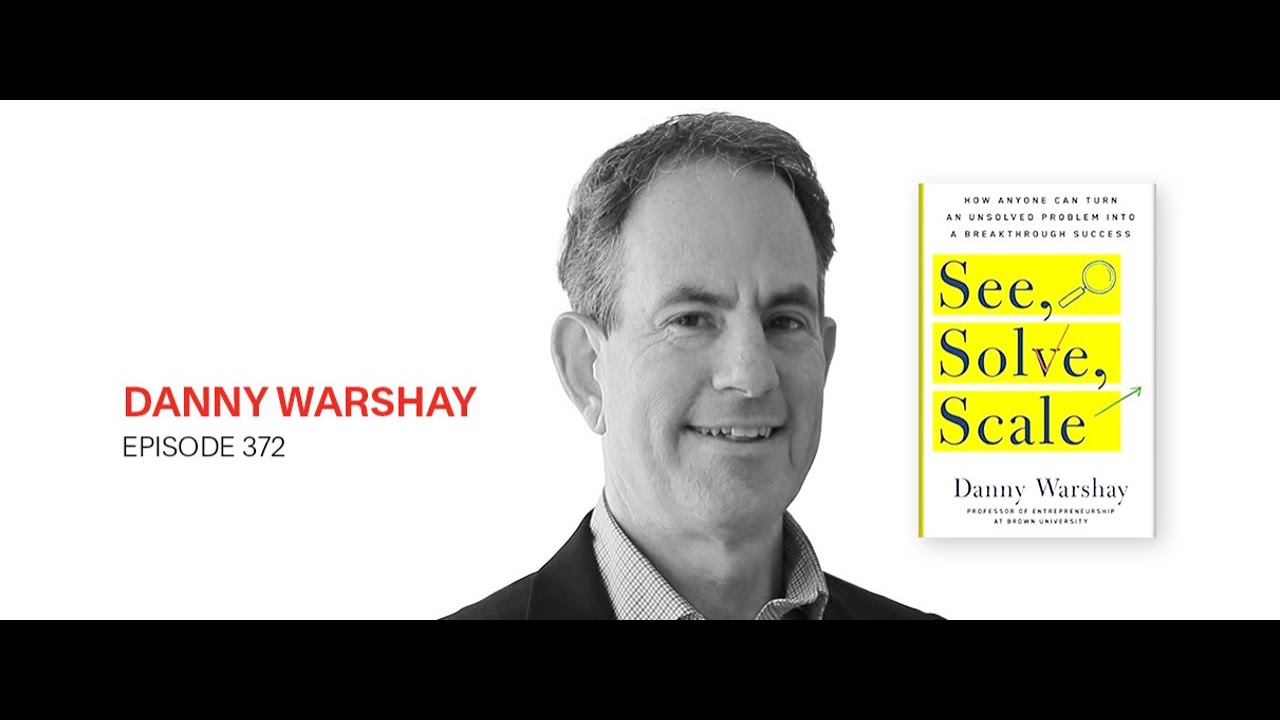
Well, first of all, I'll tell you the impetus, which was that I never thought about writing a book until many of my students kept coming to me and saying, you are not doing the 3rd step of the process that we learned from you in the classroom, which is to scale. And I paused and I said, yeah, I guess you're right. How interesting when the students become the teacher. What should I do about it? And they said, you should write a book. And so I thought a lot about the 16 years or so that I had been teaching entrepreneurship at Brown, dominantly a liberal arts environment, and my own entrepreneurial ventures that I had been involved with through most of my career. And I thought, yeah, it would be a good idea to have even broader impact if I could write a book. I didn't know how to write a book. And so I just started writing it. And it was designed to do what the student said, to amplify, broaden, deepen the impact that my teaching had been having on people from all different kinds of backgrounds. The 2 things to emphasize, to give you the 10,000-foot pitch. One is that what I teach is according to the definition I devised about 17 years ago at Brown for entrepreneurship, which is a structured process for solving problems. And it's a process that I've learned over time that anyone can learn. They can then master it and then they can apply it in whatever domain they happen to be operating to identify a consequential problem, solve it initially on a small scale, and then broaden its impact over the long term through some methods that I teach. And I think the subtitle of the book, which I think we'll delve into more perhaps, is really instructive. And that is how anyone can turn an unsolved problem into a breakthrough success. And I like to underscore the word anyone.
Yeah, I think that that was probably the word that caught my eye. I know that I've had so many conversations with people over the years who seem to think that entrepreneurship is almost a synonym for inventor, right? They're almost picturing an Einstein or somebody very similar. And I loved how simply you talk about the fact that entrepreneurship, the way you define it, is really just about seeing a problem and solving it. And I'd love it if you could talk to us a little bit about why that mindset shift feels so important for you.
So I love having that question posed to me, because it does set up how I think the approach to teaching entrepreneurship I've had for all these years at Brown and elsewhere is really different. For one, sometimes people think even worse, not invention, they think it's something that you're born with. You know, it's congenital. You're able to be an entrepreneur just by virtue of being born with a talent. And I know for a fact that is not true. I know everybody is born with the innate ability to be an entrepreneur, like we're born with the ability to do lots of things, but you don't have to be born as an entrepreneur. And then again, highlights the word how anyone can turn an unsolved problem into a breakthrough success. The other distinction that I think is important, which you cite, is sometimes people think it is about invention. On some level, invention can be helpful. It is related. It is part of the second step. But notably, it is not the first step. And unfortunately, lots of people, especially tech people, fall into the trap of being what I call a solution in search of a problem. Entrepreneurship, if it is a structured process for solving problems, needs to start with what the problem is. And too often the tech people are starting instead with what a potential solution is and hoping they're going to stumble on to a problem they can address.
And as you're talking, I'm thinking about things like the Segway or Google Glass, right? These things that have been invented in the past and they're creators thought they were cool and fabulous, but in the end, there just wasn't a market for them. And but you keep referencing this process. And so it is 3 steps. It is quite simple. Why don't you just quickly take us through it, and then we can move from there?
The 3 steps are see, solve, scale. See means if, again, if entrepreneurship is a structured process for solving a problem, Start by finding and validating what I call an unmet need. Or in short, that's basically understand what the problem is. The second step is where you might have some of what you just described as invention. There's certainly creativity involved. There's innovation involved. The solve step too involves some structure about the creativity and the innovation. It uses things that sound esoteric, like nominal group technique and systematic inventive thinking. But these are all things that I describe in really straightforward detail in the book. They acknowledge that teamwork is really inherent in breakthrough successes. But it also acknowledges that not everybody behaves the same way in teams. It also enables people from different backgrounds to contribute in ways that sometimes have been ignored or neglected. It's not typical that you'll arrive at a perfect solution right away. There's usually not a eureka moment. Instead, I cite Isaac Asimov in the book, and I talk about these moments where you might say, hmm, that's funny, because you've stumbled across something that you didn't expect. And then in the third stage, you develop impact at scale. You have real impact beyond this initial small-scale version of your solution, and you do it in a way that has scale over the long term. And both components of that third step are important because you could scale something, it could get really big and be short-lived. We would call that a fad. And that's not what we're talking about here. What we're talking about is having big impact over the long term because, as I qualify in the book too, ideally, we're looking not only for any old problem, but a strong and enduring problem. So those are the 3 steps. The book has lots of other things about team formation, the critical importance of diversity, and inclusion, how to find diverse members on your team. And the other thing, again, related to the subtitle is I'm agnostic about the form of venture that this might take. I know many of your listeners work in bigger companies, established organizations. Lots of the techniques of C-Soft Scale apply to those circumstances. Many of my students go off and do all sorts of things in all different parts of the economy and the world. And they would not describe themselves as the kind of narrow-defined classic tech startup entrepreneur. There's a very wide range of applications that this technique has.
Yeah, you know, I would love to talk more about that. Because if you define entrepreneurship as a systematic way of solving problems, who isn't in some way solving problems for a living, right? And whether you are a business owner, an inventor, a marketing manager, a nurse, that's what we're doing all day, right? Business is essentially solving problems. And so, I want to make sure that for people who do work in big organizations, they're not checking out and thinking, oh, this isn't for me. I'm not an entrepreneur. I'd love for you to talk a bit about how this process applies to people who maybe are working for an employer and are perfectly content to keep doing so.
Absolutely. And that's again why the word anyone is in the subtitle, because too often entrepreneurship has been something that has been the purview, the domain of people in a very narrow scope of our economy and in the world. And again, I know that from Many years of teaching at Brown, and I see my students go off and, you know, they're in public health, they're in the military, they're in the arts, they're in the law, big companies, nonprofits, they're doctors, they're in government. And all of them will come back to me and say, I'm not sure that I knew exactly when I took your course how I would apply this CSOLV scale Methodology, but I can tell you that I'm doing it all the time in all the ways in which I'm solving problems. And it may not be all at once, every step of the process, but learning how to be anthropological and find an unmet need is a skill that is universal and that is so critical to the way people will identify problems to solve. You don't even have to embrace the entire process. There are times when people will identify ways to apply part of the process. So for example, the bottom-up research I mentioned in the first step, C, being anthropological, being empathetic to understand what other people are going through in order to identify problems that you can solve. That's the most important part of the process. And if all you do is learn that and you master it, I promise that there will be many, many, many places where you can apply that part of the process in order to identify a problem to solve. And you're right, I'd be hard-pressed to imagine a scenario, a context in which people are not solving problems. And frankly, if you're being hired to do almost anything, it's in some way to solve a problem. And so learning how to identify those problems, how to use different structured approaches to creativity and innovation in order to develop the solutions. And then figuring out how you can have big impact in the third stage, scale. This is a structured process that has application almost no matter where you would apply it. Yeah.
You know, I think part of the problem is we are a culture that is so obsessed with being busy and Doing and churning and thinking and this idea of being anthropological and just sitting back and observing, it's really contrary to that mindset. But there was that great P&G example. I think it had to do with the powdered detergent in the box. Am I thinking of the right story?
That's right, yeah.
Would you mind quickly sharing it? It was just very charming, but very telling.
Sure, and I always caveat this to say there may be a little bit of P&G lore here. It's tough to trace back exactly what the details are, but I do think it's instructive. But one of the things that P&G did exceptionally well, I think that they do probably as well as anybody in the world, is this kind of ethnographic research where you are relaxing your bias. You are not trying to be a solution in search of a problem. You're trying empathetically and anthropologically to discover sincerely, authentically, What the problem is. So there was a group of brand people from the Tide brand who were trying to understand the way that people interacted with and what they thought about the, at the time, cardboard packaging that encased powdered Tide. They did a good job, and for the most part, people were telling them that their packaging was fine. And then they said, but let us go a step further. Let's observe you. interacting with our product in your own environment at your house. And so one woman who had said pretty much she was fine with the way the package worked gave the brand people permission to watch her interact with the Tide powdered product. She unpacked the cardboard box from the bag. She stuck it on her counter. She pulled open a drawer. She pulled out a knife and she stabbed the side of the box, bore a little hole, and started pouring the powdered Tide into a measuring cup. And the brand people who were watching were horrified. They had no idea what was wrong with this crazy woman who was stabbing the side of the box. And she looked confused because she said, this is the way I've interacted with your product. For 30 years. And by the way, I'm okay with it. Without going into her house with permission and actually observing her interacting with the Tide product, just relying on what she said her experience was like wasn't good enough. It took actually observing her and watching her use the product to discover there was a problem. The second— and by the way, Remember, the Tide people are like laundry nerds. They know more about detergent than anyone in the world. So these aren't stupid people, very talented. And yet they didn't even know that people were using the product this way. The second principle that's really important, it's not the consumer's responsibility to identify the problem. That's our responsibility. And so just asking her, do you have a problem, wouldn't have elicited anything new. It took observing it. The Tide brand had been around at the time of this story for 30 years. And bottom-up research, the first stage in this process, C, has value throughout the entire life of a venture or product's history. This insight, by the way, According to this Tide lore, led eventually to the development of Liquid Tide, which was not only a new package, but a completely new form factor.
I love that story. And I think that your last point really underscores the comment you made earlier about this being iterative, right? It's not always about seeing the big opportunity and putting that one mystical solution out there, but always watching and always looking for opportunities to tweak or enhance or improve over time, right?
That is a really good point. Yes. And I know, again, it sounds linear, and to some extent it is, you know, see, solve, scale. But it's also a wonderful reminder that these kinds of skills, even within each step, can recur, can reinforce, can help us learn new insights no matter what kind of environment we're in, whether it's an established organization or one that's brand new.
So one of the comments you made in the telling of that story was you were giving props to P&G for recognizing the importance of this anthropologic or this bottoms-up research. The reality is not every company, and certainly in this day and age, not every company Values that, right? It sort of feels a little bit quiet and a little bit passive. And I think that that's probably one of many, maybe, obstacles that we face when we think about being more entrepreneurial by your definition within organizations. And I'm curious, what are some of the forces that you see inhibiting entrepreneurship? And how should we think about those as we try to build more of your model into our days?
Yeah, really good question and one that I work on a lot with established companies because in those places, they fall prey to a principle that I teach early on in the book called the burden of abundant resources. And that's often a surprise for people in big established organizations who just assume because they are supposedly blessed with all these resources, money, pedigree, reputation, distribution channel, talent, that they must be better off than those who they believe are cursed because they have scarce resources. And in fact, the nature of entrepreneurship, at least that I teach, is the opposite, that there are benefits to scarce resources. So one thing that is really challenging for established organizations is to not let those established resources, those abundant resources, get in the way of thinking new and inventing new things. Many of my students who are, you know, often at the very entry level, they may not even have a cubicle. And, you know, they say, well, what can I do to help move the needle when I go to this job? And I say, boy, are you armed with tools through see, solve, and scale that can help you stand out, that can help you add real significant value And boy, if you come armed, can you imagine if you were in that brand group for Tide and you came armed with some of your qualitative research, your ethnographic research, your bottom-up research from the C-stage of watching Tide consumers interact with the product and stabbing it in the side of the box? And you say, hey, I've got some interesting insights. That might shed some light on where we might take the product moving forward. Imagine the kind of value that you could bring, which doesn't take any more learning or training than what you'll get in the first stages of the first chapters of this book. And I've seen that a lot with my students. So, you know, forget mid-level managers, just entry-level people can come armed with this wonderful methodology that can add real value. The other thing I'll say, by the way, is often I find that the worst offenders are the most senior people. And I have real empathy for them. That CEO falls prey to the challenge there as much as anyone because her or his responsibility is divided between sustaining the fortress, which basically means maintaining the current business, as well as inventing the future. And that is really hard to do. And if you, as an entry-level or a mid-level person, might be able to help with the invent the future part, my bet is you'll, at least among some senior-level people, be very well received because that is often the part of the business that gets neglected. You just have too much on your plate to maintain the current business. And so, why not entertain and invite somebody who's enthusiastic and has some real technique and data to help them out. So the mattress industry, I talk a little bit about in the book. You remember that part of the book?
I do.
And the mattress industry was, excuse the pun, a very sleepy industry. But it was in terms of it relied on some decades-old kinds of techniques for selling a mattress, for manufacturing a mattress, for distributing a mattress, building brands around mattresses. There was really a standard way of doing it. All of these mattress companies had a big stake in that typical way of doing it. That was the sustaining the fortress part. And even though they probably were all motivated to think about inventing the future, they just didn't get around to it. And so who did? Some former students of mine, Luke Sherwin and Neil Parikh, They went to buy a mattress one day and they realized this whole process is completely screwed up. You have to go to a showroom. You're going to make a purchase of significant value that's going to last you a long time. And how are you going to try to pick a mattress in the middle of a showroom with a high-pressured salesperson breathing down your neck? You're gonna have to lie on a mattress. It's gonna have to be delivered on a truck to your house. You're stuck with a mattress if you don't like it. They completely reinvented the process. And they started a mattress company that many of your listeners, I'm sure, have heard of called Casper Mattress, where they reinvented every step of that process. Why were they able to do it? This is a good example of the benefits of scarce resources. It's because they didn't know a thing about the way mattresses are supposed to be manufactured, sold, distributed, that they were able to reinvent the whole process. And those who knew how it was supposed to work couldn't unbiased themselves, couldn't shed the abundance of their resources, all their manufacturing capacity, their commitment to a distribution technique. They had too many resources where Luke and Neil had none. They like to say, and I always like to repeat, The only thing they knew about mattresses was that you slept on them. And so they, like all of the entrepreneurs who enter my class, were better positioned because of their scarcity of resources than the established incumbents who had abundant resources. And so I love how that may work even for people in those big companies because If you're new to the game, if you're a recent hire, or if you're making your way up the corporate ladder, you may be less likely to be committed to those abundant resources and more able to see past them for new techniques that can help senior management invent the future, which, as I say, is the second part of what they're supposed to be doing. And often they just don't have time to do it because they're so focused on sustaining the fortress.
One of the things that I loved about the book is that it really kind of shifts the way that you think, the way that you think about what your job is, what your responsibilities are, what innovation and entrepreneurship really are. It kind of expands the definition and almost democratizes them a little bit. I think it will leave anybody feeling like, huh, this is accessible to me no matter what my goals are. And so I think it's I think it's a great read, and I think it's an important read, and I think it comes at a really important moment. We are recording this interview on the first day of March in 2022, and we continue to be in unprecedented times. I don't know that times will ever again be precedented.
Hmm.
But we are in this moment of people still kind of pausing and reflecting and being unsure if they want to continue on the path that they're on or if it's time for something really different. And I'm curious, when you think about that, and you think about, you know, these big choices that people are sitting with, what are the most essential insights or the most important lessons that you hope somebody dreaming of something bigger or different might take from your book?
The most gratifying results I see from my teaching, whether it's at Brown or throughout the Middle East, or in all sorts of places around the world that I probably had to find on a map because I just didn't know even where they were. The most gratifying is when this technique, this process, see, solve, scale, empowers people who never thought that they were deserving of the title entrepreneur. In many cases, and we know the pathetic statistics of venture-backed startups, Venture money, among all those startups, only 2.3% are women, 1.5% are Latinx, and 1% are Black founders. That is pathetic. And one of the purposes of this book is designed to change that and to again underscore how anyone can turn an unsolved problem into a breakthrough success, and especially rewarding to see people who've been neglected, And ignored. And in many cases, let's just be honest about it, discriminated against. And where I go throughout the world, I'm often in places with scarce resources. And that last topic we just discussed, I see people start to brim with confidence when they realize, I could do that. And I actually don't need abundant resources to at least start the process. In fact, the scarcity of my resources may work like it did for Luke and Neil and many others in my favor. And I see that in my Brown classes too, which is, you know, comparatively a context of privilege. But, you know, one of the entrepreneurs that I talk in detail about in the book, and I just love highlighting, is a woman named Emma Butler. She took my course as a visual arts and French concentrator. And she says that on the first day of class, she was visibly shaking. She was so nervous coming into my class. And, you know, it's because she thought that she really didn't deserve to be there. And yet she learned very early on in that first session, oh, I see. I can learn a process, I can master it, and then I can apply it. And she did that. She— the problem that she's been focused on is women who have, for various reasons, different shaped bodies. In her mother's case, who had fibromyalgia and couldn't dress herself with kind of standard clothes. And she's created a whole new fashion company called Intimately, whose mission is to provide clothing to women with different kinds of bodies. to enable them to dress themselves more comfortably, more easily. And Emma's now raised over $1 million in seed capital. Her brand is publicized on every media platform you can imagine. She's been written up in Vogue and Entrepreneur and Forbes. Nothing could be more rewarding for me than to see what I call, in her case, a reluctant entrepreneur, to learn the CSOLVE scale method and to use it to solve a consequential problem. And so that's really, again, thinking back to my students who are the impetus for my writing the book in the first place. I'm enormously grateful to them for encouraging me to write this because I do feel in some ways it's my life's purpose, if I can sound grandiose. You know, to teach people this method so that they can identify consequential problems, so they can solve them on a small scale, and then so they can have big impact at scale over the long term.
Well, I think that that is a beautiful place to land this. We welcome purpose here, Danny. It is not grandiose. It is lovely. And I think you've done that. And I am so grateful to you for having developed the method, for having written the book, and finally, of course, for being on Modern Mentor with me today. It has been a great pleasure.
Mine too, Rachel. Thank you so much for having me.
I hope you enjoyed my conversation with Danny Warshay. I loved having him on the show, and if you liked what he had to say, there is so much more to discover in his new book, See, Solve, Scale. Pick up your copy today. I hope you'll join me next week for another great episode. Until then, you can follow Modern Mentor on Apple Podcasts, Spotify, or wherever you listen to podcasts. Check out my website at leadabovenoise.com or follow me on the Modern Mentor podcast page on LinkedIn. Thanks so much for listening and have a successful week. Modern Mentor is a Quick and Dirty Tips podcast. It's audio engineered by Dan Firebend with script editing by Adam Cecil. Our podcast and advertising operations specialist is Morgan Christensen. Our assistant manager is Emily Miller. Our marketing and publicity assistant is Tomlin, and our intern is Brendan Pika. The Quick and Dirty Tips Network is a division of Macmillan Publishers.
More from Danny



Changing Habits and Lifestyle Through the Entrepreneurial Process with Danny Warshay: PYP 315
Interview with Danny Warshay, Brown University, Director of the Nelson Center for Entrepreneurship


The Pissed-Off Entrepreneur: How to Turn Problems into Opportunities: Danny Warshay on PYP 513