Interview: Danny Warshay on Teaching Real-World Entrepreneurship

Danny Warshay, who co-founded a software startup acquired by Apple as a history major, teaches entrepreneurship at Brown using a See-Solve-Scale framework. He emphasizes that 65% of startup failures stem from team problems, not ideas, and deliberately builds diverse teams from strangers to reduce that risk.
Questions this video answers
Getting out of your own way—overcoming mental fixedness that limits vision, using techniques like the landscape metaphor exercise.
Don't be a solution in search of a problem; start with bottom‑up research and observe before building.
Jacob's Ladder, a Jewish bluegrass group.
Chapters
Hello, Brandon. Thanks for having me on. I appreciate it.
Yeah, thanks for taking the time. And I'm from Rhode Island, so that's why I—
Are you really? Where are you from?
Uh, I grew up in Cranston.
Sounds great. I, I'm honored to be on. Thank you for asking.
Welcome, Danny Warshay. Danny is a professor and the executive director of the Nelson Center for Entrepreneurship at Brown University. At Brown, he teaches the university's top-rated course, The Entrepreneurial Process. He's a serial entrepreneur whose first startup was acquired by Apple, and he's gone on to build and sell ventures across a range of industries. Today, he teaches problem-first entrepreneurship around the world, from boardrooms to military bases. Danny is also the author of the award-winning book, See, Solve, Scale: How Anyone Can Turn an Unsolved Problem into a Breakthrough Success. Danny, thanks so much for joining me.
My pleasure. So good to be here.
I'd love to jump right in. I'd like to learn more about how you first became interested in entrepreneurship.
Yeah, I love that. Sort of that origin story, which I ask lots of the founders I meet and students I meet about their interest in entrepreneurship. So I'm from the Midwest. I'm from Cleveland, a suburb, Shaker Heights. Came to Brown, studied History in the early '80s. I'm a huge proponent of liberal arts and the humanities for just about everything, but especially entrepreneurship. I went abroad my junior year, came back and fell into this opportunity. I didn't even know you would call it entrepreneurship. I'm not sure I could spell entrepreneurship at the time. This was in the mid-'80s. And it was a software startup that I had no business being invited to help run. I had no business background. I didn't even know really how to turn on a computer. But I was, I guess, identified by some people I knew as somebody smart and capable, you know, a very liberal arts story, somebody who has lots of good generalized skills. We got some support from Brown. We raised some money and we sold the company to Apple. In the late '80s. And often for my younger students in their 20s, I have to clarify there were computers in the '80s because they, I think they envision like this big giant box in the middle of a building. But, you know, it was at the early stages of the Macintosh and we developed some software that appealed to Apple and they acquired the company.
So what was that software that you sold?
Originally, it's a good example of identifying a problem and also then pivoting when we realized we weren't really onto the, Juicy opportunity. The, the person who really came up with the idea, Matt Kirsch, who's a very close friend of mine. In fact, he was just visiting us yesterday and came to the center and did some mentorship. Still one of my very closest friends. His father was a physician and was expressing, expressing a ton of frustration about how all the billing operations worked or didn't work. And patient tracking and all sorts of stuff that was at best on some very early stage kinds of recordkeeping pieces of— I don't even know if you would call it software, but mostly pen and paper. And we set out to automate a lot of that system by reducing it to software that had a much better interface now that the Macintosh was available.
Mm-hmm.
And, uh, partway through the process, partly I think driven by the fact that we had looked like we were gonna run outta money, it looked like one module of that, the front end that was taking in all the data, the forms management system, might be appealing to a much broader horizontal market rather than just medical offices. We went out to San Francisco, we had a tiny little booth at Macworld.
Mm-hmm.
And it attracted the attention of Apple. I mean, there were several steps along the way, but long story short, they said, we, um, have some of our own in-house software that we've developed and we're looking for others. And they took an interest in the more generically appropriate forms design and forms management system that helped you design forms that looked great with unprecedented graphic tools. that the Mac offered, and then also a lot of database backend that we could use for entering and storing data and then managing data. So I, I know today that sounds so rudimentary, like we didn't always have that, but back then that was cutting edge. And, you know, it was, um, I'd say the process was as rewarding as the ultimate results because we had a ton of fun and we were You know, our own bosses, all the kinds of romance that you might imagine entrepreneurship is like. It wasn't easy, but I'm glad we did it. And then much of my career has been spent doing other kinds of similar kinds of startups. I'm never the domain expert. I'm never the person who's like the expert in the tech or the design or the content.
Okay.
I developed an expertise in Turning an idea into an opportunity.
Okay.
Going through the entrepreneurial process. And then about 20 years ago, I was asked to teach that at Brown, and we can talk about that some more too, if you'd like.
So you focus on problem-first entrepreneurship. What does that actually mean?
I, I think that's your phrase, and I really like it. If I could borrow that from you, I, I would appreciate it. Yeah. Problem first. It's actually surprising to many people that you have to emphasize that. But the, when I was asked by Barrett Hazeltine to come to Brown to teach totally out of the blue, I know it's been 20 years because LinkedIn told me so. I, I had no expectation that I'd be teaching anything ever, let alone teaching entrepreneurship at Brown.
Right.
But Barrett said, no, I see in you, you'd be a great teacher. And it's really impossible to say no to Barrett. And before I knew it, I was gonna be in front of a classroom full of really smart Ivy League students. And I thought, what does it even mean to teach entrepreneurship?
Yeah.
And so I had to devise a method of doing that. And, you know, I heard from a lot of people a phrase, maybe you've heard it. Have you ever heard this phrase entrepreneurial spirit?
Yeah, of course.
Yeah. I mean, a lot of people have. I had, I had, I had no idea what it meant. And I certainly had no idea how to teach a spirit. And I knew that that couldn't be what I should do if I were at Brown teaching entrepreneurship. So I had to think and do some research. in the literature and also in my own experience. And what I realized was my faculty appointment was in engineering because we don't have a business school, which is often also interesting to people. You're at Wharton, and of course Wharton has a top-rate business school. And so I devised a definition for entrepreneurship that I thought would fit in largely a liberal arts environment, which is A structured process for solving problems without regard to the resources that you currently control. There's a mouthful there, and if we had a whole semester, we could unpack that in great detail. Because I thought if we were designed to teach somebody how to build a bridge in our engineering school, we certainly wouldn't say to them, just go out and have the bridge-building spirit. If, you know, just throw up the bridge.
Right, right.
And if it doesn't hold up the trucks and the cars and they come crashing down to earth, then just have more bridge-building spirit. Obviously, that would sound crazy. We would lose our accreditation. No, in teaching people how to build a bridge, you can distill some fundamental principles that all bridge building has in common, even with lots of room for variation of all kinds— aesthetic, operational, functional. No bridge is just like any other. And there's a beginning, a middle, and an end to a structured process for teaching somebody how to build a bridge. And I said, I bet I could do the same thing based on my research and especially based on my own experience in entrepreneurship. To devise a methodology, a process, a structured approach that would have a beginning, a middle, and an end, and that would empower people from any background looking to solve any problem to do so in a way that would have lots of, again, room for variation depending on where you were building this new venture. Is it in a big company? Is, as you mentioned, I teach in various locations in the military, in government. And so I followed the trajectory of engineering to try to do this in the world of entrepreneurship.
So the course you teach is The Entrepreneurial Process. It's Brown's highest-rated course. Why is this course so impactful to students? Is it because it empowers them and they don't necessarily need to be an entrepreneur or—
Well, some of it has nothing to do with me, and that has to do with the students who self-select or are selected to come to Brown. Yeah, those students tend to be very interested in solving problems. And so what they're thirsting for is, okay, how do I do that? They want to change the world. And so I always say we could pluck the name off of our building and replace it with the Nelson Center for Solving Problems. And that, I think, would be an accurate indication of what our approach is. And so last year, for example, we had 1,664 students take our 25 courses. We had thousands more who took advantage of our co-curricular activities, student clubs, workshops, speakers for which you're not getting credit. And then many others who said, I don't only want to learn the approach, I'd like to deploy this process and actually do entrepreneurship. And we have lots of venture support resources to enable them to do it. So part of the answer is We're dealing with students who are looking to change the world, and they need to know how to do that. And so we meet them when they're already like banging down our door the first week of school to figure out how do they get involved. I just this morning was approached by yet another prospective student. I'm approached by many, many, many prospective students now in our 10th year at the Nelson Center who say, I want to apply to Brown because of entrepreneurship. And that's a shock to me. I had no idea that would ever happen. But they are already primed to be involved. And so a big part of our success and why we're now scaling our impact is, um, because of the students we deal with. It's not only that, and I can expound, but that's a big part of it.
I can imagine you just get so many students who say, I have a great idea, how do I make this happen? Is that what this course helps them with? Like, what can they do at the end of the course?
Well, let's start at the beginning of the course because many of them do have that inclination to say, I've already dreamed up some cool technology that I want to invent. And I say, hold on. The name of my methodology is 3 words, not 1 word. It's See, Solve, Scale, as you said before, how anyone can turn an unsolved problem into a breakthrough success. And, and, you know, the book is now published in Japanese and in Taiwan, uh, in Mandarin and in the UK, and it's coming out next month in Saudi Arabia in, um, Arabic. And so, yeah, where I start, and I know you might ask me about, uh, later parts of the process, which I'm happy to talk about too, but the most important part of the process is to figure— if this is a methodology for solving problems, the most important thing is to figure out what problem to solve. And so sometimes I have to dampen the enthusiasm or temper it or delay it among people, anybody, it could be anywhere, not just at Brown, who are falling in love with an idea that is really a solution in search of a problem. And that's the biggest mistake I see every entrepreneur make.
Right.
Which is they think they've dreamed up something in a vacuum that everybody's gonna love. And so much better to have the answers to the test before you take the test. And so I teach a methodology called bottom-up research, which to some extent came out of the only corporate experience I've ever had, which is in brand management at Procter& Gamble. I'd gone to Harvard Business School and then worked over the summer at P&G and then had a return offer. And probably the most important thing I learned, and which I now share with my students, is this concept of how do you figure out what problem is worthy of your attention? And so if somebody comes into my office and they do all the time and they say, hey, I'm so excited to tell you what I'm working on, I stop them in their tracks and say, what problem are you solving? And sometimes they don't know, or sometimes they might know, but they can't articulate it. And in rare cases, they really do know. And the most important part of this process is the first step. Have a firm foundation based on what problem are you solving?
So what does the process look like if you don't have a problem to solve?
What, what our students in my class right now are going through is just that. They're developing a portfolio, and we can talk about why a portfolio is better than one idea, of ideas they might want to pursue over the course of the next weeks over in the semester. And where they're starting is not brainstorming in a vacuum a whole bunch of really cool technology ideas, They are working with their team through some very structured techniques that I teach them, one called nominal group technique, another called bottom-up research, to figure out what problems might be worthy of their attention. And so I expect that, in fact, I enforce that nobody walk into my classroom already set, focused on an opportunity they want to pursue. I want to start everybody with a completely blank slate, which I think is the scenario you're talking about, which is—
Sure.
If you're not good at in the shower thinking up some random idea, you are perfect for the entrepreneurial process that I teach because I will arm you with a methodology to start from square zero, to know how to observe and listen to people anthropologically and empathetically. In their own environments. It could be in a classroom, it could be in a hospital setting, it could be in a financial institution, it could be in their own homes, to observe and listen so that they can find and validate unmet needs. That's the process. There's a lot more about it in the book, some detailed instruction. It's probably the workshop in most demand, or among the keynote requests I get, or the workshop teaching I, I do in companies and military organizations and governmental and nonprofits, because you're not born knowing this. No one knows how to start. And if you start well, you'll have some momentum that can carry you through the solve and the scale sections. And if you don't establish a firm foundation, it'll just be like building a house on a faulty foundation. It won't last.
So I'm thinking about like The process, you said bottom-up research, of just coming up with unmet problems, right? Problems to solve. How has generative AI helped with this process? Do you have students that are like, I don't know what problem to solve, I'm just gonna use ChatGPT and try to come up with something. I have all the other tools, I can make it happen, I just don't have a good problem to solve.
I think there's obviously room for AI, and we have AI embedded in many of our startups at the Nelson Center, and I'm using it. more deliberately in my teaching. I'm skeptical about using something like that platform as a substitute for in-person anthropological, ethnographic, empathetic kind of observation and listening.
Okay.
I think if you have a huge amount of data, maybe more secondary research to try to understand an industry.
Oh, I see.
You can churn through a lot of that data. I do using ChatGPT or Gemini or something else. But I don't think there's a substitute, at least yet, as that will meet the same standard that I'm looking for when, again, these student teams are going to the place to discover the opportunity by keeping their eyes and ears open. And it's worked so well. I've now had over 3,000 students in my 20 years of teaching. around the world in all different contexts, not only at Brown. And this methodology of bottom-up research really works well. So look, I'm not saying there's— it's impossible for AI to amplify it. I'm sure that it could. Uh, but I don't want to substitute that for the really direct, in-person, primary kind of qualitative research that I've been teaching.
So you're the executive director of the Nelson Center for Entrepreneurship at Brown. What's the overall mission of the center?
You know, we're the hub for everything related to entrepreneurship at Brown. Brown— we're not inventing entrepreneurship at Brown. It's been around, even as I said, in embryonic form for commercialization opportunities when I was a student. But the open curriculum, which Brown is known for, is very entrepreneurial, solving very specific problems. through that. And, and again, the, the, the students who self-select to come to Brown, I think, would describe themselves, even if they don't know a lot about entrepreneurship, as educational entrepreneurs in charge of their own destiny. Our mission is to do 2 things. We want to teach as many students as we can, and we teach students at all levels, from undergrads to even high school students over the summer.
Mm-hmm.
But undergrads, every master's degree program, medical students, the School of Professional Studies, and PhD students, postdocs, and even faculty. We want to teach them the methodology of solving problems that we shorthand by the title of my book, CSolve Scale, because no matter what they end up doing, and they end up doing all sorts of things that Brown graduates do, you know, they go into public health, they go into the arts, they go into the law, they go to Wall Street, they go to consulting, they do their own startups. They're— they run nonprofits, they're in government, they're in the military. Everything that a Brown student can do can benefit from learning the structured process for solving problems. And how do I know that? Because many, many, many, many of those 3,000 students I've had over the last 20 years come back to me. It's almost daily that say, I wasn't sure what I was going to— how I would benefit from The CSOL scale approach that you taught us, but in whatever they're doing, you know, they're a physician or they're in public health or they're a lawyer or doing anything. I'm solving problems all the time, and I'm looking back to what I learned in your class and can't imagine doing what I do professionally without it. So there's a liberal arts approach to that where it doesn't— it's not pre-professional. that we're teaching them what we're teaching them. It's sort of like learning the scientific method at Brown. Doesn't mean you're going to become a scientist, but it's likely that you'll use that mental construct somewhere in your career. Actually, one of the graduation requirements— I know Brown has a reputation for no requirements. We have requirements. The third, which often people don't realize, is that you have to demonstrate writing proficiency, which isn't a hard requirement to achieve. It doesn't mean in most cases that you're gonna become a professional writer, but you're gonna learn. It's important to learn how to communicate no matter what you end up doing. And so I lump entrepreneurship into the same category of 21st century liberal arts skills, at least the way we teach it, as problem solving.
Yeah.
So that's one approach. The other approach is, yeah, venture creation. We have lots and lots and lots and more and more now in our 10th year of really successful ventures coming out of the Nelson Center, and we're really proud of those.
Mm-hmm.
You know, Perennial is a climate tech startup, which I, you know, when those founders came to us, they didn't, they were one of the teams that had no idea what entrepreneurship was. They are helping farmers optimize carbon sequestration. They did really well in our $50,000 pitch competition. And they've now raised $35 million in venture capital. Intuscare is a healthcare analytics software company. They won our pitch competition back in 2020 when we had to move quickly online. They've raised $27 million of venture capital. Imperfect Foods, Ben Chesler's founder, he was one of my students. Casper Mattress, the founders were my students. And so there's lots and lots, Liberar is a fashion company founded by Emma Butler, whose mission is to develop clothing, design clothing, to furnish clothing to the 600 million women worldwide who have some form of disability that makes it too painful for them to wear mainstream clothing. The Pussyhat founder, Jane Zweiman, was from— was a Brown grad. So we have lots and lots of really good examples. of not only students who are using the CSolve scale method that we teach to advance whatever they're doing in their careers. We have lots of good venture, venture support examples of where we've helped to spawn new ventures that are improving the world in very significant ways.
What are the specific programs you have for students through the center that help them with their ventures? Like you have venture support. What does that actually look like?
Well, so the, the, the 3, as I mentioned, these 3 buckets are curricular.
Okay.
We have 25 courses. We have, you know, which is way more than when I was a student.
Yep.
You know, over 12 times more. And we have a certificate program which serves every concentration, no matter what undergraduate degree you're achieving. We have all these out-of-the-classroom opportunities, TOM First, was an alum who was one of the founders of Nantucket Nectars. He's speaking on Friday. A, a very steady stream of very generous alumni who are themselves superstar entrepreneurs, and they tell their story. The venture support resources are many. We have increasing amounts of grant funding where we will pay you to help advance what you're working on in your startup. We start off with very small grants and we increase them. True to the second part of the definition I mentioned before, without regard to the resources, Currently controlled. We don't want students to be scaling too quickly because often that's a recipe for disaster. We have a summer accelerator called B-Lab where we pay students to work full-time on their startup at the Nelson Center. We also provide them expert mentorship. We have a $50,000 pitch competition, which I alluded to. We have a student-run venture capital fund called Van Wickle Ventures. which has its own pool of capital that sits in the Brown Endowment that they manage. And they have an expert training process, which now has attracted applicants of more than 120 people each semester eager to get in. And we have an embarrassment of riches of over 800, mostly Brown alumni, some parents who are experts in their fields. Either a service category like lawyers, accountants, IP attorneys, Scientists, and in many cases entrepreneurs who themselves find that this is a really great way to engage back into Brown and contribute to the Nelson Center students.
So I'm curious, you mentioned grant funding to help students, the Summer Accelerator. How do students get involved with those specifically? Do they apply? And what are the requirements?
I'd say most of what we have to offer are not subject to application. If you want to come to lunch on Friday and see Tom Furst speak, We— that's open to anybody who wants to come. We even livestream most of those. So people all over the world, even if they're unaffiliated with Brown, can come remotely. The courses are generally open to any person in any discipline, even any level— PhD grads, master's grad students, medical students, undergrads. I've even had faculty take my courses. So most of what we have is accessible without any application. The grant funding has an application at each scale, at each step of the way. Of course, we can't just be handing people money without any kind of scrutiny.
Mm-hmm.
The Summer Accelerator has an application. The Brown Venture Prize competition has an application. What we try to do, though, along the way is to make even the application process educational. So when you're applying to the Summer Accelerator B-Lab or you're applying to Brown Venture Prize, we make available to you an application mentor so that even if you're not selected that year to be part of the cohort for that summer's accelerator, or if you're not selected to be a finalist to pitch to alumni judges in the $50,000 pitch competition, the process alone of applying will be educational. You'll get some qualified feedback, you'll improve, and we've had lots of examples of Teams that didn't make it into the accelerator or in the finalists of the pitch competition learn, work on it through the school year, come back the next year, and even do quite well in those. So our mission is educational, and we do measure our success partly by, you know, how do we have impact on as many students as we can? And partly though, if we weren't actually helping students create ventures, this would be too academic and it wouldn't be real world.
I love the focus on the educational aspect of the application process itself. Who are the mentors? Are these alumni?
Mostly alumni. We, again, we have this embarrassment of riches. We have our own database of over 800 alumni who are rolling up their sleeves, and it's sometimes parents too who have really relevant experience, you know, venture capitalists or themselves entrepreneurs or lawyers, whoever. But dominantly they're alumni. Yeah.
When you're teaching your course, Entrepreneurial Process, are students working alone or are they working as part of a team?
Always as part of a team.
How do they form teams and what is the ideal composition of a team?
Yeah, it's such a good question. Um, I teach a lot about this. There's a whole section in the book about the sweet spot for composing an entrepreneurship team. And it, it is so fundamental because the statistics are pretty terrible. 65% of failures in entrepreneurship settings, uh, are a result of team issues. And so I try to preempt those from the very beginning. Uh, yeah, always teams in, at least in my, um, courses. And we try to encourage that in the other settings I mentioned too. Brown Venture Prize, B-Lab Summer Accelerator. Only 16% of team— of startups are founded by solo founders.
Yeah.
And they tend to do much worse than teams. Entrepreneurship's a team sport. And if you compose your team appropriately, and the watchwords for the— for doing that are both diversity and inclusion, if you do that well, Then you are much more likely to be successful. You have to do it in a way that's very precise, though. So when I say diversity, I mean diversity at large, writ large. I mean diversity of background, skills, training, experience, points of view, very much personality. We emphasize empowering both extroverts and introverts. Even the way we designed our physical space is designed to do that. Neurodivergent differences. We want to encourage everybody to be involved. Certainly race and gender. The statistics about women and people of color being invited to the entrepreneurial setting are terrible. And so we are looking— that's, that's again why the subtitle of my book is How Anyone Can Turn an Unsolved Problem into a Breakthrough Success. The challenge is, and this is from research at Harvard Business School by A woman who's a superstar, Frances Frei. I don't know if you know Frances, but she's incredible. And I love all of her research, all of her writing. And she very generously permitted me to reprint some of her graphics and some of her research in my book. And she points out very astutely that just having diverse teams is not enough. In fact, if all you do is have a diverse team but not inclusion, Then actually a homogeneous team will outperform the diverse team that just looks for where you overlap. Because by definition, if you have a diverse team that doesn't invite everybody to bring all of their true selves to the table, they're going to have much less space for overlap than the homogeneous team that by definition overlaps 100%.
Mm-hmm.
The real sweet spot, According to Francis's research, and I— it's, it's breakthrough, is you have to not only invite people to the dance, you have to invite them to dance. And that means you have to create an environment of trust where everybody from all their different points of view and backgrounds feel comfortable interacting with each other and voicing their opinion and bringing their true selves to the table. And if you do that, if you have both a diverse and inclusive team, those teams tend to outperform everybody else. And in Team Formation, my course, finally, to get back to your question, I try to do that. And so that means having people, for the most part, that don't know each other previously. Because if you tend to flock toward your friends or people you're on the same sports teams with, or people you look like, or studying the same things, You're going to have an undiverse team. And so what normally happens is we let people kind of mingle around over the first few days of the, um, set of the semester at the first part of each class, once we settle enrollment, and we nudge them together into diverse teams that have very different kinds of approaches and backgrounds. And we guide them with some very strict instruction about how to interact, how to break the ice. How to create norms so that everybody will feel welcome and included. And what I've found is almost without fail, those teams are phenomenal. And in many cases, those teams years later come back to reunions and they are still close friends. They're still in touch. And they didn't imagine it when I told them what was going to happen. They're going to be in teams of people for the most part whom they don't know and who look, who look very different from them. But that seems to be the secret.
It sounds like the teams are formed outside of the specific project or problem they're going to solve.
Completely, completely outside of it. As I say, they have a blank slate.
Yeah.
So the first thing we're doing is forming teams. The next thing we're doing after they break the ice and get to know each other and establish some norms and create a charter for their team is start the process of discovery to determine what problems might be worthy of their attention over the course of the semester. I mentioned a portfolio.
Yeah.
So this is multiple problems on the average of 5 or 6 that they're going to be pursuing and eventually paring that down to one that they will pitch to a venture capitalist at the end of the semester. And the other element here, which is important, is It's the last principle that I typically teach, although it's the first one that I introduce. It's the last principle that I have in some of my workshops, but in many ways it's the most important. And it's what I introduce early on in my classes is this Japanese word called ikigai. Are you familiar with it?
Yeah. I saw that you had that. I read about that.
Yeah. I didn't know this when I first started writing my book in 2019. I didn't know that word. My daughter, my youngest daughter, who was doing some remote training for leadership at a camp, came running up to me and said, Dad, I learned this Japanese word called ikigai, and I think it has a lot to do with what you teach. Ikigai means living a life of meaning or of purpose. And the context for this is a quote from a famous psychology professor at Stanford, Bill Damon, who says, The biggest problem growing up today is not actually stress, it's meaninglessness. And Ikigai confronts that, it overcomes that. And it's these 4 elements of living a meaningful life. It's do something that you love doing, do something that you're really good at doing, do something that's going to add meaning or purpose to the world in a way in which you want to do that, and do something that's going to pay you fairly for that value and meaning that you're adding. And so I introduced this concept of ikigai in the very first class. In fact, we have an image of ikigai as the very first image you see when you walk into the Nelson Center, because I've learned, and I write about this in the book too, I can teach just about everybody how to do the see, solve, scale process, how to figure out a problem to solve, how to solve it on a small scale with very few resources, Good. And then how to scale that solution so that you can have very big long-term impact. But if it's not consistent with your ikigai, it will not be worth pursuing. And the other is true too. There's lots of students I mentioned before who will not be starting new ventures in their career. They'll be doing all sorts of other things. I want to help guide them to doing that in a context, in an environment, in a profession that is going to be consistent with what they love doing, what they're really good at, what's going to add meaning or value to the world, and what's going to pay them fairly. And if we teach them Icky Guy and they don't ever get exposed to See, Solved, Scale, I've done a good job. The other is not true. I don't want to teach them See, Solved, Scale absent the concept of Icky Guy. And so when these students are picking their portfolio of opportunities to pursue, on their mind explicitly is the ikigai filter. Let's make sure this is not just an academic exercise for the semester. And so Liberar, the fashion company that Emma Butler started, is very clearly focused on ikigai. Ben Chesler, who is helping to reclaim the 40% of produce that gets thrown out at the farm because it doesn't conform to the way perfect Apple Looks. And he's now— at the time I had him help me write his section of the book, he had raised a couple hundred million dollars in venture capital. They had over a couple hundred million dollars in revenue. They had 1,500 employees in 43 states, and they had already saved over 100 million pounds of food. There's no question Imperfect Foods is an ikigai expression of Ben Chesler. The Cloud Agronomics folks I mentioned who are helping farmers sequester carbon, Janice Wyman, who created the Pussyhat Project, other nonprofits that are coming out of the Nelson Center because we're agnostic about what your tax status is. All of those are focused on ikigai. And so it's in many ways the most important concept that I teach.
So they need to work on projects that resonate with them.
Yeah. Resonate with them. I like that. And, you know, not just in a, oh, this would be cool, but along the 4 ikigai elements. I'm really specific about that because there's lots of things that could be cool.
Yeah.
But doing it in a way that's consistent with your ikigai. And, you know, by the way, that's a useful template for anybody listening on this podcast, no matter what you do. Maybe you're not quite satisfied or you want to make a shift or you want to pivot in your career. Think about those 4 ikigai elements as a template for helping you decide what you should shift to. So helping the students learn how to incorporate ikigai into that filter is, you know, as you say, what they resonate with is a very important thing that students tell me they learn in the class.
How much in your process, in your course, do you focus on the implementation of the venture? Maybe it's a technical implementation. In other words, maybe they're gonna build an app that's gonna be part of it. How do you help them plan for the implementation or actually implement it?
Yeah, I mean, the adage I use in class, in fact, I remember a number of years back, one of my students was selected as one of the commencement speakers and he, he used this theme as his commencement speech 'cause it had so much impact on him, which was incredibly gratifying for me. I, at some point in this process, will say, make it real.
Mm-hmm.
That's the theme. And people get sick of hearing me say this. I, I don't want this to be a term paper, an academic exercise. I want it to be real. And there's lots of ways to make it real. It could be that you invite outside people onto your team. It could be a researcher who has the key insight how to gain credibility in front of an investor, or the key breakthrough in how you can actually create a product. It could be that you develop, uh, and you submit a provisional patent application to protect the IP associated with what you're creating. It could be that you create a prototype. It could be that you develop a relationship with a supplier so that you're not just imagining that you're going to have a supply of ingredients or parts for whatever you're creating. You actually got a deal going. You might have a deal with Whole Foods for distributing your product once it's created. That happened in the class. There's lots of ways to make this real. It is what I do. It's one of the things which I do think distinguishes this course, our center, from lots of other academic institutions where when those students stand up in front of venture capitalists at the end of the semester and they pitch, The venture capitalists are blown away because they are hearing a real pitch. I'm not— what I tell the students is don't simulate reality, make it reality. And, and look, at that point, I'm not sure anybody knows for sure if they want to pursue something, but after they leave the course, there's lots of avenues that I just mentioned in all our venture support resources for next steps. And so I want all those students to feel at least the reality. And in many cases, they get great feedback. In some cases, those VCs write a check. And so, you know, that's one of the reasons I think there's so much demand for the course, because this isn't just messing around with entrepreneurship. This is actually doing it. And so, you know, it could be these days a little bit more focused on code, but we have lots of examples of actual products that are being manufactured and warehoused and distributed and fed through a distribution channel and sold at retail that everybody buys. And that's coming from our center as well.
I think I want to audit this course.
Okay, well, maybe we'll do a workshop at Wharton or something, or in, you know, in a company that you're affiliated with.
Right. So you teach and workshop your approach to entrepreneurship around the world. How do you adjust your approach based on where you're teaching? Does what you teach actually change based on you're in the US, you're in France, you're in Africa, wherever it is? Does it change or is, is your approach your approach?
The approach is the approach. I do, I do customize it for all sorts of variables. I mean, I've taught all over the world, in many cases, places I had no idea how to find on a map. I didn't know exactly where Bahrain was when the US Embassy sent me there and said, we want you to teach people there how to do entrepreneurship because they've had a tradition of relying on oil revenues and their oil supply is drying up.
Mm-hmm.
Obviously, I was very sensitive to the cultural differences between what I teach, where I teach in the United States. I taught in a variety of places there. Each one was different— an economic development agency, the embassy itself, the Polytechnic University, um, a company. Each one of those, I try very hard to listen really well. I do my own bottom-up research.
Mm-hmm.
I am very sensitive to cultural differences, language differences. When I go to China and teach, The word failure is a really challenging, charged term, and I have to be sensitive to why. And I often learn more in those cultural contexts than I'm teaching because I soak it in. When I teach, I often teach the way I learned at Harvard Business School through case studies. And so case study teaching is challenging. You have to be nimble. You have to be like one of my Egyptian workshop participants. I did an amazing— I had an amazing group of senior executives in Egypt in 2008 that I talk about in the book. And I did the same kickoff R&R case. It's a Harvard Business School case. And I thought, okay, it's going kind of like the way I normally teach it. And then there was a detour based on some religious law that had some implications you know, Muslim law in Egypt in a way that completely changed the case. And if I hadn't been attuned to that, and if students hadn't felt comfortable speaking about it, we would have completely missed it. And the way that Nagy, one of my executives from that class, said it then, and I give him credit always, and at the start of every class, he said, this is like jazz. And I said, what do you mean? And he said, well, when we're used to learning in a format that's sort of like classical music, Mm-hmm. The professor gets up there. He's the sage— he or she is the sage on the stage. It's the conductor of the orchestra. And we just have to play the piece that they're conducting note by note. He said, the way you teach is it's like jazz, where you know kind of generally what the themes are that you want us to achieve. But it's really up to us to improvise with our own points of view and bring those to the table. So I've taught that case, R&R. I actually write about it in the book hundreds of times in every country in which I've taught. And, you know, I teach also Palestinians and Israelis sometimes together through an NGO that's amazing called Seeds of Peace. I've taught R&R there. The sensitivities I have to have in that environment, you can imagine, are really charged.
Yeah.
I did that in Jordan. I did that in East East Jerusalem. I did that in London a number of times. It's a different case depending on where I am, depending on who's around the table, and of course depending on what the ambition and challenges are that the company or organization wants to achieve. Last week I did a workshop for an amazing group that is a trade group for midsize advertising agencies.
Mm-hmm.
When I teach the Knight Ridder newspaper case for them and how the internet disrupted their business. You can imagine that's a very different setting in which to do that compared to doing that at Delta Dental when I did a board retreat session for them using both the R&R case and the Knight Ridder case. So I love your question. It turns out that the book has become a little bit of a lead gen tool unexpectedly. where people read the book and then they call me up and say, wow, would you come to do a session for our senior executives or for a cross-section of their company or for our firm or a PE company for their portfolio? Big nonprofits, government agencies. I didn't expect that I would do 4 of those for the US Army and 2 for the US Air Force. But I'm gratified that the book is resonating in ways that Weren't even my idea. You know, the book wasn't my idea. It was my students who in fairly large numbers kept coming to me and saying, your teaching changed my life. I had— it had very meaningful impact. But they pointed out something interesting. They said, you're not doing the 3rd step of this process. You're not scaling your teaching. And I thought, you know, how lovely for the students to become the teacher. And I said, what should I do? And they said, you should write a book. And so now that I'm doing all this keynote and workshop kind of speaking in other places around the world, in many cases remote like we're doing right now, I go back to the students and I say, okay, am I living up to what I teach? And they say, yes, you're doing that. So I feel gratified and I'm thrilled that it was the students who nudged me to write that book.
Interesting. Are you doing anything with offering your teaching to the world, like via Coursera or something like that? Like, have you thought about developing a course on Coursera? I have 2 of them and it's a great way to scale.
Right. A number of people have nudged me to do that. I haven't done it. I feel a little bit protective of knowing and interacting with the students in the moment, but I should probably get over it because if I do want to have impact at scale, which is, you know, one of the things we teach, the tagline for the Nelson Center is Solutions with Impact. And the implication is impact at scale. I'd be open to doing that. One thing I do know, and it's actually a lesson of that Knight Ridder newspaper case, is there's a lot of wrong ways to scale my teaching, and I've seen a lot of them through the years.
Okay.
And I'm, I'm again sensitive to the quality of what I teach and whom I'm teaching. And I care a lot about the relationships that I have with those students. I'm in touch with most of those now over 3,000 students from all the workshops and Brown teaching and everywhere else. And I, I really value those relationships. So I, I suspect at some point I'll learn better how to do it in the way you're describing and you've experienced, but I haven't done that yet.
Are you ready for the lightning round?
I'm ready for whatever you want.
30 seconds each. What's the hardest part of scaling a business?
You know, I think part of it is getting out of your own way. There's a source of friction called, called mental fixedness, which a 20th century, early 20th century social scientist named Karl Duncker coined. And often the point is to get out of the constraints that are stopping you from seeing the potential vision of thinking big. That was true, by the way, with the Seeds of Peace, one of the first Seeds of Peace workshops I did for their fellows. And I used some techniques, including one that I borrowed from a very good friend named Bob Johnston called the landscape metaphor exercise. And so I have some specific techniques to help you get outta your own way.
Best advice you'd give a first-time founder?
I think it's what we said before. Don't be a solution in search of a problem. Yeah. That's, The most common problem, most common challenge I see. And if you start with the C stage, you do some bottom-up research, you observe and listen, you'll be so much better off. And almost always everybody comes back, even though they were skeptical, to thank me for that advice.
What's your favorite band right now?
I was introduced to this band a few weeks ago called Jacob's Ladder. It's an odd combination, but it's Jewish bluegrass.
Wow.
And I just am fixated on it. I cannot stop listening. And by the way, there's 2 Jewish— there's 2 Jacob's Ladder if you look it up in Spotify. One is for sure, if you look at the song titles, not the one I'm talking about. And the other is very much. And so I love them. And I often love hybrids. That's the nature of the entrepreneurship that we're teaching, you know, where we're a center. And so we're combining somebody with neuroscience expertise and music or literary arts and CS. And so the nature of a center is being comfortable with the ambiguity of multidisciplinary approaches. And so maybe no surprise that I love a band that is both Jewish and bluegrass. Check out Jacob's Ladder. I think you'll love it.
Wow, this was great. Thanks a lot.
Well, if so, if, if you don't mind including that, a good way to connect with me is through LinkedIn. Oh yeah, or my website, dannywarshay.com. There's a whole bonus section with additional content from the book, right? All the podcasts I've been on. I'll link yours, of course. Um, then, uh, if people do read the book or listen to it, because I also Narrated the audio version, which was a fun adventure. It was during COVID They had to send all the studio equipment to my house, and I did it 6 or 7 hours a day for a week straight. There's bonus sections for the audio version of the book. And, and so if people read the book or listen to it, they're welcome to join a LinkedIn group called CSolve Scale.
Okay.
And it's people from all over the world who've read it and are interacting with each other.
We'll definitely be connected.
Great.
In all the ways. So I really appreciate it.
My pleasure.
Thanks, Danny.
Thanks so much, Brandon. Good to talk to you.
You too. Thanks for watching. If you like this, be sure to subscribe. More interviews and demos coming soon.
More from Danny



Changing Habits and Lifestyle Through the Entrepreneurial Process with Danny Warshay: PYP 315
Interview with Danny Warshay, Brown University, Director of the Nelson Center for Entrepreneurship


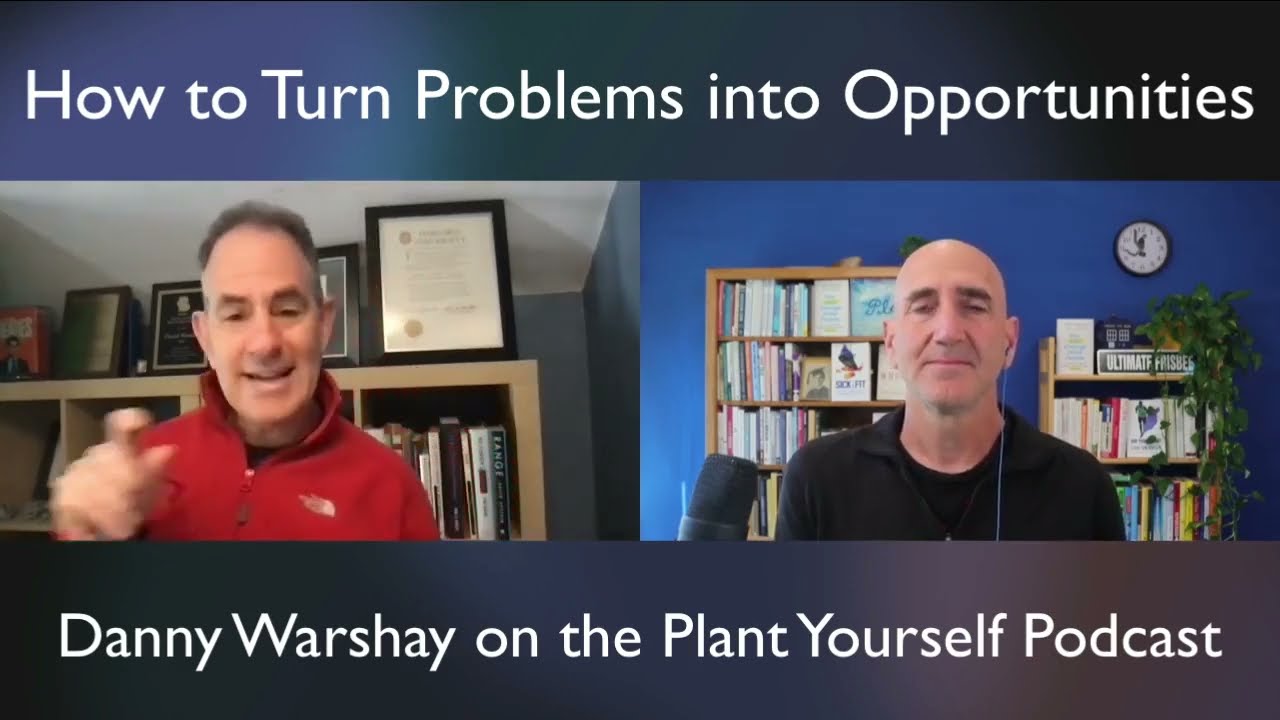
The Pissed-Off Entrepreneur: How to Turn Problems into Opportunities: Danny Warshay on PYP 513