Interview with Danny Warshay, Brown University, Director of the Nelson Center for Entrepreneurship
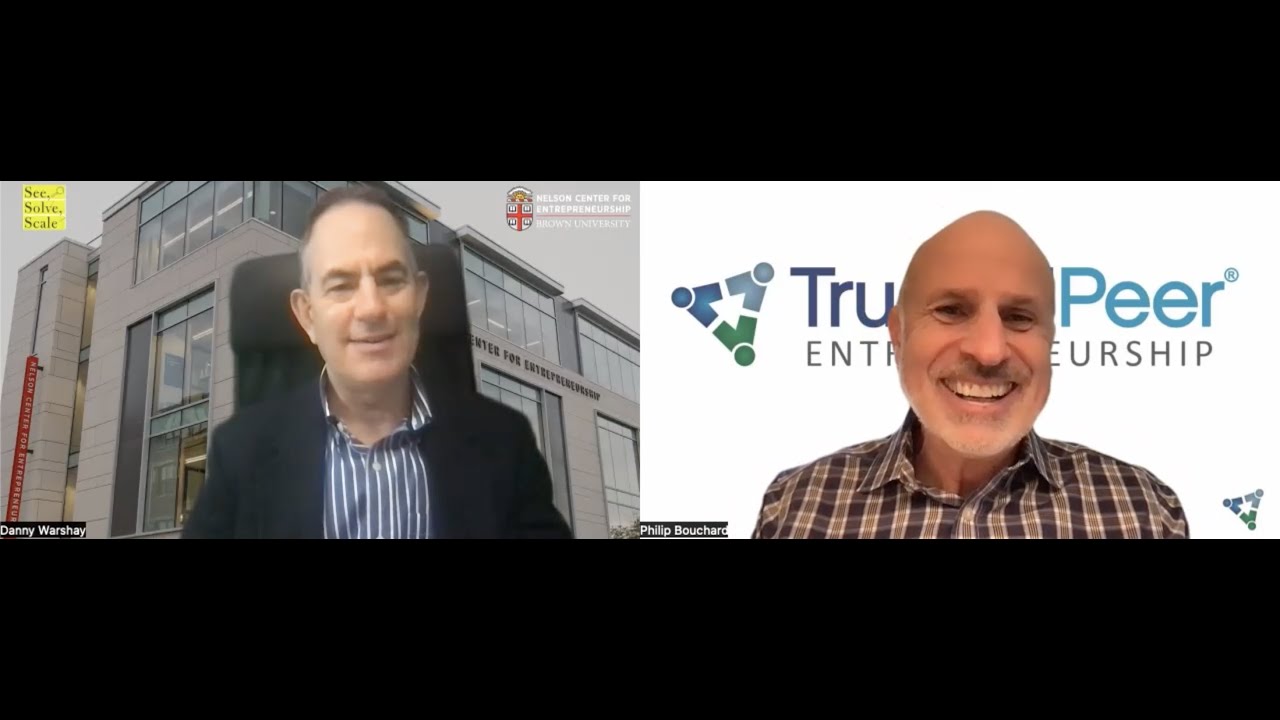
Danny Warshay, founding director of Brown's Nelson Center for Entrepreneurship, lays out his See, Solve, Scale framework: find an unmet need, develop a value proposition, build a sustainability model. He explains why entrepreneurship at Brown is taught as a liberal-arts skill, not just business training, and why normalizing failure and diversity matter for venture teams.
Chapters
Today's interview is with Danny Warshay. Danny is the founding executive director of the Nelson Center for Entrepreneurship and professor of the practice at Brown University. Warshay is the author of See, Solve, Scale: How Anyone Can Turn an Unsolved Problem into a Breakthrough Success, a proven and paradigm-shifting method to unlocking the power of entrepreneurship. Danny began his entrepreneurial pursuits while an undergraduate at Brown as a member of the Clearview Software Startup Leadership Team. Apple acquired Clearview, and since then, he has co-founded and sold companies in fields ranging from software and advanced materials to consumer products and media. Mr. Warshay is a graduate of Brown University and received his MBA from the Harvard Business School. Welcome, Danny.
Thank you so much. Pleasure to be here today.
So the Nelson Center at Brown University teaches entrepreneurship as a structured process that can be learned and applied in a wide range of contexts. This entrepreneurial process comprises 3 fundamental activities. find and validate an unmet need, develop a value proposition, and create a sustainability model. How is the Brown University approach different from, say, the Lean Startup method developed at Stanford, or disciplined entrepreneurship taught at MIT, or the theory of jobs to be done developed by Clayton Christensen at Harvard Business School?
Well, I appreciate your asking that. And sometimes people don't ask it. I've been, since publishing this book, which reflects those 3 steps, see, solve, scale that you mentioned, people just assume that the way they've conceived of entrepreneurship in some ways that I think are mythical, but not always accurate, would be the way that everybody conceives of entrepreneurship. And That's a challenge sometimes in an environment like Brown, which is dominantly focused on liberal arts, which does not have a business school. And I've been teaching at Brown for about 17 years, and I like to tell the story about— in fact, I cover it in my book— of when I was asked by a beloved former professor of mine, Barrett Hazeltine. You know, I wasn't sure, first of all, why did he ask me? I had never taught anything, like not even Sunday school. And then also, what would it mean to teach entrepreneurship at Brown? Because we don't have a business school that's dictating to us how to define entrepreneurship. And I remember thinking, well, I know this phrase that I'm sure you and many of your viewers know, entrepreneurial spirit. Have you heard this phrase?
Yes.
Yeah, we have all heard it. And yet I don't know what it means. And in fact, I for sure, thinking back then, couldn't conceive of a way to teach a spirit. And then I realized, well, my faculty appointment is actually in engineering. And imagine in engineering, if we wanted to teach somebody how to build a bridge, we just said, you know, go out there and have the bridge-building spirit. And, you know, throw up a bridge. And if it collapses and doesn't hold the trucks and the cars, they come crashing down to earth, then just go out there and have a little bit more spirit. And I said, of course, no one would trust us to teach anything if that was our approach in engineering. And I said, nor should anybody trust us to teach entrepreneurship if we're just thinking about entrepreneurial spirit. And I realized in teaching a bridge, in teaching people how to build a bridge, you can distill fundamental principles that all bridge building has in common. There's a beginning, a middle, and an end to any type of bridge that you want to build with lots of room for functional, aesthetic, operational variation. No one bridge is the same as any other. And I said there must be a similar approach in entrepreneurship. Couldn't we distill some fundamental principles, a beginning, a middle, and an end in a structured process that anybody could learn and master and apply With again lots of variation for whatever kind of problem you might be solving and whatever kind of solution you might be designing. And so that's what I did, and that was the basis of this CSolve scale method, and it seems to have been appreciated by lots and lots of different kinds of students, different backgrounds, different skill sets, different disciplines, different intentions for how they're going to deploy that. problem-solving methodology. And so the definition I came up with is a structured process for solving problems without regard to the resources currently controlled. And we could spend a few minutes to unpack that if we had a semester in my courses. That, that's where we would unpack it over the course of a semester.
You founded the Nelson Center in the fall of 2016. And now in its 5th year. How long does it take for a center to get set up, to get fully, you know, up on plane? What are the different phases or stages of development of an entrepreneurship center? And at what stage is the Nelson Center now in the fall of 2022?
You know, I was going to say, I'll let you know when I find that out, you know, when we're fully up and running, as you asked. You know, I think if we didn't, there would be a problem. But we try to use this See, Solve, Scale methodology. We try to figure out what are the problems to solve. I always say you need to start there if this is a methodology for solving problems. Otherwise, you run the risk of being what I call a solution in search of a problem. And so I think that's the most important part of what I teach. I teach at Brown, but I also teach in different contexts. all over the world, governmental, nonprofit. I'm doing a number of things for the military, the arts, in big companies that bring me in to help them train their people how to solve problems. And the most important part of the process is the very first. So I would say that's true of anybody looking to launch anything, but certainly an entrepreneurship center, you better be true to that same structured methodology. And then the second part is to iterate, to develop small-scale solutions that don't layer on a ton of resources and test your hypotheses. Did you actually solve the problem that you had identified in that first step? And only then start to layer on additional, or maybe over time substantial resources to scale and, you know, have, as I, as you put it, a sustainability model. I think people in lots of contexts do these things out of order. They don't do all 3 steps, especially in a university, I've found, or in any other big, well-established, resource-intensive place. They leap, if they do the first part at all, where they, you know, figure out what problem to solve, they leap from that first stage to the third stage, you know, they leap from the seed stage to the salt— to the scale stage because they say, oh, well, you know, we're already servicing a market of 20,000 students and immediately out of the gate, we have to have something that will scale to the point that it can serve all of them. We want to layer on a lot of our resources and that's a huge mistake because You have to have a tolerance for failure and not getting it right the first or fifth time. So that's why I say I'm cautious about saying, you know, we're at a steady state, we're up and running.
Yeah.
No, we're constantly testing the hypotheses associated with the solutions that we're developing and constantly finding new problems to solve. So I mean, I don't mean to sound unappreciative of your impression that, you know, we're up and running and, you know, it's steady state. But I do think we try to maintain this entrepreneurial approach where we're trolling for new problems. The other thing is, in a university, I always say, you know, our customer base turns over every 4 years. And so we constantly have new people to serve. And that's both an opportunity and a challenge.
Yeah, I fully appreciate your response. In speaking to a number of entrepreneurship center directors at different universities, I couldn't agree with you more, couldn't agree with you more.
Well, you mentioned some of the other universities, and I know, I didn't mean to dodge your question, I know Steve Blank, you know, you mentioned Lean Startup, and Stanford. I know Bill Ouellette at MIT and I knew Clay Christensen before unfortunately he passed away. I was in the very first course that he had ever taught as a professor at Harvard Business School way before The Innovator's Dilemma, although I saw the seeds of that in his teaching. And I would say, and I hope it's, you know, fair, but I do integrate some of each of their approaches. I quote The Lean Startup in the book, both Steve and Eric. I allude to Clay Christensen's work with Jobs to Be Done. And Bill Ouellette has been an incredibly supportive, you know, fan coach from just up the road at MIT, came to the book launch at Brown. that our Provost Rick Locke, a former colleague of Bill Ouellette's at MIT, so nicely and generously did for me. So I'm building on a lot of what those folks developed long before I did. I do think there are some differences, and I point them out in the book and in my teaching, but they're complementary. They're not combative.
How does the concept of entrepreneurship fit in a liberal arts education? Is there, Danny, is there a Brown brand of entrepreneurship? And if so, can it be replicated at other universities?
I think the answer to all those questions is yes. And I'll— I think I've alluded a little bit already to what the Brown approach is. You know, I'm not inventing entrepreneurship at Brown. Our center's not inventing it. It existed long before me or before the Nelson Center. But I think I'm certainly making the definition clear based on the definition I just mentioned, clarifying how it might be relevant to any student at Brown. And I think I come at it with some street cred because I went to Brown. I was a liberal arts concentrator. I was a history concentrator. I fell into an opportunity when I was a student, a senior at Brown, to be part of the leadership team of a software startup. Mind you, I knew nothing about software. I knew nothing about entrepreneurship. I don't think I knew how to spell the word. And yet, you know, I was friends with some folks in the computer science department who were starting something and they asked me that. I think they thought I was organized and smart and capable and they said, yeah, why don't you come aboard and work on the business side of this? We built that up with some help from Brown. and some investors and we sold the company to Apple in the late '80s. That was my first real experience with entrepreneurship. By the way, I have to clarify to my students who are in their 20s now that there were computers back in the late '80s. I'm not sure they knew that. But that was what motivated me to pursue this throughout my career through a number of successful startups after that, through running a venture capital fund. And then, you know, when that fateful tap on the shoulder came from my professor Barrett, who I had done an independent study with back then when I was in school to enable me to get credit for working on that startup, you know, I may not have really understood what it meant to teach entrepreneurship at Brown, for example, but I at least felt like I had been doing it. for my career to the point where I would at least have some credibility in knowing how entrepreneurship works. It turns out that doing it and teaching it are different. I do think they're complementary. I would say teaching entrepreneurship is a participation sport, not a spectator sport. It's one of those disciplines where I don't know how you would teach it if you hadn't done it. And actually, I think you mentioned my professor title is Professor of the Practice, which means I practice, you know, I don't do research. I certainly can appreciate research and there's a ton of research that I allude to in the book. But my activity related to entrepreneurship is to practice it rather than just research it. And so at Brown, I think it fits nicely Look, I always say, if you go to Brown, you're going to get exposed to the scientific method, right? It doesn't mean, though, that it's likely you're going to be a professional scientist. Similarly, I know people perceive Brown as not having any requirements. That's not true. It doesn't have distributional requirements. But one of the requirements for graduation is that you have to demonstrate writing proficiency. And that's true even though in most cases you're not going to become a professional writer. I think that entrepreneurship, this problem-solving process that we teach in my courses and in other courses and through the Nelson Center, is one of these liberal arts skills where you may not do entrepreneurship as a profession the way that I know classically people perceive it. But it's pretty rare that you're gonna go through your career, no matter what that is, whether you're in public health or the law or medicine or government or the military or the arts or nonprofit, it's pretty rare that you do any of those things without solving problems. And so I think entrepreneurship is another one of those baseline liberal arts skills that you should learn no matter what you intend to do throughout your professional career. And the way we teach entrepreneurship, therefore, is as a liberal art. It's as this solve— process for solving problems, not as a, you know, pre-professional or business incubator. And in that respect, I think it appeals to students of every kind of study across the whole campus.
Curricular versus co-curricular programs. How do you measure the benefits for, um, of each for students?
It's a really good question. Uh, you know, I always say there's 3 buckets that we think about to capture the approach we take to teaching. One is curricular, the second is co-curricular, and the third is venture support. There's lots of ways to learn in the classroom. There's lots of ways to learn out of the classroom, and we apply lots of those to our students. There's many students who take an unprecedented number of entrepreneurship courses for credit, including mine and including others, including the one that Barrett Hazel— the 2 that Barrett Hazeltine is still teaching after all these years with a co-teacher. But lots of courses across the entire curriculum in biology, in computer science, economics, engineering, sociology, American studies. So there's lots of ways to get official credit. In fact, we've launched Brown's first— now not only, but Brown's first certificate program Which means that in addition to a degree in a specific concentration, you can also opt for a certificate if you take 2 required courses, that Barrett-Hazeltine course that long preceded mine, my course, then 2 electives, again, from a range of disciplines, and then a practicum course where you get credit for working in a team on a startup. And if you complete those 5 courses, you get an entrepreneurship certificate. So there's lots, and we support academic research. You know, I remember when I met with Jonathan Nelson the first time, he said, I'm not giving you $25 million to start a club. I knew what he meant. He meant, and I didn't have any resistance to that. He meant Brown is a first-rate research university and We should be launching a center whose foundation is rigor and academics, and that's the case. So there's a very strong academic rigor as its foundation. But in addition, there's lots of ways for students outside the classroom, not for credit, workshops, speakers, events, to learn the same methodology or pieces of it, or at least get turned on to it. And so we're real proud of that. We have lots and lots of alumni and parents who are very well qualified to help our students learn in those respects. And then the venture support piece, I always say, is where we're not only teaching, we're not only motivating students to learn this process, we are empowering them to do it. And so we provide increasing amounts of grant funding. We run a summer accelerator where we'll pay students to work on their startup and defray the costs associated with having to make money over the semester. We pay extra to students who are on financial aid, and even more than that if they're on high-need financial aid. So we're not discriminating against students on the basis of what they can afford. We have a Brown Venture Prize competition. $50,000 prize each year. We have a student-run venture fund called Van Wickle Ventures. And then we have an embarrassment of riches of well over 500 alumni and parents who are, as I say, quite capable of advising and mentoring students, of serving on selection committees, of being judges in our competition, and doing other things. They serve on our investment committee for the student-run venture fund. So curricular, co-curricular, and venture support. All really good ways for our students to learn this CSolve scale method. We also, in some cases, send students abroad to work in a startup over the summer in an internship position, and then we take students to different countries in small cohorts to learn about those different kinds of cultural influences on Entrepreneurship communities. We'll be taking our first cohort this January to Tokyo, which we're really excited about. So those are lots of the different ways that our center teaches this, some for credit, some not for credit, and some so that you can not just learn about entrepreneurship, but that you can do it.
As a Harvard Business School graduate, you are familiar with the impact of a business school on a university. Brown does not have a business school yet, as I understand, but what can other dominantly liberal arts institutions that do not have— that have neither a business school nor a school of engineering— what can they learn from your experience?
Well, I'd be honored if they were interested, and I am approached by other schools who are launching centers. I've had the privilege of working with Spelman College, for example, on the launch of their center and have had a small impact. They're doing a great job without me. You know, I think it relates to a principle that I teach and that I have well articulated, I hope, in the book, which is these 2 polar opposites about resources, the benefits of scarce resources, where you benefit from having fewer resources, especially early in your trajectory, and the burden of abundant resources. And I think in our case, one of the ways in which that was true earlier in our trajectory when you were starting to say, how did you go about the process of launching and where are you in the process? We didn't have this building depicted behind me on our first day, even in our first 3 years. We were in a tiny little office of some excess space that Brown had access to at Brown Hill L. That was a scarce resource. It worked really well for us. It motivated us to reach out way beyond those resources that we currently control. And that's where the second half of the definition I have for entrepreneurship comes in. Remember, without regard to the resources you currently control. I mean, we could have said, oh, we don't have a building, we can't do any real programming yet. In fact, lots of people on campus just assumed that. They said, oh, you're gonna take what, like, 12 to 18 months and write a strategic plan. And I said, no, you know, we have a whole cohort of current students who are eager. We don't want to deprive them. We have a big poster in our office that says we have a strategic plan. It's called doing things. And so we got out there and we did things. We did our bottom-up research. We figured out what the problems were that we needed to solve. We started to iterate and solve them on a small scale. By the time 3 years in, it became time to build a real building. We were so much better informed about what the problems were that we were there to solve, and that the building might be able to solve, let alone, you know, having done that. So the benefits of scarce resources are really important in any new venture, was really important in ours as well. And the burden of abundant resources is true too. You know, not having a business school worked as a benefit. It made it more flexible for us to define entrepreneurship in the way I mentioned before that would be appropriate in a liberal arts environment. If we had had a business school, that would have been an abundant resource, and I think it would have been a burden. It would have channeled our definition to something that would be appropriate in a business school environment. And mind you, as I paid respect to Stanford before and HBS, I'm a product of HBS. It's not disrespectful. I'm just saying for Brown, it worked better because it freed us of the narrow focus of saying, oh, well, entrepreneurship is a business incubator. No, it's not that at Brown. It's not only that at Brown. I'd say, you know, probably 80% of the ventures that come out, at least come out of the Nelson Center, are commercial for-profit ventures. But that leaves a lot of room for others, nonprofits, the impact we have on researchers at Brown, social ventures. And we don't have anybody telling us, oh, well, this is all about business. And we don't tell students that the entity you have to create in your sustainability model has to be a for-profit. We have lots of nonprofit and other entities coming out of the Nelson Center. It's not like we put, you know, the do-gooder nonprofits on the 3rd floor and the commercial capitalists on the 4th floor. No, we often have no idea who's who, and they intermingle and they support each other. So I think in our case, at least, not having a business school was a benefit, and having one would have been a burden.
What does it mean to partner with other centers, institutes, and groups on the Brown campus? And how do you initiate and formalize such partnerships?
Well, I'd say if we didn't do that, it would be unusual at Brown. Brown just generally doesn't operate through silos. You know, it's— I was at a chairs and directors meeting today and lots of, you know, discussion around one group partnering, collaborating with the other. Brown is very interdisciplinary. And it all— I've taught elsewhere. I teach at Tel Aviv University often in the summers in the executive MBA program. I don't know anybody from anywhere other than the business school when I'm there. It's a different kind of tradition. I taught at Yale at the School of Management and in the college. It's a little bit more siloed. And so it would be unusual not to reach out to others. And people are very receptive. It's also the structural nature of a center, at least at Brown. I don't know about other places. We, by definition, have to collaborate with others. We don't have our own faculty. I'm not a faculty member, as I said before, you know, appointed in the Nelson Center. I'm appointed in engineering. We have faculty members who are all appointed in economics, in sociology, in engineering, in computer science, in urban studies, in gender studies, in public health. And so by their nature, All those people are faculty members in all of their respective disciplines. We're the convener. We're the place where people overlap, and we take that responsibility seriously. We recently hosted a lunch, which we do periodically, where we invite people from all those different disciplines to just get together, brainstorm, figure out ways to do joint academic research together. We hold every other year roughly a very substantial academic research conference, and its hallmark is how interdisciplinary it is. The first year we did it, we had, I think, 160 researchers from all over the world, all coming from their individual disciplines, and they looked around and they said, wow, this is the first time we've ever been in a place with so many different disciplines coalescing around this same topic of entrepreneurship, and we all are able to learn from each other and in some cases formulate diverse kinds of teams. That's one of the hallmarks of my teaching too. It's one of the big parts of the book that talks about the sweet spot of forming successful venture teams, and I hope we're living that as well in the kinds of outputs we're getting from Very collaborative interdisciplinary teams through our center.
Ikigai is a Japanese concept referring to something that gives a person a sense of purpose, a reason for living. How should the concept of ikigai fit into entrepreneurship education in the 3rd decade of the 21st century?
You know, I would say it's a concept that should fit into any kind of education, not just entrepreneurship, but I'm happy if we lead the way a little bit. I want to give credit to my youngest daughter, Maren, who during COVID was doing a remote leadership program through her camp. And she came to me all excited after one of the sessions and she said, Dad, I think I learned a word today. It's a Japanese word, ikigai. It means a, as you say, living a life of purpose or meaning. And it feels like this is a concept, even if you don't call it that, that's been part of your teaching for a while. And I said, oh, what's ikigai? And she said, well, it's these 4 pillars. It is doing something that you are really good at, and we might call that drive, doing something you love to do, we might call that passion, doing something that's delivering real value to the world, we might call that purpose and doing something that's gonna enable you to earn a living where you are gaining financial reward at a rate that's fair for the value you're offering. And I thought about it and I said, yeah, I like that a lot. And I started incorporating it formally into my teaching and then also into my book. And it's a big part of the book. I'm not sure that I imagined it would be as well received as so many people are noting it in all the podcasts I'm on and opportunities to talk to good people like you and radio appearances. A lot of people are resonating to that. I think part of it is I wrote an op-ed piece on the Great Resignation and saying, no wonder if people are not pursuing an icky guy kind of career. I always know if people are unhappy and you know, sometimes I've had students come back to me and they say, yeah, I, that investment banking job I took, boy, that was a mistake. Or, you know, whatever it is, I wasn't destined to go to law school. I say, okay, let's think through those Ikigai pillars. And usually one of them is not right. It's not something they're good at, or if they're good at it, it's not something they love, or if it's something they love, it's not something that they feel is really delivering purpose or they're not getting paid fairly or they're getting paid more than they want and it overwhelms everything else they're doing. So Ikigai is a really good scaffold for outlining the kinds of measures I think that are useful. And that's why I say way beyond entrepreneurship, it's true for any profession. I'm approached by lots of people now way into their careers, not, you know, 22-year-olds, but could be 52-year-olds or even older. And they say, yeah, I'm kind of burned out on what I'm doing. I'd like to talk to you about— do you have— I spoke to somebody today just on campus about that. And I use the Ikigai kind of 4 pillars as a guide for assessing what might be not causing you to be happy and what might, if you pivoted some, help change that.
How does entrepreneurial failure— you know, we always, we always hear this, fail fast or fail forward— or how does that jibe with students today who have never been allowed to fail or have never experienced failure? Isn't failure just a part of testing hypotheses and iterating? I mean, should we eliminate the word failure?
It's a good question. Maybe because so many people are allergic to it and it's also culturally bound. When I teach in China, I really can't use that word. People shut down. They don't want to talk about it. There's so much loss of face associated with failure that sometimes it stymies your career forever. And that's really too bad because The second part of the process, solve, assumes that you're not gonna get it right the first time, or as I said before, the fifth time.
Mm-hmm.
You know, it's iterative. You have to take a step forward, maybe a couple steps forward, then be willing to take a few steps back. You have to test hypotheses. I mean, if you said to a lab researcher, you have to be perfect 100% of the time, they wouldn't dare do any more experiments, right? And so you're right, especially in a context where you have students who've never been allowed to fail at anything. And I think that's really tragic. I think this kind of approach has to be embedded much earlier into our educational system. And I also said it in the book. I said, you know, I'm surrounded by students who are just, you know, incredibly talented, but they have felt their whole life like they're not allowed to take risks that might enable them to fail. I mean, Think about the questions that you're asked on a college essay, even Brown's college application.
Right. I wish—
I mean, I think it would be so much more interesting if instead you ask questions that cause students to just, you know, wax eloquent, pontificate about all their wonderful successes. Wouldn't it be so much more interesting if you said, tell us about a time when you failed? I mean, that would motivate students to think deep. It would also, if they're looking ahead, as they do these days, They would say, hmm, I guess these places are encouraging me to take risks to the point where I might actually fail and be able to talk about that on my college application. It's hard for me. We're about to turn back our first assignment in my class. I'm going to give a B to some students for whom it's their first B ever, let alone a C. And you know what I say? It's really important for you to get used to the idea of failure. This is entrepreneurship. And if Bs are failure to you, that's a real problem. How am I gonna motivate you to take risks in class, to be bold, to think big about tackling really consequential problems if you're gonna freak out when you get a B on your first assignment? So it's not easy. And I think we should do a much better job of teaching failure and making it, you know, again, maybe you're right, maybe the semantics are working against us and we should think about a different word, but, or we become less worried about that word. I mean, we tell people all the time in our curriculum, right? This novel curriculum at Brown, we want you to take risks. Well, it's pretty hard for somebody to turn on a dime and take an academic risk when they've never done that in their whole life. And so I think we have a lot of work to do there where we can help people learn how to fail. And I do have some guidance in the book, and I think it becomes more matter of fact once you engage in this process.
Is the model for diversity the same as the model for inclusion?
It's a good question. You know, Frances Frei and Anne Morris, Harvard Business School, have done some amazing work there, and I borrow some of that. I do talk in the book a lot about how the sweet spot for forming a successful venture team or any entrepreneurship team is diversity, diversity of all kinds. Certainly the kinds of diversity we're familiar with of race and gender. The statistics in entrepreneurship ventures are terrible. Only 2.3% of venture-backed startups are started by women, only 1.5% by Latinx founders, and only 1% by Black founders. We have a long way to go to change that, and we have to change it. But when I talk about diversity, I don't only talk about race and gender. I talk about where somebody comes from, their skill set, what they studied, their prior work experience. I talk about neurodiversity, different ways of processing information. I talk about personality diversity and draws on some of Susan Cain's work that's encouraged us for the good to be realizing that although the cliché and myth is that extroverts make better entrepreneurs, nothing could be further from the truth. In fact, It's really important for us to respect the kind of work that introverts do and to engage them and integrate them in part of your team. But the good work that Frances Freyne and Anne Morris have done is to pair diversity with inclusion in some really powerful ways. And they've demonstrated that, for example, if you have a diverse team that doesn't allow people to be their authentic self, and to bring their full self and full talents and full backgrounds and full personalities to the table, then you're only drawing on a small part of where everybody on the team tends to overlap. And if you can imagine a Venn diagram, I have a great graphic if it were possible to show it, but it's just a tiny bit of where they overlap. In that case, unfortunately, actually homogeneous teams who overlap by definition much more broadly in that Venn diagram Homogeneous teams outperform those narrowly constructed diverse teams. The real secret is to have a diverse team that is inclusive and encourages the team members to bring their full true selves to the table, all the kinds of backgrounds and skills and indication of who they are. And in that case, you have the full Venn diagram of all those wonderful talents and backgrounds being brought to bear in this new team. And those diverse teams who are also engaged inclusively outperform the homogeneous teams and also the diverse teams that are just diverse without being inclusive. So both words are really important, diversity and inclusion. Frances Frei likes this this phrase, and she's not the only one to say it, but she says, diversity is being invited to the dance, inclusion is being asked to dance. And I think it's really important because too often we feel like we're just checking the diversity box, and that's not good enough.
How often do you solicit student input, and how do you incorporate student feedback into the Nelson Center and your programs?
All the time. I mean, it's inherent in who we are. We have a student-run part of the Nelson Center called the Entrepreneurship Program, which long predated the Nelson Center. I was actually one of the forming trustees of that in the mid-'90s. I'd say, I don't know what percentage, but a huge percentage of our programming is student-led. The students are close to the market. And so it's not feedback, it is leadership in working alongside of us, integrated into our teams. I just talked about diverse teams. If we had a team that was comprised, that was composed just of, you know, the staff, that would be pretty short-sighted. The students, my default is always to ask students or just nudge an opportunity to the students and let them run with it. They have far better instincts than I as a 57-year-old might. We're here to guide, steward, counsel, coach, provide resources. But the leadership, I'd say, at least in many of the areas, comes as much from students as anything else. We, for example, we have a group called Peer Entrepreneurs in Residence. Shortly after, it felt like the day after we opened our metaphorical doors back in 2016, when we were just that little tiny office at Hillel, we were overwhelmed by hundreds and hundreds and hundreds of students who were enthusiastic about what the Nelson Center had to offer. And I thought, my God, there's one of me. There were only 2 others of, of our staff at the time. There was no way we were going to be able to meet the demand. And so I thought, hmm, what if I were to deputize some of my best students who are still on campus and have them be— and I thought about it in the moment. I said, I went to one of them and I said, hey, Morgan, would you be willing to be a— and I thought about a peer entrepreneur in residence. And all those students who I asked said, absolutely. They're often the first point at which other students come when they're interested in learning about the Nelson Center or have a venture idea. And so it's inherent in what we do that they're just baked. I think that's also a function of the way Brown operates. Brown has many different kinds of peer-based learning and coaching and fellowing. And so it was natural for me to think of this peer entrepreneur-in-residence program. It wasn't like I was brilliant rethinking the whole model. I was just buying into the way that Brown tends to do things in the first place.
In selecting which programs the Nelson Center will offer, do you look for some kind of linear integration? Let me give you an example. Is your Innovation Dojo, a semester-long student-led workshop series, is that designed to— It's It's designed to challenge first and second-year students at Brown and RISD to think differently about innovation and entrepreneurship through weekly classes. Is that Dojo, is that a funnel for the B-Lab 8-week summer accelerator? Is that, do you integrate programs that kind of that way?
Yeah, I'm, boy, you did your homework and I'm flattered that you saw at least some strategy behind it. I think to say that it's You know, officially linear is not accurate in practice.
Okay.
Brown bristles at the idea of having requirements. And so do you have to have done Dojo in order to do our summer accelerator B-Lab? No, but there's some natural entry points. And so Dojo is one of them. Taking one of the courses that we offer is, is also an entry point. Coming to here you know, somebody speak or meeting with one of those peer entrepreneurs in residence. We now also have entrepreneurs in residence, people who've been through lots of entrepreneurship during their professional careers. There are lots of entry points, but, you know, the way we thought about it was there's an engagement piece, there's an inspiration piece, and then there's an empowerment piece. So Dojo, for example, is one of those engagement opportunities where you may never have thought about entrepreneurship. You arrived on campus, maybe you saw something in our orientation packet, or somebody, you know, pulled you along with them to hear some speaker. Lots of ways to get started. You don't have to have an idea you're working on. You can just come and learn about entrepreneurship. We have a very high priority set on engaging students who come from low-income, first-gen, undocumented backgrounds where they may not have had access to any kind of prior entrepreneurship teaching, or again, they, they may not know what entrepreneurship's all about. And so it's really important for us to engage students of all kinds. and have them in all levels. We have master's students, we have PhD students. Last year's winners of the Brown Venture Prize competition were 2 chemistry PhD students, which we were really excited about. So lots of ways to engage, lots of ways to get inspired and say, hmm, maybe that is something I'd like to try. And you might do an application to B-Lab, our summer accelerator, or to the Brown Venture Prize competition. We—
those are select winning cohorts.
So we, even in the application process, will assign you a mentor because whether you're selected or not for them, we want those experiences to still be educational. And so a mentor can help you learn through the process. And we've had, you know, this is where it's not linear, it might be cyclical. You may apply to get into Dojo in your first semester, and not be accepted, but come back and be accepted in your second semester. You might apply with a team to get into our Summer Accelerator B Lab, and we'll assess our— by the way, our staff doesn't do the selections. That's where some of our embarrassment of riches of our alumni do the selection, and they may say, not quite ready yet. Go back and continue to work with a mentor. and then apply again next year. And that's happened. So people have iterated, applied, not got in, but applied the next year and gotten in. So same with Brown Venture Prize, same with some of the funding through Van Wickle Ventures that we offer. So while it's conceptually linear, just like, you know, CSolve Scale sounds very linear, like you do this step, then you're never going to do this step again. You do this step, then you're never— that's not the way it works.
Right.
It's a little bit circular. But it implies a little bit of linearity. Does that sound reasonable in terms of your impression?
Yes, yes, it does.
Okay.
You had referred earlier to, you know, you've got a new set of students coming in or a new set of customers coming in every 4 years. If we measure generations in 4-year cycles, what are the latest generational changes that have most influenced how you deliver your entrepreneurship programs? Well, that is—
go ahead.
That is, you know, how do students today differ from students in the earlier part of the 20th century when you started teaching?
That's a good question, and I think about it a lot. You know, I was a product of this environment at Brown, even though there were no structured resources for entrepreneurship. Again, I don't at all take credit for starting entrepreneurship at Brown, but I think we are institutionalizing it at this point. There is much more structure. There is an implied linearity. There's an unprecedented number of courses. By the way, I was sort of bending the rules when I did an independent study with Barrett Hazeltine back in 1986 or '87 to enable me to get credit for working on this startup that, you know, I was doing with a lot of my time. It was not 100% valid for me to get credit for something that was a commercial entity. Maybe I bent the rules there a little bit. Maybe Barrett Hazeltine did. I don't think Brown's gonna take away my diploma. Now, It is absolutely encouraged, embedded into the system, that we are giving credit to students for their— in the practicum, the 5th course in the sequence of certificate courses, you have to be working on a startup with a team in order to even be accepted. And that's probably, I don't know, 15 or so teams, each one of which has you know, maybe 1 or 2 or 3 students. So, and that's throughout our whole curriculum. That has changed quite a lot, that Brown and I think other places have recognized what we teach, which is it's not icky that you have something that is called entrepreneurship in Brown's curriculum. On the contrary, it is a staple of what every Brown student should be learning. It's a problem-solving methodology. I remember when I first was being asked to be the head of the Nelson Center, our wonderful president, Chris Paxson, pulled me aside and she said, I just want to warn you, you're probably going to hit some pockets of resistance. Not everybody feels good about the idea of entrepreneurship at Brown. And first of all, I had been already teaching at Brown at that point for about 10 years. And so with all due respect to President Paxson, I had a lot of experience knowing how entrepreneurship would be received at Brown. And— but I appreciated her warning, and it was good for me to think about that. The truth is, I've not had a single person, a single faculty member, staff member, leader at Brown resists the concept of teaching entrepreneurship in our curriculum. Now we have a lot of momentum. Maybe they're hiding in their office and they're just embarrassed to tell me that they resist. I don't think that's true. I think it's that they see, oh, entrepreneurship is a structured process for solving problems. That's definitely something we should be teaching at Brown. They now understand that it's different, much more expansive. Again, the benefit of not having a business school narrowly defining what it should be. There's an anecdote in the book about a dean at the School of Public Health at Brown named Don Operario, who I think was skeptical about does it apply to anything he's doing. And one of my former colleagues, Liz Malone, our former assistant director, said to him, well, tell me a little bit about what you're up to. And he said, well, I've got a team of people developing an app in China to help AIDS patients find health resources. And Liz paused and she looked at him and she said, Don, you're an entrepreneur. And he said, I am? I didn't even know that. And she said, this is about solving problems and you're doing that with scarce resources. So yes, and that led to the development of a joint program between the School of Public Health and the Nelson Center called Solving the World's Healthcare Problems Using Entrepreneurship. And so, yeah, I think it, it's a, it's turned out to be over time something that started off as like at a distance to being something that is well embraced. Can I mention one other thing?
Sure, please.
Even in the, in the short time, you know, the 6 and a half years that we've been around as a center, One obvious way over the last few years that we've learned, you said, how has it differed to deliver? Well, COVID has changed a lot of things, right? You and I, I don't know, would have known the word Zoom 3 years ago, right? Now we certainly know that word. I had to pivot in a moment to teaching my courses online for 3 straight semesters, 100%. Here's a weird one. Brown surveyed the faculty a few months before COVID hit. Nobody anticipated a pandemic.
Mm-hmm.
And they said, would you ever consider teaching online? Fewer than 20% of the Brown faculty said they would ever even be willing to consider it. Fast forward a few months, COVID hits March of 2020, 100% of those faculty had no choice and had to pivot to teach online. Well, the way we— by the way, also, our center opened this beautiful building in the spring of 2019. It was an amazing opening. Students from all across the university and faculty had loved using it. There was only one problem. We did a really bad job designing it to be conducive to a pandemic. It encourages very close team collaboration. And so on a moment's notice, we had to shut down the building, but we didn't shut down the program. This is where— this is the answer to your question.
Yeah.
Over the course of the pandemic, we did more programming than ever, and we engaged more people from all over the world in bigger numbers than ever. Another one of these benefits of scarce resources. We learned again to live without a building, and we learned ways to deliver programming in 2 dimensions, not 3, and to access Brown alumni and parents and others who aren't even related to Brown, who are on the other side of the world and would never perhaps come back to, you know, Providence, Rhode Island. And that has stayed with us. A lot of our programming still is done in a way that livestreams what we're doing and engages people to participate in our programming remotely. And so I'm really proud of that. And so, yes, it has changed, and I anticipate it changing ongoing. The dumbest thing I always say that Brown could have done after the pandemic, and we would have been dumb too, would be to just say, oh boy, that was really awful, which it was. Now let's go back to doing business the way we had been doing in the 18th century. And so I think the way we deliver ongoing is going to continue to change. And I think that's exciting.
You are an entrepreneur, you're an educator, and also a professor of the practice. So how important is it for a university entrepreneurship center director To also be an educator?
Also be an educator or also be a practitioner of entrepreneurship or both?
To also be an educator as well as a practitioner.
I mean, in some ways, I don't really even understand the question because I think at least the way I have always conceived of being a center director is you are an educator. That's the job. I mean, there's other things that I do. I raise money, I engage alumni, I run a team, I recruit people. Like, there's a lot of— if you go to my LinkedIn profile, it's kind of a ridiculous number of bullets of what I do. But at its core, in fact, when Rick Locke, the provost at Brown, asked me to do this, I said, if this is an administrative job, no thank you. if this is a platform on which I can, you know, start to scale my teaching, that sounds really appealing. And he said, well, let's make it the latter. And it's not about me, but the, you know, the definition for entrepreneurship that I used way back when I was asked to teach is the same definition we use at the Nelson Center. And so I don't, I don't—
that's—
and that's why I say also the practitioner piece. It's participation sport all around. I think in order to be a good teacher, you have to do entrepreneurship. In order to be a good, effective center director, I think you also have to do entrepreneurship yourself. Plus you have to teach. You know, it's funny too. I don't have a lot— before doing all this, I had no experience actually working in a university.
Mm-hmm.
And even while I was teaching for all those first 10 years, I was doing it kind of on the side as an adjunct. I, when I first was asked to be the center director, they said, oh, and of course you don't have to keep teaching. And I said, no, no, that's the part of doing this I love the most. Why would I give that up? And I know now that for a lot of people there's this crazy concept I now understand called teaching relief. Where teaching is viewed as a burden because everybody wants to do their research. For me, it's the ultimate joy. I would never want to give up teaching. It's why I do this in workshop formats and big companies and in government entities. The, you know, the US Embassy in Bahrain flew me to Bahrain to work with them on engaging people in Bahrain to learn how to do entrepreneurship. The teaching part of it from— it's why I wrote this book. You know, I, it wasn't even my idea. It was my students who in big numbers came to me and they said, wow, you're such a good teacher. Your teaching had such impact on our lives, but you're doing it on a small scale, you know, 30, 35, 40 people at a time every semester. You need to do the 3rd step of the process that you teach us. You need to scale. And I thought, hmm, how nice when the students become the teacher. And I said, what do you, what should I do? And they said, You should write a book. So the book is really a different platform for teaching. So are these opportunities. So are all the podcasts I've been so honored to be on, or NPR and other radio programs since the book was launched a few months ago. Those I found are all wonderful, new, different platforms for teaching. And, you know, I love doing those things.
Do we have time for 2 more questions? Keep going.
I'm on a roll.
You're on a roll. Okay. All right.
I'm happy to do as long— we can do all the questions you've got, whatever you got.
Well, you know, you have actually answered in your responses multiple questions, so—
Great.
Yeah, it's, um, I asked this question, uh, of all of, uh, the interviewees And it is, what is the single most important course a university student can take, and the course that should be a core course for all? Should it— should a course on the scientific method, or a course on critical thinking, or a course on Lean Startup be required as part of a liberal arts education?
You know, it's very hard for me to answer that question because remember, I'm at Brown. We don't have requirements. So I will dodge it in a way. I think it gets back to Ikigai. You know, I do think there are some fundamental principles that would be good for everybody to learn. I do think it's smart that Brown does have a requirement that you have to demonstrate writing proficiency. I think everybody should learn how to write. Everybody should learn how to speak. There are some basic skill sets that I think everybody should learn. But I don't want to tell anybody that they have to. I think it's good to take a course on anthropology because it helps you be more empathetic. But again, I don't want to narrowly define that. You can do that probably through lots of disciplines. What I tell students is 2 things, especially first-year students: experiment, try new things. Don't converge too quickly, diverge, and try things that you may not already be good at that nevertheless can expand your horizon and help you think in different ways. And the other is, and because too often students don't do that, they kind of try to replicate high school. And I said, no, no, you're at a place like Brown where you don't have to do that. But the most important thing I think I tell students about this is don't take courses, take professors. Find out who are the really wonderful professors, and there's many, and take their course no matter what they teach. It really doesn't matter what you major in, what specific courses you take. What matters most is that you have a teacher who turns you on to something and opens up new parts of your brain. I don't think there is any single or multiple courses that have to be taken. Really what you need to do is fall in love with something just like that second ikigai principle. And if you do that, then I think no matter what it leads you to is gonna be fruitful and worthwhile. That's true in entrepreneurship too. There's lots of things like, there's a great section in the book I think that people have resonated to where they learn that Ikigai is really a part of entrepreneurship. You can follow the CSOF scale method academically and fall flat on your face because you're not focused on something that you really love to do. And if you love to do it and it's something that you feel is, you know, adding purpose and that you're really good at, you're much more likely to be successful. So I hope that's a good, appropriate way to dodge your question.
I think this is tangential, but the question is, the core of Lean Startup is talking to customers, talking to people. Of course, it's more than just talking. How do you teach students to conduct customer interviews that yield desired incomes in terms of clean feedback?
So this is where my approach, I think, at least subtly is different from Steve and Eric's Lean Startup. And I'll tell you, when I was speaking with Steve at an event we had where he spoke, Steve Blank, he acknowledged that there's some problems with some of, at least the words they use. They use the phrase customer discovery.
Right.
The problem with customer discovery is it sounds like sales. You're talking about customers and they may not be customers and they may never be customers. And if your purpose is to discover customers, then you're really in a sales mode. That's way down the line. I talk about this first stage C being a process that I call bottom-up research. It's anthropological, it's empathetic where all you're doing is listening, and observing people in their own natural habitats. You may not be talking to them at all. My litmus test is you are talking less than 20% of the time. You may be talking 0% of the time, in which case all you're doing is looking for problems to solve. That is really different from I've dreamed up this real cool contraption. And now I want to go see if there's customers who will buy it. That is, I think it smacks of a solution in search of a problem. And so again, I like Lean Startup. I love the concept of minimally viable product. But again, in our discussions, I think Steve acknowledged it's different from the approach that I'm taking preliminarily where you are not thinking about a solution to anything. You don't have a minimally viable anything. You are simply focused on trolling for problems. Eventually, I do think it's good to think about customer discovery and having minimally viable, really crude early stage products that you can bounce off of people where you do need feedback. But not in the see stage. That's really in the solve stage. So again, that's one of the places I hope with respect I diverge some from what Steve and Eric do. I think they're brilliant and I love what they do. It's just down the line in the solve stage, not preliminarily in the see stage.
How do you teach students to do that? I mean, It's practice, practice, practice.
It is some of that. We role play. I think, you know, when I do workshops, it's the workshop most in demand all over the world, whether it's in a big company or a government. When I went to Bahrain, I did several workshops on doing bottom-up research. It's about keeping your eyes and ears open and your mouth shut. And that is hard. And I present some really compelling videos demonstrating that observing is harder than you think. I don't want to ruin them for your audience, but they're highlighted in the book based on some amazing research on brain research about how you miss seeing things. And part of it is, I think, to attune you to the idea that we all have bias. And make you more sensitive to the ways in which you have to relax your bias in order to see what those problems are and hear what they are. So it is practice. It is a lot about breaking your mental fixedness, which is your only one way of seeing things that could really change if you relax your bias. So you can learn it. That's again why I wrote the book. Because my students said you could teach this to a bigger audience. We don't have time to do the whole workshop here, but those are the— some of the workshops that I'm asked to do on bottom-up research.
Last question, Danny. What would you advise universities and directors that are just starting their entrepreneurship centers and programs? What are the curricular and co-curricular programs that they should start with?
Well, again, I'll dodge that because it sounds like which courses should a student take? And I'm not that student. I'm also not that director. I'm sensitive to the idea that, you know, Spelman College that asked me for my help is not Brown. And, you know, it's an HBCU, HBCU, with a long tradition, wonderful tradition of educating young Black women. I would be completely inappropriate if I told them the way they should organize and focus their entrepreneurship center. That would be— I mean, how could a white male be in any position to tell them that? On the other hand, I default to the process. Use the CSOLVE scale process in order to become much more sensitive to What are the problems that you could solve on this Spelman College campus, let's say? Or when I'm in other countries, if I'm at, you know, I did a session for the faculty at the Polytechnic University in Bahrain about how do you teach entrepreneurship. It'd be completely inappropriate for me to say just replicate what we did at Brown. But I can say you should be anthropological. you should do bottom-up research, you should be empathetic. When I, to figure out what are the problems to solve in Bahrain or in Atlanta, Georgia on the Spelman campus, or when I'm in Chinese universities and I'm helping them figure that out, I think this is where the CSOF scale method is a good scaffold. It's a meta-level device that anybody can use. I mean, in fact, The subtitle is even more important. It's how anyone can turn an unsolved problem into a breakthrough success. And it's underscore anyone. The idea is that anybody, whether you're in Zhengzhou, China, or, you know, Bahrain, or Palestine, or Kingston, Jamaica, or Spelman College in Atlanta, Georgia, Anybody can use the scaffolding of this structured process for solving problems with lots of variation for what the output should be, what the inputs are, what the different kinds of cohorts you'll be dealing with. I'm excited about that. I— but I would not be presumptuous enough to say, you know, you should follow what we did at Brown, because Brown, as we've been saying, is very different. It's just a completely different kind of environment. And I don't want to risk the idea that I'm dictating— just like, again, we're not doing what HBS or Stanford or Wharton or Babson or MIT are doing. We're doing what's right for Brown. Does that make sense?
Yes. Yes. And thank you so very much. I'm really looking forward to sharing this interview with the entrepreneurship community as a way of enabling some scale.
But there's a growing group online and I'd love it if people who are listening and watching your work were interested in joining. And so both links I'll share with you in the chat.
And we'll share those links and videos as well.
Great.
Thank you.
Pleasure to be on with you. Anything else I can do to be helpful, please let me know, Philip.
I will. Thank you.
More from Danny




Changing Habits and Lifestyle Through the Entrepreneurial Process with Danny Warshay: PYP 315



The Pissed-Off Entrepreneur: How to Turn Problems into Opportunities: Danny Warshay on PYP 513