Building Muscle, Breaking Myths: Redefining Women’s Strength | Thrive on Plants Episode #33
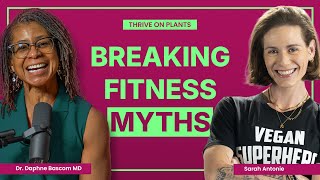
Transcript of a Thrive on Plants podcast episode (interview) featuring Dr. Daphne Bascom and Coach Sarah Antoni. Sarah describes her 2012 vegan origin story, her bodybuilding career (NPC → IFBB pro card in 2019), coaching experience with vegan athletes and general population, approaches to muscle building for women, handling body-dysmorphia and disordered eating, mindset and activism through coaching, plus a short lightning-round. The episode emphasizes veganism as activism, women’s health across the lifespan, and compassionate coaching.
Chapters
Welcome to the Thrive on plants podcast. I'm Dr. Daphne Bascom, and I am so excited to bring you yet another amazing conversation with one of our coaches from the Vegan Superhero Academy. Becoming a coach at the Vegan Superhero Academy is really hard. If any of you ever. If any of you have ever applied, I need to share that it is probably more difficult than. Than it was for me to get into medical school or residency because we only allow in the best of the best. And for that reason, we have the most amazing team. So today, I would like to introduce you to the newest coach in the Vegan Superhero Academy, Coach Sarah Antoni. Sarah brings a wealth of experience to our coaching program, to our team, and I know you will enjoy getting to know more about her, and as much as I enjoyed interviewing her to become part of our team. So, Sarah, welcome to the Thrive on Plans podcast.
Thank you so much.
I want to appreciate that wonderful introduction, and I also would love to second that interview process.
I thoroughly enjoyed the conversations I had with anyone, but I can say it is the most thorough interview process I've been in.
But I can greatly appreciate it now because I've met the coaches on the team and I completely understand. It's such a. A wealth of knowledge and incredible people I've gotten to meet so far. So I appreciate that process and I'm so excited to be here.
Well, we're excited to have you here, and it is an amazing team. But talking about an amazing team, I'd love to learn more about you. I'd love for our community to learn more about you. Can you share a little bit about your vegan origin story? And, you know, you can go back as far as you want. We only have 45 minutes, but we'll go back that far.
So.
So were you always a vegan, or how did that transition occur?
Yeah, I wasn't always a vegan. I grew up eating meat. And then in 2012, I had moved to Grand Junction, Colorado, and I was working at a dog daycare and boarding facility, and I met a wonderful woman. She was my boss, and she is vegan, and she was the type of vegan that let me know that I.
Should also be vegan. And I thank her so much for that every day.
She shared a wealth of knowledge in regards to particularly animal rights and shared that with me in documentaries. And she lent me her books to read. And I think after, oh, it must have been two or three weeks of working for her that I said, okay, I'm vegetarian. And then she lent me a book to read on the plane while I was going to go visit my sister in South Korea. So she lent me this book. And after I read that book, by the time I landed, I said, okay, I'm vegan.
I was at a month after I went vegetarian, so it was pretty quick.
And that was in 2012. And then since then, that was really it for me. I participated in a couple animal rights protests, but particularly it was for animal rights that I became vegan. And then of course, learned about the environmental impacts and the health impacts. And it's just been an incredible journey since then.
Once you go down the rabbit hole.
Yeah, that's it.
Right. And are you a pet lover too?
I am, I am. I have three dogs. Okay. I have a 13 year old. He's my little mutt and I've had him since he was a puppy. And then I have two Frenchies. The most recent one we rescued from a local. Yeah, local rescue. Vegas Pet rescue project in Las Vegas. So he's been our little monster. So I do. I have three dogs.
His name is Gizmo. And, like, is.
Okay, that says it all.
Yeah.
And are your pets vegan too?
Yeah. So we try our older guy, he's on a mixed kibble. And then our two Frenchies are. We prepare their food. So. And they're thriving. They're doing really well, minus the health issues that Frenchies kind of typically have with their breathing.
But we've been lucky to be able.
To get the surgeries to open up their nasal passages. And yeah, they're thriving as an ent.
I completely appreciate that.
Yeah, yeah, our little monster needed it.
And were you always, you know, from a childhood interested in health and fitness or what was your journey into becoming a coach and interest in helping other vegans be healthy?
Yeah. So as a kid, through elementary school, in high school, I played sports. I mainly was in softball and volleyball. And then I continued playing volleyball into college. And then I wanted to try something more individualistic that I can kind of commit my time when I was available because school was really busy. So I started going to our local gym and noticed I was really interested in watching the bodybuilders. And so I kind of would walk on a treadmill and watch what they do and then copy them when they.
Weren'T looking so I could kind of learn the ropes.
And I enrolled in some fitness classes and some nutrition classes while in college and decided I wanted to start competing in bodybuilding. So I started competing in the npc, the National Physique Committee, which leads into the ifbb, which is the pro division. So I started in the NPC as well in 2012. So it was the same year that I went vegan. So my entire bodybuilding journey has been with a vegan diet and everything I've built, which I'm really proud of that I've been able to do that. So I started in bikini, which was at the time the lower muscular division for women. And then about after two years of that and going through schooling, I started working with clients, kind of introducing them into the bodybuild world that I had known and working through them. And then since then I've been working with primarily bodybuilders and general population in muscle building and weight loss. And then in 2019, well, in 2014, I transitioned from the bikini category to the figure category. The judges finally said, you're too muscular.
You'Re not going to do well in bikini anymore.
So I was really excited about switching to the figure category, which is a little more muscular division for women. And I competed in figure for nine or, I'm sorry, for five years. And in 2019, after I would say like 20 NPC shows, I finally got my IFBB pro card.
Congratulations.
Thank you. So that's, that was probably my most proud moment in my finished journey, was getting my pro card. And that journey looks so different for everyone. Some people go in their first year and do incredible and get their pro card the first year. I don't say, I wouldn't say that's a typical journey, but it's possible.
It takes work. Yeah. And then some people, like I said, like for me it.
Seven years and doing, I think I, I think I did 15, 20 shows before I was able to do it. So in 2019, I got my pro card and had been competing as a pro ever since.
Awesome.
Yeah. And I've had the pleasure of working with clients in bodybuilding and general population, like I mentioned during that time. And, and it's, it's fun because most, most people in the body, maybe not most anymore. There's been a lot of vegans transitioning into bodybuilding now, but when I started, it wasn't a large population of vegan in bodybuilding. So it's been a great opportunity for me to, to bring up that conversation about a vegan diet and growing muscle as a vegan and being a bodybuilder as a vegan. And I really appreciate having the opportunity to do that with people. Sometimes it be. It can be a difficult conversation to bring up. So when it's kind of a natural transition into what do you eat every day?
How do you get your protein? You're negative. Let me tell you all about it. So it's a great way to naturally lead into that conversation.
And I've been able to kind of lead people into a vegan diet that weren't naturally with that, showing them that yes, this is possible, I've done it. Let me show you how you can do it as well and be healthy doing it.
So do you find, do you coach men and women or mainly women?
Both.
Okay.
I have primarily done women and I've worked with a couple of men specifically with the diet. I think that's something that a lot of people need help with originally is construction, constructing that diet, but as well as constructing workouts and things like that. So I've had the opportunity to work.
With both and it's, you know, interesting. So first of all, for anyone who's listening and becoming a physique competitor, it takes work and sustaining that for five, seven, 10 years. That takes another level of commitment. What keeps you motivated?
I'm a goal oriented person and the thing I love about bodybuilding is although it can feel monotonous, Right. You're doing the same thing every single day and it's in and out. Usually it's the same meals. Sometimes it can be, it can be a little exhausting at times. Um, you always have a goal you're going towards. So whether you're in a phase of you're losing weight to compete in a show, you have that weight loss goal and that definition and leaning out goal towards a specific date for a show. And then afterwards you can transition into what you call like a bulking phase or getting a little bit bigger and growing that muscle. So it's kind of, although it can seem monotonous, it's kind of an ever changing goal. And, and then you get to see your progression, which I think has been my main motivation, motivating factor is every show I get to see myself get a little bit better each time and I can be very competitive with myself.
Oh, you can see the change year over year is, yeah, you, you have those improvement seasons and you're like, I'm going to focus on my quads, I'm going to focus on my shoulders.
Yeah.
A lot of women though, feel that they can't gain muscle. Well, let me correct that. There's those who feel, I don't want to look like a bodybuilder, not understanding that it takes time and effort. And then there's some who think I'm never going to be able to do it. How do you coach women who, because I think muscle's beautiful. But how do you advise them with regard to aligning their goals with their nutrition and fitness, but also acknowledging that depending on the phase you are in your life, that foundation of muscle that you put on in your 30s, early 40s, that's going to carry you through to your 90s, into your hundreds.
Absolutely. And I think that's a great question. I think the first thing, I always recognize that everybody's journey is their own. Everybody's goals and desires for what they're interested in achieving is different. So the first thing is to identify what that is. Um, and I have heard, you know, women come to me and it's their first, they've just started training and they're worried about, you know, like they say getting bulky or getting too much muscle or they don't want to look like, like a bodybuilder, which is valid. You know, I mean that's not the look you're going for. And it is important to remember that in order to get to that level, it, it can take a decade. It's not something that's going to happen overnight. And while we work towards the goal that you are interested in, that may change. Maybe you do like the way that your body is changing in a certain way and it's not something, like I said, it's going to happen overnight. So if you're interested in building a certain part, we're going to work for a while on that and we always adjust the program depending on if your goals have changed, if you'd rather go in a different direction, that type of thing. But I think it's really important for us to just acknowledge that everybody's desires and goals are different. So I, for me, I love muscle on women. I think it looks beautiful. But I absolutely understand that that's not some of my clients goals.
So we want to make sure that.
We'Re identifying their goals and working towards that.
And that's the goal. And the goal could just be being healthy for the next 50 years.
Exactly.
But with that regard, having that metabolic engine because muscle is metabolically active, it'll help the structured activity of resistance exercise, weight training will help your bone strength. So there's a lot of pluses for women to be physically active in this regard, even if it's not wanting to step on the stage.
And there's something recently came out that was showed that women with more muscle, it was helping their brain health.
So I think, and please correct me If I'm wrong, it happened to be yours.
And I think that's so important to remember that although there is the aesthetic part of it, it's also just the overall health and wellness of it.
Muscle. I was talking with one of our clients earlier. Muscle is an endocrine organ and I think we just think of it as a piece of stuff but it's secreting things like brain derived neurotrophic factor and other myo kinds that can help your brain, can help your other organs. So having muscle is healthful as opposed to being sarcopenic and frail, which will not assist you especially as you get into your 50s, 60s, 70s and beyond.
And I think too for women with the bone density, with more muscle can help with. I think that's incredible for, you know, if you're struggling with osteoporosis or something like that can benefit you later in life.
Do have you had experience training many women in their 70s and later?
I have. So I've worked with a couple of clients that have actually wanted to compete at an older age and I love working with them.
They tend to have the best work ethics.
I bet.
I mean they know what they want.
And they know that they've got a.
Goal to achieve it.
Right.
They've been doing it their whole life. Right. So they're very dedicated.
And I have worked with women that are, that are lifting heavier in the gym at those ages and it's one of my favorite clients.
Do that so it can be done safely. Absolutely, absolutely. Age is just a number.
It just matters how you feel.
And so I want to discuss a topic that may, you know, sometimes it can be a difficult topic for people who a little bit of a trigger warning. We're going to talk about body dysmorphia. We're going to talk about athletes relationships with food because there are many physique athletes who do develop body dysmorphia or maybe they come into this competitive season of their life with a little bit of body dysmorphia. It may become augmented as they go through their competitive journey. And I found personally that as a competitor you may alter your relationship with food. Especially when you're going through seasons of restriction, you know, leaning out to get ready for this stage versus improvement seasons when you're trying to consume more calories so you can grow. Question one, what are your thoughts on the prevalence of body dysmorphia in our community? And then secondly, how do you coach women so that along this journey we maintain a healthy relationship with food that's.
One of my favorite questions, because body dysmorphia and relationships with food is something that can be difficult in a bodybuilding journey. And I've seen it with clients, and I've worked with people that have come to me with those already. And I think the first thing is to do is to have that conversation when you first start that relationship, let them know that this is something that is possible with this sport and to head it or recognize it head on, and to just say, kind of give them. If they are already in a pattern that is similar to that, we'll work on that first. Before we really dive into a show, I think it's important to develop that relationship with food and make sure that's healthy as well as your view of your body before you really dive into competing. You want to be in a healthy spot before you take on that challenge. And then if it's something that come in and they aren't aware of, just letting them know that this. If you start to feel this way, have that communication with me so we can. We can get ahead on one of the ways. Because in my early career, it's something that I had dealt with, um, and I had noticed it, and I was lucky enough to. In my first season, I found a wonderful therapist that I had conversations with, and we worked it out, and I've been. I've been lucky enough not to have to deal with that since. Um, but one of the things that we worked on was really identifying what you're trying to achieve with your body and fueling it appropriately, um, and recognizing that you will be at your leanest at one point and you will be at your heaviest at one point. And both of those points are. Are good and beneficial for the sport that you're in. So when I'm leaning out, I recognize that it's temporary. It's something that I will be on stage at my leanest, and then I will be gaining weight again. A lot of people get on stage and they think, you know, this is the best I've looked. I want to maintain this. And we don't want to do that.
It's not healthy.
No, it's a goal for, you know.
A day or when you do your show, and then it's something you want to get back to a healthier weight. And as you get back to a healthier weight, I remind myself that the food I'm consuming, the additional food, is creating better health for my body. I'm wanting to build muscle so I can do better at the next show, which Includes gaining body fat, includes gaining muscle. So I need to consume more calories. So I really take into account just being appreciative of what my body is doing in that moment and knowing that, say when I'm bulking or I'm gaining body fat, I appreciate that additional weight makes me stronger, that I have more muscle, I feel better. So I really just give gratitude to my body in the state that it's in. So that has helped me a lot.
But that's hard. That mindset can be very challenging. And I love one that you actually acknowledge that you needed help because it's very easy to have a very disordered relationship with food that perpetuates for years. And it's not. I also want to dispel the belief that the way you see a woman when she steps on stage, you do not look like that 365 days a year. No, it's. It's not possible. I shouldn't say it's possible. It's not healthy. Correct.
Yeah.
And so being able to separate, as you said, the fact that you have a goal to step on stage and you will have a scale weight, body fat percentage that aligns with that goal, you will have a caloric target, you'll have a body weight, you'll have a body fat percentage that aligns with your improvement season. And those will be very different. But both can be done healthfully.
Absolutely. And I think too, in today, where social media is, we see it every day and we're consumed by it. A lot of competitors don't like to share the heavier side, so that's the reality. It is. So they tend to only post or only share pictures of themselves when they're at stage weight. So it seems like they're that weight year round because they're posting those pictures year round. That's not the reality of it. They are taking their off seasons or they should be taking their off seasons to maintain their health. And another thing that I like to try to dispel is a lot of people, when they, when they can develop those eating disorders or having their relationships with food challenged, feel shame around it. Um, and I think it's really important to acknowledge that there's nothing to be ashamed of when that happens. It's something to go head on and discuss if you need to with your coach or with your therapist. And it's something that has happened to a lot of people and it's okay. And it's nothing to be ashamed about.
And it's not just competitors. I mean, one of the Reasons you know, Coach Tiana leads the empowered eating blueprint is many people have shame around the relationship with food, whether it's. Maybe they have something along the spectrum. Anorexia, bulimia, binge eating disorder. Acknowledging that you have an opportunity to improve is the first challenge. But I think educating our community and taking away the shame is one of the most important things.
Absolutely, I agree.
But it's. It's not a conversation that we often have.
No. And that's usually why whenever I get a new client that is interested in bodybuilding, that's a conversation we have from the beginning, is to let them know that I may know of tools that you don't like. If have that conversation with me and we can work it out. If we need to seek outside help, that's something we can do. But just keep me in the loop because I don't want you to feel ashamed. If that's a relationship that starts.
Easy said, that's easy to say.
Absolutely.
But no one wants to disappoint their coach.
Absolutely. I. I totally understand that. And I like to share that I've been in those positions and I've had.
To have those conversations with my coach, and it is not easy.
It's not something you want to admit.
But it's not something you have to worry about admitting.
I'm not going to be disappointed in anyone for that reason.
The best thing to do is to figure out, like, maybe why it's happening or, like, discuss the emotions around why it's happening or that there's a certain time of day so that we can face that challenge together.
Like nighttime?
Yeah, exactly, like nighttime.
It's usually the hardest.
Well, I frequently tell stories about having to put the peanut butter in the trunk of the car or things that definitely are not healthy behaviors. But acknowledging which I've recovered from. I mean, I can have the peanut butter. I don't crave it anymore.
That's a hard one for a lot of people.
The peanut butter.
Peanut butter.
Yeah.
But I agree with you. Having an open conversation is the best way. And acknowledging that one. We don't expect anyone to be perfect. So whether you enter a coaching relationship, whether it's of a competitor or not, with some need to better understand how you love your body and your relationship with food, you should have that conversation with your coach.
Absolutely, I agree with you. Yeah.
And that's man or woman.
Yes, absolutely.
Because it's not just. Not just women who struggle.
And that is important to bring up, too, because I. I feel that the conversations I've had with my male bodybuilders. They are less likely to admit it to me. So I think that's really important to stress that that's, that's a safe conversation that we can have.
Thank you. And I want to share that for anyone who's listening because this isn't just a conversation that you would have with coach Sarah as a competitive athlete, as a physique athlete, but anyone you are coaching. Disordered eating patterns are probably more prevalent than I think people acknowledge.
I think so.
And we're trying to remove the shame from having those conversations. And so just knowing that within our academy it is an open dialogue.
Absolutely.
And we talk about it from an education perspective, but also encouraging people to seek help when needed. So that brings me back to Vegan Superhero Academy. With all you've accomplished, what brought you to the vegan gym?
Oh my gosh. So I, I'm sure I've told you this story. It was, I've worked with clients like I mentioned for quite a while. My, I'd had another full time job that was more in accounting and finance and I enjoyed it and it was, it was a great experience to have. But I've always felt the most satisfaction working with my health and wellness clients. It was, it was something when I first started I did for free. I, I just wanted to help people. I just, we'd work on our posing in the gym, I'd help with diet, things like that. And then when I got the opportunity to actually start working as a coach, it's something that gave me much more of a fulfillment than my 9 to 5 did. And then I really love the community that I had seen from the Vegan Superhero Academy. And I've been watching you guys for.
Years and I, and I did, when I was looking at the application process.
I know I knew that it was.
Difficult and that what's in there that.
You guys accept the best of the best. So I've, the years have been, I need to get this correct before I apply.
I need to make sure I have this box checked before I apply. So finally when I felt in a.
Spot where I am so ready and excited to make this transition, I was like, okay, I am applying today and.
I'm going to reach out to Daphne and let her know that I applied. But it's just, and, and my conception of the team that you have built was I am so highly correct.
Like the people that I've met and worked with are incredible. The knowledge base that's here, the family feeling, the acceptance and just like Today, meeting with everybody, watching how easy it is to have a conversation with someone and they're so curious about who you are in your journey, and they're so open to sharing theirs. It's been such a pleasure to be here.
Well, thank you.
Thank you.
And this is. I mean, Leif and Anders have built this team. And I would agree that you feel like you have a. It is a family. You've got brothers and sisters. We joke, we laugh, we. And as you shared, coaches need coaches. So many of us also have coaches because we have other aspirations, goals that we're trying to achieve. But I think what unites us is our mission to really want to improve other people's lives. You know, the animals, health, animals and the planet go together. And being able to just touch one person and see spark, you know, ignite that spark that will potentially change their life, that's huge.
Yeah. And something that Leif had said in a previous podcast that I listened to was just that it's a form of activism. And, and I, I think I had mentioned this to you prior, but it's never something I had thought of that way. But after I heard him say that was. It rang so true for me that it's just a way to kind of walk that walk and show what's possible and be able to prove people wrong. That it is a form of activism. And that's something that just really meant a lot to me.
It is a definite form of activism. And one of the reasons why we love bringing people together at this retreat is what we call the ripple effect. Because we know one of them will, in their own form of activism, inspire others to maybe take. Add more plants to their plate or include movement in their lifestyle, or just do something that will help their health, that will help planetary health and potentially save the life of an animal.
And an example of that, when we were doing check ins yesterday, a client came up and saw Brian and immediately came up and said, I loved your newsletter that you sent out.
I sent it to my sister.
Exactly.
It's exactly what it is. That's the ripple effect. Yeah. Yeah, I thought that.
Great. And Sarah, one thing that I'm passionate about is women's health. And I know that I probably say in the past three to five years, it's become much more of a conversation that we're having for women's health across the lifespan. What do you, as a coach, help, want to contribute to this conversation in terms of how you can impact the lives of women that you may be blessed to coach?
I think That's a great question, and I agree. I think in the last couple years, we've seen more of a focus around women's health, and I love that. I know we've discussed how it's kind of been like an underserved population, and to see more research and more focus on that has made me incredibly happy. Something that's important to me with what I've done in the past is the importance of having muscle as a woman. And even when I started those conversations I've had with people saying, I want to be a bodybuilder, I want to gain more muscle, it was always, don't get too big. Like, don't get too much muscle.
It always made me think, like, well, what do you think is too big? And why do you think that? That's my idea of too big.
Right.
So I've never tried to adhere to.
Someone else version of what I should be. So it's something that I really want to share with women who may be apprehensive about putting muscle on their body is the health impact that it could have and the benefits that it could have, especially later in life as we're aging. So that's definitely something that I hope to contrib suit to my women clients.
What, what are you most passionate about now in terms of being a vegan health and fitness coach?
I get really. Okay, so do you know that look on someone's face when they're talking about something they're excited about? So when they tell you whether it's an entrepreneurial idea or they're starting a new fitness plan or something like that, they just get really excited and have that passion. That's one of my favorite looks on someone's face.
So when someone starts talking and they.
Light up like that, I love to listen to what drives them and what their why is. So being able to be a part of their success in that journey means so much to me. So when a woman can come up and say, I'm really excited about starting this program, I started doing this, I'm started doing this. So any way that I can facilitate that or help them or answer questions or guide them really is a passion for why I do what I do.
And I agree with you that when you see the in we're seeing it this week. Yeah, Just the energy when people are so excited about what they've been doing. Yeah, I agree.
Just share with me.
Tell me all about fuels your fire. Yeah, it absolutely does. I think an important part of what maybe differentiates us from, you know, A health and fitness coaching company is the focus on mindset. How has your mindset either helped or hindered you? And not just in your. Your health and fitness career, but in life in general in terms of, you know, we talk a lot about limiting beliefs, about being uncomfortable being comfortable, being uncomfortable, about, you know, the gym teaching you life. How has, how have you been able to overcome limiting beliefs? And how do you. How important is it for you to include mindset as part of your coaching strategy?
That's a great question. And let me know if I veer.
Off track, because there's two things that.
Really popped into my mind when I started my bodybuilding journey. I wasn't quite aware of the dedication and commitment and persistence it would take to be successful. So when I kind of discovered that, and, I mean, it was probably two years into my journey where, you know, you make the progress you do in two years, and it may. It might not have been the progress you had hoped to make, but you.
Start, I'm gonna have my pro card in one year, right?
We're gonna do this. So. And that's something I like to share, too, is that this is a marathon, not a sprint.
And something that I've noticed in that journey is that that mindset of the dedication and persistence translates into other areas of your life. So whether it had been when I wanted to continue schooling or I wanted to advance my coaching career or in work and in just my daily life, understanding that it takes dedication, persistence to get where you want to go, and it's not going to happen immediately.
And that's okay because we have our whole lives, right? I like to think it's, that time is going to pass anyway. Let's do something, you know, constructive with it.
So that's translated into my personal life, and I like to share that with my clients and hear about how that impacts their outside life as well with their relationships in their career, how they might be able to translate those aspects or those characteristics into their outside life. And then the other thing that I specifically have noticed with the vegan gym and the vegan superhero academy is the empathy that everybody has and that mindset and understanding and perspective that everyone has is much different than what I've experienced outside in other coaching areas. Interesting. And. And for me, maybe it's just because a lot of us are vegan for the animals, so we, maybe there's some heightened empathy there or something like that that translates into our human connections. But that's something I've really enjoyed with all of the coaches and the Clients that I've met is. I feel like that's heightened in our community and something special that we have.
I would agree with you. Yeah, there's a high EQ across the board. Yeah, absolutely. But it's not. While we have a high level of empathy, and I do think that it is in part tied to our activism, I also feel that this is a community that is willing to push the boundaries, which is so fascinating. And probably the hard part is encouraging people to have grace, give grace to themselves, because it's easy to be empathetic to others, but not always to be empathetic to myself. And I'll. I'll give you much more leniency for. You didn't feel great today. That's okay. You didn't. You didn't do a workout. As opposed to, gosh, woke up this morning, I'm like, okay, am I gonna go for a run? You are a runner, Daphne. You're gonna get out, and you're gonna do that run. I felt much better after I did the run.
Yeah, I get that.
But, yeah.
Yeah, I think the empathy's high.
That.
Your point, I think is incredible, is that we do tend to have it more for others than ourselves, and it's important to remember to point it inward as well sometimes.
Sarah, what are some of the biggest lessons you've learned during your health and fitness journey?
I think some of the biggest lessons I've learned have come from working with a variety of clients and the importance of being able to adjust your coaching strategies with a variety of personalities. Not everybody's motivated. Motivated by the same thing. Not everybody has the same why. So a lesson that I've been grateful for and continue to learn is different people's personalities and why they do what they do and how important it is to really get to know each other. Not only them getting to know me so they can trust the information that I'm giving them, but who they are as a person. Like, what when they wake up in the morning, what. What's their first thought? What do they think about? Are they doing this for their grandchildren that they want to be able to be there for? Are they doing it because they want to change the aesthetic of their body? Like, what is their why?
Why?
So I've been really grateful for the opportunity to meet so many different people and understand that there are endless perspectives and endless whys and that their programs and what we do for them should be really individualized. Your.
Your why is huge in our program. Yeah. And understanding and your why may change. I think that's something that people need to recognize that what motivates you in one phase of your life may not be what motivates you in the next phase of your life.
Yeah, absolutely. When I started bodybuilding, mine was mainly aesthetic. I wanted to look a certain way. But in the last two years, it's really been about my health and as I age having that. So I've changed my strategies.
Exactly.
And that's okay.
Man's great.
All right, now for the fun part. Okay, lightning round of questions. What is your favorite post workout meal?
Okay, so there's a place called Ronald's.
Donuts in in Las Vegas and it's an all vegan donut place.
They have like apple crepes.
They have everything. It's so good.
Seriously. Yeah.
So every Friday, me and my husband go to Ronald's Donuts and we have our Friday treat.
Sounds delicious. Yes.
So if you're in Las Vegas, Ronald's Donuts.
Ok. Next we fly into Vegas for our momentum retreat.
So we have to stop by and the most wonderful woman works there. She usually will add an extra donut if you're nice.
Maybe we just buy some donuts and take them to the retreat with us.
Yeah, There you go.
What do you think is the most underrated exercise?
Oh, that's a good one. I don't know if I would call it underrated. It might be the most hated.
It's the Bulgarian split squat Love bulk.
I love.
Well, another hated and loved.
Yeah.
So I think a lot of people may avoid them. Maybe that's why I'm considering them underrated.
But I.
The last.
I restructured my workouts in the last six months and I've really incorporated those and have love the results. It's not my favorite thing to do.
On leg day, but I really enjoy them or results.
Anyway. I was afraid you were going to.
Say burpees, but Bulgarian split Scots.
Yeah, yeah.
What is a book or podcast that inspires you?
So this would be a book that I read on the way to Korea to visit my sister for the reason why I went vegan and excuse my language in advance, but it's called the.
Skinny Bitch and I feel terrible.
I can't remember the author's name.
We can put it in the show notes. Perfect.
But the part that got for me.
Was it highlighted the dairy industry. So I was vegetarian on my way there and that's the book I read that made me become vegan because it highlighted the dairy industry. So that was kind of transformative in my journey.
Okay. Are There a lot of vegans in Las Vegas.
There's a group I'm on in Facebook, so I wouldn't say it's a really large group, but there's a. There's the amount of food that's available. There's gotta be quite a few of us.
There's a good amount of vegan food available.
Final question. What does being a vegan superhero mean to you?
So I've thought a lot about this, and the first thing that comes to my mind is I think every vegan is a superhero. Everyone inspires me in different ways. But personally, for me, being a vegan superhero is doing your best in trying to be an activist in the way that you can. I think that there are a lot of different ways that you can impact the world through veganism, and I don't think there's one perfect way to do it. So doing the best you can in the way that you can do it. So when I first became vegan, I had been to a lot of protests and I had done a lot of outreach and things like that, and it was something I really enjoyed. But I found that being able to communicate veganism and its impacts on health through coaching has been what works for me. So I think finding what works for you and sharing that with the world is what makes it a vegan superhero.
That is amazing. And I agree. Every vegan is a superhero in their own way. Yeah. Sarah, thank you. Thank you for your time today. This has been an amazing conversation. I learned things about you. So even through the four rounds of.
Apple, see if I have anything left to teach you.
But we are so delighted to have you on the team and look forward to seeing the amazing things you're going to bring to this community.
Thank you, Daphne. I've really enjoyed being here.
Thanks. And for those of you listening or watching today, thank you for joining us. I hope you know that the time you spend with us is valuable and we really appreciate reading all your comments, your questions, and we look forward to seeing what you're going to share after my conversation with coach Sarah Antoni. But most importantly, I want you to remember that we believe in you. Wherever you are on your journey, whatever challenges you may be encountering, please know that you have people in your corner. We're here to support you and we're always here if you feel that you need a coach in your corner to help you achieve your goals. Thank you for joining us from the Thrive on Plants community. Please remember to, like, subscribe, don't miss an episode, and as always, keep thriving on plants and living with purpose. Take care.
The information shared on the Thrive on Plants podcast is intended solely for educational and informational purposes. It is not medical advice, and it should never be used as a substitute for personalized guidance from a qualified healthcare professional. Always consult with your physician or healthcare provider before making any changes to your nutrition, exercise, routine, supplement use, or your overall wellness plan. The opinions and advice shared by our guests are their own and do not necessarily reflect the views of the vegan gym or its team. While we aim to bring you high quality, thoughtful conversations, these perspectives are not intended to replace professional medical care. Thanks for tuning in. And remember, you have the power to thrive on plants and live with purpose.
More from Daphne


The Adaptive Fuel: How Exogenous Ketones Support Healthspan | Thrive on Plants #60

Could Yeast Replace Whey? The Science and the Story Behind Spacemilk | Thrive on Plants #58
Why "Eat Less, Move More" Stops Working After 40 (And What Actually Does) | Thrive on Plants #54
Triple Negative Breast Cancer: How She Caught It Early and Came Back Stronger | Thrive on Plants #53