Could Yeast Replace Whey? The Science and the Story Behind Spacemilk | Thrive on Plants #58
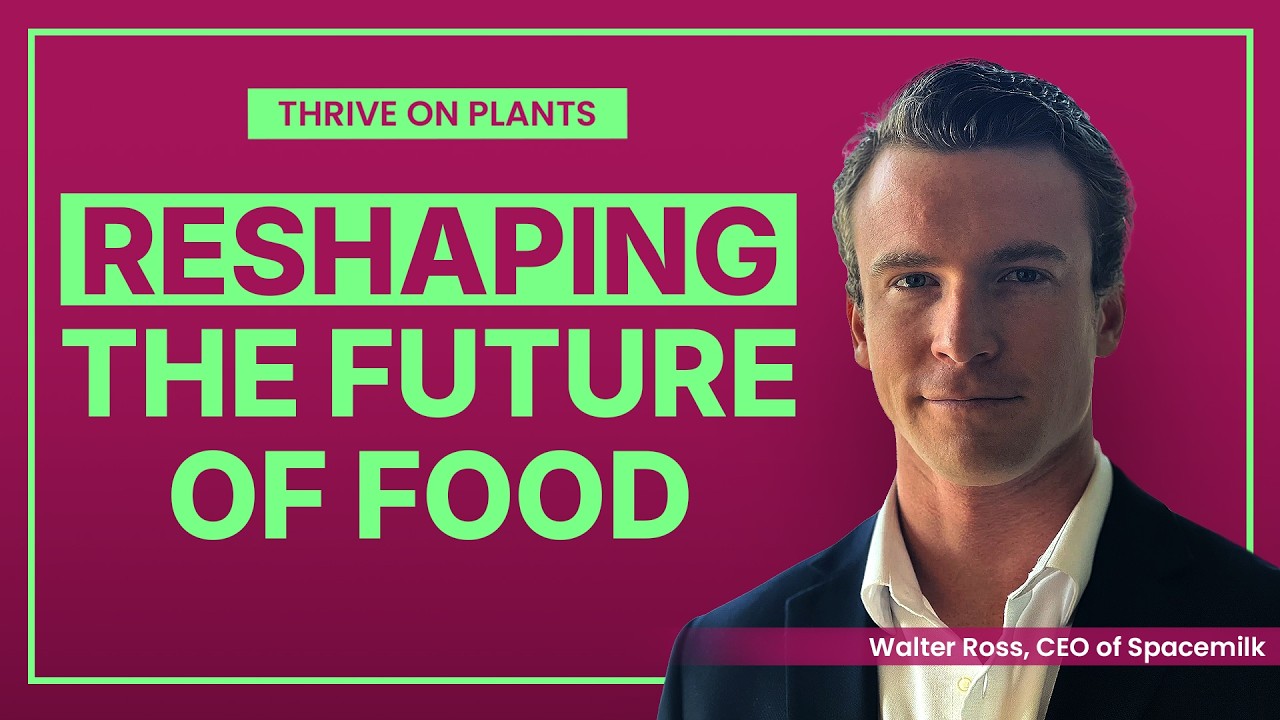
In this episode of the Thrive on Plants podcast, Dr. Daphne Bascom interviews Walter Ross, founder and CEO of Space Milk, about his unconventional path from economics and law school to creating a yeast‑derived protein powder marketed as “Space Milk.” Walter recounts growing up on his father’s hydroponic tomato farm, his early fascination with fermentation, and the moment a space‑radar conference inspired the brand name. He explains the science behind turning baker’s yeast grown on cane‑molasses into a clean, complete protein isolate: heating the slurry, enzymatic autolysis with papain, and centrifugal separation that removes purines, histamines, heavy metals, and allergens. The conversation covers the environmental benefits—up to 40 % less water, land, and resource use than soy and 97 % less than beef—along with upcycling of by‑products and a long shelf life. Walter details the current product line (unflavored, vanilla, chocolate, and an upcoming “Original” flavor), the use of algae‑derived omega‑3s, and the meticulous formulation choices (monk‑fruit and thaumatin sweeteners, clean natural flavors, strict allergen testing). He shares the brand’s transparency practices, third‑party testing for metals, pesticides, and allergens, and the challenges of balancing purity with taste. Looking ahead, he discusses the potential of gas‑fermentation microbes, the limits of scaling yeast protein, and the vision of using single‑cell nutrition for space missions and Earth sustainability. The episode ends with Walter’s personal definition of purpose—helping others—and contact information for Space Milk.
Chapters
Welcome back to Thrive on Plants. I'm Dr. Daphne Bascom. I wanna start by saying something that comes from the heart, and I feel this every time I sit down to record an episode. I'm so fortunate to do this work. Every episode is a learning experience for me. I get to learn from some of the most interesting humans doing genuinely important work in the world. And I get to bring those conversations back to you. I do not take that for granted. Today's guest is Walter Ross. Walter is the founder and CEO of Space Milk. Now, I came to this conversation, as you'll hear in the episode, already a fan. I've been using Space Milk for some time, and after trying more protein powders than I care to admit, This one is among the best that I've ever used. So I did what any curious physician would do. I stalked him. No. Well, maybe I did, but I tracked Walter down and asked him to join me for a conversation about space milk, the who, what, why, where, how. The story behind space milk is not what you would expect. Walter studied economics and went to law school. Interestingly, he grew up watching his father build something no one had done before, hydroponic heirloom tomatoes in South Florida. So Walter saw this creation process and this innovation process firsthand, which is why I think he carried that instinct, how do you do this better, all the way to the fermentation company built around the simplest organism in the food system. Baker's yeast. And I had to actually go and revisit what is a yeast. Where, I mean, I know Saccharomyces cerevisiae, and you remember from high school biology thinking about yeast and you think about yeast and bread and beer, but protein? The same single-celled organism that's been used for I don't know, 20,000 years. It's now grown in a closed-loop tank of water. No soil, no pesticides, no heavy metal bioaccumulation, and it has a perfect protein digestibility score. In this episode, we talk about how yeast protein is made all the way to a finished isolate and why that process naturally filters out all the things you don't want. Purines, histamines, heavy metals, allergens. We also get into why Walter called it space milk and the moment at a space conference that reframed the entire mission for him. We covered the environmental math, the circular production model, algae-based omegas, and what Walter sees coming in the next 5 years for fermentation nutrition. Walter is warm. He's knowledgeable. And he is genuinely passionate about where this technology is headed. I had a wonderful time in this conversation and I hope you do too. So please join me in welcoming Walter Ross to the Thrive on Plants podcast. So Walt, thank you so much for joining me today and welcome to the Thrive on Plants podcast.
Daphne, thank you so much. It's great to be here. I, I, um, certainly been a wild time for us at Space Milk. We're growing rapidly and I always happy to make time to meet people and discuss and share what we're, what we're all about at Space Milk and learn more about you and the Vegan Gym. Thank you.
You're welcome. Well, that brings me to my first question. Why? You know, being an entrepreneur is hard. Being an entrepreneur in the food industry is really hard, but maybe you can share a little bit with our community about your journey to starting Space Milk and help them understand why yeast, which was really something that caught my eye when I first learned about the company.
Absolutely. Um, so first part of why an entrepreneur, um, I think I've always been a bit, I've always kind of done my own thing. I didn't really travel in the popular packs in school or in college, or like I was pursuing my own kind of interesting classes that I thought were interesting rather than following like a traditional trajectory and doing what is interesting to you and pursuing your own path. And there's many paths. Whether that's academia or a traditional career, or maybe it's not even career for focused and you want to pursue your hobbies or life or whatever it is that's calling to you. For me, entrepreneurship kind of ties into what my path and why is, and maybe it's a little bit of love language of like acts of service or gift giving. But I see connections between things and I'm always, I have particular ways of doing things. So maybe entrepreneurship is because I didn't like listening to other people. And what the way that they wanted to do things. But, um, I, I want to improve things. I think all people wanna improve things, but I see ways of, of making things better and I wanna share those with other people. Mm-hmm. And the entrepreneurship thing is because I, I want to do it in a way that hasn't been done before and bring new, better things to people, um, that could benefit from them. And so So why food? Food has a lot of room to improve. It's certainly hyper-competitive industry. My background, I grew up, I was, I was the skinny kid growing up until I was about 14, 15, 17. And I didn't know at the time that that was entirely a factor of just not getting enough protein. And like people in my life didn't, they, I've plenty to eat. It wasn't a problem about it. It was just like nobody taught my parents that, you know, if you want your kid to be like good at athletics or even just like, like I'd, my friends would be biking off into the distance. I'd be like, why am I not going faster? Like what? And I just like, it was because, you know, like bagels and rice and got it. A lot of carbs, but, but not so much the protein. And so then I learned about I got, went into a gym and met a classic bodybuilder style. He used to be Mr. Pittsburgh and he was like, oh, you need to eat this much protein per day. And started learning about that you can control outcomes in your own body through diet. My dad's a hydroponic tomato farmer and I grew up and it kind of clicked for me because I saw him growing plants, like at different stages of the plant's life cycle, you give it different nutrients. If you want it to grow vegetatively versus providing fruit, those are different nutrients. And it kind of clicked for me at that moment where it's like, oh, well, if you want your own body to do things like, yes, genetics are absolutely a part of your, your performance and, and how you grow. But if you want to do things, it's not so much just like it's set in stone. That's the way your life has to be. You can grow yourself through nutrition. And got a little bit off track. Oh, why food? I think that people, people treat food as there, there's just a lot of mystery behind food and it's complicated, but it's also pretty simple about what's good for you and what needs to go into your daily nutrition to make sure that you thrive and you can adapt and grow into your potential. If you're not giving yourself what you need every day, than when you have a need for an adaptation response. So like whether that's a physical challenge, a mental challenge, whatever you're going on in your life, if you don't have the nutrition you required so that your body can respond so that you can grow, you can receive that challenge and then grow from it. You'll always just continually staying in that place. And so that's why like food is so important because I see every, I mean, so many people in my life that like, why am I so tired? Why am I not, you know, I'm not toned. I don't look the way I wanna look. I don't feel the way I wanna feel. I'm having negative health, health outcomes and treating other elements of this. Like I hear all the time people are like, oh, you know, I, I'd love to try your protein, but you know, I'll get back into working out. And I'm like, you need protein every day. And it's not just about like, oh, I worked out now I take protein. It's like you need to hit your protein goal every single day so that even I joked with my wife like all the time. She's like, why should I drink more protein? Why should I like work out? And I was like 24. She was my girlfriend at the time. I was like, opening doors are easier. I was trying to translate it into like things.
Yeah.
That she didn't, it was like, it's easier to pick up furniture and just, and then like a year and a half later as she started getting into nutrition and working out, she was like, you're right. And she, I heard her telling her best friend, she who was trying to get into it. She's like, Opening doors are easier. And I thought it was just like a funny full circle. And so the food is like everything, it powers each person has their path, but food is, is the baseline for what powers that path. And so like, to me, I think about a world where what if everybody's running at full potential as far as like what they can pursue energetically, nutritionally, so that they're not having to feel like Oh, I want to chase this dream. I'm just so tired. I just am overwhelmed. I have this anxiety, these things that, um, there will always be these challenges, but being able, more equipped to face them. So that's like nutrition. And then the food industry, the way we do food has a lot of, um, things that we don't necessarily do the best that we're learning about as a society in the last 5, 10, 20 years. Um, that that's becoming more and more clear today. And then yeast protein itself. Sorry, I'm like going, going on, but yeast protein being to me what is the least common denominator and like least common denominator, best solution for baseline nutrition because it's the simplest organism in the ecosystem as a single-celled organism, which makes it maximally efficient. Like it's just, biologically very, it's hard to do more for less. And it's also naturally ideal in terms of protein for your body. And it has like no allergens or, and it's very easy to grow. And so when I, when I heard about protein being grown from baker's yeast instead of soy, instead of whey, instead of pea, it clicked for me where I was like, that's, it would be, it's harder to do it better in terms of inputs and outputs. And so that, that was why I was drawn to yeast.
Well, that's a full circle. I didn't realize your father was also in food in a way.
Yes, yes, absolutely. And his approach, you know, for him, I guess it was kind of full circle too, as he grew up and he, all he wanted to do in summers or whatever it was, was like, I just want to go work at this farm, this local farm. And his dad was like, no, you need to go to school and study these things. And, and like, my dad had his own kind of lone wolf path, but it came full circle where his real passion was growing and building a farm. And he innovated his own way. Nobody had done hydroponic heirloom tomatoes before in the country. And he, he was the first one to do it, created the category actually in South Florida.
Interesting.
And then the whole mission for him in a different way for me, like I'm, I've approached this from maximizing nutrition before flavor. For him, it was like, I'm gonna create the best tasting tomato in the world. And I should have learned from that cuz it took me a while to learn that, that flavor is king. And it's not about, I mean, benefits are important, but people care cuz it, food flavor. It's so important to people.
Oh, we can talk about the food industry for a long time, but you know, the, I think the fascinating thing is to listen to you. Someone would think that you came up as a nutritionist or a food scientist, but that wasn't the case. And, you know, making the connection between a one-celled organism that is allergen-free Where, where did that come from? And once you had that revelation, how did you move forward?
I did not come from a background in nutrition. In undergrad, I got an economics degree and I went to law school. It's entirely been something that I apply in my own life and have been passionate about in my own life. I did, I was my freshman year of school. I got certified by ACE and NASM in sports nutrition. And so that was like the, the beginning building blocks for like a framework in understanding this. But then after that it was researching, learning about it, asking people about it and understanding and applying it into my own life. As far as connecting the dots, it's just, it's fortuitous that the tracks that, or the, the paths that life takes you. Before I was old enough to drink, I guess I have a little bit of a green thumb. I like growing things and I was really interested in this concept a friend of mine had talked about fermentation and he, he showed me, we, we actually made wine out of Welch's grape juice in our dorm room freshman year. And that was my first, first time with fermentation. Yeah. Yeah. They got the, the homebrew stuff and we had to go find from, I guess I, I don't know if I should be teaching people how to do, yeah, it's fine. But we went to the grocery store and there was concentrate and we had to find the concentrate without preservatives in it. And so we put the concentrate, we rehydrated it and then added the yeast and like, it's like, this is gonna make something. And it grew and I got to see over the next month how the yeast grew and fermented and it turned the sugars into alcohol and then more yeast. There's like an airlock and we tried it and it tasted crazy. And then he goes, no, no, no, I got another trick for you. And then he added, we went to the homebrewing store, got oak chips. And I swear that like Welch's grape juice turned and turned, tasted like a $40 bottle of wine after you added a little bit of oak chips to it for a week. It was crazy. But that was, that was how I did a little bit of homebrewing that became a passion of mine for a year and a half. I mean, these little things that come into life. And so when I, when I heard about, yeah, I did that in my college dorm room, like behind a curtain and like my roommate had no idea, I think. And then I read for me to know that people were growing protein from this. I'm like, that's really easy to do. It grows easy, but it grows so quickly. That you can feed it simple things much easier, I thought, than watching my dad grow crops that took months to grow, to produce, to defend against pests, to defend against disease, to have the harvesting versus like everything self-contained. I learned more about brewing. I visited breweries, like in a, in a study perspective, not recreationally. That was later in my—
fermentation. Yeah.
And, and so for me, that was like the homebrewing kind of brought home about like, this could be really big because you can do it in a faster, more controlled, cleaner environment where you're not having, a different part of my life is, and I guess this ties to the entrepreneurship is I'm always thinking about like, how can you do something better? What are the overall impacts? Maybe that's the economics, the externalities. Like when we, when we have our, I think about all the time in the grocery store where, whether any packaged food, but especially like the meats, the cheeses, the dairy, the, the animal products, like it's so nicely packaged and people don't really think about where it came from or the whole cost of the product on the shelf over time or the, You know, living in DC or anywhere in the country, oranges from Florida or tomatoes from Canada or Mexico, avocados from Mexico, like that had to get on a truck. They had to grow that. They had to provide. And so like all of the things along the way, it's so incredibly expensive from a resources point of view to grow our food. And we're so disconnected from it. Like I'm always thinking about how could you do it better? And it was profound to me as far as like the possibilities of reducing all of that chain. And then on the other side, like a third of all food is thrown away just as food waste, like, oh, it went bad, throw it out. And you can preserve this for a much longer time.
You know, you mentioned the process of fermentation. Maybe can you explain a little bit about how yeast, how you go from yeast, which I think most people listening will be familiar with from baking bread, but how do I go from there to a protein powder? And how did you go from there to a protein powder? Because I, I think the simplicity of the source is really amazing, but most— maybe the other thing is going back to the quality of the product that comes from yeast? Because I don't think most people would anticipate that either.
Absolutely. And it's the same yeast that you grow, you bake bread with. It's also the same yeast you make beer with. Brewer's and baker's yeast is the same strain of yeast. And human beings have been using it for at least 20,000 years. And yeast is a part of every food culture around the world. And so people probably don't associated all the time with, um, yeah, it's, it's ubiquitous, but the process for taking the protein out of the yeast. And so you grow the yeast and the yeast that we have in Space Milk is grown on, um, molasses from cane sugar. Uh, you, you process the sugar, you have molasses as like another, um, product stream from that.
Mm-hmm.
And so the sugar becomes its own thing. The molasses is full of vitamins and also carbohydrates that the yeast would eat. And so you feed the yeast, it grows. And once the yeast, you have a, you have an original starting amount of yeast. And so like whether it's sour, you know, you can think about this as sourdough starter or bread, the bread rises, it's growing. And you, if it's starter, you're constantly maintaining, you're growing your starter, you use some of it, you grow your starter, you, you have your starting amount and then it doubles like very quickly cuz yeast reproduces through Oh boy. I'm not a biology major. I think of it as cell division, but I don't know that cell division. I think it's like, it has like a little, a bud that comes out, but it multiplies very quickly and you don't want to eat the yeast itself. Yeast is a fungi, fungi, and it has tough cellular material. So just like you would want to cook a portobello mushroom for a long time, otherwise it's gonna be kind of hard on the digestion. Fungi, fungal cell material, like the outside of it is, is just hard on digestion. You can do a little bit of, of nutritional yeast. You can have a little bit of baker's yeast and it won't be a problem. But if you're doing protein serving sizes of this, it will be something that you're gonna have a harder time to digest. And so to, and then there's other things inside the yeast and in fermentation that a lot of people can have, but some people might be sensitive to like uric acid and purines for gout. Or histamines. And so you wanna really just get the complete protein. The way this looks is you've, it's gonna be kind of technical, I apologize, but I think it's interesting.
No, I love this.
You have the yeast slurry, it's, you know, you've grown all your yeast, it's in water, and so you heat it up to 114°F approximately, and that puts it in a condition where it starts to not break down, but it's, it's more malleable. And then you add a little bit of food enzymes, so like papain, which comes from papaya. And then that breaks the yeast down slightly, and then it kicks off a process called autolysis, which I've only read these words. I'm not sure if I'm pronouncing them correctly, but that's the, the yeast's own enzymes start to break itself down. And so the cell material starts to break down. And this is all natural, natural processes. It's not like adding harsh chemicals to break it apart or rip it apart. This is stuff that happens in nature all the time, happens in your stomach. And so the yeast starts to break itself down and then you have, you have cell material, you have the fats, you have the flavors, you have the complete protein, the amino acids inside as well. And now you have a slurry of all these things you want to filter and get the protein out. And so that's done by centrifugal separation where you spin it really fast. Trying to think of like at home, I'm sure people know, but I can't—
Salad spinner type of thing.
Yes, yes, yes. Salad spinner. So like, like a salad spinner. In that case, we're, we're trying to get the water. And so the salad being the cell material, the heavier components, whatever it is, and the protein gets spun out, or maybe we're trying to keep onto the salad and then the other stuff gets spun out. Either way, you're separating the protein from, from the rest of it. And in that process, what you're removing is the cell material. You're also washing away because this is done in water. You're washing away and separating many of the components that you wouldn't want in protein level serving sizes like the uric acid, the purines that I mentioned, those are, those are water soluble. And so what you, you end up washing and filtering away most everything except for the protein and what you're left with because of the conditions it's grown in, you're growing yeast in a tank of water instead of in the soil where it's subject to air pollution, ground pollution, pesticides, and not like in crazy amounts in our food. It just, it is, it is a factor. You don't have those things in, in in a controlled environment like the tank of water. Mm-hmm. And so what you're left with is a naturally really clean, ideal complete protein. And, and it just so happens that the protein from baker's yeast matches what the human body wants and needs. It's really great. It's like equal to, to soy protein. It's equal to dairy protein in terms of quality of the protein, the, the amino acid profile itself. It's really cool. And unlike soy or dairy or, or peas, It's very rare, but it, that you would have a yeast, a true yeast allergy, but it's, it's most, for most all people, completely allergen-free. If you do have like a, a true protein, a yeast protein allergy, and you definitely know if you do, like it's very rare, but you, it makes your life very hard if you do have one. I bet yeast in pretty much everything. We're not a fit, but like for people that are sensitive to fermented products, most of the things that you're sensitive to I would 100, 99.9% that are filtered out and removed, or that you're like histamines. People with, I have to be careful because we're not for, like the FDA says we can only talk about our products in certain ways. But if you were to have a, a something where you are sensitive to histamines, we actually tested and we have zero histamines in our product. Whereas traditionally fermented foods are, are higher histamine or, or a source of that. And so it, it just ends up naturally, fortuitously being an ultra clean, amazing protein.
So essentially you've gone through the fermentation process, but you have spun off a lot of the non-proteinaceous, you know, components of the yeast that could either result, you know, trigger something like a gout or people are sensitive to uric acid or who—
and I'm one of them. I mean, I used to have, uh, flareups where my, my, and I know I'm really young for it. I don't know. My grandma gets it. My dad doesn't really have it, but it's like in my family. And when I have like high uric acid, high purine foods, my toes, like it just doesn't really—
yeah.
And I was my, it happened for the first time when I was like 24 and people were like, that's insane. I'm like, no, I don't know what to tell you. And then I stopped and it was like, you know, You know, it went away. And so like, I, I'm pretty sensitive and I have like 4 or 5 shakes a day some days. Yeah, it's, it's pretty amazing. I didn't mean to cut you off. I apologize.
No, no, no. It's interesting that, that, well, one, that was pretty young to start getting gout, but I know. So were you the first to come up with this as an idea and actually create a product that would be widely available to people?
Using yeast as a food source is, is not a novel idea. I am the first person to bring a commercialized yeast protein isolate product to market. Nutrition, you know, nutritional yeast has been around Vegemite, people.
Vegemite. Oh my God. Yeah. Yuck.
Certainly unique. And, and there, in the '80s even, I think the, there were governments exploring like what would, it's a little darker, but like what would a world in like nuclear winter look like? How would you grow food? I didn't know about any of this. I thought it was divinely inspired and that I was like this amazing genius to create yeast protein products. But then as I've discovered, I'm, it was original and unique thinking for me, but, but many smarter people have thought of this before in the past, but it's never been done before.
Got it.
At least not as a, as a, a protein isolate product, not in the protein industry. And, and that's part of like the difficulty in, it's not so difficult, I guess it's really, I mean, we, we have 100 years of dairy agriculture and infrastructure built out where whey protein as a, as a byproduct of the dairy industry, they're like, oh, people can use this as protein. And so just, it's natural, it's cheap, it's like a natural outcome, it's cheap. And then pea protein is like a byproduct of the noodle industry in Asia. And so like natural, cheap, easy. And then soy protein, I actually don't know how, I imagine it's a similar process. Maybe it's a manufa, like soy sauce manufacturing, cuz then you would be taking the flavoring out and the protein separated, but there just hasn't been a need to look for protein within yeast before. And this was, I'm not the yeast producer. I don't create the protein myself. I, 4.5, 5 years ago, I was studying for the bar and I read a, I read a newsletter, a nutrition newsletter that was talking about Impossible Meats and was like 90% Impossible Meats and like fungi meats and all this cool stuff. And then at the bottom it said, oh, and this one R&D company has made a complete protein from isolating it from baker's yeast. And I was like, oh, that's cool. Like I know how to grow yeast. And the fact that it's like a, a clean, um, complete vegan protein that matches whey for, um, a bit like content. Mm-hmm. I thought that was really neat. And so, um, they were the one to me that created the official commercial, like ingredient category for it.
Mm-hmm.
And that company actually doesn't make it anymore. They, they, it's very expensive and difficult to become an ingredient supplier and they had to go in a different direction for their business. But fortunately they did create the category from like an ingredient supplier standpoint. And then they had competitors come up and because they'd held the, the standard so high as far as what yeast protein should be, other people saw an opportunity and, and from there yeast protein as like an ingredient category. It was created and then I was the brand that brought that into people's minds. Now I have not copycat brands, but they're definitely brands that have like directly been inspired, especially in other countries where vegetarianism or veganism is more popular, like India. There's some yeast protein brands growing there that sometimes I'm like, you guys just took what I said and made it, but it's good. It's good for the world to develop this technology. And, and that's really ultimately what my brand is about. It's not about You know, I'm, I'm not the inventor of yeast. I'm not the inventor of yeast protein. I am the person that sees what we could do with our food supply system. And I'm the person that wants to bring better future-forward solutions so that each person can have exactly what they need every single day to thrive from like the least cost standpoint, as far as environmental and input outcomes for like the maximum thriving outputs. And I think that's really where, where we need to be as, as a species culture. And I'm not trying to replace food, but I just think that currently people don't get what they need. And if you could get them what they needed and they could still enjoy their food, that's like the best outcome. I'm always trying to think about like, how could you make it better? And so like, it starts with protein now, but we're going to release in a little while, and this is not a new product at all. I just think it's really cool and it fits in exactly how I want to do it. Omega-3 essential, essential fats from algae. And so you have—
Ooh, interesting.
Yes. Yeah. And another single-celled organism. So like maximally efficient, maximally clean, but providing an essential nutrient from what would be traditionally like fish oil and all sorts of problems with the fishing industries.
So, oh my gosh, you've got my head going in so many different directions. Um, but before I jump into, so first of all, thank you, because I love that you're mission-driven and, you know, something that's important to me when I choose a product, believe it or not, but you haven't shared yet. Why did you call it Space Milk?
Uh, uh, it was called something else to start. And in the beginning it was really just a, a market solution where I saw an ideal complete protein that was animal-free and allergen-free that matched wafer quality, but was more sustainable than plant-based. And I'm like, that's a big win. There's a bunch of people that would be interested in that. But as I kept going with it, I realized like, again, what would make it better? How could it be even bigger? What would the impact be like? How could you keep pushing it further? What would the next even cooler, better thing for this? Not cooler, just like what is a more impactful way to look at this and explore this. My wife is a space attorney and she had, she was presenting a paper at a huge space conference and she's like, hey, it's, it's, you know, halfway around the world. They said I have a room there. Do you want to come with me? You just have to buy your plane ticket. And we were boyfriend and girlfriend at the time, but it was cool. I was like, yeah, let's go. I went and I was just She was doing her thing. I watched her present and she had all these meetings and stuff. And so I'm just like going around the space conference and I was sitting in this, in this, in this room and I was being overwhelmed and I was like world leaders talking about really amazing innovations from space applications for Earth. We're not talking about Star Trek, although I do love Star Trek. Um, I think it was things like, and a specific one that sparked something in me completely unrelated, but I was watching a company present how they were using space-based radar to scan cities for leaks in the water infrastructure, where previously about half of every city— um, yeah, most every city still on Earth. I don't know how they're doing today, but most every city, half of all the water escapes in the pipes before it gets to where it's supposed to be.
Wow. Okay.
And they were able to use radar from space to penetrate 3 meters into the ground and find 97% of the leaks and make more efficiency by repairing them one at a time in case study city that they'd done. I think it was in Belgium. Mm-hmm. Um, and I was like, that's just really cool. Like, and for whatever reason, um, I realized that you, you grow yeast in a tank in water and you can do that anywhere. And I, I'd say that you grow yeast in a tank in water, you can do that anywhere, even in space. Um, and that kind of hit it home for me where I was like, all of these people are very serious about putting people in space, space technology, growing the space industry and like the final frontier might be the oceans. Oceans are, are pretty hard. I don't know if it's as hard as space, but anyway, many, many people in our species are interested in becoming a multiplanetary species and exploring and pushing the bounds of what's possible for, um, our existence. And to do that, you need to feed people there. It's very expensive to bring everything with you, and it's not very, uh, it's always limited. You'll always have to come back and get the food here. But like, what would be possible if you didn't, if you could bring your food source with you and not just like a temporary supplement, but if you could bring everything you needed with you. And so for me, the starting point for that was yeast, a, and it's so rudimentary. I have so much to learn still, but if you can grow that much easier than having to grow crops, like if we've seen the movie The Martian with Matt Damon, and he's like PhD in botany, growing potatoes 24/7 to stay alive on Mars. Like, my dad's a farmer. Farming is hard. And if you had, even if you had a long-term mission of like, let's say we get to Mars or even the moon, even if you had a long-term mission of that, like you had 10 people, like half of them would have to be full-time farmers to feed everyone. And I just think about like, that was like what I was thinking about then. And then the like, well, what would be even cooler? Well, if you could do it in space, you can do it on Earth. Like if it's, if it's the easy, like space is hard. If you could do all of these really difficult things ultra efficiently and save all of this labor and time and energy and like provide everything that you need to thrive in like the harshest environment that we know. Well, of course you could do it on Earth. And in fact, it's a lot easier to do on Earth and you could have way more impact and like, whether it's food waste, whether it's, it's the pollution, whether it is runaway GMO, whether it is, uh, crop death or, um, pesticides, like the, the impact of pesticides is not just literally, uh, the pests on the crop, the things that kill pests on crop have horrible devastating implications on amphibious life and, uh, water life. It's all tied together. And like, 40% to grow the, the, the yeast protein based on a life cycle analysis of a company that's similar to mine. They have much more funding and they're an ingredient supplier. So I say like the technology, but anyway, the technology to grow yeast protein has 40% less water, land, and resource inputs than even soy, which is a plant and should be much easier. It's 97% less than beef protein or dairy. Wow. And so like the impact about the least, like if we could reduce all of the protein growing crops that we grow exclusively for protein by 40%, the amount of land you freed up, or even on the flip side of like the waste where you don't have to throw products out and you could just say like it has a 2-year-plus shelf life.
It's a lot of room for efficiency and I'm getting carried away, but no, those are, I mean, those are all the things that I was hoping you would share because, I mean, one, first of all, I always wanted to be an astronaut. So the, you know, the space milk caught my attention right away and my head went to the same direction as yours, which is, could this be something that you, you can grow yeast in such a contained space and you could take starters, you could take the yeast itself, but That probably won't be in my lifetime, but regardless—
Don't be surprised.
I would love to— I would love for us to be able to explore other areas of this universe. And you're right, the food supply and the water supply are going to be rate-limiting. And so finding opportunities like yours to use for astronauts would be great, but the applicability in what you've just shared in terms of your reduced footprint, in terms of your water use, you're, you're not hitting the land. It sounds like that you're upcycling products to the best extent possible. When it comes to, you know, so something that I always discuss, you know, with people I coach is that if you're looking for a protein powder, you want a partner that is clean, that has as least impact as possible, which a lot of, whether it's the whey protein, even the pea, the soy, the rice, I feel like they're all very resource intensive. But it sounds like you've been able to lower that resource requirement significantly.
Yes. The protein from the yeast supply that we have is actually certified upcycled. I should probably put that in my marketing more. We have a pretty— always growing, always learning. I didn't come from industry and like reinventing the wheel every day. But as far as that process, literally, so the— you grow the yeast and it is, as you break it down and you filter out the components, the parts that are filtered out are actually a whole product stream in itself. That is the flavoring, that is even the cell material, which gets used as a bulk and thickener for, um, uh, livestock crops because I don't know that process to be honest, but the, the cell material gets added to like grains and stuff.
Uh-huh.
Um, but anyway, that's not the, the cool part is like yeast extract flavoring is a whole very popular industry where people instead of soy sauce want extract from yeast for flavoring. I think, um, I have some downstairs, I think. But the protein is one part of that. So every part of the yeast is used, and even the water from growing the yeast gets recycled in to use and grow in crops and sugar beets. I don't know if it gets applied back onto the sugarcane, but I do know that it's used as fertilizer for sugar beets. And so even the water is recycled. And like, what that would look like in a far-off space scenario is where you'd have different microorganisms eating each of these components and you'd filter and recycle the water. But like actually here on Earth, it is pretty efficient. And in the way that we do things, what I've learned recently is, and always have to grow and learn, there is a limitation on baker's yeast protein. If we were to, and it's not going to happen for the time being, like I could probably replace the entire whey industry before I would face this limitation. But if we were going like full planetary impact, if you were to replace 100% of like beef protein on the planet with yeast protein, it would actually require like 100% of our sugar production. And so where would we go if we were going that? And something that I have to learn, I'm actively learning right now is there's other types of microorganisms and proteins that you can grow. There's a really cool company called Solar Foods that's growing protein from bacteria that eats CO2 and it's called gas fermentation. They're doing a whole cell protein and so you can't really have it and it's, it's pretty high in, in RNA and purines and uric acid. And so they're using it as kind of like a slight food fortifier as a flavoring ingredient. They're not separating the protein out, but it is a technology that could be developed or you could genetically modify certain types of yeast like Pichia pastoris to eat CO2, or it's called gas fermentation where you're now, um, instead of feeding it, and it's more efficient actually, so it's even cooler than yeast protein, baker's yeast protein. Um, and, and you're drawing down. And so like what that would look like if you were to have a, a base on Mars is you could take literally the atmosphere, which I think is mostly CO2 on Mars, and turn that into food. Coming back to, to Earth though, um, you said, you know, maybe it wouldn't happen in our lifetime. The technology to produce the protein that we use today did not exist 5 years ago, or it was very rudimentary. And the company that opened up the category commercially was actually using a different, it was more expensive because they were using a different type of separation for the protein. And even in the last few years, it was made more feasible because there's, there's demand for it. There's a promising new avenue going for it. And, um, in March 2023, we were nominated for the Edison Awards and we actually won gold, which is really cool. Um, we beat, we beat Cargill, which is the largest privately held food company on the planet. And I don't, I met the VP of Cargill and he was like looking at me and I was just some young guy and he's like, who are you? And I'm like, I know, right? I know. Uh, and we won gold and that was like a huge triumph for me, but I had a bunch of people asking me like, well, why aren't you developing the yeast protein yourself? Why aren't you creating an R&D company? And I said, well, you can approach it two ways. Like, I am not the first one to think about fermentation as a food solution in space even, or in, in the world. People have been doing it longer than I've been alive. But to me, the best way to achieve your goals, your long-term goals, are through other people's short-term goals. And you can have an R&D solution to produce protein in this way, but it will never, not never, but it just won't be used. It won't grow unless people want it. And so for me, I approached it of rather than, and then creating a solution with millions and millions of dollars and time and effort. And, you know, maybe somebody else does it a little bit better. To me, I thought it would be better to shape the commercial demand, the consumer demand to open up and really bring this into people's lives. Because if we can change people's minds or not even change their minds to show them a better way forward, and create the actual demand and not even create demand— demand out of— sorry, that's gonna be a different— whether you can create demand is like an econ question from— I'm like having flashbacks about demand exists already and I don't know. Anyway, showing people that there's a better solution and building the narrative around it so that people's demand shifts to a fermented protein. Like, I don't know that 15 years ago you could have come out with a yeast protein and people would've been into it. I think that sourdough, kombucha, kimchi, the way that our culture is now identifying and learning about fermented foods is making it more normalized and more familiar in people's life. I think that 25 years ago, anything other than whey was like, what is vegan in 2001? Right. People were like, what is that? Like, I mean, even organic, Longer than I've been alive, but I guess even organic in like the '80s or '70s, people were like, what is that? That's weird. Is that like a religion or something? My dad tells me these stories. I don't know if they're true, but the way people have a relationship to food and understand nutrition and growth and food industry and like what is important has shifted. And so we're at a time in our lives, like buzzwords. You see it in the news, protein, protein, protein all the time. It is to me the most important macro, macronutrient, but I don't think that the conversation would've been ready for yeast protein at any other time. And so I'm, I'm in this amazing intersection between luck and opportunity, and I just happen to be the right place in the right time and see things in a certain way. But I also think like, if it wasn't me, it would've been someone else because of these converging forces. And I feel really grateful that I get to champion this mission. To me, I mean, now I have competitors that either I've helped influence or create. And so if they do better than me and they take it all the way, like, great, we have, we have changed the world together. But I don't think that these things would've existed. And so where the future looks like growing, growing yeast protein is more expensive than whey today. It is more expensive than pea protein today. In 2 years, maybe not. In 5 years, definitely not. In 5 years, we'll be looking at gas fermentation where you're, where you're growing protein while you're growing microorganisms from feeding it literally like CO2. And that'll be less expensive than whey. And so every dollar that gets put into creating demand for products like mine and for creating and opening up an economy and a market around fermentation protein means that these R&D companies, these people that I'm going to partner with, 'cause like I had a different supplier then, I have this supplier now, maybe I have another better ingredient. I will have a better ingredient in the future because I'm always about improving and innovating as well. Like if there's a better solution and I can support the trajectory and, and get to my long-term mission, through someone else's short-term mission will absolutely adopt that. And so like building the community and the movement around fermentation foods and this type of future forward thinking is directly responsible for people being able to build that technology themselves. And so why didn't I create the solution myself in R&D? I think that I'm helping part of the entire flow of that. Not that that was the question you asked, but that was like my thinking.
No, no. In And I apologize in part because, you know, we've been talking for 45 minutes and I need to have you actually share what Space Milk is. Um, you know, I, I jumped right in because I've been, so I've been using Space Milk for some time and I will, before I hand it over to you, I have tried probably more protein powders than I can care to share. Um, and I always gift them because whether it's you know, when I was an omnivore, whey, when I became vegan, pea, soy, I've tried everything. And I can honestly say this is one of the best protein powders I've ever used. And I use it in just about everything. But can you share, you know, we've been using the words base milk, but we haven't actually shared what the product is, how, what the formulation is. You mentioned omegas and I don't wanna forget to come back to that, but what the heck is Space Milk?
Yes. So Space Milk, the brand Space Milk is a nutrition project taking life's foundational biology to fuel human potential. That's the—
love it.
Yeah. That's the overall, um, one cell organism.
Yeah.
The, the individual product today, what's available today is a protein powder. Uh, it is the, in simple terms, a better cleaner protein. Mm-hmm. If it has, I say all the time, any reason to drink protein is a reason to drink Space Milk instead. We are ideal for your body. There's a protein scoring system and we have the perfect score. We're not the only one with a perfect score. Soy and whey also have perfect scores in protein quality. Not talking about the rest of it, just literally the amino acid profile and how well that matches what your body needs. But so already perfect in terms of, of protein digestibility, amino acid score. But what it also is better in is it is a more ethical, more sustainable protein in that it requires less resources, less time to produce. And depending on how you, not even depending, I guess it is more ethical. I don't wanna like poo poo anyone. It is more ethical because there isn't the side effects of traditional agriculture, such as deforestation and land use and crop death, all those things. You grow it in a tank of water, so it's ideal for your body. It is more ethical and it has other reasons that are amazing too. It is literally cleaner. You grow it in a tank of water. Both plant-based and animal-based proteins absorb more heavy metals just from the environment that they're in. Animals eat plants, plants absorb heavy metals from the soil that they're grown in. The animal concentrates it from the plant, or when you're concentrating the protein from the plant itself, it's just, you know, heavy metals are in everything. We don't have none. It'd be almost impossible to have none. I mean, when you shower, depending, like if you live in a city, especially if you're on city water, but anywhere really, you're breathing heavy metals in, in the air that you the steam.
Yeah.
And it was like just a tiny bit, tiny bit. It's not like something to freak out about. Yeah. But they're everywhere. And to me it's for that issue specifically, it's about limiting your, your consistent chronic intake. And so like a report came out recently about all these mainstream protein brands with high levels of heavy metals. Probably not an issue if you have one serving every other day, but if you're like me and you rely, you, you want to feel amazing and have like your complete protein goal every single day. I drank a lot of space milk and if that was a lot of whey or pea protein, I might be worried about my heavy metal exposure in the total holistic view of it. Also grown in a tank of water, so no pesticides, so you won't have the accumulation of those. And we're just naturally allergen-free. I mentioned this before, so sorry, the short version, it's a better, cleaner protein. And then as far as you know, well, it's a, we're a brand. Anybody could supply this. Me personally, I'm very particular about what goes into my body and the way I have products. Like there's everything down to like my sheets. I'm like, you know, nylon, like there's rules in my house, shared rules. My wife has her own rules as well. Anyway, I'm getting off track, but I'm very particular about what I put into the formulation from my own perspective because I consume it so much. And I didn't know a lot of this when I got into the industry, but there's all sorts of corners that you can cut, things that people will never see on a label. You just will never know if the natural flavors on your label are carried on maltodextrin. And that's important to some people. You'll never know if the natural flavors on your label are processed using chemicals or if certain ingredients, like we have sunflower in our formulation and sunflower, sorry, sunflower lecithin is pseudoessential. It provides things that your body certainly needs, but depending on like if that's processed with hexane, you might get an accumulation. And these are all very small things, but I'm very particular. And so I'm like, I have the cleanest protein in the world. I should make the cleanest product in the world. And so everything down to the soluble fiber that we include, like traditionally it would be easy to cut a corner and have guar gum or xanthan gum as fibers, but those have been shown to be inflammatory, like IBS, IBD, with consistent chronic use, which is the type of use that I use, the type of use that I would encourage with a product like mine. And so I wanted to make sure that every single ingredient you can be having every single day, multiple times a day, and down to our natural flavors are, the natural flavor industry, you, it's kind of like each, each flavor house is a chef and they're not gonna give you their secret recipe. But what you can ask and demand actually is that they don't have ingredients in them that like, our natural flavors are only carried on acacia fiber instead of maltodextrin or like PEG or, or something that you might not want. Acacia fiber's a beneficial soluble fiber. It's a great fiber. They're processed only with natural, like clean methods of extraction, whether that's water, CO2, or ethanol. And so I'm so particular, and this goes across the entire brand. And these are things that you probably wouldn't see if you just picked me up at a store, but they are something that lives with me. And so like the brand is about being, you know, it's not even in the brand positioning. But that is something that is absolutely about the brand is being clean. And, uh, it goes through the entire formulation. It's like, I'm obsessed with like, what would be even better? And that translates into all of our products. And that was a long version.
No, no, no. That's probably where we should have started. So, but all of the things that you just shared are important considerations. And I love that your litmus test is, would I put this in my body? Because that, I think that's an important reflection that I usually encourage people when they're looking at a label. So everyone should label read. And if you read the label on Space Milk protein powder and you're looking for sweeteners or you're looking for fillers, what you're sharing is that you're North Star is, do I want to put this in my body?
Yes. 5 or 6 times a day. I'm probably the biggest consumer of space milk on the planet. And I, I wouldn't, there's plenty of products I don't consume. And so absolutely I agree. And I, I have certainly felt the temptation to cut corners. I could see if I could undercut a lot of people in the industry and hide that on a label. You would, you would definitely feel it. And there's been pressures too, pressures from my team, pressures from formulation, cuz it's hard to do things the right way and also make it taste good. The first couple years of our business, we had really slow growth because I was approaching it from maximal benefits, maximal cleanliness. And I assumed, I mean, we had a core hardcore group of, of people that are still with us today that if your north star was cleanliness and nutrition, then that was amazing. That was everything you needed to provide for people. And that like, if it didn't taste the best, that's okay. 'Cause that's kind of like how I am. But not everybody's like me. Most people aren't in terms of the flavor preferences. And so what we had to figure out over time and what really changed the trajectory for us as of July last year was, you know, what's even better than a really clean, efficient, and good-for-you product. One that tastes really good. And so if I were to have my cake and eat it too, it's like my favorite food metaphor. I would be having maximally clean and maximally tasty, and it's tough to do those two. And so that's my duty. It would be even better to have that. And so that's what we're working on constantly. And we released our flavors in July of re-released our flavors in July of last year. That's part of the reason that there is natural flavor in them. Used to be just the true organic ingredients by themselves, plain vanilla bean powder, plain cocoa powder.
Mm-hmm.
It's tough to hit what people want with just that. If you have co— if you're going for chocolate, you need like 8 to 10 grams of pure cocoa powder, which is caloric in itself, might even be caffeine. And it's really expensive and it's like a whole lot of powder and plenty of people didn't like that cuz it ended up coming up like a dark chocolate. All sorts of people don't like dark chocolate or the vanilla, like vanilla bean powder by itself, not very flavorful. It's kind of something that you need to have an extract or let sit in water. And so to get those, those flavors that people really wanted and expected, especially in the food industry to bring these benefits to more people, we had to go to natural flavors, which are flavors that are from nature, from plants in nature. But they're extracted and presented in a way that is more flavor forward. And so doing that with all of my principles and doing that in a way that I can still stand by was the challenging part, but we did it and we'll have even a new version coming out in the fall that takes it to another level and even better.
So right now you have original vanilla and chocolate.
We have, we have chocolate, vanilla, and unflavored. The unflavored is because we have an original, it's coming soon. I haven't told anyone about it, but The unflavored is just a plant protein by itself. If you want like a true, we have a hardcore group of unflavored community members that love that. And oh my gosh, heck yeah. Even me, even in like the hardest days of entrepreneurship, it's not all sunshine and rainbows. We're still technically not, I mean, yeah, we're not profitable. I haven't taken a salary ever, but the hardest days, like there was just some, some weeks where it was literally pasta with sauce and unflavored protein in a drink. And I'm just like, at least I had my tomato basil sauce and I'd be like, you got your protein. Yeah, I got my protein. And, but I, plenty of days I'll have the unflavored protein myself. I use it primarily in protein baking now, but all sorts of people love it. We have, we have people with immense, immense problems in their life personally. Gotta be careful about, like, I can't say certain, I think it's a podcast, certain issues medically or, or dietarily where they're like, thank you so much for having this product. I have literally tried everything else and I don't know if I would be here if I didn't have this protein source. And like, I get a lot of flack from like flavor sometimes. People are like, it's not amazing chocolate milky yum yum. But then I get the, the email where someone's like, this kept me alive. And I'm like, That's why I do it. And like to be able to bring that benefit to help people, it really makes it all worth it. And we're cracking, we did crack the code on flavor, but that's why we have unflavored, the chocolate, vanilla, unflavored, and we're releasing an original, which will be coming out probably in about 3 months. And that will be like, our flavors are really punchy, really flavorful. And I went through a whole nother round of flavoring and those, we're going to redo our chocolate and vanilla and they'll be even better. But out of that came one iteration that's actually really mild. And it's really interesting because that we did a bunch of taste testing and people were surprised. The dark horse was that a really mild kind of like slightly sweet soy milk, like off the shelf flavor was what people liked the best. Very refreshing, very nice, very tasty. And so I would say it's kind of like a a very mild, like silk milk type experience. And so I'm really excited to release— we'll be calling that Original.
Okay. I'll be on the lookout for that.
Thank you. Thank you. Well, I've talked so much. I got carried away. You've inspired me. I get so animated and I'm really grateful for our conversation. How are things with you? What can you tell me about the Vegan Gym and what you're up to as far as your movement?
Oh, I haven't let you off the hook yet.
Okay. Okay.
One last thing. I'm happy to share, but you tickled my ears when you mentioned omegas. Yes. Because yeast and omegas did not compute for me. So I'm going to have to go back and do a little bit more homework. But would you, if you're able to, and if you can, I understand, but so that is a byproduct of some of what you're actually centrifuging off? Is it?
No, no. There are fat components to Baker's Yeast, but this is separate. It's a separate complete ingredient line, all of it. It is an algae-based omega-3.
And so, okay. Okay. That makes more sense.
Yes. Yeah. And to me, you know, they're both single-celled organisms. They're both grown in water and putting the pieces together to a full nutritional profile that you would need without traditional agriculture. It's a small part of the industry. Plenty of products exist with it today, but it's something that I wanna support and I think makes sense as a part of our product ethos. And it's really cool. And, and as far as, as people that can't have for various dietary reasons, right, traditional fish oil products, I think like, and you can have omegas from chia, from flax. I just think it's easier to do that from an algae and to supplement from like an algae oil standpoint. Omegas are huge and we get a lot of omega-6 and 9 in our diet through just kind of general food, but I think we're pretty low on the 3s. And so it's good to balance that out with a supplementary source.
Got it. I mean, most of, I would say a lot of our community do use algal sources of omegas. So there's definitely a significant community of people that'd be interested in learning more. And I don't think you— people think about single-celled— I don't know if we often think about the biology of what we're eating. And it goes back to your comment that we are sometimes separated from the source of our food. We see the end product, but not necessarily how did that get to the shelf and what was— how was it derived?
Totally, totally. And if you— I think I think it's natural for everybody to want to get to 100% nutritionally. And I think once you're there, then it probably becomes a question of, well, how can I minimize the impact if I'm getting everything I need? And I think the best way to do that, the logical maximal outcome of that would be through fermentation and single-celled biology and agriculture.
And Walt, I have to ask, and I'll include this in the show notes because I know the, um, maybe the whey, those who are currently using whey or soy protein will be asking, is there any science behind, you mentioned the fact that it's a complete protein, that it's, um, you can compare the, the benefits to whey and soy, but have you had an opportunity or have, has any other organization actually looked at it in terms of its ability to stimulate muscle protein synthesis and really contribute to healthspan?
Yes. The short answer is yes, there is. The slightly longer answer is the protein scorings that I mentioned before is a scientific standard. You have to go through scientific processes to analyze the digestibility and the, the amino acids that come out of that. And so that is a, a scientific standard to determine the protein quality.. And for me, knowing everything I know about protein and nutrition, like that's enough. If you have that score, then that means like, yep, that means everything, you know, this protein versus that protein. When you're talking protein alone, they do the same thing effectively. Might have different digestion rates, but as far as, you know, that's not enough for a lot of people and that's fine. And, and the exciting part about the technology developing over time is that now we do have studies about this. I mean, there's infinite studies about whey protein, especially in pea protein, but now there are double-blind randomized controlled studies about yeast protein being equal to whey protein for muscle protein synthesis for a, a population of people who they, they split them. They had whey yeast protein and then a control protein, control and similar lean muscle trunk. What was it? Lean muscle, lean trunk muscle mass. One of those, basically the muscle that you gained from doing pushups and eating more protein. Same, it was the same as whey. The, the outcomes were nearly exactly the same, scientifically the same. And, and so there are studies, I think there's about 5 or 6 studies out there. They just study different things. Muscle protein synthesis, muscle gain is one of them. An interesting one that came out was actually improved gut biome from having a yeast protein specifically because I love that. Yeah, it modulates and, and supports your gut biome in an interesting way. And not in like an interesting way, in a beneficial way. And so there's more studies and as this grows as a category, there will be more interesting outcomes that come out of this. But, but as far as muscle and what people think about as far as a macronutrient protein score, it's done, it's scientific, it shows up repeatedly. And then there are studies that show and emphasize and, and back that up. Randomized placebo-controlled studies, which is the gold standard.
Wonderful. And you know, when you talk about the microbiome, the other wonderful thing is because your sweeteners, your flavorings are so clean.
Yes.
I think you tend not to have the negative effects on the microbiome that some other protein powders may. So, which to me, you don't get bloating, you don't get gas. I mean, to me, my microbiome saying, oh, you're happy today.
Definitely a part of that for me. I used to be a big protein brand user and there was a lot of like mainstream protein brands and there was a lot of preservatives in that. And I think about 2 years ago I started being particular about that where I'm like, the purpose of this preservative is to reduce spoilage and like bacterial growth or fungal growth. Like if I'm eating that a lot, aren't they suppressing my own positive bacteria and things in my body? And so that was one reason it would extend the the shelf life and make it less expensive in the long run. I mean, we sell through pretty quickly, but you could extend the shelf life from 2 years to like 5 years if I added preservatives, but that's not, you know, the outcome that I want to provide people. And then as far as sweeteners, yeah, I mean, gosh, it would be really easy to use sucralose or Ace-K or— no, no, and I won't, I never will.
And this is just Daphne talking.
Yeah. Yeah. And for me, I think, I think food companies have a moral duty to provide things that are only good for you without drawbacks. If you're offering someone nourishment, there shouldn't be like a hidden cost to that. And I think that's how I approach my formulation. I've talked about it a lot in my formulation, but the, the sweeteners we use to your point are monk fruit and it's not monk fruit carried with erythritol or anything. It's pure. Monk fruit and it's Maugrasside V50, which sounds scary, but it just means the antioxidant content is high. It's the sweetener. It has great antioxidants in it. And then the, it's paired with, because monk fruit by itself, as a lot of people, I'm sure we get in our comments, I hate monk fruit. It's not just monk fruit and there's a lot of different types of monk fruit. Some, I know which brand it is, I can't call 'em out, but there's a brand out there that people really don't like the, the taste of monk fruit and I think it's very popular and it's ruined it for people. But anyway, paired with thaumatin, which is a new type of protein sweetener, which is really exciting.
New to me. Yeah.
Yes. It's a new category of proteins, of sweeteners that are coming out. And because it's a protein type sweetener, people are like, oh, it's new. Is there anything weird about this? Well, the fact that it's a protein actually makes it more stable than, than a new type of anything else sweetener. It just breaks down to amino acids in your body. And it's derived from a fruit out of West Africa called the cantemfe fruit. And it's something crazy like 2,500 times sweeter than sugar, but it has a longer lingering palate taste. And so we don't lean too heavily in that. We, we balance the monk fruit with the thaumatine. And then that whole system right there is actually what we're changing. We will keep the, the thaumatine, but we're changing to a new type of sweetener, still same principles. From fermented rice actually. It's called Ono Sweet and that'll be what we, we do in the future. And because I was realizing that the monk fruit could be improved and just like people even in the last 3 years have been like, oh, I hate stevia. Like no stevia. Now I'm getting a lot of feedback of like, oh, I hate monk fruit. No monk fruit. And I'm like, that's such a strange thing to me. Monk fruit's great. But you know, always want to improve. And I think the overall flavor profile the sweetness profile is improving in this next round. So I'm excited to bring that to people too, but it'll always stay clean and true to our principles and formulation. So long as I'm CEO, if I get bought out by some crazy, I mean, it would be really hard to say no to like some wild offer by Nestlé in like 10 years. But as long as I'm here, formulation will always be clean.
And that's, I mean, I won't even go, we could have a whole nother podcast on the food industry and their— I don't wanna say obligation. Of course, base milk is considered ultra-processed or processed food, and there will always be people who choose not to because it's not whole food. And that's okay. This is— everyone has an opportunity to make choices about what they put in their body. But if you were going to put a processed food in your body, at least knowing that it's clean, that is, you can at least have confidence that it aligns with whatever North Star you have for how you feel your body.
I agree. And you wound me, ultra-processed process. It's less processed than flour, less processed than wheat flour, less processed than, than, uh, much less processed than alternative milks like Oatly or soy milk.
Right.
I explained the process. You can conceptually understand the process if I talk to you about it for 20 seconds. It's really not that crazy, but it is not the whole foods food.
Yeah.
And I, and I have kind of, well, I don't want to get in trouble. I have a little bit of a, I think what's most important, if you can get everything that you need to thrive 100% every single day from whole foods, like that's amazing. And it requires a lot of planning. It requires a lot of effort, a lot of cooking and Also clean sourcing, knowing that you're getting those things that you want. For me, I think the, the North Star for me is making sure that you get 100% of everything that you need every day from clean sources. And my, my next question after that would be, you know, is how is the source of those things made? And I think the, the macronutrients and the micronutrients that you get are maybe more important than the shape they're in. But that's not, you know, plenty of people will disagree with me about like the, the importance of whole food itself, the shape it's in and, and the level of processing. Like yeah, there's objectively biological benefits of chewing your food and the saliva breakdown and the enzymes. But I think like more important to get everything you need in a, in a raw, not raw format, but in like a raw number is, is the, the first bar. But if you can do all of that with your planning and your time and do that from the whole food sources that are clean, that you grow in your backyard, whatever it might be like, yes, I would also love to do that. But I think like the impact for me, sorry, you just, you wound me with the ultra process. No, no, I hear it. I get it. I get it. I do get it.
No, I'm going to hear it in the comments. So I thought I'd put it out there now.
Fair, fair. Totally fair. There's just, you wouldn't be able to have whole yeast in its bit. You couldn't consume it like that.
Yeah.
And that's just not, that's, I can't win. There had to be some weakness. So I suppose that it, that it is a processed food that you have to have a process to get to where it is today, but it is less processed than like store-bought flour.
So, and you know, you can say the same with tofu. It's tofu's processed.
Oh, that's true. Very true. Very, very true.
I did. I didn't mean to cause a mortal wound.
No, no, no, you're good. You're good. I shouldn't be so sensitive. No, no, you're absolutely right.
But you're right. Sometimes reading, reading comments, I try and anticipate the comments, um, rather than having to necessarily— with you on the line, rather than having to respond to them.
But, um, I'm ready to answer, deflect. I'm an open book. Like, one of our pillars is transparency. That's why we third-party test every single batch. Um, I think we talked about that briefly when we met, uh, but with, um, you know, it's not just enough to tell people these things. There's so much marketing and confusion out there And when I say I'm the cleanest, you know, anybody can say that clean's not a regulated term. And so how do you prove that? And it's expensive and it, it is a little bit of why we cost a little bit more than, than pea protein or whey protein. It's because we third-party test every single batch for heavy metals, for 77 pesticides, for molds and mycotoxins. And something I thought was really cool, and I don't know why more companies don't do this, we are allergen-free, 9 major allergens. That's not enough. The allergen labeling on a bag is entirely voluntary. Whether someone includes it or not is entirely up to the business.
I didn't realize that.
Yeah. Like shared equipment or something. And the only real way that you can know, I, to me, the only real way you can know is if you're testing for those allergies and it's like always a dice roll and it is a smaller community. But it's really important to me. Like part of the reason I keep the unflavored, it's growing skew actually. We have a big popular, it's like has high retention, but It is so important. I have people being like, I can't feed my kid anything because I don't know whether there has allergens or, or they're allergic to peas, they're allergic to soy, they're allergic to dairy. Like, and so what do I eat? And so now going forward, I should be having the tests back shortly so that we could have it in proof, but we'll be testing every single batch for dairy, gluten, soy, and peanuts. And, and so there are more allergies. It's like if you have tree nuts, mm-hmm, there's a lot of different types of tree nuts and unfortunately I can't test for them all. But these are the 4 that you can test and I'm just as strict or more strict than the big certifying agencies. I know people want like gluten-free certified from that agency. Part of it, it's more expensive to do that for me because I have to license the marketing from them and they don't batch test. And I think like I still will be batch testing regardless. We will be testing for 4 really important allergies so that people can know with 100% certainty that it is right for them and their families. I'm really excited about that. And then this kind of reminded me, and I'd love, maybe this isn't even the right place to bring it up, but I'd love to know what people think of, there's natural flavors, there's artificial flavors, and in Europe there's this thing called bioidentical flavors where they are literally synthetic and artificial and made in a lab, but they match nature one-to-one in terms of the, the complete composition of what it is. And I wasn't ever going to do this just to make things tastier, but I thought about, because I was going in this, this allergen route and like, we're going to be batch testing everything. You could make a nature bioidentical peanut flavor synthetically, but without the peanut proteins that people are allergic to.
Oh, that's interesting.
And you could do it cleanly. You could do it on acacia fiber. You could have it, it would just literally be because it's made bioidentical to in a lab to what's in nature, but without the allergens at all. I thought you could bring things that are traditionally allergenic flavors to people that have never had them and can't have them. And that would be the only case that I would ever do something like that. And that was something I'm exploring. So if anybody has feedback on that, no, it's a terrible idea. No artificial anything ever. Okay. It was just something that I was curious about. Or if you're like, hey, that sounds amazing. If you can still pull it off and be really ultra clean, just because it was made in a lab doesn't necessarily make it the worst. I would love to know, but anyway, that was, that's my little plug. If we could get some feedback.
And please feel, I mean, anyone listening or watching, feel free to leave your thoughts in the comments. And I'm sure you can also leave your thoughts if you go to the Space Milk website, uh, where they also have the third-party testing that is completed. So the transparency is not just talk. The transparency is real. So you can actually investigate that if you are so inclined.
Yes.
Well, I have taken a lot of your time today and I want to land by, and I think you've answered the question, but it's a question that I always like to ask my guests. What does living with purpose mean to you? Oh, wow.
I feel like this is one I would need to sit for an afternoon. But living with purpose, I think the root of all meaning, or the root of all satisfaction of this existence, human condition, is in helping others. And so living with meaning, um, whether, and it doesn't have to be grand planetary impact, it can be, um, helping a neighbor carry in their groceries, whatever it is. To me, living with purpose is helping others. And that's such like a, like nice and, oh, you know, Disney, Disney, um, type of answer. But I think purpose and satisfaction is derived from giving back more than you take from this planet, from society, from culture, from other people, from your parents, whatever it is. Like, I think that we inherit everything in this life from, from the people that came before us, um, from our ancestors thousands and thousands of years ago, and that we have a duty to pass on something better for the people that come next so that they can experience an even, even more fulfilling, even more amazing, um, life, and so they can explore their own passions. And it could be that If you want to bring a new amazing, um, meal or dining experience to other people and share that with them, if you want to, um, be the best masseuse and give the best massages in the world, whatever it is, like sharing experiences and sharing your ability to help others and provide, uh, um, ways to enhance or open up someone else's life, I think is, is what living with purpose is.
Well, thank you. I 100% agree. And I'm sure it's why, in part, why you do what you do. And thank you for that too.
Absolutely. And thank you. Thank you so much for having me today. I really appreciated our time together. And I apologize if I rambled a lot. I get really wound up and excited.
It was everything I was hoping that you would be able to share in terms of the what, the why, the how. At some point we'll have you back to share more about where you're going next. But if people want to get in touch with you, learn more about Spacemilk products, what's the best way to do that?
Um, our website, spacemilk.com. And I honestly, uh, as you've been speaking about this, I blanked, but I can make, um, a code for you and your community on the fly. We can call it Daphne, uh, if that works, or do you have a, a different preference you'd prefer? I know we're kind of doing this live, but no, I, well, thank you.
I appreciate that. I hadn't even, hadn't even thought about that, but no. Um, okay.
Well, if Daphne works, we can make it Daphne, uh, D-A-P-H-N-E. And, um, that will have, I've got to talk to my team, but it'll be, it'll be good. It'll be a good deal. Um, but we could find us on our website at spacemilk.com or Amazon. Um, if you want to reach out to our I read all of our customer support emails, but that would be contact@spacemilk.com. We're on Instagram. We are kind of on TikTok. We're growing our TikTok, mainly on Instagram. But, or if you see an ad and you comment something, I will read that as well. So the small team, I do, I do see still everything, whether you like it or not. I will, I will probably read what you have to say.
I know the feeling.
Yeah. Yes. Yeah.
Well, thank you so much. This has been a pleasure and I really appreciate all that you are doing, all that your team is doing, and look forward to having you join us again sometime to share maybe around the time of your new launch.
Wonderful. Thank you so much, Daphne. I hope you have a great day.
You too. The information shared on the Thrive on Plants podcast is intended solely for educational and informational purposes. It is not medical advice, and it should never be used as a substitute for personalized guidance from a qualified healthcare professional. Always consult with your physician or healthcare provider before making any changes to your nutrition, exercise routine, supplement use, or your overall wellness plan. The opinions and advice shared by our guests are their own and do not necessarily reflect the views of The Vegan Gym Dr. Daphne Bascom or its team. While we aim to bring you high-quality, thoughtful conversations, these perspectives are not intended to replace professional medical care. Thanks for tuning in, and remember, you have the power to thrive on plants and live with purpose.
More from Daphne


The Adaptive Fuel: How Exogenous Ketones Support Healthspan | Thrive on Plants #60

Why "Eat Less, Move More" Stops Working After 40 (And What Actually Does) | Thrive on Plants #54
Triple Negative Breast Cancer: How She Caught It Early and Came Back Stronger | Thrive on Plants #53