From Disease Care to Health Creation | Thrive on Plants #56
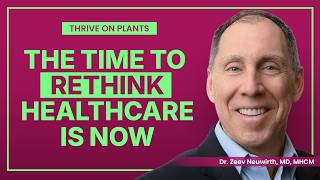
In this episode of the Thrive on Plants podcast, host Daphne Bascom interviews Dr. Zev Neuwirth, a physician, former chief medical officer, population‑health executive, author, and host of the Creating a New Healthcare podcast. Dr. Neuwirth walks through three "phases of frustration" that shaped his career: (1) as a bedside clinician he became disillusioned by the transactional, disease‑focused nature of care; (2) as a health‑system leader he realized that improving delivery did not translate into real health gains; (3) as a public‑health thinker he recognized that the entire system is built to treat illness rather than create health. He shares stark statistics (≈95 % of U.S. health‑care spending goes to reactive care, only ~5 % to prevention) and critiques the medical and emerging wellness industrial complexes that profit from disease and from selling “cures” (supplements, wearables, peptides). He argues that individuals are not the problem; instead, they face an uneven playing field shaped by food‑science, behavioral‑marketing, and pervasive environmental cues. Dr. Neuwirth proposes three practical reframes for individuals and clinicians: (1) move from self‑denial to self‑protection, recognizing the asymmetry and shielding oneself from harmful environments; (2) replace reliance on willpower with habit formation and environment design that make healthy choices the default; (3) leverage social networks and community accountability to sustain behavior change. Throughout, he emphasizes that health is something we create, not consume, and that many free tools (protective habits, supportive environments, community) are more powerful than costly gadgets or supplements. The conversation ends with a promise of a follow‑up episode to explore actionable steps and the role of data and remote monitoring in personal health trajectories.
Chapters
I have to be honest with you. I got so caught up in this conversation that I completely lost track of time. And when I finally looked at the clock, I realized that we barely scratched the surface of everything I wanted to explore with today's guest. So my hope is that this will be part one of a two-part conversation. My guest today is Dr. Zev Neuwirth. Dr. Neuwirth is a physician, a healthcare executive, author, and the host of the award-winning podcast Creating a New Healthcare. Dr. Neuwirth has spent decades inside major healthcare systems, including as a chief medical officer, a chief population health officer, and what he found there changed the entire trajectory of his work and career. He did not just get frustrated. He got curious and then he got to work. I wanna share with you 3 things from our conversation that I hope will motivate you to watch this podcast episode from start to end. The first is that there's a difference between healthcare and health. Dr. Neuwirth makes a distinction that sounds simple, but it's not. The system that we have built is extraordinarily good at treating disease. It is not designed to create health. We spend 95 cents of every healthcare dollar on reactive care and 5 cents on prevention. And I'll say it again, 5 cents of every dollar on on prevention. Once you hear that number, you can't unhear it. Second, you are not the problem. We have been told in ways that are subtle and maybe not so subtle that our poor health is a personal failure. It's a lack of willpower, a lack of discipline. But Dr. Neuwirth dismantles this story completely. When you understand the scale of the food science, the behavioral psychology, and the massive marketing machinery working against your best intentions every day, the conversation shifts from self-blame to self-protection. And third is the difference between consuming health and creating it. Now, this one hit me hard and You know, we'd actually talked a little bit about this in our pre-call, um, because how many of us, myself included, have equated buying a supplement or a wearable with actually doing the work of building health? Now, you all know I'm a gadget girl. I've got my Garmin and my Oura and my Whoop, and I've got a treasure trove of other devices that I love for monitoring because I love data. But Dr. Neuwirth argues that we've been so indoctrinated in a framework of consumption that we've lost sight of the fact that health is something you create, not something you purchase. These are helpful and we talk a little bit about them, but they don't create health. And most importantly, some of the most powerful tools we have to create health are largely free. This conversation covers all 3 of Dr. Neuwirth's reframes in depth, including why willpower is the least reliable tool you have and what works instead. We covered a lot today, and I hope you enjoy this conversation half as much as I did recording it. And with that as background, please join me In welcoming Dr. Zev Neworth to the Thrive on Plants podcast. Dr. Neworth, welcome to the Thrive on Plants podcast.
Daphne, what a pleasure. I've, I've been looking forward to speaking with you.
Well, I, I've been stalking you. Um, so I've been a follower of your podcast for years, and I just want to start by where you always end your podcast, which is thanking you for what you've been doing because reframing healthcare is important. And I don't know that we're making the strides that we need to. So thank you for what you do.
You know, it's funny when you say that, my reaction is, well, first of all, thank you for what you do. And it feels like I'm just getting started. It's just at this point in my career to feel that way is actually, I think, probably a good thing. It is, but I'm, I'm, I think I'm going to do more moving forward than I've done in the past. So I'm, I'm excited about this.
Well, I don't know that everyone in the Thrive on Plants community is as familiar with you as I am. So would you mind sharing a little bit about who you are, what reframing healthcare means, and what brought you to the concept of living well?
I started out in internal medicine, trained as a primary care physician. And in the first few years of my career, I was working mostly in sort of a teaching environment, academic environment, which I really, really loved. I loved being in the hospital. I loved being around residents. It forced me to, you know, keep on studying and learning and, you know, answering the tough questions or looking for the answers to tough questions. And So that's what I did for the first dozen years of my career. I practiced quite a bit in the hospital, in clinic, and taught. My focus was, and I would say my frustration, so I can almost carve up my career in terms of phases of frustration. And so my first frustration, right, which I don't think is a bad thing. In fact, I think it's a good thing. My first frustration really was with the way that we treated patients and their families. And I was appalled, quite honestly. And I was— I was at great institutions. I mean, I trained— I went to medical school at University of Pennsylvania, the Hospital of UPenn, and the Children's Hospital, which are just world, world class. And then I went to Mount Sinai, again, another world class medical center in Manhattan, in New York City. And so the people are amazing. The organization is amazing. But just shocked at how we became numb to how we treated our patients. And again, very, very transactional, very technological, technical, which is great. We want that. And so I don't want to get rid of any of that. But at the same time, just not very relational.
Mm-hmm.
Um, not very focused on the person or appreciative of the person. Now, the interesting thing is that people would do that. I saw my colleagues and my teachers doing that, but it was almost like it was not part of what we did. It was sort of extra or added, or they were bringing themselves into it as opposed to it was actually part of what we did. And so, uh, I devoted my first few years to really studying and understanding things like listening and empathy, standing the, even though I trained in internal medicine, not in family practice, really spent a lot of time studying the literature of family medicine, you know, the idea of actually treating the family, which decades later, I think the wisdom is profound in that modality. And unfortunately, you know, even though people still train in family medicine, they don't treat families, they still treat individuals. And I think that's a that's a big, big mess. So I did that for the first 12 or so years of my career. Got so frustrated. I would go talk to administrators of the hospitals that I was in and they would sort of pat me on the head and say, you know, thank you very much for your thoughts. Why don't you just go back to your exam room and take care of patients? And that pissed me off enough that I I left academic teaching medicine after 12 or 13 years and pursued a master's in healthcare management in Boston. And so I learned the language and the concepts of business and administration and operations and finance and marketing and cost accounting. And so armed with that, I shifted careers, uh, and, uh, up in Boston and joined a group, um, in a more leadership, uh, position and kind of have been on that leadership track ever since.
That was— now I've seen your bio. That was a very condensed history of all of your accomplishments. So I will be sure to share the details with the show notes. But, um, so that first phase of frustration, you you went from being physician in the clinic to now administration. What were you able— so what was your second phase of frustration and what did you accomplish as a leader in healthcare with that transition?
Yeah, I love this. I love this second phase of frustration. I've never, I have never spoken about it this way. So this is, this is kind of interesting and new. The second phase. So I, in Boston, I was initially a manager of a large medical office practice that was part of a large group called Atrius Health, Harvard Vanguard Medical Associates. But at its largest when I was there, it was about 1,400, 1,500 doctors. And so yeah, 20 or 25, you know, large practice sites. And I, after a year, I became, uh, the, uh, uh, head of clinical innovation and was responsible for, uh, sort of operational efficiencies and innovations in care delivery itself across all the specialties we had. We had all the medical specialties as well as all the surgical specialties, and we partnered with, uh, some of the Harvard, uh, teaching hospitals when we admitted to them. So I spent a few years really diving into like lean process improvement. I led a huge initiative across the organization and then left that organization, left Boston, and was a chief medical officer at— I was hired as the chief medical officer for the ambulatory division of what is now called Atrium Health, which is a multi-hospital system here based out of Charlotte, now called Advocate Health, the third largest healthcare system in country as far as I understand. So I spent the next, you know, umpteen years, this sort of second phase of frustration as a clinical executive, chief medical officer, chief clinical executive, population health officer, was part of the transition I made. I spent about 4 or 5 years here in Charlotte as the population health officer. And The frustration there really came to a head about 12 years ago. I, you know, I was there, you know, doing quality improvement and, and we were really moving the needle in terms of quality scores for large, you know, over a million individuals, you know, changing the way we were delivering care. But I, I started to get the sense that, um, although we were making healthcare delivery better, we weren't really making a lot of inroads in terms of health. And, um, and it was, there were a series of things that happened that just sort of jolted me, some personal, some professional, but I just remember sitting in a meeting, this sort of captures that. I was wearing my suit. I was a suit at the time. And then there were white coats in the room, the physicians and typical meeting, doctors and administrators. It's pretty much, that was my life for decades. And we were sitting in a conference room and in the hospital, and we were talking about access to care and how come access was so poor and that it took so long for people to be able to get an appointment to see their primary care doctor or specialists. And we were kind of throwing stuff against the wall in terms of solutions. And I just had this sort of wave of remembering, like, wait a minute, I was in the same exact conference room with these same people, like 4 years ago, having the same exact conversation with the same exact solutions being thrown up against the wall. And I was just like, whoa, this is weird and wrong. And then it got worse because then I remember being in another conference room back in Boston, 10 years before that. And with another different set of administrators' suits and a different set of doctors' white coats, having pretty much the same exact conversation a decade before and sort of similar solutions. And I thought, oh my God. And I called that, it was kind of like reminiscent of that movie, The Groundhog Day, where this guy lives the same day over and over and over again until he has this realization and breaks that cycle. And I felt like I'd been caught in the Groundhog Day in healthcare for many, many years. And so, so I, I, you know, I, I was stuck in this sort of existential crisis and it was about a dozen years ago. And, you know, here we are making healthcare purportedly better, but even healthcare delivery wasn't getting better. It was more costly and the same problems, actually, the problems were not getting better in many ways. They were getting worse. And so I said, well, who's doing something different? And so I started to interview, and this was 10 years ago, over 10 years ago, I started to call up and interview people who were either sort of inside the healthcare system, but they had sort of left or they were on the fringe and they were doing something different. We call them entrepreneurs. And so I started interviewing these entrepreneurs who were creating a new healthcare. And I just literally just, I was on the phone and I would say, what are you doing and how are you thinking about it? How are you framing healthcare? And that led to the podcast, Creating a New Healthcare. And literally the podcast came out of those informal, I would record them and transcribe them and read them and take notes and and that led to the podcast. And in fact, hundreds of those interviews led to both my books, Reframing Healthcare, which came directly out of just listening to these people talk and talk and talk and do and do and do and seeing what they were doing and realizing that there was a way out of this dilemma, but it was not by doing the same things we were doing in the past.
Oh no, I can— I mean, my heart is beating faster just hearing your frustration because that Groundhog Day, many of us have been there.
Well, you, you, I mean, your career, I mean, you've really been in the belly of the beast just like I have been for, for a long, long time. You know, part of the machinery as a population health officer, you've done that. Clinical executive, you've done that. Clinician, you've done that. So, you know exactly what I'm talking about. And I think if we're honest with ourselves, You know, and I know this to be true because when I sit down with doctors and administrators, it's not a secret. I mean, you know, when, you know, it is, you know, we do our best. And by the way, I don't believe this is a function of the individuals. The individuals in healthcare are incredibly bright. I mean, just the best. They're passionate. They're smart. They're hardworking. They've dedicated their lives to really doing the right thing. And yet, you know, this is one of those cases where, you know, the whole adds up to far less than the sum of the parts, far, far less. We, given the brilliance that is in healthcare and the resources, we should be far, far beyond what we are now in terms of, you know, what we could be doing in terms of helping individuals, families, communities. I mean, it just, you know, we could be doing a lot better.
And I know people want to, but if you put your physician's hat on and you want to diagnose, so what's the root cause of the problem? Um, and we know it's multifactorial, but we, the only way to break the chain and to step out of reliving the same day again and again is making an intervention that's actually going to kick us into a new track. So how do we jump the curve? Or what did you learn from those conversations that allowed you either to do something different at Atrium, or did that lead into frustration phase 3?
It did. Very, very astute of you. There was a third phase. And so the third phase of frustration So if the first phase was moving from a clinician to being an administrator, if you want to call that, I would say I was sort of an inside innovator that held administrative roles. The second phase was realizing that what we were doing in terms of healthcare delivery, as we were trying to improve it, we were, we were not really making the types of improvements we were going for. The third phase of frustration came about 3 years ago, and I was asked to speak at an innovation conference in Florida. And the woman said, I want you to talk about health. And I said to her with a straight face, I said, I don't, I don't talk about health. I talk about health and I talk about healthcare. And she said, I know, I know. I've seen your CV. I've read your book. I, you know, I know what you talk about. I gave her a list of the topics I would like to speak on. She goes, I know that, but I don't want you to talk about the healthcare industry.
Interesting.
Yeah. I want you to talk about health. And again, I said to her, I don't talk about health. And now it's like I almost saw my mother sort of standing there and saying, slapping me upside the head and saying, you're a freaking doctor. You've trained your whole career. How could you actually say that to someone that you don't talk about health? Aren't you ashamed of yourself? But no, I wasn't. And I argued with this woman back and forth via email for probably about 3 months.
My gosh.
And yeah, I'm very stubborn. And But she was more stubborn. And so she said, listen, the talk, we're going to have the chief medical officer from the Blue Zones there. We're going to have a postdoctoral PhD guy who's a researcher in metabolic health, and you're the third person and you got to talk about health. And so good for her. That, yeah, good for her. Actually very grateful because that really was the first click. In this last frustration, which was that I think we've lost sight, just like I did. We are so focused on healthcare delivery and healthcare, the industry, that I think to a certain extent, we've lost sight of the word health and the concept of health, and that ultimately our goal is health. Now, a lot of the healthcare industry and people talk about this is focused on disease and illness and, you know, trauma. And so minimizing those, right. And trying to heal or cure those. And again, it's great, but, you know, I remember even when I was still in the hospital system, not that long ago, I left about 2 and a half years ago. I remember, you know, looking at these huge gleaming new buildings we were building. I mean, they were just beautiful, shiny, and clean, and the latest technology. And we had a neurology building and an interventional cardiology building and a, I mean, state-of-the-art cancer facility. I mean, science, rocket science. I mean, just crazy beautiful, big, lovely buildings, the architecture, I mean, full of music and sound and paintings and the state-of-the-art treatment you could get. And I remember saying at a meeting, I love this, appreciate this. It's so important, but not for nothing, but as an individual, I would rather you spend a little bit of money on helping me not have that stroke instead of actually having the state-of-the-art stroke center. I would like you to spend a little bit of money as a healthcare industry, helping me not have that heart attack or not get that cancer, as opposed to having a state-of-the-art interventional cardiology seat where they can just go into my heart and, you know, open up that clot or You know, give me that chemotherapy agent or radiation agent to try to cure or minimize that cancer. Just, I'm not saying spend most of the money. I'm not even spending half of the money, but in this country, in the United States of America, 5 cents on the healthcare dollar, 5 cents is spent on primary care. 95% is spent on reactive care. I think, I don't even know the word to describe how I feel about that, but I would say frustration doesn't, doesn't come close. I mean, I am angry about that. I'm angry because it is wrong. It is wrong because it propagates a system and an approach to health that allows us to become sick, desperately sick and desperately ill, and then treats us. And the economic engine, which runs everything, right? I mean, you know, follow the money. Doesn't matter what you believe in. Doesn't matter how good a person you are. If you're in this industry, The industry makes money, makes profit, propagates itself, sustains itself by people being deathly ill and then doing things that bring in a lot of profit to, again, not doing wrong. You're doing right by healing them, but that system is misguided. And we know that. Yet we still continue to spend 95 cents of every healthcare dollar on waiting till we're sick. I read a paper that Deloitte put out, the consulting firm, and it actually was in my second book where they said the wellness industry is going to become dominant by 2040 or 2050. I don't know that to be true. I think that's a, that's a tough battle because it's, you know, making money on curing, you know, disease, end-stage disease, end-stage, very lucrative. Yes. Yeah. Very lucrative. And so we really have to, I'm not sure what will get us out of that orbit, so to speak. The gravitational pull is so strong. So for me, that third frustration and you know, I could now maybe even call it, you know, the waves of frustration realization, you know, because it's, it's a duality, frustration and realization, you know, kind of feels like another movie, like, um, oh, um, The Matrix, you know, classic, classic, classic. Oh my God, Neo. So that Matrix where he's living in a reality and he's introduced, um, to the actual reality, to that, that, that this reality we're in is, is, is really a, uh, is a veneer and that the actual reality is quite different underneath it. And he's exposed to that. And each one of these, I felt like I was, uh, going a layer deeper, getting closer to the actual reality. And so in the current phase, this current, you know, duality of sort of phase of frustration realization, awakening. Um, uh, I would almost— it almost feels like unleashing, like that, that thing I talked about before. I feel like, like I'm, I'm more energized, more excited about the future because I'm— I feel one step closer to doing the right thing for myself, for my family, for my friends and community and my country, but also for my patients. And so this sort of, it really feels like an unleashing, like a releasing, like I feel freer to do this now to really say, okay, health. And that, you know, how do we actually refocus ourselves on health? And not get lost in healthcare. And, you know, part of this reality now too is very much, you know, it's very interesting too. The industrialization, the commercialization is a very, very tricky issue. And I think even the wellness industry has become what they call, they call like the medical industrial complex, which is a term that was coined in the New England Journal back in the 1980s by the editor who coined it from President Eisenhower, who talked about the defense industrial complex where you start to get the industry starting to collaborate with vendors and consultants and politics and government. And you start to get this unholy triad that President Eisenhower warned about, and then the editor of the New England Journal back in the 1980s warned about. I think we are now seeing not only a medical industrial complex, I think we're seeing a wellness industrial complex. And so even as I'm in this third frustration realization phase, I'm seeing other unlockings as I, and this is what I'm currently working on right now, is is sort of an approach that, you know, for myself and for others that brings us closer to agency, which I think is really important.
Well, you have unleashed the kraken. There's a lot in what you just said. And thank you for sharing that because I agree with you. Healthcare healthcare is so valuable for those who are sick. Um, you know, I, I'm thankful that healthcare was there when I needed my thyroid out. I'm thankful that healthcare was there when I broke my leg, but nowhere along the way we've lost the idea of what health is. Um, not only from those of us who deliver, who, who, when we went to medical school, we thought we were focusing on health. And becoming a surgeon, I definitely got away from that very quickly. But how, how are you helping communicate the concept of health? Because I don't know that as Americans, I don't know globally that we understand what health is anymore.
Yeah. It's a great question. You, you actually have given me something to think about that I haven't I have actually not even, I'm not even sure that I've thought about how to define it. What I've been thinking about is how to reframe it. And so I like to, you know, I was an administrator for so many years and it sort of, I picked up some of the habits, which is I like to start with reality and, you know, what's the problem we're trying to solve? And the problem here is I think fundamentally, look, tremendous expertise. I mean, we have science and medical science and technology. We've got the resources, over $5 trillion we're spending in healthcare, way over $5 trillion. The wellness industry is probably hundreds of billions as well. And so we've got money, we've got resources, we've got technology, we've got expertise, we've got now science, even in metabolic health. The science is just amazing what we actually know about diseases, whether it's, you know, cardiovascular, inflammatory, you know, autoimmune, et cetera. We know so much about, you know, even at the level of molecular level, mitochondrial, how that works. And just, it's almost just, it's overwhelming how much we know. And despite all that, we're still falling behind. People are still becoming not, not just not becoming sick, we're becoming less healthy, right? We know in the US the problem is that right now we rank 40th in the world in terms of lifespan. Embarrassing. 40th in terms of lifespan, 80th in terms of healthy adjusted life years. Okay. The years we, you know, you look at lifespan minus the number of years that you're disabled or sick, 80th in the world. In terms of health, healthy lifespan, almost unfathomable. I mean, could you actually, if there was a multiple choice and test and where's the US in terms of healthy life years, would you put 80th in the world? No. And it's not, okay, here's the fallacy. So what people say is, well, it's our genetics, right?
Well, Bologna.
Can't be our, yeah, Bologna, right? It can't be our genetics because we didn't have a lot of chronic diseases that are hugely prevalent today. They weren't here 40 or 50 years ago. Our genes did not change in 40 or 50 or 60 years. Okay. That doesn't happen, right? That evolution doesn't work that fast. So it can't be our genetics, can't be our biology cuz we did not have this, you know, and by the way, can't be genetics. Why is it in, in, in, in countries that are, are not so industrialized? That they don't have the same thing. So it's not us. The other thing people will say, well, you know, this is just in, you know, not directed at any individual, but in general, it'd be like, well, you know, we just don't have willpower. We don't have willpower, motivation, you know, et cetera. Come on, seriously. So the fallacy is this, this is the larger kind of consumerist, industrialized, commercialized, industrial complex, what the complex will say to us. And again, this is not a conspiracy theory. This is just how we're constructed. What it will say to us is that you are the problem. Okay. That's, you are the problem. You, you know, it's your genetics, it's your physiology, it's your biology, your lack of discipline, your lack of motivation, you know, just make the right choices. Okay. Part one. Part 2, I have the solution. All you have to do is buy it from me. Exactly. Right? I've got, I've got the drugs. I've got the diets. I've got the lotions and potions. All you need is a pill. And I could tell you, if I could take my camera here right now, I would show you my closet in the kitchen, full hundreds of dollars of supplements.
I'm, I'm going to come do it.
Yeah. Do an audit. I'm no I'm no different than anyone else, but I'll tell you something. I went through that cycle. I'm like, I mean, I, I couldn't even, every letter of the alphabet, I had a vitamin for. I mean, it didn't, I mean, vitamin Z, I don't, you know, I had so many combinations. I've got, I had 3 different formulations of magnesium, one for the morning, one for midday, one for night. I mean, I lift weights and I do that sort of thing. So I was taking creatine and all that. I mean, I couldn't keep up with, I mean, it was a full-time job to organize my supplements and take them. I, I needed to hire a person. An assistant, a supplement assistant to help me with my life. I now, I literally just, they're in the closet. I haven't looked at them in months and months. And by the way, I feel just as good, if not better, off the supplements. But the point being that the formula that we've been indoctrinated in, okay, that's, this is the, this is the, the point, the answer to your question. You've been in a framework of I'm the problem. And, and you, you, whatever industry we're talking about, you have the solution. And I, all I have to do, I mean, all I have to do, I, I've got two different wearable devices. I've got rings and, and, and watches and bands and this and that. All you have to do is buy me, buy me, use me, pay me, and I will cure you. Okay. The fallacy here. Is that our lives are not meant to be cured, but they are meant to be curated. And that the curation is our responsibility. And so I think the reframe for me was to— that the fallacy is I'm not the problem. Okay. I actually think you my environment, the industries. I think you're the problem. And so I formulated a reframe that, you know, and I'll just share these 3 with you very quickly. One, it's not a level playing field. And so you have to protect yourself. You know, when I lead the doctor, or when I used to say to people, listen, you know, Don't eat that fast food. You know, don't, don't go into the supermarket and go down the, you know, the chocolate aisle or the ice cream aisle. You know, it's really easy to say that. And by the way, doctors know this. I was talking to a primary care doctor. So primary care doctors get graded and scored by their patients' outcomes now, right? When they're in the so-called value-based world, right? They, you know, how did your patient do in terms of their sugars, their high blood pressure, their hemoglobin A1Cs. We get scored, right? I was talking to a primary care doctor about this. And, and so the people who do this day in, day out, they know the dirty little secret. They're like, it is so unfair to score me on my patient's outcomes. Why? Because it's not a level playing field. The minute, I mean, I sit there and I talk to the patient, the minute they leave my exam room, I mean, they're exposed to state-of-the-art, the most sophisticated marketing that has ever existed in, in the history of, of humanity. I mean, there are armies, literally armies and armies of, of postdoctoral behavioral change people and marketers and salespeople who know how to make you buy and, and consume anything they want. And that's what you and I as individuals are up against. Don't you understand that? It's not like it's a level playing field. Avoid that. How can you when you have that science and that art and that industry exposing you constantly? On top of that, you add the food scientists and the food designers. Exactly. And by the way, the more I read about that, I'm finishing up a book. By Dr. Kessler, who obviously, phenomenal physician, scientist, researcher, public health officer. And he talks about these, and I've read this before, but these food scientists, I mean, again, we're talking about scientists, we're talking about people with postdoctoral degrees. We're talking about people who are just geniuses, their whole career is focused on doing one thing, making food so palatable, so irresistible, and I would add so addictive that you have no choice. You literally try it once and you are addicted, just like a drug that is designed to addict it. The neural pathways are not dissimilar. And so they just know the right combination of sugar, salt, and fat. They know how to make it not only taste well, how to feel good, how to smell good, the texture. I mean, this is a, this is science. And when they get together and they talk internally, they are talking about how do I make what I am selling the most addictive food I can make it. And so there are armies. I mean, they're not 1 or 2 or 5 or 10 armies of people who are trained to do this, coupled in companies that profit from it with the marketing geniuses that they have. So I go out there after seeing my doctor who says, Zev, stay away from that stuff. And then of course, you know, my friends and colle— you know, people are eating this stuff. I go out to dinner, you know, Zev, don't deny yourself. I mean, you deserve it. You work hard. You, you know, you deserve it. And so, number one, right? Right. One time won't hurt. Well, it does because we know how addiction works., right? I mean, literally your neural pathways, you get that Häagen-Dazs ice cream, your neurology doesn't forget that. You're, you know, I mean, it's down to, I mean, you know the science as well. So reframe number 1, it is not a level playing field. We have to move from this notion of self-denial to self-protection. And we have to literally realize the reality. And that's what— this is a strategy I'm talking about. Strategy is about understanding the rules of engagement, understanding what the reality is, and coming up with a hypothesis about how to deal with that reality. And so part 1 of the strategy is let's move from self-denial to self-protection. Realize you're not on a level playing field. You have to protect yourself. And protection, um, the second thing is leading into is protection. You know, we talk about defense. And so if you look at the military, most of the time and effort and resource the military spends is actually not engaged in pugilism, not engaged in war. What are they doing? Preparing, preparing, preparing. Look at most sports teams, right? What are they doing? Preparing their training. And so part 2, strategy number 2 is instead of thinking, oh, we want to— I'm confronted with this situation. I'm going to make a good choice. There's the other thing. You leave the doctor's office and the nutritionist, I want you to make good choices. What an absolute fallacy. What a misguided— I mean, well-intentioned, but misguided. The last, the least powerful tool we have is our willpower. It is the most volatile, acceptable part of our structure makeup. You can't rely. Now, there are some people, I mean, 2%, 3%, 5%, I don't know. There's some small percentage of people. Yes, they're incredibly disciplined, tremendous willpower. They can do it. The rest of us, myself included, very, very poor willpower. And it's not about discipline. I mean, I could be disciplined, but it's not about that. When I'm faced, you know, I'm sitting at that dinner table and maybe we're out with some friends or whatever, and they plop that big dessert on the table. I'm lost. I mean, I'm going to make a good choice? I don't think so. So you really have to prepare. And there's two things about that. One is habits. Instead of worrying about making good choices, build habits. Habits are powerful. There's actually a science to this. And you can hack that science and you can build habits. The second most powerful thing that creates, influences your behavior is your environment. So again, and it's not rocket science, it's like, look, if I don't bring that Häagen-Dazs into my house, I will not eat it. Okay? If I bring it into my house and I mean, again, I'm a human. I'll say to myself at the store, look, I'm not going to eat it, or I'm just going to have a spoon. No, it'll sit in my freezer. I'm going to leave it there. My stream freeze, it'll sit there for years and I won't touch it. Yeah. Not happening. No. 10 o'clock at night. I, you know, I feel like, you know, my willpower is gone. You know, I'm hungry. I deserve it. The Haagen-Dazs comes out of the freezer into my stomach, you know, in about 5 seconds. And so, you know, so building habits, which are neurologic, right? Habit becomes literally part of your neurology, building habits.. And so an example of a habit is like exercise. You do it enough where if you don't do it, you actually feel bad. You feel like, what's missing today? Habit formation. And there are ways to do it. You make it the default, right? You make it just like you can't, like, for instance, so I have a trainer and I mentioned this to you before we got on, I think. I have a trainer, not because so much because I don't know what to do in the gym. It's because, well, actually, I'll lead— this leads into strategy number 3. So strategy number 1 is protect. Strategy number, you know, move from self-denial to self-protection. And by the way, that was protecting your family as well. Number 2 is move from making good choices to building habits and healthful habits and environment. And 3, the other very, very powerful influencer is your relationships.
Yes.
And I learned this from the behavioral scientists. I've been studying this for a long, long time, interviewing folks. This goes back to research, you know, social network theory, Christakis from Harvard and Yale. What your friends do and your friends' friends and your friends' friends' friends literally will influence you. If they smoke, your chance of smoking is high. If they drink, your chance of drinking. If they eat unhealthy, your chance of eating. If you put yourself or you connect yourself to people who have healthful behaviors by default, I mean, I am so, and I know the science, but it is so powerful. It doesn't matter whether you know it or not. You know, I'll give you an example. So used to get together with friends on the weekends, and we would drink, right? It was just, mm-hmm. Everyone drank. Everyone was into bourbon. Everyone was into whiskey. Everyone was into wine. You know, the more wines you knew, the smarter you were.
Smarter you were.
We drank, right? And I could have easily 2, 3, 4 glasses of wine. You know, maybe a glass of whiskey, scotch or whatever. And then something changed. Something changed, at least in my group of friends where, you know, maybe we're reading the science, we're hearing about it. You know, it used to be alcohol was good, the polyphenols, et cetera. We know now that there's nothing good about alcohol, right? Except in, you know, it does make you feel good for a little bit, but other than that, it's bad for you in so many ways, metabolically, et cetera. It also, by the way, is the cause of so much crime. And too, when people are intoxicated, car accidents happen, crimes happen. So that's a whole other part to it, but a social part to it. But But my friends drink less.
Mm-hmm.
And what I've discovered is I'll say I wanna have a glass of wine and everyone around me is like, no thanks, I'm good. And then I'm like, okay, maybe I won't have a glass of wine, or maybe I'll have like a glass as opposed to 3 glasses, you know? And so it's really, it's so interesting. And this just happened to me this weekend. Like I said, you know, you guys want some wine and and a friend who normally drinks wine and whiskey and I'm usually the one that says, no, thank you. He's like, no, no, thank you. I'm good. And I'm like, oh, okay. Subtle signal. But I didn't, I literally had one glass of wine as opposed to, and the wine bottle, I threw out the rest of it. And so again, I think this notion of joining, the third thing is don't go it alone. If you can connect yourself again, the trainer, my trainer is there because he influences me. He's a partner. If I had an exercise partner, it would be pretty much the same thing. Someone's saying, hey, Seb, hey, your accountability. It's 7 o'clock. How come you're not here in the gym? How come you're not out, you know, walking? How come, you know? And so I think that sort of social influence part is really real. And so the idea of, you know, you know, being very intentional about that third strategy. So strategy number one, protect. Strategy number two, build habits and helpful environments. And strategy number three, join with other helpful people because it is such a powerful influence. You can't fight it. You cannot fight it. You will feel weird if everyone there is saying, no, I won't have dessert. And you're like, oh no, bring me a dessert. You're not going to do it. Maybe the first time, Maybe the second time, I guarantee you that behavior is going to extinguish because you're going to be inculcated into a healthful environment. And so those are the 3 strategies that I've been working on. And I do have some more specific behaviors that are helpful, but, but that's where I've come to lately. That's what, uh, that again, I went from 12 years ago reframing healthcare.. And now where I am is reframing health.
And that is such an important transition, uh, which is why I wanted to have you share this with the community because Protect, Healthy Habits, Community, one, those are all free. Um, you're educating and empowering, you're changing behavior, which is, don't get me wrong, none of this is easy. And I'd love to hear what you've been doing the past 2 years and how, because as a lean process engineer, you probably, your next step, you've identified, you know, what are the issues we need? What's the problem we need to solve? What are we going to put in place? And how do you start to articulate those 3 reframes to all the key stakeholders? Because we're not going to change the medical industrial complex. Not in our lifetime. And so you, you need to, and I think of, you know, Guy Kawasaki did a TED Talk years ago where he said, how do you jump the curve? So we need to get off the path we're on and we need to jump onto another path.
I like that.
Because otherwise we're never going to make a change.
I love that. I, yeah. It's interesting the point you made about all those things are free. I think for me, that's actually a central thesis. We've been so indoctrinated in the framework of consumption. And again, I'm aware of this, but I can't help it because I've been indoctrinated. It's just part of how we think now that in order— we believe in order to make things better, we have to consume, we have to buy, we have to purchase. And one of the, like you said, taking these 3 strategies and now taking it closer to, well, what do I actually do? Which is what I've been working on and actually been testing and iterating and implementing. And I've got a few behaviors that we won't get into today, but the, except for the first one, which is one of the things we need to move from is from, from consuming to creating. And I think we've lost that, you know, and it's really, it upsets me now that I'm aware of it. So I think even of like entertainment, like now to be entertained, you have to consume, you have to go buy a, you know, watch a movie that you pay for. Either streaming or in the movie theater, go to a concert. You know, what happened to that notion of actually creating entertainment, sitting together and, you know, playing a game, singing, playing a game? Yeah. And, and again, I'm not preaching because I am so, so guilty of this. I've been so oriented to consuming, and I think when it comes to health, I think I buy, you know, this is the thing, this is the fallacy. I buy that band, that wearable, or that wearable ring, or, you know, I buy that supplement and somehow in my mind that consumption equates to the creation of health. It isn't. And what I'm learning more and more is they may not even be correlated. I mean, I'm very interested in Do people who buy these wearables, does it actually make them healthier? No one's ever answered that question for me. You know, people say to me, I say, why do you have that ring? They're like, oh, well, it tracks my sleep. And I was listening to a sleep scientist last week being interviewed and like a real MD, you know, and she's a scientist and has been doing research and published on sleep. And I was so excited to hear her say this. 'Cause I've been saying it and thinking it. I've actually interviewed people on my podcast about it. And she said, you know, she said, yeah, I'm not really sure how much those things actually correlate to the actual sleep. The science of that correlation, do they update it every time that they change the software and update the software? I'm not so sure. And she said something along the lines was, you know, at least it's my version of it, but it's like, if you need a device to tell you if you've had a good night's sleep, you got bigger problems. Okay. I mean, you wake up, do I feel refreshed or do I not? You know, I mean, I've had people even say to me, well, you know, I know because of my device, I know if I drink alcohol the night before I wake up and I see it affects my, my sleep because it looks, I could see the numbers. I was like, you don't need a device to tell you that. We know if I drink, I wake up and I feel like shit. Okay. So I mean, do I need to pay $200 every month for a device to actually tell me your sleep is— and I remember when I would wake up with a device and it would say your readiness score sucks. And I would like, and I think to myself, I actually feel pretty good. I mean, maybe I don't feel so good, you know? And I'm like, I'm looking at the device and I'm like trying to correlate how I feel and sometimes the device would say, oh, your readiness is 10 out of 10. And I was like, I don't feel like 10 out of 10 this morning. And so I'm not saying they're not accurate. I'm just saying we've equated consumption of technology and devices and supplements and all kinds of other things as opposed to creating the health. And that really, for me, is one of the major, major reframes I think we need to— and you said it. It's free. And it's the reason you could say that is because the difference between consuming and creating, and I'm not saying there's a cost to creating too. I'm not saying that it's cost neutral, but it's a very, very different activity. And I think we have to start creating health.
And you're right. And I know I need to let you go. This is going to have to be a part 2 because there's so many deep holes that I would love to unravel. One, before I let you go, uh, 'cause I wanna give you time before your next call, I was listening to your conversation this morning around remote patient monitoring. Next time we have an opportunity to chat, I would love to, 'cause the, the, I'm a data geek. I love information. Yes. Yes. And maybe a reframe I would love to hear your thoughts are, honor, we don't know what normal is anymore. So if I, we shouldn't use the devices. And when I coach, I always, I agree with you. I don't let my WHOOP tell you how your day is. It may affirm how you feel. It may contradict how you feel, but the goal is not in the day. The goal is what is the change over time? And where I see an opportunity that I don't think we've tapped into, and it's not with, you know, remote patient monitoring, especially for Medicare individuals. That's, that's great.
And, mm-hmm.
Yes. You know, that's something that I've been fascinated about for years. But if you have a 30-year-old and now you understand your baseline, because we are a country that has not appreciated health. So how do I know what optimal health feels like if I've never been there? And how do I, if I'm, if you're now able to see the trajectory of my health, how do I intervene sooner so that I don't need to come see you for healthcare? Because I do think that there is something in the trend, in the information that we're missing the signal.
Yeah.
Yes. That we could be using more intelligently.
I think you're really smart about that. I think that makes a lot of sense. And I just want to say, I'm not opposed to wearables.
No, no, no, no.
And I love the data, by the way. I actually do think data is important. I do think tracking is really important. Although as someone who has, as you have lived with data my whole life, my career dependent on it, you can get befuddled by the data. You can actually, again, lose sight of, to your point. But I do think the trending is key. I think trends are, and the long game that you're talking about, and again, look, data is really, really important. I mean, I don't wanna, I definitely don't wanna leave that impression. I mean, I think even things like knowing, like your lipoprotein, you know, A, like things like that, these are important things. You want to, you want that data.
But what you said is the most important thing, which is if I buy this, I'm not buying health. This is not. Conferring on me. It's not telling me, it's not giving me agency to walk at the perimeter of the grocery store. It's not giving me agency to create healthy habits, like setting out my clothes the night before so that getting, going to the gym in the morning's easy. And it's not giving me the strength of will and mindset to change my environment in a way that sets me up for success. Those are your three pillars. Those are your three reframes. But we haven't taught people how to do it.
No. And I think, you know, again, the, I call one of these fallacies, we didn't go into too much depth, but lotions and potions. I mean, you know, I can't tell you how many people now I hear are taking peptides. They're injecting themselves with all kinds of these chemicals that are by all accounts, I mean, I've not yet heard a scientist, you know, who understands this field say they're anything like these things are justified or indicated now. Again, GLP-1s are the exception, but I mean, these things that people are doing right now, I mean, again, it falls into the same— I mean, this is like—
this is wellness industrial complex.
Yeah, right. But think how funny this is. We've known about the Fountain of Youth for, I mean, it's been written about in the literature. People searched all over the world, sailed to find that Fountain of Youth. We're still doing the same stupid thing. It's like somehow that peptide's gonna cure everything. It's gonna cure everything. I mean, you gotta be kidding me. I mean, now—
sprinkles on the cupcake.
Yeah. You know, I mean, I, I think about like snake, snake oil salesmen and, you know, now they, now the snake oil salesmen, they have, you know, MBAs and PhDs and MDs, you know, they're highly sophisticated. They're still selling. Same old stuff, snake oil. And, you know, and again, it's that fallacy of all I have to do is buy it. All I have to do is consume it and I'll be healthy.
Yeah.
Anyway, I love talking to you. Thank you, Daphne.
Dr. Neuwirth, thank you so much. I'm going to let you go to your next meeting. I would love to invite you back to continue this conversation because talk about your Living Well series and most importantly, what do we do next? Because I'm— Action is key.
Yeah, I, I'm with you. Love to talk to you about that.
I appreciate that. If anyone wants to connect with you, how can they learn more about you, your work, or pick up your books?
Yeah, I think LinkedIn is probably the, the way to go, and I do respond to messages on LinkedIn.
Dr. Neur, thank you for joining us today, and I look forward to continuing this at another time. I appreciate you.
What a pleasure. I appreciate you. Thank you, Daphne.
Take care. The information shared on the Thrive on Plants podcast is intended solely for educational and informational purposes. It is not medical advice, and it should never be used as a substitute for personalized guidance from a qualified healthcare professional. Always consult with your physician or healthcare provider before making any changes to your nutrition, diet, exercise routine, supplement use, or your overall wellness plan. The opinions and advice shared by our guests are their own and do not necessarily reflect the views of The Vegan Gym or its team. While we aim to bring you high-quality, thoughtful conversations, these perspectives are not intended to replace professional medical care. Thanks for tuning in, and remember, you have the power to thrive on plants. And live with purpose.
More from Daphne


The Adaptive Fuel: How Exogenous Ketones Support Healthspan | Thrive on Plants #60

Could Yeast Replace Whey? The Science and the Story Behind Spacemilk | Thrive on Plants #58
Why "Eat Less, Move More" Stops Working After 40 (And What Actually Does) | Thrive on Plants #54
Triple Negative Breast Cancer: How She Caught It Early and Came Back Stronger | Thrive on Plants #53