How to Live Longer Without Spending a Fortune | Thrive on Plants #55
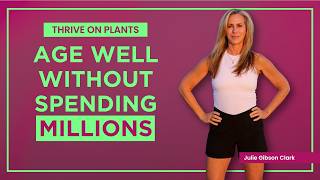
In this episode of the Thrive on Plants podcast, Dr. Daphne Bascom interviews longevity advocate Julie Gibson Clark, who ranked #2 in the Rejuvenation Olympics with a Dunedin PACE score of 0.665, meaning she ages only 65 days per 100 calendar days. Julie explains how she achieved this using low‑cost, plant‑forward habits rather than expensive biotech. The conversation covers the science of biological versus chronological age, the Rejuvenation Olympics competition, and the Dunedin PACE metric. Julie shares her step‑by‑step habit framework: a pound of vegetables daily (half greens), consistent strength training, regular sauna sessions, purposeful mindset, and minimal, evidence‑based supplementation (magnesium, vitamin D3 + K2, NMN/NR, B‑complex, low‑dose lithium, and a proprietary senolytic blend). She recounts personal health challenges—including heavy‑metal exposure, perimenopause, and a fibroid linked to quercetin—detailing how chelation therapy, targeted testing (ApoB, CCTA, HRV, DEXA) and lifestyle tweaks (fiber diversity, protein timing, cortisol management) helped her reverse negative trends. The episode emphasizes mindset work, limiting beliefs, and the importance of sleep, toxin reduction, and affordable testing. Julie’s practical advice culminates in a single actionable takeaway: move your body every day, as movement is the most cost‑effective longevity tool. Listeners are directed to Julie’s website, Instagram, and YouTube channel for deeper resources.
Chapters
Welcome to the Thrive on Plants podcast. I'm Dr. Daphne Bascom, and I am so grateful that you are taking time to join me on this amazing episode. Today, we're going to have a conversation about healthspan. What if I told you that the woman ranked number 2 on the world's most rigorous biological aging leaderboard spends less than $150 a month on her entire Healthspan protocol. No peptides, no plasma transfusions, no $20,000 full body scans, just $150 a month. What does she do? She eats vegetables. She drinks her water. She has a relatively structured weight workout. She uses the sauna and she has a very clear sense of her why. Why she wants to be around for a long time. My guest today is Julie Gibson Clark. She is a formal structural engineer, a recruiter, a single mom, and a woman who has turned the entire biohacking conversation upside down with what she calls her Ikano style approach to aging healthfully. Julie has ranked as high as number 2 on the Rejuvenation Olympics leaderboard. And the Rejuvenation Olympics is a global competition that tracks biological aging pace, biological aging pace, not biological age, but it tracks biological aging pace using DNA methylation clocks. Her Dunedin Pace score was 0.665. That means she was aging just 65 days for every 100 days that pass on the calendar. By any clinical standard or by any standard at all, that's really extraordinary. And she was number 2 to Bryan Johnson, who actually launched the Rejuvenation Olympics. Now, here's what makes Julie's story so relevant to our community. She didn't get there with any cutting-edge pharmacology or a billionaire's budget. She got there with the kind of foundational habits that are supported by the Plant-Powered Blueprint. She focused on whole foods, consistent movement, restorative sleep, toxin awareness, and a mindset rooted in purpose and overcoming limiting beliefs. So today we're gonna talk a little bit about the science of biological aging, some specific habits that Julie has adopted to help her move the needle. And she's going to take some time to answer a few questions that I hope may challenge some assumptions that are in this space. This is a conversation that I have really been looking forward to. I think I first reached out to Julie over a year ago, and I am so appreciative that she found the time to speak with me today. So without further ado, please join me in welcoming Julie Gibson Clark. To the Thrive on Plants podcast. Welcome to the Thrive on Plants podcast.
Thank you for having me. I'm really excited to speak with you and your audience about longevity and more importantly, affordable longevity. So thank you.
Well, I have been following you for some time and really appreciate you taking the time to speak with us because it's a topic near and dear to my heart, especially having lost people close to me, trying to find ways to improve our health so that we can live healthier for whatever time we are on this planet. That's really my goal with trying to provide and educate and empower our community with knowledge similar to what you've done.
Yeah. Yeah. Yeah. We all want to live healthier for longer. That's for sure. Nobody wants to live to 120 and feel horrible the last 20 years and living in, you know, laying in bed all day. Like, that's not, that's not living. So, um, yeah. Um, I kind of became not obsessed, but I mean, I've always been interested in health, you know, but, uh, when I lost my brother, not due to longevity issues, he was hit by a car unfortunately. So it was very tragic, but I just sort of saw like life just can end like that. It's, it could be over, game over. And I just, you know, had my son, he was young and I kept thinking, I'm his plan and backup plan. You know, his dad was around, but he lived overseas and, you know, that just meant a huge disruption to his life. And I just became really obsessed is not the right word, cuz that sounds, but just really focused on, I wanna be the healthiest I can be to raise him. And now that he's older, now I'm still like, I still want to be the healthiest I can to continue to raise him even though he's 20. I mean, I'll say that when he's 40, 50, you know, little youngster, but he's still a baby. He's still a baby. But also, you know, becomes more about just all the beautiful things life has to offer. I mean, I remember thinking like, "Oh my God, my brother's never going to have ice cream again and he's never going to listen to music and dance." And, you know, just all of those things. And I mean, you well know, it's like, So I, I feel like it's my, almost my obligation to like live as much as possible, you know, really get the most out of this life. And there's that sense of balance. I mean, I can't just go and like, well, eat ice cream every day because at some point you no longer feel very good. You know, it doesn't even taste good anymore. So there is always that balance between the pleasures, I suppose, and then, you know, what is healthy and doesn't necessarily feel good at the time, but makes you feel good. Afterwards. So yeah.
And how did you start to learn more about applying the principles that would allow you to be there for your son for as long as possible? Because there, I don't know what age you were when you started, but there's so much information out there and trying to figure out what, where do I start, I think is a lot, is very confusing for a lot of people. Yeah.
So you know, I've been into health long before my son was around. You know, I was in my 30s and that was more, you know, one, I was just having problems and I felt horrible. And so I was getting help for that, but it was also like, I want to have a baby someday and I'm already 30. I gotta, you know, I gotta stay healthy. So, uh, if that is going to happen, you know, I need to be in the best shape possible. So, you know, I started down the road there, but intentionally about health was when my, when my brother died and my son was 3. And that's when I started really looking at, okay, I want to make myself, you know, just optimal. And, and at that time, nobody was calling it longevity. It was basically functional medicine. I don't even know if functional medicine was a thing then. This is, you know, this is 2009. I guess it was, I suppose it was. But, um, so like everybody, I opened the internet and start down the rabbit hole, you know? Yeah, down the rabbit hole. And it just, you know, just coming at you like this. And thank God I'd had, I had done a lot of coaching in my 30s. Um, and so I knew to define my why. And, and you talk about that a lot, like, why am I doing this? But also, what is my intention? And I had to add eventually, what are my resources? Because I would be looking at things and going, well, obviously that's, you know, that's good for you, but I don't have the $100 a week to do that. That's not in the cards. So I'm just going to put that to the side right now and not let it bother my mental space and just keep the mental space clean with, you know, this is my intention. This is my why. And let that kind of, you know, that sort of helped me. I mean, I, I made all the mistakes that most people do when they first start down this path. You know, it's like, oh, I'm going to do this whole new diet and it's going to, you know, and you re, you know, throw everything out in the pantry and like all, all that stuff. Stuff, you know, I've done all of that. And you just realize like, oh my God, this is like way too much. And after what, see, it's, oh, it's been 20, almost 20 years of intentional longevity practices. I've learned that it's not about one big overhaul. It's just one small step and getting that step right. You know, and solid, like, okay, I'm going to just do, you You know, I'm gonna make sure I never miss my strength training workouts every week. Okay, boom. You know, or I'm gonna build in an extra day in case. So I have that kind of right now. I have sort of this extra day of strength training because like, for instance, tomorrow I know I'm gonna miss my normal leg day, but my upper body day is the next day, so I'll just do 'em both in the same day. Yeah. You know, like no big deal. And then I have another strength training day that's full body. So I, you know, I'll only get 2 in this week, but technically I'm not going to miss anything. So I, I set it up intentionally like that. So there's just certain steps and like, I was working on stretching for the longest time and figuring out like when to stretch. And anyway, just adding that until it was solid, whatever it is, you know, I worked on a pound of vegetables. It was just, I'm going to start with just eating a carrot every day. You know, it was like once you open that, you have the intention, you understand why you're doing it, you have the intention and you open the door. It's like people can't be stopped. You know, you'll, you'll figure it out. It just might take you months and that's okay. Look, you got the rest of your life.
So, you know, and I love that because consistency, I mean, that is, that's con— that's consistent. That is key. And I don't think people appreciate the persistence and the consistency are based on your intention, that will get you more than trying to up, you know, say I'm going to change everything and then do nothing consistently.
Yeah. And that comes from, I think, a place of perfection, like wanting to do it all perfectly all at once. And you just, we're just not perfect beings and it adds way too much pressure and way too much stress. So yeah.
And none of us are perfect. I mean, the, the mind, it takes too much energy to try to be perfect.
There is no perfection, which is why I love when you said, as much as I try. Yes, exactly.
Gonna miss a leg workout, so I'll do an upper and a lower tomorrow and I'll miss it on Tuesday, but that's okay.
Yeah.
Because over time I'll get them in anyways.
Yeah, yeah, yeah, exactly. And it's the pattern, you know, I, I, I don't know if that just comes with age or if that's just come from focusing on this for so long. You know, it just, I used to be, and I still have areas where I struggle with perfectionism for sure. But, um, I was an art, I had, I was an artist and I still very much struggle. I'm still an artist, but you know, I struggle with doing things perfectly and, uh, and I just saw how much stress it was causing me. And, um, and the same thing with, with health practices. I just had to let that go and go, wait a minute. Like, this isn't 8 weeks to a beach body. I've got the rest of my life to figure this out. So what's one small step that gets me in that direction? Okay. I got that step down. What's the next step? You know?
So, and Julie, I apologize. I jumped in the middle of your story because, uh, by knowing you so well, just from watching, you know, from reading about you and watching you, Let me rewind.
Okay.
And if you don't mind sharing with the community a little bit about what longevity is, what biological versus chronological age is, and what the Rejuvenation Olympics are.
Okay. So I think when people refer to longevity, at least myself, I'm really looking at my healthspan. You know, I'm really trying to maximize those You know, the area under the curve with which I'm healthy instead of like, so my parents are in their 80s or late 80s. I think my dad will be 90 this year. And now they're struggling, you know, with mobility and dementia and things like that. You know, I think the goal of most of us in longevity is to compress that window. I mean, some people have the goal of living forever. I'm, I'm not there. I just, I really don't want to, but, but I don't want decades of decline. I would, you know, I'd like to compress that to a few years if even I even have to have any of that, you know, it would be so nice to just lay down and be like, okay, you know, like it's over. Yeah. But who knows? Agreed. And then you asked me, so that, that's how I define longevity. What was the second question? I apologize.
How did you, you know, so I think what most people initially are familiar with you with with Phore is the fact that you ranked number 2 in the world in the Rejuvenation Olympics, which was, you know, for some people may not know what that is. They may not know what the difference between biological age and chronological age are. So how did you enter the Olympics and what, what was that competition really about?
So, the Rejuvenation Olympics was started by a billionaire, Bryan Johnson. And he wanted people, you know, he sort of saw what he was doing on a daily basis is like a competitive athlete. And so, we should compete. And the measure of success and really kind of the best measure we have right now so far is this biological pace of aging. So, it's not necessarily your bio age. But your biological pace of aging. So we're looking at, and the way to explain that, I think, is to explain, if I illustrate, if I take two, you know, some twins and one is a heavy smoker and a heavy drinker, and one is working out, eating really healthy, we know the one who's smoking and drinking is likely going to die and have a more painful, unhealthy life than the one who's working out. So we can speed up our age. But the question became, can we slow down our age? And that's what the Dunedin PACE is looking at. It takes into account all these different factors, your epigenetic age, which is— maybe I shouldn't get into that, but I'm not like, you know, that's a little above my pay grade. But the way I understand it is like you've been given these genetics, your genes, right? So like, for instance, you could be a baby born with the gene for Alzheimer's and live a life life and never develop it, or you, you know, or you could develop it. So, uh, and that's sort of this— the epigenetics are this almost like— the way I see it is almost like dust sitting over your genetics, turning on and off genes. And so we want to keep those epigenetics nice and clean, like just like the baby who's got the gene for Alzheimer's but clearly does not have Alzheimer's yet. So, you know, what What is it that's doing it? And it sounds like that's epigenetics. So, um, this test is measuring that. I think there's a few other things taken into account. And, um, I started taking a supplement by a company called Novos. And, um, because of this was sort of in my whole, you want to call it like adventure of longevity. I had kind of started learning about these this— these compounds called senolytics, which detox these zombie cells, uh, your senescent cells. And I was really interested in what they were, so I started researching them. I find this product by a company, and I go to order it, and then they were a new company, and they said, hey, we're going to do a study, would you like to be part of that? Great, you know, they're going to do this Dunedin Pace aging, which I had already known about, and I was really excited to just get those numbers. And, um, as a result of that, when my, um, Pace of Aging came back after 6 months, that's right when the Rejuvenation Olympics started.
Mm-hmm.
And they said, do you wanna upload your results to that? I said, yeah, sure. You know, that'd be kind of fun. And I got, I got on there. I thought it was so interesting because at first it used to be kind of like Facebook for health geeks almost, you know, like, because you could see like somebody's Pace of Aging and then they had their protocol and everyone had their own profile page and like, I was like, oh, this is going to be great. Like, we're going to be able to talk with each other, you know, because you could see their starting pace of aging. They implemented X protocol and then that pace. So now you could start looking at what protocols would slow down pace of aging. That's how it started. It became something, I think, entirely different, but it was, um, luckily I've met so many people through it that we have kind of our own little group and we sort of do that. You know, like, oh, I was, you know, I took the test after going in Italy for a month and that really wasn't good for my pace of aging. You know, like just fun stuff like that. Um, anyway. Um, so when I entered my results, then it turns out my pace of aging was slower than Bryan Johnson's, who was spending, you know, like $2 million a year. And I'm, you know, a reporter called and asked like, what are you spending on longevity? And really at the time it was that supplement and going to the gym. Uh, we later kind of figured it was probably fair to include all the vegetables and then all the supplements I take, even though like I was taking those supplements long before I did that Pace of Aging test. So I'm like, okay, I guess so. But, uh, which aren't many, but, um, and that came out to about $150 a month. Just the, the Novo supplement and my gym membership is $108 a month. But if you add in all the supplements and the pound of vegetables a day, comes out to a little under $150 a month. So obviously that made news. Um, just a little bit. It's a little bit. And I hope that it gives people hope out there that you don't need a huge budget. You just need a lot of intention. Now, now Brian Johnson has gone on to slow his pace of aging much farther than me. And mine has actually gone up because I started messing around with too many supplements. But that's another story. So, you know, more isn't always better. I think it was more, you know, like I said, I really kind of got into health and what used to be called alternative health, but functional medicine really, when I was 30. So I had had 25 years of being healthy, whereas he had come from a background of, you know, programming and pizza, late nights, and a really unhealthy background. So it was, I already knew then, I'm like, he's gonna he'll slow his pace of aging down further. No, no doubt. But so it takes time, you know, for sure.
And had your healthcare team ever talked with you about this or was this just—
No, this was just through that supplement company. Now I knew about it because I was reading, you know, all the longevity research and anything I could get my hands on at the time. So I knew about the test and just, it was like, I don't, I don't know, $200 or $400. I couldn't, I don't know. I just couldn't justify it in my budget. And so as part of being part of this study, they said, we're gonna give you the test at cost. And they were giving me the supplements for free. So I was like, just during the study, of course, you know, so I was like, okay, yeah, no-brainer. I'll do that. You know, easy peasy.
Um, so now I pay, pay for the supplements, but, and from some of the background work I did in preparation for our call, I remember that you had, I think you had had, and maybe I don't know if this was before or after you'd had some heavy metal exposure that you also had to detox from. Was that all in the 20 years prior to?
Okay. Yeah. Yeah. So it started at age 30. It just started with, I was on an antidepressant and I'm not against antidepressants by any means, but I was on an antidepressant. Now, a year later, I was getting, um, acid reflux, like really badly. And I'm thinking, I am 30 years old. I should not be this unhealthy. I should not feel— and my doctor's prescribing, um, an antacid. And it was just kind of like, well, you know, you'll just be on that the rest of your life. Cause like my mom has taken one, you know, her whole life. And my brother was taking— and I was just sort of like, No, no, thank you. Yeah. Oh yeah. And, and I mean, I took it, but then I just kind of went home and marinated it on it and I was like, isn't it something I'm eating? Because if it's acid, like maybe I'm just allergic to something like that. You know, I just, I didn't sit well with me. Like, okay, here we go. Let's just start taking pills. And I'm not anti-medication, especially if you need it, but I just felt like I was too young to take something for the rest of my life. So there was a school of naturopathic medicine. This was in Portland, Oregon. And I just thought, eh, it can't hurt to try taking some, you know, a food-based approach. Like, and sure enough, I mean, within weeks, like, I mean, within 2 weeks I was like, she said no wheat and no dairy. They're usually the biggest culprits. Take those out. And she had a few other things. And, but it was like gone. And I made the mistake of going and getting a latte, like after about 2 weeks. And boy, did I, like, I was like, it was just all back, you know? And I was like, that's what it is. That's crazy. You know what I mean? I eat dairy now, but you know, my body was just like, no. So that was what happened then. And she also said there was some things with my antidepressants. She said, you can try a nutraceutical protocol. And I was like, nutraceutical, what is that? You know, so basically using supplements to help me with my depression. Now, mind you, I had gone through a marriage, a divorce. Um, I was told I had 2 lumps in my left breast. I left my job that I had gone to school for, you know, for years. And I didn't know what I was gonna do. I mean, I was, I was so lost. And then I had a man try to kidnap me at knife point. And this all happened in like 36 months. Oh, I was drinking a bottle of wine every night. Sometimes following that up with whiskey. So no wonder I was depressed, you know, but that was never asked about. And, um, so the doctor asked me about that. She's like, you gotta stop drinking. Do you need to start working out? Just start walking. You know, it was just like all these things and put me on this nutraceutical protocol. And sure enough, it worked out all those things. You know, we were, I now had a therapist. I had all the mental health, you know, under my belt almost a year by then.
So.
It was easy to kind of jump onto that and have that work, um, without any issues. But it was really, what I'm trying to stress is the importance of a, like, for me, what I learned in that was nutraceuticals or vitamins, which I had always been told was expensive urine, actually can be very effective if used well.
Correct.
And so I, just made this mental note when something is not working for me, I'm going to go and try the more, you know, natural approach first. And then if that doesn't work, okay. I mean, like for, if I have a bacterial infection, clearly I'm getting antibiotics, you know, I'm not going to, not messing around, but there's, um, yeah, that's just, I learned that. And so when I was in my forties and having problems, my hair is falling out, I'm tired and I was eating really healthy. I was doing all the things I thought were super good for you, but it was like, right. After my brother died and my son was young. So the regular doctors were like, you're fine. You're just really stressed. You know, just, and I don't know, my hair kept falling out. And so again, in the back of my mind, like maybe it's more. And I had a friend say, you should just go get checked for heavy metals. And I'm so glad I did because it was, I mean, they were very high that the doctor said it looked like you'd been working in a Chinese factory, you know, like one, like these underground these guys who work in like the caves or whatever and digging out different things. So, um, I said, yeah, you know, I was a ceramics major in college. Um, at the beginning I'd never wear a mask when I mixed glazes, cause I thought that was just silly, you know, we didn't need that. And then, you know, dental amalgam issues. I had actually swallowed when I had them. I had the metal replaced to a white one. Not so much. I wasn't, I was doing it for looks, not for I didn't know they were bad for you. And when I had a chunk, when they were taken out, I kind of swallowed a chunk of one side, this huge amount of mercury. It's like, that's right when my hair started falling out and everything. So, but I'm grateful that I, I figured that out. Cause there were a lot of other metals there that were not normal. I was eating fish, you know, I'd lived in the Middle East and travel all over the world. I love fish. I love how it's different and interesting. I just missed the memo that it was. Really high in heavy metals. I just totally missed that memo. I don't know. So I'm sure that's where all of these things, you know, but so get doing that chelation therapy, which is, you know, again, I did this under a medical doctor, so under supervision. And I do think that that really helped my pace of aging. Cuz you go in, you know, you do the chelation one day and then the next day they go back and remineralize you plus giving you glutathione. So you do that 12 weeks in a row. That's really supercharging your body. So, but that had been, you know, so that was in my forties and now we're like 10 to 15 years later, we're doing this pace of aging test.
So whether it had implications, I don't know, but, but that's also very positive in my mind because you, you had the, I mean, first of all, I'm sorry for everything you went through. Um, thank you. Because we also know that whether it's adverse childhood experiences, whether it's trauma, whether it's stress, that can impact your pace of aging on its own. Oh, yeah.
Oh, yeah.
But you had all of those life stressors, you had health issues, you had heavy metal issues, and you were still able to make positive changes. And I, I think I want people to hear that because sometimes I think people think, well, my past is working against me. But no, you, you can start today and you can chart a different path forward.
Yeah. Like what I hear in that actually is like we have these always operating conversations in our head that we don't know are happening until you really try to become conscientious to them. Um, you, you know, meditation can help that. Working with a therapist can help that. Working with a coach can help that to catch those always operating conversations. And what I wonder is if trauma in our lives creates an always operating conversation. So for instance, this man who tried to kidnap me at knife point, I would not consider that a traumatic experience because I immediately, I had my coaches on board. I was working with them at that time. And you know, when that happened, they're like, come in tonight. You know, like right then we, you know, this happened in the middle of the day, broad daylight. It was the weirdest experience. Seriously? Yeah, it was just, I mean, it was, I was just sitting in my car waiting for a tow truck and the guy comes and gets in my car and I just thought, well, okay, maybe he just needs some money. You know, he's going to ask me for some money and he's going to get out of my car, but he gets in, he closes the door and then just brandishes this knife at me. And he, and it's really weird because I'm not a very sassy person, but everything in me was super sassy. Like, I am not going with you. You couldn't even get into my car very well because he kind of bumbled to get into it, you know? And so there's just something like You can't take care of me. I am not going. I mean, it was the weirdest thought, but I just jumped outta the car and left, you know? And like, anyway, in, we turn that into an empowerment story. Yeah. And I do, like, I feel not comfortable, but I feel strong in knowing I understand how my mind and body react in an emergency. And in, in a case like that, I'm not afraid. I mean, I don't want that type of situation to happen, but I'm not, I know my reactions will take care of me in a good way. And, um, so it, it was never traumatic. It was, you know, by going and working with somebody immediately, I didn't have any negative always operating conversations that because of that I have a very positive spin on it was like, You know, me and my friends started calling me Julie the Brave. You know, I'm like, this is great. This is great. I'll take it. Yeah. You know, so that's what I wonder is if trauma, whatever it is for somebody, is created a negative, always operating conversation for somebody that's happening in the background and they don't know. And so it's, you know, figuring those things out with the help of somebody, at the very least using a journal. If, you know, resources are low, but trying to find those beliefs that are driving your life. I think nobody's measured that, but it's got to help your, you know, pace of aging and your longevity to live with a, you know, we always want to be a positive mindset, but not like layering icing over a crap cake. You know, we want to like clean everything up. And I'm still, I mean, I'm 57, I'm still catching these always operating, you know, like the perfectionism or, you know, other things where it's like, oh yeah, no, I, I'm okay. Like, I don't deserve to be doing that, you know, or whatever. There's just always little things that I'm catching and, and trying to reverse that.
And Julie, thank you for reframing it that way because it sort of our operating blueprint for— I hate to use the word blueprint— our operating framework for our approach to longevity. Mindset is at the foundation. And I don't think we work enough on our mindset to overcome some of that negative self-talk or some of those programmed conversations that we don't know how to turn off. Or don't, or prevent them from getting started. But it, it sounds like for you, mindset has been core and whether it's been intentionally something you focused on or as a byproduct of just how you live your life, I think we need to acknowledge that mindset is key. It not that necessarily we can measure it, but it is a core part of reducing our pace of aging.
Yeah. Yeah. And the, I mean, it's just, you know, everything I do is like, what's your why? What's your intention? What are your resources? Like, get that mindset because now nothing's gonna stop me, you know, otherwise. And for anybody listening out there, don't necessarily think that you have to have it all figured out. You have to have your, all your always operating thoughts all clean before you can do anything. Because actually what happens is you start doing something and you realize I keep saying I'm going to do X, Y, and Z, but I'm not getting there. Why? And then that's when you, you know, you start looking at what, what, why am I not getting where I say I want to get? Then, oh, oh, okay. I, I'm holding this weird little belief that's not working for me anymore. You know, where'd that come from? Like, you know, different people have different ways of dealing with that, but, you know, um, but that's how you find them. You got to just start down the path and When you're not, you know, when you veer off the path, you have to figure out why, you know, why did you veer off the path? So, yeah.
And you're 100% aligned. We talk a lot about limiting beliefs and how do you first identify them and then how do you reframe them so that they're no longer obstacles for you achieving whatever your goal is.
Yeah. Yeah, exactly. Exactly. Yeah.
Now you've also— I might as well go through all the different elements because you touched on nutrition and eating a pound of vegetables a day. Can you share a little bit about your thoughts around nutrition? A lot of— I love what you're sharing on From Paper to Plate because it's translating the science and making it accessible. But what is nutrition to you? And then if you wouldn't mind also talking a little bit about supplementation, cuz I know that in this era where every time you look at social media, there's a different supplement. Yeah. Sometimes more is not better.
Yeah.
And I think your own journey is a good example of that.
Yeah. So, um, so I'm gonna, I'm gonna write down so I don't forget the supplement question. No, sorry. So, no, it's okay. Because I know I'm gonna start. No, it's okay. Um, So first of all, I just love food. I love, I love eating. I love food. I love cooking. I love grocery shopping. I love cleaning the kitchen. I love everything that has to do with food. So unfortunately, I know I'm unlike many, many people out there. However, but if we just talk about it, just again, way back when I was 30 and I started down this path of understanding that certain foods were not good for me at the time, you know, and missing them. And cook. I was cooking then. Um, you know, Portland, Oregon has all these farms around there, and this is kind of when this whole farm-to-table thing was happening. Everybody was kind of into all that. It was just, it was just super. I was so grateful that I lived there at that point in time, and I just became obsessed with food. But what I, what I kept questioning was, I can make something good. I mean, I can make you a chocolate cake with chocolate frosting. Invariably, it is like the greatest thing. but is that actually good for me? And if I'm going to spend my time in the kitchen, I want the thing that I'm going to make to taste good and be exceptional for my health. So, you know, because of course then I started down the path of like the, um, dairy-free options and this and that. And it was like, ooh, that's not so good. Or, you know, how can I like, and so then I became obsessed with like, where in the world do they naturally not have that? In their diet, you know, like when I was kind of doing the grain-free thing, I discovered all these nut-free recipes from other cultures, you know, so I wasn't trying to substitute. And so that kind of became one of my first things is like, let's not substitute something. Let's just find cool recipes that don't have that thing that I'm trying to avoid. So that was kind of one of the first things. Um, but that was sort of the intention and still is like, If I'm gonna spend my time here, I want it to be the most nutritious thing for my body because I think it's Dr. Casey Means that talks about like, you are 3D print— printing your cells. Mm-hmm. And as I've dug more into the research, that's exactly what I see. It's like you're gonna intake this food and it's gonna turn into your cells, your mitochondria, your— it's, it's going to be your body. I mean, if your cells overturn, what bones take the longest of a, what, a decade for overturn, but. Some things are overturning on a daily basis. And I just kept thinking, if like, how cool is this? And I put this stuff, if anybody's seen somebody 3D print a house, it's really cool. 'Cause they have these, like, I mean, I'm a structural engineer, so, and this, like, they have this hopper that's feeding the concrete and then they've got this thing that's like, you know, spinning kind of around and making these really cool looking structures. And I kept thinking that, like, that's how I visualize it. I'm putting this food in and then out is coming these, like, super healthy cells. And when I have the occasion, which I do, I eat French fries and I go to In-N-Out Burger. I love it. You know, I do that sometimes. Do I feel good afterwards? No, no, I do not. So I know that I'm 3D printing, like, a little blip, you know, maybe that's not so good for me, but So that's kind of my big picture theory about food, but as I've evolved and I'm still on the journey, so it's still evolving, but somewhere along the way I heard, I think it was Dr. Sarah Gottfried say, oh, we should eat a pound of vegetables a day. And I just kept thinking, eh, this seems like a good metric. Let me see if I can do that. And I was actually surprised that it's really not that hard. Like that's not a lot of vegetables, especially because The other thing, the other metric I put on it is I want half of that to be greens because I had read this, it was Dr. Anna Cabeca who has this Breathe Your Way Through Menopause. And I had done this diet and to me, mind you, I had like been trying diet after diet as my perimenopause was starting. And I'd gained like, I don't know, maybe like 10 pounds and I couldn't, like nothing was working. And I do this and it's all about this emphasis on greens. I lose 7 pounds in like 2 weeks. I'm like, oh my God, this works. Like, what is this? And so I just kept thinking, I know that I wanna eat greens every day and I know that I wanna eat these vegetables every day. So that's just kind of like this. I figured I'll just split it like that, you know, easy enough, 8 ounces of greens and 8 ounces of veggies. So that kind of just became an everyday metric that I still do. Um, the veggies change all the time. Um, and then 100 grams of protein was kind of what I settled on cuz I had learned that these are all evolving though. So now that's changed to like, I do a little less protein on days that I don't strength train and a little more on days that I do because it's just quite honestly with all the vegetables, like I'm just not hungry, you know, I'm force feeding the protein. When I was doing 100 grams every day. And on the days that I strength train, I wouldn't say that I'm force feeding cuz I'm really like packaging it around, you know, the strength training. I'm doing a lot more shakes and, you know, I do a lot that Orgain Vegan Shake. So it's pretty easy for me to get there with, and I think my body is also just like, yes, give it to me, you know? So I'm doing more like 130 on those days. And then on Sundays like today, I'm just, I don't even count. I just let myself do whatever I want. Yeah. And I need that lollygagging day is what I call it to just kind of not measure anything. I don't like measuring all this stuff, but I know that it's important. So I, I do. Yeah.
And how about your supplementation? And I love the greens. I mean, the, no matter what your nutritional strategy is, um, we can all benefit from adding more veggies to our plates.
Yeah, it's so funny because as you start reading research, she's like, you know, you are reading the research and it's like, oh, look at that, it's in greens. Oh, look at that, where do you find that? It's in greens. Oh, look at that, it's either in greens or liver, and I'm not eating liver, so that's not gonna happen. So we'll eat the greens. I'll eat the greens. So, um, and then supplementation, I try to keep that very, very minimal, um, and Me, it really started out of an affordability, um, issue. But again, having kind of watched this industry for 25, 27 years, you start seeing like these little darling supplements that show up and then all of a sudden they're not the rage anymore, you know? And, and when I would look, I finally started maybe 10 years into it going, okay, the research says this, but what is the research? I'm like, let me read that. You know, it's where it kind of started. Like, what really is this? And it turns out, I guess a lot of— and I don't mean to bash supplement companies because I, I believe there are many out there. There are several out there, I should say, that do good work. You know, they're really there for— they're doing stuff and they're doing the right thing. But there are many that are—
they're just—
they're marketing agencies. You know, they're owned by marketing companies and they have a bottom line to meet and they'll you know, be here for 5 years and then gone, you know, but there are, again, even with those, there are still good ones if you need them. So I keep mine very minimal. Magnesium is something in the process of doing the chelation therapy and everything we were doing together. It just, it's very clear. I am just always under, um, I just don't ever get enough magnesium. I mean, even now I take like Maybe 600 to 900 a day. And it's still, my doctor's like, you could add like up to 2,000 some days if you want. Like, no, like that's a lot. So, I mean, that's what, even with my vegetables, you know, all the veggies a day, you'd think I'd have plenty, but I just don't get enough. And it, that's something unique to my biology. So, um, and then I take vitamin D3, K2. I think that's absolutely critical. We live our lives indoors. I'm not, you know, I think we evolved to be sort of outside naked essentially, you know, and in the sun all day. And so, you know, when I go outside, I'm kind of covered up. It's Arizona. I don't want the sun, you know, so I do the vitamin D3 and the K2 mix. And then I take either— I'm always switching between nicotinamide riboside and NMN. I can't decide. So I thought, you know what, I'll just like I do a month of NR and then I do a month of NMN, you know, just sort of mix it up and that's what I'm doing. So, and then I always take a B complex. Um, that's been shifting. I was kind of getting over methylated, so I would kind of have this special B complex that's for people that were over, you know, get a little over methylated. I'd always been under methylated in the past and now I'm sort of, it's, it's very interesting. I've never, didn't expect that shift to happen, but it did. Um, So, and then I take, um, my biologic, you know, my HRT. Um, so, um, and that's, you know, prescribed by my doctor, whether people need that or not, you know, definitely work with a doctor even though like I take DHEA, but that's, I guess that's over the counter, but I wouldn't go taking that without talking with your doctor. Um, and then I take Novos, which is that same, that supplement, which is like calcium alpha-ketoglutarate. There's, um, What is in there? There's more magnesium in there. Yeah. Phycetin, which is the senolytic, rhodiola. There is ginger. There's a few other things in there. Um, I always forget all the— oh, um, what's it called? Lithium, which I love the low-dose lithium, which I had already been taking before that. So there was a few, like the magnesium, the lithium, and then I was curious. Oh, there's hyaluronic acid in there. And I was already curious about that. So when I saw that supplement, I was like, oh my gosh, this is great. Like get this all in one and you're not taking all these pills. I hate taking pills every day. It's like, ugh, you know, makes me feel like a humanoid and not a human when I am, you know, taking so many supplements. So, yeah.
So your regimen's very simple. Um, yeah. It, it's something that one, most women should be taking anyways. Uh, especially the vitamin D, K2, because none of us get enough sun. But it's, and I know that I, I think I remember from your YouTube channel, your plan is to retest.
Yeah.
So 26.
So, and yeah, so the end of the year. Yeah. So I'll probably retest a little earlier because it'll take a while to get the results back. But what happened is I got a little greedy with my, you know, my longevity desires. And I thought, oh, I'm going to add this. Well, it was also, so I had COVID 3 times actually, but after the first time, 3, I noticed this sort of light ear buzzing, you know, like a tinnitus essentially that never went away. And I had read about quercetin and that it was good for, um, you know, both longevity and then clearing kind of COVID symptoms. And I thought, oh, you know, maybe this will help. So I started taking it and maybe like a year of taking it, I developed a fibroid and, uh, you know, I'm on the same HRT for I don't know, almost a decade by then, you notice I was kind of like, that's weird. And so I did some research. I didn't know it was quercetin when I was just sort of, again, one more thing in my, what do you say, adventure, my longevity adventure. I'm like, oh, what do my genetics say that I should and shouldn't be taking? So there's this doctor in Washington, I think he's a naturopathic doctor, Dr. Ben Lynch, and he does a lot of he has this test called StrateGene. And so you can put your genes in there and it kind of says, oh, you shouldn't, you know, you have these SNPs, these, you know, these are going to kind of be your problems. Do and don't take these things. Well, quercetin shows up on there and says it will— you already have slow estrogen clearance, which makes sense because I have a history of like my mom, my aunts, they all have fibroids. So I'm like, okay. And Luckily not many, like there's only been one aunt with, um, breast cancer, but, um, most of my aunts have fibroids. And so adding quercetin apparently even slows that estrogen clearance even further. And I, I, that's all I can figure is what happened because I was, you know, I didn't have a fibroid before and, you know, after that. So I took that outta my diet. I've added. A couple of things to, to help with estrogen clearance, DIM and calcium, de glu— whatever, any gluco— I don't even know how to pronounce it, but, um, that's just temporary, so I don't really talk about that. But yeah, so it was really just taking that one supplement without really, you know, it was just like a big lesson to me. So then having that estrogen go out of whack. Yeah. And having this new fibroid, I was like, okay, wait a minute. Estrogen dominance is not a good thing. You know, it's not good for cancer. Yeah. Yada, yada, yada. So I cut my estrogen, my therapeutic estrogen in half. Uh-huh. So now I'm not sleeping and I, I just thought, well, I still, I take this test every year. I'm gonna take the test. And it was like, it went up to 0.77. So whether it was from too much estrogen or not sleeping because of too little estrogen, I don't, you know, I don't know, but it was an awful, it was an awful time and I just thought I have got to do this with food. Like, I've got to do this with food, and I need to— probably like many people out there, there's this landscape of longevity, and when you start, it's just like this overwhelming amount of information. You know, I'm throwing words out here, you know, senolytics, and, you know, um, I mean, just the— all the different techniques from mitochondria and your D— like, your DNA, like, everything. And I just was— I was just felt like Oh my God, if I don't get this organized in my head, I'm going to lose it. I'm with you. Yeah. So I was like, I'm just going to go straight to the source. And I was like, I want to know what is the most, um, what is the most effective, most groundbreaking research in longevity? What are those papers? And I'm going to read those papers and I'm going to understand what this is. So then it just turned into, then it kind of like just kept going like, well, then it's going to become, well, how does that turn into food? And then it was like, oh, and then I'm going to do this so everybody else can see. Which is now we thank you for. Oh my God. What did I do? Because, but I'm grateful because now the world is my accountability partner. You know, I mean, really. So that's, it's been nice because I would, I have Done it on the same timeline. Maybe not. Maybe, you know, I would've kept doing it, but not as intentionally as I am now. Like, uh, there'll be an episode, 10 and a half, it's called, it's all about meal prep. And, um, I did a meal prep last night. Now, would I have done that if it was just me? Maybe not. But am I so grateful that I have? I literally, I cooked for 2 hours yesterday and I have an entire 5-day solid, plus there'll be some, I'm sure there'll be some leftovers. So I've got a solid week's worth of longevity meals with these beautiful like vegetables. Like I'm just, I'm so excited about it anyway. So, you know, supplements are good. Targeted supplementation is really good, but we really do need to, to work with our doctors. And I'm grateful that more and more doctors are willing to have that conversation. Cuz in the past it was like, oh, it's just expensive urine. And then. You know, even though, like, I know, like, nah, this kind of helps. This makes me feel better. I feel good, you know? So something's changing. And, um, so I'm grateful that that's more something I can work with the doctor on.
And I mean, you, you actually said so much in what you just shared.
Okay. Sorry. Overwhelmed.
I see a cookbook in your future, but yeah, videos that you enjoy. Doing the cooking.
Yeah. That's my favorite part. Yeah.
But the personalization. So the, you know, one of the takeaways is that simply because you can doesn't mean you should. And adding, we could add, we could all be taking 100 different pills a day, but if you're not able to isolate which variable is positively or negatively impacting your health, then it's hard to have an experiment that is a smart experiment because it, it just becomes too complex, too complex in my mind.
Too many variables, too many input variables to know which one is which. So yeah, you have to always kind of like, I'm going to try this, you know, and see if that works. I mean, sometimes you can go on a, a product supplement protocol, but again, that's with the help of a experienced clinician who knows like, oh, okay, I've seen people with your situation and these 3 supplements will really help you. Most doctors are not going to be recommending that you take 100 different supplements. Like just, that's, you know, I'd kind of get a second opinion.
And now that we're, there's more understanding around personalized medicine or personalized health, knowing your family history, knowing it sounds like you actually had a genetic test, whether you had a microbiome test, but I've done that. There can be targeted interventions that are specific to you.
Yeah. Yeah. Yeah. And then, I mean, like, let's take microbiome, say that's not a test that you can afford. That's okay. You know, there's still like things you can do that are just generally good for you, you know, varying your fiber types and making sure you're getting all the different fibers, like And slowly increasing your fiber, you know, like those things we all know are good for us, whether you have that microbiome test or not. So, um, yeah, I always try to look at that like, okay, well, if I can't afford that test, what would I ultimately do? And if I do that, could it, could there be any negative downstream effects of doing X, Y, and Z? So for instance, the fiber, it's like, no, there'd be no negative effects to doing that. So I'm just gonna do that.
And for anyone who hasn't, Julie has a great video on fiber and a video on greens. So I'd encourage you to take a look at it. But while we're talking about testing, do you mind sharing a little bit about, sounds like your dad has a history of cardiovascular disease and you recently went down the, let me test my own cardiovascular health rabbit hole.
Yes. Yes, I did. Yeah. So my, my dad had, um, heart surgery. Now he had heart valve replacement surgery, but you know, it was, he'd had other heart surgeries in the past. Um, and then my grandfather died of a heart attack. Like, I mean, he was actually in the waiting room of the doctor for like a, just a regular, oh no, you know, preventative exam and had a heart attack and died right there. You know, like it was, um, so, you know, you can imagine he had all, probably all the help in the world that could have been right there on him, but he was in his '70s, I think early '70s, maybe late '60s. And then my grandma died of a stroke. And my other relatives on that side of the family, it's all like heart disease, stroke. That's the biggest risk factor. And turns out my LP, which is a marker of your gen— I would suppose your family genealogy isn't— it's not horrible, but it's not, it's not in the ideal range. You know, it's kind sits firmly in the middle. So I noticed my ApoB was going from, I had, I had an ApoB of like 61 or 62, which was good. And then all of a sudden it kind of, not all of a sudden, but over a few years it had jumped up to like 80. And I thought like, what is that? You know? So I went and did one of these tests. There's a, imaging test in the past, and which I had done the CAC test in the past and came out with, you know, no issues. But I did that when I was like late, I think it was for my 40th birthday. My parents gave it to me for my 40th birthday. I didn't ask for it, but my dad, yeah, my dad, my dad, knowing his family history, that was the best test they had then. So that's, you know, 17 years ago and now they have this CCTA, which basically they put in a contrast dye. So now they're taking that same picture, but they can see the soft plaque in there. And that's— I'm still awaiting those results, but I'm, you know, I'm grateful that that test exists because, you know, that rising ApoB could mean, you know, soft plaque. I mean, luckily, like my arterial inflammation is very low.
Okay.
So that signals like, you know, there shouldn't be any issues, but you know, test, don't guess when it comes to that. And I, what was impressed upon me when I was doing the research on, you know, heart disease was that it's the number one killer. I just, it is, you know, it's like not knowing that it's like you would've thought it was breast cancer or ovarian cancer or like for women. I mean, it's the number one killer for men and women, but mm-hmm. I just was like, wait, what? And then, you know, coming in, what are you saying? And then also, you know, I've done so much research on like Alzheimer's and dementia. My dad is struggling with a little bit of that and my mom has Parkinson's, but even before they were struggling with that, you know, I was starting to hear about Alzheimer's dementia, learning that it takes 15 years to develop. So I'm like, well, that's kind of like the worst case scenario that you have this healthy body, but you can't remember anything, you know, like that, that was like, that just sounded like a nightmare to me. And so I had just been sort of like, you know, actively researching and just trying to read about that as much as possible and thinking, okay, well, if it takes 15 years to develop, well, it turns out it's the same thing with heart disease. It takes, you know, years to develop. And I was like, well, why are we not talking about this? Like we talk about Alzheimer's. I just, maybe because people think like, oh, we'll just go and get my heart fixed. Stuff. I mean, I, I mean, I don't, I don't know, but I'm really shocked that it's not as po— I mean, again, knowing that my grandfather died like that, you know, there was no, like, he's no going in for surgery. Like, it's, it's game over. Um, so I don't, I don't know. It just became very like a no-brainer. And it sounds like, you know, I do most of my stuff out of pocket. Because I have a different type of insurance. It's kind of more of a medical cost-sharing type of insurance. But for a lot of people that, that CCTA test can be covered by insurance, you know, given like if I, if I had traditional insurance, if I had gone in and said, well, I have this rising ApoB, I'd actually already been in for an EKG and some other stuff cuz I'd had some irregular EKGs. So I'm pretty sure I could have gotten, you know, a traditional insurance plan to cover that. Um, so anyway, and it's $500 out of pocket, not cheap, but a wealth of life-saving information.
So, and, and you are correct. I think it's, I mean, we, I don't know if Go Red for Women has as good a marketing arm as breast cancer, but we for men and women, the number one cause of death is still heart disease. And the, you know, the inflammaging, the systemic chronic inflammation, everything you're doing related to your lifestyle, your nutrition, your movement, your sleep, your stress, it's good for your heart and it's good for your brain. And, but we need to make people aware that we don't want to just wait to get fixed if we can prevent it. Why fix a problem when you can prevent the problem?
Yeah. Yeah. And again, especially like having been on this, like a journey of what's the best, most delicious food to cook, you know, that's actually healthy. Like it's delicious. Like, you know, I mean, if you're used to, okay, if you're used to a fast food diet, it's going to take a while for your taste buds to shift, but they do shift. And then you like, I mean, I just, Like if I go on vacation, it's like, okay, wait, where am I getting my greens? Like, oh my God. You know, like, how is that going to happen? I need my veggies. You just, I do crave, I genuinely crave them. And so it sounds weird to the, you know, I know who I was at 29. Like I said, drinking a bottle of wine every night and eating, you know, Starbucks every morning and not necessarily the health, not always fast food, but not the healthiest dinners and, you know, my taste buds were different then for sure. And I would've sounded crazy, but they do shift and you can just put it, you know, if you're in that place of like, you're eating very unhealthy right now, just try to put yourself on, okay, over the next 5 years, not, not like over the next 8 weeks, like over the next 5 years. So I'm going to add to, you know, now I'm just going to work on eating 1 vegetable a day. And I think it's better to Although I do think so much of health is about what you don't do. However, I feel like if you fill, you know, add more and more veggies, it makes it harder to want to eat the junk because you've got the natural GLP-1 agonists from the veggies and the fiber in there. You know, it's just, it's easier to say no to the junk.
Plus it's mentally easier to think about what can I add rather than what can I take away. Yeah.
Yeah.
You're just crowding out the things that you need to take away.
Yeah, exactly. Exactly. Exactly.
But I bet you people's ears perked up when they heard you say perimenopause, weight loss, and probably combined with that, I'm going to change the weight loss a little bit to body composition.
Yes.
Because I remember you shared, maybe it was in when you had a conversation, Will Tennyson, that you put on muscle. Um, and I was also wondering if your ApoB changes coincided with you going through the menopause transition, but how did you— a lot of women are dealing with the menobelly that we hear on social media, or just that shift in body composition change as we go through midlife. How have you tackled that? And How has your movement program changed in a way that allowed you to put on muscle?
Yeah.
Okay.
So I'm still struggling with it. I mean, I definitely have the— I don't know if it's the nano belly, like, or if it's, or if it's just post, you know, having a baby, cuz I have the diastasis whatever. So, you know, my, it's just like, oh, if I eat something that doesn't agree with me, I look, you know, literally 3 months Pregnant, little poots. Oh yeah, the little poots. I'm like, darn it. So, so I struggle with that. But, um, as far as putting on muscle, I have to say I just had my latest DEXA. I haven't done a video on it, but I didn't gain any muscle. I'm like, oh, you know, but I didn't, but you didn't lose any. Well, it technically, I mean, I, I lost just the tiniest amount and gained the tiniest amount of fat, but they said actually that can just be a you know, that, that's within, well, we're in the, the standard of error, so it just probably means you're exactly the same. So that's when I was like, okay, I gotta change this whole protein thing up somehow, some way. I can't, cuz I kept missing my 100 grams a day. So I was like, okay, well we're just gonna have these days. Mm-hmm. Anyway, um, and so that, that was the first, I think when I first started adding the protein because I was never a big protein eater, I just was more about like the veggies. I think they're so good and I eat all that and I, I love meat too, but I I don't like to eat it all the time. You know, I don't, it's not like every meal, it's just kind of like, oh, at dinner I'll have that. And I was also doing a lot of fasting and which, okay, is good for longevity, but you know, just kind of messing around with fasting a lot and I didn't realize the implications that was having on my muscle composition. So, I sort of stopped the fasting and added this 100 milligrams of, 100 grams, excuse me, 100 grams of protein a day and started really getting intentional about weightlifting. And so I start, you know, I put on some muscle, which was great. That was really, really nice. And again, the greens, I just, you do something to your acid alkaline or something and they just make it easier. I don't think I'm losing like fat, but I'm, I don't hold onto as much water weight as I used to. And then my visceral fat, this has been the most interesting thing. My visceral fat is going down.
Awesome.
And I, yeah, like real, like it went, it was down to a half a pound and now it's gone down to 0.3 pounds. I know. And I, I think it's the green tea. Like I've, there's all these studies about green tea and visceral. I'm like, not, you know, if nothing else changed, but my visceral fat went down by, you know, 0.2 pounds, which was not a standard of error. Um, I just, I was like, wow, this is, that's the only thing I've really been, you know, every morning having like 2 cups of green tea. And I'm like, that's gotta be making a difference somehow. So, um, so that was good. Um, what else? Do you want my routine, my weekly routine?
Um, it would be, are you still doing Norwegian 4x4s or?
Yeah, I am. I am. I am. I am. Yes. That's how, that's a hard one. And it's never fun. I never, every time I go to the gym, it's like, oh, just, just do one. So for those that, for everybody listening, so first of all, I wanna stress this. So I've got my strength training days and I've got my HIIT days or VO2 max days, and I've got my zone 2 days and I'm had to, because I've learned the hard way, it's really messed up my cortisol when I was trying to do like, oh, I only have 3 days in the gym this week and I was doing my VO2 max and then trying to go do a leg lift workout. Like that is not a good idea. Even if you, you know, push on through and be all tough, it was just making my cortisol awful. You know, it was really leaving me drained the rest of the day and then I wasn't recovering properly for the next day. And mm-hmm. So I've learned how to space everything out and kind of, um, cuz that's another part of the belly stuff actually is the cortisol. And I think in perimenopause especially, but perimenopause and menopause, I think our cortisol must jump. And I don't know if that has to do with insulin resistance. I don't understand exactly how that works, but I do feel like, um, women are walking around with a lot higher insulin and higher cortisol during those years, which causes a lot of water and belly fat. So getting that figured out, and for me it was learning how to dial it back. Like, you mean I just need to walk? Like, really? Like, you know, especially when I went and did the VO2 max and I learned what my— I did the VO2 max test and I learned what my max heart rate was. And he's like, well, this is what you should have for zone 2. And I was Really? Oh, like I didn't feel like enough, you know, like I thought I was supposed to be going, you know, 200% every day. So that was a huge surprise to me. Um, so my week is like structured in a way. So I've got, you know, legs and then I've got upper body. And if I feel like I have a lot of energy to burn, then I'll do a little zone 2, you know, on that day. But I walk every night. So that's kind of my learning that that was sort of my zone 2. I briskly walk every night. And then I do my VO2 max on a Wednesday.
Uh-huh.
Which is a Norwegian 4x4. So for people out there, it's 4 minutes or 3 minutes. I do 3 minutes slow and then 4 minutes as fast as you can do it. It's hard. It's hard. This is where you gotta get the music that really amps you out. That stuff that like, you know, go back to like your 20s and it was just the coolest thing and makes you feel super cool. You know, like just whatever it is. And for me, I'm a punk rocker, like Here to Kingdom Come. So I got my punk rock music going. Now my son gives me his, you know, the new punk rock, you know, so I'm listening to that and that gets me going. And you're just trying to get to this, you know, the max output you can do for 4, but that you can do for 4 minutes. So I sometimes, you know, rev it up a little too high and then I was like, oh, okay, I'm not going to make the 4 minutes. So I I'll turn it down a notch or two and, you know, get through those 4 minutes. But, and it's whatever it is for you. So like, you know, if I'm at 10, but this other person hasn't been working out, their, their max output might be at 2, you know, whatever it is, you know, it's whatever it is for you, which is nice. So for some people that actually could be done on a walking workout, you know, if they haven't been working out at all. So, or on a bicycle or other things. So yeah.
But once again, you're moving your body with intention, so it's not haphazard. Your, your VO2 max training is helping you reduce your pace of aging.
Yeah.
Focusing on resistance training is helping you retain or gain lean muscle, which is important to manage potential insulin resistance. And then you're focusing on recovery because recovery is where you actually repair your muscle and lowering your cortisol and doing everything else that you need so that your next workout, you can actually hit it and do it well.
Yeah. And I have, you know, I mean, I have days I take, I do a little HRV test every morning. I just have a Polar heart rate monitor I put on. I was trying to use one of those Rings and that just the information was causing more stress than I was like, you know, this is, cuz it just, it wasn't ever accurate. You know, I'd be doing my VO2 max workout and I'm like, this is not even the right heart rate. You know, like I can't trust this thing. And so it would tell me I had a bad night of sleep, yet I felt like I had the best night's sleep. So I was like, I don't know, this is just causing more stress. So I just got a Polar heart rate monitor. I put that on every morning, you know, and it tells you, like it asks you how you slept. You get a thumbs up or a meh or a down. You know, I put that in there, how many hours I slept. If I'm sore, you know, asks you a few little questions, you put that in there and then it takes my HRV every morning so I can see. And if I can see like, oh, okay, it'll tell me like, you're kind of, you're overtrained right now. You need to tell it like, oh, okay. That morning I'm just gonna go walk, you know, I'm not gonna, or if I do lift weights, I keep it kind of lower weights, lower reps, you know, I don't really rip things up, I guess is what I like to say. Like, whereas most days they're, I'm, I'm sitting like Right at a 10, it's like, go for it, do what you want to do. But, um, it's really, it's been very helpful and I trust it because it's that strap that's sitting right over your heart and it seems like the most trustworthy information. So yeah.
But that, I mean, it, you know, listening to your body and that parasympathetic sympathetic balance. Um, yeah, that's your body talking to you too.
Yeah. Yeah, for sure. Although some days it tells me I'm in total, what is it? Parasympathetic, the one where you're more rested. Appears. Uh-huh. Because, but it, it's like on days when I've taken it and I've slept in, you know, so I've like slept in and so my heart rate usually later in the day is just a little bit stronger and my HRV is usually a little higher too. So I'm like, no, I don't know. I think I'm not gonna necessarily just sit around today. I'm still gonna go out. Nope.
Ultimately, listen, you know your body better than Polar does.
Yeah. Yeah, for sure.
For sure.
Yeah.
All right. I want to be respectful because I could talk to you forever. Two more, two more quick domains, and then I do have a couple of rapid-fire questions for you.
Okay. Sleep.
Is sleep something you prioritize?
Absolutely. And I've done it my whole life. Like, even as a little kid, like I was the kid in high school, I would just go back, go to bed. It's like, oh, I'm going to like 8:30, 9 o'clock. But I was a swimmer too, so I had to be up and in the pool by like I'd be up at like 4. I think my friend would pick me up at like 4:30 and we were in the pool by 5:00 AM every day. You know, like that was kind of my life. So it was, and I'm just, I'm not a nice person when I don't sleep. Just ask my son.
So Gloria prioritizes her sleep for, for the rest of us.
I do. I really, I just, I really do. I don't feel good when I don't sleep. I just feel feel like, I feel this is the way I explain it. It feels like broken glass on the inside of my whole body. You know, like when I don't sleep, like I can go 1 or 2 nights and I never drink coffee. So, you know, if I go a night without sleep, then I'll have coffee on that day and I don't feel great, but I don't feel that bad. But if that goes on too many nights in a row, then it's, you know, I'm just not nice. And I literally will just kind of hole up in my house cuz I know I will be too snappy. So, but if I sleep every night, I feel good and everything goes like it's supposed to. And my sleep seems to vary, but definitely depending on my workouts, I can see that, you know, some nights I need 8 hours, some nights it's as little as 7. And I just, I still do set an alarm clock, but it seems like most days I'm waking up before the alarm. Clock.
Wonderful. So, which is, that's amazing. And I love, I hope everyone's hearing that that is something that you do because I think it is also one of the keys to living healthfully. And we tend not to focus on sleep.
I just, I, well, you do when you, I think it's the funniest thing. So, you know, when my son was young, you know, and you've got all these parents, you're all around parents that have babies, you know, and it's just like, you can have like The PhDs, the doctors, like the smartest people in the world, but like put a baby in their lives and take their sleep away. And the first thing everybody is talking about is, are you sleeping? How much sleep are you getting? How much sleep is your baby? Like it's, it's, that is the only topic of conversation because everybody is like, you crave it. Like you're starving, you know? So, um, I just, I think it's funny because it does take it away like day after day for a year and you're, or a month. You know, that's all you think about.
Believe me, a couple nights and that's all I think about.
Yeah.
And then from, uh, and we, we can keep this one short because it could be a whole podcast on its own, but how do you focus on reducing toxins in your life knowing that you've been You've had a history of heavy metal exposure, which is, you know, something that you probably could identify some of the causes, but there are now so many other toxins that we're exposed to and so many new chemicals in our environment. Is that something that you're consciously focused on?
Absolutely. Or you just not— I was neurotically focused on it for a little while, which was causing some stress. And I was like, okay, I gotta live, you know, I gotta be out in the world and I gotta do things and I, I can't live in a bubble. But at the same time, I started researching like, what are the everyday things I can do to detoxify? And so that's actually my sauna sessions. I started going in the sauna because of that. I didn't know it was good for longevity. So it turns out it's really good for longevity as well. But, um, the sauna and then a, a little shower immediately afterwards. I see these people that go in the sauna with all their plastic-infused clothes on and it's like, I just wanna like You know, you can't do that. You are. But so I don't, you know, I always, if I'm in a co-ed sauna, so I have to wear a bathing suit. So I wear a bathing suit, just a tiny, you know, bikini or something, but minimal clothing and shower immediately afterwards to get all those toxins off. I'll do these like, typically when I do a fasting mimicking diet, which I'll do 3 to 4 times a year, I'll take charcoal in the morning. When I do that. So it's like 5 days of kind of, you know, that sort of thing. Take glutathione on and off. I'm not really clear on the research on whether taking that is okay. I think it's typically better to get an IV, but that's just not in my budget right now. And then I use a couple of different websites. There's consumerlabs.com. I pay for that and I research. So, you know, they're looking at, especially supplements can have a lot of different heavy metals in them. So I do that. I just try to stay on top of, you know, not missing the memo anymore because like I said, I missed the memo on the fish. And when it was like right there on the FDA's website, I mean, I was eating tuna every day and they said, put in, yeah, put in how much tuna you're eating and we'll tell you whether it's toxic for you. And they were like, whoa. And that was, again, it was on the, this was back in you know, 2004, it was not a— always, it wasn't a topic of conversation. And I just was so shocked that it was like right there in black and white by my federal government, you know, that I was eating way too much. And nobody told me that, you know, I don't know, not that anybody should have, but it was just, it was very interesting. So I just try not to miss the memo on anything. Anytime I'm doing something, you know, I definitely don't use any plastic in the house. And that started more out of aesthetics. I'm, you know, designer and I just like, I like the glass containers and I like glass a lot more. So that, you know, that kind of started aesthetically, but I'm grateful that I've done that. Minimal. Yeah, just try to just stay, like I have an air filter in my bedroom. I put a whole house water filter and I've got an RO filter. Eventually I'll have a whole house air filter, but it's just, again, you know, I do these things slowly. It's like, okay, would it be more perfect to have all that? Sure. But I just, you know, it's not in the, it's not in my resources just yet. So yeah. So I do a lot. Um, and I just sort of like, okay, what, what are the low-hanging fruit? You know, um, obviously eliminating the plastics, getting the, like an RO filter for your water, a sauna, you know, my gym is like 20 $20 a month, you know, that's whatevs. It's nothing.
That's amazing.
Yeah.
So you are amazing and I will be respectful of your time. Um, thank you. Because as you can tell, I could talk about this topic forever. Me too.
Me too.
If there was one thing that you could share with anyone watching or listening about what they can do today to positively impact their healthspan, what would it be?
Hmm. It's so hard cuz it's not one thing.
Oh, one or one or one, two or three. Okay.
We doing one parade. How's that? I just think you, you gotta move. Like you have to start moving. If exercise were a bottled pill, you know, it, it's, it would be like a for— it would cost a fortune. So just exercise. And if you're not exercising at all and you're, and I know how busy I was a single mom and my, when my son was little, that was so hard. Thank God he would sit still in the stroller because we could go walking. So that was one of the things we did when he became more active and didn't want to sit in that stroller. We would go to the park and I would run around and play with him. And when he was sleeping, I would do air squats. Um, and like, even now when I get super, super busy and for some reason, you know, I can't get to the gym, I will do air squats. Like I'll do a minute of air squats. Throughout the day. Luckily, those days are few and far between, but I do have those kind of days. So, but movement has to be part of every single day to keep that blood sugar in check and just every— everything working. But it also helps you sleep better. Your sleep isn't going to get nicer, which is just as important. And then when you have moved and you slept well, it's a lot easier to make good, healthy food choices. Like, it's just All of those things are like a free, I mean, you're going to eat. So, um, and if I look at like a McDonald's meal is $15 now, like that's ridiculous. Seriously.
That's what, yeah.
So I'm thinking, well, if people are spending that on fast food, like you can easily, you know, like my sardine recipe is like $7 a meal. I'm like, that's going to blow doors on that whole thing. So I don't think cost is. An excuse anymore.
So move your body and remember that food is information for your body cells that you're 3D printing on a regular basis.
Yeah. Which is not my concept. I, that was Casey Means, but I was like, yes, I, that is it. That is exactly it. It becomes your body. What you eat today is you tomorrow. You are what you eat.
Well, Julie, thank you. Um, thank you. I mean, there's so many other things that I know you have to share and I'll encourage people to learn from you on From Paper to Plate. But if people want to connect with you, follow you, how can they learn more about your journey and everything you're doing to share, to socialize some of the knowledge and make it into action?
Yeah. And I do care passionately about everybody out there. I mean, I'm doing this, I have a full-time job, so I'm just doing this on the side, but I, I know that this is missing from the longevity conversation because most people open up that longevity conversation and it just seems like you do need a million dollars to enter it and you don't. And I'm here to tell you, you don't. So, um, I have a website, juliegibsonclark.com. Um, that's where I'm working on putting more information and changing that, but there's some basic good stuff there. And then I've got, um, my Instagram, which is Julie Gibson Clark. I do answer messages there mostly, not through, not as many emails on my website, just so if people wanted to get in touch. And then I have my YouTube channel, which is Julie Gibson Clark. It's called Longevity Kitchen from Paper to Plate series. And right now it's 26 episodes. I'll reexamine at the end of 26, whether I'm going to do 26 more. I don't know. I don't know. I don't know. In your free time. Yeah. Well, it's, it's again, it's for me, you know, I'm getting a lot out of this. I'm really learning. I really feel very empowered having read these papers and understand how this all fits together because it, before it was just this disparate information and I was just feeling so ridiculously confused. And so I really want to empower myself and as a byproduct empower others by sharing it.
Well, thank you for doing that. And I look forward to having you back for the Longevity Kitchen Cookbook.
Okay.
Just putting it out there into the ether.
We'll see. We'll see. We'll see. I always say like, nobody's paying me to be fabulous yet, but when they do, then I'll make the cookbook. And then someday they will someday. Someday.
But more importantly, you're paying it. You are reaping the benefits of knowing people are learning from you. So thank you for all you do.
Yeah. Yeah. Yeah. Thank you. Thank you for having me and everybody out there. Thank you for listening.
Julie, be well. I look forward to speaking with you again soon.
Thank you.
The information shared on the Thrive on Plants podcast is intended solely for educational and informational purposes. It is not medical advice, and it should never be used as a substitute for personalized guidance from a qualified healthcare professional. Always consult with your physician or healthcare provider before making any changes to your nutrition, exercise routine, supplement use, or your overall wellness plan. The opinions and advice shared by our guests are their own and do not necessarily reflect the views of The Vegan Gym or its team. While we aim to bring you high-quality, thoughtful conversations, these perspectives are not intended to replace professional medical care. Thanks for tuning in, and remember, you have the power to thrive on plants and live with purpose.
More from Daphne


The Adaptive Fuel: How Exogenous Ketones Support Healthspan | Thrive on Plants #60

Could Yeast Replace Whey? The Science and the Story Behind Spacemilk | Thrive on Plants #58
Why "Eat Less, Move More" Stops Working After 40 (And What Actually Does) | Thrive on Plants #54
Triple Negative Breast Cancer: How She Caught It Early and Came Back Stronger | Thrive on Plants #53