Why We Need to Rethink Mental Health Care | Thrive on Plants #63
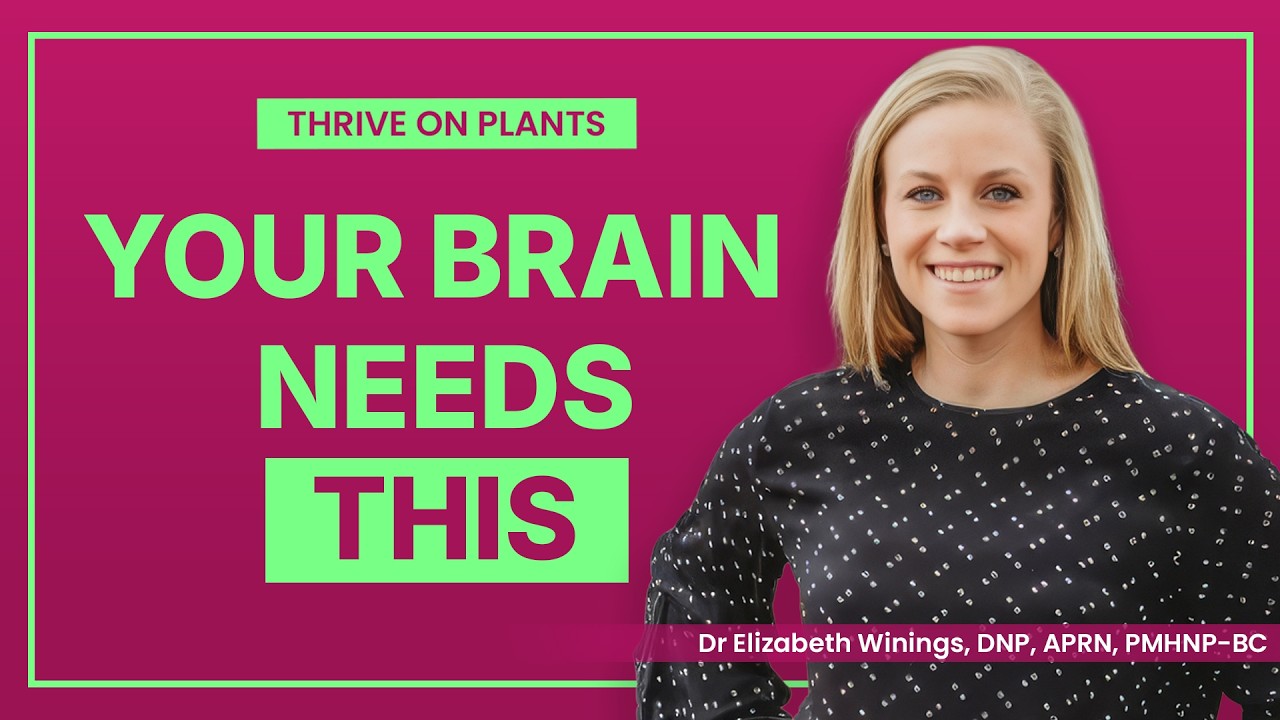
In this episode of the Thrive on Plants podcast, host Daphne Bascom interviews Dr. Elizabeth Wynings, a board‑certified psychiatric mental health nurse practitioner, diplomat of the American College of Lifestyle Medicine, assistant professor, and founder of Wynings Wellness. The conversation traces Dr. Wynings' journey from bedside nursing at the VA—where she witnessed severe diabetes complications—to a personal conversion to a plant‑based diet after reading The Omnivore’s Dilemma and watching Forks Over Knives. This sparked a career shift toward lifestyle medicine, a doctoral internship at True North Health Center, and eventually the creation of a preventive, lifestyle‑integrated mental health practice in Florida that now employs seven nurse practitioners. Dr. Wynings explains the bidirectional link between nutrition and mental health, emphasizing that neurotransmitters are built from essential amino acids derived from whole‑food, plant‑based sources. She describes how her clinic incorporates nutrition counseling, hydration, and emotional literacy into every visit, using simple, non‑shaming strategies (e.g., adding new colors to the plate, tasting fruits, focusing on hunger cues). The interview also covers broader themes: the need for preventative mental health, cultural stigma around mental illness, community‑based outreach (e.g., murals with QR codes, ACE awareness), cancer survivorship and grief, women’s mental health empowerment, and the importance of teaching resilience and intuition from a young age. Dr. Wynings shares practical advice for clinicians, outlines her involvement with professional organizations (ACLM, Plant Strong, PPoD), and announces upcoming speaking engagements in Atlanta. The episode ends with reflections on purpose, intuition, and living a life guided by curiosity and love.
Chapters
What happens when the healthcare system fails the people it's supposed to serve and a clinician decides to build something better? Welcome to the Thrive on Plants podcast. Today's guest started her career as a nurse at the VA, watching patients lose limbs to poorly controlled diabetes. She found herself asking a question that many of us in clinical medicine have quietly thought, but Rarely said out loud. When do we stop treating the consequences and start addressing the cause? That question sent her on a path that took her from bedside nursing to a doctoral internship at True North Health Center, one of the country's leading centers for medically supervised plant-based care, where she trained alongside some of the most respected names in lifestyle medicine. She went on to work in inpatient pediatric psychiatry, spent years growing as a clinician and educator and ultimately founded her own integrative mental health practice during the pandemic. Dr. Elizabeth Wynings is a board-certified psychiatric mental health nurse practitioner, a diplomat of the American College of Lifestyle Medicine, an assistant professor of nursing at Jacksonville University, and as if that's not enough, the founder of Wynings Wellness. A practice of 7 nurse practitioners delivering preventive lifestyle-integrated mental healthcare to children, adolescents, and adults in Florida. In this conversation, we go deep on the bidirectional relationship between what you eat and how you feel mentally. We talk about the neuroscience of emotions, why your neurotransmitters are literally built from the amino acids in your food, What preventative mental healthcare actually looks like in practice, the grief and identity dimensions of cancer survivorship that most of us in medicine skip over, and why reducing stigma around mental health requires meeting people inside the communities and cultures they already trust. This is a conversation about eating, thinking, feeling, In building a life that's not just longer, but genuinely more whole. Dr. Weinings, welcome to the Thrive on Plants podcast. I so appreciate you taking time to join me on a Sunday afternoon.
Thank you for having me.
I know a lot about you, partly because we are on the board of PPOD together. I've had the pleasure of listening to you present at prior PPoC meetings, but would you share a little bit about your background with the Thrive on Plants community and in particular, maybe a little bit about your vegan journey and why lifestyle medicine?
Wow. I could go so many directions with that question. And just speaking to my experiences, I will start with my my professional background and then I'll speak to my personal journey. So I am a psychiatric nurse practitioner and I'm also certified in lifestyle medicine and I completed my undergrad in nursing and then I went back for my master's. That's where I specialized in mental health. And then I went back for my doctorate and it was in that stepwise progression that I was working in healthcare as a nurse. And I was taking care of individuals at the VA hospital who were living with poorly controlled diabetes. That was very confusing to me because I, I knew that this illness was treatable and in some cases potentially reversed if you were fortunate enough at that time. It seemed like if you had, you know, the best genetics and lifestyle, you could see that your disease improved. But I took care of a few individuals who had subsequent amputations.
Hmm.
And that was very confusing for me as someone who wanted to take care of an individual, because I was curious how this was helpful and when do you stop cutting? And so that actually began my personal journey into plant-based nutrition because I was given the book The Omnivore's Dilemma, and, um, by Michael Pollan. And so I read that and It opened up my mind to a whole nother way of thinking about food. And then I watched Forks Over Knives. It had just come out. This was in 2011, 2012, that year of my life. And so I thought, okay, I'm going to give this a try. Like, does this actually matter? Will I notice anything? And I did. And I have a very supportive husband and it changed the trajectory of my education and life and lifestyle. So it really was something that I saw and experienced, and then it couldn't go back.
Yeah.
Once I understood the science of how eating and living can improve your health outcomes, I just didn't go back. And I know that for some people that might be their experience, and for others, it's much more work or more information is needed or more trials of eating more fruits and veggies and less meat and dairy. But I definitely have an all-or-nothing personality at times. And I think when there's positive outcomes, it's so much more rewarding.
Yeah.
So like for me, there was no downside. I'm not somebody who really had a lot of attachments Culturally or personally to meet. So it was very easy for me to say, I don't, I don't need that. Um, but I am sensitive to that's not everyone's experience. And so being thoughtful about how to meet people where they're at. But yeah, so that's my personal experience. And then I now, um, work as a psychiatric nurse practitioner where I incorporate both. So that mental healthcare and lifestyle medicine for the patients that I work with.
And thank you for sharing that because that, you know, it's, you actually made me reflect because I trained and worked at the VA and, you know, the truth is as a trainee, I didn't think about the number of our veterans who were coming in for multiple amputations.
Sure.
And really stopping to think why. And when do we stop or what do we do to prevent them rather than treat them?
Yeah, I think when you're the last person in the room and for any nurses that have had that experience, you're, you're left at the bedside and I didn't have an answer for what these individuals were going through, or I felt inadequate for how to support them in the next steps. of their journey. And so I was really trying to lean in on that interdisciplinary team. I spent a lot of time talking with the physical therapists and the dietitians and pain management. So yeah, it was an eye-opening experience.
And do you mind my asking what got you interested in mental health?
Oh, all of that. So realizing that was what I could imagine to be the most severe consequence. in life besides death. So, you know, to lose a part of your body, I did not understand how someone could have that consequence and continue a lifestyle that led to a similar outcome. And I wanted to better understand human behavior and how to support people achieving their life goals. Or at times, you know, you might have a life circumstance that you didn't choose.
Mm-hmm.
I don't think that everyone who's had an amputation chose that. I'm not saying it was their fault or their lifestyle.
Mm-hmm.
Um, you know, I, I do know that sometimes there, there is just a, an injury and then now we've got a non-healing wound. You know, sometimes there's just, life happens. That's really unfortunate. I think that also makes it harder to impact change if there's that grief and frustration. And, um, not everyone looks at life circumstances with opportunity or curiosity to say, okay, well, here's where I am. What can I do? How can I shift my mindset or my focus? And so I wanted to learn more about that. And, um, before I went back completely for my master's in mental health, I did go and work in the ER. And so I think that also highlighted The limited access to care and that revolving door of how individuals are seeking care as they should, but doing it in a place that wasn't skilled to meet their needs.
And were you at the VA? This may have been in 2011, 2012. Were you there when they started launching the Whole Health program at the VA?
No, not that I could remember. If they did while I was there, it wasn't impactful to me. I do not remember that.
And I don't know that it's at every VA, so that, that's part of the challenge.
Okay. Yes. So I was in Florida and I don't remember that program. Got it.
Because I, I can't imagine at the time that nutrition, plant-based nutrition. Yeah.
People thought I was crazy. No, no. I would come to the break room with my snacks and they're like, what are you doing?
What are you doing?
What are you doing? So is that program something that— could you give me a little bit more context? 'Cause I would love to look it up.
I can't remember the year it started, but the VA health system launched a program which they call Hold Health, and they created a veteran-centric holistic health model that included all of the— it's very similar to the pillars of lifestyle medicine where they focus on mindset, nutrition, sleep, stress, community, social connection, but they've also integrated it in a way that allows the veteran access to things like acupuncture or—
Amazing.
Mind-body therapy. It's not at every VA. When I was doing some consulting with the program, there were— it was mainly at some of the larger Veterans Administrations, some of the bigger VAMCs. But it was so fascinating that they really saw the vision of treating the person in 360 degrees, not just treating a disease or an illness.
That's awesome. I do know that during my time at the VA, there were, I think we used the language of complementary and alternative medicine, but It wouldn't surprise me if that programming has made its way there because there was a great initiative for acupuncture specifically. I remember that for pain management. And it's so exciting. Like, I like how you phrase that, treating somebody in 360 degrees, like really thinking about how can we support all of them. And I think outcomes improve when we have more healthcare providers looking at a situation. Because all of our lenses could be complementary. And then it's really validating when you come up with similar treatment plans, when you're like, yeah, that was where I thought we could go to.
And you, I mean, the thing I love, and thank you for sharing your bio, is that you have made your skillset and your knowledge available across multiple parts of, I don't want to say the movement, but it is kind of a movement. So whether it's working with American College of Lifestyle Medicine or working with Plant Strong. Maybe the question I should really start with is what's your why?
Ooh, that's fun. I think that's an evolving answer. So, so my why as a new nurse and clinician was To understand behavior change and improve quality of life for myself and the patients I took care of. I think my why initially was to make a meaningful impact in people's lives. I wanted to feel like if I was your nurse or nurse practitioner, that that interaction would have meaning and value beyond just today, right?
Mm-hmm.
Like that we would be accomplishing something that would improve the quality of your life. And that's not what I experienced in healthcare. You know, a lot of times it felt very transactional and disappointing, and I was tired and shifts were long. And so, as I kept pursuing that why of, I think there are other options, I had the opportunity to do my residency hours.
Mm-hmm.
At the True North Health Center in Santa Teresa, California, under Dr. Clapper. And I had the privilege of working with Dr. McDougall a little bit and Dr. Alan Goldhamer, Dr. Anthony Lim, just some phenomenal humans who were practicing medicine and delivering healthcare in a way that I'd not experienced yet. And so it was very empowering to see people get well. And to see people feel better. And for anyone listening who may not know what the True North Health Center is, it is a residential place. So you can go there voluntarily and you could do a water-only fast, or you could do a juice fast, and, or you could just go and eat. It's called SOS-free. So salt, oil, and sugar-free plant-based. food and it's all prepared by their team of chefs and it's medically supervised if you are doing any of the fasting. And so I think in that chapter of my life, my why became more empowered. Like, I'm not crazy. I think I felt very isolated for a while. When I first wanted to do my doctoral research, it was actually denied. Because my chairs felt like taking this on, and again, this is in 2014, 2015, they felt like there was not enough within our current system that I could be successful in a timely manner. And so they weren't denying it based on the rigor or my intention. They were saying like, we don't, we don't want to set you up where you're not going to graduate.
Yeah.
So, um, I think my why then felt very much like, okay, I can do this not only for myself, but for my patients. And then it shifted to education. And so I really feel like people do the best that they can with the knowledge they have.
Mm-hmm.
And so I feel very strongly about being a resource and meeting people where they're at and then connecting them with additional resources or networking with other providers. Because I also believe we can't be all things to all people.
Yeah.
And I know I'm not going to resonate with everyone, but you might, or someone else might, right? And so the more that I can be a conduit or a networker or an educator, I really feel like that is my current why. And I just want people, I think the thread is I do want people to leave an interaction with me feeling like it was meaningful now and in the future, like that it will continue to be meaningful to them. So it's kind of an abstract why, but, um, I think those are the types of interactions that have made the most impact in my life, where I find myself revisiting, even if it was a short interaction.
Mm-hmm.
Or I find myself revisiting those and it has a different meaning over time.
But the theme of education and empowerment and, you know, giving people the tools to have agency and understand, because probably at the time you were starting your dissertation was really at an early stage of nutritional psychiatry. Oh.
People were like, what? We think, or I was like, but isn't that the point of research? They're like, you just need to graduate.
Like, oh, um, you just need to graduate.
You need to graduate. And I did, thankfully. Um, thankfully. So yeah, it was, it was early and there was a lot of support but hesitation. So, so there was this belief that there could be a correlation. Yeah, sure. Yeah, sure. But there wasn't this like underlying strength of evidence. We just didn't have funding. We didn't have a lot of people doing research in a way where you could pull a meta-analysis like we can now where there is more intentional research being done. Plant-based wasn't really even in the literature yet. So any of the research that I was looking at, we were really looking vegetarian or vegan diets. And even then you're kind of sifting through to see how did someone define that in that study? So yeah, it's, it's been a fun evolution and it's really exciting now to see that we can say there is a cause and effect based on what you eat and there are protective factors for eating plant-based for your mental health. So I'm just grateful.
What was your dissertation on?
The relationship between diet and depression in adult women.
Fascinating.
Do you hear how narrow they made me go?
Yeah.
I feel like, but I wanted to do all of it.
They said, ask one question is one question, one population, one age group.
Okay.
So how do you So after your dissertation, did you start Whining's Wellness right away? Were you out in— okay.
Great question. No, I was incredibly overwhelmed. The transition from being a nurse to a nurse practitioner was daunting. And my certification as a nurse practitioner in psychiatric mental health is across the lifespan. So that also is challenging to, to take on a role in modern healthcare that you are responsible for doing mental healthcare.
Mm-hmm.
So the idea of integrating a lifestyle assessment, which it wasn't even called that at the time, but in mental health, we call it a biopsychosocial. So doing a full life history anyways. So I, um, really needed to grow as a clinician and get comfortable in those skills and really get mentored into what does it mean to be a psychiatric mental health provider.
Mm-hmm.
I needed to learn how to do therapy. I needed to take all of the things I learned about behavior change and see how that played out in people's lives. And so I worked in a variety of settings and one period of my life, I worked for 3 years in an inpatient Pediatric behavioral health hospital.
Oh, wow.
And I learned a lot and I met a lot of really remarkable children and families. The hardest part of that chapter of my life is meeting remarkable children and adolescents after a suicide attempt. Most of the people I spent time working with did not want to be alive or had Threatened, you know, that they would be taking their own life. And so that shifted my why in a big way to making sure that people understand that depression is a medical illness and that suicidal thoughts are a treatable symptom of a medical illness. And so it was through a period of conversations with other colleagues and other business ventures COVID that Whiting's Wellness came to be. It was, you know, I think almost anyone I've spoken to, that COVID experience shifted something within them or their family in a way that they might have taken a risk or were forced to shift and take a risk. And for me, I took a chance on myself. And again, my husband is incredibly supportive. And I was like, let's go for it. Um, and so Whining's Wellness did not come to be until 2020. Um, and I graduated, uh, as a psychiatric nurse practitioner in 2013, 2014. So yeah, I, um, definitely took some time to, to grow and learn and network. And, um, now I have Whining's Wellness and I'm on a team of— 7 nurse practitioners and some of us specialize more in pediatrics, some in adult, but we're all very passionate about preventative mental healthcare and lifestyle medicine. I think the language matters depending on the audience. So for the most part, we talk a lot about preventative mental healthcare because that in and of itself can be a new concept for most.
Yes.
And then if we add in lifestyle medicine, we lose them. And so it's, it's in there though. So what I mean by that is no matter what language you're using, the filter in which you would be taken care of by your provider at Whinings Wellness is going to be that lens of both preventative mental healthcare. How do we equip you to prevent mental illness? And lifestyle medicine interventions are part of that. They're foundational to that.
I'd love to explore that a little more because I'm sure people listening are familiar with how do I prevent diabetes or how do I prevent heart disease, but preventing mental health illness, that's probably not something that I'm sure that if you walked up to someone on the street, they would say depression, anxiety, Can't be prevented.
I know, right? Yeah. So we all have these working beliefs and experiences for life. And depending on number one, if your family or culture even believes that mental illness is—
That's a big one too. Right.
So what I like to say to that is before we start to categorize something as a mental illness, Or not, can we agree that emotions are real? Because I think that's also something that many people, depending on how they were raised, they may not be able to identify their own emotional experience.
Mm-hmm.
And our emotions are a neurobiological response to life. And so if we can start there, I think that is a very helpful place. And sometimes that's enough to get people curious. Like, wait a second, what neurobiological— what, what are you even talking about? And then it's a fun thread to pull to say your emotions are actually a response. It's your nervous system responding to your life. They're not random. Like, you're not making them up. You're not crazy. Emotions are signals.
Yeah.
And so that's a fun conversation to have with people. And it's a nice on-ramp to say, if we can get more comfortable with being curious about our emotions, experiencing them in safe and healthy ways, you can build resiliency and that can help you survive your life and respond in safe and healthy ways. And it can help you to think more clearly because we can't respond in a very thoughtful or cognitive way if our emotions are heightened or if our emotions are driving, then we're responding emotionally and reactively. And we all have had those moments where we're like, I wouldn't have done that if I wasn't frustrated. So I think that is where we like to meet people with this concept of preventative mental healthcare. No, not everything can be prevented, but we can help people learn skills to be reflective and take good care of themselves so that their nervous system is more regulated. Which is going to help you live within a more reasonable experience of your emotions. Because when you look at, let's say anxiety, for example, there are things that we call illnesses like generalized anxiety disorder or panic disorder. An individual rarely is born with that heightened of a nervous system. Very rare. We have some people whose temperaments, sure, maybe they've always been a little on edge, but for the most part, you can look at the course of someone's life or their experiences and see how that nervous system became dysregulated to a place where they're constantly in fight or flight or scanning because they don't feel safe. And so that's where I like to think about anxiety is actually a protective factor. It's a helpful thing. We need it. But if your brain and body has not had enough experiences where that anxiety comes back down to a tolerable, tolerable range, now we're living in what we would consider clinical. But if we can normalize emotions for people, then I think it's a more welcomed conversation to get curious about what is my own experience and how, how could I potentially Improve that experience versus just living and taking that risk, right? What's going to happen? I don't know. Like, I, we definitely can look at risk factors based on somebody's life and their predisposition to potentially have a mental illness, but the opposite is true. So we can look at your life and then we could say, can we skill you up so that you're more resilient and we can lower your risks? Then maybe you wouldn't have those negative outcomes.
I almost feel like these are skills that we should be teaching in grade school.
That's my dream.
Oh, is that really? Yes.
Education. That's my dream.
Yeah. Oh, I, I love that thought because I mean, it, you know, just listening to what you were sharing made me think about Adverse childhood experiences. So, you know, what are people's ACE score? Um, because it's, it's also very easy to, especially for high-performing people, never to really manage what they may have gone through at an earlier age.
Right. And the original ACEs study, I can't remember her exact number, but I know in like Dr. Nadine Harrisburg, she shares the, the data, the original study. It is, I think it's 70% Caucasian college educated. So when you say like high performer, high performer, and there, there were adverse childhood experiences in there and the correlations of those negative health outcomes.
Do you, I know you live in Florida, but are you able to work or do you have the ability to work with either schools in the area? Are you working with the pediatric NIC to share some of this so that it can cross? I mean, sometimes I feel like we get into silos. Mental health is here. General pediatric care is here. Women's healthcare is here, but there really is a— mental health is a thread that starts from childhood and it goes throughout our life.
Yes. I have definitely had some great conversations with other providers and opportunities to have conversations like this or get pulled in to speak to things from like an ACLM perspective. I think there's a lot of collaboration there. I will say with our local school system, there are some initiatives that are in place and there's a lot of meetings that take place to get to a meaningful—
Lots of meetings.
Opportunity. But there's a wonderful nonprofit here in Northeast Florida called Hearts 4 Minds. And they have an initiative called Murals with Meaning. And so they go into physical spaces and they create a mural and it is a collaborative effort between the school and this organization. But all of that to say, they also have been working to pair mental health education with that. And so my team has been a part of some of those opportunities, which is really nice.
Great.
And then there's a QR code with each of those murals. And when you scan that, it takes you to a resource guide for our area to increase awareness of providers because one of the limiting factors that we know is individuals are not accessing mental healthcare. And so that's been a really meaningful organization that we've had the privilege to be a part of. And so it's increasing beautiful things within our city and surrounding areas, and then also increasing access to care. So people getting connected with that.
And I would love your perspective on, you mentioned that different cultures have a different perception on one, does mental health Does mental illness exist? And even then, is accessing mental health something that is— I don't wanna say, you know, do people experience shame for actually admitting that I need help? How do we, how do we start to break down the barriers within some of these cultures? 'Cause, you know, the African American culture is one of them.
Yeah.
mental health is, it's more of a little bit of, well, suck it up, buttercup, or you just need to get tougher and be strong, or, you know, your shoulders need to get wider.
That's right.
But it's a real neuropsychological biological illness that could be treated so that individual could be higher functioning and contribute more to society.
I love that question. And I am not Black. I don't understand that culture, right? Like, that's just not my, my experience, but I grew up in a very multicultural, uh, environment and had a privilege of going to a very diverse high school. And I think that's part of why I've been curious is because it was embedded in me from a young age. And I had a doctoral student myself, Dr. Jakeva Moss, who is Black, and she did her research on the relationship between stigma. So I'm going to butcher the title. I used to have it memorized, but it was around mental health stigma and something to do with education. I know the tools that she used. One was the CAMS. in an African American church. And what she found was fascinating. And the impact that she made was statistically significant in her community.
Interesting.
And it's a study that I actually think would be really fun to replicate. Um, and with her leading it, and I know that she has disseminated this, she's, she's given, um, a few different poster presentations at Um, like the American Psychiatric Nurses Association, um, conference. But I bring that up because what she found was there were a lot of barriers and limitations based on different emotions, maybe shame, maybe just not having permission to be curious about these things.
Mm-hmm.
And, or being told like, you should have known how to deal with this. Like, to your point, like, be stronger.
Yeah.
Um, find a way to bear this burden. Um, but in safe places and a culturally safe place where people were understood and was somebody educating them that was from their organization, there was reception to this. There was curiosity. There was an increased, um, use of resources. There were people calling the, the organization, this church organization, and, and now referring people for counseling. So it was a really neat thing to see that. And I think it's something we could reproduce.
Mm-hmm.
Because I don't, I do think there's something unique about her and the way that she delivered this, but I think it is something she could teach others to do within their own communities. And I think that's what We need. I think that's what the Blue Zones has shown that, you know, you can't just show up and be someone and say, I will heal you and I will help you. Right? Like we have to go in and if we're invited and then say, what do you need? And then allow others to do the work for themselves and to support each other because that's going to be lasting change versus, you know, a quote unquote expert coming in and dropping off some stuff and then leaving. That may or may not really impact change. So I think that's an area that I get excited about seeing more research done because I do think we haven't done enough.
Mm-hmm.
I think we've, we've seen that across disease states that there are disparities in the ways that different populations and cultures are studied or resourced. And so I'm hopeful that we will see that improve and continue to improve as we get more data and more clinicians from these cultures and populations. I think that only improves access and awareness.
And I mean, to your point, being invited in is key as opposed to saying, we're coming to fix you. Um, yeah, it doesn't work.
It doesn't work.
You, so one thing that, you know, talking about different illnesses or communities, and I know, I think you're either giving a plenary presentation or leading a roundtable or both on individuals with cancer.
Um, yeah. Yes. I'm so excited for, for this PPoD, um, conference that we're both gonna be a part of in Atlanta. So the roundtable discussion is going to be multiple people speaking from their different lens and experience on resiliency and recovery for cancer survivorship.
Hmm.
And specifically for women. And so when we look at the experience of someone going through treatment for cancer, Which that category in and of itself is daunting because it's going to look different depending on the disease that you have. Like cancer as a disease state is multifactorial. But I do think there are common areas that individuals who have gone down that path can relate and/or share wisdom and knowledge for how to navigate that diagnosis and disease state and survivorship. And so I'm really excited to be a part of that conversation and facilitate from different angles. And I know some of the individuals on the panel are actually survivors themselves.
And I think I'm excited to hear this too, because I know, you know, I had Allison on the podcast last year. And one of the things we had a conversation around was like many areas of healthcare, when you're cured, all of a sudden everyone steps away.
That's right.
But you still have so much you're dealing with. You know, why did I get this? How am I going to make sure I don't, I don't get a recurrence? Is it my nutrition? Is it something else I was doing? I feel Like there's so many mental health related elements of survivorship that, and I, you know, I came from head and neck oncology that even I never really thought about. Um, you know, as a surgeon, I'll be honest, it was fix 'em, stitch 'em, send them on as opposed to really understanding that. And I knew it in my heart. I know it in my heart.
Mm-hmm.
Um, when someone enters, to me, my cancer patients are lifelong patients. That's what I learned through the journey. Um, that's not necessarily how I was taught or trained, but in reality, that's a relationship that is lifelong.
Right.
But how do, what are, how do you start to approach mental health issues that may arise in that journey?
I love, I love all of that reflection. And then what actually makes me think of is as healthcare providers, the opportunity we have, no matter our training, to value the person's experience that we're caring for. So I think when we don't lose sight of the individual in front of us, despite our role, right? Whether it is to make sure that they have a successful surgery and they don't have an infection and they can, you know, continue living in their home or—
Mm-hmm.
If you are the dietitian or the physical therapist or all the nursing care, I think making sure that we remember there's a human attached to this experience and that we want them to continue living and that concept of thriving. So not just surviving, how do we move you through this in a way that is least traumatic and then allow you to heal? And so I think that The conversation is nuanced because it depends on the person in front of us.
Mm-hmm.
But it's also relatively simple to acknowledge someone's grief. I think we skip grief a lot in cancer. Like there, there is so much that is lost.
Oh yeah.
Because of cancer, whether it's a perception of a future life or literal time that now we're shifting and resources and finances. And I think sometimes we fast-track to, but you're going to fight this and, you know, like, we've got this. And for some people that might resonate, but at the end of the day, there is a loss. There was a loss or there is something. And so how do we allow both to be true? So that holding of 2 opposing experiences, like hope and pursuit of life and accepting reality and grieving. I think that can help people heal faster, um, mentally and physically. So, um, yeah, that is, that is something that I try to keep in mind when I'm working with individuals who are Either living in their own journey or, uh, of treating cancer or, or in recovery. Mm-hmm. Um, and then identity. Does your identity fully shift into this sick patient person?
Yeah.
Or do you maintain your core beliefs about yourself and find new ones and continue to hope and dream and live while this other part of your life is happening. So I think identity matters greatly and how we speak to ourselves and define our circumstances. And I think some individuals, um, maybe a cancer diagnosis is a first time they really wrestle with some of that. Mm-hmm. Mm-hmm. So I know some individuals have described it to be an awakening or the first time in their life that they started to really choose themself. Um, But again, I, yeah, so multifactorial.
And talking about choosing themselves. So right now we're talking in May 2026, and this is Women's Health Month. And you shared that you did your dissertation on depression in women. What can you share? So I'd say a large majority of Those who aren't yet tired of listening to me and listen to this podcast are probably women. And one of the things that I do think we struggle with is putting ourselves first. Mm-hmm. And whether it's understanding who we are, where we are on the journey. In the past year, there's been so many conversations about the different life phases of a woman. What, and I know, I think we were on a panel last year talking about women's health and it's just hard to encompass that in a 15-minute conversation.
Right.
Do you have any words of wisdom for women as we come to the midway of Women's Health Month about why it's important to Acquire some of those tools to prevent or manage mental health? That's a loaded question.
Sorry. The first thing I thought of was I've never met a woman who didn't have a deep knowing or intuition about who they were. That was wrong. And I'm— what I mean by that, I wanna be very clear, is not the narrative that was internalized from others. So, so what I mean is, is when I'm sitting in therapy with someone and we're, we're trying to tease apart their core belief or their belief about themself and what was the message that they internalized from others versus who they believe themself to be.
Mm-hmm.
That's really, really fun work and it's really tedious. And I admire anyone who takes the time to do it because we all become a part of this life experience. And there's certain things that have been said to us that we may or may not know that we've internalized, like I'm so loud or I'm too bossy, or I'm always in the way, or I'm Fill in the blank. I think, you know, we all could think about some way that we speak to ourselves or think about ourselves that doesn't resonate and it doesn't make us stand up taller or take up space. But then there's this other part where it's like, I kind of am drawn to those things, or I'm interested in that stuff, or I wish I had more time to reflect on these things. And I just think for women, it's important that they know they don't need anyone's permission to listen to that part of themselves and that they will become fuller and more vibrant the more that they tune in to that core belief about themselves. And that's fun. That's fun work. It's not linear and It's uncomfortable at first and it's scary, but I think that's the power of women is typically we get in communities and then we support each other. I know that there are a lot of women who have experienced negative things from other women. Sometimes that can be the most deepful, deepful, most deep and hurtful wound is when you've been hurt by someone that you perceive to be a very close friend.
Yeah.
But there's great healing in community of other women. And I think, I guess my words of wisdom would be to trust your deep knowing about yourself, and you don't need someone's permission to listen to it. You're supposed to take up space. You have unique gifts and talents and a calling, and you should find out what that is and take up space. Don't make yourself smaller. Whatever messaging you've received. Um, and then find other women who will support you and champion you and talk good about you behind your back. And I think that helps you realize the other stuff was just a distraction. Yeah.
But that's, that's a journey.
That's a journey, right? And it's not linear.
No.
And, um, this is not my words of wisdom. We're going to end those and I'm going to tell you one other random thought, but I had someone say to me, if it's not a hell yes, it's a no. And I was like, for some reason at that point in my life, I really needed that because Yeah. I didn't know how to discern.
Mm-hmm.
What I should say yes to or who I should spend time with. And I really wanted to grow my network and understand things, but then I would find myself in relationships or circumstance and I'd be like, this doesn't seem like what I thought it was going to be.
Mm-hmm. Mm-hmm.
But that ability, when I say listen to your intuition, for me, being able to think, is this an automatic yes?
Yeah.
Or no. That's how I started to find my intuition. Like, oh, there was something there, but I didn't know what it was. Good thing I said no or yes. So, um, there are better skills and therapy and more strategic ways to navigate that, but that's just one that worked for me to help me start to practice listening to my intuition. Because I was not good at it and I would just say yes to everything and then I would be exhausted and then I'd have all of these social obligations and I wouldn't wanna go to any of them.
Yeah. No, you were— one of the things my dad told me, probably the first time, it was actually my first summer job, which was in Florida. And we drove down there from Buffalo before he, after he dropped me off, he He said, trust your instincts. And sometimes I think we talk ourselves out of that hell yes.
Yeah.
Because we're like, oh, what if, or maybe.
Yes. And especially as women, because we have these other voices in our mind that we're thinking, well, but what would they want? Or how would they say this? And I want to make sure that I'm perceived a certain way, or I'm supposed to be showing up in this way. And we can have a full conversation with ourselves.
In 5 minutes.
And then we're like, what was I being asked to do? And so I think that's some of my favorite work to do with women is, is helping them practice showing up for themselves and just listening to themselves. And again, at first, for many, many people, it feels disruptive and chaotic. And they are like, this is probably not a good idea. And then we string together a couple of positive experiences and they're powerful.
Agreed.
And it is really fun. I will never forget one of the times, um, I actually got feedback from someone and they said that I looked lighter, like that I looked less stressed. And I was like, I think it— I didn't say this in my head. I thought it, I thought, I think this is because I'm doing what I want. Like, I think this is because I'm actually showing up for myself. And so life feels less heavy. And so when I'm somewhere, I'm actually happy to be there versus like checking something off. Yes.
I have to be there. So I have to put on the happy face. Right.
Yeah.
And, you know, to go back full circle to where we started, I'd love to hear as we start to wrap up, How are you integrating nutrition into Whining's Wellness? Because food is medicine for many different reasons, but I don't know if people think about, make the connection between food and their mental health.
Oh, I hope that they do. And so I'll say one fact and then I'll answer your question. So a fun fact is that your neurotransmitters So the things that we are targeting, if you choose to take medication, I prescribe medication. I'm not against taking medication for mental health or treating mental illness.
Mm-hmm.
But I do want to clarify that if you're taking medicine, it is not giving you neurotransmitters. When you take something like a sertraline or fluoxetine, it's manipulating the way your brain and body can use your neurotransmitters. So the fun fact is that, and neurotransmitters are built from essential amino acids. And so for anyone going way back to learning about amino acids, the building blocks for protein, we require essential amino acids to make most of our current neurotransmitters that we're targeting in science. And so I say that fun fact to say, where do essential transmitters essential amino acids come from?
Food.
Food and plants. So even if you say, oh, I could get it from meat, but the meat, the animals are eating it from plants. And so I like to say we have essential neurotransmitters. So if you're not consuming high-quality nutritional content, what I mean by high quality is things that are from the earth, from a tree, not a box or a bag. So eating real food, You're going to be equipping your body with more resources to make your neurotransmitters. And so the way that comes up at Whining Wellness is number one, we talk about it and we talk about food in a way that is curious, not shame or blame. So in every single visit, whether it's your initial assessment or follow-up, we're going to be talking about how is your body doing with food? Is your body telling you when you're hungry? Do you listen to that cue? What do you choose to eat? You know, does your body tell you when you're full? Are you listening to that cue? And then if we have someone who really doesn't like eating fruits or vegetables, we say, what can we start adding to your plate?
Right.
How can we get colorful? You know, well, let's not talk about categories, but between now and your next visit, I want you to try and eat 3 new colors. And that allows someone to have agency in their own life and to come back and share what they're finding. We also talk about smoothies. I'm a big fan of hiding your greens. And so whether that means you put them in a smoothie or you bake them in a pasta sauce, go for it. And then we talk about how your tongue can learn new things. And so I do work with a lot of children, but I don't change the messaging for adults. Because some adults may not know that your tongue can adapt and you can learn new things. And so I will say, lick a strawberry, lick a blueberry. Like, if you don't like it, lick it or squeeze it in your mouth and see what happens. If you don't like it, that's okay. Great job. Thank you for trying. And we do a lot of just try stuff, come back and tell us what it was like. Um, but we are absolutely talking about food and what you're eating. And then we try to dispel myths. So what I mean by that is we don't talk about protein and carbs and fat and macros. Like we just don't, because that's a whole nother podcast episode, but I find those conversations can be distracting and confusing. And so what we want is for individuals' relationship with food to be nourishing and life-giving. So that's our hope. The other way we talk about nutrition is we talk about hydration.
Mm-hmm.
And so we talk about drinking water, refilling water bottles throughout the day, making sure that water is the foundation of what someone is choosing to consume throughout the day. And, um, we like to give a lot of facts around those things and, um, just help individuals understand the why, that we are not aimlessly asking them to eat real food or drink water, but that, that is going to benefit their life in the long run and their mental health. So, it's, I find it to be a lot of fun and I find that our patients and families choose us and stay with us because they know that we care about those things. Um, and, and we find that a lot of the people who come to see us are word of mouth because they've heard that we've been providing care in a way that was intentional and not just prescriptive. Like, oh, you have this, here's medicine. We don't, we just don't do that.
And that's amazing. Um, last final question.
Okay.
What does it mean to you to live with purpose?
Ooh. I think living with purpose is finding clarity in your life. And I think that's an evolving quest. I don't think it is stagnant. So I think living with purpose is, is finding clarity in the stage of life that you're in and then leading with love and curiosity. So, um, I know I don't know a lot. And so if I can stay curious and receptive and loving, I'm hopeful that I will continue to have purpose and add value. So I think that would be my goal.
And from what I know of you, that is beautiful and you are achieving that. So keep doing what you're doing.
Thank you. And thank you for asking me these questions and welcoming me to your podcast. This has been a great conversation.
If anyone wants to connect with you or learn more about your practice, how can they find you? Yes.
So Whining's Wellness, we are on Instagram and Facebook. Um, we're not super active there because we don't believe in a lot of screen time, but we are there and we have a website. So please reach out. Um, we do provide care in the state of Florida, but also I'm a part of the Plant Strong, um, organization and we host retreats twice a year and, um, we are active with ACLM. And then also I'm a part of PPoD. And so if you wanna connect, please consider being a part of some of the PPoD events, whether those are virtual or in-person, but those are specifically for clinicians and they're great events and great people.
And if anyone's gonna be in Atlanta, when are you gonna be there and what are you gonna be talking about?
Oh yeah, wait, I don't wanna say the wrong dates. Let me make sure.
Okay.
I'm going to be in Atlanta June 5th through the 7th. Our event is June 6th and 7th with Peapod. And, um, I'm going to be speaking about, uh, a lot of what we've talked about, but more tailored to the audience. So I'll be, um, a part of a panel that is a women's health empowerment panel where we're going to be speaking about the experience of cancer and survivorship. And then I'm going to be speaking about the relationship between your mental health and resiliency and lifestyle medicine. So I'm going to be threading that together. Wonderful.
Dr. Elizabeth Weinings, thank you so much for joining me on Thrive on Plants. It's been a pleasure. And I'd love to have you back sometime to dig into you. There were a lot of questions. If you had more time, I would have dug deeper, but thank you for what you do and for all that you're doing for our community.
Thank you. See you in Atlanta.
See you in Atlanta. The information shared on the Thrive on Plants podcast is intended solely for educational and informational purposes. It is not medical advice, and it should never be used as a substitute for personalized guidance from a qualified healthcare professional. Always consult with your physician or healthcare provider before making any changes to your nutrition, exercise routine, supplement use, or your overall wellness plan. The opinions and advice shared by our guests are their own and do not necessarily reflect the views of The Vegan Gym or its team. While we aim to bring you high-quality, thoughtful conversations, these perspectives are not intended to replace professional medical advice. Thanks for tuning in, and remember, you have the power to thrive on plants and live with purpose.
More from Daphne


The Adaptive Fuel: How Exogenous Ketones Support Healthspan | Thrive on Plants #60

Could Yeast Replace Whey? The Science and the Story Behind Spacemilk | Thrive on Plants #58
Why "Eat Less, Move More" Stops Working After 40 (And What Actually Does) | Thrive on Plants #54
Triple Negative Breast Cancer: How She Caught It Early and Came Back Stronger | Thrive on Plants #53