Can Soy Help with Hot Flashes? Dr. Neal Barnard Explains the Science | Thrive on Plants Podcast #22
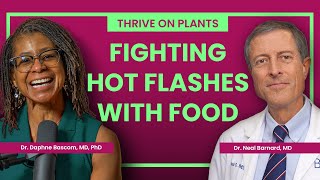
Podcast episode (Thrive on Plants) featuring Dr. Daphne Bascom interviewing Dr. Neal Barnard about the role of soy and a low-fat, whole-food, plant-based diet in managing menopause symptoms—particularly hot flashes. Discussion covers a clinical trial (diet: vegan, low-fat, plus 1/2 cup soybeans) reporting large reductions in moderate-to-severe hot flashes, practical preparation/food substitutes (soybeans, tofu, tempeh, soy milk), safety notes about soy and breast cancer, and broader public-health implications including lifestyle-first recommendations and ongoing research partnerships (Blue Cross Blue Shield studies on diabetes and older adults).
Chapters
Hi, friends. Welcome back to the Thrive on Plants podcast. I'm your host, Dr. Daphne Bascom. I am super excited about today's episode because we are talking about a subject that affects so many of us and one that is often misunderstood. Menopause and perimenopause and midlife in general. But specifically, we're talking about how food, especially soy, can help us navigate menopause. And we're joined by someone whose work has changed the way I think about food and about hormones and about health. You probably know Dr. Neal Bernard as one of the most respected voices in lifestyle medicine and nutrition science. He is a physician, a researcher, and an author who's published more than 100 peer reviewed papers and over 20 books. His research has helped reframe type 2 diabetes as a reversible condition. And his work on women's health is opening new doors about how we understand our hormone physiology, menopause, and how this intersects with plant based therapies. Now, I hope you enjoy this conversation half as much as I enjoyed recording it. Let's dig in. Dr. Bernard, thank you so much for joining me on the Thrive on Plants podcast. I'm honored that you would take some time out of your day.
Well, it's my pleasure. Great to be with you today.
As I shared leading up to our call, I have the benefit of teaching a 8 week Menopause mastery program for plant based women. And there are frequently questions related to how do I manage my symptoms, whether it's hot flashes, sleep, you know, the whole bandwidth of different types of symptoms that women need to navigate as they're going through midlife. But one of the things that I recommend is lifestyle first. And that includes, based on the work that you and Dr. Kalihova have done, thinking about adding half a cup of soybeans to your diet daily, if it's not already part of the regimen. Would you be able to share some of the evidence and the science behind this recommendation?
Yeah, I have to say, it kind of came about in sort of a funny way because I was really struck years ago by the fact that at the other end of the reproductive spectrum, that for young women who had cramps, menstrual cramps, that diet could make a difference. Um, a young woman called me up, she had terrible cramps. And she called me for one reason, one reason only. She wanted serious heavy duty painkillers. And I said, I can give you some painkillers for a couple of days, but. And let's do that, you know, because I want you to be able to function but how are we going to tackle this in the future so this problem doesn't come back? And so one thing led to another and we started to look at how foods affect hormonal balance. And bottom line, when people went on a low fat, high fiber vegan diet, no animal products, no animal fat, and everything's from a plant, so it's high in fiber. And we kept oils really low for a lot of women, their cramps just went away. And maybe not everybody has some variability, but by and large it was very powerful. And I thought, well, that's amazing. And we started to discover that there were a lot of areas where hormones could be manipulated by diet changes in a good way. And so I started writing about menopause because menopause is a time when not only does a person have a lot of symptoms, sometimes like hot flashes, sexual symptoms, other things, but also it's a time when you get, you're like a ping pong ball getting bashed by one commercial interest. Somebody's selling one thing and somebody's selling something else and you think, what am I supposed to believe? And my doctor doesn't know. And so, so anyhow, so I wrote this book called you, Body Imbalance to try to talk about different kinds of hormones. And insulin is a hormone, estradiol is a hormone, testosterone is a hormone, and the fact that you can have control over them is cool. Anyhow, forgive me for this long winded answer, but I want to tell you that when that book came out, a woman named Betty called me up and she said, Dr. Barnard, I read your book and I did what you said and I was having terrible hot flashes and they were gone within just days. And I said, wait, wait, wait, stop. What did I write that you took? What were you thinking? She said, well, you're talking about vegan and you're talking about low fat, you're talking about soybeans. So that's what I did. But you know, I gotta tell you, honestly, I wasn't that specific. I didn't say how much soy to use and whatever. So I said, betty, what. What did you actually do? She said, well, no animal products. Okay, got that. And I kept oils really, really, really low. Okay, got that. I had soybeans. What kind? She said, I went on Amazon and I bought soybeans there. What brand? Laura Brand soybeans. I've been like quizzing her and I said, how did you cook them? She said, I put them in an instant pot. For how long? For like 40 minutes. And. And she ate a half cup A day. And so anyhow, after, after the phone call ended, I ran into Dr. Kaliova's office, Hannah Kaliova's our, our research director here. And I said, I just found our new study. We are going to test Betty's diet or Betty's interpretation what she thought I was prescribing. And so I called up the head of Instant Pot and I said, could you send me some Instant pots? And we went on Amazon, we ordered exactly the brand that Betty was using and we put it, wow, it was an amazing success that women didn't just add soybeans. It was three things. Vegan, low fat and a half cup of soybeans. And that combination was better than any part alone, and frankly, better than hrt, if you ask me. So, I mean, we had an 88% drop in the moderate to severe hot flashes. Women lost weight, they felt better. And perhaps most importantly, it's the diet that sets you up for a healthy life. So anyway, that's kind of how we got here.
Which is fascinating because it started with one anecdotal story and I have to share that. I have everyone from our community. I encourage reading this book because it's a very easy understanding of your body and its hormone because they all act in concert. Trying to tease out what one is doing from another can be a challenge. But using food as medicine is important. Do you. So based on the work that you and Dr. Kalihova have done, do you have any idea why some women respond better than others? Or are there differences? And is it a dose response, is it a biome response? Any insight into what may predispose women to be in that group that has 88% reduction?
It's a great question. First of all, what we did see is that some women would also respond very rapidly like Betty did. So within the first week, we would see hot flashes just going away. For others, it took much longer. Maybe six weeks, seven weeks, eight weeks. Why? I don't know. And then why some people would not respond at all, to tell you the truth, I am going to guess. And we've seen this with just about every diet trial. Different people will implement a diet in different ways. And I think that how much you actually do it does matter. And the reason I put it that way is if we say a vegan diet, a vegan diet means you're not eating animal products. But some people may say, but you didn't mean what I'm going out to eat, did you? Or hey, like, it's my birthday. Yeah, that's that's one part of it. The other part of it is that even within a vegan diet, the foods can vary a lot. So let's say I'm eating. And let's say I'm having vegan cheese, which is pretty fatty. And it's. If it's made from coconut fat, that's like a terrible fat that you should use to put in your hair or shine your shoes. But we shouldn't be eating it because it raises cholesterol. And so if we're eating a lot of fat for reasons I can't explain, a higher fat content seems to goof things up a little bit. And that can be hard in modern life. Going vegan, I gotta tell you, is easy. People think it's gonna be hard. They think, oh, vegan, my God, I gotta acquire a taste for folk music now. How am I gonna go vegan? You know what I'm talking about? Being vegan is easy. I mean, you take the meat off your spaghetti and you put on tomato sauce. I mean, you can do that. But to really minimize added oils is challenging at restaurants and with commercial products because manufacturers and chefs love to pack grease into things. And so avoiding that is hard. So to answer your question, the first issue usually is that a person may not have quite gotten there with what they're doing, but an 88% drop in moderates or hot flashes is huge. It's almost everybody. And you're seeing really a very strong effect. But I wouldn't. I mean, we don't do these studies if we know all the answers in advance. So I wouldn't put it past the possibility that for different people, there will be different effects. That could be related to genetics, or it could relate also to how much body fat we're starting out with. Does body fat makes estrogens? And some start out skinnier, some heavier, and everybody's different. The microbiome thing that you mentioned is interesting. The microbiome will take these hormones and convert them into other things. And if anybody says they really understand the microbiome, I know they're lying. We're all trying to figure the darn thing out. It's complicated, so it's something I didn't. Everybody's different.
Exactly. And I don't know about you, but I didn't learn about the microbiome in medical school. So all of this is new to me, which is why it's fascinating and which is why we need more studies.
Yeah, exactly.
Another question I get, if you wouldn't mind weighing in as I'm the same. You know, go to Amazon, get the soybeans, cook them in the instapot. Is it okay? Can I substitute tofu, tempeh, other vegetables that may be higher in phytoestrogens?
Well, first of all, all those are good foods. Soy products. Quite apart from what we're talking about with menopause, soy products reduce breast cancer risk. And by the way, I should say that twice because some people think I misspoke. Soy products reduce the risk of getting breast cancer. And the reason that's important to say is that somehow an urban Myth got started 15, 20 years ago that soy caused cancer. And soy does not cause cancer. Soy, soy isoflavones do attach to estrogen receptors, but that does not mean they cause cancer. They do the opposite. Soy products. And I don't care if it's organic tofu or soy products turned into veggie bacon. I mean, you know, the soy gets turned into everything. It's such a versatile product. One day they're going to make snow tires out of soy. I mean, it's amazing. But if, however you're getting it, it reduces the risk of breast cancer. It also, for some reason that I can't explain, is strongly associated with weight loss. The nurses study and others have looked at, for some reason, people consuming more soy lose weight. There are some theoretical reasons why that's the case. But anyhow, soy's a fine thing. But here's the issue. Different soy products have different amounts of isoflavones in them. So it is in tofu, it is in soy milk, it is in the who soybeans, it's in edamame. But edamame is a baby soybean. Somebody plucked it off the vine when it was still juvenile. If you leave it on the vine and it becomes a mature soybean, it's got a lot more isoflavones in it. So this doesn't mean you can't have edamame. It's just when you're sitting at the Japanese restaurant having it, the isoflavone content is modest. Soy milk has isoflavones. That's good. But to get the isoflavones that you would get from a half a cup of cooked soybeans, you would have to drink two quarts of soy milk to get that amount. So the reason, so that's a good reason for just using the whole soybeans. And for convenience, you can cook them up at home and use them like pine nuts on your salad, or you can buy them pre roasted and they're dried and you just put them in a bag and you carry them to the board meeting you got out of town. Or you can roast them yourself in your oven. You just cook them in your instant pot and when they come out put em on a baking sheet with some.
Roast them.
Set the temperature maybe 350 for about an hour. Make sure they're really dry. And then you put salt on or whatever and you put parchment paper down so you're not adding grease parchment paper on your baking sheet. Put the soybeans out there, spread them out, let em really roast, salt em up and you got a great snack. So anyway, there's a million ways of doing it. But the whole soybeans are better than the. They're stronger than all the other forms of soy.
And for people listening, isoflavones are just phytoestrogen. It's a form of the phytoestrogen.
Yeah. And phytoestrogen is a confusing name because people. Is that like a prescription or what is it? Estrogens, They all have different and sometimes opposing actions. So I tend to think of them as just by their chemical name, which is isoflavones because they're, they don't behave, they do not behave like estradiol or HRT or something like that. They are safer and they work with your body better.
Are there any other key findings from the work that you have already published? Because I know your work continues that you want. I'm sure women understand because I do think leading with the evidence and especially because menopause is having a moment, everyone is talking about it. And I think that there are some confusing messages out there regarding what choices women have to make. And we are being marketed to in terms of taking supplements, taking medications and there's a place for everything. But from a lifestyle perspective, what are the key, what are the three things that you want women to know based on the studies that you've done at Barnard Medical Center?
Well, I think one general comment should be made. Some people I think mistakenly said a number of years ago that menopause is sort of a weird accident, that women are now living longer. And they'll quote a figure, they'll saying back in 1900, the average woman might be dead by age 45 or something like these various things. And so you're just living past your cell by date. So that's what menopause is about. And that is complete nonsense. There have always been women living to ripe old age. The reason that the overall average life expectancy was shorter is that women and men or boys or girls, there was much higher infant mortality. So if, if half of, just for purposes of, of arithmetic, if you're in a community where half the people die in, in infancy and the other half live to be a hundred, the average life expectancy is 50. But, but anyhow, when people get past the rigors of early life and get through infections and things like that, there have always been older people. Menopause, I think, is sort of nature's design for saying, okay, first of all, hormones are risky stuff. So all hormones will kill you. I mean, insulin can kill you, growth hormone can kill you, thyroid hormone can kill you. And that's true with estradiol and testosterone. They're mischievous chemicals. So nature, Mother Nature, if I can put it this way, said, all right, we're not going to start your reproductive window yet. We're going to start it when you're maybe 16, 17, 18. That was nature's idea because you're getting to be the age where you could be olam. But once you're 50, listen, you don't need to have a toddler on your kitchen floor. So factories closed. We're not going to be a reproductive machine anymore. So it's nature's way of shielding us from excess hormones. Now, it creates a lot of ruckus in the process, but it has nothing to do with what our life expectancy should be. The second thing is I strongly encourage people to use lifestyle, but lifestyle number one, two and three is food. And I really encourage women to shy away from hormone replacement with maybe one or two exceptions. And one exception is in our studies, we did find that hot flashes were treated as well by diet as they were by hormone quote, replacement. Except that we saw improvements in vasomotor symptoms. We saw improvements in physical symptoms and psychosocial symptoms and even in sexual symptoms. But I do not believe that diet is going to make it really possible. I don't think it's going to avoid all painful intercourse and vaginal dryness and all that kind of thing. So if a woman wants to use a local estrogen cream or something like that, it's pretty hard for me to say there's any big risk to that. The ones that I'm more concerned about, those that are systemic. So if you're swallowing the hormone or using as a patch, I would really encourage exploration of other, of lifestyle approaches. And the second thing is, I would do it all the way. If a person says, oh, Dr. Barnard, I don't really want to be vegan for the rest of my life, what I would say is that's entirely your decision, but don't make that decision. Now. If you're waking up three times a night with pajamas soaked with sweat, why don't we just try the diet and let's see if we can cure you first and then if you want to back off from it, do that later. So our study that we were describing is 12 weeks, so three months, anybody can do that, but really do it. So if somebody comes into our clinic and they've got pneumonia, I don't say, well, let's meet you where you're at. You're not taking tetracycline now let's just take a little bit, kind of work our way up. No, I want to cure you. So we're going to give you the bazooka dose so that we knock out that infection. If you've got hot flashes that are making life not worth living, let's give you the treatment that works. And that means no animal products, not even when you're on vacation. It means keeping oils really low. And that's a big challenge, but we'll walk you through because you can do it. And then third, have the soybeans and we'll make that work for you too. It is not rocket science. It's doable. And then let's just let the weeks go by and see. And if you got whatever result you get and you at that, at some other point want to do something different, fine. But give yourself a chance to see what the diet will do and then if you want to back off on it and hopefully you won't need to have your little bag of soybeans every day. My guess is, my guess is that for a lot of women it just being vegan and low fat is gonna, over the long run will help.
I, I have a feeling that's it. I would agree with you, but. And again, the little bag of soybeans which you can carry everywhere, just like your roasted chickpeas. So a whole food plant based diet that's low in fat, it is easy and always love to work with women who are trying to explore how to do this. But I agree with you that it can't be. I do it sometimes. Consistency is key. And whether it's consistency in taking your medications, whether it's consistency in your nutrition approach, you need to commit and you need to have that. It becomes part of who you are and that's what you do. Not that it's something you're doing for a short period of time.
Yes. And yet at the Same time, you don't have to commit to what you're going to do for the rest of your life. It's like if you've got an alcohol problem, I don't care what you're going to do in the year 2055, you, you want to get through today. And so if you decide every day this is the way I'm going to do it, that's fine. You also, you don't have to commit forever. You're just going to, we're going to really do it for now, for this short period of time, and then the future will take care of itself. The second thing is you don't have to give up skepticism. You don't have to believe in penicillin. You just take it. You don't have to believe in a vegan diet. You just do it and let it show its magic. One other thing, don't get distracted by the world of food has a lot of nonsense in it. And the current bit of nonsense is condemning processed food. Now let me be clear. There are processed foods that are really bad. But some people have made the mistake of saying we should avoid all processed foods. Here's the reason we know that's a mistake. Harvard researchers have done many studies, but one of the ones that did was really good. They looked at processed foods and diabetes. And what they. And you look at the Harvard nurses study or the health professionals follow up study, which is men, or the Physicians health study, which is also men. In all of these you show that overall processed foods aren't so good as a group. But then you look at individual processed foods and what you discover is the animal derived processed foods like hot dogs and ham, sausage, bacon, those are the drivers, those really increase the risk of diabetes, colorectal cancer, cardiovascular disease. If you look at the plant based ones, cornflakes or a sugared cereal, in the Harvard study, it was not neutral and it didn't increase the risk, it reduced the risk. The more people ate those foods, ultra processed plant based foods, the lower their risk of diabetes. But most people didn't read the fine print and so they just think, well, processed stuff's gotta be bad. It depends on which one you're talking about. And if a person who right now is eating sausage and bacon for breakfast and they decide, I'm going to have corn flakes with soy milk, and then somebody rushes in the room and says, don't have soy, it's processed, you're making a mistake. Those foods, yeah, they went through a factory, but they, but they don't Increase the risk of these things, they reduce the risk. So anyway, I hope that's helpful. Maybe one last thing. You don't have to be absolutely perfect in every single purchase you make. Yeah. Be vegan. But let's say you went to the store and they don't have organic. You know, whatever. Get the one that's not organic. That beats the heck out of, you know, a chicken salad or something like that.
I don't believe in perfection, and thank you for clarifying that. The processed food conversation is also a very complicated one. And I think that we're kind of throwing out the baby with the bathwater sometimes when we try and be too strict about what those definitions are.
Yeah, you're at an Italian restaurant and you've been having spaghetti and it's white spaghetti. And so I said, oh, that's processed. Have whole grain spaghetti or don't have wheat at all or something. You just can't show me studies that suggest that a person having white spaghetti with vegetables on top is doing themselves harm. They just aren't. So go for it. You can still enjoy your life. But we do run into problems with both processed animal products and even with the unprocessed animal products, even unprocessed meat that came from a free range cow is going to increase your risk of diabetes and colorectal cancer.
Dr. Bernard, last question for you. What studies are you doing next with women in menopause and how can we support them?
Well, we've got a lot on our plate right now. We're doing a big study right now with older folks. It's a partnership with Blue Cross Blue Shield. Now our focus here is on diabetes. And we have 300 people who are doing a low fat vegan diet. And what we're actually looking for is not just do things get better, which, you know, they do get better. I mean, they lose weight and their diabetes gets better and their blood pressure gets better and so forth. What we're looking at and what Blue Cross is especially interested in is do you need less medicine? Do you need to be hospitalized less often? Do you need to go to the emergency room? Does your medical utilization go down? Because if they can show that you're going to save money and they're going to save money, and if Medicare saves money by promoting a diet change, heavens, we just got another reason for doing that. So anyway, I got to tell you, it's the funnest study because the average age is between 60 and up into the 80s. And anybody who says that an older person won't Change their diet, they ought to come join our group. People do not want to be sick. They don't want to be taking a lot of medications and so forth. And they love swapping recipes so people can go vegan at any age. And that's what we're seeing. We're doing a study with the ALE also where we're looking within the body. People have type 2 diabetes, they do a low fat vegan diet and and then with magnetic resonance spectroscopy, we look into their liver, look into their muscle and we see the changes that are occurring as fat comes out of the liver, it comes out of the muscles and their insulin sensitivity returns, which is, it's miraculous to see this, but we can now do this in intact human beings and see inside their body and its really cool. So that's the science part that the social part is they gotta make this work at Denny's or at the Olive Garden. And so they're helping us to see how you negotiate this goofy life that we find ourselves in.
Opportunities. Yeah, and I said last question and I mean it this time. You know one thing. So population health was my background and I love that you're working with Blue Cross Blue Shield. But how do we move this up into our 30s and 40s? I mean there's a significant investment in terms of the cost of care when someone already has type 2 diabetes or has a lot of the chronic diseases that you're trying to prevent. But what do we have to say to someone in their 30s and 40s because we don't want to get there. That's where the opportunity in my mind is to prevent disease and not wait and to see how we can really reduce the total cost and the morbidity mortality. But we have to change the approach that people are taking before they even get those diseases.
You put, my God, you hit. I think the key item that we are facing now both as a population and as a profession. If you look at colorectal cancer, which is strongly linked to diet meat eaters, especially processed meat, but meat in general, colorectal cancer is actually in the overall population declining. We're doing better screening and sometimes people are eating, actually eating better, it's declining. There's still pretty serious racial disparities, but as a group it is declining. Except young group. For the group you just described people up, people under 50, it's going up. And we're seeing cardiovascular disease going up. This is not something genetic. I believe it's for two reasons. One is that bacon has become a fad. I mean, you can now get bacon flavored soap. And if you're under 50, you're immortal. So people, you know, if you're like, when I was in school, you're in college or whatever, you know, you go out with your friends and you're not thinking about your cholesterol, your systolic blood pressure, your glycemic control. You're just thinking about pepperoni pizza. And people do okay for a while. And you could smoke a pack a day. And you're not going to have lung cancer. Not yet. But regrettably, people do start paying a price pretty soon, and in some cases, very, very soon. And there are tragedies happening all the time. And then the person who has gotten used to an unhelpful diet carries it with them into older age when the risks really manifest. And so we also have, unfortunately, the deck stacked against us with regard to industry manipulating what kids eat in school. So there's an effort now to put whole milk back in school because kids can tolerate all that saturated fat. And that's just a mistake, in my view. And we need to really, I think, treat our kids as if we really do love them and put foods in front of them that we would be proud for them to eat and not have them be a marketing chip for some commercial enterprise. And that means educating the kids. It means educating their parents. It means getting this message out like lives are at stake.
Because they are.
Because they are.
Dr. Bernard, thank you. I think that is a fitting place to end our conversation today. I hope everyone takes away that message loud and clear that we need to start today and we need to start with our youth because we can see what will happen if we don't. And preventing disease is much less costly than treating disease. And I'm hoping that all of the interests are aligned so that over time that will become the key focus and not necessarily following the money, which I think is what's happening a lot today.
Exactly.
Thank you so much for joining us on Thrive on Plants. I would love to welcome you back anytime, especially to share more about the work you're doing with Blue Cross. Population health is something that we should all be more cognizant of. And thank you, thank you, thank you for all that you and your team do at the Physicians Committee and the Barnard Medical Center.
Well, thank you. And I'm hoping that people come see us. Every August, we do our international conference on nutrition and medicine. It's a blast. It's hundreds and hundreds of doctors get together, we talk about the latest in food and research and it's one of the few medical conferences where every single meal is not only delicious, it's also healthy. So anyway, thank you for including me in the program today, and I look forward to talking with you more in the future.
You're welcome. Thank you.
Thanks a lot.
Bye Bye.
Bye.
As you can probably tell, I was more than a little starstruck in having the opportunity to speak directly with Dr. Neal Bernard. And Dr. Bernard, thank you again for the gift of your time and for the wisdom that you bring to this conversation. I hope all of you who are listening and watching walk away like I am with a new understanding of just how powerful food, especially soy, can be when it comes to managing menopause symptoms and supporting long term health. What stood out for Me Most was Dr. Bernard's message that food is not just fuel, it's information for our bodies. And for many women, food can be the first step in taking back control during a time that often feels uncertain or overwhelming. Now, if this episode resonated with you, please share it with your friends or a colleague or someone else who may benefit from hearing this message. And don't forget to subscribe so you don't miss conversations like this in the future. I hope you'll join me for the next episode of Thrive on Plants. Until then, keep thriving on plants and living with purpose. Be well. The information shared on the Thrive on Plants podcast is intended solely for educational and informational purposes. It is not medical advice, and it should never be used as a substitute for personalized guidance from a qualified healthcare professional. Always consult with your physician or healthcare provider before making any changes to your nutrition, exercise, routine, supplement use, or your overall wellness plan. The opinions and advice shared by our guests are their own and do not necessarily reflect the views of the vegan gym or its team. While we aim to bring you high quality, thoughtful conversations, these perspectives are not intended to replace professional medical care. Thanks for tuning in. And remember, you have the power to thrive on plants and live with purpose.
More from Daphne


The Adaptive Fuel: How Exogenous Ketones Support Healthspan | Thrive on Plants #60

Could Yeast Replace Whey? The Science and the Story Behind Spacemilk | Thrive on Plants #58
Why "Eat Less, Move More" Stops Working After 40 (And What Actually Does) | Thrive on Plants #54
Triple Negative Breast Cancer: How She Caught It Early and Came Back Stronger | Thrive on Plants #53