Failing Forward: Why Setbacks Are Your Superpower | Thrive on Plants Podcast Episode #23
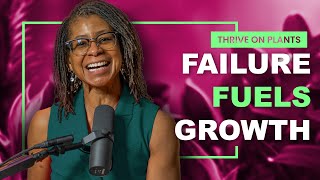
Solo podcast episode (Thrive on Plants) in which host Daphne reframes failure as a necessary and informative part of growth. She argues failure is data, contrasts perfectionism with progress, and introduces a five-step mindset/self-leadership framework called GRACE (Ground, Reflect, Adjust, Compassion, Empower) to respond constructively to setbacks. The episode emphasizes self-compassion, small sustainable adjustments, sharing honest stories to build connection, and actionable next steps to 'fail forward with grace.'
Chapters
Welcome back to Thrive on Plans. Today's episode is personal. It's powerful. And if I'm honest, it's something I still need to be reminded of sometimes. We're diving into a topic that every single one of us faces, but few of us truly embrace, and that's failure. Not the shiny, neatly packaged kind of failure that people post about on their social media feeds after they've already bounced back. I'm talking about the messy, uncomfortable, what the heck just happened? Kind of failure. The kind that makes you question your progress, your worth, and sometimes even your purpose. But here's the truth. Failure isn't the opposite of success. It's part of it. And it's time we stop seeing failure as something to fear, and we start seeing it as what it really is. It's a teacher, a data set, a moment of clarity. So in today's solo episode, we're going to talk about what it means to fail forward, to fall, to learn to get up again with more wisdom, more grit, and more grace than before. Because if you're not failing, you're not testing yourself. If you're not stumbling, you're not growing. And if everything feels too easy, you're probably still standing inside your comfort zone. So if you've ever missed a workout, slipped up on your nutrition, ghosted your own morning routine, not excelled at work like you wanted to, or just felt like you were falling short in any part of your life, this episode is for you. We're going to talk about the data inside of failure, because failure is data. We're going to talk about the difference between perfection and progress. And I want to share with you a mindset framework that I've called grace. And I'm hoping all of this together will. Will help you move from frustration to focus when life doesn't go as planned. Because I don't know about you, but nothing ever goes completely as planned. And let's start with the truth. Every single one of us fails. And that failure can. It can have different magnitudes of swings. We can skip workouts. We can eat things we didn't plan to. We can lose our temperature. We can miss our morning routine we plan to stick to. We can not get the job promotion we wanted. We can not make the career change we are aspiring to. We cannot have the hard conversation that we wanted. We tell ourselves we'll try again Monday, Tuesday, Friday. And then we don't. And yet, despite how universal it is, we. We treat. You know, we treat failure like a character flaw. We internalize it as proof that we're not committed. We're not disciplined. We're not good enough. But here's what I want you to understand. At a core level, failure isn't personal. It's informational. It's not judgment of your worth. It's data about your process. Failure's not proof that you're weak. It's evidence that you're in the game. You're actively pushing your boundaries. You're trying, you're stretching. Because if you're never failing, it means, or at least likely means that you're not trying anything new. You're not pushing boundaries. You're not evolving. You're just repeating the same thing. You're not growing. And that's not why you're here. That's not why you're listening to this podcast. At least I hope not. Because I know that you want to find ways to accept the fact that if you're going to grow, you're going to fail. Failure is evidence that you're in motion. Standing still might feel safe if when we're doing the same thing, it's comfortable, but it's not transformative. Motion is messy. You know, trying new things, doing something outside of your comfort zone, it can be messy. But growth is nonlinear. And when you're making progress, it's not a straight line. There's going to be pivots. And what if we stopped asking ourselves, why do I keep failing? And instead we started asking ourselves, what is this moment trying to teach me? That small shift turns failure from something we fear into something we welcome, something that we can use. Reframing failure is not just about mindset. It's a radical act of self compassion. It means refusing to define yourself by a single misstep. Heck if I. I mean, I have failed so, so many times. It's so many things. But I look back and every one of those failure points was a learning point because I chose to learn instead of loathe. I understood that I'm human, that life is complex, and that I was evolving as I was going through these changes. And let's be truthful, every high performer, every athlete, every leader, every coach, you name it, they all fail. Frequently, deliberately, repeatedly. And the reason why is that the only way to uncover the edges of where you have opportunity to grow and stretch is to find the outer boundaries of that comfort zone. You have to test what works and what doesn't. So what if every time you stumbled, you asked, what is this teaching me? Instead of saying, what's wrong with me? Let's get really honest about Something that is quietly holding many of us hostage, myself included, I guess. And that's perfectionism. Perfection paralysis, as I like to call it. Perfection is often marketed to us as the gold standard, the ultimate goal, the thing to chase if we want to be successful, desirable, high achieving or worthy. And it's worse in this era of social media because what you see on the feed, on Instagram, on TikTok, you're seeing snippets of life. You're not seeing the journey that it took for people to. To get where they are. Let me be very clear. The concept of perfection is a trap. It's a trap because it's unattainable, it's curated, it's filtered, it's not real, but it. It makes us all feel less than because we don't feel perfect. And when we chase something that doesn't exist, we end up feeling constantly behind, disappointed, inadequate. And I'd probably tell you, if that's how your social media is making you feel, turn that stuff off. You don't need to do it. You don't need to have it mess with your head. Because perfection tells you unless you do everything exactly right, it doesn't count. I'm not going to post that picture because it wasn't perfect. Whereas progress whispers to you every small step matters. So what perfectionism sounds like is if. If I didn't have time for a full workout, I'm not going to do anything. I already messed up lunch, so I might as well just eat whatever I want. And if I can't stick to this thing a hundred percent, I'm failing. Does that sound familiar? That's not a strategy for success. That is self sabotage wrapped in shame. Perfection creates an all or nothing mindset. But progress invites a one step at a time mindset. One of the mantras I live by and I teach to every client is progress, not perfection. Because perfection will keep you frozen. Progress will keep you moving and movement physically, mentally, emotionally. This is how we change. It's not about making perfect meals or having a flawless routine, or executing every goal with military precision. Heck, if. If we all execute it perfectly, you wouldn't need a coach. But it's about making choices day by day that align with who you are becoming. That. And listen to that. It's who you are becoming. It's not who you are. And it's not the glossy photo of what you think perfection is. You're on a journey and it's okay not to be perfect on that journey. And the truth is that most people don't fail because they aren't capable of achieving what they set out to. They fail because they avoid the discomfort that comes with the process. And I get it. Discomfort brings up fear. Fear of embarrassment, fear of not being good enough, fear of being seen, of starting from the beginning, fear of not being seen as the expert. Fear, fear, fear, fear. There's a lot of fear that can go in with not being perceived as being the expert or being perfect. But here's the deal that I've learned. The fear of failure is often louder than the failure itself. Courage isn't the absence of fear. And you, you've heard this in people who've attempted and done things far more courageous than I ever have. Courage is choosing action in spite of your fear. Asking for help is a part of our journey. Because a lot of times, and I'm guilty of this, we don't ask for help. And we normally try and push through things alone. Whether it's struggling with a broken leg, whether it's understanding how to use equipment in the gym, whether it's struggling with meeting your body composition goals, whether it's getting feedback on how to take that next step in your career. You don't always have to do things alone. But sometimes it means that you also have to let go of an identity that no longer serves the person you're becoming. All of these are little micro changes, little micro expansions. And these little micro expansions, if they get repeated over time, they lead to massive growth. But part of that element of stepping out of the perfection paralysis is knowing that it's okay to ask for help. So one of the tools that I use in my own life and in coaching hundreds of plant powered women, it's a simple framework that as I was putting together this episode, I've called it grace. And we talk about grace a lot. Because let's be real, when failure hits it, it doesn't feel good. It doesn't feel enlightening, it feels heavy, it feels frustrating, it feels personal. It may feel shameful. And you might be thinking, here we go again. I'll never get it right. What's wrong with me in that moment right there, that should be the turning point. That's when you either spiral into shame or you choose to fail. Forward with grace so when you're in the midst of a misstep, whether it's skipping a week of workouts, whether it's emotionally eating, whether it's not getting that bright, shiny new thing that you wanted, whether it's a job, a boyfriend, whatever you may be aspiring to we don't need more judgment, we need structure, we need grounding and we need reconnection to purpose. So I put together Grace. It's not just a mindset tool to me, it's a self leadership practice. It gives you a repeatable, compassionate, and an empowering way to respond to failure. So grace is G, R, A, C, E. And the G stands for ground yourself. So that means breathe, pause, regulate your sympathetic and your parasympathetic nervous system and remind yourself this is not the end of the story. So get out of your head and get into the present moment. The simple pause gives you the emotional space to observe without reacting. You know, an example is, let's say you had a late night binge. So you were up late. I was working on this podcast, I was writing, and, and because I was tired, I was also eating everything that was in the refrigerator. And there's gonna be. And I'll log it, but there's gonna be some shame that goes with that. And you know, if it happens once, that's okay. If it happens repeatedly. And I know I have a tendency to eat when I'm up late, which is another good reason I like to go to bed early. I need to resist the urge to shame myself and I need to resist the urge to try and fix everything. So instead I'm just going to take a couple of deep breaths and say, I'm safe, I'm learning and I'm still moving. I'm moving forward. That mistake, that failure, it doesn't define me. The next thing I'm going to do is reflect. And I'm going to ask myself, and you should ask yourself, what happened here? What triggered this? What was I feeling? And separate the facts from the stories that are in your head. This is not about blame. It's not about shame. It's about awareness. Why did this happen? Was I tired? Was I over scheduled? Take a moment to reflect. Awareness without judgment can lead to wisdom. And then you need to adjust. Take what you've learned and make a specific sustainable adjustment and make this a small shift, not a giant overhaul. So let's say, for example, I. You missed some workouts. You were scheduling your workouts later in the day because you wanted to do them after work, but consistently your workday got in the way and, and that happens. Instead, adjust. I'll schedule my workouts earlier in the day because work meetings drain me or my work schedule gets in, like in the way of me getting to the gym on time. Or, you know, the other thing is that nighttime eating I mentioned I'll adjust. I'll prep some plant based snacks on Sunday so it'll help when I have that emotional eating. These are not punishments, these are simply refinements. I have reflected on what happened and now I'm making adjustments in order to keep moving forward. And then the C stands for compassion. Talk to yourself like you would talk to a friend. Shame is not a motivator, it's a silencer. And we all learned this from Brene Brown. I'm this is not something that Daphne came up with. You have to speak to yourself from a place of love, not a place of criticism. So you can reframe what you're saying to yourself. Of course you struggled. This is a hard season. Let's figure out how to move forward. You've made progress before, Daphne, and you'll make it again. Or more importantly, one moment, one night, one opportunity is it does not define you. Which leads to E, which stands for empower. Step back into alignment with clarity and confidence. What's that next best action you can take today. Not tomorrow, not Monday, but today. Because progress starts now. So if you missed a week of workouts, use the grace framework and say empower yourself. Okay, I'm going to go for a 15 minute walk today just to reconnect with my body. I'm going to post in the community and I'm going to share what's been going on to help with my accountability. Not shame, but accountability. The reason why grace works is that it meets you where you are without judgment, but it walks you forward with intention. It keeps your nervous system regulated so that you're not going into that alert, high cortisol anxiety, provoked state. It keeps your mindset empowered and it keeps your strategy rooted in reality, not fantasy. And it turns what could be a spiral into a stepping stone. So when you meet failure with grace, you don't lose momentum. So remember, when you meet failure. And failure will come if you're pushing yourself hard enough, respond with grace and grow from it. One of the most powerful things you can do, not just for your health journey, but for your life, is to own your story. Especially the messy, imperfect, raw and real parts. And this means all the crap that you don't want to share on social media, the skipped workouts, the failed meal plans, the weeks where you gave up and the moments that you got back up, the goals you haven't hit yet, the versions of yourself you've outgrown. These aren't detours or mistakes. They're the most important chapters of your evolution and Somewhere along the way, many of us learn that we should only share the polished versions of ourselves. That's. You know, that's where I think social media makes me crazy that you only see the after photo, the highlight reel, the neat tied in a bow conclusion, not the crappy stuff that happened along the way. But that's not where the magic lives. The magic lives in the. In between where you started and where you are. It's the uncertainty. It's the rebuilding. It's the tension of still becoming. And you should feel comfortable telling your truth. Tell your truth about your struggles, because you don't lose credibility by telling your truth. You build it. You create connection. You foster trust. You give other people the courage to face their shadows without. Without shame. And it's easy to think that. And I know we all think it. I'm the only one who can't get my act together. But you're not. The truth is that no one has it all together. Not the coaches, not the experts, not the people you see on social media, not even me. Everyone you admire has struggled. And in some ways, I admire them more for sharing their struggles. Everyone who's successful has failed. And they failed more than once. They learned how to use their failures instead of being defined by them. And now it's your turn. You don't need a perfect story to be powerful, but you need a true one. One with substance, one with soul. One that reflects who you really are, not who you think you're supposed to be. So what would happen if you reread your story not as a list of setbacks, but as a saga of resilience? What if you could say that was the time I learned how stress affects my body. Or that was the year I finally stopped dieting and I started healing. Or that was when I realized that my value isn't based on the number on the scale. Or that was the season that taught me how to show up, even when I felt like quitting. And here's something else that you might not realize. Your story, especially the hard parts, could be the lifeline someone else needs. So when you share how you move through failure with honesty and grace, you give someone else the permission to say, if she can rise from that, maybe I can, too. Because you never know who's watching, who's listening, or who's quietly gathering the courage to begin because you spoke first. So own your truth. Here is my heartfelt challenge to you this week. Don't hide from failure. Don't let it define you. And please don't wait for the perfect time to begin. Instead, I want you to do something radically powerful. Welcome failure in with grace. Sit with it, listen to it, learn from it, and then rise from it. Because every time you get up, you're not starting over. You're starting from a place of greater wisdom, greater strength. Those failure points are data points. So what falling forward. What falling forward. It is falling forward. What failing forward with grace really means is that it means that you're letting go of the illusion that the journey from where you are to where you want to be, it's never going to be linear. It means that it's okay to normalize the missteps and the messy middle moments. It means that you have to celebrate who you're becoming through the process, not just where you end up. And it means that trusting that discomfort, as much as we hate being uncomfortable, it's part of transformation. And that setbacks aren't signs to stop, but they're signals to re evaluate and realign. It means walking forward with grace over and over again. You fail, you fall forward with grace, with intention and with self compassion. All right, that's it for me for today. Fail forward with grace. Failure is nothing to be ashamed of. And I submit to you that if you don't ever fail, you're not pushing the envelope hard enough. If this episode resonated with you, if it helped you breathe a little easier or see yourself a little more clearly, please share it with someone else who needs to hear it. You know, I spent a lot of time reflecting on this, and it was actually I had written a blog post two or three years ago, which I had at the time, or maybe it was a walk with Wing Nan. And I had called it Fabulously Failing Forward. And the same topic came up on a team call last week, and I thought this was a good time to revisit this topic. And to that end, I want to personally invite you or someone that you think would benefit to join our incredible community@thriveonplantslife.com that's where we grow together. That's where we share the wins and celebrate the hard days. We celebrate the progress. It's not about perfection. And we remind each other that no one rises alone. So until next time, keep thriving on plants and living with bold, beautiful purpose, and I'll see you in the next episode. Take care.
The information shared on the Thrive on Plants podcast is intended solely for educational and informational purposes. It is not medical advice, and it should never be used as a substitute for personalized guidance from a qualified healthcare professional. Always consult with your physician or healthcare provider before making any changes to your nutrition, exercise routine, supplement use, or your overall wellness plan. The opinions and advice shared by our guests are their own and do not necessarily reflect the views of the vegan gym or its team. While we aim to bring you high quality, thoughtful conversations, these perspectives are not intended to replace professional medical care. Thanks for tuning in. And remember, you have the power to thrive on plants and live with purpose.
More from Daphne


The Adaptive Fuel: How Exogenous Ketones Support Healthspan | Thrive on Plants #60


Could Yeast Replace Whey? The Science and the Story Behind Spacemilk | Thrive on Plants #58


Why "Eat Less, Move More" Stops Working After 40 (And What Actually Does) | Thrive on Plants #54

Triple Negative Breast Cancer: How She Caught It Early and Came Back Stronger | Thrive on Plants #53