Identity Is Not Fixed: Why Growth Feels Uncomfortable | Thrive on Plants #48
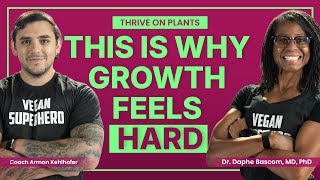
In this episode of the Thrive on Plants podcast, Dr. Daphne Bascom hosts a round‑table with Coach Armand and two members of the Vegan Superhero Academy, Tuesday and Katie, at the annual Vegan Superhero Retreat. The conversation centers on the fluid nature of personal identity and how shifting self‑labels can both hinder and propel growth. Participants share personal stories: Tuesday describes navigating perimenopause, discovering a sustainable fitness routine, and transitioning from a public‑health career to entrepreneurship and yoga teaching; Katie recounts moving from a self‑image of a “chubby, non‑athletic” girl to a confident runner, powerlifter, and aspiring bodybuilder, while also confronting family expectations about weight and social behavior; Coach Armand reflects on reaching a 600‑lb deadlift, dealing with injury, and feeling uncertain about moving beyond the powerlifter identity. The group explores how language (e.g., affirmations, the "I am / I am no longer" exercise), external labels, and physical challenges (Angels Landing, half‑marathons) serve as mirrors for deeper psychological work. They discuss the concept of "choose your hard," the importance of recognizing when a task is a linear puzzle versus a growth‑rich zigzag, and the role of supportive communities and coaching in facilitating identity shifts. The episode concludes with each participant stating a present affirmation and a former limiting identity, underscoring that identity is a tool, not a fixed box, and that embracing uncertainty and letting go of perfectionism can unlock new possibilities.
Chapters
Welcome to the Thrive on Plants podcast. I'm Dr. Daphne Bascom, and I am so excited that you are here with us today. We are in the Pocono Valley. We're at our annual Vegan Superhero Retreat, where we come every year to celebrate the accomplishments of our amazing vegan superheroes. But more importantly, we don't just come to celebrate the accomplishments, we come to celebrate the journey. Because it's not about getting to the end, it's about the path you take to get there. So with me today, I have the amazing Coach Armand, who is one of our coaches in the Vegan Superhero Academy, and he has brought with him two amazing vegan superheroes. And we are going to talk to you about a topic that is not frequently addressed, identity, and what it means as your identity morphs changes along your journey to get to where you are going to be. So let me turn it over to Coach Arman to introduce his two amazing vegan superheroes.
Thank you so much, Daphne Bascom. And I'm actually really excited to talk about this topic, and not only because it is such an important topic, because we have some incredible athletes here today to chat about it. And I have had the privilege of getting to know you guys over the past couple of— past year or so. And see you guys blossom into some incredible athletes. And not that you weren't before, but you guys have some seriously high standards for yourself and love to push and overcome challenges. And I'm excited to hear how identity has played a part in that. And so to my right here, we've got Tuesday, and across there we've got Katie. And I'll let you guys introduce yourselves. We can start with Tuesday here.
My name is Tuesday. I've been with the Vegan Superhero program since March of 2023. I've learned a lot about health, about myself, about caring for myself through perimenopause, about building workout plans and nutrition that supports me. And it's a great program. I'm loving it here. I love all of our activities. I love our coaches. I love the other members. It has been much more than I ever expected to get from a health support program. Awesome.
I'm Katie. I've been with the Superhero Academy since March of 2024. Um, and yeah, like Tuesday said, I have been so blown away by the VSA coaching program. It's been incredible. Like I joined thinking I just wanted to lose weight and I've gotten so much self-confidence through it and lots of like information on strength and nutrition and just really like developing my mental and physical self. So it's been really amazing. And all of the resources, like, it's almost overwhelming how much support and amazing content that you guys support us with. So it's, it's been absolutely amazing.
Yeah, you know, and we appreciate that, but it's— it takes more than just support. It takes you guys putting one foot in front of the other and really putting the effort into your own journey to get your results. So I think that speaks for itself. Awesome. So let's, let's dive into this topic today. And identity is, is a really dynamic and ever-shifting idea. And it's, it's, it can be something that potentially limits you and holds you back. It also can be a powerful, powerful motivator. You know, I think we're all a little bit guilty of this at one point or another of saying things like, you know, I'm, I'm fat or I'm too old or I'm too weak or I can't do this. And that mindset can sometimes hold us back and sometimes limit us. But it can also be a powerful tool. Like, I am a capable runner. I am an athlete. I'm someone who has overcome adversity, overcome obstacles and injuries. Right. And I'm reminded of a story from the book Atomic Habits where they— two people are working on their cessation journey and they're offered a cigarette. And one of them says, No thanks, I'm trying to quit. And the other one says, no thanks, I'm not a smoker anymore. And both of them are in the same point in that cessation journey. So what's the difference? The difference is really in the way that they identify about that cessation journey, and one is more powerful than the other. All right. So I'd love to warm us up here a little bit with asking each of you, what is one word that describes how you feel about yourself today? We'll start with Katie.
Um, I guess open-minded.
It's a great one. Tasty.
Capable. I feel really capable of a lot of things. A lot of things I probably haven't even discovered yet.
Awesome.
There you are. Absolutely. And, you know, let's rewind a little bit. What's one word Um, or what's a, where's, what's a, a word that you would've picked in the past that maybe you don't identify with anymore? Oh yeah.
Limited or anxious.
Entrepreneur.
Hmm. Okay. Amazing.
Those are very different words.
Yeah, absolutely. Yeah. I wanted to ask Daphne as well, or should we just stick with—
Oh, sure. Um, how do I feel today to start with? I feel strong. Um, a word that described me in the past that I no longer feel, I would say uncertain.
Yeah, very nice. I guess I'll answer that as well. Um, I think mine is a little bit different because I've been very sure, and right now I'm in a bit of a period of uncertainty as I transition from a previous goal and identity and mindset into something new, which is a little bit unknown. So we're still trying to figure out what that is. Awesome. So I'd love to start with Tusti here because we did have a similar conversation last year around identity, and I'd love to just hear a little bit about how it's shifted and changed over the past year.
Honestly, I don't remember last year, so we'll start with that. But me not remembering the particulars or the details of last year is actually very rewarding It means that I've moved on. I'm not dwelling on the past. I'm looking forward. I'm not looking behind me. So that was last year. Now we're here. I do remember, though, toward the end of last year, I finally figured out what type of physical fitness program worked for me. And I spent the first 8 months of VSA trying to work that out. And it was tough. Before I even entered VSA, I was trying to figure that out. I am perimenopausal and hormones changed. Everything changed. Everything changed. And the things that I had done before to keep myself motivated, keep myself in shape and feel good, it was just all different. The old things, they didn't work, but I didn't know what the new things were. And it took me well over a year to figure out what the new things were. And I think it was about November, December last year where I finally came to that and kind of solved that puzzle. And I remember talking with Armand about it call after call, call after call, just trying to, um, when I would discover something new and what I should and shouldn't do. And I was used to doing a certain number of workouts per week and it was wearing me out. It was just, it was kicking my butt and I was not recovering well. And because I wasn't recovering well, I couldn't be as consistent as I felt I needed to be because I was too tired. And thank And thankfully I was smart enough to give myself grace and not push and continue to try and work out even though I was tired. But I was still frustrated because I wasn't being as consistent. I didn't have a regular schedule. I couldn't count on myself getting up at the same time on the same days of the week to go for my workout because my recovery wasn't where it needed to be. So once I figured out that puzzle and developed a routine, amazingly all sorts of other things started to fall into place, things that I don't even think most of us think are really even attached to one thing or the other. So all sorts of things that aren't even related to my nutrition or my physical health started to come together, and I developed clarity around that once I came to the solution for what my physical fitness should be.
That's amazing. Thank you for that. And I think you bring up an important point is sometimes you have to let go a little bit. Of something to be able to go further. Right. And it's, it's cool that identity is something that changes so much. It's— I think ideally, you know, we all want our journeys to go up and up and up, but that's just not the case. Sometimes it goes backwards, sometimes it goes down. And, and that's something we have to be okay with because ultimately it's all part of the process. And the lessons we learn when it's going down are ultimately going to help us you know, go even further when we're on the way back up. Right.
And also acknowledging that sometimes you have to let go of what doesn't serve you anymore, which can be hard. Yeah.
So Katie, I'd love to hear a little bit from you just on what identity means to you and, and if that's something that, you know, you really thought about, you know, a year or so ago. And, um, if, how much that you think about it now.
When you mentioned the Atomic Habits quote, like, where they ask the smokers of— or the non-smoker and the people trying to quit. I think about that line all the time now, um, because it's so, so powerful. And I definitely didn't think about identity before joining VSA. I mean, maybe a little bit here and there, like, um, in my personal life, but not necessarily with, like, fitness. And, um, yeah, it's kind of crazy. I have never ever identified as an athlete, like very much the opposite. Like I identified as like, oh, the chubby girl that cannot do any sports. Um, so my identity has completely shifted and now I view myself as somebody who really cares about my health and it's kind of crazy because like the people around you notice that too and they're like, oh, you have a health question? Oh, go ask Katie, which is like so wild because I'm like, my high school self or middle school self would be like, they were asking you like what you should make or what you should do for a workout. Um, so yeah, it's, it's pretty cool. It gives you a lot of self-confidence and Yeah, it kind of puts you at ease a little bit. And like listening to Tuesday's answer too, um, it's calming to know that just because you're changing or pivoting what your main focus is, you can still like allow that to happen and allow, you know, yourself to grow and change. And it doesn't mean like you're you're losing something that worked for you before. Like, you're just accepting something else that's going to work for you now.
Absolutely. There's no limit to who and what you can be, right? Only we tend to limit ourselves.
Exactly.
Yeah. So I'd love to also hear, Katie, and if, if you felt like identity was something that did hold you back in the past, and, or even if it still does now, and How do you catch yourself in those moments and, and, you know, ground yourself and, and come back to the answer that you just gave?
Yeah, so like I said, I think, um, my identity in the past was very much like, oh, I'm good at like non-athletic things, like I'm good at art, I'm good at school, but I'm— I shouldn't be like trying to put myself out there trying physical things. That's just not my strength. That's not my area of expertise. And now I definitely have a lot more confidence that like I can, I call it like I can handle myself in life now. Like if I was out on my own and needed to, I don't know, like climb a mountain or something, or I was in a car crash and I needed to get out of the car, like I could do it. Um, so it gives me that kind of like reassurance that I can handle what life has to throw at me. Um, when I think about if I still kind of identify with a limiting identity, um, yeah, I mean, definitely. Like, I for sure struggle with, uh, if I'm not like totally hitting every single thing that I set out for myself that week. Like, oh my gosh, I just failed. Like, I'm actually not consistent enough, or not, um, uh, what's the word, uh, not determined, but, um, disciplined enough to get what I want, like achieve the goals that I want. Like, man, if I don't hit it every single day, that means I'm just not working hard enough and I can't achieve those goals. But that's not the case, and I know that. So a lot of times I just have to like I guess, look at the past things that I've been able to accomplish and know like, okay, I wasn't perfect when I did those things, which means I don't necessarily have to be absolutely perfect when I do these things.
That was very well said. No one, no one is perfect, right? And, uh, I think, you know, most, some of the most successful people struggle with some of these same things of, of, uh, you know, doubting themselves and and making mistakes and feeling like they have to start over potentially, right? So yeah, we're all human and we're all, you know, on this journey to grow and grow and grow. So thank you for that.
And Katie, if you don't mind, what you started by describing physical strength, but what I really hear you talking about is mindset and emotional strength because you probably could have lifted the car before, you probably could have climbed the mountain, but now you believe you can.
Yeah, that's so true. It's definitely crazy. Like, you don't even try because you think that you can't do it, and now I'm like, you're right, like, I probably could have done maybe 80% of what I'm doing now, but I didn't think I could, so I didn't even go for it.
Exactly.
Yeah, yeah. The goals that we are setting for you now compared to the goals that we set in the beginning. I mean, seriously, stark contrast.
Climbing Angels Landing, running road races.
Yeah.
Amazing. So, Tuesday, we've had some, some big revelations, I think, in this, in this past year about who you are and what you want. Can you, can you tell us a little bit about that? What was the defining moment where you realized the identity you needed to change?
The defining moment for me was actually at the Momentum Retreat in February. As a group, a small group of us, Katie included, we went to Utah to climb Angels Landing. And I prepared for that. I worked hard on it. Armand was very supportive in my daily wrecking and came up with a really great plan for me that I admittedly did not follow to the letter. But I was about 75% on it, but I spent a lot of time preparing for that because I wanted to do it. I wanted to climb all the way to the top. I didn't want to have any doubts or reservations when I got there. And I did that. And after that activity, when I came back down the mountain, we all talked about what we realized. I realized that I did not need to climb that mountain. Physically, I didn't need to climb that mountain. I, I was totally physically capable of doing it. It wasn't even a great physical challenge, but it was an incredible mental hurdle I overcame. Like, if I hadn't climbed the mountain, I wouldn't have discovered what I discovered, that I didn't need to climb it, right? Was that like the butterfly effect or something weird like that? But What I realized is I had been using physical goals and fitness goals as complete avoidant behavior. Um, and there were other things that I needed to work on that had nothing to do with my physical capabilities. The time and energy that I had spent getting up early, putting on that weighted vest and like walking 5 miles was time that I probably should have spent developing a comfort level with doing exactly this, which is being on camera and recording myself to promote my business. And in training for hiking up Angels Landing, it was really easy to get distracted by that because so few people have been able to do it. And so people, many people know about it. They've seen all the videos. They know people who've done it. It's gorgeous. It's beautiful. It's difficult. And as I was telling people what I was planning to do, all of the feedback was uber positive. Oh my gosh, that's great. You'll have to send us pictures. Wow, how's your training going? This, that, and the other. And so because the feedback was so positive, it just put me in this infinite loop of, yes, I'll work harder on this. I'm proud of myself. This is a goal that anyone would be grateful to be able to go and do. Meanwhile, there was a whole other shortlist of things that really I should have been putting my attention toward because there are things that I need to do and then things that I'm not comfortable with. And so I had kind of just been, you know, doing something that was actually easy for me to do. Not easy in the physical sense, but easy mentally. I have the discipline to follow any plan that I'm given and train for something and hit the mark. I can do that without effort. As long as I have a plan, I'll follow the plan and I'll do it. Me promoting myself, getting in front of a camera, doing what I'm supposed to do, being consistent with it, not so much, not at all. And so at that retreat, we talked about what was next. And I committed that day to not go on any additional extremely physically challenging retreat. And that— and I'm— and I, I'm not signed up for anything else. Um, I'm not— I'm not signed up for a competition. I'm not signed up for, um, any of the additional retreats that have physical challenges. There are no physical fitness goals on my calendar other than to maintain the consistent thing that I'm doing because it's a distraction. For me, quite honestly. I love to do it and it's fun, but it's a distraction and I could be spending that time working on things that are beneficial to me and can help me grow and expand in a different direction.
Absolutely. Yeah, it reminds me of the quote that, "Gym teaches you life." And sometimes it's, if you know, a physical challenge that makes you realize that it's actually the emotional challenge that you really needed. Right. That's amazing. And what would you tell, you know, both your past and future self?
My past self, great job, girl. You did it. You did some things that others probably thought you couldn't do. I don't know. I don't know that anyone's ever told me I couldn't do something. So if they did, I was totally deaf to it. So Move on, try something else. If you've done it before, try something else. Um, I've tried a lot of new things over the past year. Um, changing my mindset and just accepting that, um, I have other skills and talents, some I'm aware of, some not. Just opening my mind has actually opened opportunities. A number of things have literally fallen in my lap that I have didn't know that I wanted or needed, did not ask for, but I've been approached with and I'm like, "Oh my, okay, sure. I'll try it. Let's do it. We'll see what happens. I'm terrified, but that's all right. It's not unsafe.
It might be weird, but as long as it's not unsafe, 9 times out of 10, I'm just, I'm trying to say yes and go with it and see what happens." What, and Juicy, if you don't mind my asking, what changed at the Momentum Retreat because a lot of people go on retreats and they don't have that understanding that I need to do something different going forward because it's easy to do things that you're comfortable with. It's easy to do things that you are successful at. As you said, you could, you know, we can do rim to rim, you could do rim to rim minimal hiking. So setting additional physical challenges that would be easy for you, but you stepped over the line out of your comfort zone. How did— and a lot of people don't get there. What light bulb went on at the Momentum Retreat that you just said, it's time?
The light bulb for me, I think, was that even though Angel's Landing was something that I had not done before, the process for getting there was the same. So, I didn't learn a whole lot from the process. I learned a lot from actually doing the thing. But when I reflected on that, I think, okay, I mean, you know, I would— Armando could put together another plan for me to do rim to rim or whatever. And the process is not going to look that different. It's probably actually not even going to be all that fun because it wouldn't, it wouldn't bring a whole lot of new things to me. And so I think, I think that was it. It was, it was like, well, there's, I didn't get a whole lot of new stuff about getting here. There in the moment, it was great, but the process of doing it, um, there wasn't a whole lot. To it. And I can see that now because I've done some additional things since then that I had not done before. And I'm excited about the process of figuring it out, of the puzzle. There's no puzzle to me hiking a hike anymore. There are puzzle— other puzzles that I've started working on. So I guess now going forward, I know maybe that's part of the litmus test for whether or not I say yes or no to something is, is this an actual puzzle? If it's a linear process, if I'm going straight from point A to point B, maybe not. Maybe it has a lower priority. If there's a zigzag involved or even I can't even see the endpoint, then that's probably something that, that's a direction that I need to go.
Awesome.
Absolutely. It's like a choose your hard, right? Yeah. Like you've, you know, you can accomplish those physical challenges, but these, this whole putting yourself in front of a camera, it's scary. It's new. And That's the challenge that you, that you seem to really need now. Right. Thank you so much. I, I recently hit a big goal in my powerlifting career, and I'm in a weird kind of limbo where I don't know what the heck to do at this point. And I'm struggling because I feel like I have to let go of this identity as a, as a powerlifter. I know that's not necessarily true, but it also could be, and that could be okay. I don't really know what's next for me, but I'd love to hear from you guys, like, what's the hardest part of letting go of an identity? Start with Katie.
It's uncomfortable because you just don't know, like, what you're supposed to be and you have this kind of like old set of expectations in your head of what you're supposed to be doing, and if you're not doing those things, does that mean like you've kind of lost your discipline or you don't really know what you want? Um, I relate to your like being in limbo and in this kind of like weird area of uncertainty because I feel like that happens to me like every few months where I'm like, oh, okay, I am not really like— this isn't serving me anymore. Um, this goal or whatever I happen to be like doing and trying to stay consistent with. So yeah, it's, it's tricky.
Yeah. Sometimes I feel like, you know, in powerlifting there's almost no end in sight. You know, I hit a goal, but I could go further. So it kind of feels like I'm giving up to a certain extent, right? Like, why, why stop now when I'm, when I'm on top? Um, but it also feels like I've, I've done this challenge. It's not, it's not challenging enough anymore for me. It's not what I really need to grow further as a person. And that's kind of the realization I'm coming to is that I need to challenge myself in a new way. And I feel like that's similar to kind of the story Tussey has told us as well.
Armand, do you mind just telling the audience what your goal was, how long it took you to achieve it? Um, and then How comfortable— I mean, everyone knows you as the powerlifter. So what was your goal? How long did it take you to get there? And like Tuesday, you could go linearly to the next.
Yeah. Yeah, absolutely. So my, my goal was to hit 600 pounds in the deadlift. And, and I did do that and it was, it was great and I was happy for a couple of hours. Right.
Yeah.
And so I mean, I had a lot of obstacles. I broke my foot. I couldn't walk for 3 months and couldn't really train for, you know, a couple of months. I was doing what I could. But the past 5 years have been really slow progress. And I think that's something that's hard to deal with, you know, especially when you're putting in 110% effort every single week to see very, very little progress. Um, and I think, what was the other side of your question?
How are you? I wanted to you to reflect on the same questions that you've asked Tuesday and Katie, which is where are you in the process of letting go your past identity? And, and you maybe you don't know yet because similar to Tuesday, you've reached the mountain. You've climbed to the top and now you have to figure out, okay, do I just go further up the mountain or do I choose a different mountain to climb?
Right.
Yeah. I think I've held very strongly to this identity as a powerlifter, but I want to go broader than that. I want to be someone that's more than just a powerlifter. You know, I love the identity of being a coach, of being someone that that helps others, right? I think I get a lot of, I get a lot of passion and satisfaction out of seeing others grow. And that's an identity that I can, like, I can always have. And I think that's, that's something that is what I've been trying to shift into is, you know, what's something that has no end that can serve me for, for longer, right? And I do love these deep progressions and something that has a you know, something that I can, I can progress at over long periods of time. So yeah, I still don't know. I don't know. I'm, I'm, I'm trying to figure it out. I think it goes to show, you know, even 13 years into, you know, a fitness journey that you might have these moments of uncertainty and trying to find, you know, a new direction.
Thanks, Arman.
I'm curious to hear, you know, what is maybe a label or an identity that other people have, you know, placed on you in the past? Maybe it's something that looking back on it now just kind of makes you laugh. But, um, yeah, I'd love to hear that.
That's a good one. Um, one that I have talked to Daphne Bascom before is just like your family kind of convincing you of what you can and can't do. Um, the women in my family have always struggled with our weight, and I was told that I would always struggle with my weight. Like, oh, you're from like stocky Nordic, like, thick women that we survived, and that's why our ancestors are here. And you know, like, you're always gonna struggle because that's in our genetics. Like, you're, you're meant to be like thick and, and hearty. Um, so I think I've really had to like overcome that mental barrier of like, no, I'm not destined to be a certain way or have certain capabilities. Like, it was kind of also like, oh, you probably aren't going to be super athletic, and super, you know, whatever. Like, uh, also told like, oh, you were such a shy kid, so you're probably just gonna stay shy forever. And that's something that I'm starting to realize now, like, maybe I'm not as shy as I have told myself I am. Like, maybe I can be more social. I'm very naturally introverted, and I do know that about myself. Like, that's, that's true, but it doesn't mean that I can't enjoy like being in groups like this, like with all of these awesome people. And I kind of convinced myself like, oh, I, I don't want to go and talk and socialize, like that makes me too nervous. But like, does it actually? Like when I do it, I enjoy it. Like I like hanging out with you guys and meeting everybody and kind of like, oh, once you're doing it, you, you kind of calm down. So I think, yeah, the expectations that other people have of you and how you're supposed to act and behave, um, are really hard to overcome because you also don't want to— like, somehow you don't want to disappoint people, even if it's like a bad expectation. Like, oh yeah, Katie just goes in the corner, like, don't— she doesn't talk to anybody. And you're like, okay, yeah, I'll go in the corner and not talk to anybody. But you know, it's, it's hard to, um, buck other people's expectations of what you're supposed to be doing.
Absolutely. I think it says more about others than it says about ourselves when we, when we hear these things, right? It's, it's more that they don't think that they're capable of it. Right. And, and, you know, I identify with that as well quite a bit where I, I feel like I'm bad at running or I'm not a runner. And this is also potentially a goal that I'm picking up now. And because I want to change that rhetoric, I want to change this idea that, you know, maybe I'm genetically not, you know, gifted to or destined to be a runner. And these are silly, silly phrases, right? Anyone can do almost anything. You just have to, you know, put some effort and time into it and you can get there. And, you know, maybe next year I'll be saying that I am a runner. And yeah. And what about you, Tusti? Same question. You want me to repeat it?
Yes.
Yes.
Um, how have others, you know, shaped and maybe labeled identities on you that, you know, maybe made you laugh now, or in hindsight, but potentially kind of held you back?
Uh, being strong. I've always been physically strong. Um, I was the tallest kid for always. I was a big kid. And so being an athlete was a given, or so everyone else thought, but not for me. I did not enter into being an athlete until I was in the 9th grade. And my mom tried desperately to get me to participate in something physical when I was little. It was, you know, "Do you wanna play T-ball or baseball or something?" And I resisted vehemently. I don't even know, I didn't have the vocabulary to say that I wanna be more than just the big kid, but I think that's what the message was. Basically, like, why, why should I have to go out and do this physical activity just because everyone thinks I have the body that's built for it? And so I didn't. And I behaved badly in some cases. My mom put me in a tap dance class once and I was a jerk at every lesson. Did not— it wasn't good. And oddly enough, my mom doesn't even remember. I showed her a picture of it and she's like, "When is this?" Like, you don't remember this? This is like the single worst experience of of my childhood having to participate in this and wear this silly outfit. So I fought it for a long time. And in 9th grade, I finally started playing basketball. And I don't even know why I said yes, but I did, and I enjoyed it. But it wasn't just the physical part of it. It was really the community and the friendship. I played all year round with the same group of girls. So I played in my school team and, you know, summer league and everything. And it was fun. And through that, I discovered that sport was a great way to be social because I am an introvert, but it kind of gave you built-in friends. You knew you had a common interest. You were going to have to spend a lot of time with these folks. You would have somewhere to go and everything. So, I entered into accepting that I was an athlete. Like, I didn't even struggle with playing. I was just resistant to following the stereotype I had been given because of my physicality. But over the years, um, I've totally embraced being strong, and I, I am, I am an athlete, and I've gained so many great friends and relationships and lessons through participating in various activities. So, um, I am strong. I, I go with that now, but not for the reasons that the label was initially given to me, not just because of my size. Like, I'm strong in the fact that, yes, I, I'm a large person, I have a lot of muscle mass, I'm very capable. But I'm also strong in the fact that I will enter into a new situation and try a new thing, even if it's unfamiliar, which to me is more important and also more personally gratifying. Um, like you, Katie, people used to say I was shy when I was a kid. I was not a shy kid. I didn't talk a whole lot, I was an introvert. I was the only kid. I was not shy. I know I was not shy. And I think I knew I wasn't shy when people said that, but I was like, okay, if you say I'm shy, fine. I don't have to bother with you. You're not going to talk to me. Leave me over here and I can play with my Legos. So that worked to my advantage. But I think you all know Tusti is not shy by any stretch of the imagination. But yeah, yeah, I kind of went with it. So I'm not that, and I am strong and I am athletic, but I think the— the way people think of, the way they define strong and athlete when they apply it to me, I don't receive the definition. My definition of those words for me is different.
Well said. You know, I kind of asked this a little bit earlier, but I'm curious now that we've unpacked identity quite a bit here, how do you see that playing a part in the future? In who you could potentially be? Tuesday.
Oh, I'm first. Well, I mentioned before that now I see myself as an entrepreneur, which I did not see myself as that maybe 5 to 10 years ago. When I finished my college and graduate school education, I very much saw myself going to work for a government agency and work in public health education because that is what I had studied. And, you know, I was gonna do that and I did that and I still do that. Like, that's still my primary career. I've been there for a couple of decades, but I started a business some years ago and like 3 years ago now, 4, I don't know. I'm not, I have not been keeping track, but if someone had asked me 10 years ago, what would your ideal business be? What would you do for a business? I'd be like, I wouldn't. I'm not doing that. That's— it's really hard. You have to do so many things yourself. You have to learn so many things. You have to do a lot of things that you're probably not good at, but you got to do them anyway for the sake of the business. But a few years ago, I started practicing yoga and I discovered that I'm actually a yoga teacher. Who knew? I didn't know. My teacher knew and she told me I was a teacher. Turns out she's right. So I'm a yoga instructor and I started a business as I grew in my yoga practice. Based around the things that I really enjoy about yoga. So, and then from that, I somehow got roped into hosting a yoga retreat in Cozumel a few weeks back and didn't see that. That was not on my bingo card. So, there's all sorts of things that have come up and landed in front of me that I didn't anticipate that have pulled me to grow in different directions. And I don't remember the question.
That was a great answer for not remembering the question.
Okay.
Um, yeah, in, you know, I mean, I guess you answered it well, honestly, but it's— I was just curious, um, you know, now that we've unpacked it, you know, in the future, do you see your identity changing again? You know, do you, do you see you using the power of identity to continue to fuel your journey?
Absolutely. Yeah, yeah, yeah. One thing that I've definitely come to realize is that I have made good choices about the people I keep in my life. And if they tell me I can do something or I should try something, even if I doubt it, I'm gonna trust them. I know that, that I can trust them. So I may have a bazillion doubts, I may be scared, I may be shaking in the moment, but if Armand's like, hey, Tusi, you got it. All right, fine, Armand said it's cool, so I'm just gonna go with what Armand said. I'm just gonna shut my brain down and I'm just Tuzi, you be quiet. Armand's in charge right now. He say you can do this thing, do it. The same if Daphne told me I could do something. My friends at home, if they're like, "Tuzi, girl, you got this. You can do it." Okay. All right. I've made good choices about the people that I know. They know me well. So yeah. Yeah. Okay. Yep. Trust others. I think trust your cheering squad. Trust your fan club. Nine times out of 10, the fan club, the cheerleaders, they really do want what's best for you. So trust them, even if you don't trust yourself.
Awesome. That was very well said. Yeah. Yeah, I think that's a good kind of final question is what lessons have identity taught you and how are you going to take that into the future, Katie?
Yeah. Um, so I, as I'm listening to Tuesday, I keep like, my mind kind of goes back and forth of like really relating to what she was talking about. And at the Momentum retreat, when you stood up and you said that to everybody, we were all like, oh my God, I do that too. Like you do sometimes use like physical challenges and stuff to kind of distract from other parts of your life that you wanna work on. And for me, I kind of struggle. I went to school for mechanical engineering and that's like what's been my job this whole time. And so my struggle is kind of, should I keep climbing up that mountain and like working on that, or should I try to pursue other interests that I have? And same goes for my fitness journey. I started out just wanting to work on being healthier. And then I got into running, and now like somehow I enjoy running, which is crazy. And I consider myself a runner, which is also crazy. I never thought that that would be the case. And now like literally the last 2 weeks, we've started working on a bodybuilding plan, which is absolutely insane. Never ever ever thought I would do that. And I think, um, I'm still kind of struggling with, with that as an identity thing. Like, that's— I'm resisting it because it just sounds like so not me. Um, but I'm excited for the challenge of it, so I'm, I'm being open-minded about it. Um, but it is uncomfortable and different. Um, but yeah, very excited.
Damn, you ran a half marathon.
I did. Yeah, it's crazy. I can't believe I did that. And it was fun and I want to do another one.
It's, it's so cool to see, you know, that we— it's almost like we have— it's limitless now. We— who can we be? We can be anything, right? And sometimes it takes, you know, breaking down our identity to realize that we can be so much, right? You know, identity doesn't have to be a box that defines us down to the nail. It should be a tool. That, that helps push us forward. Right. And, you know, I think Tusi said something really cool is, you know, having a support system that just reassures you that you are on the right path and towards becoming whoever you want to be is also really important. Right. And coaches have, have coaches too. And, you know, I think, I think that's powerful. I think these, these are difficult obstacles to overcome. So Having that support system can be really valuable.
So I have an app that I, I have a couple rituals, but one of the apps I have is an affirmation and every morning it says, I am. I would like to ask, starting with Katie, then Tuesday, then Arman, if you could complete this sentence, actually two sentences. First, I am. And the second, I am no longer.
I am grateful and I am no longer trying to meet other people's expectations.
Love that.
I am ready And I'm no longer doubtful.
Awesome. Tasty.
I am a leader. Um, and I'm no longer afraid.
I love what the three of you just said. Yeah. And those, I know I would say years ago, I used to think affirmations were woo-woo. But they can be so powerful. And even just every morning getting up and telling yourself and reminding yourself of what you just said, that's huge. And it's probably, those probably aren't affirmations you would've used a year ago. So our journeys are not linear. And I love what Tuesday said earlier about if it looks like it's very linear, maybe that's not the path I wanna follow. Maybe I need to take, I need to go where there is no path and leave a trail, which is hard in life because no one wants to feel like they are not successful. Because some themes that I heard as we wrap up today, perfection, we talk about perfection paralysis a lot on The Titans. And that you can't be paralyzed by wanting to be perfect because none of us are perfect. You also, Katie, it was funny because when you were talking about being put in the corner or Tuesday, I was thinking of Dirty Dancing for some reason. Um, nobody wants baby.
Exactly.
But don't let people tell you who you are. Um, because otherwise you become limited. That, that is their limits on you become your limiting belief. And stepping outside of that comfort zone, it's hard because everyone sees me as the stocky person, or everyone sees me as, you know, not the yoga teacher, not the entrepreneur, but you can. Um, I am and I can should be things that you say to yourself constantly. And Arman, you are a leader. Um, you step up all the time within our organization and you will continue to grow as a leader. And none of us should be afraid because I think one thing that I hope everyone takes away from working with a coach like Armand or being part of the Vegan Superhero Academy is fear is actually a good motivator. And if you're not stepping into that zone of discomfort, you're probably not challenging yourself enough. And I hope that when we bring you back next year, that your growth over the year, you know, learning more about Tuesday, where you've gone with your business, and you're a natural in front of the camera. You're much more comfortable than you were last year. Same with Katie. Um, first time you did this was spring when you were, you could see the nervousness, but now you, all three of you have skills strengths that are yet untapped. And so your identity will continue to evolve. This is coming from someone 20 years older than you who have— has been through 4 or 5 different identities. But don't limit yourself because you can be whatever you choose to be, and you have all of us supporting you on your journey. So for those of you listening, or watching, I want you to say the same thing. I am, and I am no longer. And then don't allow anyone to define the boundaries of what you can become, because those boundaries are limitless. And yes, it's scary. It's, it, it's scary to think about trying new things. It's scary to think about not living up to people's expectations. It's scary to think about failing. But as we always say, fail fast. Failure is not an inevitability, and failure is not bad. Failure is something that I think we judge ourselves on. But if you're not trying something new, then you're not going to evolve the identity into what you actually can become. And we are here to help you. We're here to provide examples that you can aspire, and we hope to inspire you to aspire to be all that you can. So Armand Touzdi-Kady, thank you so much for joining us on the podcast today. Uh, we really appreciate what you've shared. I know that you're going to motivate others to think about what they can become and that identity is not fixed. It's, you know, just like going in, putting in the reps in the gym, the more reps you put in on growing that identity, the stronger you'll become. So thank you. The information shared on the Thrive on Plants podcast is intended solely for educational and informational purposes. It is not medical advice, and it should never be used as a substitute for personalized guidance from a qualified healthcare professional. Always consult with your physician or healthcare provider before making any changes to your nutrition, exercise routine, supplement use, or your overall wellness plan. The opinions and advice shared by our guests are their own and do not necessarily reflect the views of The Vegan Gym or its team. While we aim to bring you high-quality, thoughtful conversations, these perspectives are not intended to replace professional medical care. Thanks for tuning in, and remember, you have the power to thrive on plants and live with purpose.
More from Daphne


The Adaptive Fuel: How Exogenous Ketones Support Healthspan | Thrive on Plants #60

Could Yeast Replace Whey? The Science and the Story Behind Spacemilk | Thrive on Plants #58

Why "Eat Less, Move More" Stops Working After 40 (And What Actually Does) | Thrive on Plants #54
Triple Negative Breast Cancer: How She Caught It Early and Came Back Stronger | Thrive on Plants #53