The Inner Battle: Body Image, Hormones, and a Warrior Mindset | Thrive on Plants Podcast Episode #16
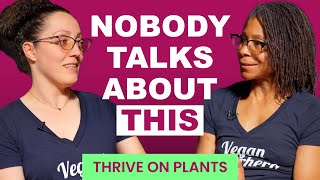
Podcast episode (Thrive on Plants Ep. #16) in which Dr. Daphne Bascom interviews vegan community member and nurse practitioner Sarah Katkuda about her personal health journey. Topics covered include long-term eating disorder (weight drop from 130 to 89 lb), autoimmune/connective-tissue history (acute kidney failure at age 13 with creatinine 3.5; positive ANA and antiphospholipid antibodies → undifferentiated connective tissue disease), transition to a vegan diet (~3 years vegan), pelvic pain for ~12.5 years ultimately diagnosed as pelvic congestion syndrome (first seen by pelvic pain specialist Sept 2024), major surgery (hysterectomy with oophorectomy and salpingectomy) on Dec 20, 2024 leading to surgical menopause at age 39, initiation of estradiol patch at surgery and later addition of progesterone and testosterone via menopause specialist, recovery (~90% pain relief at 12 weeks), return-to-movement/coaching and plans to work in midlife women's health (MIDI Health) and telehealth primary care. Episode emphasizes self-advocacy, gaps in women's healthcare, and interplay of nutrition, hormones, and mental health.
Questions this video answers
December 20, 2024.
September 2024.
About 12.5 years.
39 years old.
Almost three years.
Chapters
Today, I want to talk about a topic that is near and dear to my heart. Women's health. Women's health is something that has become a more popular topic recently, especially when we're talking about premenopause, perimenopause, and post menopause. But there are so many aspects of health care that underserve women in general that we could have a whole podcast about that. But today, I want to share, share with you the journey and the story of a very special woman, someone that I've come to know and respect and whose journey and story exemplify the struggles that many women have both with their health and with their journey through the healthcare system. I'm Dr. Daphne Bascom. Welcome to the Thrive on Plants podcast. I'm excited that you're here with us today. I am even more excited to share with you a special guest, one of our vegan superheroes, Sarah Katkuda. Sarah, welcome to the Thrive on Plants podcast.
Thank you so much. I'm so excited to be here.
Thanks a lot. So we talk a lot, and we have had many opportunities, and first of all, I really have admired everything that you have brought to the Vegan Superhero Academy.
Thank you.
And maybe you could start by sharing a little bit with our community about who you are, what brought you, what does your vegan origin story, and what brought you to the vegan Superhero Academy.
Yeah, of course. I am a mom of two young girls, one in middle school, one who will soon be in middle school. It is busy. I work as a nurse practitioner, have been now for almost six years, working from home. Honestly, love it. It's great. But I have that firsthand experience in healthcare as well as being a patient, and it is truly an interesting journey when you experience both sides of things. As I have navigated through the healthcare system myself, I struggled quite a bit with multiple health issues. And that led me to really start looking into things myself, really start exploring my own health, how I could help myself. And hearing from my family that there's a really high risk of heart disease, I decided, hey, I'm going to convert and go vegan. And I was already an athlete. And being someone who has a history of an eating disorder, I told myself, I cannot do this by myself. I need support. I need someone who will keep me from slipping. So I googled, literally googled vegan athletes, vegan sports, vegan diet, and I landed on the vegan gym.
Okay, awesome. And how long have you been vegan?
Almost three years now.
And do you mind sharing a little bit with our community about the nature of your eating disorder.
Absolutely no problem. I started really struggling with my disordered eating and challenges around food in high school. It is actually kind of interesting because I had a friend who had an eating disorder and they say that eating disorders can be competitive. I am not certain that that played into things though. My family would tell you that it did. I just honestly wanted to get healthy. At one point in time I did have a lot of body image issues. I struggled quite a bit with some trauma throughout my life, felt really insecure in general and was trying to be the perfect person so that perfectionist personality. And then my mom was diagnosed with an autoimmune disease and I was diagnosed with an autoimmune disease and my mom went on this processed carbohydrate restriction and then she started going through menopause and she restricted even further and I was like, oh, I'm going to do this with you because it must be healthy. There's all these diet recommendations out there for anti inflammatory diets and ways that you can help your body with, you know, changes to your diet. So I thought, hey, why not? My mom's doing it, it can't be bad. The problem is, as someone who has worked in the eating disorder field for the last two years, I have learned that there is like a predisposition as well as almost a switch that gets turned on once you lose a certain amount of weight. It's like that eating disorder just takes control. And so I started slipping and I would say now knowing more about eating disorders would have diagnosed myself with otherwise specified feeding and eating disorder. And eating disorders. Yeah, OSFED is what they call it. But it looked a lot like anorexia nervosa, binge purge type. I dropped from 130 pounds to 89 pounds in a matter of three months. And I'm five foot eight. So I went down to wearing a size zero and it was falling off of me. I was in college, I was in my first year. Leading into that my parents had said to me, hey, you're, you're transitioning in life, you're going to college, it's going to be hard. We don't want you to do sports, we want you to focus on school. So with my history of trauma, my perfectionist personality, I went, whoa, I need sports. And they're telling me what I can't do. Okay, I will control everything. And so there was a piece of it that was control as well. Unfortunately, it landed me in a really challenging situation. My mom ended up coming and Secretly sleeping on my dorm room floor and showering maybe once a week. Massive sacrifice for a parent because she was worried I was going to stop breathing in my sleep. So that actually went on for about 10 years. I gained some weight back and I maintained around probably 115 pounds for a long time. I struggled with my eating disorder through my pregnancies and postpartum and finally hit a point where I went, I need to get better for my children. It wasn't about me. I still didn't care about myself. I needed to be around for my kids.
That's a long journey. Yeah. Yeah. During that time, you know, just expanding on your inter, you know, your interaction with the healthcare system, were you able to find health with behavioral health therapy or any type of mental health therapy?
Yeah, that's a great question. So unfortunately, the eating disorder treatment world is really challenging to navigate, even as a healthcare provider. And I was living in the Middle east where mental health at the time wasn't treated like it was anything Understood. I was here in the US for college, but I went back to live with my parents after my first year and did some online courses so that I wouldn't have to miss out on any college. And I went to see a psychiatrist. My dad is Middle Eastern and doesn't believe in mental health conditions, or didn't at the time. He does now. He didn't at the time. So I was begging my parents to find me a psychiatrist. Find me a therapist. I needed to see someone. Unfortunately, part of our relationship struggles led to a challenging selection of a psychiatrist who he had to approve of. And at one point I felt like what I was sharing was getting back to him. And it was just, I lost all trust when I walked into that office one day. The psychiatrist looked at me and said, I'm taking you to the hospital. His office was right next to the hospital. So he walked me right over to the behavioral health floor. I only spent one day there, and it was the most traumatic experience of my life because it was not eating disorder specific. It was behavioral health, mental health. And if you could imagine a scene out of a movie, that's what I was experiencing. It was awful. It was awful. So they were. Fortunately, they let me leave and come in and hang out on a medical surgical floor for a while, doing a bunch of medical tests to make sure that I was okay before they could officially diagnose the eating disorder. But then it was just mainly me doing life, trying to get through on my own until I found a therapist I really trusted.
That is A difficult situation. Yeah.
Yeah.
And at the same time, you were. You had your little girls that you were trying to take care of.
Mm.
Fast forward a couple years. And so during that time between your diagnosis and you actually looking for becoming vegan and seeking out a health coach, you. You found a way to find some more stability in your life.
I did. Yes, I did. I always say that if it wasn't for my eating disorder, I wouldn't have my girls because I was so insecure that I married a man who, unfortunately, I should never have married, I wasn't supported. It was a really rough marriage. And when I finally got to a point where I told myself I need to get out for myself and for my girls, there's no such thing as sticking together for your kids. When it's an unhealthy relationship, as far as I'm concerned, people do it. No judgment on my end. But I just couldn't. I needed my girls to see a healthy relationship. So I decided I was going to get back into therapy because I had taken a break. And I went to therapy every single week for two years before I decided to officially leave. And during that time, I did one of the hardest things I've ever done, which was I was given an assignment by my therapist. And she said, sarah, I want you to list your core values in order of what's most important to you and your priorities in order of what's most important to you. Come back to me next week and we'll talk about them. I kid you not. I was doing them at the last minute. And it wasn't because I was a procrastinator. I had been trying, but I couldn't figure out who I was. I lost my identity in my marriage, in my eating disorder, in. In everything prior to that. But that gave me purpose, and it gave me the ability to put all of that behind me.
And do you mind sharing what those values were?
Yes. Yeah. Honestly, I am probably the most beauty pageant, like, individual, because I always say I want world peace, but the reality is I want world peace. Right? So for me, the big thing is be kind. Kindness is at the top. Love the way you want to be loved, but also love the way others want you to love them. Pay attention, listen to them, really give them what they deserve. And keep in mind that everybody is on their own journey. And just because you experience something they say or something they do in one specific way doesn't mean that they meant it that way. When we react to something someone says to us, it's because it's triggering a memory, it's triggering a prior reaction. It's not what they said, it's how we felt about it. And learning that for me was huge. It really helped guide me. Then I, you know, my, my priority list was my kids were at the top. Prior to that, it was my job, it was my career. My identity was. I was a nurse, I was a nurse practitioner, I was a healthcare provider, then I was a wife, and then I was a mom. But at that point, when I realized my kids were number one, I knew what I had to do with my.
Marriage, which is a very hard decision.
It was very hard, yes.
So kudos to you.
Thank you.
Because not everyone is able to come to that point where they can actually take action and more importantly, what you represent and how you did that. And I know, I know your girls are still young, but you set a great example for them of what it means to be a strong woman and make the decisions that are sometimes not the easiest path, but that they align with your values and they align with your priorities. You mentioned that you're a nurse practitioner. So when you finished your education, did you have a focus in terms of what really excited you about healthcare or.
My program was family based birth to death is what I always say. The full range of ages. And it was very interesting journey because in school there was a huge focus on primary care. And I told every single person through that process, I hate primary care. I'm not going to do that. And my final clinical rotation, something changed. I don't know if it was my instructor, I don't know if it was the patient population. I was able to find tongue cancer on a patient who had been inappropriately, inaccurately diagnosed by multiple other people. And I think that was a boost for me. Like, look what I can do. I can help people, which is my goal. I'm in the field for that and nothing else. I've always said I can't be kept in a position, I can't be bought with money. For me, it's about what I'm doing and who I'm helping. And so that experience made me go, man, I want to do primary care. And that's where I landed for about four. No, almost five years. Yeah, almost five years. And it was a very challenging experience. I always say, nothing's easy. And some of us, we just like to walk the harder path, the more challenging path. And I think that I've done that in every, every step along the way.
The.
The job itself was wonderful in terms of my experiences with My patients, My patients were like family members. I was solving puzzles, I was solving mysteries, I was helping people. But it also gave me an opportunity to help eating disorder patients who couldn't find care and help people who needed mental health care because there's such a shortage of psychiatrists and it's hard to find a therapist. And the wait list through Covid, which is when I was working what it was actually I started working as a nurse practitioner in 2018. So I was two years in Covid hit and then mental health went down the tubes for everyone and there were just not enough therapists. So, you know, between your primary care provider and telehealth, there really wasn't a lot. So I became the everything, which is.
What primary care generally is.
Yes, yes, absolutely.
So my guess is though, that during your training you didn't learn about plant based nutrition.
Not at all. No, not at all.
You're. Your decision to become vegan related to your family medical history. How, how did that. I mean, I'm assuming that your family wasn't vegan at the time.
No one in my family is vegan.
Okay.
It's just me. My mom is. Well, my mom and dad are actually probably 80% plant based and we were raised with very healthy diets. We. My mom's mom was a nutritionist, so she always made a balanced plate with the perfect number of servings of everything. But my dad likely has an undiagnosed eating disorder, the opposite end of the spectrum. And he was very, very focused on food all the time. So when my dad dieted, we dieted, it was a family affair. And he also decided on what we ate. He unfortunately has had a lot of medical problems which are likely related to lifestyle and diet. And he's finally at a point where he's doing something about it, which I'm really proud of him for. But it took multiple stents, it took multiple visits to the cardiologist, it took multiple scares. And he was then told, we can't do any more stents because where you are starting to develop blockages, we can't get to it's past two stents, it's just not possible. So it would be open heart surgery if you need anything else. And that's when it clicked for him. Then my mom went to see his cardiologist and she had always had slightly high cholesterol, but it was through the roof at this point. And she was eating healthy and she was exercising and her cardiologist said to her, if you had not led such a healthy lifestyle, you Likely would have had a stroke in your 40s. So they ran all the diagnostics and discovered she has probably the worst version of hereditary high cholesterol. And knowing my dad was dealing with some heart disease. My mom's family also had a history of heart disease, but this was my mom specifically dealing with a high cholesterol. I had three grandparents out of four who passed away from heart disease. I just told myself, I want to be around for my kids. And again, it wasn't entirely about me. My kids are always at the top, something I'm still working on. But it really, it was life changing to get that information. And that's what made me go. I just, I can't. I want to be around. I want to be healthy.
And that is important. And it's interesting because I think a lot of people feel that, you know, we're healthcare providers, we should be able to do this on our own. But you, you clearly stated that, one, you needed someone to help you navigate this because of your history of an eating disorder, and two, you needed to do it to do it right.
Absolutely. Absolutely. I knew nothing about vegan nutrition. Nothing. In fact, I didn't even know tempeh and soy curls existed. I just knew tofu and I knew beans. And I remember my first conversation with Leif through Facebook messenger, and he. I was telling him about my ibs and I was like, I'm really worried. I've had IBS and everything makes me bloated and really uncomfortable. I can't do soy products. What do I do? And he was like, there's so many options out there. And he started listing them and I was like, oh, man, I have to Google all of this.
So you did mention that both you and your mom had an autoimmune disease. That's the irritable bowel. IBS's irritable bowel syndrome.
So my mom actually has scleroderma.
Oh, okay.
And I, when I was 13, had a very acute onset of renal failure. So I went. I had the stomach flu within 24 hours. I was having low back pain. My mom took me to the ER and they checked some labs and they. My creatinine was 3.5.
No, you were in acute.
So I was in acute kidney failure. Yeah. And where we lived in Saudi Arabia at the time, they just had a clinic. They didn't have a hospital. The nearest hospital was an hour away. So that was my first ambulance ride. I remember, though, my dad had a brother in a set of twin brothers who passed away in his 20s from kidney failure. And so at that moment, when they told me this and I saw the look on the face of the doctor walking in to tell us this, I looked at my parents and burst into tears and was like, they can fix this, right? They can give me new kidneys. They can transplant it. So. So during that time, I was in the hospital for about a week. They did a full workup and found positive ANA and positive antiphospholipid antibodies. And for five years after that, I got labs drawn every three months and basically landed in undifferentiated connective tissue disease. Wow.
Just your health history is actually, it's a lot.
How much time do we have? So here you are.
Nurse practitioner, history of autoimmune kidney disease, history of eating disorder, history of irritable bowel syndrome. And now you're completely changing your nutrition.
Yeah. Oh, and migraines. I started getting migraines with aura when I was five. Okay, we'll throw that in there.
This is why you love primary care.
This is why I love primary care. So how.
How has your journey been related to becoming a vegan? And then also just looking at you, I'm assuming that at some point in your journey, you resumed your athleticism.
I did. So, interestingly enough, when I was really in the depths of my eating disorder, I didn't exercise for a number of reasons. I started out exercising as I was losing a lot of weight, and then as I was gaining it back, I actually didn't. I was terrified. I was thinking to myself, and this is healthcare knowledge, but not enough. But still, some, like, I thought I had damaged my heart for good. I was like, if I am going to go run, walk, do anything strenuous, I am going to have a heart attack. Which, looking back, is completely irrational because I had two children during that time period and that is a big stress test. So it was pretty irrational. But I convinced myself I couldn't and my ex husband didn't allow me to exercise. It was a fairly controlling relationship and it wasn't like, hey, you cannot do this. It was the gaslighting of, well, why do you have to do that? Why isn't spending time with us enough for you?
Oh, okay.
So one of the first things I did when I got out of my marriage was I signed up for a 5K. And I had planned to do some training, but I say planned because I didn't actually do the training. I had thought, hey, if I sign up for this 5k in 3 months, I can work up to that. And it's not that bad. I had run a lot before I was in track and cross country, but I ran one mile for the first time in five years and then I went and ran the 5K.
Okay. Another good stress test.
It was very good stress test. But then I got back into it. Yeah, I just jumped right back in after that.
And what has. So you're working with a coach. How has that changed you and your perspective on your nutrition and your fitness?
It has been life changing. And I tell my coach all the time that no one in my life has ever been able to convince me to pull back. She is the first person and I, I joke that she can read my mind because we're so similar. I'm very good at pushing myself to the extreme and she knows that and she could tell from the very beginning. So when we first met and we were talking and she set up my first fitness program, she said, sarah, we know you are healthy from a cardiovascular standpoint. You're running, you're rowing, you're doing all of these things. You're doing high intensity interval training three times a week. Like I was pushing it. And she said, I don't want you to do any of that. You get one day of cardio and it's going to be 20 minutes max.
Oh, how that broke. That broke your head.
It was tough, but it was a rule and I had to follow a rule. And it wasn't like me telling myself, do this. It was someone else. And I didn't want to disappoint her and I didn't want to disappoint the community. And so looking back two years ago when she said that to me, it's almost two and a half now, actually. I'm shocked that I actually took it with such ease and just implemented it. I just, I just trusted her. It was instant.
Going into. And I'm glad because I know your coach and she's amazing.
She is.
And I love the fact that you acknowledge that you struggle to pull back because I think it probably relates to your perfectionism too.
Oh, yes.
But as you were coming into the program, just from the number of years that you had an eating disorder, were you having. Did you know if you were osteopenic or had early osteoporosis? Was. Had you lost a lot of muscle mass during that time?
I had lost all of my muscle mass. And I was an athlete prior to that. I played every sport. I was athlete of the year. I was team captain for everything. Even when I was a freshman sophomore in high school. I was on the varsity team and I was a captain. It, I was just an amazing athlete. It just came to me naturally. And I was mainly muscle and going from £130 to £89. I lost every bit of muscle, every bit. I didn't know anything about my bone density at the time. I did lose my cycle for two years, but I never got eating disorder specific care, and I never had a primary care provider say to me, hey, we need to check your bone density. This is important. Never once did I have anyone say to me, hey, you're really underweight, you're not getting your period because of this. No one, they tried to tell me I had pcos. And I didn't openly, in the midst of it, tell people that I had an eating disorder, but afterwards I did. I was very honest and not a single person ever said anything to me. In fact, I just had my first bone density scan this last year in.
2024, after a 10 year history of eating disorder.
After a 10 year history. And now I've been recovered for plenty of time. But it, it's crazy to think I could have had osteoporosis and not known it. And then I got back into exercise, I could have ended up with a stress fracture. No clue.
And that's why I wanted to have that conversation, because there's a lot of women either who have a diagnosed eating disorder, an undiagnosed eating disorder, who may not have consistent cycles. And it's hard to know, especially if you're on, if you have an IUD or if using any various types of birth control. But if you are consistently underweight, significantly underweight for prolonged periods of time, if you are not having your cycle, meaning that you're not releasing an egg, you're not having estrogen, that can put you at significant risk.
Absolutely, absolutely. Yeah. And the guidelines really say six months of malnutrition or six months without a period is sufficient for bone density screening.
So that's something that you will do with your patients.
Yeah, yeah. The other piece I've learned too is that there's this common misconception that it is okay for athletes not to get a period.
Yeah.
And there is the female athlete triad, which they, they do teach you about in most situations, even in school. But it's shocking to me how many people will come in and say, oh yeah, my heart rate was in the 50s. And they just told me that I was fine. I, you know, I was just, I just had a strong heart. I'm an athlete, I haven't Gotten my period for X amount of time, but it's okay. I'm just. I'm an athlete and it's a female. And you're thinking, what in the world? Who is caring for you?
Yep. And that has to change.
It does, absolutely. It has to change.
For. For your own health. How did you go about. So you. You obviously listened to your coach. You stopped and I don't want to say over exercising, but you. You pulled back a little bit on your cardio.
Yes.
You implemented resistance training, I'm assuming.
Yes, I did.
And where are you now?
Now I am in a place of starting back up with my coach. She was out for six months on maternity leave, and I chose not to work with anyone else and take six months to see how I could do on my own, which I think was a really good thing for me. I needed to figure out where I was at because, again, I'm a good rule follower. But while I have attended a lot of our vegan gym masterclasses and learned a lot about nutrition and fitness and how to do things the right way, I think it's just always easier to have someone else tell me to do it. I mean, it is for most things in life. Right. So I'm starting back up with her. Unfortunately, I had to have surgery in December, and so I'm at a place where I'm quite insecure about my physical abilities and my body because I had activity restrictions and my body has changed and it's not been entirely under my control. So I was nervous, honestly, coming back into things and during that time because of my history of the eating disorder as well.
And yet here you are at the momentum retreat.
Yes.
Kicking it.
Pushing my. Pushing myself.
Pushing yourself. Right. So this is a good place for you to restart with Sarah and to, you know, for anyone who's watching, they're probably looking at you and thinking, why are you not comfortable in your body?
Yeah, yeah. Oh, I'm sure. I'm sure. I hear it all the time. But that's the thing, is that it's not about what other people see. It's what I see. And unfortunately, I don't think I see what is really there. I see all the imperfections.
And you are not alone.
Yeah.
Yeah. You're not alone. And that's what a good coach can help with.
Absolutely.
Is to help you see and help you achieve your goals.
Absolutely.
And hopefully this weekend and we'll talk a little bit about maybe your own limiting beliefs.
Yes.
But before we do that, I'd love to talk a Little bit about. You mentioned you had surgery.
I did, yes. Yeah. Oh, the journey to this surgery. Yeah. This could be a story in its own. So after I had my first child, I started having a lot of pelvic pain. And it was the kind of pelvic pain that I, for lack of a better description, would say felt like I was being impaled by a sword through my vagina. Sorry for the language, but it's a normal body part. Right. And so I'm just gonna say it, and I'm gonna be very open and honest here with all of this. And that was miserable. I felt that on a monthly basis midway through my cycle. I also felt that during intercourse, and it would. I mean, it would take my breath away and send me into tears instantly. And unfortunately, I didn't feel comfortable talking to anyone about it. So I just dealt with it. I just experienced it. And I would dissociate or find ways to think about other things, distract myself so that I wasn't hurting. Then I finally decided after it started affecting my relationship, which I now know was already not great to begin with, but it made things worse. I decided I needed to ask. I needed to say something. Nobody had asked me about my sexual health.
Your sexual health?
Yeah. At all. My intimate life. Hey, are you happy? Are things going well? People don't talk about it, so I've actually added that to my practice as well. I don't let people ask me. I ask them. And when I finally spoke up and I asked about it, my ob gyn, and this was after my second child, My kids are two years apart. So I went two years of dealing with this without asking anyone or having anyone do any screenings. When I finally asked my ob gyn, she said, well, let's do a urine test. Let's do some STD testing. Your Pap smear has been normal. And we'll do an ultrasound. And I was like, okay. So we did those tests. Everything was normal. And she went, I don't know what it is. And that was that.
Okay.
So then I was left to figure out what to do next.
Not a referral. Nothing.
Nothing. Nope. Nothing. Nothing at all. Nothing.
So where did you go from there?
From there, I thought for a while. I also felt really ashamed.
Why?
Because I was having pain. I was experiencing something that no one could see. And my doctor had told me there was nothing wrong with me.
So is it all in your head?
So is it all in my head? Am I crazy? Is there something wrong with me? And I finally decided I was getting a New OB gyn, because I didn't like the way that ended. And I found a provider who was wonderful. Unfortunately, I didn't have a lot of confidence in my healthcare providers at that time, So I didn't 100% follow all the recommendations she gave me. And this was. There was. There were other things that happened before this visit, but I wanted to focus on the GYN part here, and then I'll kind of throw those other little pieces in. I told her. I told her the routine. I was like, hey, every single month, mid cycle, I have pain, and. And this is what it feels like. And I have pain with intercourse, and it's miserable. And she said, oh, that sounds like endometriosis. Okay, so we have two ways we can diagnose it. One is invasive laparoscopic surgery. We just do exploration. We go in there, we excise things and move on, basically. Or we can put in an iud. And if the IUD stops the pain, because in most cases it will cause amenorrhea, it'll stop your periods, then we know it's endometriosis. So I said, okay, give me the iud. I got the iud. The pain improved a little.
Okay, it did.
Thankfully, the mid cycle pain went away, which then I was like, okay, there really is something wrong with me, because that went away. And she told me I had endometriosis. So why am I still having pain with intercourse? Like, oh, my gosh, what is wrong with me? So I thought, okay, maybe it's my intestines, maybe it's my bladder, maybe it's something else, right? So I went to a GI doctor. I said, hey, I have all these IBS symptoms. I've had IBS my whole life. I had an eating disorder. I deal with all this mental health stuff. Can you help me out? Yeah, sure. We need to change your mental health meds. Why? They could be aggravating it. I'm like, okay, no, no, they're controlled. They're good. I'm fine. And then he essentially did nothing else. He did upper GI stuff, but never really did much of anything for my ibs. He said, oh, sounds like ibs. Okay, you should go see a gut hypnotherapist, which is supposed to be the standard of care for IBS treatment at this point, which then confirmed, oh, my gosh, this is in my head. So once again, I'm the crazy person. So finally, after all of this and after all that time in therapy where I was also talking about these experiences because I continued in therapy after my Divorce as well. I decided I was going to reach out to my new obgyn, who put my IUD in. And I said, hey, I'm still having pain. It's not mid cycle, but there is pain with intercourse. And she gave me a referral to a pelvic pain specialist who I just saw for the first time in September of 2024. And I went in to see him, and mind you, I delayed that because he's a man. And I told myself, I've seen all these women and not a single one of them could figure it out. How is he going to. He's a man. Like, come on. Well, I went in there and I was in his office for an hour and a half.
Wow.
My first visit. Yes. An hour and a half. I was so impressed. He did a really deep dive into my medical history. He did a pelvic exam. He got out his ultrasound. He did an intravaginal ultrasound. And what he did that no one else had done was he did a Doppler and checked the blood flow. And he discovered that I had pelvic congestion syndrome, which essentially is like having varicose veins throughout your pelvis. So as you can imagine, I had an explanation for my pain. Right. Varicose veins hurt everywhere. And that's exactly why I was hurting.
And how long by that point in time. So this is now September 2024. How many years had you been experiencing pain?
12 and a half. Oh, no.
Really?
12 and a half years? Yep.
Okay.
Yeah.
And for any woman listening, pelvic congestion syndrome is. You may hear it called PCs. Definitely. We'll include a link for you to explore more in the show notes because you may, if you're having similar symptoms to Sarah, please make sure that this is in the differential. I was not really familiar with it until we started talking about it. So I've learned a lot just preparing for our conversation. But what happened subsequent to that?
Yeah, so we had a conversation, and like I said, I'm kind of the beauty pageant queen type of person. I'm also just a little eccentric. And on my bucket list is to participate in a clinical trial. I have applied to so many and been rejected. And I was so excited. He was like, you have PCs and you qualify for my clinical trial. The diagnosis and everything planned went, like, way over my head in terms of I didn't care because I was excited I could be in this clinical trial. So at that moment, I was thrilled to have a diagnosis. I was thrilled to be a part of a clinical trial. And the next day I had a meltdown because what he told me was, you need to have a hysterectomy. You need your ovaries removed as well. And we'll take the fallopian tubes. So essentially an entire organ system. My entire reproductive system. Yep. He did tell me that he was going to leave my cervix because he is a world renowned pelvic pain specialist and has done some amazing things. He does some procedures nobody else does. So I got lucky there. But he said that if you have your cervix removed, it can increase your risk of vulvar pain that tends to be more neuropathic. So nerve pain, and it's much harder to treat. So he said, we're leaving the cervix. It's not affected. We'll just take everything else.
And that everything else is a lot because.
Huge. Yes.
Do you mind my asking how old you are right now?
I'm 39. I just turned 39 last week.
So you are about to become menopausal very quickly.
Instantly. Instantly menopausal. And it was a very interesting situation because as a healthcare provider, I was not taught a lot about menopause, which is insane if you ask me. None of us were insane. And it's so interesting because I was also not aware, until I went through all of this that if you have your uterus removed, just a hysterectomy, but you keep your ovaries, you could still require hormone replacement therapy. You will have a drop in your hormones. So I had patients coming in prior to all of this when I was in primary care who would say I had a hysterectomy a couple months ago. And I don't know why, I feel like junk. And I was thinking, it sounds like menopause, X, Y and Z. And I'd be like, well, do you have your ovaries? And they'd say, yes. And I go, you don't need it.
Now you're rethinking.
I feel so bad. I feel so bad. But, yeah, when I was talking. Right. Yeah. When I was talking to my surgeon, he said, so you're gonna need hormone replacement therapy. And I went, what? No, Can I just keep one ovary? And that was when you and I started talking about it because I was convinced I could keep one ovary and be fine. And you mentioned to me, hey, consider the vasculature and consider the drop. Anyway. And I started thinking I was likely having some symptoms of perimenopause already because the blood flow was so impacted.
Right.
But I Didn't know. No one screened.
That's a lot. So you went ahead and had the surgery?
I went ahead and I had the surgery on December 20, 2024. I'm a little over two months out now. It was such a difficult journey for me. What I think maybe people who have experienced an eating disorder may be aware of, but maybe not everyone else is the stomach, the core, the trunk is a very sensitive area, an area that we're all very insecure about. The tiniest bit of bloating in our minds goes right down the path of, oh, my gosh, I've gained weight. I'm fat. And when you have a surgery like that, there is excessive bloating. And when you go through menopause, there's increased weight gain around the middle. So for me, it was not just the physical journey. It was the mental journey as well. And I'm still working on it. I won't pretend that I'm anywhere close to okay, but I'm realizing that this is a new beginning.
You mind if I ask, are you pain free?
I'm 90% pain free.
So it's much better than it's been for the past 12 years?
It is much better. Absolutely. Absolutely. And I think that what remains is just recovery time. I just need time. My surgeon said 90 days out, I'd be 90% recovered. So I'm not there yet.
You'll continue to get better and better and better.
Yeah. And he told me, don't judge until 90 days. So I'm not judging, but I can tell you that I'm a good 90% recovered.
And you've started hormone therapy.
I have started hormone replacement therapy. And it was an interesting journey again, because at first I didn't want to do it, and then I went, okay, I'm in. I'll do it. I had a bone density scan at your recommendation, not at my primary care provider's recommendation, sadly. And I did. I got started on an estrogen patch right away. Estradiol. I started it the day of my surgery. Within about two weeks, I felt okay. About two weeks after that, I felt awful. I was having trouble sleeping. I had no appetite whatsoever. I was super anxious, which I thought was really weird because my mental health meds had been really well controlled, and I was in a good place prior to my surgery. And they were unexpected panic attacks that I was having. And I was having so much trouble sleeping.
Progesterone.
So much trouble sleeping. But my energy level also felt like junk. So it was like, well, I should be able to sleep Because I'm super tired. So I talked to my surgeon and I said, hey, I'm on estrogen only. But I had both my ovaries removed and my uterus. Where am I getting testosterone? Where am I getting progesterone? We need these hormones. And unfortunately the answers that I got were, you don't need progesterone because you don't have a uterus. We only do progesterone to protect you from cancer, uterine cancer with unopposed estrogen, and we only do testosterone for sexual dysfunction. So I decided to go see a menopause specialist and now I'm on all three and I'm feeling quite a bit better. Not perfect yet. It's a titration situation, but yeah, yeah, I feel better.
So you're sleeping better?
I'm sleeping much better. Maybe a little too much.
And your energy's better?
Much better. Much better. I have motivation. I'm not having panic attacks anymore. I don't feel like I, I don't feel like I have any muscle wasting anymore. Which is interesting because it's also something I'm hyper aware of because again, body insecurities. So it's been, it's been life changing, honestly.
And Sarah, I mean, first of all, thank you for sharing this. And I, I know it's only been a couple months since we started the conversation and I am so glad that you advocated for yourself so strongly. What would you say to other women who, you know, what words of encouragement can you give them around the fact that you have to stand up for yourself?
Yeah, it's sad that we have to have this conversation for one, because we all deserve the same level of healthcare. We all deserve the same level of attention. Women's health deserves the same amount of research. My advice is ask questions.
Yeah.
Always ask questions. Know what you need, know what you want. And even if you don't have an answer, ask questions, do research, talk to people who have had similar experiences there. There's no question about the fact that every single woman is going to go through menopause if they live to that age. So every single one of us has experienced something related to it. And if you can get information from someone who's been there, been through it and learned, you will always come out on top. You just unfortunately have to be your biggest advocate because people, people won't. Doctors, nurse practitioners, PAs, medical providers, they won't, they won't ask you the questions, they won't treat them. They are very, unfortunately, by the book. In this case, not in all cases, but in this case. Because there's not enough research.
Yes. But going through surgical menopause at age 39, it's a little different.
Yes.
You need to protect your heart, your brain, your bones. So making sure that, you know, menopause happens to us because we are blessed to live so long, but the cumulative effects of the lack of estrogen for the years. Right, right.
Huge.
Or in progesterone and potentially testosterone.
Yeah. And that was for me also. One of the deciding factors is I became vegan because of a family history of heart disease. And then I was trying to avoid taking hormones. And when I started doing a little more research about hormone replacement therapy and I attended your menopause mastery course, I honestly realized I was going to be doing myself a big disservice. And I was going to be completely undoing the work that I've done, if not making things even worse.
And not that. I mean, you're doing everything right with your lifestyle first pillar. Right. So your nutrition, your mindset, your movement.
But we can't do everything with nutrition. I wish we could, but we can't.
So that brings me to where we are now. Yes. And 12 weeks out from major abdominal surgery, here you are climbing mountains, going to the top of Angels Landing in Zion, walking through the narrows, participating in the momentum. Murph.
Yes.
I don't know if that's pulling it back, but one of the, you know. So we are at a retreat that was designed to. For a small number of individuals to come together and really start to explore what are our limiting beliefs? What is keeping us from achieving our optimal self.
Yeah. This has been such an amazing experience for me. I honestly almost convinced myself not to come because I told myself, I'm supposed to be resting, I'm supposed to be recovering, I can't do anything. It was that all or nothing mentality that we all battle with at certain points in our lives. And I know better, but I was there, I was stuck in it. And then I told myself, well, I paid the money, I might as well go. And I like seeing my friends, so I'm just gonna do it. And when you asked me to do the podcast, I was like, well, I can't let Daphne down, so here I am. But I don't regret any of it. I think it has been so amazing to see how well my body has recovered and how much muscle, how much endurance I maintained even though I was on a one month, 20 pound lifting restriction. And then very, very, very slowly increased from there. Have basically just been doing slow cardio up to this point. So carrying weight up a mountain and then going on to, like, down across Angel's Landing and doing the momentum, Murph, my goodness, the push ups, the running, the pull ups, the squats, I felt it. I'm extremely sore because I'm deconditioned, but helped me with that, that bit. The, the limiting belief that I had that was, you're not good enough, which stems from childhood, from, from trauma, from. Mainly from trauma. There's, there's various other things, but it's mainly from trauma. And you know, unfortunately, when you've been through traumatic things in your life, you do everything that you can to be perfect for people. So that perfectionism, that I must do this, I must be the best, I must look the best, I must get the highest grades. It. That's who you are. So for me, it was, well, I'm not going to be the best at this, so I'm not going to do it because I'm deconditioned. And coming here and doing all of these very challenging things actually helped me realize it doesn't matter if you're the best. And I mean, I knew that conceptually, but I needed to experience it, that I could do this to prove to myself it didn't matter if I was number one. It didn't matter if I was my best self. Self. I still could do amazing things.
And how do you feel? So, and that's important because you definitely could have just decided, oh, I just had surgery, I can't go. Yeah, but you, there was nothing that you didn't do, which I think is also a testament to your mindset. Not, not necessarily that you overdid it, but that you didn't say, because I'm not perfect, I can't do it.
Yeah. Yeah. I had a moment when we were filling up our sandbags, when I needed you to help pull me back. Because we were asked, how much weight do you want to carry? And my instinct was, give me the heaviest. But I knew I had made a promise to my coach and I had made a promise to you to take it easy. And I looked at you and you said, 20 pounds max. So I did it. Did I love it? No. I felt like a failure. Right in that moment, I felt like a failure. And I knew that this was something I said I was going to do, but I felt like a failure. So I carried all the weight up and carried all the weight back down because I told myself, well, I have to do a little bit more. And then afterwards, I thought that was really hard. Even with £20. Yeah. It would have been hard with nothing. And I'm so proud of myself. Had I had more weight, I would have gotten hurt. But I think what's important, too, is it's okay to lean on people. When we know our weaknesses, we know where we struggle, we know where we are still not perfectly tuned up. It's okay to say to someone, hey, I need you to make sure I don't do this. I still do that when I run, I text a friend, I call a friend, hey, not all the time. I'll clarify that. Not all the time, but many times when I'm running, for the purposes of de stressing, I will call or text a friend and say, don't let me go past that.
Don't let you run too long.
Yeah, Call me, text me, tell me to stop, because I know that I will push it and I don't want to go there.
But the growth piece that I really welcome and applaud you for is the fact that you reach out, that you're one that you trust. There's enough people that you trust to say, hey, we need to pull you back, and that it's not a failure, but this is to keep you healthy and to keep you moving toward the things that you want to do and not having to step back because I overdid it. And now I'm going to go home from the retreat and I need three weeks off because I can't walk. Right.
Yeah. Yeah. Thank you. I appreciate that. It's one thing that my coach often says, too, is, hey, Sarah, I'm always so impressed with your awareness, and I think awareness is the first step. I just wish sometimes that I could actually implement it. And that's the aspect that I'm still working on. But again, I used to think that that was a weakness. And what I'm recognizing is we're never fully finished doing the work, so it's okay to have things on my list.
And that actually is part of the theme of this weekend. We are never whether again, it stemmed from a book we read but never finished. Can have multiple connotations. And it's really whether you're a Goggins fan or not, we are all works in progress.
Absolutely, 100%.
And none of us are perfect.
Nope. As much as we want to be.
And that should not be something that lets us limit what we want to do and what we want to try.
100%. 100%.
Sarah, as we wrap up, I mean, you have your. I wanted you to share your story because One, your story is so complex and it's so nuanced and I think it really, it really reflects you and your what I see you in. You know, you're a strong vegan woman. You are a great role model for other women. What's next in store for you? Where are you, where are you going? How are you giving back to the healthcare system? How are you giving back to the community? What's next for Sarah?
Yeah, I have so many big ideas. Next for me is a set of goals from a physical standpoint, athletic goals. I really want to be able to do the human flag. I'm a very big calisthenics fan and I came into the vegan gym saying I want to walk on my hands and I could barely even hold my head off the ground, up against the wall and now I can do a handstand. So yeah, two and a half years in, it's taken that long. But I'm convinced I'm going to be able to do a human flag. So that's the big battle I've got ahead of me from a physical standpoint because that's a lot of core work and having had abdominal surgery, it's going to take a lot of. From my experience with the healthcare system and my surgery and menopause, I also discovered that there are menopause specialists out there which I didn't even know. And I had been at a point in my career where I felt like I needed a change. I was getting very burnt out with eating disorders and I felt like I did what I needed to do. I gave back to the eating disorder community. So I started doing a little digging and I found MIDI Health and applied and MIDI Health is a women's health organization that focuses on midlife women's health care, perimenopause, menopause and weight loss in women in that age range. And I thought, oh my gosh, this is a sign I have to do this. So I applied and thankfully got the job. And congratulations.
Thank you.
So I'm starting that job later this year, in a couple months actually. And I also have found another position part time in a telehealth primary care team where at my meeting with them when they offered me the position, they said, we loved meeting you and getting to know you so much. We want you to think about taking on a leadership or teaching role.
Wow.
For the organization, once you hit your six month mark, they said you could really do a lot to bring menopause awareness and eating disorder awareness. And so I'm going to do It, I mean, why not? Right? I might as well jump in and share with people, educate people if I can. One, educate my patients to treat people properly, but also educate healthcare providers.
That's huge.
It's huge. We can make a difference. So for me, it's about helping people and using my lived experience to do.
It while at the same time continuing to grow.
Grow, yes. Always growing.
Because you're never finished.
Never finished.
Sarah, thank you. Of course, this has been. I mean, I've actually learned more about you during this conversation. I feel like I just, I could keep talking for another couple hours, but the, I mean, you're a beautiful flower and so the layers, you know, just watching you blossom and seeing you healthy again is. Is amazing. And I know that you are going to do great things at midi, great things with Galileo and we're always here to help.
I appreciate it so much. I really appreciate you giving me the time to share the story. I think this is a really important topic.
It is.
That doesn't get addressed. And one day, hopefully I will jump into some healthcare policy work so we can get a little bit more for women. Probably not now or for the next four years, but one day. One day.
In the meantime, you will continue to help the people who write.
I'll do what I can. Yeah.
And that's what counts.
Yeah. Yeah. Thank you so much.
Thank you. I can't wait to bring you back and hear everything that you've accomplished.
Happy to share.
So for those of you listening who may have challenges with the health care system, who may have been experiencing, struggling with eating disorders, struggling with pelvic pain, struggling with any of the things that Sarah shared, please feel free to have the conversation with your healthcare team. It's so important for you to advocate for yourself to speak up. And if you're not comfortable having that conversation on your own, take a friend, take someone you trust. But don't deny yourself the healthcare that you deserve because you're important. We care about you and we want to continue to bring you stories and knowledge from people like Sarah so that you can optimize your health the same way Sarah has. It's not easy. Sarah's been on a over 12 year journey and has the battle scars to show it, but we want to mitigate and minimize the challenges that you have in seeking your own healthcare here. Thank you for joining us for Thrive on Plants. We'd love to have you as part of this community. Please feel free to join us. You can go to thriveonplantslife.com we are hosting challenges. We're providing education because we want you to thrive on plants and live with purpose. Be well and look forward to seeing you on the next episode. The content provided in this podcast is intended solely for informational and educational purposes. It's not designed to replace professional medical advice, diagnosis or treatment. While I'm a doctor, I'm not your doctor. Always seek the guidance of your physician or other qualified healthcare provider with any questions you may have regarding your health, medical conditions or treatments. Our goal is to provide accurate and up to date information. The discussions and views shared on this podcast reflect the opinions of the host and guests and they may not align with your unique health needs. Decisions related to your health and wellness should be made in consultation with your healthcare team because they understand your specific circumstances. Thanks for joining us on this journey to thrive on Plants and I hope you enjoy the future episodes.
More from Daphne


The Adaptive Fuel: How Exogenous Ketones Support Healthspan | Thrive on Plants #60

Could Yeast Replace Whey? The Science and the Story Behind Spacemilk | Thrive on Plants #58
Why "Eat Less, Move More" Stops Working After 40 (And What Actually Does) | Thrive on Plants #54
Triple Negative Breast Cancer: How She Caught It Early and Came Back Stronger | Thrive on Plants #53