You CAN Outsmart Menopause | Thrive on Plants Podcast Episode #24
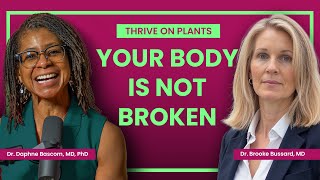
A podcast interview (Thrive on Plants Ep. 24) featuring Dr. Daphne Bascom and Dr. Brooke Bussard about menopause as a reframed, actionable life phase. They discuss lifestyle medicine pillars — strength training (heavy lifting, 5x5), HIIT/SIT, nutrition (adequate calories, ~1.2 g/kg protein target), sleep, gut health (microbiome/estrobolome), bone health (jumping, resistance) — and practical, plant-forward strategies to preserve muscle, bone, metabolic health and manage symptoms.
Chapters
Welcome back to the Thrive on plants podcast. I'm Dr. Daphne Bascom and I am so excited that you are here with me today. Today's episode is one that every woman, whether you're in your 30s or in your 80s, you need to hear this. I am joined by Dr. Brooke Bussard. Brooke is a physician, personal trainer, a health coach, a friend, and the author of Outsmarting Menopause. She's someone who's not just talking about lifestyle medicine, she's living it. And she's helping women just like you navigate this phase of life based on science, strength, and self trust. So in today's conversation, we get honest about what it means to go through the midlife transition. We talk about the myths that keep women stuck, the metabolic truths that no one teaches you, and why it's never too late to to take charge of your health. So no matter where you are, whether you're starting your journey, whether you're in the middle of your midlife journey, or whether you're way past the menopause transition, my hope is that you walk away from this episode feeling more equipped, more empowered, and more excited about what's ahead. Dr. Broussard, welcome to the Thrive on Plants podcast. We are so excited to have you here with us today.
Well, thanks for having me, Daphne. I always love chatting with you.
Well, this is going to be a fun chat because it's a topic that I love talking about. But before we get started, I want to ask you a couple of myth busting questions. And these are just going to be fact or fiction, so not too much, but just know. No pressure, but everyone who's listening is counting on you giving the right answer.
Okay.
First question. Fact or fiction? If you're plant based, you'll struggle to get enough protein during menopause.
Depends.
Once you hit menopause, your metabolism slows down and there's nothing you can do about it.
Fiction.
Cardio is the best way to lose weight and stay lean after 15.
Fiction.
Hormone therapy is too risky for most women. It's safer just to tough it out.
Fiction.
And final question. You can't improve bone strength without medication once you've been diagnosed with osteopenia or osteoporosis.
Fiction.
Awesome. And we are going to cover all of those topics and more over the next 40 minutes or so. So thank you so much for your time.
Oh, you're so welcome, Daphne. And I'm happy to be here with your audience. I really am.
So, Brooke, can you share with the community what prompted you to write Outsmarting menopause. I mean, writing a book is a big undertaking. And I know after you wrote Chew on this, I'm sure you probably had a little bit of recovery, but what was the motivation or what did you want to deliver to the world about women's health?
Well, first of all, I think I'm at the right time in my life to really dive into the research and to be thinking about this topic. I've been living the contents of this book for the past five years or so, and the stories in the book, they're based loosely on my friends and my clients. And. And when I finished writing Chew on this, I was actually thinking about writing another book and, you know, was sort of tossing around some ideas for topics, and I realized this was the perfect one. And I saw that there were some good books out there about menopause, but none of them really rounded up all the lifestyle pillars and presented them in a book that you can read from COVID to cover, you know, on a plane ride or in an afternoon at the beach. I feel like too many books get a partial read and then they sit on a shelf and people never finish them. And I felt like this topic was so important that I wanted to try to deliver the information in a way that was fun and engaging and that would get read cover to cover.
And I'll be honest, that's exactly how I read it, and it is so unreadable. So thank you for doing that, because you're right. I have a bookshelf full of books on women's health, menopause, and while we consume them, having something that is consumable by everyone is so important.
I'm right there with you on. On the books that are sitting there as references, and I'll go and look in the index and look up something specific. But, yeah, reading them cover to cover usually doesn't happen.
So, Brooke, one of the key takeaways that I had, and I want to go to the end first before we dig deep into some of the other topics you reframe menopause. I'll say the whole midlife journey as a power phase. And so I'd love for you to talk, to start the conversation by reframing this. Not as an end or not as a something where we're losing, but really talking about what we're gaining and why this phase of life, why you found this phase of life so empowering and why other women should, too.
Yeah, it's really disappointing to have people look at this phase of life as something they dread. And I'VE heard so many women, particularly once they're in their 70s and 80s, and they talk about how life just gets better, better and better as you get older and, you know, being excited about what's ahead and having the wisdom and the perspective that you get as you get older, having that as, you know, valuable tools that you're using in your life. And so I think the mindset that a lot of these women have who are so happy and fulfilled, is that they're curious and they want to see what's around the next bend. And they know that we can't slow down time. So all we can really do is just try to create the sturdiest, healthiest, most resilient version of ourselves that we can. And so that's really the mindset that I would love to see women have as they go through menopause and enter this next chapter of life.
In talking about. And I agree, because I actually, I agree with you in. In that I'm in this phase. So this is never a conversation, never really talked about it with my mom. I remember her having hot flashes, and it was just kind of mom's flashing kind of thing. But never really a conversation about what menopause meant. And I love how you are repositioning this. And I know many of the physicians and others who are really talking about menopause now. It's the same approach. And I hope women are embracing that and not feeling that it's I'm in decline, but really that I'm rising and rising into a new phase, a new power, a new opportunity to learn about our bodies and to optimize all of the lifestyle pillars that can keep us healthy.
I totally agree. I feel like there is this shift that happens in us emotionally and psychologically that really is empowering. And if we can just embrace that part and use it to help us move forward, I think it's so valuable.
In talking about shift, did you experience a shift in your philosophy around strength training and movement? I grew up in that area. I remember going to Bally's Club and being. I call it, the cardio bunny. So being on the elliptical for hours at a time, how have you approached your strength, your resilience, just your overall fitness as you have moved into menopause?
Well, Daphne, I would say I'm actually pretty lucky in that I got into strength training first when I was in high school. My. One of my colleagues on my basketball team, she wanted to lift weights. So she and I would go out to the trailer behind school where they had a Rack of dumbbells. And we would lift weights with the guys after school. And she had, you know, nice short muscle fibers and she would get ripped like right away. And I was always like, oh, Michelle, like, look at your biceps. It was crazy. And so that was my first foray into strength training. And then I, I did get out of it during college. I became a group fitness instructor. And so I was teaching step classes. Do you remember? Good old fashioned, you know, high intensity. I do, yeah. High intensity aerobics and low impact aerobics and step aerobics. And so I was doing that. And so I was like you, I was like a cardio bunny. And then after I finished med school and started my residency, I, I decided to leave the practice of medicine. And I wasn't sure what my next phase was. And I got into personal training. And of course with that I became very entrenched in strength training. But I was entrenched in it in that 8 to 12 rep range or more that women are told is a good rep range for them. And I would see guys in the gym lifting three to five reps and then sitting for minutes at a time. And I thought, would you just get off that machine if you're not actually going to use it? But they were using it. They were using it in the way that now I use those machines. So when we have estrogen floating around, the estrogen binds to receptors in our muscle cells that helps with the contraction of actin and myosin filaments pulling together and creating a force. And so we're lucky in that way that we can get away with not doing those low rep ranges and still being able to build muscle and build strength as women in our reproductive years when we have those hormones floating around. But I learned that as we lose those hormones and go through menopause and we don't have that stimulus from the estrogen anymore, we need to create a new stimulus. And so lifting in those high rep, it, lifting in the low rep ranges is now critical for maintaining and building strength. And it's interesting because when I went through menopause about five or six years ago, I noticed that I was getting weaker. I would go to do a dumbbell chest press and I'm like, gosh, I can't do as much as I used to. Not knowing that I wasn't creating the right stimulus. I was like, I'm in the gym, I'm doing everything I used to do and it's not working anymore. And so when I came across the science of, oh, once you're in menopause and afterward we need to work out in a different way. I mean, that was. It was life changing for me because now I get great results, which my workouts working in a 5 rep range, usually a 5 by 5, and it's been all the difference I needed.
In that. So. And Brooke, thank you for sharing that because I think that philosophy and that shift is huge. So you're talking about lifting heavier for you and I. Maybe you can talk a little bit more about for women that are trying to understand how do they apply this? Because I think as we were talking before we started recording, a lot of people hear the science, but learning how to apply it to what does that mean to me, whether I'm working out at home, whether I'm working out in the gym, and how do I look at a five by five program, for example. But also apply the principles of progressive overload so that I'm continuing to make progress for me, because everyone is going to have a different starting point and a different trajectory. But can you make this applicable to the community that's watching us today?
Sure. I think we've got to break it apart and talk about people who don't really have any experience with resistance training. And then we have the people who have done resistance training like I had, but just need to shift their mentality with the rep ranges. So we'll go with the second group first because that's the easier group to transition to this new method. People who are comfortable throwing dumbbells around, usually I feel like they're quicker to say, oh, I'll give that a try. Right. Because they've been in the gym, they're comfortable with the weights. And so I just take them and say, what's heavy enough for you that you could get to five reps and feel like you have one or two in reserve. You don't need to do those one or two, but you want to feel like after one or two more you can't lift them anymore. But we don't want to go there because you don't want to accidentally drop a weight on your face or something. You know, we've got to be safe and be thoughtful and, you know, consider our safety while we're doing this, particularly if you're home by yourself. But we want to use a weight that's heavy enough that you're in that range of I'll do five and I could have done one or two more, but I don't need to because I'm now creating the stimulus that I need to build strength in the way that estrogen used to help me build strength. And then you take a rest. So you rest for two or three minutes and really let your body get back to baseline before you do the next set. Because we don't want the muscles to accumulate this fatigue during these five sets. We want to try to get back to a baseline so that you can again, just give it everything you've got and, and you'll recruit more muscle fibers and stimulate the connection between your brain and the muscle. So think about when you're lifting something super heavy. It feels very different than when you take a dumbbell that is light enough that when you first pick it up, you're like, oh, this isn't very heavy. But by the 15th rep you're like, oh, this is, this is so tiring. Now my muscle is burning. That's a very different type of stimulus on the muscle. So we want, we want in the low rep range to have our body just feel like, oh my God. Like, this is a, this is intense. And I've, I've recruited everything I've got. I've. The muscle is exhausted and I'm done. And I think it's really hard to actually wrap your head around at first. Doing only five reps, you're like, really, I'm done. But if you're lifting heavy Enough by rep4, you're thinking, oh, thank goodness, I only have one more. Right. So, so, so for, for people who are in that group, they can just sort of start to adjust their thinking, increase their weight and think of it as five reps with one or two in reserve. For people who haven't done any strength training before, I always start them with body weight and work on movement patterns. So work on squatting, hinging, pushing, pulling, and doing some single leg exercise work. And so that might look like a set of reverse lunges. It might look like push ups that are on your knees. And for some people, it works perfectly. 5, 5 reps of that is pretty tiring because I like to think of it as a gravel road between the motor cortex and the muscle that we are paving. We've got to pave that road because that path is bumpy. It hasn't been smoothed out, it hasn't been worked in a while. And so once we get that movement pattern down, then we can start to add some weight to it. And if somebody gets to a point, okay, so say we're doing push ups on our knees and five reps at first might be hard, then the next progression would be we could, you know, extend the legs and get into our plank position and we might need to elevate that plank a little bit on an ottoman or a coffee table and do our push ups that way, getting to five. And then eventually you can take that push up to the floor and get to five reps. And then once you're ready to start using dumbbells, then, you know, you progress into that phase. So does that help with sort of painting the picture of what it looks like to implement?
It does.
Okay.
And because that, and that's important because you're, you're sharing one. Meet everyone where they are, where you're starting. And if you're experienced, you're starting from a different point than if you are just getting into any type of resistance training, but not making your experience be a barrier. Because one takeaway from outsmarting menopause is that every woman should be lifting too heavy.
Yeah, I agree.
Now, how do, what is your approach to integrating resistance training, but also knowing that we need to continue to stimulate our type 2 muscle fibers? So I think you, one of the stories that you shared in the book is about the benefits of doing some high intensity training. How does that, what is high intensity training? If you could define that and then what does that mean? Is that I need to go to Orange Theory three days a week or do I just need to get on the rower and maybe do some tabatas on the rower?
Yeah. So I love high intensity interval training, which is the, the acronym is hiit H I I T. And then there's a subset of that sit which is sprint interval training. And both of these are great because they don't take very long. And the research has shown that if an exercise session is shorter, there's more compliance. People are able to actually do it, check it off their box and continue to do it and stick with it. So you don't need to pack a gym bag and stop by Orange Theory or go to some sort of class that's going to last for 45 to 60 minutes. And actually you don't want to do that because with high intensity interval training, you need to go to an intensity that's high enough that, that it will stimulate the body in a way that releases growth hormone and testosterone. And, and that in turn will lower your cortisol, which in the book, I talk about that in chapter one, because it's so important to realize that the body's going through this internal stress when the hormones are fluctuating all over the place. In the last, you know, it varies number of years before you finally stop making E2 estradiol from your ovaries. So these intervals are short. So typically with HIIT, the HIIT training, I would say a 20 minute session is about right. And you're using a rating of perceived exertion on a scale of 1 to 10, where 10 is an all out effort. Your RPE is going to be 8 to 9, and you're going to go for short bursts that are 10 to 30 seconds long. But longer than that, it's really hard to stay at an 8 or 9 RPE. And that's why some of those group classes where they're doing hiit, you're not able to stay at that higher intensity and you end up at a moderate intensity. And if we stay at a moderate intensity, it doesn't stimulate the release of the growth hormone and the testosterone in order to lower the cortisol. It just creates more stress on the body and keeps that cortisol elevated and sometimes elevates it even more. So these short bursts are so beneficial, the sits are even shorter. And you can do a sit in five to 10 minutes. And you can tack it on to the end of a resistance training session, because with a sit, you want to go at a 10 out of 10 on your RPE, you want to just blow it out as safely as possible for you. But again, it's 10 to 30 seconds. And I actually think 30 seconds is too long for a sit. I think that our energy systems in our body, really, 10 to 20 seconds is probably the most you can go at 100%. And so a lot of times I'll set a timer for 15 seconds and see if it looks like somebody can definitely make it to the end of that. I might challenge them and put it at 20 for the next one. But if at 10, I can see their legs are starting to slow down, if we're doing something on the bike, doing a sprint on the bike, then I'll set the timer for 10 seconds on the next one because I want somebody to blow through the finish line. And that way, you know, you're at that max effort. And so with the sits, you can do just two of them. You could do three or four. But if you get up to the six to eight range on the sits, I start to wonder, are you working hard enough? You know, because I feel like you should be pretty exhausted after four or five of them and think I'm done.
Yeah, yeah, no. And you know, for everyone listening or watching, this is getting on an air bike and you are going to the point where you can't go anymore. That's really the level of intensity that and a lot of people don't know how to get there, both with cardio and with lifting. And it may be helpful to spend some time with someone like Brooke so she can walk you through it and can help you gauge. Well, I think, you know, maybe we can push it to 20 seconds this time, or you were able to do six or eight. Maybe you can push a little harder next time. But you, you have to be working to really get to that threshold of perceived exertion that you're trying to.
Have.
That level of intensity that Sid is really defining.
Yeah. You have to know that it's going to be uncomfortable and be okay with it and know that it's finite. It's a pretty, it's a. It's a very relatively short period of time.
And it's like 100 meter dash.
Right. And think about what's going on in your body while you're doing it. I mean, that's what's, that's what drives me to do it, like knowing that my type 2 fibers are getting work in that they wouldn't otherwise get, and I don't want to lose them and getting that stimulus for our hormones. There's just so many good things that come from those high intensity intervals that I think remembering that is a good, you know, a good driver for us.
And Brooke, can you explain what type 2 muscle fibers are and why it should be motivation for all women to retain them as they go through this phase of life?
Yeah. So the type 2 fibers are our fast twitch fibers, and they're, they're type 1 fibers, type 2, and the type 2 are split into A and B. But for this discussion, we can just think of the type 1 as our slow twitch fibers. You can just go low and slow for very long periods of time. And then our fast twitch, those type two, they allow us to have power and force production. And they're really important as we get older because they help us recover. If we trip and we're about to fall, they help us regain our balance. And women have fewer type 2 fibers than men or females have, fewer than males do. And so as we get older and we start to lose them, you know, it's something that we really want to try to hold on to.
Agreed? 100%.
Yeah.
And you also mentioned cortisol, and I'd love to pull a thread on that a little bit because cortisol has, I think, can be demonized depending on who you're watching or who you're listening to. Cortisol is vital for life. We all need it. And over training is real, but also, to your point, managing our efforts. So when you're putting together a movement program, a training program, making sure that you're not over training, but balancing the need to have that high intensity stimulus for short periods of time to make it beneficial so that you release the growth hormone, release the testosterone. How do you talk to women about cortisol in terms of being acute and that acute stressor versus the chronic cortisol stimulus where we're at hyperdrive all the time, whether it's from life, work, whatever, and how cortisol in those two situations are similar but different.
Yeah. So cortisol, as you say, Daphne, is definitely vital for life. It is a. It's a key component of our endocrine system and our nervous system. And so the acute cortisol release is critical. And we want that. We want it when we're strength training, when we're doing our hits and sits, we want that spike in our cortisol. And cortisol, actually it spikes in the morning and that helps us wake up. It's part of our circadian rhythm. But we don't want it to stay elevated because when it stays elevated, it has all sorts of effects on a cellular level. It impacts our immune system, it impacts our body's ability to decrease inflammation, like we can't. Like we stay in a more inflammatory state when our cortisol is elevated. And, and it keeps you in that tired but wired state where you have trouble sleeping, but you feel exhausted. And so we want to do things that create the acute spike and we want to try to eliminate the things that cause the chronic elevation. And we've got things going on internally that cause that chronic elevation when our hormones are all over the place as we go through menopause. So we have to do some things to help mitigate that. And so we need to really protect our sleep. We need to eat better than we ever have. We need to really lock in on the fact that we can control some of this. But it's going to take a little bit of effort by really dialing in on our lifestyle pillars.
Too true. And I mean, we could talk for an hour about sleep, but all of the pillars are important to managing stress, optimizing your sleep, making sure that your movement is healthy. And then the next thing I'd love to hear your thoughts on is nutrition, because just going to the gym, you are not going to build Muscle. You need to. It's a combination of fuel and stimulus. Can you talk a little bit about how women should be fueling this is. That's a broad statement. We talk a lot about the different macros, protein, carbohydrates, fats. I'm going to add fiber in there because I think it's the fourth macro that we don't talk about enough. But how do we get out of this old mindset, kind of the diet mindset of eat less, move more? Because if I'm in the gym doing five by fives, but I go home and I eat a thousand calories a day, this isn't going to grow. How should I be eating as I'm a woman in my late 40s, early 50s, or even my late 30s, because that's where you really can establish a good foundation for your musculoskeletal health. What does Dr. Broussard say about my nutrition?
Well, Daphne, first of all, I love how you put fiber in its own category for macronutrients. So I'm going to have to adopt that from you. So thank you. Because I do. I think fiber is so important, but I think as we talk about training, it's so important to remember that you can't build a house without lumber. Right. So when you point it to your bicep, there's no way that you can grow that muscle if you're not giving your body nutrients to serve as the lumber for your body. So I would say, first of all, we've got to think about having adequate calories. I think that's important. Yes, the calories need to be quality. You know, we don't want to put in a lot of processed foods that are going to create a lot of inflammation and not promote growth. We need to make sure that we get plenty of carbohydrates, because as women, we have areas in our brain that are sensitive to carbohydrate consumption. And they let our body know that, oh, we can actually be in the mode to build muscle. So there's two stages of our body. We're either in an anabolic mode or catabolic mode. So we're either building or we're breaking down. And for women who are only getting a thousand calories a day, their body's in a starvation mode and things are getting broken down in order to help the body survive. The body might tap into muscle in order to get protein, to make enzymes or antibodies or any number of things. The body might tap into the bone and use it like a quarry to get calcium or phosphorus or magnesium, anything that it needs for nerve conduction or, you know, other processes. So I think that's one of the greatest problems. One of the biggest problems. It's not great. It's actually terrible. It's one of the, one of the biggest problems is that women don't consume. A lot of women don't consume enough calories and they need to be quality calories and they need to happen at the right time. Some people hear about fasting and they think, oh, I want to try that. And fasting can actually work maybe for some women, but it works for men way more than it works for women. And I would say it doesn't work for most women because of our physiology and this protective mechanism. We have to make sure that our bodies get what they need in order for us to be able to reproduce. And those mechanisms are still in place. Once we no longer make estrogen and progesterone anymore, our brain doesn't really change in that way. So we need to make sure that we get fuel in the morning after we have that cortisol spike. We need to send a message to say, oh, there's food coming in today. We need to have adequate nutrition before and after our training so that a, our training sessions can be optimized. We can have enough energy to push hard. So if you're doing a hit or a sit, you're not going to be able to get to 8 or 10. It might feel like you are, but it's not your true potential for getting to an RPE of 8 or 9 or 10 if you had fuel in the tank. And likewise when you're lifting, you won't be able to lift as well if there's not enough nutrition coursing through your bloodstream. So timing's important before and after your meals and sort of front ending, front ending those calories in your day. So at the end of the day, we don't want dinner to be the biggest meal. We don't want to eat a lot after dinner. And for people who need to have a calorie deficit to lose some fat that they may have accumulated during this whole menopause process, we want those, the calorie deficit to happen at the end of the day before you go to sleep. So that's sort of my overview of nutrition. Do you have any specific questions based on that?
Do you want to tackle the protein question?
I would love to just discuss it with you, Daphne. It is so all over the place.
Isn'T is all over the place?
Yeah. So you know, even though observational studies might indicate that a higher protein intake is associated with a higher lean body mass, there was a narrative review in Physiologia that came to the conclusion that there's limited evidence, not of high quality, and it makes it difficult to make inferences about the protein needs of postmenopausal females, is what they said in their conclusion. And I thought, you know, that is very well said because that's how I feel now. In the Women's Health Initiative study, the higher protein intake was at 1.2 grams per kilogram of body weight, which is 0.54 grams per pound. And that was associated with a 32% lower risk of frailty and better physical function. So for a woman who's 135 pounds, that's probably the average weight of a lot of my clients. So I use that number a lot. That's about 73 grams of protein per.
Day, which is doable for everyone.
I was gonna say that number is not hard to get to. If you're eating the number of legumes that I would want you to eat and you know, other great plant based foods throughout the day, it's about 50% more than the RDA.
But which is, which is, yeah, like.
I think it's, it's, I think it's very doable. So I think shooting for 1.2 is where I am in my head with the mess of literature that's out there. Some studies, they use 1.6 grams per kilogram of body weight for their high protein group. I think that takes you to 97 grams for, you know, the number that I use. But that, that's a little bit challenging for some people to get to, particularly if their total calories for the day are lower. You know, if there's somebody who's, who's pretty small in stature and they're aiming for more like 17 to 1800 calories per day, then the percentage of calories from protein becomes even higher, which becomes more challenging. So I think really just playing around with it and seeing what works for each individual, like there's time, it's not a race. So I feel like, you know, you can work with people and figure out like what's going to work for them and is that going to be a good amount for them? Is it going to work for them? Are they building muscle with that amount of protein? Because we know like the human body is so variable that that number, it's not specific to every single person. Right. Like there's going to Be some range that, that works. And you just need to figure out what's, what's doable because for some people, you know, getting to 73, it's like, feels like a little more of an effort than for other people.
But your first premise, which is you have to be taking adequate calories, that's key because if you are, you can't underfill your body and expect to grow. You can't underfeel your body and expect to stay healthy either.
Totally.
I would. I think the article you referenced is great. You know, if anyone's listening wants additional resources, I think Brenda Davis book on protein is a great compendium of a lot of the literature and she talks about women athletes, seniors. It's a good reference and it's very readable. But all of you listening, you are an n of 1. And so treat yourself. Don't try and generalize what you're seeing on social media and saying, oh, it works for her, it'll work for me. Whether it's your training, whether it's your nutrition, take the foundations of what you're reading and outsmarting menopause and then apply it to your life. Because this is not a race, as you said. This is something that you need to sustain for the next 40, 50 years.
I totally agree.
Talking about. So the protein gap is real. And I would also encourage anyone who's watching, grab Brooke's first book, chew on this or go to her website because there's some great recipes out there that are, you don't need to be a chef. They're plant based, they're healthy, they're something that you can make in almost no time. They're great for meal prepping if you like to meal prep, but they can help fuel your body in the way you need to as you're moving through this phase of life. And the family will like them too.
I agree. Daphne, thank you.
An important part of so the nutrition. If we can transition from fueling your body, how do I make sure that I'm actually absorbing my nutrients? So you talked a little bit about the brain muscle axis. Can we talk a little bit about the gut brain axis as we're going through menopause cause and why you need to make sure that your microbiome and your gut is healthy during this phase too.
Absolutely. And don't forget that Daphne has a podcast on the estrobolome so you could check that out to get a little more detail on this. But your gut microbiome is so important for helping to absorb the nutrients that you consume. I think one of the main things that we need to make sure is that we minimize processed food and we minimize ingredients that cause inflammation in the gut. Because once we, once we compromise the lining of the gut, certain things can get through that shouldn't get through. Other things that we want to get through don't get through because there's too much mucus or just, just generalized chaos. And the gut bacteria that we want to digest our food can't survive in that environment. So we want to make sure that we feed our good gut bacteria with our whole plant foods and a nice diverse variety of those foods. So the American Gut Project looked at how many plant foods we need per week in order to really maximize our diversity in our microbiome. And the answer was about 30 plant foods. So trying to track those is a good idea, I guess, with if we want to go back to how menopause ties into all of this, when we go through the menopause transition and we stop producing all of this estrogen, the gut bacteria that were metabolizing estrogen and its metabolites that came through the liver, they don't have everything that they need to survive anymore and they die and they get flushed down the toilet and they, they don't leave any survivors behind. So what happens is, is that women who in our reproductive years had a microbiome that surpassed the male microbiome, now have a microbiome that looks much more similar to theirs. So we're working with a smaller range of species of bacteria and a lot of women end up with GI issues, bloating and gas and constipation or diarrhea or a combination of both as their microbiome tries to settle into its new norm. And so supporting it with, with good plant based foods and including some, for some women, including foods that have a lot of probiotics in them is helpful. So, yeah. What other questions do you have about that, Daphne? Or do you want to just add some things?
Do you have some favorite probiotic foods that you would recommend?
I love tempeh. I have a client who loves kimchi. Sourdough bread is a nice one to start with if, if the others seem too far out there. That's true. I don't really suggest plant based yogurts to people. Again, just because it's hard to say which ones have a lot of additives or other components that might be irritating to the gut. What about you, Daphne? Do you have some favorites?
I'm with your client. I have a serving of kimchi Every morning it's part of. So I use it to break my fast.
Oh, okay.
More of a savory eater than a sweet eater. So some kimchi I know. Along with my Brazil nuts, my prunes for my bone health, and then my matcha latte. That's. That's my breakfast.
Oh, wow. I like it. It's very. I've never heard that before.
It's very eclectic.
It really is.
So, Brooke, I feel like I've been dancing around an important question, which is, and I think a lot of women probably come to see you as a coach for weight loss resistance or, you know, know. I don't know if you experienced this, but in my 30s, I could drop 5 pounds on a dime. Easy peasy. 40s got a little harder coming up on 60. That 5 pounds just doesn't want to move. And it doesn't sit in the same place it used to sit. What is your guidance for women who are going through perimenopause in post menopause and our bodies just don't respond the same way to our efforts to lose fat? 1. The fat is in a different place. And would love your thoughts on subcutaneous fat versus visceral fat. But then what do I need to do? Because you already said you can't starve yourself and. And I can't train for three hours a day, but I don't want this anymore.
So I think one thing to try is leaning more into those sits and hits. So not wanting to train three hours a day, that's exactly where this comes into play. Like we want more short bursts of these high intensity exercises. And instead of doing so, when people first start going through menopause, I usually say two to three sits or hits per week is good. That's all you need. But as women get older, I think doing them a little more frequently can be helpful. And sits in particular, because they're short and you can add them in the end of your resistance training. If you're resistance training three days a week, you could put three sits in there and then you could have another day or two where you do your hits. And the sits, they don't need to be even be on equipment sometimes for myself my go to for my sit and I'll only do sometimes one, sometimes two of this exercise. For at the end of my resistance training, I'll do 20 seconds of fast feet. Do you know fast feet where you're just doing this as fast as you can? Yeah, I'll do it for 20 seconds. Take two or three minutes off, I'll be like, oh, my God, that was too much. And then I'll set my timer for 15 seconds and I'll do it again and that's it, I'm done. Like, I did my resistance training, I did those two at the end, and then I'm out of the gym. So you're not adding much extra time to your workout at all, but you're giving yourself another shot of that high intensity training, and I think that's helpful. So the Copenhagen women's study that was published back in 2020, they found that three months of high intensity exercise training reduced both subcutaneous and visceral adipose tissue masses in both pre and postmenopausal women. And I think it's. It was a great study to show us that we can tap into both sources of fat even after menopause. Because I feel like some of the studies, they look at the difference between pre and post and they're like, oh, it works in pre but not in post. But I think this was a good one to show us that those hits actually can be beneficial well beyond that one day of menopause, once we transition into this new phase of life. So I think adding more of them into the week is valuable. So getting to both visceral fat and subcutaneous fat. So that visceral fat is what? It's that deep fat, it goes around the organs. It's. It's more dangerous because it can sort of choke our organs. I sort of describe it to people as, you know, imagine you wrapped your liver in cellophane and then, you know, it couldn't, like, have any breathing room. Right. As blood tries to come in and come out and, you know, filter things and detoxify us. So we don't want visceral fat to accumulate much at all. Like, I think everybody has a smidge, but you don't really want anymore. And then that subcutaneous fat, it's a little less dangerous for everything except your psyche. Right?
Right.
Yeah. So, but that subcutaneous fat, it's this. It's the fat that you can pinch on yourself and it's just going to accumulate either from, you know, a calorie excess or your body, for some reason has released a lot of cortisol and, you know, said, oh, let's store some fat today. Because not all of that fat is visceral. Like, some of it's going to be subcutaneous. So I think there's a lot of reasons why that extra fat sort of comes and goes. But I think the best way to. To try to attack it if your nutrition is clean, you're not drinking alcohol, is to increase those interval training sessions.
Which doesn't need to add a lot of time. I'm going to keep saying that it's not 30 minutes, it's five minutes at the end of a workout or five minutes at some point in your day.
Right. Does not need to add much time at all.
No. Because I know we're all. All women, we're all stressed because time doesn't seem to expand to accommodate all the things we need to do during the day. And as I'm looking, I didn't realize that there's so many things I want to talk to you about. And I can't believe we've already been talking almost an hour. Do you have a phone in the camera?
I do. I can't believe that either. Daphne, now that you say that.
Is sit. So is there a way to also use sit and hit to stimulate your bones? Because musculoskeletal health, and I don't know how many of the women that you coach, you get a DEXA scan on or who come to you saying, you know, my T score is minus 2, or my doctor told me I have osteopenia, or. Or I have frank osteoporosis. How do you. How do you create a program that optimizes musculoskeletal health so that. So stimulating the bone and hopefully leveraging all of the good work to either stabilize our bone scores or improve them by focused attention to how we're moving?
Well, we know that jump training can help stimulate the bone and protect our. Our bone density and our bone quality. So I do like to incorporate jump training into somebody's regimen if they don't have any contraindications to doing that. So you can incorporate that into your sits and hits? Typically, I would say it's more of a. I typically do it more in a sit, but that's because I typically do my hits on a bike. And the research has shown that when you do your hits on a bike, people can usually hit a higher intensity because we don't have as much pain in our joints or other things that might be troublesome as we're getting older. But. But. So I will sometimes jump for 20 seconds as my sit, and I will just do squat jumps. But the important part is you've got to get a little more intense with them than you would if you were just doing jump training. So you want to pick up your pace a little bit you want to, you want to try to jump as high as you can and but when you land, you don't want to land with as soft as it as soft of a knee as you normally would because you want to try to get the ground force to come up as your bone is hitting and really create a stimulus pushing up on the bone. So but, but yeah, you can use jumping as one of your sits. And otherwise let's see, what other questions did you have about the bone? Like just how, how should we think about trying to protect our bones?
Are there any. I mean I, I know you talk about bone health in the book, which is awesome because. And maybe the, the question I really should be asking you is for anyone listening who's in there, impurities. Because bone and muscle health starts when you're younger. And I think that if I had known when I was 30 what I know today, I probably would have done some things differently. And we could probably have a whole nother podcast talking about alcohol and some other things that are lifestyle decisions that we may want to assess if we're looking at our long term health. But how can we when is it's always a good time to plant a tree. But how can women start to think about their bone and muscle health sooner so that when they get to be my age, unfortunately my T scores are still good, but I just feel like I see more and more women who are in that T minus 2 and above range when they come to see us.
Yeah. And I think probably there are more women in the generations below us who are going to see more osteoporosis because they've lived in an environment that.
Is.
Promoting, not promoting it, but causing it. Right. So first of all, if you are Daphne and I's age, you can always share this podcast with someone who you care about who is in that 30 to 35 and 40 year old age range. But if you happen to be in that age range, it is that is the time when you really reach your peak bone mass around 30. And whatever you can do to build your bone and then maintain your bone, it's really going to help you for the future. And the same with your muscle. Trying to build and maintain muscle, it's so much easier when you're younger and you can set yourself up for so much more success for both, you know, what your body composition is when you get to perimenopause and menopause, but also the whole physiology of how your endocrine system is working and how your musculoskeletal Health is and how much muscle mass you have so that your glucose has a place to go when you're consuming carbohydrates and you're not becoming insulin resistant. And, I mean, it just goes. I mean, it just snowballs. It's all tied together. So the more bone mass you can develop by doing activities that either pull on the bone or push on the bone. So when we think of resistance training, when we are working a muscle, the muscle is attached to a tendon that's attached to the bone. And so when we do our resistance training and the muscle contracts, it's tugging on the tendon, which is tugging on the bone and creating the stimulus that helps the bone get stronger. And then any type of jumping that you want to do, whether it's playing hopscotch with your kids or skipping down the street. I have a friend who. She is hilarious. I remember this was probably eight or ten years ago. We met at the park for a walk, and she said, brooke, do you want to skip today? I said, sure, let's skip. And literally, we linked arms. We were in our mid-40s at the time, and although I think she's five years older than me, so she was probably 50 at the time. And we were literally skipping around the park, and it was like people were cracking up. But I thought, oh, this is just fun. Like, I didn't care. Like, I was just having fun. We were laughing so hard. And looking back at that now, I was like, wow, perfect exercise. Yeah. We just needed to, like, tap into our, you know, inner child. Yeah. And find activities that you used to do that are fun, but they're also very beneficial for your skeleton. Right. Yeah.
That image of you skipping around the park, but in. I mean, you not only had the movement, you had the community, and you had the joy. And those are underrated. I mean, again, if we're talking about holistic health, you meet all of those. We have to have joy in life. Totally.
Otherwise, what are we doing this for?
Exactly. Brooke, I need to be respectful of your time. Two last questions for you.
Okay.
I know. If you had an opportunity to give some words of advice to anyone who's watching or listening about how to outsmart menopause, what would that be?
Well, I think it's to really embrace the lifestyle pillars, to lean in and think, what can I do one day at a time to get 1% better every week or every month to improve my musculoskeletal health, to improve my nutrition, and to improve my sleep? I think just remembering that, again, it's not a race. And there are these tools that are available to us that if we could just try to incorporate them into our lives, the decades ahead will be hopefully, you know, more enjoyable.
100% agree. And for anyone listening who's in health care, I mean, you wear the hat of physician and coach. What do you wish we would, what should we. And could we do more in terms of how we educate women of all ages about women's health? So that, and I do agree with you that the, the generation behind us who's sitting more probably is eating more ultra processed foods. We, we may see more obesity, more osteopenia, more osteoporosis, but how do we start to have these conversations so that we can turn the tide and that women can age more powerfully and healthfully and not have to learn everything that you and I have learned when we're already in our 40s and 50s?
I think just keeping the conversation open or I feel like we have sort of opened it. I feel like in the past five years or so, the conversation has really become more out there where people are talking about this. But I think for the younger generations who may not have really been paying attention because it's not in their, you know, universe yet, I think if they could have open and honest conversations with each other and be thoughtful about their future. And I know it's really hard at that age to be thinking, what am I going to be like in my 50s and 60s? It's a really hard thing to do. But I think supporting each other, if you have a friend who wants to get healthier, you know, don't make her feel like an outcast or like, you know, she's not being fun anymore, you know, like just because she wants to eat healthy and maybe not have three glasses of wine with you that night, I think, I think we just, we need a little more. I don't know what the quite, I don't know quite what the right word is, but we just, we need to be people to be a little more accepting of the health journeys of each other and respecting those journeys.
You are the sum of your five closest friends. 100% agree. Yeah. And we all need to support each other more. Brooke, thank you. I have gone way over time and I appreciate you being so gracious with your time. If anyone listening or watching wants to contact you, what's the best way to get a hold of you? If they're looking for a coach, how can they reach out and learn more about everything that you do?
My website, drbrookebassar,.com d r brookebassar.com probably the easiest way.
And you can pick up this book if you haven't already. Outsmarting Menopause. It's an awesome read. I really enjoyed it and I've loved having this conversation with you today, so thank you so much.
Oh, thank you, Daphne.
And I hope to have you back because I've got a whole list of questions that we didn't get time to touch on, but maybe for another day.
Yeah, yeah, we covered a lot. But yeah, like, it was, it was good. Yeah, I thought the questions flowed really nicely.
Brooke, thanks so much.
You're welcome, Daphne. Enjoy the rest of your day. And you know, anytime, I'm happy to come on and chat with you, have.
Some fun or do some cooking.
Exactly. Yes.
Take care.
Okay, you too. Bye Bye.
Bye. Bye. I hope you feel as inspired by this conversation with Dr. Brooke Broussard as I do. What I love most is how Brooke reminds us that menopause is not an end of your health journey. It's an opportunity to rewrite the narrative. It's a wake up call to treat your body with the respect and the attention it deserves. So there are a few things I want to leave you with as we wrap up today. Strength training isn't optional. It's essential. You can't talk about longevity without talking about muscle. Second, fuel. Fuel. Food is fuel. Especially during menopause. Your body needs nourishment, not restriction to thrive. Third point, you can train your hormones. When you dial in your intensity, your sleep, your stress, you give your body the signals it needs to optimize your physiology. You are not too late, you are not too old, and you are not too far gone. The science says it and we see it in our community every day. And Brooke's story is proof. So if this episode resonated with you, I encourage you to share it with someone else who needs to hear this message. And if you're ready to make this next phase your strongest yet, start today. Lift something heavier than get curious about your training. Fuel your body like it matters. Because it does. You have the power to outsmart menopause. And if you need some support, accountability, or if you're looking for a plant based coach, join the conversation on thriveonplantslife.com so thank you for tuning in. Stay strong, stay curious and keep thriving on plants. Take care. The information shared on the Thrive on Plants podcast is intended solely for educational and informational purposes. It is not medical advice and it should never be used as a substitute for personalized guidance from a qualified healthcare professional. Always consult with your physician or healthcare provider before making any changes to your nutrition, exercise routine, supplement use, or your overall wellness plan. The opinions and advice shared by our guests are their own and do not necessarily reflect the views of the vegan gym or its team. While we aim to bring you high quality, thoughtful conversations, these perspectives are not intended to replace professional medical care. Thanks for tuning in. And remember, you have the power to thrive on plants and live with purpose.
It.
More from Daphne


The Adaptive Fuel: How Exogenous Ketones Support Healthspan | Thrive on Plants #60

Could Yeast Replace Whey? The Science and the Story Behind Spacemilk | Thrive on Plants #58
Why "Eat Less, Move More" Stops Working After 40 (And What Actually Does) | Thrive on Plants #54
Triple Negative Breast Cancer: How She Caught It Early and Came Back Stronger | Thrive on Plants #53