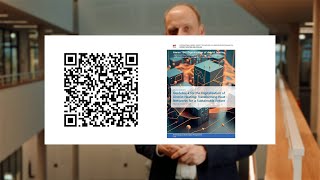
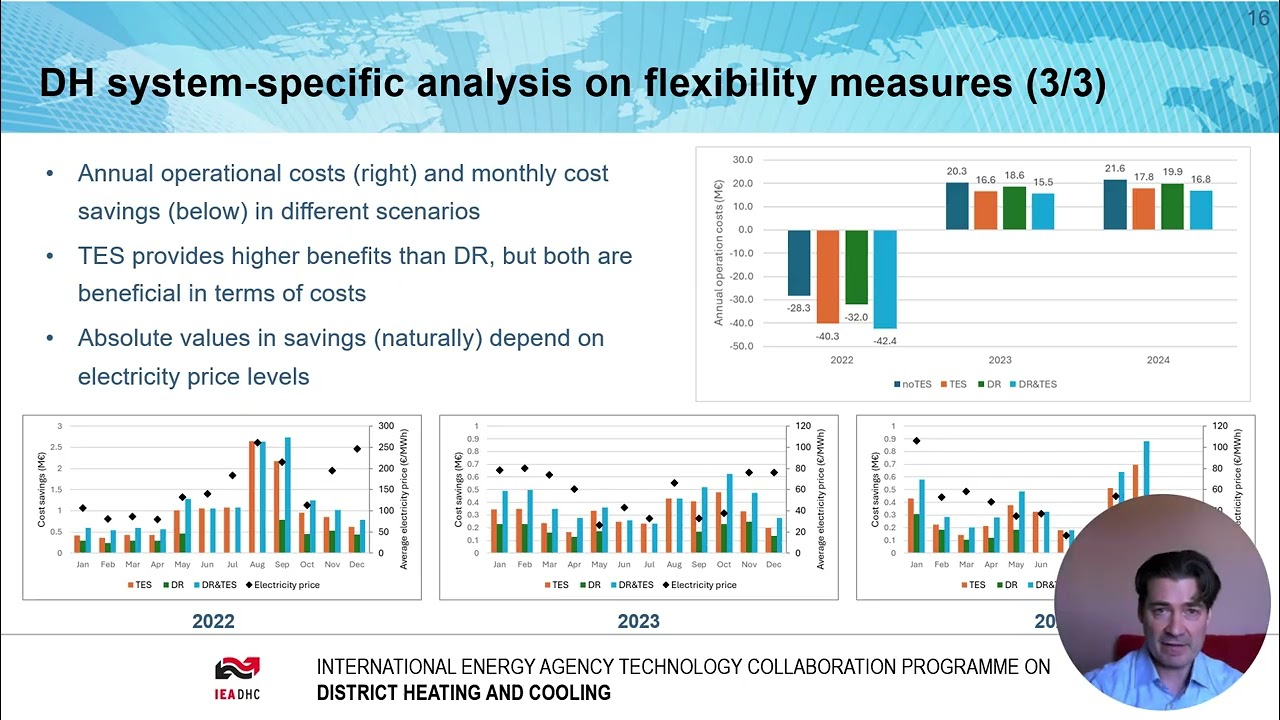
Video summary and guided tour of an IEA DHC guidebook (Annex TS4) on digitalization of district heating and cooling. Presenters (led by Dietrich Schmidt) frame digitalization as essential for decarbonization, system optimization, and new business models; they describe the guidebook’s aims (awareness, overview of technologies, evaluation of non-technical barriers) and note the project ran from 2020 and concluded with publication in November 2023. The transcript includes focused remarks on demand-side digitalization, digital twins, whole-system optimization, customer metadata, business-model changes (heat-as-a-service), and legal/cyber considerations (GDPR, NIS Directive).
Questions this video answers
November 2023.
Started in 2020 and ended in November 2023.
63 experts.
11 countries.
March 1, 2024.
Chapters
Welcome to this talk about the digitalization of district heating and cooling systems. My name is Dietrich Schmidt and I'm here to guide you through the content of this book, which has been published in November 2023 within the Technology Collaboration Program of District Heating and Cooling within the International Energy Agency. District heating is a key technology for the decarbonization of the entire heating energy sector. Traditionally, these networks, these heating networks are operated with just a small number of controls. More detailed information about the energy generation, about the energy transport and the energy utilization are not provided. But there's a strong need for increased digitalization to get a fully sustainable energy system.
For a sustainable energy system in the heating sector, many, many technologies have to work together in a very flexible and good way. On the other hand, we have only limited resources, both in time and money to fulfill our task. With increased digitalization, we can build in much more optimization processes and we can use much more efficient and sophisticated methods to operate our systems.
Digitalization is, in my eyes, one of the most important tools to meet the future requirements for district heating. At the association in Germany, AGFW tries to give all the relevant information for his members in the district heating branch using the platform fernwehrme Digital.
We drafted the guidebook because he wanted to create awareness among all stakeholders for the benefits of the digitalization of district heating and cooling schemes. Furthermore, we want to give a current overview of the technologies based on R and D projects, demonstrators and case studies. And we want to evaluate non technical barriers for the digitalization of district heating and cooling, such as the development of new business models, legal aspects or even policy instruments. So we decided to put all information in one guidebook to facilitate the wider implementation of district heating and cooling digitalization measures.
It has been the work that was ongoing for three years, starting in 2020 and ending in November 23rd.
Many people have been involved in this project. In total, 63 experts from 11 different countries conducted work for this project. So in this particular project, digitalization means the use of digital technologies to change the business models and to get opportunities for new revenue streams. So it's clearly beyond the normal technology problems. It's also integrating various stakeholders and taking into account the entire energy chain from the generation over the distribution to the utilization of energy. So in the following we want to give you some insights of the different possibilities for the digitalization of district heating based on the various levels and so called sub tasks.
The digitalization of demand side is crucial for the green transition of district heating and cooling industry. Historically, buildings were perceived as black boxes due to the lack of information, recent policy and advancement in digital technology open up to new opportunities for monitor and control.
Digital solutions enable buildings to become flexible energy users and in that way help decarbonizing the energy system.
District heating and cooling networks are very large infrastructures with numerous components and typically in control and optimization. This is done individually. Now what we have researched in this subtask is to see how to optimize the system as a whole, so controlling and also analyzing the entire system rather than the individual components.
Reading the guidebook NXT is 4, I was impressed by all the possibilities emerging from digitalization. Especially customer metadata seems to be a game changer. I am convinced that digitalization will help to optimize network operation and DHC systems. Furthermore, sector coupling possibilities will be unlocked.
Digital twins are are enablers for making digital applications available online and in real time for the operation and maintenance of district heating systems. Applications that were primarily developed for the desktop can be made available directly in the field. So for instance, simulation models or machine learning applications or geospatial data spaces can be integrated into decision support systems for operators and field technicians.
I believe that we will see the strongest impact of digitization in the business models towards end users and building owners. We will see business models where they become an active part of the energy system and the energy transition. This could be by giving the right incentives for them to optimize or for the operators maybe to go all the way to offering heat as a service.
The General Data Protection Regulation has to be observed when processing personal data. Processing requires an explicit consent or other justification under Article 6, paragraph 1. Additionally, the network and Information Security Directive contains the new legal framework for cyber security. The Directive is not directly applicable, but will be transposed into national law of the EU Member States very soon.
And now some concluding words. What have we learned? What are the main takeaways from this project? The key finding from this project the digitalization of district heating and cooling is a key technology for decarbonizing our energy system and with an increased complexity of the system, with a growing demand for flexibility and integrating more renewables, this technology is just vital. So thank you for listening and please take your own copy of this guidebook home using this QR code.