XIV-06: HY2HEAT - Using electrolysis waste heat in district heating networks
Stefan Bushnick's HY2HEAT project studies how to use waste heat from electrolysis in district heating networks. About one third of electrolyzer electricity becomes waste heat, potentially reaching 1000 kWh per capita by 2050. Three case studies show the impact varies by location: preheating can halve heat pump capacity when waste temperature is 10°C above return temperature.
Questions this video answers
About one third of the electricity input (≈33%).
Up to ~500 kWh per capita for 2030 and up to ~1000 kWh per capita for 2050 (under the study's assumptions).
10 tonnes of hydrogen per day (target).
Supply ≈80°C, return ≈50°C; peak demand a bit over 20 MW; available waste heat ≈5 MW.
Approximately 55°C to 75°C (two cases: low and high temperature).
Chapters
Yeah, also a very warm welcome from my side. So my name is Stefan Bushnick, I work with Enig Institute at the Johannes Kappa University in Linz in Austria. And yeah, I was coordinating the project Hydroheat which stands for hydrogen to heat. And basically its research is focusing on using the electrolysis based heat for district heating purposes. And yeah, the project consists based on Italian University of Technology, from Sintef, from Norway and from the Austrian Institute of Technology.
Yeah, let me give you a short overview about the project team. So besides me there were Simon Moser, Jin Muya and Hans Boom from the Energy Institute side on board. From Sintev we had Hanne Kauko and Davide Domasini on board. Davide will also present today his focus points within the project. From the Austrian Institute of Technology we had Nicholas Max on board and Stefan Reuten, Janik Wimmer and Nicholas will present today as well. And from the Dalian University of Technology there were Anna Volkova involved, Hesham Ali and Victoria Kislenkova. And Hesham will present his findings in today's webinar.
Yeah, the project Hydroheat, what's the background you need to know? So all of you might be aware of that Hydrogen which is currently fossil produced based on fossil resources, we will be a key technology or key resource in a climate control energy system and it is expected that in the future electrolysis capacities will evolve substantially. And yeah, however that part of.
Part which is wasted currently is the waste heat. So around one third of the electricity input depending on the technology is currently wasted and so this resource is untapped. And that's exactly the focus point of hydro heat where we want to use this waste heat, want to analyze the expected capacities and how you can integrate it and how is it from a techno economic point feasible they use this for district heating purpose and thereby supporting the general decarbonization of heat supply systems.
So what are the objectives and ambitions of the high to heat project? And that's basically spans also the agenda of today's talk. So in the beginning we will focusing on okay, what are the expected capacities of electrolyzers and what is the expected volume of waste heat which can be expected in the future. So based on 2030 and 2050 as time horizon then we will go over about some technical solutions for capturing the waste heat and then analysis based on okay, what's the technical economic impacts and last but not least it's about deriving a practical guideline for this district heating operators so that in general we can raise the awareness. Then in the end for policy makers to take already now then the right methods that this untapped resource is then used in future. We want to support district heating operators and companies who invest in hydrogen production technologies that they know. Okay, that's feasible from a technical but also from an economic point of view. And of course it's also about supporting new district heating networks where supply temperatures are usually much lower compared to conventional district heating systems, where the waste heat can in an idle case be already directly integrated.
And yeah, to have a better understanding about our project, we came up with this figure. You see in the center that the electrolyzer and all the blue arrows that are linked to hydrogen flows. So you have the electrolyzer, you get your electricity input to the electrolyzers process, you get, you produce your hydrogen and your oxygen which is a byproduct. And the focus point for us is to utilize the waste heat potential. So that can either be directly integrated into district heating network or on other way it can be upgraded for example via heat pumps to meet the certain temperature requirements of the local district heating network. And basically that then spends out everything which needs to be considered. So it's about the renewable electricity input you need for driving and operating your electrolyzer. It's about producing hydrogen for hydrogen consumers or also for future hydrogen supplied heat technologies. And it's about the district heating dimension. We have different heating technologies to cover the district heating demand.
And yeah, the high to heat main focus area as mentioned was then about just utilizing the waste heat potential and have a deep dive on that part.
Yeah, I want to start with with the hydrogen framework. So as in the beginning it was mentioned that we conducted the project is based on some funding from the iadhc. That's the reason why we focused on the member countries of the IADHC for doing our specific analysis. So we reviewed the IA DHC member countries regarding the future plans of hydrogen capacities or expected electrolyzers capacities. What is written in the roadmaps for 2030, you see that in the left figure and on the right it's even up to 2050. So we did that country by country, all the reviews. We also collected a lot of information about hydrogen project infrastructure developments. So everything which is somehow related to the hydrogen infrastructure. And if you have a short look on the left figure you see the capacities for the countries. The countries are listed on the x axis and vertically on the left axis you see the electrolysis capacities. So for each country, the reason why there is a double call out of power is that some countries have Like a minimum value which they stayed in the roadmap. Some have kind of a range so they have a min and a max value. So that's the reason why we have the two colors obviously light and blue colored. Dark colored power.
You see on the right figure regarding the electrolyzer capacities until 2050 that's basically the same procedure. But you see there are some orange powers also in that figure. That means for those countries there are no data available or no plans available yet for 2050. So there is a good picture I would say for 2030 for the countries where they have plans.
But.
But for 2050 there. Yeah, in some countries there are not that specific plans available. And in addition you see that.
Green dots also on the charts that are simulation results which were made by the informal Europe perspective from NCE and N2G which are stated in their 10 year network development plan where they expect to have in Europe what electrolysis capacity they expect in Europe to have a climate neutral energy system. And you can clearly see some countries are behind that green dot and some are even.
Over that dot. So that means that they have very well on progress and some countries are behind that goal. You will find the detailed results and once the final report is available for your specific country if you want to have a closer look on order hydrogen related aspects. But based on that analysis we calculated the waste heat potential. So we did it based on a gist based analysis. So we made then the quantification based on kilowatt hours per capita for the IA DHC member counters since otherwise they would be a bit too much of information. You see here on the upper figure for 2030 the values and for the lower figure for 2050 you can clearly see that yeah, for the 2030 it's going to be up to 500 kilowatt hours per capita. In 2030 it's even up to 1000 kilowatt hours per capita. So we had a lot of assumptions to come up with this number. So it's based on the technology shares of diverse electrolyzer technologies. It's about full load hours where we also conducted sensitivity analysis to have a bandwidth available for what's the min and max what can be expected and yeah, altogether that specific analysis can then be found in the specific final report.
Yeah, and then I hand over now to my colleague Davide, he will go over the technical integration concepts.
Yeah, thanks for the introduction Stefan.
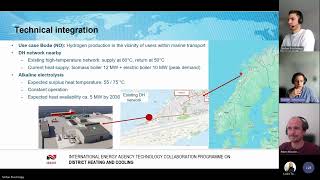
From our side Novapot, we focus more on the technical integration of the wastage from the electrolyzer to the distill heating network. So we had the case study in Buda, northern Norway, where there is hydrogen production facility and a distal heating network very close. The distal heating network works with a supply of 80 degrees and a return of more or less 50 degrees. And they have a peak demand of almost a bit more than 20 megawatt.
There is an electrolyzer, or they're planning to have an electrolyzer, an alkaline one. And the expected surplus heat, it varies from 55 and 75. So we investigated in some way two cases, low temperature and high temperature. The operation is constant throughout the year and the expected heat availability is more or less 5 megawatt. Next slide, please.
Then for the technical integration.
We considered a heat pump, an ammonia heat pump to do the heat upgrade. And we investigated three different configurations. The first one is just to have a heat pump to elaborate all the waste heat to be upgraded towards the DC heating network. Then we have a second configuration in which we add a heat exchanger that serves as preheating the return line before the heat pump in some way. So you upgrade the distilled heating return line with the high temperature wasted, and then the low temperature wasted is elaborated by the heat pump. While in the third configuration, the heat pump and the heat exchanger are reversed. So you upgrade the distal heating network line with the low temperature wasted and the heat pump elaborates the high temperature wasted.
Next slide please.
Yeah, so what are the main outcomes of this?
Gone. Yeah, so the higher the wasted temperature, the better it is. So if we are working with, let's say 70 of 7 or 75 degrees is much better than working with the 55 degrees. But that's logical in some way because it can lower the heat pump capacity as it is shown there. So it decreases from 6 to 5.4 megawatt, the heat pack capacity, then the COP increases, so it can go from almost 5 to almost 8, thus increasing this 20 degrees.
Gone.
Then one important thing is that in this case study we have seen that the wasted, the upgraded wasted, can cover a bit more than half of the demand, the total yearly demand of the system. So this will reduce a lot the reliance on the fossil fuels, like the biomass boiler, for example, especially like during the summer, you're able to operate as it is. You can see on the top charts you see the orange line or the green line in the chart on the left. On the right, that in the summer the orange line or the green line are fitting to the dist heating demand in some way. So for like two or three months you are able to just Operate with the heat pump and not the boiler or the biomass boiler or the electric boiler. Yeah, gone.
Then we have seen that the preheating makes a difference. If it is available, then we will see when it is possible because it can reduce the heat capacity by 50%. So if we consider a case of 75 degrees, it can go from 5.4 to 2.6 megawatt. Then it can improve the system copy by more than 100%. So it doubles in some way because it goes from almost 8 to almost 17. Why this? Because the. Let's say that the heat that is exchanged from by the preheating heat exchanger is in some way free. We are not spending energy to exchange that heat, except for some circulation pumps and so on. But they are, let's say, negligible.
Next point is that this preheating setup is only available when the wasted temperature is 10 degrees higher than return temperature of the DIST heating. This is a kind of a rule of thumb. So if we are working with a return temperature from the dist heating of 50 degrees, then we need at least a wasted temperature of 60 degrees. Otherwise it is not feasible from the physical point of view or is almost negligible. Yeah, thanks for the small presentation. I will leave.
To who is next?
Yeah, thank you for that. My name is Nicholas Marx from the Austrian Institute of Technology and we tried to answer the question, is it feasible to integrate electrolyzer waste heat in existing distributing networks? So on the one side we looked at the levelized cost of heat. So this is the perspective of, of the district heating operator, what's the maximum benefit from this side? And on the other hand, what's the level? How much can the level as cost of hydrogen be reduced? So this is the perspective of the electrolyzer operator. So in reality of course the benefit will be somewhere in between. So.
As they have to mutually agree on a certain strategy here. So we looked at both extremes and we did this in three case studies. The Buddha case study, as was presented before, there's a target of 10 tons of hydrogen per day. The Jimbach case study in Austria, where the hydrogen is used to power gas motor tests. And this, the third one is in Tallinn, Estonia, where where it's used for the local transport and the aim is to produce 40 tons of hydrogen per year compared to quite large distributing demand of 1.7 terawatt hours. Next slide.
So what we did is we tried to have a bit of a broader view on the topic. We have modeled the hydrogen system and the digital system in our Optimization framework called IES optimization. On the one side we have the hydrogen system with the electrolyzer, which is following the hydrogen production strategy, as no electrolyzer would operate based on the waste heat, as hydrogen is the main goal. So the waste heat is there. But the question is then is it more feasible to cool this away? Or maybe is it feasible to build a connection to the Keeling system? I need a heat pump there. And will it sort of displace some of the existing dish heating supply to lower the overall costs here? So the decision is whether to connect both systems. And we have done this with hourly data based on historic data. So 2024 energy prices and using the CAPEX and OPEX from the Danish Energy catalog. Next slide.
So, based on all the three case studies in Tallinn, we have to think that the base load is provided by waste incineration, which means the distributing provider earns money for burning the waste. So it's tough to displace that with electrolyzer waste sheet. The waste heat from the electrolyzer compared to the heating demand is lower than 0.01%. So this means not a lot. We displaced some of the gas boilers, especially during the peak heating.
Times. And compared to the other case studies, we had the highest average electricity price. So this means the optimizer will still build it, but it lowers the levelized cost of heat by just about 0.01%. So.
Depending on like whether to build this or not, this is a question in Jimbach. In the Austrian case we are displacing the powder heat module and we have a bit of a better ratio between the waste from the electrolytes and heating demands, covering about 7%. So we can reach a level of cost of heat of 5% here. And in the Buddha case there were two cases to look at. So one is where the waste heat is at 55 degrees and one is where the waste heat is at 75 degrees. And with that we displace mainly the electric boiler in the summer and the biomass boiler in the winter. Additionally, we have the lowest average electricity prices here. And with the 10 tons per day, the electrolyzer becomes quite large. So we have around 28% of the of the ratio of the waste heat to the heating demand and 30% in the 75 degree case. So we can lower the level as cost of heat by average of 19 to 27%. And then looking at the levelized cost of hydrogen, go to the next slide.
So in Tallinn, in this case we have the highest average electricity price. Also as the electrolysis is quite small. We have high specific capex and also we have compared to the size, very low full load hours. So around 2,200 hours per year. Which means we can lower the levelized cost of hydrogen by an average of 1%. In this case, in the embark we have the average electricity price at 62 Euro per megawatt hour and we have high full load hours of 7200 roughly. So we can have a bit of bigger impact here. And then in Buddha we have a large electrolyzer meets low specific capex we have due to the size we can produce more in some hours compared to others. So we're more flexible here. We have high full load hours and like I said, the lowest average electricity price, €33 per megawatt hour. So in the end, to sum this up, the impact of the waste heat utilization strongly depends on the existing heat generation technologies. Sites with high electricity prices and already inexpensive baseload heat supply like the one from like the waste heat incineration will benefit probably less from using the waste heat. Larger electrolyzers offer flexibility to produce more cost effectively and high full load hours and capacities reduce the specific cost of the electrolyzer and thereby improve the levelized cost of hydrogen. But in the end, like this is based on three case studies. We have looked at only one year and we have not considered any future market development. So this is to sum it up based on our insights. Thank you.
Thank you, Nicolas. So I can carry on from here. I'm Hisham from Tallinn University of Technology Taltech. I will share some insights from our survey on the challenges and drivers of integrating hydrogen electrolyzes with heat into the district heating system. And that was the main objective of the survey. In addition, to understand the perspectives of different stakeholders on this integration, we targeted different groups in our survey, including district heating and electrolyzers operators, policymakers, researchers and energy experts. We collected responses from 27 countries and most of the responses came from researcher.
The survey also explored some policies and regulations regarding to this integration. We can go the next slide.
Yeah. Now I will share some insights from the responses where we received and they have electrolyzers in operations or they plan to have electrolyzers. I will focus on five key aspects of the survey. Connection to the district heating network with heat management, operational strategies, technical requirements and cost impact from these nine responses where they have electrolyzers, eight of them are electrolyzer operators and one district heating company where they are already connected to electrolyzers and integrated their waste heat in their network. So for the first Key aspect, the connection to district heating network. As I mentioned, one is already connected.
Two plants are located close to district heating networks and six are far away making the integration is less visible.
The second aspect is the waste heat management for the electrolyzers. Reject the heat into the environment without any use of this. Two electrolyzers found alternative use for the heat for their internal usage and one electrolyzer connects already to the district heating network. Another one has plans for future connection.
Also regarding the operational strategies, five electrolyzer operates based on hydrogen demand, one operates based on seasonal storage and one operates based on the excess renewable energy. And one still undecided for the operational strategies.
For the technical requirement for the integration. The responses were varies from minimal adjustment to full infrastructure modifications. And one of the comments mentioned that when the electrolyzer when it was designed at the beginning and it was designed ready for the integration, it makes the infrastructure less and the investment for the integration would be less when the electrolyzer is already designed for that. For the cost impact also the responses were mixed some expected increase in the cost while other reported minimal impact or even reduction in the operational cost of the electrolyzer company. We can go to the next slide.
Yeah. So the survey identified several challenges which make the integration more hinder the integrations. The main reported challenges were as follow the high investment cost and infrastructure needs were reported many times by different responses. The fluctuation in the electricity prices was reported as the electrolyzer can be based on the electricity grid and the prices would affect the production of hydrogen. Therefore the availability of waste heat, inconsistent availability and the location issues of the electrolyzers plant. As many times the electrolyzer is located near to the location of power of renewable energy plant like solar parks or wind park and these locations can be far from the district heating network.
The last two challenges were regarding the awareness and knowledge gaps. Lastly regulation and legal barriers.
Next slide. And yeah, it's worth to note that the response with the already integrated west heat reported no challenges during, before or after the integration. So the integration went smooth without challenges. To overcome the previous challenges, we drafted a policy brief. We highlighted the challenges. We tried to throw recommendations to overcome these challenges. The recommendations are to recognize waste heat as a co product for optimized utilizations for the electrolyzer production like the hydrogen the main product and to recognize waste heat as a co product to encourage district heating operator to engage in hydrogen production which is a case in Estonia where a district heating company expanded its work and start to build an electrolyzer to produce hydrogen and that make the integration easier smoother, implement financial support, subsidies and grants to overcome the infrastructure and investment challenges, ensure future plants are designed for efficient heat extraction.
Foster collaboration among stakeholder, address variability in heat supply with storage technologies, enhanced research and innovations and lastly to develop certification for renewable hydrogen waste heat. And that's from my site?
Yeah, thank you. Yeah, that was basically the key insights and very compact insights to our high to heat project results. So last but not least, some overview about dissemination activities we conducted since we also tried to get our results.
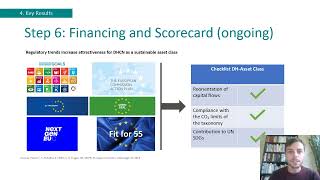
To our research partners and also to the industrial companies. So we participated at four conferences at the Stavas, at the Smart Energet System conference and at the IVT and at the EPCOM conference with presentations. There's currently one peer reviewed article in progress and there will also be an article in the Euro Heat and Power magazine and one in the Hot and Cool magazine. And we also had expert meetings and webinars. So also we had three expert meetings with the IADG experts where we discussed result and future outlooks. We have this presentation today with you as stakeholders and yeah, the recorded version of today's presentation will also be made available at the IADHC YouTube channel so you can then find this information there as well. Yet in conclude yeah, the wasted utilization can be or can support the decarbonization of heat supply system. As you have seen, it depends on operation strategies. So as presented regarding technical and economical feasibility, it's about the dimensions of hydrogen production, electricity availability and district heating demand which makes then the impact preheating can make a difference regarding reducing heat pump capacity and increase the overall system cop. The larger the electrolyzer, the more flexibility and the lower hydrogen production costs are. And the stakeholder insights showed the potential for electrolyzer wasted integration but also showed the challenges which needs to be addressed in the future. And we also derived that however, the technical economic visibility varies always from case to case. So that was it from our side. If there are any questions left, feel free to contact us directly me or also like the other colleagues who presented. Thank you.
More from IEA
XIV-05: Flexibility and DH value chain (FlexVal) – advanced analysis & compatible pricing
XIV-04: RE-PEAK - How to cover peak loads in district heating networks with renewables.
Digitalisation of District Heating: Summary of findings from IEA DHC Annex TS4
25/01/2024: The crucial role of district heating pipe lifespan in achieving climate objectives
IEA DHC XIII-03 Generation of simulated faulty datasets to ease heating network fault detection

XIII-01: Leave 2nd generation behind: Cost-effective solutions for small to large scale DH networks
XIII-04: Cost Benefit study on the building secondary network for improving DH performance
XIII-05: OPTiTRANS - Optimized transition towards low-temperature and low-carbon DH systems