Eliza Guelpa presents research on lowering supply temperatures in existing district heating networks to use renewables and waste heat. Two systems were tested: a small network cut temperatures by 10°C, a large one by 15°C with no investment and 30°C with limited spending. Less than 20% of 400 substations need above 90°C, making upgrades feasible for around 1,000 EUR per connection.
Questions this video answers
~15°C reduction with no investment; ~30°C reduction with limited investment.
~10°C reduction.
About 400 substations.
Less than 20%.
Approximately 120°C.
Chapters
Welcome to the Smart Energy System audience. I'm Eliza Guelpa from Polytechnic Ditto and with this presentation I'm glad to describe the experience that we have gained during the project Leave second Generation behind, which is funded by the International Energy Agency with the aim of reducing the supply temperature of the existing dish reheating system.
I want to take the chance to thank the other partners of the project which are the CEA and the University of Birmingham which I want to thanks for sharing this positive experience. So the research question of the project is how to achieve supply temperature reduction in existing distro heating system to allow the integration of renewable energy sources as well as waste heat which are usually available at lower temperatures and specifically is how to find potentials in terms of supply temperature reduction as well as proposing ways to overcome possible bottlenecks. Main bottlenecks are due to unsuitable pipe diameter, pumping system and thermal substations.
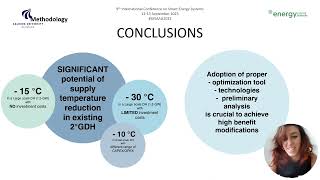
Here, among the main achievements of the project that we have achieved, we obtain in the study for existing second generation this reheating is in the large scale case study it is possible to reach -15 Celsius degrees without any investment cost and -30 Celsius degrees with limited investment cost and as concerned small scale case study -10 Celsius degrees can be achieved.
There are two case studies considered in the analysis. The first is a portion of the METS DIS reheating which is adopted as a small scale case study, and the Turing DIS reheating which is one of the largest system in Europe which is considered as the largest scale case study.
The MET distroheating is a second generation system fed by CHP plants which is supplied by temperature that reach 160s. The analysis is focused on a portion of 60 substation and the goal is to propose a methodology that allows to find the optimal improvement for modification of pipes, booster pumps and thermal substations.
The decision parameters of the analysis are therefore the diameter of some pipes, the size of some substations and the addition of booster pumps at specific locations. The goal is therefore to find the CAPEX and OPEX cost optimal for various scenarios that allows to respect some constraints which are the load matching the maximum fluid velocity and the maximum absolute pressure.
So, in order to find the best operations, an evolutionary multi asset optimization algorithm is associated with a simulator of the distribute heating network taking into account the nonlinearity in the network thermo fluid dynamics.
In the figure, one of the main results represent the multiple optimal solutions which are obtained by the optimizer for different CAPEX and OPEX values the colors of the point represent the supply temperature which are reached with a specific value of capex and opex. So results show that it's possible to reach non negligible supply temperature reduction and and in particular they provide a bunch of possible solutions to the disk reheating operation, giving them a larger latitude in the decision, also considering uncertainties and unexpected constraints.
Now we'll see the approach adopted for the large scale dies reheating.
The turing system supplies 8,000 buildings at 120 Celsius degrees with CHP plants. It is characterized by a main network of large pipes that we can see in Bold and 182 distribution networks connecting the main network to the buildings. And some of them are depicted in the figure and here we can see a zoom of them of one of them.
So in this more complex case a cascade approach has been used and in order are the disk reheating to shape the thermal peaks. An analysis on thermal substation both as is and with modifications on the network as is and with modifications and an analysis for storage installation.
As concerned the substation for all the big buildings. A basic model has been considered which includes thermal substation and a fictitious heat exchanger representing like the sum of all the heating devices of the building. The substation characteristics are estimated using the substitution data of temperature and mass flow rate and estimated by a proper data analysis approach.
So a model for each thermal substitution is adopted to estimate the relation among supply temperature, its flux and mass flow rate.
This allows estimating 3D cube like this, which allows to find given the maximum mass flow and the thermal flux required to the building, which is the minimum supply temperature that can be used for a specific thermal substation.
The minimum supply temperature is estimated for about 400 substations in cold winter operation. The figures show the minimum supply temperature in the descending order for the analysis substation and the maximum value achieved is 100. Furthermore disadvantageous substation and this means that the system can be as is can be supplied at 104 Celsius degrees. And it is also possible to see that less than 20% of the substation require temperature which are larger than 90 Celsius degrees. This means that it is possible to reach a supply temperature reduction of 15 Celsius degrees and is without any investment cost in a typical cold winter day.
Here we can see which is the investment required and the graph represents the supply temperature which can be reached for different specific investment costs. The investment is per equivalent substation, so it must be multiplied for all the substation in the network. So if considering erythrofectin analogy analysis, it is possible to see that with an investment of 1 kilo euro per equivalent substation, it is possible to make all the substations suitable to operate with a supply temperature of 90 Celsius degrees instead of 120 Celsius degrees.
Now let's see if the pipelines are suitable to operate with such supply temperature, since the supply temperature reduction increases the mass flow rate. So this is done using an optimizer to find the maximum mass flow rate supply to the building and therefore to minimize the supply temperature. So the problem is formulated through a mixed integer quadratic programming and is constrained by maximum and minimum pressure and velocities.
The increase of mass flow rate that can be sustained by the system by the network in a cold winter day is 47%. So if considering the mass flow rate increase that is required by thermal substation characterized by.
Different value of supplied temperature, an increase of 47% is it means a reduction of supply temperature of 2,100 Celsius degrees. So it means that as is the system can be supplied. Actually the network can be supplied with.
Temperature which are 20 Celsius degrees lower than the current temperature.
Since the congestion in a pipe is located in a pipe connecting the.
Thermal plant to the city center.
How it is possible to achieve the supply temperature that is minus 30 Celsius degrees.
Also in the network? There are two possible solutions. The first is to adopt the twin pipelines and the second is to use distributed generation. So exploitation of heat pumps, waste heat and renewable energy sources. And in particular this will be.
Something that is probably more closer to what will happen in the future with the inclusion of thermal prosumer in these three heating networks.
Another option for reducing the supply temperature consists in the use of storages. And this analysis consists in testing different types of storages, sensible, latent and thermochemical for reducing the supply temperature in the system for about 400 buildings. In particular, it has been considered that while reducing the supply temperature, the additional mass flow rate required is supplied using the storage.
Results show that with sensible storage it is possible to achieve very low investment cost but not negligible volumes, while thermochemical energy storages allows to obtain very small.
Volumes, but with larger investment cost. Payback times are in all the cases comparable with the lifetime of this reheating.
So in conclusion, potential of supply temperature reduction in existing large scale, this reheating is not negligible. This opens to the possibility to feed this reheating using renewable energy sources as well. As waste heat and heat pumps and in particular the adoption of proper tools as those presented in the analysis, preliminary analysis and suitable technologies are suitable in order to perform modification ensuring high cost benefit investments.
So thank you very much to the audience for the attention and thank you to IEA District Heating and Cooling that founded the project.