Presentation by Sebastian Schulze (Stuttgart University of Applied Science) on the IEA-funded 'District heating business model 2050' project (6 partners across 4 countries; two pilot cities: Alberslund and Nice; ~2.5 year duration). The project developed nine boundary conditions for district heating in 2050 (e.g., ubiquitous waste-heat recovery, fully decarbonized and decentralized supply, integration with storage, circular-economy framing), created business models via value-proposition and business-model canvases for two customer archetypes (passive and active), and validated findings through interviews, workshops and conference feedback. Key outcomes: future business models add new partners (heat providers, prosumers, co-creators), require digital infrastructure and new resources (heat pumps, staff for customer co-creation), and need investor education. For financing the project proposes targeting green/infrastructure investors, a sustainability balance scorecard of economic and sustainability KPIs, and a two-page investor information package.
Questions this video answers
Sebastian Schulze, researcher at Stuttgart University of Applied Science.
District heating business model 2050, IEA-funded.
Six project partners across four countries.
Alberslund and Nice.
Approximately two and a half years.
Chapters
So welcome everybody to the presentation. District energy in 2050 business models and sustainable finance Solutions. My name is Sebastian Schulze, I am researcher at Stuttgart University of Applied Science in Stuttgart, Germany. So I'm the third person here on the slide and yeah, thank you very much to Christina Lugno, our project coordinator, to give me the opportunity to present our project results here on the SAS conference.
Let's have a look to the agenda. I will quickly give you some project information. We have a look at our research hypothesis, the process we followed in the project and then of course some key results and financing sold out Financing soldiers Solutions.
So the project information. We are IEA funded project named the District heating business model 2050. We are six project partners in four countries. We have two cities, that's Alberslund and Nice.
We have one German district heating company, Veolia, the Danish bureau of district Heating and then two research organizations. So Stuttgart University of Applied Science and Iel our coordinator from Sweden and project is running for, yeah, two and a half years.
Let's talk about why we're looking on the project today. A lot of technical improvement was done in district energy sector in the past. So we think this makes also new business models and financing solutions necessary. Let's have a look on the research hypothesis. We think the boundary conditions will change for district heating. So under what boundary conditions will district heating operate? We think the business models will be different. So what will be the characteristics of the future business models in 2050? And the third part is about financing. We think that investors in green finance can be attracted by district heating. So what are the informations they need to consider an investment in district heating.
Here we have our process we followed in the project. So in the first two steps we did a literature review on policy and on the market in our Fiat 4 project countries. In the third step we done interviews with distributing users, so end users, building owners and so called prosumers. A prosumer is someone who can be a consumer and a producer. For example offers within data center needs, on the one hand heat and can provide heat for the system. Then we created business models and in the last two steps we validate what we've done before and we had a look on financing.
So let's come to the most interesting part, our key results.
Let's jump to step number four. We use the information from the literature review and the interviews to define nine boundary conditions for district heating in the year 2050. I just want to highlight some of them. For example, it's standard to recover waste heat. The heat Supply is completely decarbonized and decentralized and is combined with storage solutions. And there will be no more discussions about transition technologies like they were ongoing this year with the European taxonomy with nuclear power and gas. And district heating can be seen as part of a circular economy.
Here we have some insights from our business modeling workshops. Two screenshots. The left one is the value proposition canvas. The right one the business model canvas. The value proposition canvas is about a customer need. So in district heating that would be of course to get heat for your home or your office building. And then you think about how is your product or service fitting to this need from the customer. And then you define value propositions. You can see them below. We define two of them. The first one we named the passive one because we think that the most customers in 2050 will remain passive. So they just don't care about how the job to getting heat is fulfilled. So they just want to pay their bill and get the heat. And the second one is about active customers where we think they want to improve their heat demand and optimizing the system, want transparency about the system. And then you use this to do the business model canvas for each of the value proposition. Then you just think about who are our key partners, what key activities we have, what key resources we need, what is the cost structure and how do you make money and so on. And so you create a business model for this value proposition.
Here you see the result of the business modeling process.
In black you have the standard model from today, so 2022, standard third generation model. In orange you have the passive value proposition of 2050 and in green the active value proposition of 2050. So these elements came on top to today's business model. I just want to highlight some of the differences because you can see nearly in every box. Awesome.
Here we have on the left side the key partners that you can explain it really good because today you need mainly a fuel provider if you want to burn for example gas to create heat for the network. In 2050 we think there will be heat providers and prosumers so.
You have more players in your business model. And if you have the active business model, so the green one, you also have co creators to get in touch with these active customers. And of course this also affects the other boxes here. So for example the key resources you need more heat pumps, you need digital infrastructure and staff that is dealing with the co creators. And other boxes are affected of course too.
So let's come to the validation, the fifth step. So what we're doing is we validate our results by workshops or interviews or here in the conference. So please give us feedback because your feedback is part of the validation too and valuable for us. And here we have the key learnings from the project and the validation so far. I think it's important to mention that the boundary conditions of 2050 make assumptions that are not standard today. So of course they can change.
The second point about the future business models is that they are created to helping the customer to make the right decisions in sense of optimizing the district heating systems. And the last point is about investing. So even infrastructure investors are not really aware of district heating and cooling. So it's not a big deal today. And a knowledge building is really required to helping investments here.
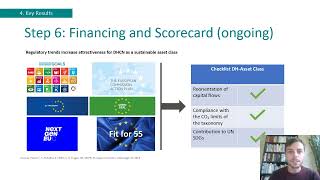
So finally, I want to quickly talk about financing. Financing is a big challenge because most municipalities are cash trapped and private investors, as we heard before, are not aware of this retreating. But the European regulatory trends and also worldwide are in favor of with district heating and cooling networks as a sustainable investment. A lot is going on there and investors search for green investments in the moment because they have to or they want to. And new generations of district heating with waste heat recovery, for example, they can be green investments. So what we're doing in the project is.
Searching for suitable investors and instruments for financing district heating in the moment. We are creating a sustainability balance scorecard with key performance indicators. So there are.
Economical and sustainability performance indicators. And with them investors can assess a potential investment in a district heating network.
And see for example, if this investment has a positive return or reduces his carbon footprint. And finally, we also create an investors information package. So this is a two pager where we wrote the most important things about district heating and special investment case and build up this knowledge about just reked that as needed. So that's it. Thank you very much for your attention.
If you want to stay in touch, you have our email addresses here and please give feedback. So thank you.