XIV-05: Flexibility and DH value chain (FlexVal) – advanced analysis & compatible pricing
Mika Räma presents the FlexVal project, which studied how flexibility can improve district heating systems across four European regions. Key findings: low-temperature operation cuts costs without losing service; thermal storage delivers bigger savings than demand response; integrating peak-shaving into network design reduces pipe sizes and total costs by 5-9 percent.
Chapters
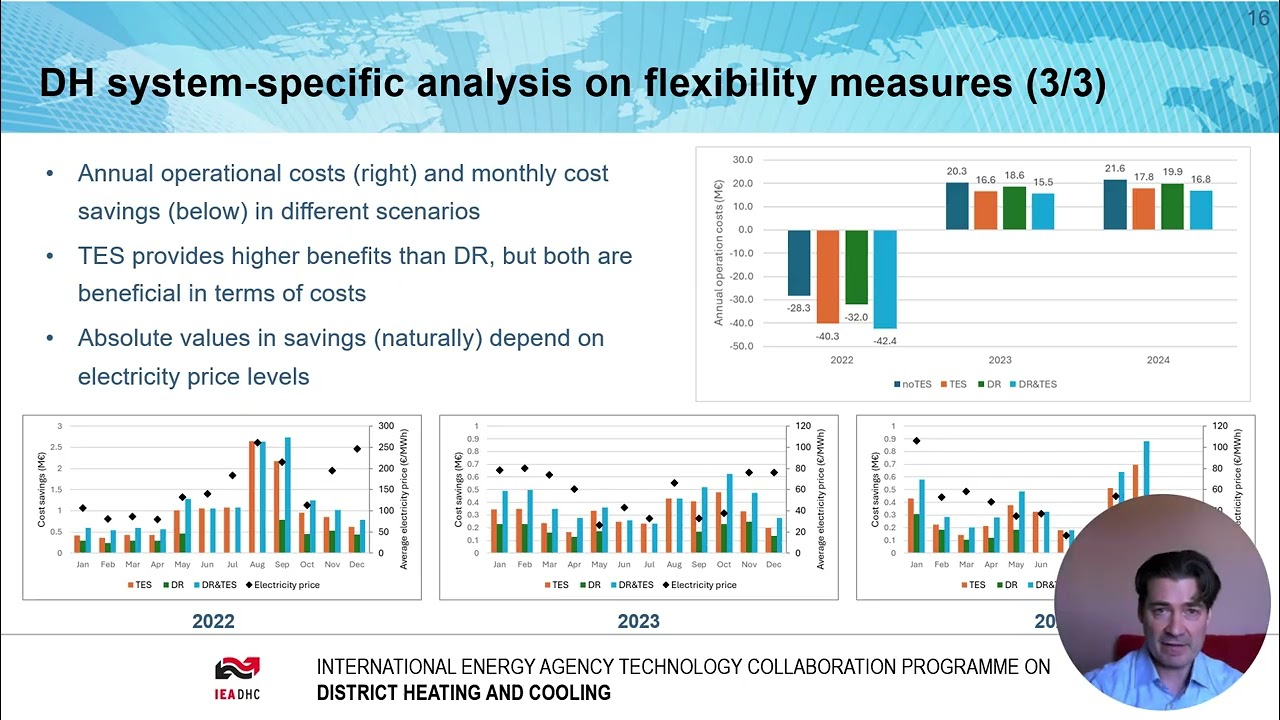
Hello, my name is Mika Räma, and I'm presenting the results of our project Flexibility and District Heating Value Chain, part of the IEA DHC AI 14. The object of the project was to investigate flexibility in district heating systems. The work was divided into 4 different studies led by different partners. IEA DHC AI from Sweden focused on potential of district heating flexibility in a long-term perspective, while VTT studied the operational flexibility of district heating within the Nordic energy system. DTU from Denmark focused on future-proof design and operation of the buildings, while Vito studied the flexibility from the network design perspective. There was also a fifth project work package on management, communication, and cooperation that included a task on joint analysis that included analyzing results from individual VEPs with conclusions drawn. District heating systems are commonly operated and designed using a top-down approach, considering alternative heat supply options in investment decisions. However, a bottom-up approach adopted strongly in this project prioritizes demand-side opportunities and actions that can actually increase and enhance the heat supply options available. Moreover, a systemic approach would support reconciling the alternatives and emphasize the interlinkages between the district heating system and the surrounding energy system. So what is flexibility? It is an ability to control the heat supply to accommodate the heat demand. This is useful for managing the demand profile, but also to accommodate, for example, wind and solar power from the electricity system, or to react to seasonal availability of resources. Heating sector can potentially provide significant amount of flexibility in a cost-efficient manner. Usually, operational flexibility is in focus, but the motivation for increasing the flexibility is more strategic in nature. For example, anticipating changes within the surrounding energy system, preparing for the emergence of excess heat, or considering the availability of renewable heat sources. In the figure there on the right-hand side, there is an attempt to categorize the flexibility measures based on where in the system they are provided or from the temporal perspective. And now moving on to the first VP1: potential of district heating flexibility options in a long-term perspective. So the objective of this study was to evaluate policies or measures that affect the flexible use of district heating by using an energy system modeling as a method. So this was actually a case study for the island of Gotland with the focus on the district heating network in the Visby region. Visby has a district heating system with biomass boilers, heat pumps, and thermal storages already. The method was TIMES modeling framework, and the two scenarios that were considered were wind power-based ones. So one with no offshore wind and the second one with the large-scale offshore wind enabled. In addition, four district heating-based sensitivity cases were considered: a base case with no additional measures, with a capacity tariff, with a bonus system for low temperature district heating, and then finally the fourth one with both capacity tariff and low temperature bonus. Enabled. So on to the results. Here, district heating production is presented with and without the offshore wind being part of the system. With offshore wind, the district heating is clearly shrinking unless low temperature district heating is introduced. Without offshore wind, the outlook is much more positive. However, when introducing a capacity tariff, this is clearly not beneficial for the development. Of the district heating system. So another interesting example of the results is the use of district heating energy storage. So the utilization of the storage clearly is present in all the scenarios and cases where district heating remains a relevant option. Also, as the energy system develops and we go forward in time, the storage utilization increases. Additionally, higher levels of electrification by heat pumps and electric boilers, part of the district heating supply, increase the use of storages. So here are some main conclusions about the work. Surrounding energy system has a profound impact on how the system develops. Capacity tariff as a measure or a policy instrument clearly decreases the economic viability of district heating. Introduction of low-temperature district heating helps to maintain the market share quite a bit better than the alternatives, and use of storages clearly increases in the future district heating systems, especially if electrified heat supply is present. So moving on to WP2 and operational flexibility of district heating within the Nordic energy system of 2030s. So the overall plan and objective was to consider and assess the impact of flexibility measures, namely demand response and thermal energy storages, in district heating systems on two levels: first, Nordic energy system level, and second, for a specific case district heating system. As part of the work, the impact of different weather years was considered. This slide summarizes the modeling setup used to assess district heating-based flexibility at an energy system level. Backbone energy system model and its North European model was used, but the analysis is centered on Finland and its district heating sector. Within Finland, the 7 largest district heating systems are modeled in more detail while the rest of the sector is aggregated. Three scenarios are compared: first, a reference scenario; second, a thermal energy storage case with additional thermal energy storage capacity; and thirdly, a demand response case with added demand response capacity. To assess the robustness of the results, the model was run for different weather years: 14, 15, and 16. So here are some examples of the results. First of all, the impact of flexibility— additional flexibility— was positive, although minor. This is due to the comparably small additional capacities defined. There was also a decrease in biomass consumption in heat-only boilers and a corresponding increase in CHP production, and also an expected increase in electrified heat supply, especially the electric boilers. Thermal energy storages were used extensively and with high capacity while demand response was operated with more frequent but smaller adjustments. In the study, we also noted a methodological issue concerning where flexibility is observed, as the system was optimized as a single entity. So, would specific parts of the system actually provide the flexibility as modeled? In other words, while the outcome is optimal, can the market mechanisms be assumed to steer the operation of system as indicated by the model. Due to the methodological issue, there is clearly a need for a system-specific study. This was carried out using the same energy system modeling method but for a specific case study system. This case study was done for the district heating system of the city of Kuopio with approximately 1 terawatt-hour of heat demand and a very versatile profile. Production mix. Four scenarios were considered: one, no thermal energy storage or demand response capacity included; second, with thermal energy storage capacity increased; third, with demand response capacity added; and fourth, with both thermal energy storages and demand response. Electricity and weather years of 2022, 2023, and 2024 were considered. These include the crisis year of '22 and a year with very low electricity prices, '24. Here are some more results. So, changes in heat production within the CHP and electric boilers in different scenarios and with thermal energy storage, demand response, or both in included are presented on the right-hand side. So having additional thermal energy storage has the most visible impact, but there are significant differences between years. On the left, utilization of thermal energy storages and demand response in different scenarios is presented, with thermal energy storages again showing the more visible impact. Here, annual operational costs to the right and monthly cost savings below in different scenarios are presented. Thermal energy storages provide higher benefits than demand response, but both are beneficial in terms of costs. Absolute values in savings naturally depend on— highly on electricity price levels, which is a significant factor for the results here. This can be observed by comparing the results corresponding to years and then to the scenarios. So here are some main conclusions that can be drawn from the presented work. So flexibility is becoming an integral feature of the district heating systems due to the heat supply electrification and also due to the increase of wind and solar-based electricity production in the systems. Linked to this need for flexibility, electrification is clearly a trend in in district heating development. While flexibility provides benefits from both energy system and district heating point of view, the yearly variations can easily outweigh the impacts of having more additional thermal energy storage or demand response capacity, for example, in the systems. The large-scale energy system modeling shows that there is a benefit to be gained through flexibility, but it also shows some signs of unrealistic behavior. So will actually specific systems provide the flexibility as modeled? Also, one additional point is that the reserve market participation that was not considered in this study is likely to represent opportunities for systems that have increased flexibility. Next, moving on to VP3 and future-proof design and operation of demand-side components. A realistic case example of the city of Viborg and its district heating system is used for this study. So the Viborg district heating system was originally based on natural gas but has an aim to be fossil-free by 2027. This target, its economic feasibility is compromised by the bottleneck of having high supply temperatures in buildings. This is mainly due to the future heat supply being mostly dependent on heat pumps. VIBORG also has an advanced pricing system, for example, a discount and penalty for the heat tariff based on the supply and return temperatures. So-called motivational tariff. The first part of the work presented focuses on space heating systems in existing multi-apartment buildings with radiators as the heating elements. The plan and the method was to utilize heat cost allocator and heat demand data to analyze the operation of a heat distribution system and to suggest improvements. The outcome was that significantly lower temperature levels were possible without any compromise in the heating services itself. As part of the work, a methodology for securing low-temperature operation of buildings was developed. Other significant barrier for low-temperature operation in buildings is the domestic hot water system, one specific problem being the hot water circulation. Two new design options were compared against the typical substation configuration. First, a domestic hot water preheater with the booster heat pump, and second, a cascading aftercooling design for a substation. The first resulted in 15 to 20 degrees lower return temperatures on average, while the second enabled 3 to 7 degrees lower return temperatures depending on the supply temperatures. Related to implementing the rollout of advanced substations, two business models were compared and studied in the work. In the first alternative, there is a business model where the substation is owned and thus the investment is made by the end user, and in the second, the substation is owned by the district heating company that is also making the investment. In the end-user option, the capital costs are offset through pricing provided by the district heating company, while in the second, the capital costs are paid back through the direct economic impact of the improved efficiency due to low temperature operation. This slide shows a comparison between the business models and their feasibility in rolling out the advanced substation designs. The results show that pricing itself cannot offset the capital costs from the end-user perspective, while the investments made by the district heating company represent the feasible arrangements for rolling out the new advanced substations. This is of course a result for a specific system but represents a highly interesting perspective for any district heating company aiming to reduce distribution temperature levels. So here are some main conclusions about this part of the work. Economic feasibility of decarbonization of district heating systems can be bottlenecked by high temperatures in buildings and their heat distribution systems, and as a result also in the district heating network itself. The work carried out here demonstrates that there is a potential for lowering temperature in existing buildings with existing heat distribution systems. Substation designs can help and support in low temperature operation, especially regarding the domestic hot water supply. Introduction of new business models can help in this task as well and allow the district heating operator to be more active player in development of their systems targeting low temperature operation. And now, VP4 and flexibility from network design including operational aspects. In this part of the study, topology design is considered from a perspective of combining spatial and operational aspects. Network structure and dimensions are optimized considering both the investment and operational costs, also taking into account demand-side management. Management opportunities. District heating planning perspective is somewhat different in mature and emerging district heating markets. In mature markets with established district heating system, operational perspective is important, while for a new system, the network and system design is more relevant. In this work, these two aspects are combined to produce an even more feasible design for a new system with operational perspective considered as well. This work is based on two existing tools, the Storm and Bathopt. Storm District Energy Controller focuses on operational optimization while Bathopt provides a network topology optimization service. The use of the two approaches were combined and demonstrated in an imaginary case example set in the city of Menen in Belgium. In the picture here, the potential routes for district heating pipelines are presented, as well as the locations for the consumers to be connected. Three scenarios were considered: a business as usual scenario as a comparison point, a scenario with -20% peak shaving for all consumers,— and then finally, -20% peak shaving for the 5 largest consumers in the system. This slide represents the business as usual arrangement resulting in the total heat demand of 1.46 MW and the total cost of ownership of €8.7 million. The -20 peak shaving scenario shows smaller pipe dimensions and a reduction of -14% in peak heat demand and -9% in total cost of ownership. The scenario with -30% peak shaving for the top 5 consumers shows similarly smaller pipe dimensions and reduction of -7% in peak heat demand and -5% in total cost of ownership. And here are some main conclusions about this work. It was demonstrated that including operational aspects into the design stage can affect the network feasibility and result in different topologies and dimensioning of the network. The total cost of ownership due to the introduction of peak shaving measures while utilizing the developed approach shows clear savings due to the modified network design. The details do matter. For example, the non-linearity of the problem has an impact on the balance between CAPEX and OPEX of the studied cases. Ultimately, the work here presents a different approach to flexibility. Automated design can increase district heating network feasibility and increase the integration of renewable energy and waste heat sources. And finally, here are some conclusions on the project in overall. Four main learnings can be drawn from the project. First of all, building-level actions are in key role. A bottom-up approach utilized in this project could enable more efficient development pathways for district heating systems, aiding the introduction of especially the low-temperature distribution. Flexibility is becoming a systemic feature of district heating coupled with the energy system, and its significance will only increase as wind and solar-based electricity production capacity grows and the trend of electrification progresses. However, it has to be said that the solutions are strongly context-specific. The operational environment in terms of regulation, energy markets competition, technological developments and climate is always to be considered. Lastly, anticipating the future development is crucial. As the operational environment changes fast, the interconnections between the electricity and heating sectors, for example, become stronger. One should not focus only on the district heating system in hand, but to consider also the developments surrounding it. Many thanks for listening, and should you have any questions regarding the work or any specific elements within, please don't hesitate to contact us. Thank you again.
More from IEA
XIV-04: RE-PEAK - How to cover peak loads in district heating networks with renewables.

Digitalisation of District Heating: Summary of findings from IEA DHC Annex TS4

25/01/2024: The crucial role of district heating pipe lifespan in achieving climate objectives
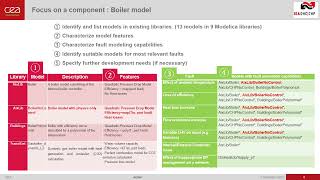
IEA DHC XIII-03 Generation of simulated faulty datasets to ease heating network fault detection

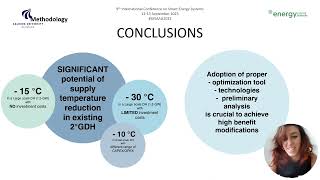
XIII-01: Leave 2nd generation behind: Cost-effective solutions for small to large scale DH networks

XIII-04: Cost Benefit study on the building secondary network for improving DH performance
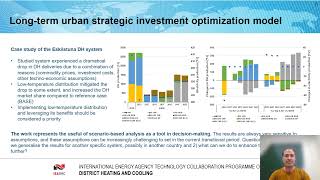
XIII-05: OPTiTRANS - Optimized transition towards low-temperature and low-carbon DH systems