IEA DHC Annex XI: Structured for Success - Final Workshop (Beginning)
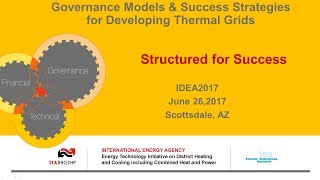
Lakshmi Rao opens an IEA workshop on district heating and cooling governance, presenting research on strategic decision-making. The session covers renewable integration, economic and resilience drivers, and case studies from Canada, South Korea, and the UK.
Chapters
Good morning, My name is Lakshmi Rao, I'm a director with the International District Energy association and it is my pleasure to have you join us for this workshop today. The content and discussion will be based on a research report that idea produced for produced in April of 2020 17. So it's very recent for the International Energy Agency.
Implementing agreement on District heating cooling and CHP. It was part of Annex 11. That's how they do their research reports. So I would like to thank them very much for supporting this important work and for enabling this workshop. I look forward to your engagement and a rich discussion. We have a lot of experts in the room and we'd like to build on the work we have done. So I want to very quickly show you the report.
Because today's workshop is just going to touch on the highlights of this report which is very comprehensive and.
It'S available on the IDEA website. It's also available on the IEA website and it's a report that covers select countries. Canada, where Bruce Ander hails from South Korea, Jong Joon Lee, Michael King from the UK and Anna Chittam has put in content for Denmark and we worked on usa. So it's a select bunch of countries that we have showcased in this report and it's very focused on governance models and strategic decision making processes for deploying thermal grids. There's a lot of work done to date on technologies and success stories but what we've done is we've peeled the onion around the success and gone deep into what was it that made it successful, what were the strategies. So at this point I want to also thank my co authors here, Anna Chittam to my left, Anna from Gritcraft and Ida Jung. Joon Lee is representing Korea District Heating Corporation which is very helpful in supporting content in the report. And Michael King, my dear friend from the UK who has been writing about this subject for many, many years but has provided very useful content in this report. So I just want you to I think it's over 100 pages and we have two appendices, 12 case studies from these select countries, an appendix on tools. You'll find the appendix on tools available at your seats and I want you to take the time after this workshop to look at the report. So I'm going to provide a brief introduction of the agenda today. We are going to start off with.
A very important context setting piece and that's to look at the political, economic, technological and social context. Anna Chittam will provide an overview and talk about the countries that we've covered in our report. And that will be followed by a panel discussion that we have panelists from Canada, Bruce Onder from Markham, District Energy. Bruce has been a past chair of IDEA and a very experienced, insightful district energy.
System manager. From South Korea, Jong Jun Lee, and then from uk, Michael King. Anna will follow that segment with looking at policies, you know, what are some of the federal, state and local policies that enable successful district energy systems. We're going to have Tomas Smith Metnisova from Canada talk about procurement opportunities and challenges. You know, part of making a district energy system work is procuring the system components and the challenges that one has to face both in the public and private sector and getting all the components lined up. And then I will follow that with a look at the business models that are in use across successful systems. What are some of the best practices, what are some of the challenges and the lessons learned? And we are going to have three of the 12 case studies presented today from the public sector perspective. We'll have Aarhus from Denmark, Anna Chittam will talk about that. Jung Jun Lee will talk about Sangam from South Korea and Jim Lodge, who's our host for this conference and is busy making all the things happen today, will join us and talk about Phoenix here in Arizona. After lunch, we're going to look at an important aspect. Our research shows that district energy systems are not static. They have a life cycle. They're conceived, the feasibility studies and then they're implemented and they have a long life. They need to be operated, maintained and then sometimes modernized and nowadays sold and acquired by.
Other parties. We also have a panel discussion during that segment with Ken Smith from Evergreen Energy.
Suresh Jambunathan from Veolia. I've seen Suresh this morning and Jim Lodge from nrg. Michael Ahern is going to join us from Evergreen Energy. He's on a plane right now to talk about community based energy planning for successful projects. So we're covering the breadth of what it takes to be successful in implementing these systems. We also have a short video on stakeholder engagement, stockholders, stakeholders too, that Helen Andrews Tipper from the Carbon Trust has sent in. She couldn't make it, but it's a very insightful video. Ten minutes or so that you will get to see this afternoon and then Michael will talk about capacity building, a very important aspect of success in these systems. And then we'll have time for open discussion after each segment. Feel free to ask questions. I think there's a mic up front here and we'd love to have engagement and also listen to what your insights are to build on what we found. So district energy systems, as we know, live in communities. They work with municipal objectives and support cities as they grow and modernize and urbanize. But success really requires a balancing act. It's really looking at physical, financial, environmental and social landscapes and seeing how as a systems provider, you can meet as many of you these objectives as possible and still have an economically viable system. So this is the concept that we have produced for the life cycle of a district energy system. Starting with the concept, you have to spend a lot of time developing the concept before you open the valve to go to the next stage. So we'll cover this in detail in the afternoon. But we've also identified some key factors that we call them the rimped set of factors, risk information, money, people and tools, and all of the systems that we've looked at, and I'm sure you will identify these factors in your own systems, is that getting from vision to viability requires paying attention to some of these key factors.
And I wanted to end with this slide because this is, this is a slide that shows that the district energy industry continues to grow. This is produced by IDEA, we call it. We get this information from folks who volunteer. System growth and district cooling systems, as we know, are growing more rapidly these days than district heating systems, as our folks from the Middle east will testify. But in general, district energy systems continue to move forward. They are. A lot of them are doing it right. Doing it right, I think, as Bruce and Michael will tell you, is very important because.
A failed project is not just a failed project. It reflects poorly on the whole industry. So our hope is that with this workshop you have insights and information and make connections with experts and service providers so that when it's time for you to look at your project or system, you can bring those to bear on your system.
So with that, I'd like to introduce my dear friend and colleague, Anna Chittam. Anna is energy planner and she founded Gridcraft. She's a consultant and researcher in federal, state and local energy policy programs with a specific focus on chp, district energy, micro grids, energy efficiency programs, and comprehensive energy planning. She has a Bachelor's of Economics from Gonzaga University and a Master's in Urban Planning from Columbia University and has been a co author with me on the report. And I look forward to her discussion and presentation, which I line up.
These are Bruce's slides. Hang on.
Don't want to get ahead of ourselves.
Oh, thank you.
Thank you.
All right.
Excellent.
Okay.
Good morning. How are you all doing today? Good. I guess I can't really stand back because then you can't hear me. So I'll go ahead and stay right here.
So as Lakshmi mentioned, today's workshop really draws significantly from this report. And I do encourage you to spend a couple hours, an entire afternoon reading the report. We're not going to sit here and, you know, recount all of that verbatim. But what we are trying to do is tease out a couple of the interesting takeaways that we as a group thought were.
Some of the kind of key lessons that we learned. Especially, you know, us having been embedded in this world for a long time. I think doing this report, a couple of interesting trends and ideas emerged. And so what I want to talk a little bit about right now, this morning before we move to our panelists is some of those trends that I think are shaping kind of the district energy systems that we see today. So, so we identify quite a few trends in the report and.
You can see this whole list here. The political unknowns at the bottom, I think is becoming even a bigger trend in a lot of areas of the country. And we could talk a little bit more about that and sort of how people are addressing that maybe in our discussion period later today. But I wanted to just talk a little bit about nodal development and integration of renewable resources because we're definitely seeing more interest in developing kind of smaller scale nodal systems with the expectation that later on down the line they will be aggregated into larger systems. And I think it's a real opportunity that hasn't been as.
Frequent in the district energy world for, you know, in the recent past. And then integration of renewable resources. We're seeing a lot of local and state and provincial and regional goals for renewable energy, not to mention a lot of the national goals, the EU goals. And so translating those renewable goals that are often thought of as electricity goals into specific goals carved out for the district heating and district cooling sector is something that we're seeing successful district energy systems do. And we're seeing, you know, representatives of those systems really establish district energy as one of the opportunities to reach renewable energy goals.
So for one example of the nodal development, and this is kind of, I would say, representative of some of the new systems that we're seeing. I looked at the Surrey city energy system and what I think is really interesting about this and I will say again, that kind of everything that we're presenting here is in the report. So if you can't, if you don't want to write it all down. You'll find it in the report.
The Surrey City Energy system. There was a recognition by the city that they wanted to develop a new system to meet this expanded downtown area where they were going to be targeting a lot of their new density. But they were not ready to fully identify what the resources, the long term generation resources would be. There was an expectation that there were potentially some renewable resource opportunities, but they weren't really ready to totally identify those and make those capital investments. So what they did is they began to build the system out in a nodal fashion and they actually installed temporary gas boilers in some cases to make sure that.
The services to the buildings was there and developers could be confident in the fact that they could develop a building and there would be hot water, there'd be the heat resources that they need. And then it kind of allowed the city to buy some time to investigate some of their opportunities that were possibly lower carbon or possibly would leverage local resources better. And then the expectation is that the temporary gas boilers will stick around and they might be used as emergency backup or something like that. And so I think that this idea that if you want to build a new district energy system, you have to build the entire thing right away, we're definitely seeing a little bit of a pullback from that and a recognition that you can look at a couple of buildings or one building and you can look at another building a couple blocks away and you can think about 10 years down the line how you might integrate those two systems, even if you can't build that entire system right now. And there's some other examples of that in the report as well. And then another major trend that we've seen is systems that are really designed to maximize and best optimize existing renewable energy resources. And so one example I like is Hamilton Community Energy's McMaster Innovation park, which is up in Ontario, Canada. And this particular system has kind of three, I sort of think of it as three tranches of energy resources that it relies on. So there was an identification of.
Geo Exchange opportunities. So this is kind of the geothermal heat pumps. There was a recognition that that opportunity was there and was potentially cost effective, but it was not going to meet the full demand. There was also an interest in solar and so what the facility is structured such that the Geo Exchange bank is essentially operating to kind of meet and fill in some of the gaps from the solar thermal resource that is deployed there. And then there are natural gas boilers that address the peak. And so there's kind of these Three different.
Bands of resource availability to make sure that they can meet all the peak needs, but also taking advantage and really maximizing the renewable resources there. So that's definitely something we're seeing a lot more systems that are structured like that. And I think that's really compelling and interesting especially to city leaders who are establishing renewable energy.
Goals.
And long term targets.
So I want to just kind of switch into those, those are some of the trends. And then we also tried to really look at the drivers. So things that are actually maybe kind of tipping the scale or they're sort of the final thumb on the scale to make a system actually move forward or make new investments in a system move. And we separate them into economic, environmental and social drivers. And I just want to kind of hone in on two of those that I think are some of the bigger drivers right now. And one is climate change mitigation and concerns about reducing greenhouse gases. And so one of our case studies is Paris, France that has a, you know, they've had a district energy system for a long time, but they were looking to reduce the greenhouse gases of the entire city. And so the city early on recognized that renewable district heating was one of the most cost effective ways and tools that they had to reduce their greenhouse gases citywide. And then so the city established their own goal. The EU obviously has their own goals. France has, you know, there's a carbon tax framework. So Paris was able to basically take their city goals and turn that into requirements for one of their district energy operators as part of the concession structure. And so while there was an initial goal to increase the share of renewables in the district energy system to 60%.
That that goal existed. Then the city came back and said, you know, as part of this concession agreement, we actually want you to reach 75%. And they were directly involved with the district energy company to identify in this particular case some geothermal opportunities. They did a big study and helped the district energy company identify how to sort of most cost effectively integrate that and into the system. And the district energy company then was a partner in one of the investments in a new geothermal system. So, you know, we see kind of these top down drivers and influencing these city drivers. And because the regulatory scheme which we'll get into a little bit is, you know, so varied, I think a lot of the cities are starting to find opportunities to integrate certain greenhouse gas and renewable energy goals in whether it's a concession or it's other types of leverage that they're giving to the district energy system. And so we talk a little bit more about that in the report. And then another main driver that we're seeing kind of across the board is this resilience driver. And I think it's funny because I made this slide before the Phoenix area hit some records temperature peaks last week. But really the notion of thermal resilience is driving some new entities to connect. And in the Phoenix area, the Maricopa County Sheriff's Office actually connected to the one of the existing district cooling systems in part because they wanted to make sure that, you know, at peak summer.
Energy demand periods, if the grid went down, the electric grid went down, they wanted to make sure that their system was going to remain and their building was going to remain comfortable and it was not going to become a public health type of hazard. And then beyond thermal resilience, we're also seeing drivers in electric system resilience. And this is something that I think District Energy systems have maybe not done a great job of making the case for, but there's a really excellent example at the University of British Columbia where the existing electric infrastructure was regularly. One of the substations was regularly operating very near its peak. And so BC Hydro was very concerned about this. And so when the University of British Columbia updated and expanded their District energy system, they were able to show that they, by generating a lot of the, the heat on site, they were able to reduce the electric demand on the substation. And so that was so beneficial to BC Hydro that they're actually paying the university for that benefit. And that's something that we're seeing in a lot of other instances, even kind of throughout the US where there are electric utilities that are saying, you know, it's actually more cost effective for us to pay to have this type of resource diverted to be met by a district energy system, rather than putting in a new substation or making major investments in our distribution system. So that's something that we see definitely driving a lot of new system consideration and an expansion of existing systems. So I'm going to pause there and I'm going to introduce my esteemed panel. Ooh, do I have my bios?
I'm just going to introduce, I think all three of them at one time and then we can just kind of go down the line. So first we are going to hear from Bruce Onder, who is president and CEO of Markham District Energy. He's held this position since 2002. Markham District Energy, for those of you who don't know, it's a thermal energy utility owned by the City of Markham Mr. Onder has spent over 35 years in Ontario's energy sector, developing community energy systems and CHP facilities. He has been a chair of the International District Energy association as well as the Canadian District Energy association and the association of Power Producers in Ontario. In 2013, he was awarded the Queen Elizabeth II Diamond Jubilee Medal. I didn't know that. From the Government of Canada in recognition of the recipient's contribution to the municipal sector in Canada. That's really wonderful. So we're very happy to have Bruce here. Then we're going to be hearing from Jong Joon Lee. He is with the Korea District Heating Corporation. He's a senior researcher there. He's responsible for for research on power plant performance. He holds a Bachelor, Master's and PhD in Mechanical Engineering from Inha University. And then after Jong Jun Lee, we will hear from Michael King, who is the Director of District Energy Development Limited he is the principal there and he has 23 years of experience in the sector encompassing consultancy, development, research, lobbying and authorship. He is currently engaged in developing a United Kingdom municipally owned district energy procurement agency, which is based on an existing model in Stockholm, Sweden. He holds a Bachelor of Science degree in Psychology from Northeast London Polytechnic and a Master of Science in Organization and Policy from the London School of Economics.
So while we're waiting for Anna to find the question she's going to ask the panel. Are there any thoughts from the audience? Anything you want us to cover? I briefly went over the agenda. Are there topics that keep you up at night? Anything you want us to pose at the workshop? I know it's still early, so if you think of something, I mean, we do want you to engage.
He's going to come up and present slides, I think.
Okay, so what we're going to do is we're going to have each of our panelists present the political, economic, social context and then we will have the panel discussion.
Thank you.
Good morning, everybody.
Welcome to Scottsdale and greetings from Canada. If you're attending next year's conference, we'll be in Canada, so we'll welcome you there as well, hopefully.
This is a great report, by the way. I have read it. I have spent the afternoon a few weeks ago reading it and there's a lot of meat to it. It was well done, I guess, from my perspective. Also.
It doesn't cover everything. As I think about my system and things that I've learned. And this is a very complicated business, I think.
So.
Anna has.
Helped me out by populating a few slides that I've looked at and reviewed the two case studies from Canada that the report deals with is the N Wave system in Toronto and the Southeast Falls Creek system in the, in the Vancouver area. And so these, these three driver areas, it starts with economic drivers. And I found it interesting that under N Wave for example they talked about N Wave over many years years provided a dividend to the city of Toronto. That's a good thing. And ultimately after running for many decades, share appreciation got to the point the city decided to sell to the private sector, to Brookfield and they made a nice profit on their investment.
So yes, it provided a revenue to the City of Toronto as an owner over the many years and undoubtedly rates were competitive for the customers of N Wave for both heating and cooling. And then you get into Vancouver talking and some of the points out of the study talking about the rate structure, not front end loading to the customers in this new system that's pretty important or it wouldn't have got off the ground.
As I think about these two points around Vancouver and Toronto, there's a focus on rates. I think when you talk about economic drivers, rates are only part of it. In fact, in Markham we think in terms of the District Energy service to our customers as a premium service. So we're never trying to get to the point where the definition of our rates are equal or cheaper than.
The status quo. In other words, in building systems. And for Marcum, again, Markham wasn't a case study in this report. But the economic driver for Markham's investment wasn't necessarily the return on investment of the Markham District Energy to our shareholder. It was the economic development.
Drivers.
It's interesting that our system, which is not all that old, we're in our 17th year, we've attracted major investments by IBM and Bell. We, we've recently attracted a university campus which will be in construction next year. And if you talk to our city shareholder, they'll tell you the economic development value of these investments in the market because of the District energy system dwarfs the return on investment of the actual company itself. So the economic driver is the business that attracts to the city. The other point made under the economic drivers area was in Toronto and Vancouver taking advantage of local resources. In the case of Vancouver, it was a sewer energy which was right there on the property. And in Toronto, of course, although Toronto had a District heating system for many, many years taking advantage of the, of the latent heat or cooling in the lake.
World class project in terms of taking many, many millions of square feet off of electricity grid for cooling. So I guess the point There was taking advantage. There's windows of opportunity in District Energy, whether it's a development opportunity or you know, in the case of Vancouver, it was the Olympic Games. There was a short window that opened. The Olympic Games was coming. Those behind the system saw the District Energy system development saw there was an opportunity. They probably had a one year window to make a decision, yes or no to go with that in this case in Vancouver to meet emission reduction goals, but to develop a system and, and once that window has passed, it's passed. Toronto for me is an interesting city because it has N wave which has been around for a long time has deep lake water cooling. But Toronto is a big city and it's a growing city and I've said at various conferences my disappointment in our sector is one of Toronto missed one of the big opportunities that I've ever seen. There's a lake water development, millions and millions of square feet where District Energy was to be part of the platform and for a variety of reasons, governance reasons, pushback from the developers because they were looking for rates that were cheaper than the alternative. And that's a very tricky discussion based on your assumptions what's cheaper as opposed to trying to figure out what is competitive and what's a superior service. To make a long story short, that platform, the Distro Energy, you know, proposal fell, fell down. It was cancelled. And we've got millions and millions of square feet of buildings going up in Toronto with conventional boilers and chillers on the roof and that will be the, that will be the stat that's the status for that development area for 50 years. So there are, there are windows of opportunity that we have to, that we have to pick up on. The deep lake water cooling in Toronto was interesting. You know, this was, this was published a couple of years ago in taking in connecting all the buildings to deep lake water cooling, they'd removed almost 80,000 tons of CO2.
And that's the 15,000, 15,800 cars off the road. I think those numbers are always changing because at the time this was displacing coal power at the margin in Ontario. Coal power, we've eliminated coal power electricity generation in Ontario a few years ago.
But nonetheless it's a significant number.
There was a point on social drivers in Vancouver that Anna brought out of the report for me again related to rates.
And so rate stabilization, competitive rates. I suppose you could view that as a social driver for the customers. When I think of social drivers I think of other things such as resiliency.
And the fact that you Have a thermal grid gives you that flexibility in the future. I mean that's another definition of sustainability. Having that fuel flexibility in the future in the event that fuel prices or carbon tax or whatever is driving us from fossil to renewable or, or to other fuels. One of the great examples in Ontario where I came from in the 70s, the utility at the time, which was a monopoly, Ontario Hydro, they had a very strong marketing for those from Ontario might remember that live better electrically. So live better electrically meant a lot of buildings went on for electric heat and 30 years later these were, these were, these buildings were in real trouble if there were condos or simple rental properties. And the other term that I find interesting, I don't know whether this came from the uk. Michael, fuel poverty, is that a UK really? I'm starting to think about that fuel poverty. That's what I'm talking about is the inflexibility of switching from one fuel to another because of certain design decisions we've made in our communities. So again that's where district energy will is. One of our great promises is having that flexibility around the thermal supply. So I've added one last slide just to a few observations that might help the discussion from my perspective and it was pretty evident to me in reading the report there are a few district energy systems we talk about that are technically the same.
Southeast Falls Creek and N Wave are two great examples of our diversity in terms of size and fuel and technology. Taking advantage of the local opportunity is key. In the case of Vancouver, it was the Olympic Village project. There was as I said, a very short window. They had to make a decision. And in the city of Toronto the deep lake water cooling had been on the table for some time. People have been thinking about it, frankly for decades. But the fact the city was looking at its future water supply from deep in the lake was the opportunity to work with the city. And we have to work with the city to also extract the cooling energy. At the same time I find we far we too often focus on rates. Is district energy solution cheaper than the status quo? It's a mugs game because your decision whether one thing is whether one solution is cheaper than the other is based on your assumptions. How long will conventional equipment last? What is its efficiency?
When we have this discussion as rates being the driver for our decisions around energy, it just drives us to short term low cost alternative solutions.
Which has been one of my frustrations for many, many years.
Customer connections and the retention of those customers is a challenge that we all share even though the systems are different Technology size, customer connection, how do you get there is a challenge we all share in one way or another. And I have to say that mandatory connection, which is also a regulated rate structure, is not necessarily the solution in our case in Markham. And I can speak to this later in the discussion, we don't have mandatory connection. We have a competitive energy contract that we offer to our customers. We spend most of our time talking to our customers around the benefits of having a District Energy connection to the building, whether it's a hospital or a condo or sports complex. We then turn to rates after we've convinced them, I think successfully that this is a premium service for the building and for the operation over many years.
Then we turn to rates and it's fascinating how it's cheaper, it's a premium that becomes less of a discussion factor in the decision. And I have to say we don't have mandatory connection in Markham, but we've had 100% connection success. We haven't had one building at the end of the day turn us down. There's some reasons for that as well, which I can talk later about.
So I guess the other conclusion in reading the report as it goes through all these various case studies, there's no one ownership or governance model that I think is superior, private, public, private or government controlled. We're a hybrid of those. We are a private for profit corporation. We happen to have a single municipal shareholder at the time and that if our shareholder, like the City of Toronto did a few years ago, sold us, we would suddenly have a different ownership structure. So there's no one model I think that is superior. They all have their applications in certain situations, they all have their pros and cons. But I will say this District Energy is far different than other energy investments. Power plant or wind farm or solar farm. This is a municipal, this is a municipal decision. So ownership aside, every successful that I've observed, every successful District Energy launch has the municipal support at the outset. Doesn't need to be investment or ownership, but it certainly has. The.
Municipality should be driving it because it's not just the investment in the District Energy platform, it's the economic development benefits that spin off. It's the environmental priorities of the municipality. So governance, whether it's ownership governance or the champion, if you like, needs to come from the municipality. That's been a consistent observation for me. The other, the last point I'll make, Anna, just before I sit down, is.
When you talk about the economic competitiveness of the distro energy and the economic development piece in Markham One of the things that has been interesting is as we we do, we do not require our customers to pay us a connection fee. We don't require anything from them other than signing a long term energy agreement with us which has fixed and variable rate components to it. And what's interesting is the most of our customers would have a higher return on equity expectation and a shorter time frame. So when we apply our capital and our weighted average cost of capital to connecting our our customers, we do have a 20 to 40 year horizon and it doesn't really matter. We're assuming in our model, in our pro forma for our shareholder that the building will be connected to our system for much longer than 20 years, 20, 30, 50, 60 years. So we have that when we apply that investment criteria we're taking a large.
Piece out of their investment criteria of their project and that difference of the model is really working. They like the avoidance of capital with those restrictions on their side and the cost of capital on our side. So that's a big economic development factor. So Anna, that's all for today.
Thank you Bruce and we will have a discussion so you can hold your questions until we get to the discussion portion. Jang Jun, you ready to tell us a little bit about South Korea?
Good morning everyone. Thanks for introducing me and before I starting my presentation please apologizing me about my Englishes actually my English is not my mother language and so it's not comfortable to speak or presenting about using English. So sometimes you cannot understand what is he talking about.
Yeah and so before I start my presentation yeah I said I want to say that today I'm going to talk about Sangam case about in in South Korea and I going to focusing on the political economics and social content and then I will actually I preparing a small part of the current status of KDHC in after presentation so let's start my present.
Yeah first drivers is actually the same as Canadian case. I mean we have a focus on the economic drivers, environmental drivers and political drivers. Maybe first thing is the economic drivers.
Actually the Sangam area is a part of the Seoul metropolitan city. We are in general regular revenue stream for the waste from its waste management system which the district energy system pays for as its primary fuels. Actually Sangam has three different kind of fuels. We use three different kind of fuel. One is rent pill second one is gas and the other one is.
Wasted garbages we burned the garbages. So we have three different kind of fuels using and primary fuels is rand fuel and previous managing the waste in landfill was caused and increasing local economic competitiveness is the rent fuel gas that is used by the district system was already available. By using solid waste for this productive purpose, the city could reduce the amount of waste that would otherwise signitate in the red fear.
And rent is very.
Scarcity in Sangam. So filling up brand for others higher value used to have healthy economic development. That is the economic drivers. And the second one is the environmental driver. So when I talk about the environmental drivers, I have to talking about South Korea's status, about renewable energy policy and something.
So.
Actually, the South Korea want to increase the renewable energy amount of the entire energy system. So especially the Sangam area is the national gold. Okay?
Okay.
Yeah.
Good.
Sangam area is national goals requiring district heating resources to be addressed 10% renewable energy by 2022. So with the establishment of waste to energy as renewable resources, the city took advantage of its existing waste resources and made a productive use of them. So this slide shows the plan for distributed power generation in South Korea. And as you can see, we are planning the distributed energy amount in the red line and renewables is green line and the total power amount is green blue line. We are preparing. We are plan to. We will increase the distributed energy and renewable energy by 2029. Okay.
And the next driver is the social driver. In South Korea, large size housing development must utilize the district. We should use the district energy. If the area setting the district energy zone, Then the district energy zone must using the district energy. Okay. And the government competitively select a company to offer those services. And this ensure that new developments will open future.
Oprah that the future tenants low cost energy impacting a large portion of the population immediately because so many peoples reside in these housing development. As an additional driver, the Sangam district was able to transform that what was formerly a landfill into a desirable residential area.
Yes, After I will.
Introduce the KDHC. The first part is the history of the KDHC. Actually.
In 1978, after the oil crisis, the Korea government considered to introduce the district.
Heating system as politically for the purpose of energy conservation and greenhouse gas reduction. As a result, KDHC established in 1985 as a government funded corporation.
And then in 1991 government.
Make a development of new cities of metropolitan area. We have many new many new cities in metropolitan area. And then government adopting the act of the district heating and cooling law.
According to this law, the new city must be provided district heating and cooling if the city exceeds such scale. And yeah. Then in 2001, the structural reforming of electric power industry was announced. So according to this role so district heating and cooling companies can enter the electric power market.
Now I will talk about the current status of Korea district Heating Corporation. It's not entire Korean district heating. It's just Korea District heating Corporation status. And.
This table showing the annual trend of district heating propagation in South Korea. And in you can see the 1995. Can you see the. Yeah. In 1995, 1995 and you can comparing the 2014 we have dramatically increased the total in total means total households. Whereas we are supply and Sorry, we are total requirements. And it is supply and supply rate is.
5.5 from 1995 to 12.7 in 2017.
And number of companies means the district energy company in South Korea. In 1995 we only have two companies then. Now we have 36 companies. As you can see approximately 20 years. Right. And we have dramatically increased the district heating and cooling business in South Korea. Propagation rate of DHC increased more than twice. Yeah, you can see that. And the trend of DHC in Korea. In South Korea has 36 district heating companies and 59 sites. We have and 2.43 billion households are using the district energy. And especially in Korea District Healy Corporation supplying the heat to the 1.3 million household and 2,100 buildings. Sorry.
This slide shows the current state of Korea District heating Corporation. In this we have our branches in here and subsidiary companies. We have two subsidiary companies. And this part shows the.
Metropolitan area of South Korea.
I mean the in Seoul metropolitan South metropolitan area. Here is the Seoul. And this part is new cities. And we connecting the every cities using a pipeline. It's approximately.
Doing that. But maybe.
1000 kilometer maybe. Yes, it's very very long pipe rise. And company's table shows the 1978 versus 12. So we offset is increased 90%.
This slide shows the integrated energy suppression. That means the district energy zone. When the government make new cities then government.
Announcing the disintegrated energy supply zone like as the rules. So yeah, it's the most important thing in South Korea.
How to increase the district energy in South Korea. If you asking me, then I can say that government.
Make the district energy business in South Korea. Yes. Okay. Thanks so much.
Thank you, Jong Jun. Okay, now we are going to hear from Michael King who's going to talk about what a third of the way across the globe from South Korea, the United Kingdom.
Thank you very much. Good morning to you all.
So in the UK it's not a very big district heating country. In Europe we've always had abundant supplies of fossil fuels. Coal was the foundation of the Industrial Revolution back in the 17th and 18th century century we still got about 200 years worth of reserves still in the ground and more latterly discovered oil and gas off the northeast coast. What district heating there is is relatively small. It's in.
Mainly social housing, public housing estates that were constructed after the Second World War during the reconstruction phase between 1950 and 1970, and only comprises about 2% of the market for heat. Now I kind of became involved in the district energy sector from the perspective of fuel poverty, which Bruce referred to, and I would like to say that that was a driver for doing communal systems for heat networks, but in fact it wasn't really. The best, I suppose we did is actually defend what was there, which came under threat when gas was discovered off the northeast coast in the North Sea, brought ashore and in fact 80% of the country relies on.
For its heating needs on gas. And so that is the predominant.
Fuel. What actually kind of really changed things, oops, gone the wrong way, was the whole issue of climate change. This was discovered in the early noughties and culminated in the UK in the adoption of, by government of the Climate change Act in 2008. And this actually committed the country to reduce carbon emissions by 80% by 2050 against a 1990 baseline. Now this is right across the economy. It's not just the power sector, it's also agriculture, industry, shipping, aviation, but also heat. Now, some of these things are a bit easier, for example electricity, much easier to tackle than heat. And so consequently it's going to have to make more rapid progress and deeper cuts in carbon emissions in order to accommodate ones which were a bit more difficult to tackle, such as agriculture. What you do about cows that produce methane, you just can't do much about it. And so therefore things have to be adjusted elsewhere. The other interesting thing is that it's also established this expert committee, the Committee on Climate Change, to advise government on progress. And this is made up by a load of senior academics with a supporting staff that review policies and.
Programs, market developments, technology developments and what have you, and advise government on progress towards that 2050 target and make recommendations in terms of adjustments to what's happening now. They actually divide their work into five year terms, which they referred to as budgets. And so the first one, 2008-12 and then, et cetera, et cetera, they've published the fourth carbon budget and are currently kind of working on the fifth one, which is from 28 to 32. And within that is that they're taking a particular interest in heat and last November published this paper, Next Steps for UK Heat Polish Policy. And I've given the reference there and it's worth having a look at because some very interesting stuff in there now. See if I get this right this time. So that's just how they're kind of working. That is the trajectory of reductions that they anticipate and there are the slices in terms of the budgets that they're kind of working on. You can see the fourth carbon budget they anticipate a reduction down to 52%. Fifth carbon budget, 57% cut by 2032. Now this is a scenario drawn from that paper of what they anticipate it will be or heating would look like in 2050. It's an infographic if you like. I mentioned that 80% of the country is reliant on gas risk heating needs. And there is an extensive gas network, a national gas network. Most urban, suburban and even villages have kind of a gas network. And what they are saying is that because natural gas is a fossil fuel, is that that is going to have to change and consequently is that a lot of it is actually going to have to be be decommissioned. So old gas network now not used, some of it is going to be repurposed for hydrogen. Outlying remote places, as you can see in pink, will move to heat pumps. So these are in the rural areas which most probably not served by gas networks anyway. But then in the urban areas over on the right hand side you can see is that it's primarily going to be low carbon heat networks with possibly a few buildings actually kind of.
Being on a heat pump just for that particular building. I think that that is unlikely as I think most probably it will all be heat networks and that will actually come kind of have industrial scale heat pumps actually like serving all of those areas. Now of course this has very much alarmed the gas network companies because that's their asset that they're talking about and they're all getting very, very itchy about it. There's a lot of lobbying saying that, oh, you know, hydrogen is the answer to everything. But in fact we don't actually have any upside stream productions facilities for hydrogen. And there'll be a massive kind of.
Investment required to build these electrolysis plants to build it. And they're talking about using.
Reformulated methane to produce the hydrogen. So they'd also need to build carbon capture and storage facilities in order to do that. And so there is a kind of massive challenge. Now what the carbon committee, climate change committee is saying is that at the moment is that the action now needs to be on these kind of four areas. Get on with the simple stuff in terms of improving the efficiency of buildings to reduce heating demand in the first place. Roll out heat pumps, heat networks and biomethane. And all of that is going along. Build new homes to a much higher standard so it drives down the cost of heating and doesn't require costly retrofitting at a later date. But also begin to invest in carbon capture and storage and hydrogen, leading to the 2020s when the government will have to make a decision about what actually happens with the gas network. Is it going to continue with hydrogen or is it going to be decommissioned and we're going to move over more strongly into heat networks? So what is governments doing about this advice? So I'm just going to run through a quick explanation of the political structure of the United Kingdom because you're most probably not familiar with it. All of these islands off the northwest coast of Europe is known as the British Isles. But the one on the left is Ireland and the one on the right is Great Britain. Great Britain contains three countries, Wales, England and Scotland. These are going back 1200 years, but they're all one political entity. The people in Ireland back in 1921 decided to take themselves off, but like the people in the Northern Province, threatened insurrection. If they did, they didn't want to leave. And so therefore they remained part of what is known collectively as the United Kingdom. But in terms of our interest for this discussion, we're only kind of interested in Scotland and England because those are the most populous places. 55 or 6 million people in England, 5 million in Scotland now in England is that the government has developed a policy framework where they document the future of heating backing in 2013. Focus, as Bruce mentioned, is on municipalities, local authorities we call them or LAS for short. And they established this heat network delivery unit to support local authorities with that kind of pre development activities, heat mapping, policy development, early feasibility and techno economic assessment. They then kind of launched just recently the Heat Networks Investment Project. And this is a five year program, 320mil of of money to invest in the sector. And they believe that that is going to leverage other investments from other sources, giving a total of about 2 billion investment into the sector. Current rates that's about I think $2.4 billion. But you've got to scale that in terms of the United States, which is what, about six, six times larger than we are. But the overall objective of this is to kick start the industry and so that it no longer relies on public subsidy in order to kind of progress. So it will be self sustaining. Alongside that they encourage industry to develop a consumer protection vehicle, the Heat Trust, and also kind of worked with the Chartered Institute of Building Services Engineers and the trade association the ADE to produce a kind of manual of technical standards. Now, by contrast in Scotland is that they are taking a different route. They actually did the followed a similar trajectory in terms of producing a policy document which contained a target. The UK government didn't. Sorry, the English one didn't have a target. This is of 1.5 tetrawh from Heat Networks and 40,000 homes connected. Now in fact that wasn't particularly challenging because it incorporated the 10,000 that were already on heat networks. But they have got better. They established an export expert commission on district heating to advise the government and some of my very good friends are on that established a district heating loan fund which is actually giving fairly small amounts of money to at a kind of a very favorable rate, public sector rates to help things get along. And also a heat network partnership analogous to the heat network delivery unit in England. And that helps coordinate support from different agencies for projects. But the really exciting stuff is that last December they launched a consultation on the regulation of district heating. And this very much follows the Danish model that Anna has talked about and will be talking about. That action makes it mandatory for local authorities. To date it's been voluntary for them to do so, but now it's been mandatory for them to develop heat and energy efficiency strategies which essentially mapping out demand and finding out where things can be sold through energy efficiency measures. And also used to define where there are distribution heating zones. There will be people that will be companies wishing to operate in this sector will need to be licensed. So that will do all the due diligence, like checking out their financials, their credibility, their technical abilities, this, that and next thing. And those licensed operators will be able to compete against each other for exclusive connection concessions to develop and operate within those district heating zones. Those criteria will include affordability, decarbonisation. In terms of actually moving towards that goal, the local authorities, they will encourage people to do these on commercial negotiation. But if that fails, then the concessionaire can appeal to the local authority to actually obligate a building to connect if they won't do it. So Bruce kind of made references and this is very much following the Danish approach. A lot of industrial waste heat there and that should at the moment are just asking them to provide data so they know where it is. But the aim is 80% of all buildings in Scotland will be connected to what they define as low carbon heat sources by 2032, which is really challenging considering that's only about 17 years away. So my final slide Lakshmi is flashing at me is just to outline these three kind of areas. Firstly, in terms of environmental drivers, I've mentioned that within the context of the UK but the UK is still at the moment a member of the European Union. We are regretfully to me have elected to leave. But that is democracy. But at the moment is that we are obliged to comply with EU directives. And one of those, EU Director of Energy Efficiency requires each country to do an assessment of the potential for CHP distribute heating and cooling. And that has been completed. That suggests that there is a technical possibility of 60% of all buildings in England being connected to heat networks, 7% in Scotland. Now the other like side is economic drivers is that there has been an austerity program going on since 2010 where public taxpayer support for local authority municipal services have been cut. And a lot of them are actually seeking out new opportunities for revenue raising that will help them support frontline services. And a lot of them have found heat networks as an opportunity to actually set up municipal energy companies which they can derive revenue from. So that is actually a great thing at the moment. It also helps that the government is putting 320mil on the table at the same time excites the financial director's interest. And also there's the, at the bottom, the fuel poverty agenda that I refer to, referred to again and the trilemma as it's referred to, which is carbon reduction, energy security and affordability is incorporated into the objectives in terms of reference for the climate change committee and it will be incorporated into the Scottish government's proposals on heat regulation. In conclusion, ladies and gentlemen, I just say is that there is this kind of different approach being advanced in England to that in Scotland. After five years the 320mil will be gone, whereas in Scotland is that the regulations will still be in place. Underwriting that kind of demand guarantee the Scottish government hopes will actually de risk the projects. So consequently investors can accept, accept a lower rate of return that will actually drive down the cost of connection for buildings, make it much more attractive and the whole thing would then kind of have a kind of snowball effect. Thank you for your attention, ladies and gentlemen. Sorry for overrunning a bit.
Okay, so we are trying to stay within our allotted time. So I'm going to limit. Oh, I'm going to limit our questions a little bit and then maybe we can have some Discussion a little bit later. So I have maybe, I think about one question for each of you. I think I'll just start down the line. And Bruce, you know, I think the fact that your system has 100% connection without a requirement to connect is kind of a stunning fact. And I think our audience might be interested to know how have you achieved that and what kind of information specifically and who, when you're looking at kind of new system expansion, who are the people that you are targeting most to try to get them on board?
Well, the use of the word studying might be over.
I guess. We're proud of that outcome. It's a strategy that we, you know, district heating and cooling in Ontario is not regulated. This is not a regulated utility activity. So.
The systems in Ontario for the most part that have developed are.
Not mandatory, not mandated by the municipalities. So in Markham we took a strategy a few years ago where, when we started out that the city of Markham, one thing it does control is the planning process, the planning approval process. So it encourages all developers, all development building in the city to they have to go through the planning process and meet certain requirements, whether it's built form or use of open space or its interaction with transportation services and certainly the sustainability agenda. So the city of Markham put on the built structure where the developers had to respond to all these priorities in order to move through the development process. And on the sustainability file, they offered the developers the opportunity to connect to district Energy in order to achieve approval, if you like, points, if you will.
And in that regard, early on the developers were encouraged to talk to the district energy company to see if this was an option to possibly doing a LEED building or solar panels on the roof or green roofs or any number of other things that they could do to be to deliver a sustainable.
Sustainable point, sort of sustainable building. And the problem with mandatory connection of course is mandating that they connect to the district energy platform by the city. And the city happens to own the company that is offering the rate structure. That's that was just something that would end up at an appeal at what we call the Ontario Municipal Board. There would be objection to that. So the developers were given the opportunity to develop, to connect to the disarray as an option. And then we went to work again.
Proposing not only the benefits, we always started with the benefits and ended with the rates. And at the end of the day.
The developers and there are building owners that have a long term interest in the building and there's developers that have a short term interest, such as a condo developer which will only have an ownership interest for a short period of time. But we made that point and.
It'S a very learned sales process. It took years for us, I think to even before Markham Di Sarangi was formed, for some of us involved to have learned that skill of how to talk about district energy not just from a rate perspective, but from a benefits perspective. So it's worked very well for us.
Maybe I'll pause and see if anyone has any specific questions for Bruce.
Yeah.
I do sell the benefits, but I'm just wondering how close are you to market? You know, it's one thing to be within 3 to 5% of your market alternative. Where do you see your district Energy.
As the next.
When they do, when they do settle on the rate review? Yeah. Well, that's really interesting. You know, it's not complicated, but it does require some work. If a building owner who is literally looking at the disparity rate structure compared to what they would have otherwise done, which is in building systems, it's a really tricky piece of business because the equipment vendors, the chiller manufacturers or the boiler manufacturers will talk about their efficiencies, a 90% boiler efficiency or a chiller with a cop of six. And, and there's no test for those numbers. So one of our biggest challenges in working with a building owner to talk about the district energy rate structure as an alternative is getting these comparable efficiencies correct. And it's surprising to me how many consulting engineers, with all due respect to anybody in the room that are in conventional building systems don't really know what the conventional building system efficiencies are for equipment. They know what the nameplate efficiency is, but they don't really have any knowledge of whether that an 85% of boiler efficiency, nameplate boiler actually operates on a life cycle basis closer to 68 or 70 or 72%. So that's. So we have had two barriers when we've had this discussion. We don't have this barrier anymore, by the way, the building, the developers in our city center, they don't even talk about this anymore with us. It's just a given. Their new buildings will connect to our system because we've gone through this light, we've gone through this process with them on more than one occasion. But we found two barriers. If I can and if I can just add the two barriers we had was the equipment manufacturers who claim these high efficiencies for in building systems without any requirement to prove it and very little information to prove it. And the other barrier we had was the building contractors and engineering and consulting engineers that are. That had a natural. There was a natural.
There was natural competition for the district energy option. They would lose millions of dollars of.
Cost in the building that drives engineering fees or equipment sales. So.
What we found was in the early days with a new building owner developer that had never connected to a district energy system either in Markham or anywhere else. The sales process took a year and we always started with the owner. We never sat down with the owner's engineer. Just frankly due to the natural barrier that was there. We always started with the owner and warned them that there would be.
Opposing views from their conventional suppliers, equipment and consultants and contractors. So. But that, you know, that was a learned process that took years.
I think maybe we'll wait until we get through questions with the two and then maybe we'll open it up to the questions for the whole panel. Just want to make sure that we get everyone an opportunity to speak. Jong Jun, One thing I noticed about the case study in Sangam was that there was some resistance to having landfill gas and having that be something that residents could accept as being in their backyard. And I'm wondering what did you do to overcome some of that resistance.
In.
Some case, to be honest, we do not do any special activities for residents around the Sangam flat because Sangam is naturally a landfill site. So around the Sangam place, not much residents are living people. So.
So within the three kilometer radius we have not much people are living there. So the city of Seoul creates environmental park on the Randipuri site. And after the end of its life in Randipur site and covering the tops of Randiperi with soils and two parks built and made many holes. And then we put the rent peak gas using that holes. So.
And the rental gas is sold to my companies very cheaply. That means the residents are happy when we many make some parks and they make a landfill facility that they. I'm not sure, but many people becoming happy.
So they like the fact that the parks were a new asset to the neighborhood. Interesting. Okay, and then I'll jump to Michael. Michael, I know that in the UK there have been a lot of new tools, kind of technical tools and analysis tools that the national government has been trying to develop and try to encourage municipalities to. And municipalities obviously have some of their own tools in terms of assessing heat resources and opportunities. And I'm wondering what do you think have been the most kind of useful tools or useful maybe model pieces of policy that have been developed at the national Level.
What has the national government done that has been sort of most.
Helpful to maybe smaller municipalities that don't have a lot of those resources?
Well, it's interesting because it follows on a bit from what Bruce was saying is that actually having these.
National bodies such as the Heat Delivery Unit and the Heat Network Partnership in Scotland is the standardization of processes. So we were getting reports coming in from consultants and some were using IRR and others were using, using.
Npv. And there were all these sort of assumptions that just didn't marry up. And so as they were actually kind of providing funding for these pieces of work, they could actually say is that you actually have to do this according to these assumptions, these kind of bits and pieces and what have you. And so consequently is that it's in a way kind of upskilling the consultancy.
People in terms of how to actually do an adequate techno economic assessment of a district of a heat network opportunity. So there's all these kind of mapping and this, that the next thing. But I think it's that standardization of approach and putting heat networks onto a level playing field, if you like, with the existing incumbent energy systems.
Okay, thank you. Yeah, I think that's something we really lack in the US which I'm going to talk a little bit about. So why don't we open it up to questions in the audience for our esteemed panelists.
Sure.
Well, I didn't do that.
That was in the Vancouver system. And I think they were concerned at the outset that of course when you, I think the full build out in South east falls Creek is 5 to 7 million square feet. And of course they started with half that or less than half that. So they were worried about, you know, what we face with the upfront capital costs. And if you tried to layer, if you tried to get your regulated return on investment right from day one, your rates would be to this question, way out of whack with the conventional option. And I'm sorry, I didn't actually answer your question about what's a range that our customers are finding acceptable as we go through this analysis. I was thinking about that, I didn't actually answer it. Maybe 10% either way around conventional, whatever their assumptions are, that becomes anything more than a 10 or 20% premium, they start to view it as too expensive. So obviously Southeast Falls Creek decided to they put in a reserve fund where they would simply.
Pull from it later to make sure they.
Level rates over a long period of time. In Markham, we viewed it quite differently. It wasn't in the rate structure. It was on the ultimate return on investment on the asset. So we knew we couldn't offer rates that would be 50% premium from day one. Nobody would sign. We'd never get any traction going. We simply looked at it. We have a 25 year pro forma, we're assuming customer connection and if they all happen, you know, we end up with this long term return on investments that's acceptable. If it turned out, if it turned out that our customer connection rate did not, you know, connect customer connections did not happen and it was dramatically lower over 20 years compared to the capital investment, our return on investment would have gone from utility style rates of 10 to 12% down to 4, perhaps or 5. And the city viewed that as acceptable. That's not what we want. But it would have been acceptable because some of the benefits that accrued from the economic development spinoffs of the dis investment. So we levelized rates but it transformed into our return.
Right, right, right. There's a different way of looking at the same problem and I would say.
In Vancouver as well, it's a unique situation in that it's regulated. It's regulated kind of like a typical utility, but because it's municipal owned, the regulatory body is essentially the city council. So there's kind of an existing regulatory framework where there's a recognition that it's going to be a pretty long period of time before the recouping of those initial costs is going to be made and that's okay. They're ready to sort of make the rake structure work. And as Bruce mentioned, there's a reserve account essentially to help, to help cover that.
Yeah.
The core issue is defining the.
Scope within which you calculate the the cost.
If you exclude the larger economic benefits.
Restricting project on surfaces, you have good returns in building project. But if you truly find your restricting project as larger benefits then the parallel much more favorable.
And maybe that might not be able.
To capture all the benefits. Is that a fair way of saying what you said?
I think what Bruce is saying is guaranteed long term demand helps you allocate the fixed cost.
So his customers are willing to sign a 25, 30, 40 year contract. And that, you know, because you can fix costs, it's a smaller piece you allocated over 40 years or 30 years as opposed to you don't know if the customer's around. And another role the cities can play is de risking this demand side risk we'll get into that is, you know, we have to make sure there's customer stay. I think Bruce also brought this up is and therefore the quality of service is important. The customer will stay. The IBMs will stay with Margo because the small 10% premium they're paying is worth it. And they. So the other benefits add. But I think economically speaking, and Bruce can corroborate this is you must try to have a longer life cycle view of things.
Well, absolutely. Whether you're signing a customer for a 20 or 25 year contract, you have to have a proper life cycle. They have to buy into what proper life cycle accounting of the energy to serve the building is. And that's the other thing we find interesting about building owners. I'm not sure this is answering your question. One of the observations we had is.
Building owners have budgets but they don't normally understand or get the life cycle correct about equipment replacement and equipment efficiency over time and so on. They deal with short term budgets and they start adjusting.
And maybe under somebody else's watch. So a lot of our district energy, it's interesting, a lot of our district energy sales process is educating building owners about their own situation. And it's. And some of the consultants don't like, some of the building consultants don't like that.
It's a real art challenge to their professional integrity.
But I think the, I mean, one of the questions that I think you brought up is is there a value to the sort of local economic development that is somehow being embedded in a, you know, a cost benefit analysis? And I think, I mean, is there some sort of, you know, qualitative.
The local economic development benefit is specific to the type of owner that we have, which is a municipality. One of the presentations I make quite often, if you take a look at the benefits of a district energy platform investment, we invested hundreds of millions of dollars in ours. There's the return on the company itself. There's the economic development, local benefits, there's the resiliency benefits and there's the environmental benefits. So you got these four buckets and the, and what's interesting is a municipal investor is interested in all the buckets at the outset. The private investor is only interested in the first bucket, which is a return on the investment unless they're being paid to have an interest in these other ones. So for my purpose, a municipal investor at the outset, if they can, is the perfect investor because they're attracted to all the benefit buckets later, like the City of Toronto did, once the platform has matured and they've achieved some of these other benefits locally, economic development, environmental and so on, that's when they can monetize it and sell to the private the pension fund who now wants to see the next 40 years of return. It's really interesting.
It's basically been dealers for them.
The municipality has the ability as the lead investor and proponent of the project de risk it for the investor later. So I think we're being kicked off, are we?
Yeah. So we're going to just make a slight change in the agenda. Lakshmi, do you want to let us know what the plan is? All right.
So thank you to the panel. Give them a big round of applause.
More from IEA
XIV-05: Flexibility and DH value chain (FlexVal) – advanced analysis & compatible pricing
XIV-04: RE-PEAK - How to cover peak loads in district heating networks with renewables.
Digitalisation of District Heating: Summary of findings from IEA DHC Annex TS4

25/01/2024: The crucial role of district heating pipe lifespan in achieving climate objectives
IEA DHC XIII-03 Generation of simulated faulty datasets to ease heating network fault detection

XIII-01: Leave 2nd generation behind: Cost-effective solutions for small to large scale DH networks

XIII-04: Cost Benefit study on the building secondary network for improving DH performance
XIII-05: OPTiTRANS - Optimized transition towards low-temperature and low-carbon DH systems