TS3: IEA DHC Annex TS3 - Hybrid Energy Networks - Block III
Webinar (IEA DHC Annex TS3) on hybrid energy networks and sector coupling for district heating. Alf Humar Schmidt (AIT) opens and frames Annex TS3 goals: promoting integrated planning/operation of district heating with electricity and gas systems. Three technical talks: Odger Gutmundsson (Danfoss) emphasized district heating's role to absorb excess renewable electricity (power-to-heat, heat pumps, large thermal storages) and planning flexibility/resilience; Joseph Jammalai (Comsof) demonstrated COMSOF Heat GIS-driven automated network routing, sizing and costing with Glasgow (57 km trench, 2 MWh/m heat density, ~£252M cost; sensitivity IRR examples using heat production costs £33/£15/MWh) and Kortrecht multi-source case (source selection by investment/production/carbon cost); Hans Boehm (JKU) discussed hydrogen integration opportunities—electrolysis (low/high temperature), waste-heat integration, methanation, fuel cells, and trade-offs (electrolysis ~60% for low-temp; high-temp electrolyzers operate ~500–1000°C; reversible fuel cells TRL ~3–4). Panel Q&A highlighted electricity grid constraints, market dynamics, seasonal storage (gas grid and large thermal storage examples), software needs for integrated multi-vector planning, and policy/business-model uncertainties.
Chapters
To start. So again, welcome everybody for the webinar on digitalization for optimizing integrated district heating systems. We have already two blocks today. The first one on the policy framework, the second one on focusing on the digitalization aspects. And now the third block on hybrid energy network systems or energy integration towards the electricity and the gas sector. Yeah, my name is Alf Humar Schmidt. I am from AIT Austria. I am operating agent or leader of task share, the ts3, the task share Annex on hybrid Energy networks. I'm doing that webinar in cooperation with Dietrich schmidt from Fraunhofer IEEE who is leading the TS4 on digitalization. Although we have the same last name, we are not related at all since Schmidt is a quite common name in Austria. We have a nice program for today. First of all, I would like to introduce you mention that the webinar is recorded, as I mentioned already, and the video file, as soon as we have it available, will be uploaded to the YouTube channel of the ID CTCP. And we will have a group photo at the very end of the webinar. So please be prepared to turn on your webcam if you want. It's not necessarily. It's not a must, but would be nice to have a bit organized group photo of seeing some known faces but also some new faces in the webinar. Second point to talk about how we do the webinar. I know we are all very used to webinars in the meantime, but still I would like to mention that you should mute your microphone that is still happening that people forget this. But please mute your microphone as long as you're not speaking. If you want to speak either put it in the chat. But we have some issues with the chat. But you can also just turn on your microphone and speak. But if so, please state your name and institution before you speak. We should turn off the webcam for general webinar in order to reduce the bandwidth.
If you speak, you can obviously use the webinar obviously also for the group photo at the very end. And we have quite a large group of people from different cultural backgrounds. So be cautious with humor and sarcasm that might not be understand everywhere. And you cannot see the face that maybe smiles at the same time if you make a stupid comment. So now without further ado, just introduce a bit to the agenda for today and we're going to talk a bit about the Annex TF3 project on hybrid energy networks. And then we have four technical presentations. One is on the technologies for hybridization that's presented by Odger Gutmansen from Danforth Another presentation, more on the design GIS based automatic design of district heating networks.
From Josef Jebamalai from Commonzoff and the last one quite interesting one that is often forgotten. A lot of people talk about hydrogen but we're going to see.
Presentation on the synergies or sector coupling between hydrogen and district heating. Then we're going to have after each presentation we have the option to ask direct questions but at the very end we can also talk have a general question on hybrid energy networks to all presenters. Now I'm going to start with the introduction to the IA DHC Annex T3 and Hybrid Energy Networks. That's a project that is looking on district heating and cooling networks in an integrated energy system context.
The background is that there is increasing need for integrating the electricity gas grids and heating cooling networks since this is seen as one of the key measures for decarbonizing the energy system. Also is very much highlighted in the recent communication by the European Commission on sector coupling and smart energy system integration since it triggers important synergies that couldn't be realized by optimizing the sectors individually but also by on the other hand we see a couple of challenges such as competition complexity between the different energy domains.
The aim of the Annex Tier 3 is to promote the opportunities and overcome the challenges of district heating and cooling networks when looking at these integrated energy system context so just saying, it is not all about electrification but it is about looking at the overall system, making the synergies and making the advantages of each sector be available to the other and thereby making the whole system a bit better. Following a holistic approach for planning and operation, but also for assessing the networks evaluation and we're going to consider both technical aspects and more strategic aspects. We have a couple of subtasks, don't want to go too much into the details, but we're looking on a socio economic perspective. We're looking on a set of tools and methodologies, going to highlight a couple of case studies where these networks are developed already or demonstrated, and looking at the business models and frameworks that are enabling or maybe not.
Hindering the implementation of a hybrid energy network. The Annex TS3 is focusing on a couple of sector coupling technologies.
And these four technologies are the core technologies we're going to look at. Obviously there's a couple of enabling technologies like controllers but also like storages for example, but I just want to highlight that this is the real the coupling between these three different networks is mainly done via either electric boilers, power to heat and Cold technologies, especially heat pumps, heat pumps, power to gas, increasingly important to be considered electrolysis processes. And important point here is that there are two ways to connect to the district heating in my point of view. One is using the hydrogen or other gas or gases that are produced based on hydrogen for burning and creating a heat and electricity for example. But the other very much forgotten thing is to use the waste heat in the electrolysis process or that is generated during the electrolysis process industry heating networks to increase its efficiency and obviously economic performance as well. We're going to have a presentation on that at the very end and obviously good old CHP plants that might change their role significantly but still have a role in the future of district heating since they can generate high temperatures that are not easily done with the heat pumps for example.
And also.
Can use the fuels. If you do not have other heat sources available, you can use easily CHP plants. Anyways, that already goes quite into the details. We're going to discuss about these points during the day. Just one point final point or almost final point for the Q3 since that has been asked a lot. What is a hybrid energy network? What is an integrated energy network from a district heating point of view? Since the CHP is a well known sector coupling technology that is introduced decades ago. So the very first district heating networks are actually already hybrid energy networks since they connect electricity, heating and gas. Now in order to capture this multitude of different integration schemes, we developed within the TS3 the classification approach you see on the screen. So we are differentiating on one hand between different layers of integration and on the other hand between a minimum and a maximum degree of integration.
Don't again want to go too much into the detail here, but just saying, for example, on the technology layer, minimum integration could be the CHP I was mentioning. That is a large scale CHP that is just connecting the three different layers of networks, heating, gas and electricity. The maximum technology integration would be going to all these four coupling technologies I was mentioning and combining that with operational flexibility, advanced controls, automation and analytics and the similar applies for the other two layers. You always have a minimum integration and a maximum integration. And I just want to highlight as well that this classification differs from the one that is quite popular currently. The idea of these four different discrete heating network generations, like from the first to the second to the third to the fourth generation that is.
Differentiated especially on one hand on the temperature levels that are applied in a district heating network. On the other hand also in the age or the year that it is dominant, the dominant, the best available technology.
But we are trying to get here a different, more meaningful classification approach when it comes to the integration. Since the temperature level doesn't necessarily say something about the integration to the electricity and gas network.
This is at the end. This is still under development. Just want to highlight the TS3 project is still in. It's almost at the end of the first beginning of the second half of the working phase. We had a couple of workshops in the past. We have a good cooperation with Eskan since electricity and related aspects are quite important from my point of view. So we had a year ago, one and a half years ago, a workshop with Iskan representatives and we have some interfaces and review and feedback from Iskan people to our documents and developments. So I'm quite looking forward for these things. We do not have final results yet at the moment. Yesterday we had an online telco, today is a public webinar. There's still one year to go. We gonna have a next meeting at the Mission Innovation Week in Austria that I actually also would like to invite you. Already now it's a Mission Innovation Week. If you Google it, Mission Innovation Week Austria will find it easily. It's in Innsbruck, a nice city in the Alps. And then we're going to hopefully have already first results to be presented. And there's a couple of results we're expecting. One that I am personally working on is assessment of the strengths, weaknesses, opportunities and threats of hybrid engine networks. But there's a couple of other results. So I want to go too much into the detail. At the end we have a final guidebook summarizing all these results I'm mentioning.
Yep, that's basically it. I would like to go now. First of all, maybe I would like to see if you maybe have some questions to the IA Annex T3.
I don't see anyone having question. If you have a question either, raise your hand. There's a small raise your hand symbol but I don't know if that works properly. We had some issues here or you just can speak out and ask your question directly.
No question at the moment. But we're going to have the chance to discuss points at the very end. Maybe in the overall context more questions will come. So. So I'm now going to switch to the next presentation. That's from Otgje Gutmundsson from Danfoss. Odger, you have your presentations. You want to show your presentations yourself?
Yeah, I will share it now. Hopefully. Let me know when you see it.
Yes, I see it.
Yeah.
Perfect.
Odger, the floor is Yours.
Thank you. Thank you all for being here. My name is Otke Gunsson and I work for Tanquirs looking on different things.
And one of this is the role of this resource in the energy future energy system. And there it's interesting to look on what is the role of this red energy in the traditional hydrogen system. Because of course the systems have been connected since the beginning of district energy. And in that sense the traditional district energy, it's basically an important service using low quality energy, so a dumping ground for generation of power where the power is the highest quality. And then we have the demand for heating here with the low quality demand. But.
This is somewhat changing now with the more renewable energy. So the future energy generation where we have a lot of wind power and solar and all kinds of other renewable energy sources, it brings new challenges. And in Denmark, where we have a lot of wind power, then in 15th or September last year, it was the first time we had quite a lot of excess wind power generation for over 24 hour period.
And this was really a lot.
And it was replying more than 130% of the demand and for a one hour period 60% more.
Our generation that was actually needed. This brings some challenges of course, but it's good news news and we'll for sure hear more and more of those news.
If we consider what we can do to capture this excess energy.
In the current situation. Of course we can export it to a different countries in the case of Denmark, then Norway, Sweden and Germany. But when more and more renewable power comes in, then there's we can easily run in the problem that we cannot get rid of the excess power. And there we have some options. You can have batteries, you can have of course the distal density system. So power to heat. We can run individual heat pumps, we can use thermal storages in combination with this density. Or the heat pumps can apply ticketization, so load shifting software can move something in so that we can delay power consumption or increase the heat consumption. We can of course go to power to synthetic fuels or simply use the power directly.
And all of those technologies of course have their different benefits and as well abilities to capture the excess energy, excess power. And there it can be, as mentioned before, quite a lot. So 60% above the demand for one hour and then it might drop down to.
20% more or even less. So it's a huge amount of capacity that we need to be able to use Os we simply lose it.
And it has to be done cost efficiently.
Now this brings the district density to a much more interesting Role for the future high pretendancy system.
Because the distal density system, they can of course capture enormous amount of energy.
Very fast, can ramp up electric boilers in matter of a minute from 0 to 100% and basically take a lot of power. Or we can run up heat pumps which are getting more and more used in the distance system and then multiply the value of the power, excess power.
And if we have big systems like for example in Copenhagen, it's huge amount of demand combined with either large thermal storage or pitch storages, there is practically no limit on how much power it can be grabbed.
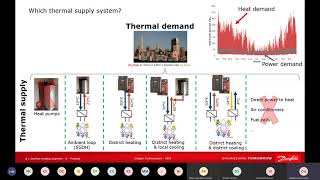
But there are of course different supply systems that we need to consider. In the core we of course have a thermal demand for the buildings. And if you look on it in relation to power demand, then typically we have quite a lot of heat demand in the winter period and which goes down to a very low level in the summer, while the power demand is more or less stable. So in that sense we need to do things smart. We cannot just electrify things and do it in that way because then we have a huge increase in the power demand and we'll just exaggerate the challenges when it comes to renewable. We build up the capacity to supply the power demand in that way. But the thermal supply system that are in play, there's of course the individual heat pumps. Or we can have heat pumps supplied with.
This dreamcy system which has a low temperature levels, just supplying a source for the heat pump, can have a district heating where we have a central generation and then supply sufficient temperature levels of fulfill the heating demand.
If we are in locations where we have some cooling demand, then we might also have individual heat pumps.
Simply supplying cooling to the building. And then we could dump the excess or the heat withdraw from the building into distributed heating network.
If we have a high share of cooling and heating demand, so maybe 50, 50, then we might run with two sets, distribute heating and then distilling cooling network. But there are of course other options as well. Not only this agency, we can have direct power to heat, but we don't have much flexibility with that. We can have the air conditioners, there's the split units, normal ones, we could have fuel cells and I'm sure many others. But.
My interest is in the distance density. So I was considering to just show you the analysis on different aspects in that way where I compare the abilities for ambient loop systems and the distribution system.
But when we are considering those, then of course it needs to be planned ahead. So all communities obviously needs to do some heat planning. For the future. And when doing those plannings, they should be evaluating the supply options on a range of metrics like economics, the life cycle cost. There is a big difference between the different technologies. When you take everything into account, needs to be considered the supply, security.
What if things do not go as we expect today?
In that sense, the flexibility comes as well. That we need to make sure that what we design for the future is flexible enough to address it if the future is not going in our direction. And then there comes other parameters like robustness. We need to have systems that are robust to it. If something happens that they can still run earthquake, for example, that we don't lose the systems. And we further need high reliability.
And what is coming more and more into play is resilience. That we need systems that are resilient. If there is an unexpected disruption. So we have a huge storm which is ruining some parts of the system, you might have terror or cyber attacks. And then the resilience is once we have the disruption and how long time it takes until we have the system up and running again. Those are all metrics that should be considered when we are planning for the future. And high pretendancy system as well in that respect.
Now, this redundancy system, they are both simple and complex. And I would say they are very simple because we are basically just applying heat to buildings or extracting heat from buildings. But they are also quite complex. It's a lot of stakeholders and there are actually a lot of market specific conditions.
And I will present here those cases I show here case one where we have an ambient loop. So we just take heat from whatever heat source supplied to a building. And then we have a connection point to the power system as a heat pump. And that one is compared to a normal distributed heating where you have the heat source, you have the connection point to the power system as a centralized heat pump and you supply more or less the temperature level you need for the.
Fulfilling the heating demand of the building.
And it's quite interesting to look on it from economic perspective and different markets. Because if we take one source or whatever heat source at 10 degrees and look on what the situation might be in the UK versus Denmark. In the UK we have milder climate, so less demand.
Than in Denmark. But due to market specific conditions, we have quite a lot of higher prices when establishing the.
Distribution system compared to in Denmark. And this I think is quite a risk if you plan for high pretend system and you only look on your own market and you don't look for experience elsewhere because you might Come into a solution. You prioritize solutions that are of course good heat pumps, energy efficient, but not economically viable in the future.
And I have met analysis on different temperature level sources, 10, 10 degrees, 25 degrees some and 45 degrees. Just to get a range of.
Different options, different sources you might have available. And they are all the same.
So just to say that we have option to take a lot of have a good connection to the power system and take a lot of power from it, excess power. But.
We need to rely on experience, wherever that is.
If I come back to those different metrics.
Then we can say that obviously the economics are in the centralized sources. You save quite a lot of money, you have quite a lot of security there. You can always add different energy sources.
Like.
Synthetic fuel plants. They can be coupled to the distributed heating system. As we will hear later on. We will not lose temperature level.
If we are able to get the right temperature level. It's quite flexible.
Distribution networks. They are simple and robust. They're also very reliable.
And they are district heating systems with a central source. They are quite resilient. You can easily have multiple units, multiple coupling points compared to if you have individual solutions, then you're relying on one coupling point which is the power grid. And.
That can't be a risk.
Now I also just recently heard about how Denmark is looking on maximizing the flexibility when coupling the different system. And then in the.
Northern Jutland in Denmark, in old city, Old Pork, they have decided to build a very big thermal storage of about 1 million cubic meters. And that is to give them the maximum energy flexibility so that they can support whatever renewable power generation there is. They can take whatever excess. They can balance the local power plants. So if there is no renewable and they need to ramp up the CHPs, which may go far beyond the heating demand, they can just dump it as well into the thermal storage.
They can take the waste heat from industry, whatever industry it is.
Even if it's fluctuating wildly.
And when they also have waste incineration, which they need to dump the heat into the ambient during the summer, now they have the ability to to store that as well in this thermal storage. So it's the ultimate flexibility.
And this brings me to the end.
If you have any questions, then feel free.
Thanks a lot, Oskje. Very good presentation. Interesting insights. Yeah. Is there any question just very spontaneously from the audience to otge what he was presenting?
I don't see anyone raising his or her hand otherwise and just can speak directly. Unmute yourself. It's not possible to raise your hand in the meantime, maybe I would like to know, maybe not a question, but just highlight one thing that's often forgotten what you're mentioning two points you're mentioning. One is that with the district heating network you can integrate more than one. So sector coupling technology that's in an individual basis, quite challenging to have a heat pump, electric boiler, maybe a small CHP that's quite cost effective, so costly to do so.
And the other point is a big seasonal storage that as you mentioned, can take whatever heat source is available and just use it. I think that there are two very important key points from my point of view that are that.
Have an important benefit of a district heating network and an integrated district heating network towards an integrated individual building. I think that's two things you should not be forgotten in these discussions.
Any other questions or comments?
Nope, I don't see anything. So then, thanks Otke. Again, we're gonna have a discussion at the very end again, but then I would like to now show my screen again.
This one, I guess.
Yeah. So I can share my screen.
Okay, that's good. I mean, I'm sharing my screen, but you can also do the presentation from your computer as you want.
Yeah.
So now we have Joseph Jevamalai, I hope I pronounced that correctly, from Comsoft software provider for district heating networks, presenting on GIS based automated system design or design of district heating networks. So. Yep.
Please can you see my screen?
Yes.
Okay, so today I'm going to talk about a GIST based automated design of discrete heating networks using COMSOF Heat. So I am Joseph Jammalai, I am working as an innovation engineer in Comsoft and also I am doing my PhD with Ghent University. So COMSOF Heat is a tool to route and dimension the network automatically so it can estimate the cost of the network and you can visualize the cost background of the different segments such as service connections, distribution network, transport network and heat source cost. So and also we can do financial analysis such as cash flow analysis over the network lifetime. It can also be done using this software, so it can be used to find the feasibility of the digit heating networks. So these are some of the users of ComSafe Heat so comes of heat is used by engineering companies such as Ingenium Rotterdam Engineering over Morgan, some other companies and network operators such as Fluis and hvc. And also there are some cities using the software such as Nijmegen Rotterdam and now Amsterdam, and also some universities such as KU Leuven and let's talk about the Planning methodology of comms of heat. So as an input we need a number of inputs. So first GIS inputs. So such steep center lines of the area and also building polygons of that particular area. And also we need a heat demand of each building. So and then we specify the design and cost parameters of the network. So the pressure constraints and flow velocity which and the temperature levels which needs to be there in the network. So once these inputs are specified, then the software creates a network automatically and you see as an output the network design and the bill of material with different equipment, such as pipes, substations, heat interface units and heat sources, and also the cost of the network. You can also visualize the cache flow analysis, cache in and cash out over the network lifetime. And also you can optimize the design. After the software created the automated design, you can finally man tube. So first you have the data collection and then you prepare your data and you specify your technical and cost parameters and the software designs network and you can inspect those results and you can manually fine tune some of the parameters and then with a click of the button you can create and compare different multiple scenarios. So then now I want to present two different cases. So one in Glasgow, so this case, so it's in Glasgow city center. So we have a Glasgow city center and we are going to extract a heat from a river with heat pumps. So one or more heat pumps can be used to extract heat from the river and feed the city center of Glasgow with energy for heating of buildings. So we have four heat pumps at four locations along the bank of the river. And then we need the inputs, so we need GIS inputs. So for this case we used OpenStreetMap data. So for the street center lines and also the building polygons. And then we need heat demand data. So for the heat demand data we can use gas consumption of the buildings. But in this case we used Hotmaps, which is an EU Horizon 2020 project. So the Hotmaps website has a data for heat demand density and grass floor area density for the whole Europe. So we can download this data and we can estimate heat demand of the area using this publicly available data. So we used hotmaps to estimate the heat demand data and then once you have specified the distribution network, so you can specify the design parameters. So we specified steel pipes with 16 bar pressure and the supply and return temperatures, 80, 50 and 4 heat pumps supply heat to four different clusters. So as you can see, four different clusters is supplying heat from the heat pumps and the total public trench length is 57 kilometers. So the total network cleaner heat density is 2 megawatt hours per meter. So from the software you can also see the different lengths of different pipe diameters. So DN25, how much length is needed for this project and DN200, DN150, so these can be easily seen as an output. So then you can easily modify the network design. So initially we made the area of this particular location and we just extended the area here in the north. And we looked into what are the implications of extending the area. Does it have any cost or financial benefit we get out of extending those areas. So then once we have this, then I'll also explain some of the deployment cost assumptions we made for this study. So we initially used different cost data for different pipe diameters, but then it was changed to constant cost which is £2,000 per meter for all the pipe diameters. So it is from expert advice from one of the project partner because the trenching cost almost dominates the deployment cost. And also we have source feed source cost and intermediate pump cost because there is an elevation in the city center in the Glasgow. So inter need to consider cost for intermediate pump cost also. And we also assumed heat delivery unit cost for different breakdown from 1 kilowatt to 50 kilowatt. And then we have different cost assumptions for different categories of heat interface units. So once we have all these costs, so we assumed 100% uptake. So which means all the buildings in that area will be connected to the DC heating network. So as a result we got an estimation of 252 million pounds for total cost of the project, which includes 34% for energy center, 17% for service connections and 6% for demand. And 43% is for distribution network. So also what we did is we also looked into different financial parameters. So we used two different cost of heat production. So the first one is 33 pounds per megawatt hour and the second one is 15 pounds per megawatt hour cost of heat production. So for each cases we changed the heat sales price. So heat change heat sales price is differed from 6 bands per kilowatt hour until 12 pence per kilowatt hour. So in the first case for the cost of heat production we have 33 pound per megawatt hour and we changed the heat sales price from 6p to 12p. So you can see the IRR was negative at the start and at 12p we have 3% IRR. So you see you have all negative NPVs because the discount rate was assumed 4%. So it was not beneficial. So we don't have much business case for this with 33 pounds. So we can change with 15 pound for cost of heat production. If you get cheaper electricity for the heat pumps, then we can see if you change from 6 punch to 12 punch. The IRR is we have positive IRR around 4.4% but. But still we don't have a high IRR to support very positive business case. So we need government subsidies or carbon tax to have this project realizable. But you can see how you can compare different scenarios easily with different NPV and IRR and payback time for different parameters. So this is one of the case study and then the other case study we did was it's using multiple sources. It's an area in Kortrecht. So in this case study you have like six sources and 2,300 buildings. So the building inputs we used for this project is around. We use the gas consumption data. So we map street level, gas consumption data to the building level using building area ratio. And we categorized buildings using residential, commercial and industrial. And we use load factors to estimate peak demand. So if you look at the heat source, we have a waste incinerator at the north, so which is 2km from the network. And we have three heat pumps in the city center. And we have a gas boiler and CHP. So we have like six sources and 2400 buildings. So then, so we assume the heat source attributes for waste incineration, heat pumps, CHP and gas boiler. We assume the investment cost, energy production cost and CO2 release for each of the different sources. Once we have all the heat source attributes, we have to give the technical parameters. In this case we designed two layer network. What do I mean by two layer network? One is transport network which provides heat from transports heat from source to all the substations and distribution network which further distributes from the substation to each individual buildings. In the transport network the temperature level was assumed 80, 50 and in the distribution network the temperature levels are such as 70, 40. So and then the network is sized and then the cost is estimated. So in this case we have a supply is greater than demand. So what do I mean by that? So we have more number of sources than necessary. So we can actually select the source for to meet the demand. So in order to select this source we have like number of possible options, how the source can be selected. So we can use the investment cost as a source selection criteria or energy production cost or CO2 cost or combination of anything. So we can also have the Combination of all of these costs to select the sources out of the six sources based on these different scenarios, we can choose the sources. So I present the different scenarios here in this graph. So we did the scenarios for only investment cost, for energy production cost, for carbon cost and the combination of investment and energy production cost. Combination of energy production and carbon cost, investment and carbon and the total cost which is investment, energy production and carbon cost. As you see here, in the carbon cost scenario, the investment cost is quite high because the investment cost for heat pumps are higher. So if you see the investment cost case, so in the investment cost case you have a lower investment case. So if you see the total which is the investment, energy production and carbon cost, you have somewhere in the middle between the carbon scenario and then the investment scenario. At the same time, if you look at the energy production cost, it's also costly for the carbon scenario because heat pumps has higher energy production cost. But then the CO2 cost is much lesser because heat pumps doesn't have much carbon emissions. So in the CO2 cost, the carbon emission scenario have much lesser CO2 cost. But then investment cost which have higher CO2 cost. And this investment, energy production and carbon cost scenario at the end which has somewhere in between the carbon scenario and the investment cost scenario. And then if you also look at the CO2 emissions for these different scenarios, so the investment cost and energy production cost, these are high CO2 emissions. And then the carbon scenario which has very less CO2 emissions at the expense of higher investment and energy production cost. Also you can see the CO2 saved based on the reference CO2 emissions. The carbon cost scenario have much higher CO2 emissions emissions. So using this scenario we can easily see what is the optimization, what is the source we need to select out of the given sources. So then here I am showing this case with investment, energy production and the carbon cost both combined. So three sources are selected out of six. So these sources are one heat pump and a waste incinerator and a CHP plant. So here we have CHP which is connected to electricity grid and heat pumps which are also linked with electricity networks. And we can have storage which is also easily integrated in this model. So these kind of integrated approach of different networks are necessary to increase the renewable energy share and eventually move towards the sustainable energy solutions. So.
That'S all. So I'm happy to take questions. Thank you.
Okay, thank you.
Thank you Joseph for your presentation. Again, any question from the audience from the group to Joseph directly for the methodology and the tool he was presenting.
I would actually have A question, two questions. One was on the different heat sources you were explaining heat pumps, hp, race, incinerator, and I think it was boiler also you had as an optional heat source. Is there how you optimize.
How you calculate the benefits or how you like the different cost you were calculating is there because I mean the operation of a CHP and the heat pump, I mean that is the core of the hybrid energy networks are. One of the core is kind of dependent on each other a bit and it's basically also depending on the electricity prices and especially on the fluctuation. So are you considering fluctuating electricity prices or you have a flat rate for electricity?
We are having flat rate for the electricity, but we can also consider the inflation rate, which is a input parameter which can provide. So based on the input parameter, we can. We are choosing the different sources. But for the selection of sources, for example, for the investment cost, we only look at only the investment cost, which is calculated based on the input provided. And also for the carbon cost, everything is estimated based on the network lifetime. So we get an overall network lifetime. So based on the network lifetime, we calculate what are the costs for each from each source, what is the cost we get for the overall network lifetime.
And.
And based on that, we select the sources based on these inputs.
Okay, and I see there's another question from Clemens Feldsman.
Yes, thank you.
Thank you for presentation.
So my question is about the simulation that is in behind. So to calculate heat losses, to calculate.
The energy demand of the pumping.
So what kind of simulation is in behind?
So it's. Yeah, so initially we route based on the cheapest route. So once we have routing, we dimension the pipes. So based on the pressure constraints we have. So we can have three design constraints. You can either specify flow velocity or the pressure constraint. So 1 to 6 bars or 10 bars or 16 bars. And also we calculate the pressure losses along the pipes when it's routed. So based on that, if it respects the pressure constraint, then we dimension the pipes. And also heat losses we calculate based on normal heat loss calculation. So we only do it for the peak, we don't consider for other times. So we only do that for the peak. And for the heat loss calculations, we have to have profile. So load profile has to be updated. So based on the load profile, we calculate heat losses for different time frames and we provide the heat losses for over the year.
Okay, so thank you.
Okay.
Any other questions to user? I. I would have one. I'm sorry, but it doesn't work to raise the hand. Or write a message in the chat.
You have just explained that you calculate this for different time frames. So do you really have a simulation, a dynamic simulation with a time resolution? What is the step size here? Or are these single calculations for different load conditions?
So the design itself is for only for the peak, but only for the heat losses. We use load profiles just to give the yearly total losses. But this is not doing any dynamic simulations. It's only do it for all the design and calculations and network pipe estimation, but that everything is only for the peak demand. So we design for the peak demand and only for the heat losses. We use the profiles to calculate the heat losses over the year.
And a second question. Thank you for this answer. And the second question, how detailed is your mathematical representation of the grid you finally calculate? Is is it really that you can define each single pipe or.
So this method for the multiple source method. So we need to do several iterations to come up with the optimal solutions. So it just assignments and the routing. So we have the forms of software, they have routing algorithms. So it calculates different routes. You can specify cost for each seats. What is the cost for? Maybe based on the concrete or based on the other network grids concentration, you can specify cost for each and every street cost. So based on that they route and then here based on the cheapest routing, we assign for each substations to the sources and we iterate based on different orders of substations and. And then we come up with the optimal solution based on different iterations. So for this particular design it was around 24 different iterations to come up with optimal solution.
And how detailed is the grid then described?
So the grid you can see until from the transport network and you can see the distribution network and you can even see the.
Pipe connection to the end of the building and you can see the pipe dimensions and you can see also every parameters of that pipe associated with that pipe.
Thank you. Very impressive. Thank you. There was one other question, but that is Gan Norway. So whoever I saw just one hand, I don't remember who was it, but is there any other questions at the moment.
That seems not to be the case. So thanks again for your presentation and we're gonna go now to the last presentation of today. Hans, you would like to present it from your screen or should I present it on my.
Then I will share my screen.
Okay, perfect.
So then now we have position coupling what I was mentioning between hydrogen and district heating. We're looking forward for this often overseen aspect. We actually see the presenter view now not the full presentation.
So now it should work.
No, I still see the presenter mode.
Doesn't really seem to work.
No. So I maybe. Should I present them for my.
Yes please.
That's maybe a bit. But I switched off the presenter mode and then it's working. But I'm gonna do that now.
Is it working? Can you see my screen?
Yes, works fine.
Wonderful. So then close yours.
Yes, thank you. So my name is Hans Boehm. I'm working as a researcher and PhD student at the Energy Institute at the Johannes Kepler University in Linz. And I'm mainly dealing with techno economic.
Analysis.
Primarily for powder gas and hydrogen applications. Now I would like to talk about some selected aspects of sector coupling between hydrogen and district heating.
Next slide please. So when we are looking at this visionary picture of future hydrogen based energy system, one can already imagine the manifold applications for hydrogen and powder gas reaching from industrial processes over residential usage to transport and mobility applications. So sector coupling and sector integration is really an important aspect to increase energy efficiency, especially in terms of waste heat utilization. So let's have a look at the technical opportunities we have. Next slide please.
When looking at electrolysis as the main technology for producing green hydrogen from renewable electricity, we can basically categorize these in low temperature and high temperature electrolysis.
Low temperature electrolysis is usually supplied with liquid water and operated as an exothermal process.
And therefore requires external cooling. On the other hand, high temperature electrolysis can also be operated with steam instead of liquid water and below the thermo neutral voltage. And this means that it allows to partly provide the energy demand from external heat sources and so reducing the electric energy demand and therefore increasing the electric efficiency of the electrolysis process. Next slide please.
So, looking at the state of the art technology options, one can already see that PAM and alkaline electrolysis as low temperature applications mainly encourage thermal integration. In specially close applications or wherever temperature level is of secondary importance due to temperature levels from 50 to 90 degrees Celsius.
On the other hand, for heat intense industry, they would rather use high temperature electrolyzers to utilize their wastage to increase the efficiency of the hydrogen production. However, this could lead to increased heat demands in future district heating. If today's suppliers such as steelworks tend to use their waste heat internally instead of supplying district heating grids. However, when talking about powder gas or power to x processes, also the downstream synthesis processes such as methanation for example, should be taken into account for wasted utilization since they often provide heat at elevated temperatures. Next slide please.
When it comes to energetic utilization of hydrogen fuel cells are the main conversion technologies.
So, looking at current technology options as listed here in this table, it can clearly be seen that there are technologies available that on the one hand already provide heat at elevated temperatures and can be used in.
CHP applications, and on the other hand are already available.
At multi megawatt scale. So, next slide please.
So how are these technologies supposed to be used in terms of sector coupling in future energy systems? If we take Austria as an exemplary use case, we can already say that national renewable electricity potentials will not cover the Austrian consumption neither profile nor balance related.
So the trade off between electricity supply and demand demand requires short term and long term storage options and therefore seasonal storage in the forms of hydrogen or powder gas and its derivatives will be essential. However, this also means that today's gas infrastructure will still be required in the future.
Or in future sustainable energy systems to Supply renewable gas CHPs as.
Backup capacities, but also industrial applications using hydrogen or or SNG as energy carrier or feedstock materials, and also other customers such as transport and mobility applications. Next slide please.
So let me give a concrete example for the integration of hydrogen and district heating. Let's start with conventional CHP plant.
Connected to existing gas infrastructure, district heating and power grid. Next slide please.
So now assume that electrolyzers will play a significant role in future energy systems.
Using.
Renewable electricity to generate hydrogen for direct utilization or partly feeding into gas grids.
So in this context, it has to be kept in mind that the two processes, CHP and electrolysis, are usually operated at different times, depending on the electricity and probably.
Heat supply and demand. Next slide please.
So this can be taken a step further by taking downstream synthesis processes.
Into account, like methanation, which provide.
Opportunities for carbon capture and utilization as well as direct substitution of fossils and to.
Enable carbon cycle economies.
Next slide please.
So now we come to the heating part. If we.
Take this system as a whole, this also offers new possibilities of heat utilization for local or district heating applications by integrating these power to gas applications.
So by meaning electrolysis and demethanation.
Next slide please.
And in the further step we could also think about substituting the conventional chps by large scale fuel cells as mentioned before, and therefore enable the direct usage of hydrogen for electricity and heat generation and therefore reduce direct carbon emissions.
Next slide please.
And last but not least, both systems, the electrolyzers and the fuel cells could also be combined in future into a single system, for example using reversible fuel cells and to allow to optimize operating hours and plant costs in a self containing Seasonal storage and regeneration system.
Next slide please.
So to shortly sum up the options for direct integration of powder gas applications in heating grids.
Low temperature electrolyzers such as PAM and alkaline cells provide wasted potentials of about 10 to 25% of the nominal capacity for mainly spatially closed applications.
Downstream synthesis processes like methanation.
Provide additional sources for heat integration, usually at elevated temperature levels.
High temperature electrolyzers operate at temperatures of 500 to 1000 degrees. However their function is a heat source or drain is depending on the actual mode of operation. And last but not least, fuel cells can and partially are already used for microchp applications for decentralized electricity and heat supply. And taking this further, can in future.
As large scale applications also substitute conventional CHP plants in hydrogen or CSNG based energy systems. So in conclusion, there are quite some aspects of sector coupling that should definitely be considered and investigated for future integration of hydrogen and powder gas.
Energy systems.
So that's all from my side and thanks for your attention.
Okay, thanks a lot Dan, for that quite new insight into this area of sector coupling.
Does someone has a direct question already at once.
From the group from the audience? Yes, I see already Dietrich raising his hands please.
I have a question. You mentioned in the last slide.
Some different technologies with temperature ranges. At least in district heating we are trying to come down in temperatures. I don't know if you followed the morning and the sector a little bit. So.
At least the first temperature level, 60 to 80 degrees is somehow in the range what we are thinking about. But definitely not 5002000 for waste utilization. I think these high temperatures should be used also for other processes, not for district heating.
Yes, this.
As I already mentioned before, these high temperature electrolysis.
Will mainly be an application for industrial processes.
Because they are mainly used in a. In a mode where they utilize heat themselves rather than producing heat just to.
Raise their electric efficiency. So this.
Will mainly be something for industrial applications. But I think this could lead to some problems in future.
As I mentioned.
This can lead to the case that.
Industries that are suppliers to district heating grids will use their wasted in future to operate.
Hydrogen production.
Okay.
And so there could arise additional heat demand for district heating in future.
Thank you.
What is actually not necessarily a problem, but maybe a new business model for district heating. We have another question from Yani Becky. Yeah, thank you. Genevik Orzeli from Kassel University. Thanks for the presentation.
I have some questions about the way.
Of how to use hydrogen. So assuming that we have a lot of electricity and you have electrolysis, so.
You produce electricity and I mean maybe.
You can go one slide before.
And.
So with this produce hydrogen, you can use it somehow directly or feed it in gas grids and so on.
But what is the purpose of or.
What is the advantage of using this hydrogen to produce methane? Again, so this step with methanation, so.
What is actually the advantage of this.
Step and how we are doing this? The main pathway or.
The preferred pathway should be the direct utilization of hydrogen. But methanation is somehow a bridging technology to further use existing gas infrastructure.
To minimize.
Investments in this infrastructure in the midterm. In the long term, for sure, the direct utilization of hydrogen should be the preferred pathway.
Okay, thanks.
I had a similar comment a bit that the gas grid you're mentioning, you could actually also have the direct H2 utilization without the gas grid actually. So just closing that arrow and avoiding the gas grid in between, that might be also a way.
To. Because I'm personally not so sure if gas grid we need in the extent we currently have. So there's a lot of it is required to supply to end users. And if you want to supply the.
Yes, this is more or less something where the.
Seasonal shifting of.
Demand and production comes into account. So the gas grid is somehow used as a storage option.
Okay, I see that. Okay. Are there any other questions? Oh, I just saw another one. Johan van Bajl von Yes, hello, good afternoon. Yeah, thank you for the presentation. I hear also that hydrogen can also be used in industrial probe there where you need the high temperatures, where there are not that much options to further use renewable sources. In your last slide you mentioned also that you can use also micro fuel cells. The question is in fact is there enough hydrogen to use also this micro CHP in the houses? Because part of the hydrogen will be also used in industrial processes to go to these higher temperature. And then the question is, is there enough hydrogen in that case also to provide the small or the medium sized CHP in the houses?
Yes, that's actually good questions. A good question, I think.
Yes, primarily we will need hydrogen for industrial applications where.
A switch to renewables is not really possible in other ways, such as.
Steel making processes.
I think.
If we can extend district heating this far as we don't need decentralized utilization of hydrogen in micro CHPs, this would be the preferred way.
Okay, thank you. Thanks. Are there any other questions to Bernd or maybe also the other speakers?
Maybe a short comment from my side. Bernd, again from Stadjacke Munichen.
In my point of view it's A.
Very nice presentation and a very hot topic because I think it's much better to use excess electricity electrical energy to produce hydrogen instead of re dispatching it or just losing it. Like the presentation before in Denmark where we had 60% excess energy or 130% excess energy. What do we do with that energy? And hydrogen is a perfect long term storage or storage for that excess energy. Just a comment from my side.
I really enjoyed the presentation on that.
Okay, wonderful. Good to see. I agree. Definitely excess electricity. As long as you cannot dump it into power to heat. We use it in the heat pump. Hydrogen might be a good idea for sure. Definitely.
Any other questions or comments?
Yes, Dietrich.
Yeah, maybe a question about efficiency. So how much energy we are going to lose by.
Transferring it to for example from the electric grid to H2 to hydrogen first?
Yes. I actually had a slider with electrolysis efficiencies. So low temperature electrolyzers is in the efficiency range of about 60%.
So.
We will lose quite a lot.
Of energy that way. So the preferred way will still be electrification or direct usage of electricity wherever possible. That's for sure.
Yeah. Okay. That's also my, my main conclusion that means in terms of mobility, not trying to.
To.
To come with hydrogen cars on the market, more usage and batteries.
Right, sure. So for individual traffic.
Electric vehicles will still still be the preferred way. Yes.
Okay. For heavy, for heavy transport of course changing.
Sure, sure.
Okay. And I mean role of hydrogen in the future. I guess that as Ben said and others, it's a hot topic. So how much hydrogen we're going to have. But I think we can all agree on that if we introduce hydrogen, we in my point of view need very much the things what you drawing here. So especially that orange arrow that uses the waste heat. And as one of my main conclusions as well is to if you design or plan the electrodes are electrolyzer plants, you need to consider the distance to the nearest district heating network, nearest electricity, heat demand or heat consumer. But we have another question. Ian Spencer.
Good afternoon.
Great presentation. It's just the reversible fuel cells. Is that technology tried and tested now? Is that available on the market? And if it is, do you have any information?
No, not really. It's still on rather low TRL level at about 3 to 4. So this is more a long term solution.
Okay, thanks.
Okay, thank you.
I would like to have a question maybe to all participants. Thanks again for the presentation.
The general question and answer session I would like to open for all participants. Since what we see now is a Couple of technology options. What otke was presenting nicely, these different ways of looking at using the waste heat in different.
Types of energy systems, planning networks, considering different heat sources and now the waste heat. That's quite a lot of different aspects. My question now basically is.
How are we or how are we going to plan our and operate our future energy system? Since all these solutions we have are basically particular individual solutions or let's say sector specific solutions, none of these are really considering the other one. So like the tool.
I believe there's at the moment no way to really plan electrolusis nearby waste district heating networks and takes away seed as a source. Nor is there a solution for fourth generation or fifth generation network taking the waste heat from electrodes processes. Although that's I guess a quite straightforward point. But the question now is what do you think? What kind of software, what kind of methodologies should be developed or is required? Or do we maybe already have all these bits and pieces for planning and operating future district heating systems?
What would be your opinion here? How can we consider waste heat from electrolysis processes? How we can at the same time consider the spatial distribution of heat demand and supply and the different temperature levels and technologies for sector coupling.
Is there one software we need or is software we have already sufficient?
We have softwares because what is needed when you look from the distributed heating point of view, that is Load shifting, if you have incoming a lot of energy then you can do it either by load shifting the demand or you can apply the thermal storage system. So we have certainly the thermal storage system and the software for load shifting and building. We have it available, but it's not widely used.
So from technology perspective.
We can certainly do more, but we also have a lot.
Okay, yeah, I agree. Any other comments here? Impressions from Komsov maybe? Joseph, do you have waste in electroluzer as a future heat source integrated your software already?
Yeah, we can integrate as a heat source with the temperature and we already have working on thermal energy storages to integrate different levels of thermal energy storages like centralized storages and distributed storages. We are already working on that. So yeah, I think the technology, as said the technologies are available, but it's not widely used.
Maybe one final point, what I'm a bit missing in all that presentations is that electricity network. I mean we talked about electricity prices a lot, about the availability of electricity, the markets. But one point that is maybe a bit not very much considered is constraints in the electricity network. There might be situation where you cannot transport sufficient amount of electricity from renewables. Away from the source. So for example, having a wind park that is connected to a weak electricity network and you cannot remove that electricity with the given network capacities. And that might be an opportunity that is still a bit under evaluated. And I don't think it is really considered at the moment in the current tool settings. And this business model is basically not really.
Considered in the current developments.
I don't know if you have any reflection on this point otherwise. Oh yeah, there is one. Daniel, please, you have a question?
Hello, Daniel from Best Austria. There's at least an electricity market as far as I've seen it. I'm not an expert on it in any way, but of course there's this dispatch 2.0 or redispatch where they really try to improve their current markets structure in such a way that localization also takes a part in it. Because at the moment you just send your energy somewhere on the electricity market and nobody really cares where the electricity actually is coming from. And then in the second step, after everyone has bought and sold electricity, the poor transition providers must find out a way of getting the electricity from A to B. And if it's not working, they have to to redispatch it. And there's lots of money going into this. And I think this is one of the main points that I'm a little bit worried about. It's everybody's talking about this excess electricity that we have. And of course this was only for a few days last year and it's by no means.
A general thing we have now that we have more electricity from renewables than we actually need. I think this is really special case back then with a lot of wind. And of course I think it was a weekend, right. So perhaps not so much usage, not so much demand. And everybody's now thinking about this excess electricity and how we can use it, but nobody really knows how this will affect the price because at the moment electricity is much too cheap in my mind. And this electricity, this excess electricity, once everybody thinks this is a market segment that you can use to store it in H2 to store it in the heating network. If we suddenly provide all of this flexibility because we think that this electricity is more or less for free, then it won't be for free anymore because there will be much more demand. So these dynamics of the market and how this will develop, I think this is very interesting looking forward how this would turn out.
Very good point. Any reflection on this point or. I see also another hand raising reflection. Yeah, okay, please.
I showed a graph with the heat Demand and the power demand. So if you make the demand non flexible then you ramp up the problem because then you need to build in extra capacity. And when you have those peaks which are it was a unique 24 hours but it's quite common that you have in Denmark very high peaks of excess electricity for a couple of hours. But if you put all the heating demand or whatever other demand as a stable load, then you need to have even more renewable capacity and you just exaggerate the problem. And also as for the power grid, now I'm not an expert there but what my colleagues which are in the heat pump industry are saying for Germany then the grids for the older towns, they are not dimensioned or designed for higher demand than they actually have and also not in the building. So the wires, they are not capable of using too much electricity. So it's not even necessarily option to have heat pumps located there.
So there are a lot of problems.
Yeah, very good point. These integrated optimization indeed is missing and I would like to highlight I guess those sectors with the highest flexibility and the cheapest way to transform electricity into other useful heats either hydrogen or heat will have on this electricity. The future electricity market will be for sure have.
Competition here and the outsources with the cheapest flexibility and transformation capacity will win. Maybe, but this is a guess. Let's go to the other question. Asad Ashfak. Yeah, hi, I'm just regarding your. Your rough. Your comment. I would add to it like I'm working on Greater Manchester, looking at how in future scenarios we are net zero pathways we are developing. So I'm looking at how we can decarbonize the energy networks and how it will impact your electrical grid system. So but we are working with uk, we are working with national grid and everything. But then the biggest concern we are having what if we are so much depending on hydrogen, so what happens in future we don't get that much amount of hydrogen. So this is an area which there's also a question like what people are thinking about here.
So that's what.
That's also an addition and a question as well.
Comment and question.
So yeah, yep, very good point. So this overall system view, how much power to heat, how much power to gas you're going to have, where are we going to place the electrolyzers, where we're going to place the power to heat, where we're going to place even the wind turbines. Nowadays you look at a wind turbine from an electricity generation and electricity network point of view and maybe you try to avoid that people are complaining too much on the wind turbine, that the people living nearby. But maybe in the future you need to think about dumping the excess wind in a distributing network or or using it directly at the location in electroluzer for producing hydrogen and then maybe using it hydrogen directly in a nearby industry or making.
A hydrogen recharging station for trucks for example.
But the question how much hydrogen we're going to have depends a bit what are the competing options like power to heat for excess electricity and how is the market going to be developed? That's an interesting discussion and another one. Ian Spencer again, please join the discussion.
Good afternoon. We keep talking about excess power, but I was at a conference last year when we could all go outside and they were talking about conversion of trucks from diesel to gas by 2030. We're talking about converting cars into electric.
So we keep talking about excessive energy, but actually have we got excessive energy? We're going to replace all the diesel and petrol. What's fueling the vehicles while flying around the roads? Is anybody looking at the global picture of how that all works together? Because I'm looking at it. If you're thinking you've got a couple of days extra excessive electricity, it's not going to compensate for all the trucks and the cars that are on the road. So I'd say we've got a shortfall of energy at the moment. Everybody's going towards the fuel cells to heat buildings, electricity to cook. So by the time we had all the cars on there and then find out our networks aren't good enough to deliver all this electricity we need, the gas is already gone because the trucks are going to be using it to travel around the country. So we're going to have a real big shortage of energy.
That's a really good point. So a massive increase of wind and PV for sure. We need and I agree with you, that is not really visible in the current strategies to have so much electricity and wind up PV and hydro and other renewables upcoming. But I agree on this one. Any other reflection maybe on that comment?
No, but actually it's four past five already. Unfortunately that discussion was very interesting and very happy to have so much active contributions, but I'm afraid we have to close now. Although the last point is missing the work proto as we had in the last section but would like to have another one since there might be new people joining compared to this last session. So please turn on your webcam. I will try to cover as many people as possible.
In the.
Screen.
Why?
I cannot.
Okay.
Stop Presenting.
Okay.
Computer is a bit slow nowadays.
Wonderful.
Sorry, my computer, I had a mistake. Now I gonna.
Hopefully soon be able to make the work photo. Now a lot of pictures are wonderful. Nice to see all of you.
Now I'm gonna make a screenshot very soon.
People coming in. Wonderful. So one screenshot I gonna do white style.
And I'm gonna do another one. So please. One, two, three, smile.
That looks very good.
Perfect. So wonderful. Two screenshots that should be. Well thanks a lot for your participation. That's all from my side at the moment. Was very nice webinar. Looking forward to.
Continue the work and as I mentioned the recordings will be uploaded to YouTube. I will send out the presentation files together with the photos and we will have then the opportunity to contact Dietrich or me if you have any other questions or contact the other persons. We can also contact us and then we can maybe forward make the contact to the presenters if they don't have the contact details in the presentation. Dietrich, you have any last words from your side?
No, thank you. I would like to thank everybody for joining here and especially the presenters for the excellent presentations. I think it was very interesting day with all our three blocks with the politics with the digitalization of district heating and now with the hybrid energy networks. I think for sure we are going to continue a series of follow up workshops maybe during our next meetings. Let's see when and where at least I think we are somehow planning to have hopefully a live workshop in Nottingham doing the DHC symposium. Hopefully next year, September next year. So let's see how and where we are going to meet. But for sure we are going to contact you for the next week workshops. So thank you.
Yes and any, any contribution from your side to both Onix's TS3 on hybrid engine networks and TS4 on digital digitization of district heating and cooling networks are very welcome. Please again contact one of each us and yeah, thanks for participation. Thanks for presentation also from my side. Have a nice day and stay in touch.
Thank you.
Bye. Bye. Ciao.
Thank you. Thank you.
Bye.
Thank you.
Bye.
Thank you. Bye.
More from IEA
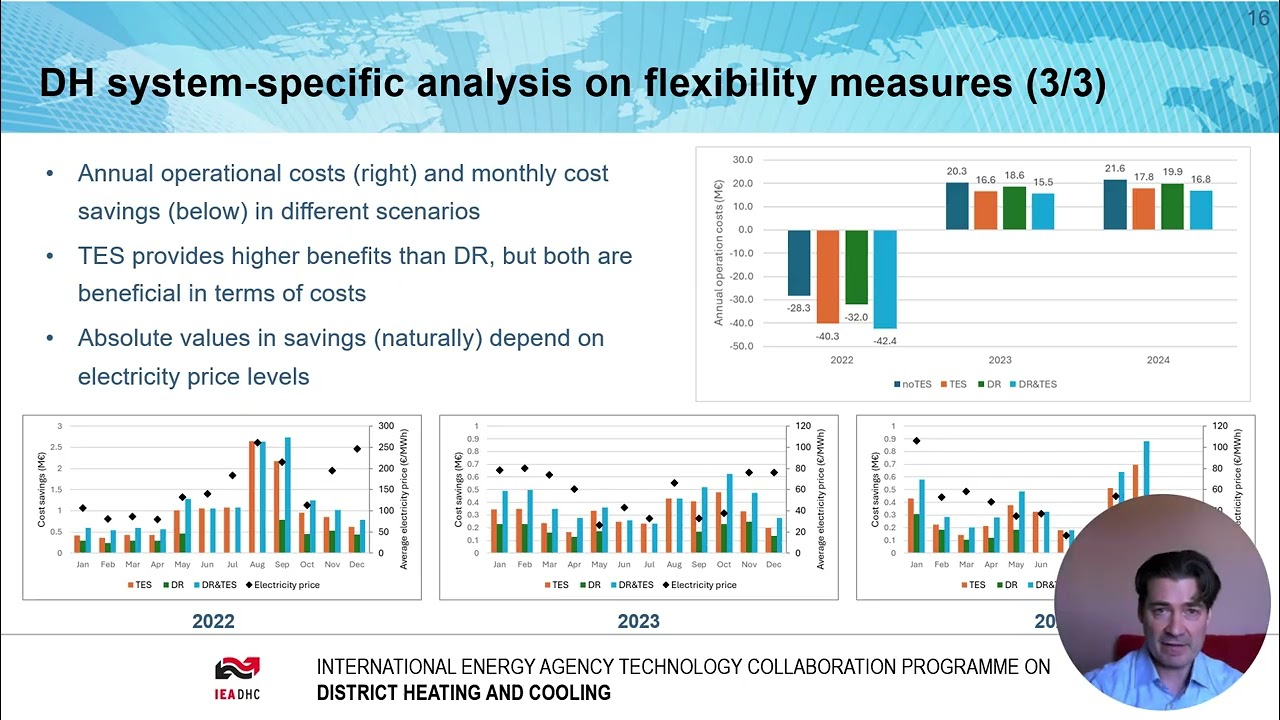
XIV-05: Flexibility and DH value chain (FlexVal) – advanced analysis & compatible pricing
XIV-04: RE-PEAK - How to cover peak loads in district heating networks with renewables.
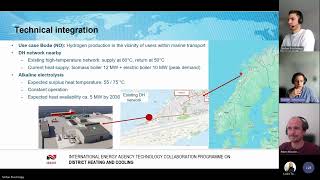
Digitalisation of District Heating: Summary of findings from IEA DHC Annex TS4
25/01/2024: The crucial role of district heating pipe lifespan in achieving climate objectives
IEA DHC XIII-03 Generation of simulated faulty datasets to ease heating network fault detection

XIII-01: Leave 2nd generation behind: Cost-effective solutions for small to large scale DH networks
XIII-04: Cost Benefit study on the building secondary network for improving DH performance
XIII-05: OPTiTRANS - Optimized transition towards low-temperature and low-carbon DH systems