TS3 / TS4: 1/3 - IEA DHC Workshop on Hybrid Energy Systems and Digitalization in DHC
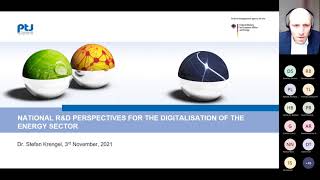
This content was created by IEA DHC AI. This content was uploaded by IEA DHC AI. This is a YouTube video titled "TS3 / TS4: 1/3 - IEA DHC Workshop on Hybrid Energy Systems and Digitalization in DHC" from November 9, 2021. It features a recorded webinar session with multiple speakers, including Dietrich Schmidt, Ksenia Petrichenko, Stefan Klinge, and Matteo Pozzi, discussing topics related to digitalization in district heating and cooling systems, energy efficiency, and regulatory frameworks. The session includes presentations on national R&D strategies, the role of digitalization in energy systems, and European frameworks for digital innovation in the energy sector.
Chapters
So it's now recording. So just let you know that we.
Are.
Recording this session. So this webinar is recorded. The video file will be available later on the YouTube channel from IADHC and we would like also to make kind of group photo later by end of this session. If you'd like to participate on that.
Just for the webinar itself, please mute yourself if you're not speaking. If you're not a presenter.
Only one person speaks at the time, that's the presenter. We do not have any chat function as it looks now. But you have this sign, hands up. So please, if you want to ask later, just use this one and then we can can just name name you. So please turn off the camera if you're not the presenter. And yeah, use normal, the normal conversation methods as we normally do. So maybe be a little bit caution with humor and their cousin because we are having this online commun. So maybe this is a little difficult.
So for the first block.
I have the pleasure to give the introduction here. Then we have a first presentation from Stefan Kringe from the Project Management in Julich about national R and D strategies and perspectives for the digitalization of the energy sector based on the German example. Let me get a presentation from senior Perishenko from IA in Paris about the role of digitalization with focus on buildings and district heating. And we are closing this blog with a presentation for Matteo Ponce from the HC plus and European Power about the European framework. So we are having different.
Different levels here.
In the different presentations.
For the second block, starting at about lunchtime we are going to have some presentations. I have the pleasure to start with some introduction about the TS4 project about digitalization on district heating. Then we get the utility perspective. So why digitalization is done by Julia Westerveck from Bama Hamburg from a utility company here in Germany, followed by presentation from Emilian Jungic from Danfoss about digital solutions for heat infrastructures and backed up with another presentation From Anna Kallag, Dr. Anna Kallag, also from Fraunhofer where we would like to present you some of our ideas. What's next about research facility in this perspective for district heating purposes. Then we have the last third block, which is. Which is chaired by Ralph Roman and he's also giving an introduction here for the third block followed by two more presentations. We have the TSO perspective on sector coupling and district heating from Anders Hansen. And we have a presentation about analyzing systematic benefits in an integrated expansion planning model by Hendrik Schweppe from University of Aachen and also followed and closed by a Q and A session and interactive blog.
So what is the framework? So we are meeting here within the framework of two IA activities, two DHC annexes. So in terms of the general level, so IA Technology Collaboration Program, the different TCPs where the district heating and cooling implement or District Heating TCP is one of those as a platform for meeting international experts. So it's especially meant to foster the exchange of ideas and results in the field of digital keeping and also partly from CHP and develop this technology further. The current member countries are Austria, Belgium, Canada, China, Denmark, Finland, France, Italy, Germany, Korea, Norway, Sweden, United Kingdom and the United States of America. That's quite large number of different countries involved here. And within the IADHC we have two ways of collaborating together. One is the cost sharing, cost sharing way where.
Some. Where the different countries are giving some money and somehow hiring researchers based on the call for proposals. The the other one, what we're doing here is the task sharing that we are coming together from the research side and all the participants contribute with their own.
In kind fee and working together here quite freely. So if you want to know now more about what is the iadhc, what's about the collaboration program on district heating and cooling, please visit the website.
And now I would like to hand over directly to Stefan Klinge from the Project Management Office in Julich in Germany. So, Mr. Klingle is the heading the Energy Efficiency in Communities.
This program for the funding organization. So Mr. Klingel, please give us some insights about the national R and D perspectives on digitization.
Yeah. Thank you, Mr. Schmidt, for the brief introduction and of course for the opportunity to join this workshop.
With our perspective, I try to start sharing my slides. I prepared some slides, usually it works. If you give me two seconds, it says that it's sharing.
Yeah, it's perfect. Thank you.
Perfect. Okay, thank you.
Yeah. My statement will be on the national R D perspective for digitalization of the energy sector. As you explained, I work with project management Julie, which is one of the biggest funding agencies in Germany. And we work on behalf of the Ministry for Economic affairs and Energy.
And Research in Germany is organized in research programs. It's a strategic element of energy policy since more than 40 years. And our current program is the seventh energy research program we started in 2018. And this is a common program of BMWi and BMBF which are the Ministries for Economic affairs and Energy as well as the Ministry for Education and Research. For our.
Ministry, we have a budget of more than 500 million euros per year for doing research on energy. And with that we start roughly 1,000 projects per year and have more than 4,000 running projects overall in the program.
One primary goal of our research funding is to support the transition to climate neutral energy supply. Of course, this is one of the main political goals and we try this by increasing the usability of all the innovative energy technologies. Because we know many of the technologies we need for neutral energy supply, climate neutral supply.
But we not always know which concepts we have to use to apply for the users. So we do research on technologies because we can improve them all the time. And we also do research on concepts and to to offer significant increase in efficiency, also integration of renewable energies. And maybe, you know, we have a very high level in the security of supply in Germany and we aim to ensure this high level also in future. Together we try and we aim to rapid transfer of the results into the application and of course also into the market. Remember, we work for the Ministry for Economic affairs and Energy. The key ideas of our program is that is technology, open technology, open approach. The Ministry does not set which technology has to be used.
Altogether. They have to meet Germany's climate goals. We try to adopt new trends like sector coupling, digitalization in the energy sector, and again Ministry for Economic affairs we try to offer opportunities for innovative companies to go into the markets and to build up new businesses.
In the program we have four main focus areas. First one is the energy in the end use sector, which is buildings, communities, industry, mobility, etc. The second big part is the energy supply and mainly electricity generation from renewable sources, wind, PV etc. The third one is the system integration. All this fluctuating generation into the power system, into the grids, applying energy storage and do sector coupling. And the fourth area is cross system research, like system analysis. But we also are allowed to do research and in the context of energy transition and society. So how do these new technologies interact with the society that they are accepted and can be successful in the markets? Digitalization is one major topic in all of these focus areas, although it's not. And this is important because all these areas have aspects of digitalization, like the digital twins, planning concepts, digital plant monitoring, asset management, all these aspects are covered by digitalization. And this is why we have not put the digitalization into fifth focus area. But it's settled in every single area. However, we see that digitization processes are currently more advanced in the area of electricity and we have a lack in the area of heat supply. And at the same time we see that the current Development in the Ministry that there's strong demand to generate climate neutral heat. Because maybe you know, Germany we have roughly 50% of renewable energy electricity in the system. Sometimes less, sometimes more. But the climate neutral heat is roughly 15%. So we have a lack of renewables in this area. This is what we see that there's a strong movement more to put more money in the research on climate neutral heat combined with digitalization. We set up a call this year which was called Contactee. This is how we put more effort on this topic. Because.
We use in our technology open program. We use calls to highlight special ideas of research. And we put the call with a special focus on utilization of communication technologies. In the end use actual buildings district heating city districts, but also on electrical networks. We think the call was quite successful with 39 proposals with a budget of 100 million euros. And we were very happy as we saw that 75% of the partners came from industry. So we see there's a high demand of application application this communication digital technologies into the field. The projects while they are running they will be supported by a service project called National 5G Energy Hub. We set up this project five years ago, not four years ago. And it offers a platform to all other projects with the standardized interfaces for data collection, data processing based on mainly on 5G transfer technologies. And this is how we. Yeah how we support these projects and try to give the digitalization this energy sector a bit like a boost with the DHC context. We will expect several projects from this call to start in 2020. And topics of these projects will be wireless monitoring of thermal networks, digitalization of network operation and network planning.
Once one company.
They operate a district heating network and they want an area wide rollout of the digital processes into their network doing in our. So they will try to do this in the research project funded by our ministry. And one other project will deal with digitalization of heat transfer stations and network nodes. So you see many aspects of digitalization and district heating will be covered bike projects. We try to get in this call. One other very important idea of our research program is the new pillar we have there, which is the living labs. They focus on the transfer of technologies and innovation into daily life. So preparing the markets for the innovative solutions. We concentrate on the very relevant problems for the energy system.
And we identified them in the city districts and multi energy infrastructure in the district heating and in the hydrogen production and hydrogen use especially the first two aspects are highly connected with all digitalization aspects. With this new pillar we improved also the funding options.
We now are able to do investment grants for plant technology, for infrastructure, so that the projects are able to build up, for example our sheet pumps, additional heating networks to demonstrate their new approach.
Yeah, we have roughly 100 million euros of funding per year for new projects. And very important we have a systemic approach, we are socially embedded so that we have a strong connection to the society, to the people who live and who are aff by the research. I may try with our living labs to improve the innovation in an industrial scale and in a real environment. Currently we have five living labs in city districts and tackling problems of.
Renewable heat supply. And in the short time I will try to present two of them. One is Living Lab Transurban NIV nrw which is a regulatory sandbox for the Shelby regulatory sandbox for the energy transition here in North Rhein Westphalia, in the former coal mining region. Here we have lots of fossil based district heating networks and the objective is to transform those networks or some of those.
It will be five networks to transform those into low carbon supply systems. And the partners want to introduce fifth generation networks, so energy systems with a climate friendly supply. And all these networks and projects are supported by digital processes, digital monitoring and cloud applications. One partner is the company E on. They want to implement their ectogrid technology in this network. And.
We think that this project will show how the high temperature energy infrastructure can be converted into a sustainable low energy system. And our ministry puts 70 million euros which on this project, which is from our perspective a pretty large amount. The other project.
Which shall be known in context with digitalization, is the real laboratory, no, Living Lab, it's called in English IW3 which is performed in Hamburg.
There we have the objective to combine renewable energy sources, storages, prosumers in a multi energy network. And all this in a very intelligent way. In the end there will be a virtual power plant to regulate energy supply of districts and especially distributed renewable feed in an efficient way.
They use. They try to use blockchain technology to operate there and to manage their system to generate.
An energy market. And in this project we will combine research and practical application.
In the real world, because there are hundreds of customers supplied by this network and you do research in the real world in this project.
This should be more or less the most important things from German perspective. You should remember that we have a very technology open program for energy research in Germany and we see digitalization as one key aspect across all focus areas. And this is why it's not mentioned on the top level, but it's hidden in every single project, our research aims to demonstrate and applicate all the new innovations in a real environment, so that we can prove this concepts and roll out them quickly. And what we call. I have no idea of if there's an English transition, we call it Vermewende. So the part when energy transition focuses on heat supply, it becomes politically more and more important.
Not only from our perspective as a funding agency, but also on the Ministry. And I think this shall be a good point, because for our country heat is a very.
We say in German, sleeping giant. I have no idea if there's an English expression for this, but there's lots of work to do on this area.
I think in the end I'll give the slides in advance. If there are any questions you can ask me, there are my contact details. Maybe most of you know Carsten Magas, who's a colleague of mine, he's working on the TCP as well. So thank you for your attention. And Mr. Schmidt, I'm not sure if there are questions we make in the end or better now.
Yeah, we have one. We could take one question. Thank you. Thank you, Mr. Kranger, for your contribution. And we can allow one question.
Otherwise we are going to have a short discussion later.
Yeah, I have a question. Thanks for your presentation. Interesting living labs you're mentioning in Germany on heating, but you were mentioning regulatory sandboxes for the heat transition. And I was wondering. I mean, I know the concept very well. From electricity point of view, there's like national laws that is like syntax for these things. There is very much focusing on the electricity side. So I'm wondering what kind of regulatory sandboxes from the heating point of view, or what regulatory.
Things have been addressed from the regulatory point of view in heating?
Yeah.
You make the right point on this. This expression was made by the consortium. By the. Yeah, by the partners. By the consortium. In fact, we have no exceptions during this project for regulatory problems. When there's a problem, we try to solve this with money. So if you say there's something we can do, we try to fund this problem and to offer this opportunity. And in the end we shall learn. And we establish a process to give the Ministry all this information they need to change regulation in the end.
Okay, so this is learning. That's the learning concept. Okay, thanks.
Okay, thank you. So I would like to invite other questions at the end of the session. Thank you, Mr. K. And now I would like to introduce Kdenia Perichenko from the IA in Paris. She is energy efficiency Policy Analyst and leading the work on energy efficiency in emerging economies and we are looking forward to your presentation about the role of digitalization with focus on buildings and district heating.
Thank you.
Thank you very much for the introduction and hello everyone. It's my pleasure to be here. I joined IA quite recently and as mentioned, I'm working with Energy Efficiency Division leading all the division's work on building sector. So it's my pleasure to talk to you today about the role of.
Digitalization from the perspective of.
Buildings and the district.
Heating. Also from the point of view of.
The recent net zero energy Net zero emissions pathway prepared by iea.
So.
Apologies, I'm experiencing a bit of technical problems.
Just one moment. It's all fine now.
So, in the IA net zero emissions pathway by 2015 it is estimated that buildings floor area equivalent to that of the City of Paris will be added every week globally between 2020 and 2050 and 80% of this floor area will be coming from emerging markets and developing economies. In advanced economies, half of all existing buildings which we have today will still be standing by 2015. Therefore, energy efficiency improvements and decarbonization of both new and existing buildings are crucial to make it to net zero, which also requires that by 2050 we have more than 85% of buildings to be zero carbon ready.
Heating plays an important role in this process as already about 12% of global energy related CO2 emissions can be attributed to heating in buildings. One of the most important ways to enhance energy efficiency and decarbonize buildings is to move away from utilizing fossil fuel fired boilers and furnaces for water and space heating. This increases the need for compelling alternatives such as heat pumps, efficient and sustainable wood stoves, renewable energy technologies and of course low carbon district heating.
In this scenario, district energy networks are expected to remain significant by 2050, especially in regions with high energy needs and dense urban populations and existing gas or district heating networks. In order for them to contribute to achieving achievement of net zero emission goal, the network should be made as efficient and as flexible as possible with high level of renewable energy integration and be supported by digitalization.
The pathway toward zero carbon ready buildings requires that decarbonization of heating should be accompanied by accelerated rates of deep renovation of existing buildings and high energy performance of new ones. It is estimated that a delay of 10 years in acceleration of retrofit rates would increase residential space exceeding energy demand by 25% and cooling demand by more than 20% by 2050. That will put more strain on power system and also result in additional 15 exajoules of fossil fuel burned and emissions of 1 gigaton of CO2.
Moreover, energy efficient building envelopes can also be used as energy storage for using thermal mass in buildings, which can also offer more flexibility, manage heating demand peaks and potentially incorporate more renewable energy into heating.
Additionally, we estimate that reductions in emissions from buildings can come from behavior change from for example lowering temperature setting for space heating or reducing excessive hot water temperature. As well from digitalization and smart control which enables further efficiency gains. And as you can see, it's at the level of 250 megatons CO2 by 2030 already.
For district heating, it covers around 9% of global space and water heating demand as of 2019 data. However, about 90% of it still comes from fossil fuels with a major role in played by coal and gas. Integration of renewables is increasing, but as you can see, it's still relatively low. And in order to contribute for district heating to the transition towards net zero.
Further improvements should be done in order to decrease grid losses, increase efficiencies and integrate more renewable energy. Digitalization can further help to utilize this potential by facilitating the shift towards modern district energy systems.
Such systems will require that efficiency would decrease and the temperature of supply heat would inevitably.
Decrease while the same amount of energy output is produced and the same level of thermal comport is maintained. At the same time, district energy systems are becoming more and more complex integrating multiple technological elements. But in summary, the improved district energy systems for net zero emission pathways would need to be able to supply low temperature district heating for space heating and domestic hot water, distribute heat in networks below grid losses, recycle heat from low temperature sources and integrate renewable heat, particularly from solar and thermal heat and to be able to be integrated into a larger energy system and smart energy systems like integration with electricity, gas, fluid and thermal grids and as well ensure sustainable planning, cost and motivation structures which will encourage investments in such improved networks.
Digitalization can help to accelerate this transition by providing the opportunity to gather and evaluate huge amount of data and moving towards the computer intelligence that allows real time 24,7 decision making in order to optimize the functioning of the whole energy system.
In 2021, we are moving to the situation that number of connected devices with automated controls are overtaking the number of people on the planet. Over the past five years, the development of such devices grew by around 33% per year and reached 9 billion in this year from 7 billion just last year. By 2024, it is anticipated that 83 billion connected devices and sensors will be creating large diverse data sets On a wide range of topics which will, among others, include energy consumption, air quality, traffic patterns and so on and so forth. We expect that artificial intelligence can help to analyze the data in a meaningful way. For example, to predict the energy consumption for heat and buildings based on variations of behavior patterns and climatic conditions. This data can be used to optimize heat supply and demand, regulate temperatures, flows, pressure storage availability within the network and help to shave the peak loads. Digitalization will also facilitate the integration of new energy sources including waste heat and renewable electricity.
Interaction and integration of district heating system with other sectors. We already heard about that a little bit today and I'm sure we'll talk more with electricity and transport will also have to grow to increase efficiency and synergies within the overall energy system.
It is and municipalities should play a major role in creating a sustainable and energy efficient system. Digitalization can enable cities to create a range of distributed energy and flexibility platforms that can support the acceleration towards net zero emission goals. It is important to include cities and municipalities in long term energy planning to make sure that the municipal initiatives and national plans benefit from each other and don't hinder each other. But the more local stakeholders often can serve as efficient drivers for sustainable energy transition.
We heard about two German living labs which was very interesting. When I was thinking about what to talk about, I thought that I also mentioned a very interesting project, the Energy Lab Nohan project in Copenhagen, which I thought would be a good example to mention. I'm sure some of you are familiar with it, but for me I had the pleasure to visit the project as I was living for five years in Copenhagen, not actually far from this district. And it's really a living lab which shows how modern integrated energy system can be operated in a highly efficient and low carbon manner at the district level, but also potentially at the city level because it's really like city within the city.
Among others, the project has demonstrated the possibilities for low and ultra low district heating utilization of large scale heat pumps with smart controls for coupling and electricity and heating, helping electricity grid to balance solar and wind power production as well as in some parts of the district, they utilize the thermal capacity of buildings to reduce peak loads.
Now, HOUND has also demonstrated numerous opportunities and benefits of digitalization by connecting points of demand energy demand supply, storage and management of those and smart control through smart controls to the data warehouse where data is collected through all these connection points and.
Analyzed for further decision making, adjustments and communication to different users and producers of energy.
This project has already demonstrated the potential for flexible, integrated, efficient and Low carbon energy system which contributes greatly to Copenhagen's ambition to become carbon neutral city by already 2025.
So from that coming to the conclusions, the energy system needs to undergo substantial transformation to follow net zero energy pathway and flexibility of energy systems. Very much needed also to encourage the active participation of consumers and consumers. Digitalization would be key to this process and of course we need to work on creating enabling policies for effective digitalization of energy systems.
Is providing guidance to policymakers in this area mainly on electricity side and the digital demand driven electricity network initiative.
And I will conclude with highlighting six high level policy recommendations for national policy makers but also with engaging different levels of governments specifically placing a lot of focus on the on the city planning which you can also find in the recent report on empowering cities. We of course need to this recommendations cut across policy development, building capacity on digitalization and decarbonization of energy system, ensuring the open and transparent access to data, availability of finance and supporting financial innovation, utilization of international standards and best practices and of course creating opportunities for sharing, learning and collaboration among different cities, countries and experts. With that I'll conclude my presentation and thank you very much for your attention. Happy to answer any questions.
Thank you, senior. So we could allow immediate question if there are any.
There's one from Volkan.
Please state your name and where you're from.
I can hear me.
Yes.
Okay.
What is the role of liquid air.
In clean energy systems?
Sorry?
Liquid. Could you repeat the question again?
The liquid air.
The role of liquid air in energy systems.
Liquid air.
Yes.
Okay. Liquid air.
So do you mean. Do you mean liquefied natural gas?
No.
Because I also have some difficulties to understand the question.
Maybe he's referring.
If I may.
Maybe he's referring to the storage of energy via liquid air. There's this concept that you liquefy air.
And then store this and then expand.
It afterwards and drive engines with it.
Thank you, Dalian. So it's about storage capacities.
Well, I think I would be able to speak about storage in general. Wouldn't be able to answer this specifically on that technology.
I think the energy storage would play a very important role in district heating in the modernized district heating systems. Also to ensure flexibility and coupling with the with electricity, smart grids and digitalization of course plays important role to be able to manage the flows of energy and availability of storage at any given point.
So I think I would be able to give this answer particularly on this technology. I think we would need to have a technical expert on that. Unfortunately, I won't have more information at this moment.
Anyhow, thank you. So, of course, storage is also one issue in terms of digitalization. We need digitalization to operate them in the right way and to connect also storage capacities to the markets and to have an overall optimization on that level. Okay, thank you, Xenia. I would be very happy if I could get the slides to distribute it later to the group for own purposes. And now I would like to ask Matteo Ponzi from DHCPLUS Platform. He's the vice chair of dhcplus. Welcome, Matteo. And he's giving us some insights about the European framework for infancy's perspective. Matthio.
Yes, thank you. Let me just.
Make sure I can share the screen.
Okay, thank you very much.
So, yes, Matteo. I'm Matteo Porti. Happy to see many familiar names on the attendee list. Many of you know me as CEO of Optic, but I'm really honored to be representing the dsc, which as many of you will know, is the knowledge, innovation and technology platform of your heat and power. So my perspective today is going to be how Brussels looks at the process that we are looking at. There is no doubt that digital innovation is having the most profound impact on the heating and cooling sector. I mean, in fact, everyone who's spoken before me and everyone who will be speaking after me will be confirming this. And I think that together with the opportunity given from digitalization to enhance the.
Performance of energy networks, energy and heat networks, I think it is really the complexity of the system as they are developing that makes digitalization the core of.
The current debate on improvement of digital heat. So the point is, traditional ways of managing systems is no longer sufficient unless it is supported by tools that enable the exploitation of data, the automatization of.
Processes, and sometimes actually the insertion of artificial intelligence into the decision making itself. Of course, this brings new challenges about security, about privacy, about data ownership, about the sheer capacity to provide good answers to digital energy users. At the same time, not only a technical thing and regulatory point, but also a business model opportunity that we now have, where the availability of data really opens up for horizons that were never available there.
Let me say a few things about the context and the history of how we've come here, because everything has happened really quickly. It is about two years ago that the AC issued the second release of the digital roadmap for District Heating and Cooling, which was actually building up on top of a former document. And.
We were presenting a comprehensive outlook built from the industry experts, ranging from production down to consumption through distribution on buildings, to show how along the supply chain, digitalization could actually help looking at all processes from integration to asset management, design and planning. Also looking at the various horizontal topics like big data, AI and blockchain. And it is interesting that more or less at the same time also the Joint Research center was coming out with something similar. So to say that there was an urgent need at the time, which seems a very long time ago, but was also only a couple of years ago, to actually make the point of where digitalization was getting in order to inform future policy and regulation. In fact, this builds on the shoulders of giant, which I would call it as Industry 4.0. I mean, the initiatives started at the beginning of the 10th decade of the century where the comprehensive transformation of the whole sphere of industrial production through the merging of digital technology and the Internet with conventional industry was coming up as a real revolution, focused in principle on the manufacturing sector, but which aimed at smart grids as a key focus area from the very beginning. And it was interesting to see that remark by Stefan before when he said that electricity is still leading on digitalization, possibly because Industry 4.0 was already addressing those more or less 10 years ago. But we are closing the gap, I think very, very quickly. Of course, Industry 4.0 has fuel lots of money in Europe, 100 billions to Member States to make investment in digital innovation and innovation through the European Structural Investment Funds and in fact.
Lots of interesting regulation promoting digital innovation, research and development, et cetera, with loans, stack credits and funding which have changed the culture. I always sometimes quote Paul Voss who said that maybe just a couple of years ago.
Digitalization seemed a specialist issue. Now it is just the cross topic through every topic has to deal with digitalization, as my colleagues addressed before. But let's look at the policy landscape and jump from the history to the very present.
On the 10th of September of this year, the roadmap feedback period closed for the action plan on the digitalization of the energy sector. And the open consultation is open until 24 January with a commission planned for adoption in the second quarter of next year. We are speaking of.
An action plan which will help develop a competitive market for digital energy services and its infrastructure that are meant of course to be cyber secure, efficient and sustainable. This action plan is the attempt to outline how policy fundings will have to work in one direction to exploit the benefits of digital solutions in the energy sector. Supporting integration, prosumers, consumers, interoperability of data platforms, et cetera. The five focus areas already identified by the EU Data sharing infrastructure, empowering citizens, uptake of digital technologies, cybersecurity and climate neutral solutions for ict. So we are really in a moment where policy is reshaping itself in order to meet the future challenges. Not long ago, in fact we're speaking of 2018, the energy efficiency Directive was already bringing on the table of this reheating and cooling operators very, very important things.
Mostly empowering and informing consumers looking at metering, building related metering, sub metering, cost allocations, remote readability.
Billing that relates to frequency, consumption based measurements.
Level of information provided to customers and of course the fact that customers should not bear the cost of access to metering, billing and consumption info. So a transition which is really becoming pervasive and very deep in the everyday fruition of heat and power and with important.
Impacts also with respect to the public sector bodies. The Public Sector information directive of 2019 governs the reuse of data generated by public sector bodies, substantially enabling access of third parties for commercial and non commercial purposes purposes to data that.
Should be shared.
Based on their public undertakes and meaning operating water, energy and transportation.
District heating and heat data.
May fall under the Director if they meet the requirements to be considered as public undertakings, which of course is both a threat and an opportunity for operators.
As it could imply some additional burdens for distributing operators, even though it is thought that this could be quite minor. Of course, for industrial players who may leverage on those data to create apps or supply new services, this could be an interesting opportunity. The act of the Public Sector Directive were meant to be published in the first quarter of this year and it's being currently delayed. So we are still looking at what's going to come out on this matter.
I cannot just leave without speaking about a very important point which is the General Data Protection Regulation. We are speaking of smart meters that are capable of getting data with a very, very fine granularity. I mentioned hardly, but it could even be less in many cases and to this extent.
Looking at smart metadata may look into personal behaviors of people and should therefore be covered by the GDPR regulation. Of course this is very important for operators because everything that falls under GDPR is subject to consent and if consent is denied it means that data from customers may not be used other than for bidding purposes, which of course may hinder the capacity to develop certain kinds of digital applications in a very substantial way. In this respect I should mention that the Danish Energy Agency and the Department of Justice in Denmark have proposed that to the extent that such processing is in the public interest, and the key example would be to save energy or for the purpose of legitimate Interest Improving energy efficiency District heating operators need not request consent from customers to read remotely smart meters more frequently than required for billing purposes. Of course this doesn't apply instantly to everyone, but it's an interesting.
Development and interpretation with respect to gdpr. Of course this doesn't mean that GDPR may not be used or should not be used for other data constant information. Let us also just think of blockchain as an additional element and challenge with respect to the GDPR application.
So many.
Let me say controversial or important things going on that look and deep dive in the regulatory and policy arena. But at the same time the EU is also providing means to try and meet the challenges through funding. Let me just mention a couple of them quickly. Within European Horizon Europe, the partnerships are the means to bring the public and private sectors together to face pressing challenges. Let me mention the key Digital Technology partnership which aims to strengthen electronic value chains to ensure EU digit technological sovereignty in global competition, which seems very much focused on electronic providers, but given the links with sustainability policy and smart networks, it means that district heating and cooling networks are indeed a very very attractive research project due to the potential for decarbonization and uptake of cutting edge digital technologies. There is significant amount of money being allocated to this and the first calls are expected very very soon in the coming months.
Another partnership that is worth mentioning is the one on smart networks and services which aims to strengthen Europe's scientific and industrial leadership with respect to the Sustainable Development Goals from the un. And again.
There is significant funding which of course needs to be matched by the private sector. This is an important line of funding, but let's also say that.
Horizon Europe is currently providing a number of calls and many more will come in the coming months. We see these are just examples. When you receive the presentation you will be able to click on each link and be redirected to the appropriate landing page. They range from reinforcing digitalization related know how of local energy systems or circular and low emission value chains through digitalization and many actions regarding buildings, smarter buildings for better energy performance, smart grid related smart network ready buildings as active utility nodes or demand response again in building. So there's a lot of attention within the Horizon Europe on the end of the value chain.
Which of course is related to everything we've mentioned before. To finish with many of the.
Cooperation resource.
Support action have now been migrated on the LIFE Program Clean Energy transition. So we see a surge of interesting calls regarding the acceleration, digitalization technology rollout, new services and business models. Just a couple of them as Examples one, on creating the condition for a global improvement of smart readiness of European buildings. Still a focus on buildings and smart readiness, but also an interesting look at establishing innovative business models and contractual schemes for smart and sector integrating energy services. I will finish here. Thank you very much for your attention. I know there is space for a few questions. I will leave it to that. Thank you very much.
Thank you, Matteo, for this lively presentation. Thank you. So, are there any questions directly to Matteo.
You just indicate. Yes, there's Steven.
Hang on. Is this going to work? Dietrich, can you hear me?
Yes, yes, we can.
It's all right. Teams was playing up until this morning.
When the British Smart Meter project went together in 2008. What we did emphasize heavily to them is it isn't just metering. You're sending back and simple communication. It is going to be quite a lot of data, virtually bartering with the customer in the long run, especially DH installations which will be at the upper level. And therefore you needed to. To make the data traffic what the content of the data traffic flexible. Fair enough. You make the communications mechanism standardized, but you make your flexible as regards the content. And indeed in the specification there's a requirement for elective services. That's what we use to the data communications company. They've actually come out to stakeholders saying yes, what do you want to do with this? Which is quite interesting. And I said management and interactive control is vital. Our next system operation gb anyway, so I can see the issues. Do you see any issues with the GDPR over this area, bearing in mind we are going effectively behind the meter.
Well, as I said, the.
The interpretation from the Danish Energy Agency is very important given.
The breadth and depth of District Energy in Denmark, which of course.
Has to be seen together with how. I mean the awareness that the Danish government has with respect to Dysio Energy as one of the key leverages in.
I mean District Energy is a real national industry there, so the sensibility can be very high. I think it is an open challenge. I just gave a few hints. I would say that the policy arena.
Is.
Moving forward very slowly with regards.
To.
Actually giving the right interpretation. My quick question to you, which may not be seen as final and ultimate, is that of course, to the extent that we are really getting in the apartment because in many cases we really understand how people are behaving and how they live, there may be limitations to what can be done with those data.
I have no final answer to that. I will be very happy if anyone from the audience has a very latest update on how this is going to be handled. But I think this is a challenge.
To many operators as they are trying to think of large investments. I think that to the extent that the.
Action will not go too much in the apartment, I think that many things can be done in order to boost efficiency and the overall performance of the network. But as we go into very deep demand side management.
Domains, for instance.
That.
Could be need for higher consent and GDPR will definitely be a part of the picture there.
Thank you. I've actually just buried Dietrich with the Global Power System Transformation Network, which includes the Danish Energy Agency and Fraunhofer and virtually every other expert I can see on the planet. Virtually in there. They are looking at visibility, which your previous speaker was also stressing as regards accuracy of operation.
Thank you Tim for this remark. So I would like to, even though we are a little bit delayed, but maybe you're. So you're still free to stay. And I think I would allow maybe one or two questions also to the other presenters.
And maybe also Ksenia. So if there are any, let's say any special topic we would like to touch, I think especially Matthias, what you touch. This GDPR question is very crucial, especially for district heating. So we had a lot of discussions also in our annex about this how and where we are allowed to use data. And if you need OC consent, it somehow this machine is not really running. So I'm quite happy that you mentioned this example from the Danish agency. But maybe. Xenia, do you have similar ideas on an IA level about what's about data security and how to use data?
Yeah, that's a good question. I think it's at the IA level, at the global level, the way we incorporated in the scenario, we acknowledge that it might be an issue, but it's still, it's very, I think country and region specific. So we don't model it per se as a. As a barrier, but it will be of course a policy barrier. As we, as we heard from Matteo, I think from our side, the need is to draw policymakers attention to. To this barrier because if that stands on the way of digital transformation and uptake of digitalization tools and potentially harnessing all the benefits of digitalization for optimizing energy system, that's a huge problem. So I think we'll have to leave it to the national government and our work as expert communities, with each national government on figure out how we can do it in a safe and private manner, but still that we can provide the open access to the aggregated and anonymous data to use for Energy analysis for the purposes of the flexibility and optimization of the system.
One is of course the global analyzers or can we come into statistics and maybe also to global optimization. But on the other hand we have this idea of on site optimization to optimize all the operational citizen system. I think from the German perspective, Mr. King, you mentioned the living labs to test all this issue how to. How to handle data. I think that's kind of this sandbox idea. Let's play around with, let's see what comes out and maybe then later advise policy development. I think that's a German way.
Right?
And we heard the denif way. Let's say, just say okay, let's just take the data we have.
To some idea. So maybe I think it will be quite interesting to see the different developments. But what I mentioned before, I'm very happy that I see that this Danish idea of just using the data for optimization is at least also from DHC plus one issue. So maybe we can have similar ideas in Germany in the future that we are more freely allowed to do with the data. I think we still have this issue in Germany. So if there are not more questions, I would like to close the first block because.
You will get the slides later and of course the contact data of the speaker to close the first block. I would like to invite everybody for kind of group picture for everybody switching on the camera for one moment and then we can make a picture. You can take a picture.
I can definitely just. Oh yeah, okay, wonderful.
I can make a screenshot.
The webcams are turned on. If you do not want to be on the photograph. Obviously you don't have to otherwise make sure your background is properly.
And your hair is good.
I think, I think we are somehow used to this online conferences now. So everything should be prepared.
Yes.
So now I have a bit. There's a bit of.
The pictures are not so clear from my side at least it's a bit of fuzziness. I. I don't. I don't know if you have a better pictures.
Let's take a picture that we can try with the next session.
Yeah, it's a bit. Was that English? Pixelic. What's that in English?
In English?
A bit of pixel. Anyways, I will make a one already.
Great.
And I make another one just right now.
Thank you. Thank you. Thank you for joining this first block. So we meet again at about 12:30 for the second block on the digitization of the district heating system. So then we are focusing much more on technologies on the district heating system. So thank you for the speakers for the from the first block. And.
So thank you.
The second one.
Bye. Bye.
Thank you. Bye Bye.
Thanks.
Bye bye.
More from IEA
XIV-05: Flexibility and DH value chain (FlexVal) – advanced analysis & compatible pricing
XIV-04: RE-PEAK - How to cover peak loads in district heating networks with renewables.
Digitalisation of District Heating: Summary of findings from IEA DHC Annex TS4
25/01/2024: The crucial role of district heating pipe lifespan in achieving climate objectives
IEA DHC XIII-03 Generation of simulated faulty datasets to ease heating network fault detection
XIII-01: Leave 2nd generation behind: Cost-effective solutions for small to large scale DH networks
XIII-04: Cost Benefit study on the building secondary network for improving DH performance
XIII-05: OPTiTRANS - Optimized transition towards low-temperature and low-carbon DH systems