TS3 / TS4: 3/3 - IEA DHC Workshop on Hybrid Energy Systems and Digitalization in DHC
Ralph Roman Schmidt from AIT Austria and Dietrich Schmidt from Fraunhofer discuss hybrid energy systems and digitalization in district heating and cooling. The webinar covers sector coupling and energy system modeling for integrated heating networks.
Chapters
Are you recording?
Yes. At least it says something. Yes, it works.
Perfect. Wonderful. Thanks a lot. So welcome Everybody to the block 3 Hybrid energy systems on the webinar of Digitalization for Optimizing Integrated Distributed Heating Systems. This webinar is held in the framework of two international cooperation programs, the IADC Annex TS3 Hybrid Energy Networks and the IATC Annex TS4 Digitalization of District Heating and Cooling. My name is Ralph Roman Schmidt from AIT Austria. I'm leading the TS3 and together with Dietrich from Fraunhofer. Dietrich Schmidt from Fraunhofer, Germany, the leader of TS4, we were preparing the whole webinar. We had two very nice blocks with a lot of participation in the morning and in the afternoon. Now later in the evening, we talk about hybrid energy networks or hybrid energy systems.
First of all, just for the record, this webinar is recorded. The video file will be available after the webinar on the IAADC YouTube channel. When I say after the webinar, it's not like the day after. It might take a few days to upload it and to maybe edit it a bit, but it will be available soon. So we will send out an email or we can regularly check the YouTube channel. Also, we'll have a group photo at the very end of the webinar. So please be prepared. Turn on your webcam at this time if you want.
Just some general rules for this webinar, your microphone should be muted by default, I hear something in the background, so whoever is that, please turn off your microphone. If you want to speak, you can use the hand symbol. I do only have one screen. I do not see the participant list or the camera. So if you raise your hand and no one noticed it. Just feel free to talk during my presentation. If you speak, please state your name and institution. In general, you should turn off your webcam to save bandwidth. But obviously you can turn it on for spoken contributions. In the group photo I mentioned already.
For today, the webinar we will have a. I will give you a welcome and I will also introduce you a bit to the IADHC Annex TS3 project. That is the background of the webinar. Then we have today two nice external presentations. One, giving the TSO so Transmission System Operator perspective so Electricity National Electricity Energy Network perspective on sector coupling.
And District heating from Anders Bamnoy Hansen from Energinet and a similar perspective, the Analyzing Systemic Benefits.
Analyzing Systemic Benefits in an integrated Expansion Planning model from Hendrik Schweppel from Erwit Herr Aachen University. I will use the later part of this discussion, because it's only two presentations, I have a bit extended interactive session. So we have a bit of question and answers to the presenters but there's a bit of extension on a SWOT assessment or assessment of strengths, weaknesses, opportunities and threats for hybrid engine networks and I need your help in this point. We have an interactive tool here and around 5pm we should finish the whole webinar. So without further ado starting introduction into the IADHC Annex 3 projects first of all and Dietrich mentioned that in the morning already what is the IATCP technology cooperation program on district heating and cooling? It's a platform for international experts for supporting district in general. You can see the current members, it's quite European, but there's also a lot of partners outside Europe.
Like in the uk, us, China, Korea, Canada. So it's a real international setting. There's two types of projects either they are funded by cost sharing so it's direct contract to some researchers and you can apply for the upcoming the Annex 13 is already running the Annex 14 is currently prepared. I think it will be open next year if I'm right. So there's new funding money from IADC for your research ideas on on district heating and cooling present in separate information on this one.
And others like the TS3 and the TS4 are funded by a task sharing approach. So participant contributes resources in kind and you can find more information on the website shown below. The IADH Annex TS3 is part of this. It's an international cooperation project a task share project within the IADHC with the aim to promote the opportunities and to overcome the challenges of district heating and cooling networks in an integrated energy system context. As I said, it's funded through task sharing approach. I'm coordinating, I'm leading the project but there's a lot of people from Fraunhofer, ntu, Bess from Austria, Albert University, guys from Sweden and a colleague of mine who are supporting me with the different work on the different subtasks and many many others who brought their input. It still runs for four months and we are about to finalize or five months actually and we're about to finalize the whole annex in the next coming five months A guidebook and policy papers mainly guidebook will remain results and you'll find a lot of information on the website also including previous webinars. We had.
Motivation in general, where are we doing this? Hybrid energy networks on one hand these the idea of an energy integrated energy system of sector coupling. The sector integration is considered to Be one of the most important measures for decarbonizing the energy system.
From a European level, from an international level. These things appear a lot. And we are discussing hybrid engine networks in the past. And we noticed if you look at district heating from a very early stage or from a very initial stage, the traditional district heating network is already linking the heating and cooling sector to the electricity sector, since they have a chp and very often for the gas chp, you have the gas network, you have the electricity network and the heating network. So that is actually already a hybrid energy network, if you will. That is already sector integration. However.
The role of CHP plants in my point of view will change significantly in the future due to competition for renewable fuels. And also since less electricity from CHP will be required, since we will have more pv, more hydro.
Basically more wind and more pv. So we need other heat and cold sources. And from electricity point of view, the CHPs will not be supporting the electricity network so much. So we will need other coupling points to provide flexibilities. And if I talk about coupling parts, I really talk about technologies that couple these three different types of networks. The electricity, the heating and the gas networks. And one of the most important is the heat pump connecting the electricity and heating network and making available a lot of different ambient heat sources. Electric boilers could be directly connecting electricity and heating networks. We have power to gas processes to generate fuels that again can be used in remaining CHP plants for generating electricity and heat. And actually for power to gas processes, I would suggest to rephrase them as a combined heat and gas plants, since they are analogy to a combined heat and power plants. They are providing heat and power, but heat and gas, because you have a lot of waste heat when generating, when creating gases out of electricity, electrolyzer creates a lot of waste heat. So you can use that waste heat for power heating networks. Again, that's a true hybrid network in this case. To understand the classification of these, what is coming from the first idea of a single chp, that many district heating networks towards a more integrated idea of considering different coupling points with a classification of hybrid energy networks that's oriented through these three layers of technology. Layer where the most simple variant is what I mentioned, a single chp. I think it's simple centralized controls. And then that would be a minimum requirement for hybridization. But we also see.
Maximum integrated system where you have multiple and diverse coupling points, a lot of flexibility, advanced controls, automation analogies. There's a bit of noise in the background, so if you maybe can mute yourself or someone can. Everybody can mute the other. So maybe if you can mute the one who makes noise. Second layer, organizational layer minimum from a minimum sector or minimum integration that is considering the ownership of the coupling points, business model services to a diverse ownership prosumer integration, innovative business models. And the final layer.
Strategic layer from centralized structures to decentralized structures and integrated planning and design processes. So that's what I understand when it comes to hybrid engine network and what is the different levels or layers or integration levels of hybridization. But now without further ado, I would like to.
Open the floor for the external presenters starting with the TSO perspective on sector coupling and district heating. I already saw Anders from Energinet. He will give us now a presentation from his point of view. Are you? Yes, here we are. Perfect.
So if you can share your screen.
Yeah. First of all, thank you for the introduction and as said, I'm Anders Bauernhensen from Inner Guinet and Inner guinea is TSO for power and gas system in Denmark. And in this presentation I will go into the sector coupling and show some of the issues we are working with as a TSO when it comes to sector coupling. And.
Yeah, if you have a question on by the way, you can take it. Otherwise we'll be a few minutes to take questions afterwards.
So when it comes to the danger situation, there's A Bishop About 70% climate gas reduction towards 2030 and it really influences what we are doing as a TSO because it's so much changed the system in the coming decades. So we're looking into a reduction for the total emission that's a 70% target on well more than 20 million tons. I know it's a small country, so it's really harsh reduction and we have to go for the energy system even to almost half of this total amount because we still got agriculture and other industrial gases. So it's really a harsh reduction for the total energy system. And we're talking total energy system, it includes transport sector, heating sector.
And further on, if we look at the different sectors we did some scenarios where to get this reduction and how would that influence the power and gas system. And this graph is showing in black blue the emissions in million tons today and two different scenarios to cope with this reduction. First of all, if you look at the electricity and district heating sector, it's much about more heating pumps for district heating, much more wind and solar and really phasing out coal in Denmark still as a little emission from methane gas or natural gas. So it's really significant production.
Not speak about oil and gas. Offshore there's more electrification. So it's not really an issue when it comes to at least for this presentation that when it comes to process heat for industry, it's also very much about heating pumps, high temperature heating pumps. So it gives us reduction significantly. Light transport, electric vehicles gives us reduction with dual heating also a lot of heat pumps. So it's really a lot of heat pump pumps everywhere, electric heat pumps due to industry, also electrification. And all this significant change does not lead enough to this reduction that we need. So this is very much about direct electrification, but we also need a significant, what we call indirect electrification. Producing a lot of power to X fuels, green fuels, methanol, ammonia and use this as a fuel in the other sectors to further reduce where we can't direct electrify. And taking all this we will get this needed reductions. But it so much changed our system in the coming decades.
And if we look at short sector coupling slide, trying to show what integrations are we talking about and actually it was in your presentation also mentioned little here we have a number of essential processes in this sector coupling and electrolysis is one of the core elements of course taking electricity.
The blue one and to the purple one here, producing hydrogen. And this does produce heat to be used for district heating. So it's a part of the heat district heating sector coupling. And then when it comes to to biomass and waste, as you also introduced, we might reduce our operation of CHP plants and use more our biomass and waste for pyrolysis and gasification to produce synthesis gas and then go into this biofuel catalyzers. Then there's a lot about.
Yes, keeping this one showing the the ESMR process to.
Refine methane gas also to synthesis gas. Then there's ammonia to be used.
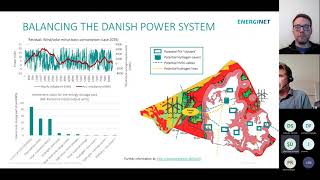
For shipping and for virtualizer. And then I think in the right out here, the direct air capture is also very essential. When we look beyond 2030, that's the difference. This actually captures heat because you take some heat from 100 degrees temperature and you produce CO2 use for all these processes. So summaries, there's a lot of heat exchange in all these processes. So in our planning we look at and see in the upper left corner it's our district heating demand in the country. And then we look where do we have some good sector coupling areas. And there's of course areas with the refinery and biogas and large district heating demand. There's a good area close to the North Sea. We have good access to offshore electricity and also Large district heating demand, Copenhagen areas, huge district heating demand. And then there's areas up here where we can store hydrogen due to oxygen in salt caverns. So it's also interesting area finally some other areas. So we try to take this sector couplings areas, investigate in this cluster areas and see how does this influence the power grid and the gas grid as well. Then it's another issue, it's about energy islands. We're looking into two large energy islands.
One is Bornholm, a physical island and the other ones in the North Sea Germany also working so much with this energy island. So it's part of the solutions how that feed into the system.
And then this one showing lines analyzed in our GSO planning work. The blue one is feed in for electricity from energy island and.
The dotted yellow one is lines investigated and still only investigated for hydrogen transport. So we try to say what's the most cost efficient to connect this different cluster areas reinforcing the power grid but also establishing new hydrogen lines. So yeah, also part of this looking into hydrogen and caverns and and refinery of fuels and all these activities shown in the presentation. What activities and cluster areas also about CO2 capture on biomass and waste CHP. And finally there's a direct air capture investigated post 2030 producing this CO2 for further production of biofuels but also in the long term to capture CO2 to be.
Deposited in the ground as CCS or carbon capture and storage. So it's definitely our plan. And then when it comes to looking into the grid we have this model is an energy system model and it's the left one is energy system model. And we have to put this into a more detailed grid model, a power factory model. So we have this might say raw energy system model and put it into the power grid model and analyze do we have congestion? If you have all these new elements introduced.
And then yeah, we have some congestion zones shown here in the left one. So it's two different models working together here to see if we fulfill our requirements for the grid then run a little out of time. Then this graph upper left one here shows the imbalances annually in 2035. And it's the yellow sorry the red one showing storage capacity needed and this show what the imbalances is more than 2 terawatt hour but it's still within a limit we could have in a hydrogen storage. So our hydrogen storage covens could have these imbalances. The down left one shows the cost of storage for different uses. And what we can see is well battery storage is Very expensive. And current storage for methane hydrogen is very cheap. So the model of course invests this kind of storage solutions.
I think one slide and then I wrap up.
The. Yeah, this one here showing the consumption for electricity. And if we look at.
Without this what we need for going climate neutral. This is the amount shown here. But if we look at resources offshore, we might produce even further power to x even export hydrogen to Germany and to Europe. So we analyze that export scenarios for this as well.
So summing up well, the 70% climate gas reduction in Denmark towards 2030 is analyzed and it's definitely doable. But we're also looking into a carbon neutral system in Denmark analyzed for 2030 and that requires this negative emission of 10 million tons. And it's obtained through carbon capture and storage using heat from this and deposit of the CO2 offshore wind power. Potential very high and has potential for producing even more fuels than we use for the Danish supplies. It could be potentially for export as well. Dark der kept as it used sector coupling cluster areas are used for efficient integration and coupling with hydrogen lines analyzed. And then we also look at offshore electrolyzers and the North Sea hub. And it seems to be cost efficient to take some of the electricity offshore and do electrolyzers, not feed it into electricity as a whole, but have some electrolyzers offshore as well.
And coming to this, there's really a lot of things to integrate digitally. So it's digitalization and further development of market operation solutions is so essential because there's a lot of markets here to be met by intelligent energy systems. So I think that concludes my presentation.
Yeah, thanks a lot Anders for your presentation. A good insight from a high level point of view and I really appreciate, I really think it's a step forward that the TSO takes care on heating and electrolyzers and on the gas things that sometimes, I mean in the past TSO's were very much focused on their electricity network. But I really see you're taking care. Is there any questions from the audience towards Andrey and his presentation already now? Yes, Stephen and Anthony Inayakev. Stephen, please, you are the first one.
Okay. Now the problem we have of course is that hydrogen cannot be moved around a pressure in the same way as methane as we do in Great Britain. In fact, the compressor does not exist to run it up to high pressure and even if you did, it would only have a third the energy and equivalent length of pipe. But produce it locally, use it locally. From the days when Britain was run on 60% hydrogen, town gas comes out Also obviously you can hydrolyze, you can electrolyze, anywhere you can connect. So I believe Maersk are actually proposing CO2 sequester, sequestrated plus H2 to produce methanol for the fleet. And they are of course I believe the biggest shipping line in the container shipping line in the world. Any comments on that lot? Sorry. The information on pumping hydrogen by the way came from the retired chief metallurgist of British Gas. So Fred's lecture is pretty good on that point.
Yeah, thank you. I could comment a little on it. And I said very much agree there's a difference between handling methane and hydrogen. So first of all, as also said, a significant part of the hydrogen is used in the clusters. So you might produce your methanol, ammonia, just right in the clusters. And then we look to connect these clusters and it could be new lines, not necessarily methane lines, but build new lines. But we're also looking into to refurbishment of existing methane lines and well, we don't have the answer now. What's the most.
Efficient way to go for this? Definitely cost in both part, also by refurbishment of hydrogen lines. So I think I agree with your comments. And also when it comes to propulsion for aviation, producing methanol from captured CO2 seems to be a way of kerosene derived from methanol.
Okay, the other question was from Anton.
Anton Inayakiv. Are you still.
I think you're not muted.
Doesn't work.
Okay, maybe you can hold your question to the next stage. We will have other opportunity after the next presentation for other question and answers. Is there any other question to Anders? I would actually have one.
When you were doing all this modeling and of the whole Danish system is all these different projects and you already mentioned digitalization is an important point. But how easy or how difficult was it at the end to get all the data you need? I mean there's data from a lot of district heating networks, data from Aussie. Okay, the electricity gas network. I guess you have the data yourself, but you need data from all these projects. You're mentioning what is its capacities, sizes, profiles all over here. I guess that's a lot of data you need for modeling. How much effort was it to get these data or what was the largest barriers for getting these data?
Yeah, I would say getting the data for the district heating system works fine. I mean it's an well established activity and we have data for this for a number of years. So it works already fine for this project. And it's quite essential that driving this to heating integration, what gets More challenging, of course, is if we look into the future and we try to see what's the most cost efficient, the least cost solution. It comes to technology data and then we come into what's the cost? And also referring to the question before, what's the cost of hydrogen lines compressing lines, looking.
Now, but also 10 years ahead, and what's the cost for catalyzing that, producing ammonia, producing methanol and all this? So then we have a common work together agency to have this technology data catalog for all these technologies. So it's. It works, but there's a cost, lot of information to handle. So what we really would work more is also to having more. Like we always talk about this digital twin. So somehow you have a model and there's a lot of operations very hard. But of course getting that more smooth, better digitalization, better data setup, going towards a more digital twin would be of course a dream to do it this way.
Okay.
So if there's no other question, I mean please, if you come up with other questions, or Anton, if you able to answer your questions in a later stage. We still have opportunities for question and answers later, but for the moment. Thanks, Anders, for your presentation and your time. I hope you will be with us for the next time. For the webinar, for the events, rest of the webinar. And now perfectly switching to Henrik Schapel from Elvet here Aachen. Also on a similar perspective, from a.
Larger, from a high level point of view on systemic benefits of district heating in an integrated transmission and generation expansion planning model in 2050. Henrik, please, I cannot. Yeah, perfect.
Yeah, yeah. I know the title is a bit longer, but maybe before I start, I may start to introduce myself at first and also, you know, make some words on what I'm going to do in the next minutes. Yeah, first of all, hello everyone. I'm very new to this round of people here, so I'm currently working at Ever Aachen University. I'm a research associate here in the energy system planning team of the eiav for those who are familiar with the several institutes at our university. And currently I'm pursuing my doctoral degree. I hope to finish by the end of next year, I mean, hopefully before summer. But you know, I have to be realistic about how those procedures always go. Today I'm not only here as part of the Abiti Ha, but also as part of the research project Plames, the Integrated Planning of Multi Energy Systems. You may see the logo over there below, where I am currently the project coordinator. And we are, you know, so I'm on the one hand I'm part of the research program, but also I try to organize the program somehow.
Maybe as a little disclaimer up front, you know, I come very much from the electric side. In the last years I've started working on from the electric side, from electric markets, energy, economic perspectives and so on. And through the project I've slowly gained some knowledge in multi energy systems. But why I'm certainly here today to enhance your perspective of my point of view. I'm also here to share knowledge to, you know, to gain knowledge that you have. So over the. Over the course of the presentation, you see something that should be corrected or that I should take care of, please share it with you. Because what I'm presenting today, I've originally presented at the Smart Energy.
Systems conference in Copenhagen. I'm currently writing a paper. And if you think something really needs improvements, what I'm presenting here, please share it with me. I really haven't changed anything about the presentation. So, Ralph, contact me whether I would like to share what I've shared here, what I'm going to share with you. And so, yeah, if there were any mistakes, I haven't changed them yet, but I intend to do so. And you may get track of my paper once it is going to be published. Anyhow, starting from that, today I want to talk a bit about systemic benefits of district heating. What that means in particular, we will see on the following slides. So, first of all, currently I think it should be clear to everyone that climate change requires radical change in systemic thinking, meaning that systems that we formerly knew as being separated now need to be integrated with each other, with the main objective to reduce greenhouse gas emissions, but of course also so to increase the overall efficiency of systems. And one term that is always being used is the sector integration. But there of course are several approaches to sector integration. And yeah, district heating, a topic that we're here for today, certainly is one of those approaches that is very promising. District heating, or sometimes also the overall terminology is district energy provides electricity, heat and cooling in very local ways.
And when we talk about district heating, we especially refer to the provision of tap water, space heating and process heat.
It turns out that district heating is very promising. But on the other hand, we also noticed that there is some hesitance in expanding district heating. First of all, of course, district heating is only. It's not really restricted, but can only be used in areas where there's a lot of. Where there's a high density of people living. But what we can also notice There is that there's some kind of hesitance to invest into district heating, especially from a subjective point of view where there's a fear of monopoly. The problems that.
And because many people hesitate to invest in district heating so they don't want to be connected to district heating grid. Yeah, it raises the question, if district heating generally was so promising, should we probably spend more effort on enhancing it? And the question is then why? So does it somehow reduce the cost or emissions of a thermal supply? And secondly maybe distribute heating offers benefits to other sectors. And with that introduction, I would then lead to the agenda of the following slides today, in which at first I want to talk about what I currently consider to be systemic benefits of district heating. And after that I will introduce an integrated transmission and generation expansion planning model, which after that is being applied. And I will show some very exemplary results on from my investigation on the systemic benefits that I've been talking about. And then in the end I would like to have a little outlook on what's possible with the model that we are presenting over here. So first of all, what are systemic benefits of distributed. What do I want to say by that? First of all, I consider this to be versatility and flexibility, although flexibility certainly is an outcome out of the versatility. What do I mean by versatility? What I mean is that in conventional decentral heating systems, we are usually only making use of one technology, meaning we are using electricity, we are using gas, we are using whatever is available to heat our house or whatever we have that we need to heat or that we require heat for, which means we can only always use one technology. The immediate benefit of using district heating then is that to one heating grid we can connect several of those technologies and always make use of it when it's available. Meaning when we have a high share of renewable electricity, we can use heat pumps. When we have a low share of renewable energy, we may use CHP plants, however they are fueled, but they do not then only provide heat, but they also provide electricity. So we have some kind of benefits already. And yeah, one very important factor is that industrial heating systems, we usually have a scale in which it is very feasible to integrate large storage systems. And definitely large storage systems are also what provides.
A lot of additional flexibility to our system. What's very important, or what I figured out in my research then was that if we look at the table in the presentation over here, I'm sorry, I will simply try to have my laser pointer over here and the table over here, we can see that the cost of Large scale heat storage actually is very cheap compared to a lithium ion battery which can be used in grid storage. The parameters that you see over there, over here, have been extracted, extracted from the.
Danish Energy Agency technology catalog. And you know, the cost have been.
How to say, have been given for 2050 already. But as a matter of fact, the cost that is given for large scale water tanks and pit thermal energy storages almost always already refer to today's cost that we require to extend such energy storages. However, from a electrical point of view, large, large scale water storage can only be charged in one way because, you know, we can insert energy into that storage, but we cannot extract it electrically. But if we consider that in the future there may be a lot of energy storages, we cannot only pursue temporal load shifts that we have, but we can also pursue location load shifts by simply acting differently with the storages we have. And I think those are very important.
Systemic benefits that we may use in redispatch situations or whatsoever.
Yeah. Having introduced those benefits, I will now head over then to an integrated transmission and generation expansion planning model. On the left side you can already see results of such a model. It's actually the expansion results for German transmission grid in that bespoke scenario of 2050.
So what does the model do? It is actually a single stage linear expansion planning model where the overall objective is to minimize the total cost of expansion and operation while being compliant with the CO2 emissions or CO2 restrictions and also covering all the demand that is given in the model. The demand over here refers to electric demand, heating demand and also gas demand. So we have different decision variables. For example, we have transmission grid expansion, which can be noticed by some red lines in the, in the results we have nodal capacity investment. So every node that you see in this graph over here is a capacity of a certain technology that is being expanded in that particular at that particular node. And we have hourly operational decisions. But I will get more into detail on my next slide about that. And that model that we see over here, we have several exemplary inputs. We introduced several existing power plants, so younger power plants of today, of, of today would still exist. In this model, in terms of capacity, we have the high voltage grid over here. In this case, a representation of the German voltage grid with 575 nodes. Each node has individual electrical demand, but also at each node.
We have.
Introduced decentral thermal demand. And also at 182 nodes, we have introduced a district heating demand. All the data that you see over here of course also comprises weather data. It Comprises potential data that we use a lot of cost parameters. You know, it's a very, you can do a lot with that model, but you know, it's an overall introduction that is that kind of model. Continuing, I would like to introduce the also operational decisions. So the results that you've seen over here can also be viewed in perspective. You know, on an operational decision point of view. We can solve the whole model with all the capacity expansions and so on in roughly 20 hours in our high performance cluster. And then we can already integrate 8,760 time steps. And you can see the result of that over here. Of course, you cannot really get an overview. So I just try to extract something. Of course, all the results that we see over here can be investigated in several manners. You can analyze the CO2 emissions of certain technologies. You can look at a cost analysis. You can also try to find different results. I mean that's all possible. But what we're here for today is of course analyzing district heating. And I talked about it. So we also have introduced some kind of heating system in the model. And with this graph I try to explain how this is being implemented. So we have a high voltage grid in that blob over here. And if we have decentral heating options in this model, they are all connected to the electric grid because they're heated by heat pumps. And then when we have district heating, you can see that, you know, we aggregate all the demand of the district heating options and then offer different heating options with CHP storages, heat pumps, electric boilers and so on. And of course also these results can be showed and displayed over here. So what we can see here is the aggregated thermal district heating balance in the model. Of course, by the way, please ignore the white stripes that you see over here. There's some glitch that I really cannot get rid of. But of course we cannot only use look at the aggregated thermal demand. We can also use look at nodal demand. So this is the.
Operational balance at some note in northern Germany as far as I remember. You can see that we have different technologies. And you can also see how the model really makes a lot of use of the thermal energy storage that are being displayed here in red, some back pressure turbine in pink or what is this color? I'm really not good with colors. And of course the electric boilers being used over here. However, this of course is the way that we can analyze this. But what I try to do here is to figure out what are the actual systemic benefits and to showcase this, we are Making use of a. I made use, you know, I made a sensitivity analysis in which in the base case that you can see over here, in this model we had a share of district heating of 10%. And to every district heating node of the 182, we offered in total 6 gigawatt hours of heat storage. By offering, I think this is equal to the same as offering for four large scale water tanks and one pit thermal energy storage by the capacity that I gave up front. And in the sense sensitivity analysis, we offered an additional capacity of heat storage, an additional capacity of additional share of district heating in the overall model. And then of course we combined it all together. What's important is this is an exemplary analysis. So please don't quote me with the numbers later on, but I just wanted to show what kind of analysis is possible. And of course when we started, first we can compare the total annual system cost of the model that we can see over here. And you may notice that in the original scenario, in the base case, the total system cost that we came up with was around 21 billion euros. And then comparing that with the other scenarios, we can see that by adding heat storage we don't really gain anything. We only can reduce the total cost by 20 million euros. However, going down to the increasing the district heating share could reduce cost by 700 million euros. And then offering again more heat storage reduces it by another 70 million euros. Of course, we haven't included the cost of district heating expansion in that model yet. So this should, you know, we should think about this. However, making sure, I mean showing that there is, there are substantial cost reduction potentials with increasing district heating, of course also allows for the question whether district heating should be expanded because it is systematic, systemically more affordable. Secondly, one can of course also Compare the annual CO2 balance. There's nothing really important about that simply because.
The.
Actual CO2 limit that had been given in the model wasn't really reached. But you can see that the use of the technologies offered enables a further reduction of CO2. And maybe that's also a good argument for expanding district heating. And then lastly, one can can also have a look at the cost of supplying district heat. Interestingly, the cost increases, so you can see that in the base case it was at around €3, and then increases by another 2 or €3 in the additional district heating case.
To understand this, of course, a bit more analysis is required. But I would like to explain in such a way that.
This is first of all the dual cost of expanding the model. And you can See that the system really needs to be expanded in total to enable the supply of district heat at those district heating nodes, which makes district heating more expensive because technology needs to be provided for district heating. But still, what we need to keep in mind is that the overall cost reduces, which means making use of district heating makes distributing more expensive, but also decreases the total system costs. And that certainly is an argument for. I mean, this introduces an argument where you could say that districting costs more but reduces the overall cost. Maybe this is an argument for subsidies overall. However, I mean, as I said, these are very exemplary investigations. And please don't quote me on any numbers over here. What I wanted to share here is some kind of perspective on how you can analyze the system. And all of this is being done in the plants project. The plants project has now run for the last two years, and there still is one more year to go. We will continue to develop our software and of course, if you have any ideas how you can work with the models we are providing over there, we are very much open for feedback, as I said. Also, if you want to enhance my perspective on the model and how it can be used, please get on. But maybe also you want to get in touch with us because you want to use our model. So maybe you have some data, maybe you want to model something that certainly is up for discussion and very open for any. For any input or feedback over here. So this very much sums up my presentation. I'm looking forward to listening to your questions. And of course, also if you get in touch with us, whether it may be for scientific purposes or any other purposes, project related. Yeah, I'm available. Yeah, thank you very much. And it's gone.
Yeah. Thanks a lot, Henrik, for your good presentation. Very good insight into the work you're doing or you're currently doing and developing.
I'd like to open now the floor for questions not only for Hendrik, but also for Anders. Is there any questions? Obviously maybe first to Hendrik.
From the audience. I don't see if. So please raise your hands. I don't see any hands raised at the moment.
I would have a question.
So this project you're doing is very much focusing. I mean, the research partners you have on your list, on your. On your project partner consortium list are mainly research partners, partners, consultancies. I'm wondering how much you will. I mean, the results of your model, I think they're very valuable for, especially for Germany, for pointing out measures towards the energy transition in Germany.
How much you will communicate or how much impact you will have on the German policies? Or how much would you hope to have on German policies? Or how to implement your results, how to support the implementation of your results in real life.
To be honest, I think with the current framework, there still needs to be a lot needs to be done to really support policymaking. On the other hand, I know, because what actually is required then is a lot of work with regard to input data. So we haven't really got all the data that is required to really feed the model with everything that we need.
And of course, you know, we are getting to a level of detail where, you know, you cannot. You cannot solve all the problems.
You cannot solve all the problems by just offering models. You know, you need a lot of money and dedication to really output results from there.
However, with the consortium, we are, of course, we are academic partners, but we also have industrial partners and we aim. We aim at offering software services to those who are interested in policymaking.
That is, let's say, the business perspective on that, the academic perspective on it is very much, with regard to my thesis, where I think there is, you know.
In several branches of energy system modeling, we have gained knowledge that alternatives are very important. So in the solution space of an optimization model, there are a lot of solutions that almost all cause the same, but come up with very different results. So, for example, in the model, on the results that I've shown, you could see that there was a lot of solar in the south. In that model, by the way, we have no foreign countries implemented yet.
But there might be very similar solutions where a lot of solar is integrated in the north, which is not much more important, much more costly, and we need. We. You know, currently I'm also working on that scientifically, so maybe it may help to understand where I think I'm heading with policy making.
Perfect.
In the meantime, Anders, you have a question?
Yes. First. Yeah, Henrik, thanks for a nice presentation. And of course we're working in some of the same areas about the system energy system integration. But one question was, when it comes to simulation times, what are you looking into? Because it starts getting heavy. Our simulation is six to 10 hours. And if you want to investigate different solutions and you have to change something, it's really getting heavy stuff. So I would like to hear your comments on this. Another comments about your boundary conditions.
Were you looking into European Swiss scenarios and what did you do on this boundary?
Sure. First of all, yeah, I mean, when it comes to energy system modeling, on the level of detail that we are providing. So if you want to integrate congestion on High voltage lines, you have to be as detailed as we are. And so there are also some publications not from our side, but I've read some publications where they talked about if you want to consider congestions on the transmission grid, you have to be that detailed. We could of course reduce somehow the number of time steps that we integrate. But it is, you know, very. In my field it's very normal that we calculate for several hours to just generate one result. I mean from that, you know, I'm very privileged working at a university where we have a very large high performance cluster that we make use of and that is somehow has become a tool for us.
The good thing is the model that you've seen still scales very linearly, meaning if we increase the model size by a factor of two, we simply need to calculate around twice the time. And thinking about that, that leads over to the question of boundaries. We are not within the project of claims probably, but we intend to increase the boundaries of the model that we're looking at. And if we integrate just.
Twice as many nodes as we've seen, we may already integrate, you know.
The Netherlands, Belgium, maybe Denmark. Okay, let's talk about Luxembourg. Maybe we can still integrate France and stay within, you know, we can increase the size and we will still be able to calculate those. Of course after that we have to think about reductions and so on. But here the main problem suddenly is the preparation of data. You need a lot of data and you need a lot of coherent data. I mean you can find a lot of data, but you need just some people and on the other hand money that makes it possible to prepare all of that. But part of plan certainly is the preparation of such processes. So we are very much preparing for automating all those processes. But still.
You said we work in the same sector and you know how much data is a problem and also keeping data on one database, for example.
Okay, I hope that answers the question. And yeah, so any feedback question or any other questions from the audience, we are good in time. I still have one other session. Oh, Peter Soknaz. Perfect, please.
Yeah, thank you for two very good presentations. Very interesting. And one question from me, you didn't touch much upon it in either presentation because one discussion there is in the dispute heating is going for lower temperatures which both facilitates much better COP values for heat pumps but also facilitates a lot more potential industrial exacerse heat and exace heat from other sources. Is that something you have done some analysis on or might want to do some analysis on or how do you see that.
As a question for both.
Yeah, I don't know.
We want to start. I can start say a few words about it. We have not analyzed with focus on this. So when we have our our efficiency factors for this for the heat pumps it's based on existing district heating system. But of course it would be very interesting to to take a. Yeah. Analysis and variation and look into how would that influence the economy. And as hen like shown some examples of if you change something with a district heating system how does this influence.
Will definitely be interesting to to take a look on this. But we haven't done it so we will need some input to say.
What'S a fair expectation of take how would that influence the cost of the system and also how would it give better efficiency.
In my particular case, you know the whole model runs under the assumption that there already is low temperature district heating. I haven't varied the temperature levels although this would be possible.
But for example pit thermal energy storage can only be operated if I Remember correctly at 55 degrees of even 40 it's in kind of that range because otherwise the losses become too large again. But no, I haven't made any further calculations here. This was more or less to showcase to demonstrate what's possible once the temperature decreases.
But I like the question since the benefits of reducing the temperatures are not only on the. I think Peter, what you mentioned having a better COP is quite a key benefit for having lower temperatures that's often overseen. If you look at these systemic perspectives it's a lot as you said, you just take a standard value. Just assume something that that making an investment optimization between investing into optimizing of the district heating system into the benefits you have on high SOP for example. That's something that's not really investigated on a systemic perspective.
Yeah. One thing I can add is actually the COP in the model over here is temperature dependent. So ambient temperature dependent at least for the air heat pumps. Just if it's important. Okay. See there's more questions.
Yeah, but Peter, that answers your question.
Yes, that answers my question.
Thank you then.
Stephen Browning.
Okay, take it this is going to work. I've got the 11 month old on my right arm. The one trick with the modeling is decoupling. Now we have examples of this running the big generation fuel simulations in the 70s where we decoupled the fuel annual fuel allocation model from the generation model, coupled them together by fuel heat and system marginal cost of heat coming back to the stations and then iterated in order to make the thing converge. That's One trick now, what I have seen done for the Hypergridge models, which you may have seen, we just got a new one in this country from Breyer, which does actually use heavy PV in the. In the southern areas. And also Zich from 28,008 was that they did spatial aggregation within each country group in order to make the model solve. So the trick might be to run spatial aggregation with the aggregate with the adjacent countries and then use that to give you the boundary condition to Germany in order to then remodel the internals. I didn't know if that was an idea. Might help.
I assume the question referred to me. Of course, I'm very much familiar with those tricks. The question of course then is what is the purpose of the model? What are we running it for? I came across a lot of, you know, decomposition methods. But here at first we wanted to, you know, integrate as much as possible before we actually then start to decompose again. And so far I can say that we haven't reached the limit of what's possible. And I don't see, you know, decomposition comes with a lot of problems. And I can talk about practical problems from experience over my last four years. So, you know, I'm still hesitant until we reach a certain limit. But then of course, thank you very much for your suggestion, very much. Appreciate it.
Okay, so hope that answers your question or feedback your comment. There's no other comment yet. I would suggest we still have a bit of time, but we can go if there's no other comments. We can switch now to the interactive session.
That's a question and answer. No, no, no, the question answer. We did the question and answer session. That's the SWOT factors.
So thanks again, Hendrik and Anders, for your presentation and your time was very well appreciated. Anders, you sent over your presentation. Hendrik, if you can send your presentation as well, we can distribute then to the participants or put it on the website.
And now I would like to switch to the final session of today's webinar. That's the session on SWOT factors for hybrid engine networks. I did this exercise already during the Copenhagen conference as well. Background is that within the IADC TS3 Annex Tier 3, we were creating a SWOT assessment analysis of strengths, weaknesses, opportunities and threats of hybrid engine networks. Together with the Iskan people, the International Smart Grid Action Network, that is on the electricity side and it's not yet fully finished. So we collected a couple of SWOT factors. There was quite a comprehensive discussion phase. There was a big Word document with a lot Of I think above 500 comments we had in total on the whole document and this is kind of compromised now and I would like to.
Introduce a bit the intermediate results. We are still up waiting or planning to do a larger survey and you are kind of a test for this.
Oh.
Okay. Hello? Can you hear me again?
Yeah, I'm back. Okay, I'm sorry, there was something with my network connection quality.
Okay, what was the last thing you heard?
You explained the spot analysis.
Okay, so I just continue from that point on. Sorry, seems to be some issues with my network connection. So again we did.
Yeah, I can maybe switch off the cam. That's a good idea.
So we did an assessment of these SWOT factors with the IAE scan on hybrid engine networks and I will very briefly go through these but then I would like to involve all of you in an interactive session where you can rate all these factors but just go step by step first very briefly overview of these factors. So looking at the different strengths like higher degrees of freedom. If you truly set up such a hybrid energy networks with a high level of integration, you have a lot of options for selecting coupling points. You have security of supply and flexibility can counteract limitations of electricity networks, create new business models, you can decarbonize your district networks, integrate low temperature heat sources and create an economic added value. Weaknesses include someone has to invest, someone has to buy put money into the system.
So investment capex intensive systems, it's complex. Some tariffs and taxes are barrier for sector coupling. You have regulatory restrictions seasonality of the heat demand that is.
Not the same as it is in the electricity. On the electricity side from a district heating network system you have a supply component, especially in summer times if you have more heat pumps and other sources integrated and if you use fossil free electricity, this thing is renewable, but in many countries you do not have fossil free electricity at the moment. Opportunities include the current developments, you have research on demo projects, trainings, products.
Improved improved performance of coupling points, more and more digitalization supports handling the complexity. You have more flexibility required for in including more PV and wind energy. There's upcoming green financing options and a general tendency for reduction of district heating cooling temperature levels, which just discussed earlier in order to increase the performance of the heat pumps. Integrated threats include possible disruption of existing business models, a few couple things people are having a running model maybe not be happy the overall high electricity demand electrify everything. Obviously somewhere the electricity needs to come from Changing regulatory framework general competitive flexibility providers very often waste heat is used as a source for heat pumps that Availability of a threat. And in many countries you might not have suitable district heating infrastructure. But that's a very brief overview. Now you will have time to go each and every to go to each and every.
Category. I would like to invite you to join the slido. You can just go either go to the slido.com and type in this code or you scan the QR code on the right side and you will come to a. You will come to a come to the same website. I'm going to share the screen and you will see the slido poll the.
Options here on the left side still. So you will still have time to join the website and go to the go to the website and I'm now asking you if you could.
Rate or sort the different strengths I mentioned by relevance. So you have now the option for each of these strengths I just mentioned to sort them by relevance. So the most important strength is top one priority, the second important top two priority and so on. You can able to sort those strengths and if you did so just please push the send button. I think it's called send.
Yeah.
Okay, here we have the first results already.
And just wait until we have a couple of feedbacks. That's the first one already. I think we have 50 participants. So I'm waiting until 50 people will fill in the poll. No, not maybe 50 but a couple of dozen we should have answering this point. Just take your time. Look at all these different.
Strengths we have here.
In order to make a good choice which one is the most important strength. And I see already flexibility, security, supply, resilience seems to be one of the most important strengths.
Had recent freedom. I see. I agree on this one. Decommission of the strategic networks.
Belong the top top three or these are actually at the same rating at the moment 10 people yet have replied.
Still waiting for more replies. Hopefully more people are still active.
I don't see how many people are in the call.
So we do have 42 people in the meeting room. So maybe there's still some people filling in the survey.
That looks quite good.
So the business models seems to be not so important. So most of the strengths of a hybrid network is the security of supply, flexibility, decarbonization, higher degrees of freedom belong the top three weighted values.
Very good. We are going we have still 20 minutes. 15 responses. I will switch now to the 16. Very good. I will switch now to the next question. 17. Wonderful. I hope now you 18. Perfect. I hope now you understand a bit better how that works. It maybe take the first time a While to understand how it works I hope the next one go a bit faster.
Now jumping to the second poll.
That.
Are the weaknesses of hybrid engineering. Now let's see if we get 18 or 19 responses as well. It's the same weaknesses as I just introduced the capex intensive system. So additional investments complexity, the electricity tariffs and taxes, regulatory restrictions, seasonality of heat demand, supply competition.
Yeah the fossil fuel free electricity is used. You do not have to rate every.
Every factor. So if you do not don't want to rate if you think some are equally important, you don't have to rate them. This can also just give the top important.
Factors.
Complexities seems to have a lot of people see complexity as the main weaknesses.
Okay, 30 people already. Great. So maybe a couple still to come. Supply competition seems to be not a big case.
Barrier big weakness interesting.
Regulatory restrictions as not only to the top is the complexity tariffs and taxes seasonality of the heat demand seems to be also a big barrier from your point of view. 17 Responses Great. We had 19 in the first one so maybe there's one or two still upcoming. Otherwise I will switch very soon to the third.
Opportunities.
Great, stop this one going to the third opportunities.
So please next one opportunities. So what looking into the future how the system might develop more research products, demo projects, training, improved performance of coupling points more digitalization will support support the handling of the complexities. Obviously complexity is a big issue. Digitalization might support here.
More flexibility demand since we want to integrate more wind and more PV.
Green financing options, the last one on the slide and a general tendency for reducing the district heating temperatures supports integration of heat pumps integration of storages as you just discussed could be a big opportunity but the flexibility requirements and that actually answers well the strengths the flexibility.
Provision of flexibility obviously very well is connected to the demand of flexibility.
Digitalization is on the top three very good.
Increasing PV and wind and we had that improving performance of coupling points and controls. So that's about technology development. Many people say technology maybe is already developed but obviously what I see here now if we increase the performance of heat pumps having higher cop if we increase the performance of a controller, district heating or hybrid energy network controller whatever that might be.
That seems to be very important as well.
Green financing options seems to be not such an interesting opportunity from your point of view. 18 Responses Very well then it's almost the number we had in the previous poll. So we're going to switch now to number four and that's almost at the very end of the webinar Main threats of hybrid Energy network.
Looking into the future what could be possible future threats coming from outside future developments that are not very good A possible disruption of existing business models. So that means people who are operating at a strategic network might be against a higher degree of sector coupling since their existing business model is for example third party access could be a keyword here. Availability of district heating. So good idea to do sector coupling hybrid energy network. But if there is no district heating network at all or the heat demand densities are very very low in a certain area discrete heating is not a good option.
Yeah future you never know how regulatory framework and market design will look like. So that might change and or everything what you what you thought about sector integration might not work anymore. I think alternative flexibility providers Everybody's talking about electric vehicles. So maybe in the future when people have all the electric cars in their back in the. In the. In the garage and they can do bi directional charging. So that might be a big competitor to other to district heating that have a similar flexibility.
Overall high electricity demand is not so much evaluated and availability of waste heat sources is not highly rated as well.
Changing regulatory frameworks the main threat and the available of suitable infrastructure market developments. Main thread 16 answers 18 answers no perfect. I think that's as high as we go.
Coming to the final question is there and that's an open open so you can feel free to just type in what maybe we have missed what aspects you would like to add whatever. If it's a threat, a weakness, strength, opportunity.
Or any other aspects you would like to add. Just feel free to type in whatever comes into your mind. What's not yet properly.
Considered in this idea of hybridization. Also when you think about digitalization, how that fits together. If you have any ideas what could be add here.
In these topics.
Seems to be quite complete. No one answering that one. Still wait for a bit. You have some ideas.
No, seems to be quite complete. You can put in short words, you don't need to put in full sentence, just put in keywords and send them and you can actually put in multiple keywords as well and send them together.
But I'm happy that we obviously have all these important points. If you think about hybridization.
Included security threats, system hacking. Okay. And now here we are training.
Okay, Training. I don't know what you mean with training. That's an opportunity to have more training or that's a demand to have more training or weakness. Since the system's getting more complex and you have threats to security, you need more training.
Time shift on the electricity side okay electricity trading.
That electricity trading goes a bit with business models on that includes trading on the electricity side.
Maybe someone who added these words would like to explain a bit here. Just feel free to open your mic and explain a bit what you meant with system time shift electricity and training and electricity trading.
Someone like to explain a bit if not don't worry I don't force you.
Okay hang on a minute. Yeah if you start time shifting the electric electrical appliance demand in response to variable renewables output and not just demand you will destroy the basis of top down forecasting and we have to rebuild from the bottom up. Www.elect ethic.com is my web space future power systems 20 for that one strategy and the fast and actions note is also up there. Ralph Roman, you've also got them on emails.
Okay okay thanks. I would check that one.
But I didn't get your your comments so much. If you if you start time shifting electricity devices you change the planning processes but in my point of view time shifting electric appliances is a response to planning processes where you see bottlenecks and then you are trying to reduce those.
But anyways thanks for your feedback at the moment I will close the poll now there was some one other coming.
There it is.
Oh yeah okay perfect. That was the question answers. Okay perfect. I will look at these things separately.
Just the final point of the webinar for today is a group photo again so feel free to and I will do again hopefully network connection is good again so feel free to open your account and.
This time I will do the group photo myself.
So there's still a lot of people in today. Wonderful. Although it's already quite.
Hi woman, are you still there?
Sorry, I'm back again. I think my Internet or my teams has some issues.
Back again you have still your cameras on. Appreciate that take that as most as we can get. So I will make a Group photo by 32 oh there's one leaving the picture just I don't think Stephen is left anyways.
Still there.
At least I took also the picture so it should be should be okay.
So.
Alfuma, you're back.
Yes I'm back. Sorry again I don't know Isaac teams has some issues I had that in the past already but just one time I was.
Okay let's.
It.
So I'm also sorry for this technical problems but.
It'S just like it is for the moment. Let's hope that ralphmankamp is coming back very soon.
Maybe we give him some more minutes to come back.
It.
That's a little funny.
Puma is trying to connect via phone.
Yeah. So back again.
So I. I don't know what I missed. I might. My total computer crash now. I don't know. Now it's not even restarting. Anyways, sorry for inconvenience. I'm back again. Thanks again a lot for participation. Webinar is closed anyways, I don't have anything and except thanking all of you for active participation. Thanking Dietrich for also webinar organization and providing the teams and the registration platform and everything worked very well. And for the presenters doing very nice presentation for the active discussion feedback into.
The slido survey. That works very well. Yeah. And thanks again for your participation.
Also from my side. Thank you very much. I just have to confirm what Raf Boman just said. Thank you very much for coming. Thank you for all the presenters or for the nice presentation. We are collecting all the presentations into kind of proceedings for this workshop like we did also for the first one. So I'm still missing just one presentation. When I get this, I can also inform all the others about.
Where to get the slides.
Exactly.
Perfect.
And we will make it available either sending it by email or putting it on the website. You will get the recording of the webinar as soon as it is really uploaded. We will also send a link to the YouTube channel. So then thanks a lot and have a nice evening.
Thank you.
Perfect. Bye bye everybody.
Bye bye.
Thank you. Bye bye Bye. By the way, you're interested in the current state of the gas supply issues?
More from IEA
XIV-05: Flexibility and DH value chain (FlexVal) – advanced analysis & compatible pricing
XIV-04: RE-PEAK - How to cover peak loads in district heating networks with renewables.
Digitalisation of District Heating: Summary of findings from IEA DHC Annex TS4
25/01/2024: The crucial role of district heating pipe lifespan in achieving climate objectives
IEA DHC XIII-03 Generation of simulated faulty datasets to ease heating network fault detection
XIII-01: Leave 2nd generation behind: Cost-effective solutions for small to large scale DH networks
XIII-04: Cost Benefit study on the building secondary network for improving DH performance
XIII-05: OPTiTRANS - Optimized transition towards low-temperature and low-carbon DH systems