TS3 / TS4: IEA DHC Politics Workshop (Digitalisation & Hybrid Energy Systems)
Recorded IEA DHC webinar (Sept 24, 2020) covering digitalization and hybrid energy networks for district heating and cooling. Speakers (Ralf-Roman Schmidt, Robin Wilshire, Carsten Magas, Alessandro Provaggi, Dietrich Schmidt) reviewed IEA TCP activities (Annex TS3/TS4), national German funding priorities (Seventh Energy Research Program), EU Green Deal and funding opportunities (including a ~1 billion short-term call, Horizon/’Orizont’ ~80B, and €390B recovery funds), and ongoing projects (Tempo, RewardIt, Magnitude). Discussion highlighted the lag of heating sector digitalization behind electricity, TRL focus (noted TRL 4–5 for a district heating call), and collaboration opportunities.
Questions this video answers
About 100 registered.
Approximately €76 million in 2020 and another ~€76 million in 2021.
Around €1 billion (short-term call to be launched in September and close in January).
Around €80 billion for the seven-year Horizon programme.
About €390 billion.
Chapters
Programs. On one hand, we are on the IADHC Annex TS3 that is on Hybrid Energy networks where I'm the operating agent or leader of this program. And we are cooperating Here with the IEA DHC Annex TS4 Digitalization of District Heating and Cooling where Dietrich Schmidt is leading our operating agent. Although we do have both the same last name, we are not related at all. It's quite a common last name in Germany, so that's just a coincidence. So I'm very happy to have so many people coming here to that webinar. We have about 100 registered. Let's see how many will still come. We have people from all over Europe, actually from all over the world participating. I'm really excited to have such a big interest in the topic Digitalization Integration and District Heating Networks. So I'm really looking forward for the webinar today.
So first of all.
Some hints. So the webinar is recorded. So all three blocks we have today will be recorded and will be available after the webinar on the IADC YouTube channel. You can see here the link. It's a bit complicated. We'll send it out later as well together with the presentation slides. Also at the end of each block we will make a group photo. So please be prepared if you want. Obviously participation is voluntary. If you want to participate, it would be nice to turn on your webcam to make a small group photo. The webinar is some webinar etiquette. Obviously we are all very well trained, I guess or very used to webinars nowadays since we all have been in the situation of focusing on home office a lot and staying at home. So webinars gets very common. Still, I would like to highlight a couple of points. So I would like to ask you to keep your microphone muted. This way if you are speaking, you will have the opportunity to speak so you can switch them on at this time. But if you speak, please, we try to make it clear. Make a chat note, request to speak RTs so we can ask you to speak. Or in Microsoft Teams you also have the hand button where you can raise your hand. That is a small hand at the control screen of the Microsoft Teams screen. So you can see that you want to talk. So I can ask you to talk. And please state your name and institution before you speak to get a bit of context. Next point, please turn off your webcam. We will need to reduce bandwidth to make the computer make the thing as smooth as possible. Obviously, except for the group photo, we can turn it on again and for those who speak, obviously can also turn on the webcam, but we should keep it just for one webcam at the time, except for the group photo. And for online meetings it's difficult sometimes to convey humor and sarcasm. So please be careful if you use these kinds of things in your discussion.
Yeah, what should I say? We have three blocks today. We're starting with the first block on the policy framework and the big picture of digitization of energy infrastructure, especially integrated energy infrastructure. So after that introduction we will have some national research. Oh no.
We will just have a small change in the agenda. I wasn't able to modify that. Here we will have Robin Wilshire speaking, that's the chairman of the IADC Technology Cooperation program. After that we will have a national perspective from Germany on digitalization of the energy sector. Unfortunately, Kathleen Gaffney from IEA Central in Paris is not able to come today.
But we have after that the view on the European Framework on Digitalization and integration of energy systems from Alessandro Provajo from the district Heating and cooling technology platform that is part of Euradian Power. And since let's see how far we go, we are looking forward for quite interactive session question and answers to our presenters at the very end. Obviously after each presentation we have the time to discuss these points with the individual presenters as well. But at the end we might have a more.
Complete discussion.
Again, we have three blocks today. So this is the agenda for now. I'll just give you a small insight into the other two blocks. The second block then from 12:30 on.
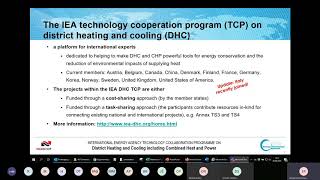
Focuses on the digitalization aspects from an industry point of view. And from. We will also have a short introduction from Michael Huepner, he's coming from the Austrian Ministry, Climate Protection Ministry on funding and cooperation possibility. We have other presentations from the industry side, mainly from the industry side. What is digitalization? From utility and from a software and component provider point of view. And then the third block today is focusing on hybrid energy networks. So sector integration. What is the role of district heating? Talk about also from the mainly from the industry perspective on technologies and software optimization software. And one presentation I'm looking forward particular to is the connection between hydrogen and district heating. Since when people talk about sector coupling? Nowadays a lot of people talk about hydrogen and that's okay, that's good. But you have also district heating, obviously. And I think there's quite interesting synergies you can have between both sectors that is not very much considered nowadays. And again also we have an interactive session on question and answers to our presenters for each block now, without further ado, I will just very shortly introduce the IEA Technology Cooperation Program on District Heating and Cooling and then have Robin, maybe some words talking. The framework we are doing this webinar on is this IEA Technology Cooperation Program that's a platform for international experts that is dedicated to helping to make the strategic energy cooling and combined heat and power processes plants powerful tools for energy conversion. And it's about reduction of environmental impacts on supplying heat and cold obviously as well, there's quite a lot of members already that has been gained significantly in the last years and this list actually is not completed. Just very recently Italy joined the IADHC tcp. So that's very good coverage of European and also non European countries.
There's two ways these IADHC projects are funded, either by a cost sharing approach. So we collect fees from the member states and issue that fees or redistribute that fees and a call for proposals. Last the Annex 13 just has been closed and Annex 14 will be there in a couple of years, I guess in two years if I'm right, we're going to start with Annex 14. And the second way is a task sharing approach where participants contribute resources in kind for connecting existing national and international projects such as these Annex TS3 and TS4 where Dietrich and I are doing that webinar on. And you find more information here on the website given below. And now I would like to keep that slide on and maybe Robin, you have some words on the view of the IADSC TCP on sector integration, on digitalization and synergies and perspectives from the IATCTCP point of view.
Yes, well thanks very much, Ralph Roman for that introduction and thanks also for the opportunity to say a few words.
So I first of all like to say I'm very grateful to Dietrich and Ralph Roman for setting this up. It's very important that we maintain a strong progress towards our overall aims for sustainability, for carbon reduction and of course the district heating and cooling role in moving towards those goals. And actually this, this event falls on what would have been the date, one of the dates for our biennial symposium, which was due to take place in Nottingham right now and was of course postponed due to the coronavirus and will now take place these dates next year in 2021. So very much hope you'll be able to join us face to face next year. But of course, in these times where we can't appear face to face, as I've said, it's very good that we're able to maintain our trajectory towards our common goals. And here of course, we see digitalization and hybrid energy networks both represented in this event today. And of course what we're seeing is that there is a very strong resonance between different themes of work. So the digitalization, I think, is an important element where we see an increasing need to decarbonise and integrate renewables and also local sources of waste heat into our district heating networks. And of course those are innately intermittent. So water, we have here something which can help us towards achieving that, but also the future combination of energy vectors in an increasingly integrated overall energy infrastructure. Which brings us of course, to the hybrid energy networks work. So these are important themes in our overall program. We've actually just very recently, in the context of the overall IEA program, had to take a good look at our overall strategy. This happens every five years to tcps. And in our current strategy, both digitalization and hybrid energy networks are very strong themes moving forward into the future. That brings me just to say a couple of words about. Well, unfortunately, as we see, Kathleen Gaffney from the IEA Secretariat was not able to join, but what I can say on that is that from the IEA Secretariat point of view, digitalisation is also seen of paramount importance for its enabling of efficiency optimization and integration of systems. And this was brought home strongly to me and my colleagues on other TCPs, for example solar heating and cooling, heat pumps and etc. Because we will meet the chairs, meet once a year to see where our programs can complement each other and where there may still be gaps. And this year's, which was taking place just before the. All the lockdowns happened, so we were able to meet face to face. And it was really striking how.
Really every, just about every One of the TCPs had a reflection on the need for digitalization. So this is a very exciting new area, or not entirely new, but let's say a very exciting area for which there is a. A strong future component of our work and our work where that also complements the work of other TCPs as well. So with that, Ralph, Roman and Dietrich, that's my comments, I think, for how I see the work fitting in. And I thank you again for the opportunity to just say a few words and help to set the scene for today, which I'm really looking forward to.
Perfect, thank you. Thank you, Robin, already for that outlook or for that insight into the current developments. I would actually honestly open already the floor if there's any question to either Robin or Dietrich or me on the framework, on the IADHCTCP on I mean we do have for both annexes, TS3 and Tier 4, we will have a more detailed introduction in the. So if you will have a more detailed introduction to the second and the third block for both annexes. But if there's any question already on the overall framework, I would leave the room already for discussion now. And please raise your hand if you don't have any questions already. The raise your hand button is just in the small control panel.
Small hand, but I don't see any question at the moment. Yes, there is a question. Please unmute yourself and give your question.
And state your name and your institution before. No, I guess there was a mistake. Maybe.
It'S already done. Okay, so no question at the moment. So thanks again, Robin. I hope you're going to stay with us. If there's maybe other questions at the end and we can go into a discussion on a later stage.
So now, next slide, next viewpoint we're going to get on this topic. Digitalization the energy sector comes from Germany. Carsten Magas, who is actually also ex co member of the IA DHC TCP from Project Management Ulich gives some words on the national perspective from Germany. Carsten, are you with us?
Yes. Can you hear me?
Wonderful.
Yeah, yeah. First of all, I would like to thank you for the invitation and possibility to give a brief statement regarding national RD perspectives for digitalization of the energy sector. You mentioned it. I work at Project Management Ulich and we are a national funding organization working on behalf of several federal ministries. And I myself work on behalf of the Federal Ministry for Economic and Energy. You mentioned it together with agfw, the German Disreputing Association.
Hai Kohuta and me are representing Germany in the TCP ieadhc.
Yeah, let me go now a little bit more into detail into the national strategy. So in order to achieve our ambition is national climate goals mentioned in the Energy concept and the Climate Protection Plan, a deep transformation of the energy system is required. You know it all. The energy vendor energy efficiency has to be significantly increased at all levels of the transformation and utilization chain. Furthermore, the availability and fluctuation of renewable energy sources and the increase in the supply share need new methods for balancing supply and demand. In this context, of course, digitalization and sector coupling are powerful instruments. So many of the developments are not yet technically mature or cannot yet be operated economically. So the Energy Research Program is a strategic element of the federal government's energy policy that aims to support a continuous research and innovation process. In September 2018, the Seventh Energy Research Program with the title Innovations for the energy transition has been launched. The primary goal of research funding in the energy sector is of course to increase the usability of innovative energy technologies in all sectors. This is achieved through a broad based funding approach that is open to new technologies and this is new takes also into account social processes and the creation of an innovation friendly framework. So our funding aims at technologies and concepts that offer significant increases in efficiency, integration of renewable energies, ensuring security of supply and last but not least, a rapid transfer of research results to the application and into the market promise. Our technology open program approach and the adoption of new trends such as sector coupling or the digitalization of the energy sector offer opportunities for innovative companies in the national market. However, companies and research institutions are strongly encouraged and especially supported to also carry out R and D topics within international cooperations under the framework, for example of iea, EU or special issues like Z Plan or Mission Innovation. So in the energy research program there are four main focus areas. First, energy in the end use, so buildings and communities, industry mobility. The second one is the energy supply, wind, pv, bioenergy and so on and so on. Third one is the system integration including power supply, system, energy storage and sector coupling. And last but not least, number four is the cross system research topics of the energy transformation. There you will find system analysis and digitalization. So although not mentioned explicitly, digitalization is of course a major R and D topic in all of the aforementioned focus areas. So if you have a deeper look into the research program, you will find in nearly every chapter issues related to digitalization, for example digital twins, digitalization of the energy transition, city or neighborhood level, or digital concepts for district heating and cooling networks. So, since I'm responsible for funding of research projects in the district heating sector, I would like to show you just two examples, one following top down approach and the second one bottom up approach. So first, by digitizing the energy industry and heat supply structures, the overall efficiency of the system can be improved, costs and greenhouse gas emissions reduced and the integration of renewable energy is facilitated. However, in a comparison of different sectors in the energy industry in Germany, digitalization processes are currently more advanced in the area of electricity than in the area of supply. So the aim of a research project that started this year is to investigate and evaluate the digitalization measures in all parts of the heat delivery process using a top down approach. This heat delivery process is subdivided into technical, business and legal framework processes and the technical processes include generation, distribution, load forecasting and power plant deployment planning. While the business processes, these include customer acquisition and retention, billing and customer service. So Very interesting project. The results of the project will reveal to what extent the levels of added value can be increased in their efficiency through the data integration between successive processes. So this is the one example with the top down approach. A second project which Fraunhofer and Dietrich Schmidt is involved, aims at elaborating potentials and possibilities to increase the level of digitalization of grid based heat supply. So this project follows a bottom up approach using the district heating grid of Hannover city as a case study. So by integrating information and communication techniques into the operation of the grids covering both heat supply and demand side efficiency increases are assessed. Furthermore, the project results can serve as a basis for in depth analysis of data through data science methods. Thereby the use of digitized processes in future business processes that involve an interconnection between supply and demand side is prepared. So this is also interesting for other heat suppliers. The most relevant benefit of the project will be the practical implementation of the final customer's system flexibilization. So the seventh energy research program that is ongoing implies a more or less unlimited call for projects. There is a two stage selection process but no real deadlines. And the limit is of course only the available amount of funding. Just to give you some numbers for the funding in the end use part. So building and communities, we have an available amount of money this year of 76 million euro for this year funding and another approximately 76 million euro in 2021. So this is for the energy in buildings and communities, including district heating and cooling, thermal storage and the solar thermal. So this is the unlimited call for projects. Furthermore, additional limited calls for projects are launched dedicated to special issues. In 2019, for example, a call for projects dealing with general aspects of digitalization has been launched resulting in over 50 proposals. So and the first project example with the top down approach led by AGFW was one of the successful proposals.
Maybe interesting for you is in the context of digitalization, we are currently preparing another limited call for projects dealing with future developments and implementation of smart meter gateways as a communication platform for energy networks. I'm not sure when it will be published. I think probably this month or latest at the end of the year. Yeah, I hope I could give you a very brief overview of our national funding strategy with some special focus on digitalization. Thank you for your attention.
Yeah, thanks a lot Carsten for your short words. I have been asked why there's no slide, why there was no slides visible has been asked, but there is no slide actually. So that was a presentation without slides. So if you just have Seen that current slide? That's the one you should see.
So coming back to your presentation, I really see that there's a big focus on these topics from a German point of view. So that's quite helpful for the German participants in this call. And we have in the later afternoon, also in the next and the second block, we're going to have a view on the eranet call that is more the international perspective where also Germany is participating. But what would be your view, Carsten, on that? Cooperation between German and non German partners, or non German researchers and companies in terms of doing research and development for district heating, for digitalization, for energy integration? Is there opportunities outside the ERANET call? You see? I guess. How do you see Horizon 2020 in that context?
So these are other people responsible for that? I can only say that in the national funding there's always open for seeking for collaboration to other countries. But of course it is not possible to get the funding from the German ministry. So each country has to take care of funding in the country itself. And then we offer the opportunity for collaboration like iaea, DHC and the other IEA programs. So we are currently trying to join another eranet on I think building and communities, but this is still in the process and of course there will be a strong focus on digitalization, but this is still in progress.
Okay, I just also noticed that this raising hand doesn't work. So if you have a question and the raising hand button doesn't work, please feel free to unmute yourself and just raise your question to Carsten or also to Robin if there's any at the moment.
Otherwise we will have the opportunity also at the end to give more questions to the overall framework of innovation and policies in digitalization topics and sector duration topics. So if there's no concrete question. Thanks again Carsten Magaz for your talk and I will gonna switch now to Alessandro Povagi.
That has been cancelled to Alessandro Povaggi on the European framework. Alessandro, are you with us?
Hello.
Hello.
Perfect. Good morning everybody. Do you see me? Do you hear me?
Yes.
Okay. Okay, Very good. So.
Yeah, thank you. So thank you very much for inviting me to speak today. I've been asked to give you a bit of a framework on let's say, what's going on at European level, meaning the EU level when it comes to energy integration and digitalization in industry heating. So, next slide.
So maybe you know about that, but let's say from we have a new commission.
Since late 2019 and the top priority of such commission is the green deal. So the green deal is not only about energy as such. You see them here circle what is about energy, but it's a general transformation of if you want the European economy in a more green way. And that was.
The clear political priority announced when the nuclear commission came into power. So, next slide. And what I may say that actually with the whole Covid situation, we were all a bit afraid.
That somehow the priority would have been.
Shifted to the near economic recovery. That we actually even seen that some opponents to.
What you could call the energy transition have been vocal in saying, okay, now the energy transition is too costly, we just need to focus on jobs. But this didn't, let's say this narrative didn't really happen. Actually what happened is that.
The green deal and the recovery, the job recoveries.
Merged.
Into a priority that is obviously helping our economies.
To pass and to be strong.
In this situation, these difficult situations, but to do it in a green and even in a digital way. So, next slide.
And so what are the priorities, let's say the pillars of the energy integration of the green deal? Well, one, you may say one is really the energy integration one. And so there was a recent strategy of the commission that was launched in July that was a very important strategy for us. And what you see here is actually a graph from the commission itself so that there is really a political and policy will to go toward a more integrated energy system. So next slide.
And so I went through.
The strategy to read more what is, when I mean, what is written basically about district heating. And obviously we've been, let's say, very much into the dialogue previously in order to also contribute to the strategy. So we were very happy to see that the commission took on board many of our recommendations. So if you take the strategy, what is, is really written there, this is really an extract of some of the sentences, is that modern low temperature district heating should be promoted because it can connect local demand, it can get connected to the electricity and the gas grid. So we're very happy to see.
Let'S say, the synergy with the other grids. And also we are very happy to see that the energy integration is not only about, let me say gas and electricity.
But has been seen in a, so that what we may call sector coupling, but is actually seen in a more in even wider.
Interpretation.
So that for example, where wasted is also part of and a more secular economy exception in a systemic way. So that wasted is very much also mentioned in this strategy from industrial sides, from data centers and so on. Next slide.
Then the other point I went To I mean I read again the strategy and I tried to see what are the points that are about energy integration but also at the same time digitalization.
What comes out pretty clearly is the role of the customer or the consumer. So what you see here, consumer play an active role in multidirectional system by exchanging heat in smart networks. This is a sort of extract from a sort of vision of the future. But somehow you may see that, let's say the commission may expect that we go toward a future where a bit similar to the one of the electricity where the consumers actually play a more active role.
And that's a part where that is about energy integration, but also very much about the digitalization. There is a section on the role of heat pumps and district heating is written in providing arbitrage opportunities. So again here I think would be a big role for digital and energy integration aspects. And then what you also see here, the third sentence.
The reference to the European leadership in the clean technologies. So this.
Is a concern of let's say the European policymakers that somehow we are passing from situations where we have, let's say fossil fuel energy dependence on let's say from Russia to a situation where yes, we are going toward the energy revolution. Yes, we will be. Maybe the Europe will be the first.
Continent to be net zero. But sections of the new energy puzzle will be, let's say very much dependent on China. So a sort of shift from Russia to China. There was actually an article on the Financial Times on that. So a point here is again and what you may see is that there will be a lot of emphasis on smart grid and district heating systems.
Then what you see in the section there will be.
There is actually even a section on.
Digitalization as. But it's a bit of a general, I may say.
Let'S say chapter. But yeah, what is important is also that district eating is seen as.
Let'S say as a point where Europe can still be, let's say a world leader. Next slide.
So this was a bit so far on the side of the policies.
Now on the side more on the fundings.
We are quite optimist because given that let's say that the energy is, I mean that the green deal is the priority and by the way, digitalization is priority number two, which is also, let's say quite the news. Digitalization has never been, let's say, so high on.
The political and policy priorities.
So that will normally also translate, get translated into more funding opportunities. So one immediate opportunity opportunities that is coming up is that the Commission Is you may know that let's say the budget of the Commission as a sort of seven years framework. So this is the last year of the current framework and with, let me say, leftover money.
That is around 1 billion, the commission will launch this month.
They call it call for proposal, but it's actually much wider because normally a call for proposal is not 1 billion, it is much, much less. So.
They will be launched in September and they will actually close in January.
A lot of opportunities like 1 billion new with this 1 billion call and district meeting is part of that. And I mean, I really invite you to have a look.
It's not public yet, will be public soon. We sent a copy to our members, but I believe that shortly will be public for everybody.
Also in terms of more wider letters, more the long term for information, as I said, the EU budget for the coming seven years has been, let's say, recently agreed among the member states and now is under negotiation with the European Parliament. There is the point of ORIZOMB Europe. It should be now around 80 billion for seven years.
That is, let's say, which is a steady growth from the previous horizon, 2020.
And then on top of that, what is also interesting and is also totally new for the European Union is that there will be 390 billion that will be, let's say, brought to the economies, to the economies most affected by the COVID but in general.
To almost all, I mean, to all the economies of the EU and.
In the next two years. So it's a big injection of funds.
In general for the European economy. And what is interesting is that let's say the member states need to focus. You can remain there. Thank you.
No, you can still go up. Thank you. What is interesting is that these recovery funds, I mean, the priorities need to be decided by the member states, but they will be on energy and digital aspects. This is pretty clear, probably around 30% on energy, 30% on digital aspects. And so again, this is a good opportunity. Doesn't mean that will be for district heating, but it means that actually if you are in touch with your, let's say, national government is also now the moment, let's say, to remind them that this money that will come up may be used also for district heating.
In general, the focus on digitalizations will be on the topics that you see here.
First generations and AI and so on. Even in this case.
What Europe is trying to do.
Is trying to build up.
Let'S say, an economy to catch up, let's say the delay that he has with us And China.
So next slide.
So what I did here, I went actually through the text of the green deal calls and I've seen, I looked where what is written in relation to digital solutions. So you may have an idea on the expected funding, what would be the angle used for digital aspect? So you see here the first one, digital solutions for enabler for enabling multi source distributed. Then.
Often digital aspects are seen, let's say as a way to involve more local communities and involve more, I mean and to create changes.
In the wider community.
And also the third sentence that you see here I think is important because it may refer to the fact that sometimes we all think that digitalization is mostly about optimization of the energy generation.
And the energy network, the district heating network, which is obviously extremely important and vital and we will have a lot of efficiency there. But what we may expect is also the commission will put a lot of emphasis on the role of digitalizations for the customers you see here, usability and also for.
Enhancing the comfort and de facto make.
The housing healthier environment.
So please, this is sort of invitation to also consider these aspects in your research. And then another point, there will be probably funding on addressing the skills gap.
Next slide.
G. I just want to mention that as DAC Euro term power.
We can support, let's say if you're interested in European funding, we help our members to create consortium to let's say to make their life easier when it comes to applying for you funding. So in case you're interested, and since there are so many youth funding possibilities coming up in the next month, please feel free to contact me. Next slide.
And then here I just want to mention the ongoing projects where.
We are partner and specifically there are two projects that are about digitalization, Tempo and also RewardIt, which is a new project that started last year and has many, many different aspects. It's quite a big one. And also Magnitude is an interesting project that we have on sector integration and is actually a project that will soon release a lot of deliverables and results and we will have a final event probably March next year.
So that's it. You can go to the next slide where you see my final.
Slide with my.
Name and way to contact me. So maybe if there are questions I can reply to them right now, if there is time.
Thanks a lot Alessandro. There is definitely time. We still have 10 minutes for the general question and answer session. Not only for you, but for all. But just taking the chance, is there any direct question to Alessandro? Again, either raise your hand if it's possible or if the option doesn't work. Please just unmute yourself and speak freely.
No direct question.
I would have a question.
So what I see in the European funding instruments, a lot of that, these very like, let's say these very general calls on digitalization in the energy sector. And what I noticed that the, as you mentioned also the electricity sector is quite advanced on digitalization topics. Just like flexibility platforms are already tested and implemented, there's European markets and there's a lot of development on the electricity sector. District heating is kind of lagging behind. And I'm wondering a bit how the commission or what do you see When I read these calls, they are general and if a sector that's already very advanced applies to a very.
Practical or very implementation call, they are very close to implementation, they're very close to innovation. I see better opportunities for the electricity sector than for the district heating sector.
What is your view on the European funding instruments? Are they going to stay more general or do you think there might be also dedicated funding instruments for district heating and cooling? They are more basic, a bit more on the basic side than on the application side.
Yeah, it's a good question indeed.
What you say, it can be true.
I saw that, for example, now.
In.
This call that is coming up in the green deal, the district heating part.
The TRL for that call is quite low, so 4, 5 TRL. So that could also mean that they are looking for some very disruptive, innovative solutions for district heating, which may be also the digital aspect of it, or the energy integration aspect of it.
But apart from that, yes.
We always a bit, let's say in a cooperation, but also in a competition with electricity sector. So there are calls that, that, let's say, when they don't refer specifically to electricity, but they refer to energy, that maybe the electricity sector as, let's say, an advantage because.
They are more advanced, let's say on the digital aspect. So.
Yeah, there is this risk indeed. But I hope that, I mean that we are serious about the decarbonization, the focus we see. I mean, we are gradually going towards a scenario where it is and inter decarbonization is more and more at the center, let's say, of the political attention. So I'm cautiously optimistic.
Okay, thanks. Is there any other questions to Alessandro in the meantime?
It seems to be not the case. I would maybe have a more general question.
To the participants. So I noticed that not only European participants where these funding instruments apply, but also non European participants. So if, I mean, that's not discussed in advance, so not prepared in advance. But if, if any of you would give some comments on your local or national funding situation when it comes to district heating and or digitalization, especially the combination of both.
Is there any viewpoints from participants that are currently online in the call from maybe non European countries?
Please just raise your hands.
No.
Either it's not technically working or we have a very passive audience today. What's fine for me but maybe I have a question to all presenters from today. So Robin, Carsten and Alessandro.
What I noticed.
When it comes to.
Digitalization that digital solutions are very well scaling. A good digital solution can scale very well. We've seen that in the past when like the Internet comes up. And I remember very well at the very beginning you had there was a couple of search engines available for looking for searching the Internet and after a while Google was basically the only one that really survived. There's obviously a couple of others now. But Google is for sure the dominant player on the market and similar it's for social networks and for others we have these similar effects we see in the digitalization area that there are big players dominating the scene very fast.
Do you think? I mean district heating and cooling is a very local market often however electricity going to be European markets and having a European setting and just integrating both systems might require to step up to a more European viewpoint. How does these funding instruments you were presenting all these programs in these different international, national and European programs. Is there any way how they avoid that.
We first see another Google or Facebook of digitalization in the energy sector or district heating sector. Is there any.
Ways to support other solutions than seeing the big players coming up at the very end?
Is there any view from or is that not an issue at all in the European national or international funding instruments?
That's Robin here. I think it's a big and interesting question. I'm not sure I. I really have an answer to it, but maybe in a way you put your finger on something which should be examined in one of our work streams going forward.
But I don't feel quite qualified to give an answer on that issue.
Okay, any. Any other viewpoints? Carsten, Alessandro.
Yeah, this is Carlson. So in Germany I do not see it yet, but as I mentioned in my statement in this repeating, we are far behind the electricity sector. So we start with this top down approach just looking first into what can digitalization on different levels can do.
For the energy industry with special focus on the circuit and cooling. So I'm not sure how this will develop but our program is currently of course open.
Okay.
Yeah, maybe just one comment. It's a very interesting question and I hope that maybe the other people will also reply throughout the day on this. I can only maybe think that yeah, for example, Google is very scalable. So you know, if you use it.
For California or for the whole world, probably.
The effort is, I mean it's very, very scalable. And for district heating the digitalization comes necessarily together with the infrastructure and so on and with the know how on district heating. So I would say, yeah, I would say it's a bit more blended.
That's actually my very personal point of view. That's both an opportunity but also a challenge. Since the challenge what I see that small scalable solutions like PV heat pump combination and individual buildings that are more scalable on a worldwide level. So that is a competitor to these district heating situations. That is very. Where obviously digitalization can help. But it's still as you mentioned, it's a very local infrastructure. You need a lot of local know how and knowledge and infrastructure cost and capex as well. But anyways that's I think it's another discussion.
So in the meantime anyone would like to ask a question to the presenters for the first block?
Dietrich, do you have any final words from your side?
No, but just thank you for this very nice introduction to our topics we have today. And I'm looking very much forward to the next blocks where we go in a little bit more in detail. But this general overview on the politics and the general framework was very interesting to me.
Wonderful. So then I would like to close the session the first block on the policy point of view and funding point of view that gives a good framework. We will have one other presentation on the funding that should have been in the first block but unfortunately was not available at this time. So we moved to the second block where it fits very well. Also on the funding opportunities for digitalization on European or not even European international funding program, he will introduce in the next block starting at technical connection test starting at noon and the second block will then starting at noon 30. Noon 30 also 12:30 Central European Time.
So thanks for all participants, thanks for all speakers and we will stop recording now and see hopefully a lot of you again in one and a half hours. So have a good time and talk to you later. Bye bye.
See you. Thank you.
You.
More from IEA
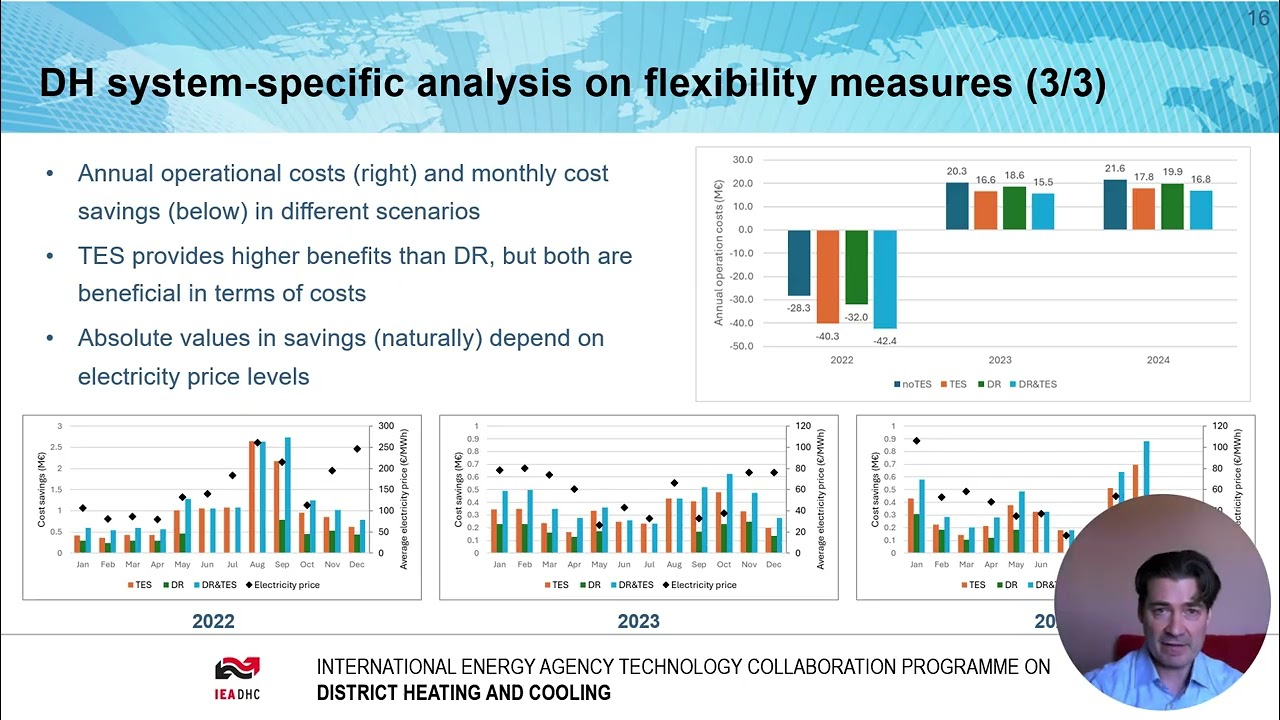
XIV-05: Flexibility and DH value chain (FlexVal) – advanced analysis & compatible pricing
XIV-04: RE-PEAK - How to cover peak loads in district heating networks with renewables.
Digitalisation of District Heating: Summary of findings from IEA DHC Annex TS4
25/01/2024: The crucial role of district heating pipe lifespan in achieving climate objectives
IEA DHC XIII-03 Generation of simulated faulty datasets to ease heating network fault detection
XIII-01: Leave 2nd generation behind: Cost-effective solutions for small to large scale DH networks
XIII-04: Cost Benefit study on the building secondary network for improving DH performance
XIII-05: OPTiTRANS - Optimized transition towards low-temperature and low-carbon DH systems