Stefan Pushnick presents research on integrating low-temperature subnetworks into existing district heating systems. The Cascade project identified 29 candidate examples worldwide, but only 4 met the strict definition and were actually built. A survey of 85 stakeholders revealed barriers and drivers for adoption.
Chapters
Hello, dear listeners, I'd like to welcome you to my presentation about low temperature subnetworks in existing district heating networks. My name is Stefan Pushnick, I work for the Energie Institute at the Johannes Kepler University in Linz. And within the next minutes I will talk about our research carried out in the project Cascade, which was funded by the IEA THC CHP program. And. Yeah. Also project partners are the Italian University of Technology in Estonia, the Center of Energy Research in Norway and the Austin Institute of Technology.
Yeah, I structured my presentation into following points. In the beginning I'll give you a little introduction to the Project Cascade itself and about the aim of our research and also about the status of the project, since this project is still ongoing. Then I will talk about our defined definition of a sub low temperature district heating network and about the identified examples which we gathered within our research. And in the end I will talk about some about lessons learned which we derived from our analysis and about various drivers of subflow temperature determination heating networks.
Yeah, I will start now with by giving you some background information regarding our research. So in general, urban district heating networks operate on relatively high temperatures. So this can go up to around 130degrees supply temperature, depending on the country. Yeah. And low temperature networks operate between 50 to 70 degrees. Yeah. We can know fourth and fifth generation district heating networks can even be lower. And what we analyzed within our research was that we create a sub network by integrating a low temperature network in the return flow of an existing district heating method. And thus we have a cascaded solution which we consider as one of the key enablers in decarbonization of the urban district heating network.
So what is the aim of our research? We try to identify the best practice examples and derive some lessons learned of existing and theoretically elaborated sub networks. We analyze their design and how they are operated and we evaluate their scalability potential. And in the end we try to develop some general guidelines and recommendations on how in the future subnetworks can be integrated.
The main work from the NEP Institute side and which was also my work was to identify the best practice examples. And therefore we conducted literature research with a focus on Austria, Germany, Nordic and Batu countries. We conducted several district heating operators, either via mail or by expert interviews. We had also expert meetings and tried to gather as many examples as we could. And from that gathered examples we derive some lessons learned. Yet the work which is still ongoing from our partners are the Stalin University of Technology and Estonia, working on the bearers and enablers and describe their triggers for implementation that I Will present in the end of this presentation synthesis energy research works on the technical solutions. So they try to analyze the connection and the control of the single subload temperature networks in case areas.
Via dynamic simulations. And the Austrian Institute of Technology they conduct technomic analysis and ask kilopinate analysis of networks. You can see here now how we defined within the project as sub network. You can see here the superior distance network. And you can see here in the green dot dashed lines, the sub network, which is here. You see here the integration of the sub network into the return flow of the superior distribution network. And there's also an additional connection from the super supply flow of the superior distributed heating network to guarantee always a continuous supply temperature. And what are the advantages? You can also integrate now in the subload temperature networks renewables like solar or geothermal. And you can also integrate, for example, waste heat, which is low temperature. And what we analyze is also this connection point how to integrate the sub network into the superior dist network. And the four main requirements which we have is that it has to be connected the sub network to the superior distance network. The sub network must primarily use as the return flow to cover the energy demand. And the sub network must be low temperature. And there must be more than one customer to be.
A network.
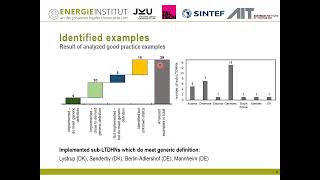
I will talk now about the results of the identification process. So, in total, we could identify 29 examples which we analyzed in detail. And from those 29 examples, which is illustrated here in the Spartaflow diagram, only four that meet our generic definition and were implemented in practice. And those examples were located in Denmark, that was lisztruppen sonarpi and there were two also in Berlin, Adlershof and in Mannheim. Further, then examples were implemented but did not meet our generic definition. So there was, for example, not a real network connected. Or they did also use mainly the supply flow from the superior distributing network instead of the return flow. There were five examples which were only theoretically elaborated. And from 10 examples we do not know the status and it was not able to find that out. And as you can see, the main examples come from Austria, Denmark and from Germany. I will give you now a compact overview about what we learned within our analysis. Although subnetworks are not that well promoted or established, they are often considered at least operative as state of art the business. There exists organizational hindrances within companies regarding when should subnetworks be integrated. That's always favorable if there are new city districts, if there are new buildings. If you integrate a sub network, you can increase the capacity of the overall distributing networks. The connection point so the control is very complex and potential risk can occur. And regarding the location it's always good to locate it near the heat generation unit since there is the mass bay sufficient in the end. I will talk now about pairs and enables stop flow temperature dist heating networks. There's currently a survey ongoing from our project by Natalie University of Technology.
And this survey is based on previous research on case studies and previous projects, on workshops with experts and interviews with distributed companies. So in the survey you have in the beginning a short introduction about the sublo temperature network concept and then you have the possibility to evaluate specific barriers like technical ones like frolic issues or non technical ones like high investment costs or or also on drivers. So what could drive a sub low temperature network integration in the future. And you can evaluate them from very important which is five to not important with only a score of one and yeah, we would be happy to receive your feedback on this. I will give you the link on the next slide. We contacted already several Experts like the IEA.member card and Baltic state and we also contacted other district heating companies and suppliers within our project network.
We received already feedback from 85 participants where 42% were from distinct heating companies, 18% from engineering companies and technology providers and 40% were from academia and research organizations. As you can see on the screen.
The figure is structured regarding country and background. You can see that especially Estonia has a high feedback rate. Yeah, we would be happy if we have some further participants that we have more feedback and we have more meaningful results. So just use this participation link here. Or you can also use the QR code to give us your feedback on sub low temperature distributed heating networks and it will only take you around five minutes to fill out the questions. That's now basically all from my side. If you have any further questions don't hesitate to contact me and I say thank you for your interest in my presentation and in our research. Thank you. Bye.