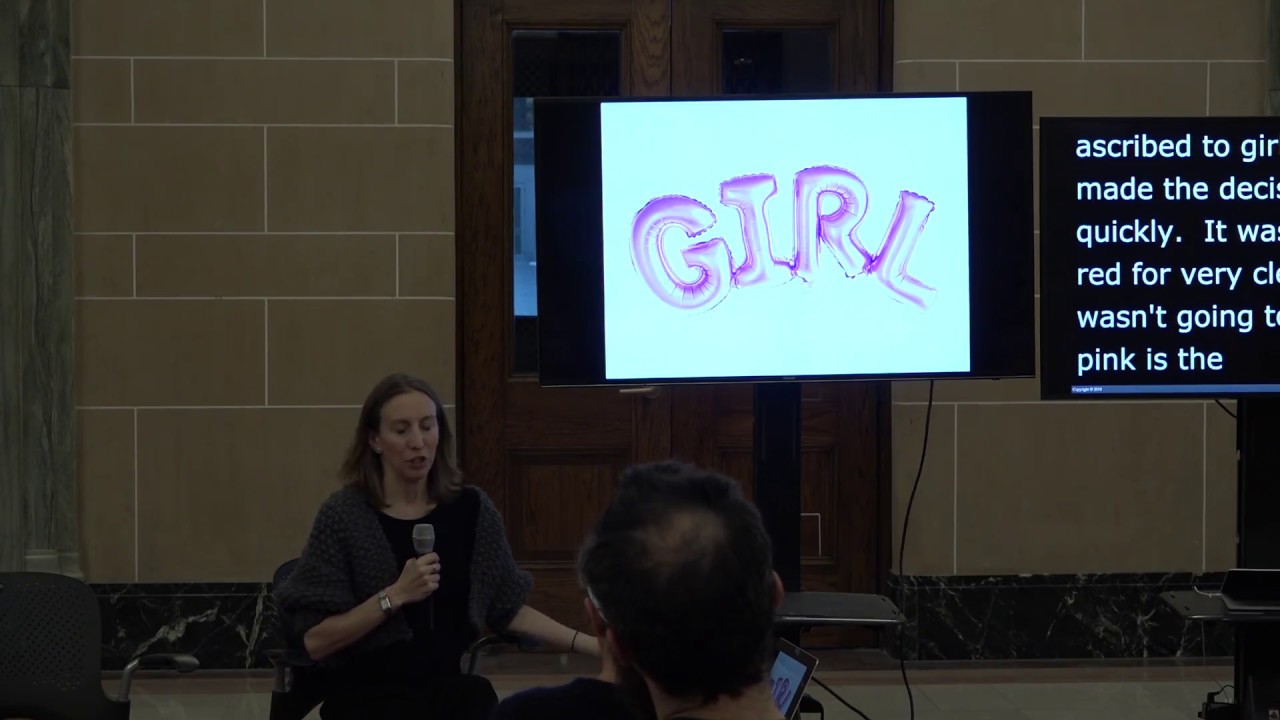
The panel, hosted by Expo Chicago and the Smart Museum, brings together feminist art pioneer Judy Chicago and activist‑artist/architect Jayna Zweiman, moderated by Alison Gass. The conversation traces Chicago’s early struggles as a woman artist in 1960s Los Angeles, her development of feminist art practice, the making and legacy of The Dinner Party, and her later collaborative projects. Zweiman discusses her background in architecture, the creation of the Pussy Hat during the 2016 Women’s March, and the Welcome Blanket project that re‑imagines the U.S.–Mexico border as a fabric of welcome. Throughout, the speakers examine how material choices (auto‑body paint, china painting, knitting, quilting) intersect with gendered craft, how community‑driven, crowdsourced actions become political art, the backlash and accusations of essentialism faced by both artists, the evolving meaning of feminism, and the role of social media in amplifying and threatening activist art. The dialogue ends with reflections on institutional change, the persistence of patriarchal push‑back, and the future of feminist art practice.
Chapters
Hello, everyone. Thank you so much for being here tonight. My name is Stephanie Christello. I'm the Director of Programming for Expo Chicago, as well as the editor-in-chief of The Scene, Chicago's international journal for contemporary and modern art. It is our pleasure to be hosting a Dialogues panel here tonight, which is a program, a year-long program of panels, symposia, and provocative artistic discourse with leading artists, curators, and art professionals on the current issues that engage them. I wanted to take a moment to acknowledge the partnership between Expo Chicago and the Smart Museum of Art, which has allowed us to present this program this evening. The talk is held in conjunction with the Smart Museum's current projects, Welcome Blanket, created by Jayna Zweiman, and Conversations with the Collection: Building Environments, which features the work of Judy Chicago, who's represented by Jessica Silverman Gallery in San Francisco, who we're thrilled to have join us today. I wanted to also thank the Lab School for generously supporting and hosting tonight's program for this panel. Please join me in extending a very warm welcome to Alison Gass, the Dana Faitler Director of the Smart Museum of Art, and our panelists. Thank you.
Thank you all so much for being here tonight. This is incredibly, incredibly exciting for me to be here having this conversation with 2 really extraordinary women on topics that have been really near and dear to my heart for my whole life, really my whole career. But I just want to start, it's sort of hard to introduce Judy Chicago. I would say that everyone knows Judy Chicago. There have been words that have been coming up on my Facebook feed, a legend, my hero. Judy and I have been in talk, we did a talk together, and I have never seen an audience respond to an artist the way people respond to Judy. Judy has been a seminal figure in the art world since the beginning of her career. She is perhaps best known as really the creator of the idea of feminist art practice, with a seminal work called The Dinner Party, which I'm sure many of you know, which is now permanently housed in the Sackler Center for Feminist Art at the Brooklyn Museum. Judy's work is in collections in museums across the world. She has been featured in articles, books, canonizing books of every kind. She has authored, she has taught, she is extraordinary. I'm really honored to have you here tonight. Thank you.
Thank you, Malle.
Now I also want to introduce more— a new name in the art world, the incredible Jayna Zweiman. Jayna has a BA from Brown University and a Master's of Architecture from the Harvard GSD. She has done incredible things throughout her career. She has worked on the Clinton campaign. She has been an architect. She has become an extraordinary community activist and an artist. She is probably best known to you and to the rest of the world as the co-creator of the pussy hat, which we'll talk about later.
Yes.
And I was so thrilled when I came to the Smart Museum this summer to begin my job as the Dana Feitler Director, to bring with me Jayna's newest project, Welcome Blanket. So we'll talk about both of those things tonight. I will just say that my very, very first museum job ever was writing catalog entries for The Dinner Party at the Brooklyn Museum of Art when I was still in graduate school. I went to graduate school to study feminist art theory, and it all began with Judy. I just met a young woman who graduated from college as an art history major, major and said she too was just in awe of being here because she has been studying and studying Judy. So it's pretty— just to embarrass Judy, I'll keep going with that. But recently, I was asked to write a major essay for a forthcoming book, a monograph for Judy's work that is being published by the National Museum of Women in the Arts. And it's a really kind of a moment to take stock of the arc of this career. And the essay that I've really been asked to write is the introductory essay that positions Judy's career and really considers her legacy. Much of my curatorial practice has been about thinking of this legacy of feminist art practice that was born of a moment in the '60s and '70s, but what has it meant for generations of artists moving forward, and what has Judy's career continued to do during that time? And that's something that's really important to talk about tonight. The reason I say this is because Jayna came to me in large part through the Judy Chicago installation at the Brooklyn Museum, where she went after Pussyhat to think about her own position within this legacy of feminist feminist art practice and activist practice, and said, I have this project. And someone said, oh, you should talk to Allie Gass. And we actually knew each other, having gone to high school together, though not having talked for a long time. So this really is a talk born of this story, this arc of Judy's career, my own career, Jayna's career, that really made sense. So when Expo asked us to think about what kind of a talk the Smart Museum might want to do, this was sort of my dream. panel idea. So I just thank both of you for being here. What I want to do tonight is do an arc that kind of goes back and forth between looking at Judy Chicago's artistic practice, thinking about Jayna Zweiman's practice sort of within that legacy, and thinking about what are the linchpin ideas that getting these 2 incredible women together helps us to think about. I want to think, of course, about feminist art practice, activist art practice. I want to think about what it means to make a practice in artistic materials of any kind that harnesses a political moment, a sensibility that forges a power for change. I want to think about the moments when people react negatively to those things as well. And I think we're just going to have a conversation, and we're going to dive in. I want to start here, Judy, which is some of your early work from the '60s. And when you and I talked before, can you tell me a little bit about the experience you had in graduate school, being a woman artist in LA in these moments, and the work that came out of that. Talk to us a little bit about what we're seeing here.
Well, in the top left-hand corner is an image called— well, it's actually Flight Hood. It's painted on the hood of a car, and it's an adaptation of an image I did in graduate school. Which my male professors hated. They hated my color. They hated my imagery. It was like wombs and breasts.
Yes. And this was a moment when the male artists were doing what? Minimalist practice?
Well, there was a kind of counterpart to New York minimalism in LA, which was a very macho, scene, very inhospitable to women artists. I was telling a young woman who was interviewing me on the phone that in the '60s, the biggest compliment you could get was that you painted like a man. And she was like, you are kidding me! I'm like, no, I'm not kidding you. And in fact, there were no solo shows. There were only one-man shows.
One-man shows.
So you had to have like A gender reassignment.
To have a solo show at a museum. Yes.
And so I was a very ambitious young artist. And at the time, there was no— LA was very different than it is now. It was very wide open. There was very little art scene. It was just being built. And consequently, artists of my generation never imagined making money from art.
Interesting, 'cause we think of LA now as this hotbed. It's completely different.
I mean, now, you know, LA is part of the international art scene, but it wasn't then. It was really kind of on the edge. The art scene was just being built. And the goal at that time was being taken seriously as an artist, which is what I wanted.
And you were just determined to do it.
I was determined, yes. And so what I did for the first decade of my career was kind of back away from my early imagery and become much more minimal. But the thing that's amazing is that I also went to auto body school.
So this is what I— this, I have to talk about this, 'cause we did this, we talked about this once before. The fact that I think of like the car culture of the LA art scene, Chamberlain, whatever, this is about masculinity. This is about toughness. So tell me about being a woman artist using these colors.
Well, I used to hang out with John Chamberlain.
Yeah.
And he used to always say, what I should do is go to auto body school and really learn how to paint, because those guys really— Well, he didn't. I did. Me and 250 guys.
I love this.
I love this.
The thing about it, though, is important in terms of understanding my art practice. Is that, you know, 15 years, 20 years later, when The Dinner Party was premiered and people talked about my having brought women's crafts into high art. Well, my whole practice was built on learning techniques that were appropriate for my aesthetic needs, starting with going to auto body school.
Right.
So will we think of these materials as totally gendered? We think of needlepoint as a feminine material. We think of Auto body school as masculine. For you, this was just a means to constructing a vision.
Because, you know, techniques have no gender. Of course, artists have gender.
And color, in fact, has no gender either.
Yes.
Except that the thing that's really interesting about, even when I was trying to be at my most minimal, I clearly didn't succeed because, you know, in the Pacific Standard Time, you know, in 2011 and '12, there was this big initiative in Southern California funded by the Getty. That was called Pacific Standard Time.
And didn't you have work in 8 of the different shows in Pacific Standard Time?
Well, it's funny. It's what goes around comes around. But anyway, the thing— I'll explain that. The thing is, is that it was like across all the art institutions from San Diego to Santa Barbara in Southern California, looking at and celebrating Southern California art from the '60s to the '80s, which was exactly when I was in LA. And The big change that had happened was now it was inconceivable not to have women in the show. But since I was one of the few women in that scene, I was in like so many shows.
Oh, that makes so much sense. Right.
So, but the show that the Getty did, the kind of signature Pacific Standard Time show, that painting in the corner, which is 8 feet by 8 feet.
It's an incredible painting.
Was in the show. And one of my male colleagues from the '60s apparently complained to the curator. that it didn't belong there. It was too sensual, too erotic.
Complained in 2011?
Yes, in 2011, yes.
And that's why we're gonna talk today about why some of these issues that we think aren't a problem anymore, 'cause we see women artists in shows all the time, this is still not done. This is still a story that we have to tell and fight for. I mean, that's pretty clear from everybody's practice. quickly about this wonderful work in the middle, which I really love.
Oh, Rainbow Pickett?
Yeah, I love it.
Rainbow Pickett was a piece that I did and couldn't get any traction for, even though it was in the most important minimal show. But I was such a young and naive artist. And when you're from a disaffected group, one of the problems is that there's a lot of information you don't get. Like, when you're in a big New York show, you're supposed to get on an airplane and go to the opening.
Right, and do your thing.
So I didn't go, and I didn't know what to do with that piece. It was— so I destroyed it, and it was rebuilt actually because of a woman who's here in Chicago now, Ann Goldstein, who was a curator at LA MOCA. Now she's the chief curator and deputy director of the Art Institute. And she, it was because of her that Rainbow Pickett was rebuilt.
That's incredible.
And actually now a lot of my early pieces are gonna be rebuilt. It's great. I'm really thrilled. I never thought, it's like what goes around comes around.
I mean, this work that you felt like it was worth destroying, that's pretty incredible. All right, I'm gonna keep us—
Yeah, you never, the moral of the story is you never know what's gonna happen if you live long enough.
But it's a good happy story. All right, let's talk about The Dinner Party, which premiered in fact in Chicago.
Mm-mm.
San Francisco. Oh, you're from San Francisco. I knew that. I knew that. And then— We were just talking about— it was staged in Printer's Row, though, where these ladies saw it. Yes.
All right.
Let's talk about The Dinner Party, because this is the work that kind of got the attention of the art world at this moment. And I think when many people think of you, although your career has been long and varied, this is the thing that comes to mind, I think, at first for a lot of people who don't know your work well. All right, can you tell us a little bit about it?
Well, I was just telling some people here in Chicago about the show that just opened at the— The Dinner Party traveled around the world through a completely alternative grassroots movement. It was the piece that everybody wanted to see and nobody wanted to show. And that's how it ended up on Printer's Row, which ended up gentrifying Printer's Row, because there was a There was a grassroots group here called the Rosalind Group for Arts and Letters who organized. And what happened with The Dinner Party, it was pretty unprecedented in the art world, is people got together and organized, raised money, created staffs. That's what they did on Printer's Row. And there was a developer who gave the space and then developed the building.
After you got some attention for it, yeah.
But the thing is, The Dinner Party was seen by a million people as it traveled around the world. And it's been— since it's been permanently housed at the Sackler Center at the Brooklyn Museum, it's been seen by another million and a half people.
That's incredible.
But I was just telling these people that we were just in New York because there's this show that's opened at the Brooklyn Museum called Roots of the Dinner Party: History in the Making, which is the first look at my creative practice and process.
Which I would like us to talk about a little bit.
But on the way, when My husband, Dullin, and I were in the car on the way to the opening. I was texting with some of the Dinner Party people who came in for the opening. One of them called the rest of them the Dinner Party leftovers. But anyway, they all have had very stellar careers. So I'm texting with the Dinner Party leftovers and saying, 37 years ago, the New York art world tried to kill me and the Dinner Party.
Right.
I mean, the reviews of The Dinner Party, anybody who knows anything about my career knows that the reviews and the hostility of the art world towards The Dinner Party was vitriolic. Totally vitriolic, right?
Yes. So does everybody here know what The Dinner Party is? Let's talk about what it is. It was an intentional mechanism to kind of rewrite human history by pointing out Significant women from across history.
Just the history of Western civilization.
Just the history of Western civilization. All right.
I mean, I was ambitious, but let's not get carried away.
All right, fair enough. Okay, so talk to us a little bit about how you conceived of it. How did that—
Well, I slowly came back, which is what you're looking at in the imagery of through the flower and peeling back. slowly came back to my own imagery. The one thing about Southern California, as tough as it was for women artists, was that there was a spirit of self-invention there that allowed me to imagine that I could create a feminist art practice.
Yeah.
And a new form of education called feminist art education.
Yeah.
Where women's needs would be addressed, which they're not, because university Studio art education is inherently biased against women. What do I mean? Like, well, one of my students in the feminist art program in Fresno, which is where I started it, is a sculptor. And she was always interested in sculpture, but she wouldn't take a sculpture class when she was in Fresno because she didn't wanna make a white plaster cube.
Yeah.
Which is, What you make.
What you make.
What you make.
Because that's what men like.
Right.
She wanted to work with a needle and thread and cast clothing in bronze.
Amazing.
And that was impossible at the time. And nobody supported her, which is what I wanted to try and do in my educational program. But anyway, by the end of the 1960s, I was sick to death of trying to be a guy.
And so—
Well done.
Yeah. Also, when I was in college at UCLA, I took a course called the Intellectual History of Europe. And the professor promised to talk about women's contributions at the last class. I waited all semester. He came in. He walked up to the front of the class, and he said, women's contributions, they made none.
Are you serious?
Yes, that was the prevailing attitude in the '60s. Women had no history. There had never been a great woman artist. What women did didn't count.
Didn't count. Or if they did it, it was woman's work and it wasn't high art and it didn't have deep meaning like crushed cars and plaster cubes.
Right. Like, I mean, there was no way Jayna could initiate a project like the Welcome Blanket then unless it was I mean, it would've been completely ghettoized.
Right, it would've been a craft project.
It would never be in a major— in a museum.
Exactly.
Okay.
So—
That's why we're here.
Yeah, so I was trying to figure out whether there, you know, 'cause I was having so many problems in the male-dominated art scene, I started wondering whether there'd ever been any women before me who had encountered similar obstacles.
Yeah.
And if so, what they had done. So at the end of the '60s, before there were women's studies courses, I started a kind of self-guided study tour into history to look. And wherever I was traveling around a lot talking about my work, and wherever I went, I'd go to used bookstores. And I found all this material that I got, and I bought these books for $1 a book because nobody was interested in them. And I discovered this treasure trove of material and discovered that it was a complete fiction that women didn't have a history. I found women artists, I found women's biographies, I found books that had been published. Actually, there's a series of 5 books in the Ritz show.
Yeah.
That was by a woman named Mary Hayes, who was a contemporary of Mary Wollstonecraft. It's a history of women.
Wow.
When the Dinner Party administrator found it, when we were researching for the floor, for the heritage floor, the book had not been checked out of the library for 75 years.
I mean, it hurts to hear this. It hurts to hear this.
So, you know, all this gasping. Well, that's what I did. I gasped. You know, I'm like— and it got me really pissed off. So I was a young, energetic, ambitious, young woman who had been raised by Marx's father with a mandate to try and make a contribution to the world. And so I decided with my paintbrush, I was gonna change all this.
Yeah.
Me and my paintbrush.
But you know what? You did.
Right.
So, yeah. So, but actually, I do have to tell one.
Yeah.
Okay. I just wanna tell one very brief story, which was I'm gonna— I'm really moved by this. I'm gonna get an honorary doctorate from the School of Chicago Art Institute.
Yes.
Which I have other honorary doctorates, but it really means a lot to me. Because from the time I was 5 years old, I was telling you, I used to get on the 53 bus every Saturday by myself, which is unheard of now, right?
Right.
And go to the Chicago Art Institute. And every Saturday from the time I was 5 to the time I was 17, I took art class lessons there. And my primary teacher in junior school was a man named Manny Jacobson, who's taught a lot of— who's, I'm sure, gone now, but he taught a lot of artists who became famous. And when The Dinner Party opened in Printer's Row, Manny Jacobson And then James Madison came and I gave him a private tour and he talked in a hushed voice like this. And we walked around the piece and he said to me, I always knew you were gonna do something important.
Oh my goodness. So this is an incredibly meaningful honorary doctorate. It's incredible. It's incredible. Okay, I'm gonna give— we're gonna keep talking about The Dinner Party, but I wanna jump.
No, I'm not ready for that.
We're gonna jump. We're gonna let you talk now, Jayna, too. I want you guys very much to ask each other questions, so Judy, please help me talk through this as well. Okay, Jayna, let's jump from 1979, '74 to '79 is when you were making The Dinner Party, to 2017. So one thing that I will just quickly say is that over the course of my curatorial practice, one of the things that has troubled me a great deal was a resistance in women artists of my generation or younger generations to using the word feminism. It was something that I really have written about quite a bit, Feminism became kind of a hard word. I was trying to figure out why are women who so clearly embody everything we believe about feminism resistant to it? You talked about the struggle with naming the Sackler Center the Center for Feminist Art, that people said, no, it's a dated term, don't use it. So I just want to use that as kind of a framework. Talk to us about how this happened.
So is this on?
Okay.
So maybe a really quick one too is in my art history class, There was one page on feminism. And there was a mention— I had Janson, it's, you know, the tome. And there's a mention of women in decorative arts in like 2 sentences.
And this is at Brown?
This is at Brown.
In the '90s?
Late '90s. And the art history professor showed a slide of yours. He's like, this is the decoration. You should really know about this. This is Judy Chicago. And when I saw it, I saw that there was like a place for everyone. And we didn't really understand the slide. And it's grainy. We didn't really go into it. But it was this way of thinking about space that I think I've always carried with me. So thank you, which was really important. And also at Brown in the late '90s, early 2000s, I had a really fantastic painting teacher who was a woman who would always show us women artists.
Great.
Which was really— it made me understand sort of what the possibilities were and actually led me to architecture school and then back here.
Well, architecture is a whole other realm where we could talk about women being—
Sure. So the Pussyhat Project came about for a bunch of different reasons. One was the election, as you can imagine. And I had actually come back to knitting. I started knitting to understand lines and surface and how those constructed together to make objects and form.
For you, it was very much an architectural endeavor.
Exactly. And from a very sort of masculine architecture program, I actually got a grant to learn how to knit.
At Harvard.
At Harvard to Haystack Mountain School of Crafts.
Wow.
Which is amazing. And so I don't think the competition was so stiff for that in that place, but it definitely changed the way that I thought about sort of the possibilities of making facades and how to think about spaces and open up other artists' work that I got to see. So I put that on hold for a while, and I had had a really difficult accident back in 2013. And so as part of recovery, even a couple years later, I wanted to learn how to do something where there was zero cleanup and I could like learn something new. So I roped someone in.
Because as part of your recovery process, the kind of general practice of architecture wasn't something you were really doing and you couldn't paint so well at that moment or didn't want to.
I wasn't, I wasn't there yet. So it was sort of like, what can I do that I can potentially succeed at? Not get too frustrated. And what I found was not just this craft, but I also found this community. And so the knitting community— I don't— who in this— who here knits? Crochets? Okay, you should know all these people. And one of the most wonderful things is that you can be the most novice person in a room and people will take you on. And it's this process of learning that is often in a very feminine space, but I think that a really strong space, and you learn a lot from the people around you because they come from so many backgrounds.
And one of the things you've talked to me about as well is that knitting circles or knitting classes kind of tend to be a place where people start to have real conversations, and that's for whatever reason it has felt a bit of a safe space to have difficult political conversations even, or things like that, which I think is interesting.
Absolutely.
Well, I would actually like to comment, because when I apprenticed myself to the china painters, It was exactly the same. One of the things that I have not actually talked that much about is how affected I was by this whole alternative model. Not only of teaching, but of exhibiting. So that the way china painting— by the time I apprenticed myself to the china painters, china painting had gone completely into the hands of women and was passed down from mother to daughter. And much the same way you were talking about knitting circles, the way china painting was taught is that there would be like, you go to somebody's house and the women would sit around the kitchen table and paint and drink coffee and talk and converse. Well, this was completely different from art school. Right.
Boy.
And also—
And architecture school, I'm sure.
Yeah. And also, Then I started going to china painting exhibitions. You know, I came up out of university studio art courses.
Yeah.
And I came up through the elitist art world, where the idea of there's a small audience for art. And here there are literally thousands of people at the china painting exhibitions. So, you know, that had a big effect on me and the way I structured The Dinner Party and my subsequent work and my art Because I set out deliberately to make my imagery more accessible because I saw the possibility—
Of the expanded audience.
Of the huge audience.
Of the huge audience. No, and when you said about looking to different techniques to kind of be able to create your vision, not for a political reason or a gendered reason, I thought of you and the things you've said about how you turned to knitting and how the hat came about. Talk to me a little bit about— this is amazing— about— you said something to me yesterday about how pussy hat was, of course, about a kind of response to your accident and perhaps not being able to go and march yourself, but also about architecture. That was really interesting.
So this part— so to me, this is an architecture project. And the pussy hat in many ways is an actual— it's a diagram. It's just a rectangle folded on its side. You put it on your head, and you get these cat ears. So pussycat, pussyhat. And then everyone makes their own, or they give it to someone else. And so that's kind of like a modern-day barn raising. You're actually bringing your brick to the table. So each of these hats, because they're handmade, they're all a little bit different. So it's this sea of pink pixels that everyone contributes to actually making. And so it's a true community. endeavor, and I think that's one of the reasons why it became so successful. I mean, it's really a platform for participation, for people to be able to be involved. We also included a note that people— a template for a note so people could share what women's rights issue was important to them. So it had this incredible scale of like the single diagram of the pussy hat and the actual knitting circle where people were making them together, and then this huge sort of site plan of paint.
Well, I think when you talk about it as an architecture or even an urban design project, it completely makes sense to me. As you Google pussyhat or Women's March, what you see is kind of seas of pink. And I love this image, which is a rendering, but this is what sort of well-known city landscapes— and you can see it across the world— you see the Eiffel Tower and a sea of pussyhats, or you see what the Washington Monument and And a sea of pussy hats. And then, of course, it became this extraordinary cultural icon, and they were everywhere. When did you realize that was happening, or how did that happen?
Well, I think we had 2 main goals when we started. One was to create a strong visual image so that these ideas could be better shown. And when you think of other marches, sometimes it's really hard to identify them. So, it was creating that kind of signifier. And then the other one was so that other people could represent themselves who might not be able to be there. So, if you couldn't go because you had to work that day, or you couldn't afford to fly to D.C. and march, this was an opportunity to do that. So, as soon as we actually launched, people were writing me who were 9 months— were going to be 9 months pregnant, who just wanted to march. And they're like, I have a way to do it. Thank you. And then other people with like terminal illnesses or people who have to work, and you just started seeing these people who are all finding ways to actually get involved.
Well, you know, you acknowledged my influence on you. I want to thank you for the term because you have solved a huge problem for me. I just had a show at Jessica Silverman's called Pussy Power, due to Chicago's pussies. And then Sarah and I had a conversation. Well, and, you know, in interviews I've been— for all these shows I just had, you were gonna ask a question about essentializing.
Yeah, I was just gonna get there. You start talking about it.
Well, because I got accused of essentializing women, blah, blah, blah, blah, blah. And you got accused of essentializing. So now in this Yes. I get to say, really?
We all wear the pussy hat.
Look at the pussy hats, or go on Instagram and look at Club Clitoris, or go look at Vagina China. I mean, you must be kidding me. You have opened up—
It's everywhere.
You've given us back the word pussy. I mean, when I was a young artist in LA hanging out with the guys, that was the thing that they would say to each other that was like the worst thing. Don't be a pussy.
Yes.
And now everybody wants a pussy hat.
No, I think that's— I'm so happy you said that. You know, we didn't talk about— whoops, I'm going backwards. We didn't talk about it with The Dinner Party, but obviously I'm sure everybody in the room knows, but these are vaginal images. You called it at the time central core imagery, which is— and people did accuse you of reducing these famous women to To vaginal images, to vaginas, to pussies even. That's something that I think has been going on for a long time, this idea of some branches of feminism say, oh, I don't like essentialist feminism. Some people say it's offensive. Some people just can't even say the word. Talk to me— I know we talked about this a little bit last night. Talk to me a little bit about some backlash for you with pussyhat. Whoops, I just keep going the wrong way.
Okay, well, with pussy hat, it comes from 2 parts. One is pussycat, pussy hat, because of the form, and also the hot mic recording.
And the color, don't forget.
Oh, the color.
Oh, and the color.
Well, I want to talk about the color too in a second, but so the hot mic thing with Donald Trump.
And Donald Trump saying you can grab him by the pussy. And so what we were really trying to do was to take that word back. Like, the idea, don't be such a pussy, shouldn't be that negative. Like, it really, really shouldn't.
Like what? Like, I used to say, okay, I'm sitting there, what do you do if you have one?
Right, exactly.
Right?
Exactly.
And it shouldn't be a derogatory term.
No, and language, as we talked about last night, can be violent, and taking back the word pussy has been really important. And I think kind of incredible, Jayna and I just did a talk in this room a few days ago for a bunch of 3rd graders, Yeah. Talking about pussy hats, and I marched with my kids. Lots of people here marched with kids, and everyone's wearing their pussy hat, and the word takes on a totally different meaning. But you did get a lot of anger. There were people who felt pussy hat was a problematic endeavor, both because it was sort of gender essentializing, reducing women again perhaps, or the idea of feminism to vaginas, but also to the color and the issues of who has a— who has what color pussy.
The original intention was never to actually put a pussy on your head. And I think that's just really important to be extraordinarily clear about. It was a form. It was a play on words. It's funny. And so—
And where did the pink come from?
So the pink, when we thought about the color, Kat Coyle, who designed the hat, she's our knitting instructor, we asked for something that was very clear, to design and also extraordinarily simple to make that could be easy to just replicate in different ways.
Right.
And so we worked with her on that. And so her name is Kat, and she put it on, and we're like, what is it? And she's like, pussycat, pussy hat.
Yeah.
Pussy power hat. And so the pink was just— it's the color associated with girls. Like, if you walk down, you know, a kid is born, and often someone's like, is it pink or blue? Pink or blue? And it makes no sense because those colors used to be switched as well. Like pink used to be—
This is what I wanted to talk about, about your minimalism work.
You know, I had a life experience coming up in the '40s and '50s. And anybody who works for change is gonna get Attacked.
Yes.
My father was a victim of McCarthy, and I keep thinking about the period we're living in now in relationship to then.
Yep.
You know, the FBI visited our house when I was 6 years old. My father was drummed out of the labor unions. His life was destroyed. So it is, I think, one of the things women in particular need to move to is an understanding that you're not gonna get beloved if you make trouble.
Right.
You know, because women always want to be loved. They want to please.
Certainly women are raised largely with that.
Women continue to be raised that way.
Yes.
You know, and We really gotta get over it.
Over that. Believe me, I think about it a lot.
It's the opposite. It's the opposite. You can measure the effect by how strong the negative response is. And, you know, that's something— of course, I'm old now, and I can understand that when you're getting it, which I did, which you did, it doesn't feel so good. So, you know, it's like you don't have that perspective. But we've really got to get over it.
Right. We've got to get over it. And I think that in many ways, you know, I was asked to write this essay about you before the election. And I was very excited to do it. I got my big new job. I was like, oh my goodness, this is going to be a lot. The election happened. And all of a sudden, writing about you and your career and your legacy and thinking about the way we could think about people like Jayna and many other people's practice It became for me a political action in a new way. And what I wanted to say about the word feminism is I have also found that that word has become something that I see younger women suddenly much more comfortable using. And I think that's an interesting thing. So I think there is indeed a moment where sometimes there— you could say, oh, the dinner party or this feminist practice, it's a very '70s thing. Maybe it's an '80s thing, it's not relevant. We look at the world we're in now, we look at the way Donald Trump speaks, others speak, we look at what's happening in the news today. These issues are at the forefront still. We talked about needing to raise women the same way. So I think the practice continues to be urgent at this point.
It is freezing in here.
It's really cold in here.
I'm sorry.
You want your coat back?
Yeah, I want my coat back.
Michael, could she have her coat back?
Michael, I need my coat back.
I'm gonna keep going because we're gonna run out of time and we have only got We've gotten to the very beginnings of both of your careers. Judy, I want to do this very, very quickly because I want to use it as just a quick frame of reference.
People probably don't know what this is.
People don't know what this is. Could you tell us what it is?
Yeah.
It's a coat.
Thank you very much.
You're welcome. Thank you, Michael.
I hate to ruin my outfit, but—
The coat's cool too. It looks good.
Okay. When The Dinner Party started traveling, I got ragged on a lot about a lot of things, including why didn't you, like, include this person or this person or this person? So for the first grassroots exhibition in Houston, I came up with this idea. I was telling Jayna, she's thought way far ahead. She thought way far ahead with the welcome blankets. I didn't think that far ahead when I had this great idea. What was it? I'm like, oh fine, we'll develop a kit and people can make their own damn quilts. I mean, they can just make triangular quilts.
Make it for any woman they want.
Honoring whoever they want. And they can send them to us and we'll put them up with The Dinner Party as it traveled. So as The Dinner Party traveled around the world, more and more of these came. And we had this Still have this little nonprofit that I had organized to be a fiscal receiver to finish The Dinner Party. And it was actually handling this worldwide tour with, like, no staff. But anyway, Through the Flower ended up with almost 700 of these quilts.
Oh my goodness.
Yes.
And people would send them to you?
Yeah, they'd send them to us, 'cause we were the tour organizer. So I asked, I said, Jayna, what are you doing with all the welcome blankets? Well, she's got a whole plan. I'm like, oh, I wish I had a plan.
I spilled into it.
Because finally we came up with a plan, which is that the International Honor Quilt was gifted to the University of Louisville because Kentucky has a huge quilt tradition. And so, but it's— they're very much like when I saw the documentation for the Welcome Quilt. I mean, it was—
It's amazing.
Very similar.
Documentation, the stories that people wrote about who they wrote, who they made quilts about. Like, there was one series of 12 quilts made called the Stella quilts. There was this woman, Stella, who had 12 kids, and every one of her kids made a quilt in her honor.
Wow.
So, I mean, it's very similar, the documentation.
And I think it's really interesting because people talk about Welcome Blanket in relation to the AIDS quilt, but This is such a similar thing. But what I think—
No, the International Honor Quilt preceded these.
Oh, I know. No, absolutely. No, I mean, I think this is a really important point of reference. I want to quickly just explain Welcome Blanket for people who don't know what it is. Do you want to take this one?
Sure.
Yeah, I do this one a lot. So Welcome Blanket— okay, there are some good images. So Welcome Blanket takes the 2,000-mile distance of the proposed Mexican-American border wall, this length of exclusion, potentially all concrete, and reimagines it as a length of inclusion. So 2,000 miles of yarn to make individual welcome blankets for new refugees, new neighbors coming to the United States. And with each one, we're asking the maker or the makers to include a note about a story important to their family about immigration, migration, or relocation, as well as some words of advice, some words of welcome to the person who's gonna receive it. So it creates this relationship potentially between a new neighbor and someone who's already been here, and really this huge show of welcome.
So I think what's really interesting to say just quickly, and then we're gonna keep moving so we can see more of your practice, is that we positioned it in a different way from Pussyhat. It became a project in an artistic institutional framework, a museum exhibition. And I think that's where the indebtedness to what you have done in your career really comes up, and the point we've made. Pussyhat was a kind of crowdsourced public art activist action. Welcome Blanket, this exhibition opened as an empty gallery, and you see this wall being built through yarn over the run of the show. This is also a point of deep difference between your 2 practices, because for you, the quilt project, the International Quilt Project, is not really your artistic practice. At all. It was a way to kind of—
Something I facilitated.
Something you facilitated. But The Dinner Party and the Holocaust Project, which we'll get to as well, in much of your career you have worked relatively collaboratively. Or The Dinner Party in particular, there were many people who came in, but it was always your design, your vision. That's something very different for you. You've really relinquished all aesthetic control in a different—
Not all control.
Some aesthetic control.
Well, I mean, that's how come they all— one of the things I thought was so funny in relation to the Welcome Blankets and the International Honor Quilt is that, you know, our direction said 2-foot-on-a-side triangle, and then there'd be this big—
Yeah, that's what we—
And I noticed with the Welcome Blanket, there was some altogether different shape.
Yes, yeah, absolutely.
And I think that was actually somewhat a reaction to Pussyhat, in that it really gives the option of make something you'd like to receive.
Yeah.
That would never happen in my collaboration.
Right, exactly.
The Holocaust Project was different, which I did with mostly my husband, photographer Donald Woodman, with some selected artisans. It was a much smaller group of collaboration. But I mean, the Welcome Blankets are much more like the International Honor Quilt.
Yes, and the people flock to it because it gives It gives them an avenue to—
for personal expression.
Yeah, so that's what I wanted to say. I think what's important to say is we think about Pussyhat certainly as a gender-specific reaction, a project about a gender-specific issue. We talk about you as this great feminist artist. Your practice, both of your practices, have really started with an ethos of feminism, but it is largely about social and political progress and reaction to general inequalities in the world. And I wanted to make sure that we kind of came to the rest of your practice to understand the way the idea of feminism underpins a lot of this, but we're talking about much bigger issues.
We're also talking about how feminism as a philosophy—
Yes.
—has evolved over the centuries.
That's important. Perfect thing to say.
From focusing on issues of gender, I mean, in my own practice, my lens has simply gotten wider and wider. For example, tonight someone's here named Martha Nussbaum, who's from your community at the University of Chicago. And she's written for the monograph, like Allie has, on my most recent project, called The End: A Meditation on Death and Extinction. And the reason I had asked Martha was because of her work on aging and animal rights. And the fact that also, for me, my trajectory from the beginning of trying to create a feminist art practice has been to try and see if the female experience can be a path to the universal the way male experience has been. In fact, that's how universality was defined in art, was through male-based art. And when, so for me, starting with issues of gender, and then interestingly enough, first expansion was from the construct of femininity to the construct of masculinity.
Yep.
Which, when I started, I went to the library and looked up gender in the early 1980s, before queer theory, before masculinity studies, before gender theory, and the only books that came up were books on women, as if only women had gender.
Yeah.
In the same way that only people of color have race. Because the white male experience has been the avenue through which we've supposedly experienced and seen the universal. So expanding that gaze to embrace all first all peoples who have been marginalized, whose experiences— because if you think about it, the female experience of victimization is more like most peoples on the planet. Most people are not winners on the planet.
Right.
Most people are victims on the planet, whether they're victims of genocide or victims of gender inequality, or victims of harassment, abuse. I mean, that's more the universal human experience.
Right.
And certainly it's the experience of many creatures on the planet. So what's feminism? What does feminism have to do with all this? For me, feminism is a philosophy that challenges the entire structure of dominance.
Yeah.
And is committed to overturning that so that all people and all creatures have the right to live with dignity for their lives. And that's what feminism is for me. And so welcoming, it's not moving away from feminism.
I'm gonna bring us to this work that you made.
Oh, yeah.
Let's just move along through my work.
We'll keep moving. There's more Welcome Blanket. You know, I think we've talked a lot. We didn't get to go through a lot of work, and we've been talking for now almost 50 minutes, and we probably should open it up to the audience. So let's do that, and we'll continue to have the conversation through these questions. So thank you both so much for giving us this incredible lens onto the work. Thank you.
Could you introduce yourself first?
Yes.
I was just wondering if—
Who are you? Would you mind saying your name? We'd like to know who we're talking to.
I'm a former lab parent and a lover of art. I was wondering, given the death of Linda Nochlin, if you have any comments or any relationship with her to talk about?
I certainly do. Linda was my great mentor, and I went to graduate school to study with Linda. Linda most famously wrote this article, Why Have There Been No Great Women Artists, which has something you sort of said and was something that you reacted to in a very different way from an artistic perspective. I also think there's a lot going on with Linda's death where it was very meaningful for me to have this conversation about a legacy of feminist art practice. Linda died on set this past Sunday. So yes, I don't know. Judy, I know you knew Linda.
Yeah, and not well.
Not well, yes. But Linda, I think, in the realm of art historical language, was a figure very parallel to Judy, who was doing it through a practice of making, certainly. I also think something Judy and I have talked about, and part of the reason we're so thrilled that Martha Nussbaum is here and is writing, is that there has been a problem in the art world recently in terms of art criticism and people who are writing seriously and thoughtfully about art. And I think both of you make the case that your practices have a great deal to do with a larger understanding of the world in general, with philosophy, with economics, things like that. And so it's really incredibly exciting to think about— there you are— to think about people who are writing and engaging with artistic practice from a very different and unexpected background. Linda Nochlin was someone who did it firmly within the language of the history of art, but brought in the social and political in a different in a different way. So it's really wonderful to have that expanding out. Thank you for that question. Other questions? Yeah.
Hello, my name is Rocco. I'm an art historian. Question about The Dinner Party. What are some ways that you can see the future of The Dinner Party now that you could not anticipate before? In sort of talking about like the Brooklyn show and and sort of the exhibitions that have sort of formed around it in the Sackler Center, where do you see The Dinner Party's role in the future?
Well, The Dinner Party accounts for 20% of the traffic to the Brooklyn Museum, and—
Which is amazing.
I imagine that, and hope that in the future it will continue to bring such a big audience from around the world. Because it talks about, by implication, the exclusion of so many histories from the history of Western civilization. I mean, you know, I took the structure of how we all learned the history of Western civilization and basically told that same story through a series of female figures. instead of male figures. And it could be told through the eyes of African Americans, Native Americans, gay and lesbians, because the history as we've learned it is so narrow. So The Dinner Party is a critique of the way history is written. Is that gonna change in the next few minutes? Probably not. So until it changes, The Dinner Party will remain relevant, right?
Hi, Larry Fields. First of all, thank you, Allie, for what you're doing, and Chicago Expo, welcome to Chicago.
Thank you.
The Chicago art institutions, within the last week, we've heard Amy Sillman talk, Laurie Simmons talk, Judy Chicago, and of course, Jayna. The conversation about women in the arts is ongoing, but even more essential today than ever.
I agree.
At least we're getting out there. The couple takeaways I had I want you to comment on was, number one, how brutal it was to be involved in the New York or all these urban scenes, '60s, '70s, and '80s. Number two, I realized that women artists do stick together and create a great support group for women coming into the arts. And number three, and more importantly, the more things change, the more they don't. So where are we at now in your own mind, and where do we go from here? Thank you.
That's fantastic. Thank you. That was a question at the end. Okay. Where are we at now and where do we go from here?
Well, I mean, I appreciate the question being cast within the framework of the art world because that's where I fought. I fought within the structure of the art world to change the art world. And where I think we are is there's been a lot of change. but most of it is on entry level. Where there has been very little change is at the top in terms of institutional change.
Right.
And that is what has to happen. There has to be significant institutional change because institutions, through institutions, culture is passed down. And the reason the battle has been so fierce is that there's huge amount of intellectual and financial capital invested in a particular narrative in both academia and in museums. And changing that is a really long, hard struggle.
And it's something I think we take very seriously those of us who are in the position in institutions, certainly about women. There are many, many women, of course, working in the art world. The numbers of women who are museum directors is still staggeringly low, and that's something to think about. But diversity in general, there have been a lot of studies recently about how not diverse the profession of museum practice is, or even art history. And that's something when we think about using a feminist language as a lens onto a much larger practice, That's something that I take very seriously, and one of the reasons I was really excited to come to the University of Chicago and to this city to be part of a conversation of a place where I think you're seeing a deep commitment to diversity in every way, in every aspect. And I think as you watch the Smart Museum in particular, we are spending this year deeply thinking about what is a great university art museum collection and program, and how can we tell stories that reflect the life experience of hopefully any and every visitor who comes into the museum. So I think we have a lot of people, artists, museum curators and directors, gallerists, who are seriously thinking about this, and it's top of mind, which I think hopefully suggests the possibility of change. But go ahead.
Hi, thank you so much for being here.
Who are you?
My name is Michelle Murphy. I'm an artist in the community and a recent grad of the Art Institute. And I just want to say that The Dinner Party was definitely influential in my undergraduate arts studies, and it forced me to look at Western history throughout the years in terms of what stories and narratives are popularized and which ones aren't. Specifically in my practice, I studied the history of exploration, space exploration, and how that has been gendered, and primarily white men go to space. If we look at the, like, the numbers and the history, and a lot of people know Hidden Figures or the Mercury 13, but there's a lot more narratives. There were 2 men of color that were in training to become astronauts. There were 13 women, and they did not become part of the Apollo program. So that's in my research that was heavily influential about what I made art about starting from undergrad forward. So I want to thank you for lifting the veil off my lens of how Western history is shown. And my question for you is, what led you to want to revision Western history? What, what led you to want to revision?
What led you to want to revision Western history? experience, right? Your experience of not having been taught Western history. I won't answer for you. I did answer for you.
I don't quite understand.
So like, I guess the— what was the impetus to want to retell the story, to recast the story of Western civilization?
Yeah, because it was fucked.
Yeah, because it was fucked. Because it was fucked. And it still is.
And work— body work Female body work, I had a breast image that I wasn't allowed to face the street. These are still censored.
Yeah, changing— that's— no, it's a really important point. Thank you. Okay, we'll go over here, and then we have time probably for the people who are still standing. Okay. Hi, I'm Anya Kamakala, and I very literally grew up with Judy Chicago. I actually had a question more based— because both of you are multimedia artists, I was wondering where the media intersects to influence either your concept or how your concepts influence which medias you use to express your projects. That's a good question.
That's an awesome question. For me, a lot of times, the form actually follows the function of what you want something to do. With both Pussyhat and Welcome Blanket, it had a lot to do with actually harnessing the community So the people who are making these hats and the ability of being able to make something by hand and really looking at what's often considered women's work is something that's often denigrated, is something that's actually really, really powerful. So it naturally led to this very traditional women's craft. And I think it's when you were talking about auto bodywork, I feel like you often look You look for the way to be able to express the thing that you want to show, and you gather those tools to be able to do them and work with other people who have already developed a lot of techniques in how to make them happen.
That's a good answer.
Okay. Good answer.
Thank you.
Thank you.
Hi, I'm Gail Tanzer. I went to University of Chicago, and I write historical fiction books about artists. I read the book The Invention of Wings. I'm sure you're familiar with that. And Sue Monk Kidd got so inspired.
The Grimkes.
The Grimkes it was. I don't know if you folks have written— read The Invention of Wings. That's another way that your career is keeping to influence others. And I just thought that was really cool.
Thank you.
All right.
Go ahead.
She didn't know who the Grimkes were, even though she grew up in South Carolina, which is— the Grimke sisters were major abolitionists and feminists. And she, Sue Monk Kidd, discovered them in The Dinner Party and wrote this whole book on them, and it got all kinds of prizes. And so it's a great— it's a wonderful book.
It's a wonderful book.
But it does attest to the— The question that you were asking about the failure of institutions, the fact that she didn't know about them, that young women still aren't taught about women's history unless they take a specialized course. A specific class. Why shouldn't men have to study our history? We have to study theirs.
I mean, give me a break.
All right, we have time, I think, for one more. Oh, and 2 more. We'll do this, and this will be our last.
Last one.
Okay, my name is Elena Zinchenko, and I work here at the university. And my question, I think, is more about Marxism and the kind of the interesting experiment that we— I'm from Russia, so in a couple of days there will be the centennial of the Russian Revolution, and the Smart Museum has a beautiful exhibit of the art propaganda from the '20s and '30s where women are put front and center as absolutely equal to men and actually taking the burden.
Yeah.
And these are the messages that I've grown up with. This was the political agenda for now a century, coupled with an interesting historical experiment of men being wiped out for 3 generations with revolution and famines and then the Second World War. And even though all the Russian women grew up with this lack of men and kind of carrying the honor and the burden of being the primary winners, I see an incredible backlash in Russia, and I'd like to comment on that, of people, women particularly, embracing patriarchy, wanting, being very tired of being the engineers and accountants and having to work, and really wanting to just stay at home and having, you know, men protect them. And there isn't a narrative yet for people like my friends and me to counteract that, to counteract this kind of message of patriarchy. So if you have any comments on, you know, here's an experiment, 100 years of women's equality that crumbles in front of our eyes.
Well, see, this is where knowing women's history is really helpful, because if you know women's history, if the institutions were doing their jobs and teaching it, then you'd know that women's history tells a story of pushing forward, pushing backwards, pushing forward, pushing backwards. We're just in another period of pushing backwards. I'm glad it's awakened a lot of young women, but the fact is, this isn't the first time in history this has happened, that there's been a reassertion of male-centered patriarchal values. I mean, if you've read any of the analyses of the photos of the Trump administration, administration, what you see is a sea of white men.
I was just going to say that.
No women. It's strategic. If you look at Russia, you know, you've got the strongman phenomena all over again after a period of chaos, and so everybody grabs onto it. It's not a surprise. It's not a surprise. It's only a surprise if you don't know history.
Right.
But it's temporary.
What?
It's a temporary kind of backlash.
Yeah, but when you're living in it—
It doesn't feel temporary.
You know, it's like, excuse me, it doesn't feel good. And why do we have to go backwards yet again? Why do we have to go backwards?
And we don't have to have a whole political analysis. We don't even have time. But I would argue that something not that dissimilar we're seeing happening in the United States as well. So, all right, last question.
Hello, my name is Yetta Starr. I'm a designer in Chicago. And you've been talking about women's history through print and art and architecture. And I'm curious how— what your impression or your thoughts are on the impact of social media on the historical narrative. Both, I guess, positive. I mean, that's a very hot topic right now, but it's kind of wide open. I'm just curious.
Well, I think we're in an exciting time. I think 20 years from now we're going to look back and think we were really all naive about social media as this kind of uncharted territory. And in understanding how Judy put together The Dinner Party as this crowdsourced collective action in the '70s, it's amazing that you got that together in the same way that with Pussyhat.
It was a crowdsourced collective action, the tour.
Yeah, but the thing is, is that since I thought— I hoped you would talk about something you talked about last night, is that you've actually been a victim of social media. media as a result of what you've done.
Oh, sure.
And in terms of this question of how social media is operating now.
Fair.
And also how it's defining the history.
How is what?
How it's defining the history.
Well, write about— talk about what happened, what's been happening.
Well, I think sort of what you've often seen is that we're tagged a lot. You see it in a lot of places, and it's really helped us disseminate the idea. So I think in that way, it's been very powerful. And I think also, I'm really interested in a relationship between both the physical and the digital communities.
Mm-hmm.
And you see a lot of people who are in Boise, Idaho, who are not necessarily around people who think the same, who don't feel like they have a community in terms of how they feel about women's rights, talking with people in different parts of the country. So it actually opens it up and can create these communities. Judy's referring to trolls who have written me about going into gas chambers. And it's one of those things that my reaction, one, it's horrifying. And I also knew that we had made an impact because some horrible person had written me something completely violent. And I think, you know, it has two sides to it.
Sure.
So as the world kind of opens up and everyone can sort of say what they want, that means that everyone gets to say—
Yeah, so there's a dark side to social media. Yeah, absolutely.
And you talked about how you kind of keep yourself unavailable. Certainly you have a website, you have an Instagram, but you're not the one— no one can write to you directly on that.
It's hard to get to you.
Not so much, no.
Not so much. much more access to Jayna.
Yeah, I think Jayna's used it as a tool. When we announced Welcome Blanket, when Jayna announced Welcome Blanket before we had even dropped a press release and gotten the gallery ready, people were sending Welcome Blankets. So that's entirely because of your social media following.
And what I think is really exciting about both Pussyhat and Welcome Blanket is really harnessing social media for good. So I don't necessarily read my email and the negative things that come in very often, so hopefully Hopefully, you know, they kind of go to the wayside into the spam folder. But I think there's something really exciting about using this medium to be able to connect and being able to share. And I think there's a lot of potential with that. And we see both sides of it being— us becoming very siloed and having echo chambers and only hearing what we want. But I think there is potential for really building community and having more conversation. conversations. I think it just takes a little bit more time. And with Welcome Blanket, we kind of have that online presence, but also sort of the knitting circle, and sort of that opportunity to have those conversations.
Thank you. It was a really good question. Okay, we could clearly go on for days. We have to stop. I'm incredibly grateful to you, Jayna, and thank you so much to you, Judy.
More from Jayna
Community Voices: Sloane Davidson, CEO Hello Neighbor and Jayna Zweiman, Founder Welcome Blanket

Founder Friday: Jayna Zweiman ‘01, co-founder of the Pussyhat Project and the Welcome Blanket
Jayna Zweiman, co-creator of the Pussy Hat Project and creator of Welcome Blanket talks to us