EP 166 : Streamlining Fish & Shrimp Farming - Rajamanohar, Founder & CEO - Aquaconnect
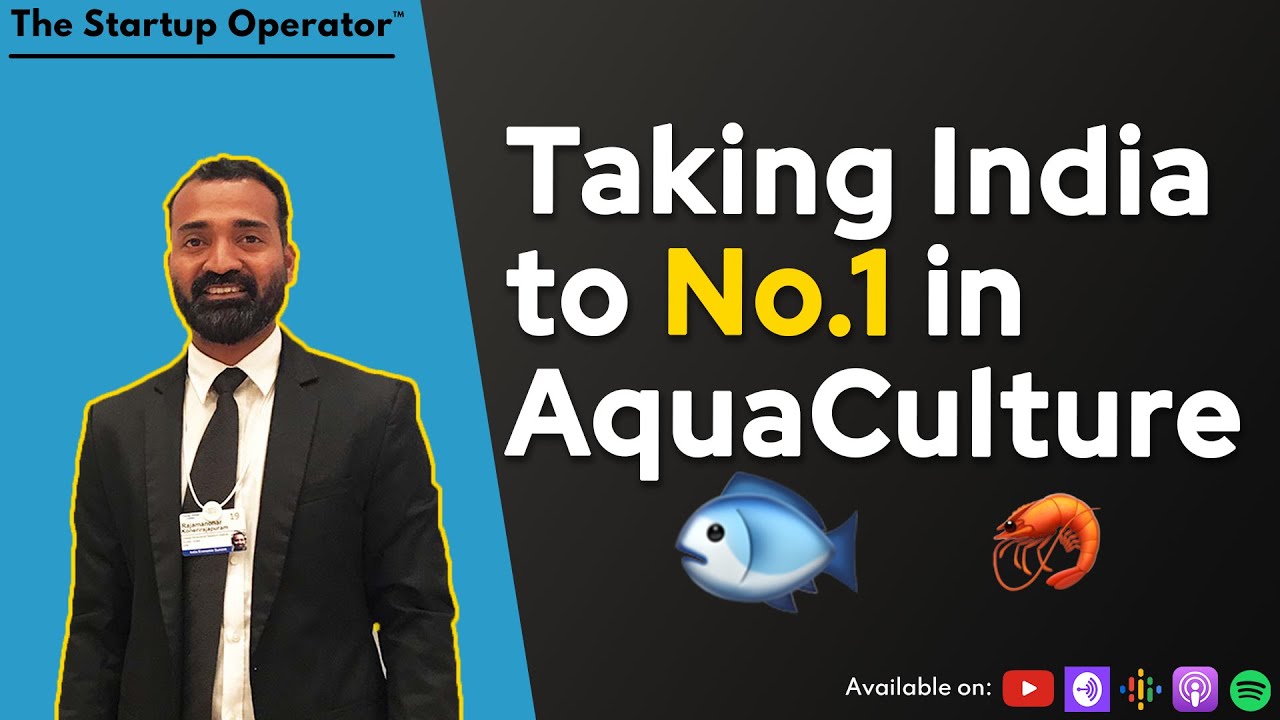
In this episode of the Startup Operator Podcast, Roshan interviews Rajamanohar (Raj), founder and CEO of AquaConnect, about the massive yet fragmented Indian aquaculture sector. Raj outlines the market’s scale – India is the world’s second‑largest aquaculture producer, generating ~14 million metric tons of fish and shrimp annually, worth $25 billion, and exporting $7 billion of frozen shrimp. He describes the ecosystem’s challenges: a huge number of small‑holder farmers, lack of data‑driven decision making, opaque middlemen, limited access to quality inputs, financing gaps, and weak last‑mile distribution. AquaConnect’s response is a full‑stack platform that links farmers, input‑aggregators (Aqwa Partners), and buyers (Aqua Bazaar) while providing advisory, financing, and a marketplace. The company employs a hybrid data strategy – “boots on the ground” mobile apps for non‑intrusive transaction data and “eyes in the sky” satellite remote sensing to monitor pond health. Raj explains how they overcame low adoption by avoiding intrusive data entry and leveraging existing farmer transactions. He details the multicultural, multilingual team structure, the focus on farmer‑facing and technology teams, and the current North Star metric of scaling technology to accelerate expansion. Funding is pursued via debt to finance working capital for partners and post‑harvest value‑chain growth, with equity still an option. Raj shares advice for newcomers: understand the entire value chain, address financing and traceability, and explore opportunities in cold‑chain, productization, and domestic market segmentation. He also recounts his own journey from mobile‑value‑added services in Africa to aquaculture, driven by serendipity and a desire to democratize technology. The conversation closes with book and podcast recommendations.
Chapters
The last mile distribution is still a challenge in India for the seafood. So like in West, you do not have all these, you know, filleted fish or like different productization. So there is a huge opportunity for the domestic market for fish and shrimp in India, which is yet to be explored. And I would invite some of the brightest minds to think about a domestic market angle.
Hello everyone, welcome to another episode of the Startup Operator Podcast. On this episode, I'm talking to Raj, who is the founder and CEO of AquaConnect. AquaConnect is, you know, plays in the fish and shrimp cultivation ecosystem. They're streamlining this very fragmented ecosystem with technology and financing. As Raj says, they have boots on the ground and eyes in the sky to ensure that, you know, market linkages are established. And there's enough data to mitigate risks on financing and so on and so forth. Again, they're very thoughtfully building out a full-stack solution for this ecosystem. It's something that we've seen with the likes of, let's say, Zetwerk, OfBusiness, Reshamandi, and the likes, right, where people are going beyond just a managed marketplace and layering software automation and financing and really solving 360 degrees of the solution, right? I mean, of the persona, really. So yeah, this was an interesting conversation about a domain that we don't know too much about, and I certainly enjoyed it. So yeah, I hope you find it interesting. I hope you like it. Hey Raj, welcome to the Startup Operator Podcast. Thank you so much for making the time.
Thank you for hosting me, Roshan. It's a pleasure to be here with you.
Yeah, I've been looking forward to this chat for quite a while. Again, thank you so much for your patience. You operate in a very interesting domain, and I don't think people really know much about this. So I would love to understand about the domain, right? Fish and shrimp cultivation. You know, what is the market like? What is the ecosystem? Who are the stakeholders? What are the challenges they face? And yeah, more importantly, why did you decide to operate in this space?
All right. Yeah, as you rightly pointed out, this is a niche of the niche sector, right? Like agri used to be considered a niche. Now, like there are like many agritech companies are upcoming and some of them have already become a unicorn too. So in the food production valuation, yes, fisheries is upcoming. And aquaculture is nothing but growing aquatic animals like fish and shrimp in a controlled pond. So India is one of the major aquaculture producers. It might be surprising to many of us that we are the 2nd largest aquaculture producers globally. And we produce close to 14 million metric tons of fish and shrimp every year. And this whole value chain is worth about $25 billion.
Wow.
In India alone. And there are some interesting facts that I can further share, that India is the largest exporter of frozen shrimp to the world as well. So we are exporting close to $7 billion worth seafood every year. This industry is that big, and there are about 5 million aquaculture farmers who are undertaking fish and shrimp aquaculture. And globally, we are contributing about 1/6 of, you know, production. So this market is that massive, and we are one of the largest aquaculture producers globally.
Right. So, you know, I've spoken to a couple of agritech founders, more than a couple in fact, and, you know, when you look at agritech specifically, right, there are just so many challenges that are ripe for, you know, solving by technology, right? I mean, whether it is market linkage, whether it is data, whether it is software automation, you know, supply chains, so on and so forth, there's just literally like a plethora of problems that you can solve for. And so when you look at it from the outside, I mean, it seems like so lucrative, right? What are those 2 or 3 insights that you realized once you started operating that was kind of counterintuitive for you?
So let me share our experiences here. Like, what were the challenges that we set out to solve and where did we end up, right? So one thing is like, one of the, like I jokingly say that the farmers are already using AI. I mean ancestral intelligence, right? Whenever I walk into a farm and the farmers, you know, I mean, many times I've heard saying, it's like my experience is your age, right? So that's the kind of response that we get when we talk about technology to the farming community, right? So people seem to have already, you know, learned many things by, you know, practicing. But at the end of the day, there are like much room to improve the practices. And in my view, the biggest impediment for any development is lack of data and lack of data-driven decision-making capabilities. So with the data, you would be able to first identify the problem. So the moment you identify the problem, then there could be like many solutions that we can, you know, come up with. But unfortunately, in many of the sectors, traditional sectors in India, including agriculture or aquaculture, so there is a lack of data. And we set out to, you know, solve that problem in first place. And we seem to be like achieved a fair amount of success in the last 5 years.
Right. But it also is a complex system, right? I mean, there is no perfect information as such, and there's just too many variables involved. So how do you sort of standardize all of these things and make it kind of like a control system for you to look at data and then hypothesize based on that?
All right, so let me quickly walk you through how this aquaculture activity is undertaken here. Like, so in the West, I had traveled to, you know, Norway. I had traveled to many other Western countries who do aquaculture. So there, the demography is completely different. So when you talk about Norway, there are very few corporate entities who are into aquaculture. And when you talk about aquaculture, they are like vertically integrated. So they start with their breeding program. They have their own hatcheries. They have their own nurseries. From the nurseries, they'll take it out to the ponds, which are the marine cages, and then they have their own harvesting systems. So they have the processing plants and it's kind of highly vertically integrated. So there is a, you know, a fair amount of traceability that exists in the system and the data has been generated at each and every point. So it's much easier to tame that kind of a system compared to what we have in emerging geographies like India or Southeast Asia. So here we have got different set of problems. We have like the demographic challenge, such as like we have got like huge number of small and medium holding farmers. So the standardization becomes like much difficult in our geography. So this is when we need to, you know, go with AI plus AI, that is like our ancestral intelligence with artificial intelligence. So we need to go for a hybrid model. So that is when in AquaConnect initially we used to, you know, come up with pure tech solutions for the farming community. Over a period, we realized that like you gotta, you know, capture the imagination of the farmers. So, I mean, we need to, you know, create usable systems and we need to use community engagement model. On top of that, you need to be like bringing in technology solution. Then that comprehensive omnichannel approach really works well with Bharat.
Right. So I'd love to understand a lot more about the communication, but before that, I mean, I think we're at a point in the conversation where it's useful to let people understand what Aqua Connect is, right? So what is Aqua Connect today, you know, and And what are some of the common use cases that you're serving?
Sure. So before that, I'll quickly, you know, walk you through how aquaculture is done in India. So that gives a context, or, you know, people can imagine how it is done here, right? We get seafood largely through 2 sources. One is aquaculture, that is commercially produced, farm-fed, you know, seafood. And the other one is marine caught. So as we say, like, the large chunk of our seafood, about 75% of seafood that you are eating in India, is coming from the So the way it is done here is the shrimp and fish farmers, they go to a hatchery, they buy the fingerlings or post larvae, that is baby shrimp and then baby fishes. Then they take it to their ponds. Typically a pond is of 1 acre in size and it would have like 4 to 5 feet deep water into it. So they then stock them up in the pond and they grow them for about, you know, 5 to 8 months of period depending upon the size of the you know, harvest that they would like to, you know, achieve. During this period, there are certain, you know, parameters that you need to undertake and monitor and then take care of. The first one is water quality. The second parameter is feeding efficiency. And the third part is like animal healthcare. So if you are growing these fishes and shrimp in the water, you need to, you know, monitor the water quality, like, you know, what is the dissolved oxygen in the water, amount of dissolved oxygen in the water, And nitrate, nitrite, and then salinity, alkalinity. So there are about like 10 different parameters one have to look for. And the second part is like feeding efficiency. So 60% of the cost of culture goes into feeding the animals. So you have to control the efficiency of the feeding so that like you can get good returns out of that crop. And the third part, the animals are like babies, they can catch diseases anytime. So you have to provide enough, you know, healthcare supplements, minerals, so that like We would be able to, you know, keep them healthy in the pond. So once this is done, like you, you do the farming for about like 5 to 8 months period, then you'd have to take it to the local markets through the middleman. So this is how this large, you know, value chain operates. So there are like middlemen in every transaction points. So they are the ones who would be like creating opacity between the layers. So as I mentioned before, since this is not vertically integrated, so that is when the middlemen are the one who would be like creating challenges in terms of transparency. Further, I would be able to, you know, walk you through what are the problems that we are solving here. One is for the farmer, he's looking for, you know, scientific advisory on how to improve the water quality.
How do—
how does he, you know, how can he improve the feeding efficiency? And further, how can he improve the health of the animal as well?
Right.
And there are like, he has got business level challenges. So these are the business level challenges and there are like underlying financial challenges. So most of these farmers do not have access to formal capital. So they depend on the informal lenders. So typically they will— the cost of capital is very, very high. So to start his farming activity, he's looking for some kind of a capital. And then further, when he is harvesting, he has to, you know, provide it to the middleman, and middleman takes about 2 to 3 weeks to pay them the harvest payment. So, so these are the inefficiencies that are existing for the farmers. And also, there are issues on accessing quality inputs such as like, you know, feed, healthcare products to groom the animals. So these are some of the challenges that the farmer has got. And as I told you before, 60% of, you know, cost of culture goes into feeding the animal. So there is a, you know, retailer network that provides the fish feed and shrimp feed to the farmers. And these are the village-level entrepreneurs. So they have certain challenges like aggregation of multiple farm inputs and healthcare products. So that becomes a major challenge. Challenge for them, and also they had to work with multiple companies, corporate entities. So it's very difficult for them to you know aggregate it at one place. And further, there are like working capital challenges for the input providers as well. And if you kind of move further down the line, we have got buyers. So as I told you, India is one of the largest exporters of seafood. So they are looking for sourcing assistance on the ground. So the middlemen are the one who are creating opacity. That is the negatively impacting the quality and pricing like of the seafood. So that is when we have like challenges on, you know, accessing the traceability and transparency of the sourcing processes as well. And last but not the least, even the buyers have got working capital challenges to expand their businesses, right? So to sum it up, each of the stakeholders have got a business level challenge and they have got financing challenges as well underlying. So we are set out to, you know, solve these challenges for the stakeholders by providing business-level interventions as well as financial solutions to them.
Right. So that's a whole plethora of problems that you're solving, right? I mean, you're truly building a full-stack solution with software, marketplace, and financing solutions, right? This runs counter to some of the startup advice you generally hear, which is that, you know, you focus on one thing and you focus on that niche and you do really well and then add things to that, right? But what has been your experience? Why was there a need to solve all ends of the problem from the beginning itself?
All right, so we are a full-stack aquaculture platform. So let me tell you where our focus lies, right? So we are solving a farmer's problem at heart and by enabling the players around them, right? So as I told you, the farmers have got a lack of access to the scientific farm advisory. They have lack of access to the inputs, they have lack of access to the financing. And finally, when they are selling their harvest, they are not able to, you know, command the price that they want. So we are solving this problem by knitting the other value chain stakeholders together. And on the farm side of the business through the Aqwa partners. So we have, you know, enabled network of Aqwa partners who are our franchisee stores. And the Aqwa partners are the one who are enabling access to the quality inputs to them, and we have upskilled the Aqua Partners to provide scientific advisory to the farmers. And also, these are the ones who would be able to enable financing solutions to them as well. So farmers are getting all such, you know, solutions from my Aqua Partner. And on the downstream, again, I'm enabling buyer to buy it directly from the farmers through my Aqua Bazaar intervention. So it is a farmer-focused solution, but we are enabling the enablers like aqua partners on one side and the buyers on the other side. For aqua partner and the buyer, I am solving different set of problems. That is like for an aqua partner, he needs to aggregate all the farm-level inputs. That's the one challenge. And he is also looking for financing. So through the retailer channel financing solutions, I'm able to provide the farm input aggregation as well as financing that input. On the downstream value chain, the buyer is looking to expand his business. He's looking for quality sourcing, and he's looking for transparency and traceability of the seafood that he's buying. And finally, to expand his business, he's looking for financing solutions. Here I'm kind of, you know, knitting it together so that like I would be able to solve problems of different stakeholders through Aqua Connect's platform.
Right. Yeah. So if I'm hearing this correctly, I don't think you can solve any one problem in isolation, right? I mean, if you increase the yield, I mean, the obvious next thing will be that, hey, I mean, what do I do with this? Like, how can I get the best price for this? And so on, right? I mean, and so on throughout the end-to-end ecosystem per se, right? Slight deviation here. I mean, you're solving this persona, right? For this persona, the person who's cultivating fish and so on. Right. So do you have like a background in this? I mean, did you, do you come from a family that perhaps owns farms or something like this? Or, you know, were you someone who had no background in this and then dived headfirst and kind of realized everything? I kind of think it's the latter, but I would love for you to let us know, you know, what was your experience like understanding this persona?
Sure. So before commenting on that, like, I'll go back to your previous question, probably like I kind of liked the way you put it. So most of the people think that when you are bringing sustainability to the farmers, they would like you to, you know, go to the farmer and address his, you know, like whether you are improving his production, whether you are improving his yield, all such things are, you know, coming in. So I kind of, you know, try to, you know, take a step back and then, you know, I would want to, you know, think that you cannot solve this problem in silos, right? We need to be thinking about bringing efficiency to the value chain. So bringing efficiency to the value chain by disrupting the other stakeholders positively and bringing finance so that you are bringing in the efficiency. And eventually this would trickle down and then improve the farmer's life. So I, in my opinion, the sustainability should be looked at, you know, by transforming the entire value chain rather than looking at like one part of the value chain. So I guess you summed it up really well. Coming to the, you know, second question, how I ended up doing this. So it is pure serendipity. I used to run 2 tech startups before Aqua Connect. So I was into mobile technology space. I was running a company before that was into providing mobile value-added services to the operators in both Asia, Africa, as well as Southeast Asia. So at one point of time, we were running services in close to 10 different markets in Africa. So the mobile value-added services domain have given me a kind of an experience in how to package the technology efficiently as a product to the masses. Like it's something like they have learned it from the FMCG sector that how do we, you know, make some small sachet kind of products so that it goes for a mass consumption. So I was at the time where the mobile pocket internet has been introduced from the 2G. When we moved to the 3G, people have started, you know, selling internet as like a pocket internet, like for like ₹10 per day, like, or like, you know, $1 per month, that kind of, you know, subscription. So that is where I learned how technology can be democratized for the masses, right? So still it is in a very sustainable way. Like you are still earning by providing that packets of data and then you are not calling them as like internet. You are calling them as like, you can download songs, you can download video, you can download—
End use cases basically.
The end use cases. So that kind of really inspired me to create technology solutions for the masses. So, and again, like every good thing has to, you know, end and technology ends very soon. Like we were providing mobile value-added services and eventually the 3G, 4G has come. So we have shrunk as a data pipe. The mobile operators have shrunk as a data pipe. So everything has, you know, gone OTT. And I was like looking for some, you know, green pastures. And this time, you know, farming sector caught my attention. And to answer your question straightforward, like I do not have any experience in aquaculture before I entered here into aquaculture. So I was like, you know, in 2015, I believe, like I was heading to my hometown in a train and that's when I met an aquafarmer, right? So I was thinking that I would do broadly something in agri-value chain, but this is some niche sector that caught my attention. I started, you know, chatting with them. I got to understand a little bit more about this sector. I initially thought that this is a kind of a cottage industry wherein like people would own up a small pond, they'll do a little bit of fish or shrimp aquaculture and they would consume it locally. But then when I got to speak to him, I got to understand that there is a huge export market. India is one of the largest exporters. And I went back and I did my own research. I got to understand that this is one of the, you know, upcoming sectors. And this sector is considered to be a sunrise sector by Government of India as well. So it fits really well in their mandate of improving the farmers' income. So here the sector grows in 2 digits every year. It's like 10% CAGR, I would claim, in the last decade. And this is growing faster than our GDP. So that is when this is considered to be a sunrise sector. So that's how kind of, you know, I got interested and I started doing my research and I found that these are the challenges that existed. So I would just sum it up that every value chain has got some challenges like, you know, You know, transparency is amiss, and then the market linkage is another challenge. And underlying, there is a financing challenge as well. So we set out to solve these challenges in 2017, and it's been 5 years I'm into this journey.
Awesome. That's awesome. So as a typical tech guy, right, I mean, you're obviously very excited about all of this technology and stuff. And now when you take technology to these farmers, right, As you mentioned, you know, I mean, there is this whole gap, right? I mean, they're talking about ancestral intelligence, you're talking about artificial intelligence. And so, I mean, the way you communicate with these folks is really critical, right? So how did you sort of deliver that message to these folks? I mean, how do you let them know that, you know, they can kind of trust you with their livelihoods?
Sure. So, okay, we used to go direct to the farmers and when we set out to transform this industry, we thought that we should be, you know, providing solutions to the farmers. Like we first created a close to a farm management platform, right? So that can be accessed through a mobile phone and we were doing pilots. So that's when we understood that like it's kind of difficult to change the practices on the ground when you're asking farmers to, you know, change their behavior or way of life. So the first day they're really excited to see that like they would be able to, you know, get data-driven advisory and everything. But over the period, the adoption was really, really low. So that's when we understood that we have to, you know, go along and create solutions that can be really, you know, accepted and then scaled as well, right? So the best way that we found is like non-intrusive. Like when you want to, you know, change farmer's life, do not ask them to, you know, work more on that kind of a solution. So what we had created is like we had created non-intrusive data collection methods through the transactions. We are capturing the data. And I would say that like we are now adopting 2 strategies to like, we have a hybrid strategy in place. One is like technologies that is like having like boots on the ground, like for each stakeholders we have provided a mobile application so that like they would be able to transact with us. That's at one level. And we have got another layer in the sky. So it's like boots on the ground and eyes in the sky kind of a comprehensive strategy that we are working on. So there are certain data points that we are collecting from the farmers non-intrusively. We are not, you know, asking to, you know, provide any input. The moment you ask them to, you know, input something, there is a very less, you know, adoption for such kind of a solution. So that's one part of the solution. And the second part is like, we are also, you know, using satellite remote sensing in a very innovative way. So we are one of the pioneer technology players who are using satellite remote sensing for getting more intelligence from the aquaculture ponds. So for agriculture, there are like many satellite remote sensing companies that are working on at the data analytics layer. Because everything is above the soil, it's much easier. For aquaculture, we have got like different set of challenges. So everything is underwater here. So that's when this problem gets much more complex. So you need like boots on the ground as well as eyes in the sky. So that's when you'd be able to, you know, create a comprehensive data analytics strategy and through which we'd be able to, you know, get an insight. And that could be used for different use cases in this value chain. Something like, you know, how do I do the demand generation for my aquaculture partners? How do I do demand generation for the buyers? With a click of a button, a buyer can understand like in ten kilometers who are the farmers are there and what is the you know date of culture when they may probably go for harvesting. So these are some of the insights we can you know provide. And last but not the least, as I told you, aquaculture is one of the you know complex sector for the banks and financial institution to enter into because they haven't found a robust way of doing the risk mitigation. Since everything is underwater, how do you do the, you know, underwriting efficiently? So that's when they are looking for a player like us so that like we would be able to, you know, provide intelligence in terms of like, like in terms of origination, in terms of underwriting, dispersal, in terms of collection, and finally like complete portfolio management for such players.
Right. So how are your teams structured today? You know, I mean, I would assume that there is a marketplace team, there's perhaps a team working on financing and so on, right? How are your teams structured at AquaConnect and what is the North Star metric for you at this point in the journey?
Sure. So see, we are a multicultural, diverse, and multilingual team. So as you know, like India is vast geography and people speak different language and they follow different culture. So the understanding is like to, we need to be like as close as possible to the, you know, farmers. So that's when we focus more on diversity. We focus on more on a multilingual workforce on the ground. And as we are providing omnichannel services, so there is a huge farmer-facing team and there is a huge technology team that develops whatever that I talked about. Like we are developing high-end technology for this sector that does both data analytics as well as satellite remote sensing part.
Right. So you've chosen to raise debt funding right now. I mean, you've raised $8 million. Any reason why debt and not Conventional equity as such?
Well, so like equity instruments, yes, of course, we are always, you know, as you know, like as startups, that option is always open. But this debt round is to, you know, to expand our Aqua partner network, provide them, you know, working capital. And also like we are expanding the post-harvest value chain, right? So this is when we are like looking for debt fund to fulfill the working capital requirement. As we speak, we are raising further rounds as well.
Right. And what are some of the high-level challenges that you're solving for right now in the business?
So largely, this is about, you know, developing the right technology for this sector. So that's one of the, you know, high-level challenges that we are working on currently, because the moment you create a, you know, strong technology You would be able to scale faster. These are some of the points that we are at this moment focusing on. And also there is a, once you create the scalable solution, the expansion becomes much easier.
Right. So for someone who's listening to this and is keen on getting their hands dirty in this space, right, and perhaps building a solution, what are some of those insights that they should be aware of? What are some nuances of operating in the space? What should they be aware of before entering the space and starting a business?
All right, so you are inviting more competitors into the space.
You already have a head start, so if anything, they'll build the market out further for you.
No, of course, we kind of— the competition keeps you alive. And as you know, like, it is one of the, you know, upcoming sectors, and this is, you know, growing double digits every year, and it's an exciting space to be. And there are like many gaps that are yet to be, you know, filled in this value chain. So we are one of the full-stack integrators, and there are like many other opportunities that lies in this value chain, like, you know, cold chain infrastructure that is there because like we are dealing with like perishable goods here. So we can talk about like the new age technologies for developing cold chains. And further, we can talk about, you know, merchandising all the products that we are making So the last mile distribution is still a challenge in India for the seafood, right? So like in West, you do not, you know, do the— you do not have all these, you know, filleted fish or like different productization. That never happens in India. So there is a huge opportunity for the domestic market for fish and shrimp in India, which is yet to be explored. And I would invite, you know, some of the brightest minds to, you know, think about That domestic market angle.
Right. And perhaps join our Aqua Connect team as well, right?
Of course, we would always invite you.
Awesome. So Raj, before we end the podcast, any books or podcasts that you would recommend to our audience?
Well, like, see, I kind of like this, the Startup Operator podcast, right? That's one thing that I've been recently following. And apart from that, like, see, I like books in terms of Anthropology, neurosciences, marketing, and psychology. So like I read this recent book called like The Power of Habits by Charles, and there is another book called Thinking Fast and Slow. Probably like this has been like discussed 1,000 times. So I like both the books and largely otherwise, like I talk about, you know, Zero to One, The Lean Startup, and Hooks. So these are some of the, you know, very well discussed, you know, books. Awesome.
So thank you so much, Raj. Thank you for being on the podcast and making time for this. This was certainly an interesting conversation, you know, very interesting space as well, right? I mean, not too many of us understand the space really well, and hopefully we got plenty of insights from this. So thank you again.
Hopefully that was very helpful to your audience as well, Roshan. So thank you very much for hosting me once again.
Thank you so much for listening. If you liked this episode, then don't forget to subscribe to us on your favorite platform. And share this episode with all of your fellow startup operators. Also follow The Startup Operator on LinkedIn and Twitter for more updates. Stay safe, take care, and see you soon on a brand new episode of The Startup Operator.
More from Rajamanohar
CIAC Conversations: A Conversation with Raj Somasundaram, Founder and CEO of Aquaconnect

Aquaconnect raises $15 million in #SeriesA amid funding winter. Rajamanohar, CEO shares future plans

Aquaconnect's Rajamanohar Somasundaram Exclusive On The Outlook For India Aquaculture Market

How can AI help transform the seafood value chain? | Rajamanohar, CEO-Aquaconnect
Rajamanohar Somasundaram - CNBC interview on Aquaculture sector's Challenges and opportunities