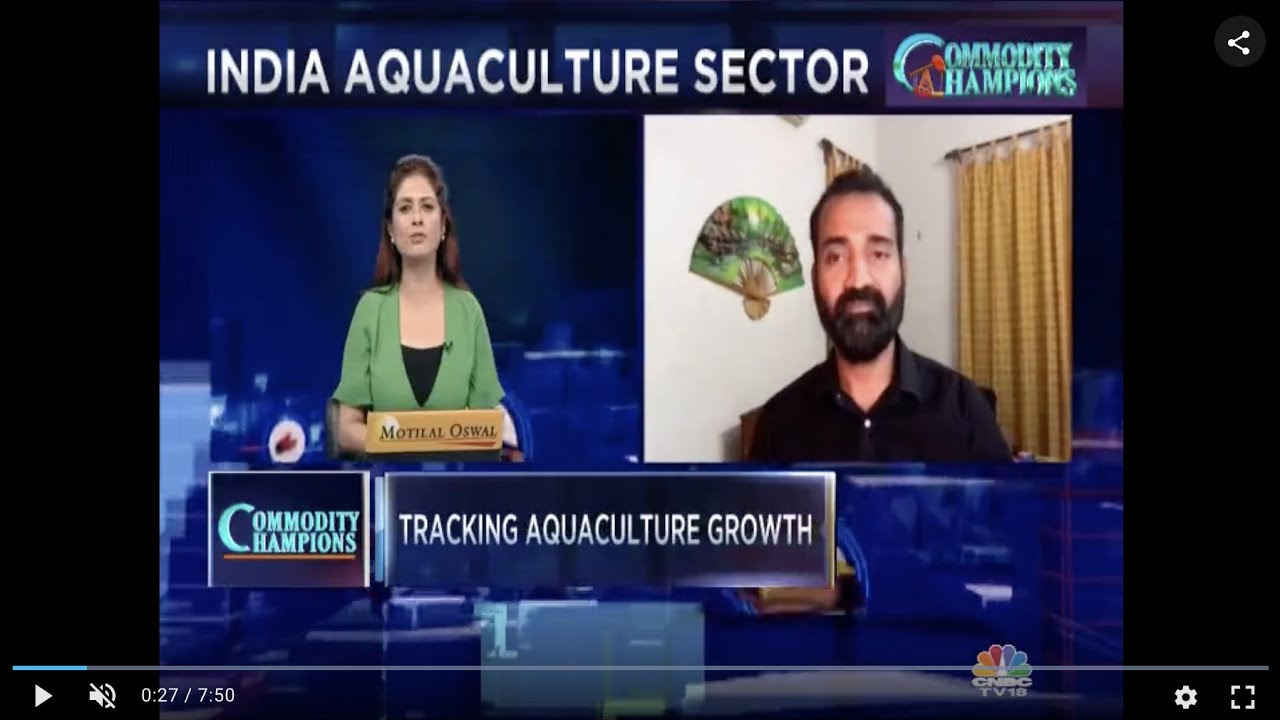
In this presentation, Rajamanohar Somasundaram, CEO of Aquaconnect, outlines the company’s full‑stack aquaculture technology platform aimed at improving productivity for shrimp and fish farmers in India. He describes how the platform combines on‑ground farm management tools, satellite remote sensing, data digitization, planning and predictive analytics, and market linkage to address key challenges such as high feed costs, water‑quality degradation, low farm‑gate prices, and limited access to credit and insurance. He contextualises the sector’s scale – India ranks second globally in fish production and its seafood exports were valued at $7 billion in 2018, with frozen shrimp accounting for 69% of that value – and highlights the sector’s heavy reliance on export markets (≈95% of shrimp). The COVID‑19 pandemic exposed vulnerabilities in logistics and demand. Somasundaram explains that a typical shrimp farm must monitor 50‑60 parameters, which he groups into four categories: water‑quality management, feed‑conversion‑ratio management, growth management, and health management. Digitising these parameters brings transparency, enabling better decision‑making, planning, prediction, and ultimately market readiness communication. He notes that technology adoption in India and Southeast Asia lags behind Europe and North America, where higher‑value cold‑water species (e.g., salmon) drive stronger unit economics for tech uptake. By reducing production costs, improving traceability, and providing data‑driven risk mitigation, Aquaconnect aims to help low‑value shrimp and fish producers access premium markets and withstand disruptions such as lockdown‑induced logistics bottlenecks.
Chapters
Aqua Connect is a full-stack aquaculture technology company. So we work with shrimp as well as fish farmers to improve their farm productivity by providing them farm management tools. So we are improving their access to credit, access to insurance through various technologies. One such notable technology that we are using is satellite remote sensing technology. With the ground connect that we have and also the satellite remote sensing capabilities that we are processing, We are now able to connect the farmers with the BFSA player. In the last 3 decades, the role of aquaculture in fulfilling the world protein requirements is substantial. And also aquaculture in India witnessed an enormous growth, and so the stakeholders of the industry. India stands second place in fish production, and its seafood exports are valued about $7 billion in 2018. Frozen shrimp is the key contributor to our overall seafood exports. It accounts for about 69% in monetary terms out of that $7 billion. Whereas shrimp output has raised tenfold. So put together in fish and shrimp production capabilities that we have, India's aquaculture market is valued about $7 billion. And then this COVID had happened to the world. So, so that, that has had a major impact on our, you know, aquaculture sector. Unlike Indian agriculture or dairy, there is, and there is a disproportionate dependency on the export to overseas market. 95% of our shrimp production is being exported. Most of the shrimp importing nations too are locked down due to the COVID-19, as you would know. The implications are you are spending a lot on feed, and also since you are throwing more feed into the water, that is the small pond that you have, it also pollutes the pond. So eventually your pond creates more ammonia because the feed that you are throwing into the water, it is not being consumed by the fish. So this feed is turning into ammonia and it reduces the oxygen in the water. The biggest impediment for any development of any sector is, I would consider the lack of technology adoption, the lack of reliable datasets. to make an informed decision. So that is what's happening in Indian farms right now. So what our solution helps farmers is to provide technology to be able to have a better farm management practice. So our tool is considered to be a farm management application on the ground, which is helping farmers to improve the water quality management of their pond. to improve the feed conversion ratio management. And also it is helping them on health management of these species as well. So let's take an example of a shrimp farmer, right? So a farmer, to become a successful shrimp farmer, one has to manage about 50 to 60 different parameters. So largely, you can put all these 60 parameters into 4 categories. The first category would be water quality management. So it's something like we are living here and there is an air around us, and air has got a composition. So when it has got the right composition, you'll be able to breathe it. Breathe. So the same way, when the fish is in the water, you need to be providing the right environment for the So the water quality, you know, gets a major critical importance in this, like feed conversion ratio. The third part is growth management. You need to understand how much of feed that has gone into the pond. What is the growth ratio, right? Category would be health management. So the shrimp would be getting a plethora of, you know, deficiencies. And diseases relevant to that. So one has to be able to make a note of like what is going on into the anatomy of the shrimp. See, the first part is digitizing the farm management. So by digitizing, you are bringing in transparency into this, in your operation. By bringing in transparency into your operation, you can now take decisions better. So the first part is digitizing. The second part is planning. And the third part is predicting what is upcoming. And the fourth part is linkage to the market because your data can now be put to use. I can tell the buyer that this farmer will be ready in 2 weeks for harvest. These are the upcoming technologies the whole Southeast Asia hasn't picked up as well as— I'm talking about India as well as Southeast Asia. Compared to India and Southeast Asia, we are still behind. Southeast Asia is still doing better and their yield is better and their technology adoption is also getting higher day by day. I would place the forerunners as European players and North American players. And also their unit economics supports the technology adoption. So we are talking about cold water species in Europe and North America. When we talk about Southeast Asian aquaculture or Indian aquaculture, we are talking about shrimp aquaculture and a low value fish. So salmon fetches more than ₹2,000 per kilogram, whereas shrimp would only fetch ₹400, ₹450 per kilogram at the farm gate. If you're talking about fish aquaculture in India, we majorly farm IMCs and catfish. IMCs are known in the name of katla, rohu, and mirhal. So these fishes fetches the, you know, farmgate price anywhere between ₹90 to ₹120. what is expected as of now. And, uh, so in those conditions, how a farmer can mitigate the risk of, you know, getting into losses? Because he's gonna get one, he's gonna fetch only the lower rates for his harvest, right? So now a shrimp farmer is, uh, spending about ₹220, ₹220 for for a kilogram of shrimp and he's fetching about ₹350 to ₹400 at the farm gate. So the rates are going to go come down, right? They are going to come down and the way, only way you could improve the production is by having the technology implementation that is actually helping you reduce the cost of production. And the other part is the technology also can help you, you know, improve your product quality because it can help you with the traceability part of the business, right? So worldwide, the traceable products are, you know, getting a premium value in the European as well as North American market, or you talk about any other developed markets that are importing Indian shrimp. So we are talking about 90+ percentage of it being exported to, you know, like US and China and Europe, whereas only 10% is being consumed in India. So we need to now think about how do we actually mitigate such risks of You know, the whole lockdown in the logistics chain, the worldwide logistics.