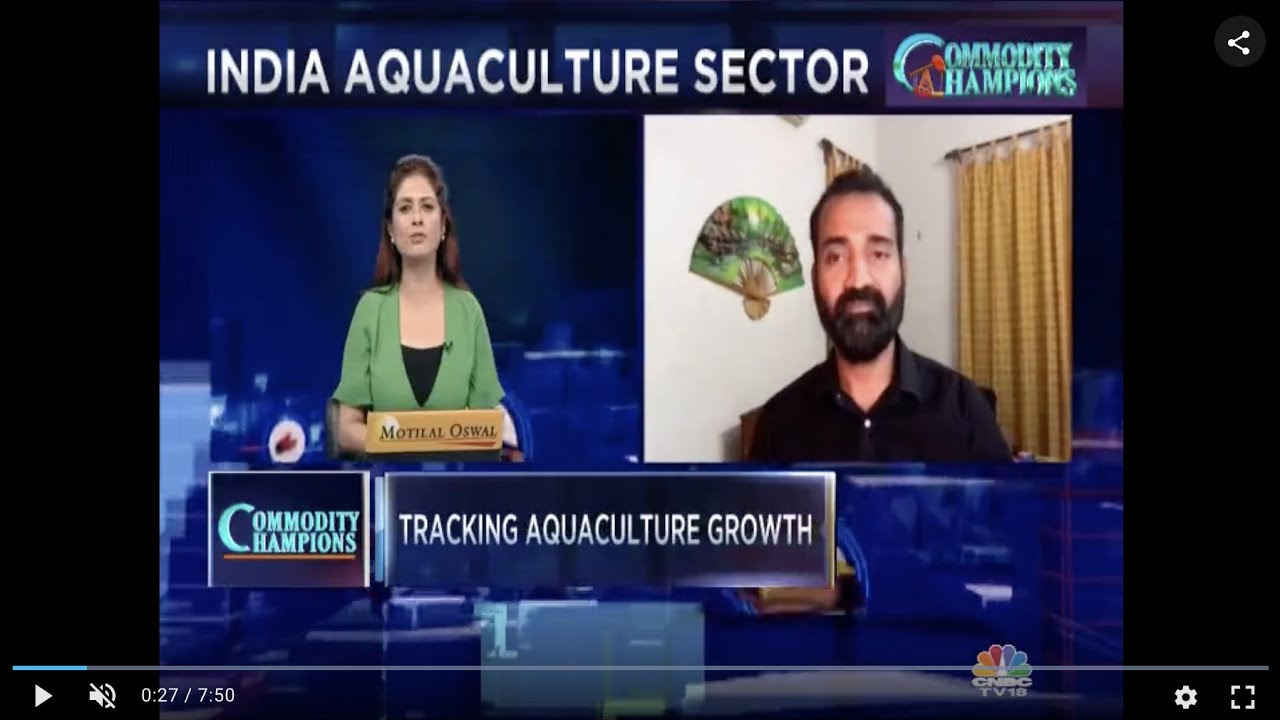
In a CNBC interview titled “Commodity Champions,” host Manisha speaks with Rajamanohar Somasundaram, co‑founder of Aqua Connect, about the state of India’s aquaculture sector. Raj outlines how COVID‑19 disrupted the entire value chain in 2020 – from seed and feed shortages, transport constraints, and worker migration to a sharp decline in shrimp production (about 20%, roughly 620,000 MT) and a collapse in shrimp prices. He quantifies the export impact, noting a $1.2‑$1.3 billion loss linked to a glut caused by reduced Chinese shrimp imports. Despite these setbacks, Raj highlights a rapid digital shift: Aqua Connect’s farm‑management platform saw an 18‑fold increase in users over nine months, signalling broader technology adoption. He argues that data scarcity is the sector’s biggest bottleneck; by delivering farm‑level data intelligence, technology can enable financing, risk‑scoring for banks, and improve traceability, thereby adding value to Indian seafood exports which currently rely on raw material sales. Raj expresses cautious optimism for 2021, hoping vaccination will ease restrictions and allow the sector to recover, provided technology and data‑driven solutions are embraced.
Chapters
Welcome back to Commodity Champions. And India's aquaculture industry grew sixfold over the last 2 decades, but the sector is marred by several challenges including a complex supply chain for exports, ill-fated policies, unregulated growth, and market instabilities. What can be done to address these challenges? To discuss that and more, we are now joined by Rajamanohar Somasundaram. He's co-founder at Aqua Connect. Mr. So, Sundaram, hi, good to have you. What is your sense on how the year 2020 really treated the sector? Because including all sectors, this one as well took a bit of a blow.
Sure. Thank you, Manisha, for having me today. It was a tough year for the sector. COVID-19, which has left no sector untouched, has affected the fisheries sector too. We felt the tremor across the value chain from the production, processing, to exporting. At the production side, some shortages of seeds, feeds, and related aquaculture items have also been reported due to the restrictions on transportation and travel of personnel, with particular impacts on the aquaculture industry. Further, cancellation of international flights meant that SPF broodstock for seed creation could not be brought in throughout April, right? Government of India did a splendid job of arranging chartered flights to transport the broodstock to India so the hatcheries can produce feed and, you know, provide it to the farmers. While many of the challenges were eventually resolved, one of the issues that is having a lingering effect is the shortage of workers. Many working in the sector predict that India's shrimp production would decline by about 20% To about like 620,000 metric tons in 2020. On the demand side, we had other challenges. So we went into the lockdown in late March 2020 to contain the coronavirus pandemic. Many farmers panicked, harvested their shrimp, while shrimp processing plants facing cancellations and postponement of purchase orders, possibly shutdown of the factories, and migrant workers returning to their homes, had challenges in receiving the harvested shrimp. As a result, Shrimp prices crashed too. Shrimp and fish commodities that are highly dependent on international trade suffered quite early in the development of the pandemic from the restriction and closure of the global markets. Whereas the fresh fish and shellfish supply chains were severely impacted by the closure of the food service sector, we call it Koreka, right? The processing sector also faced closure due to the reduced and lost consumer demand. So this has a significant impact, especially on the women who form the majority of the workforce in the post-harvest sector.
Absolutely.
Further, the reduction in the shrimp exports from China created a glut in the international market and would probably mean a loss of about $1.2 billion to $1.3 billion for the Indian sector in 2020. But the silver lining of COVID was the increased technology adoption across the value chain. In the past nine months, our farm management application users grew about eighteen times. So this is one of the first hand proof of the digital transformation that is happening in the sector.
Absolutely, Mr. Som Sundaram. I I just want to come back to some numbers yet again. So while of course this year hasn't been so great, but what has been your sense? What kind of export numbers do we usually see? Because when you look at the export report card, you know. Fisheries, marine and seafood aquaculture really is a big part of that. So what have we seen in sense of growth? How would you put the numbers in this year, and are you expecting a pickup as we move to the new year?
Um, okay, to answer your first question, yes, a larger chunk of our seafood exports come from aquaculture industry. Uh, last year we posted about $7 billion worth seafood exports. Out of which five billion dollars came from the farmed shrimp industry and two billion came from the marine shrimp, marine fishes and other shellfish. So what will happen in 2021 will inevitably be marked by COVID-19. So the mood within the industry is quite bleak as 2020 has also been a tough year for us. But we are hoping that vaccination would be able to bring some respite and. We could look for a better 2021. As I mentioned earlier, the reduction in the shrimp imports from China created a glut in the international market. Of course, it had tremors sending in the Indian seafood export industry as well. So we do have a substantial reduction in terms of Chinese export numbers here, and which will only be like be able to pick up once we have the right You know, Soreca sector pick up in the overseas regions.
So, you know, you talked about technology earlier in the show, and it has been important. You have come out with Aqua Connect. You also said that 18% of a gain is what you've seen, or a surge in numbers that you've seen in sense of growth. What is the expectation? How is the response to it? Do you see a lot of industry now attaching to technology-driven work, as it were, especially in this sector?
Of course. Um, so, uh, if you check about the, the aquaculture value chain, uh, there are certain technology interventions that needs to be, uh, implemented at the production. I'm talking about the farm-level automation that needs to happen.
Sure.
So that would improve production efficiency as well as that would reduce the cost of, uh, culture. And eventually, uh, that would provide the data intelligence. With the data intelligence, we will be able to make this industry fundable. So the biggest challenge that we have in this industry is lack of data. In my view, the biggest impediment for any development is lack of data. So the technology can provide you that data and data intelligence. So with this data intelligence, we can bring in finance to the sector, which the farmers lack at this moment. So what we are kind of envisioning to provide in the future as well is you know, creating a risk mitigation solution for BFSI institutions, so with which the banks can understand the risk as well as the risk score of these aquaculture farmers, and eventually they will be able to extend the credit to this sector. So that's one way of, you know, technology intervention that can transform this, you know, upstream of this value chain.
Sure.
But in the downstream, again, the data intelligence can play a major role as The downstream connects with the buyers and seafood importers in the overseas. As the traceability is gaining the importance in the global value chain, India is still lacking that kind of a value addition that is happening towards exports. We are largely exporting the raw materials, right? With the technology adoption, the byproduct would be traceability and transparency. So eventually, such a technology intervention can improve the value addition of Indian products in the overseas markets.
Oh yes, technology and value addition are going to be the buzzwords going forward. In any case, a lot of stuff has moved online, and clearly at a lot of levels aquaculture has taken a hit in this year, whether it has been because it has— it is a perishable commodity. Also transportation, manpower, and various other things haven't really helped the sector. But as Mr. Somasundaram pointed out, that next year perhaps could be a game changer. Thank you so much for taking time out for us. Well, that's all about the aquaculture sector.