Futurelab Weekly Webinar: Core-How to start the process and establish who/when/what/how you will ask

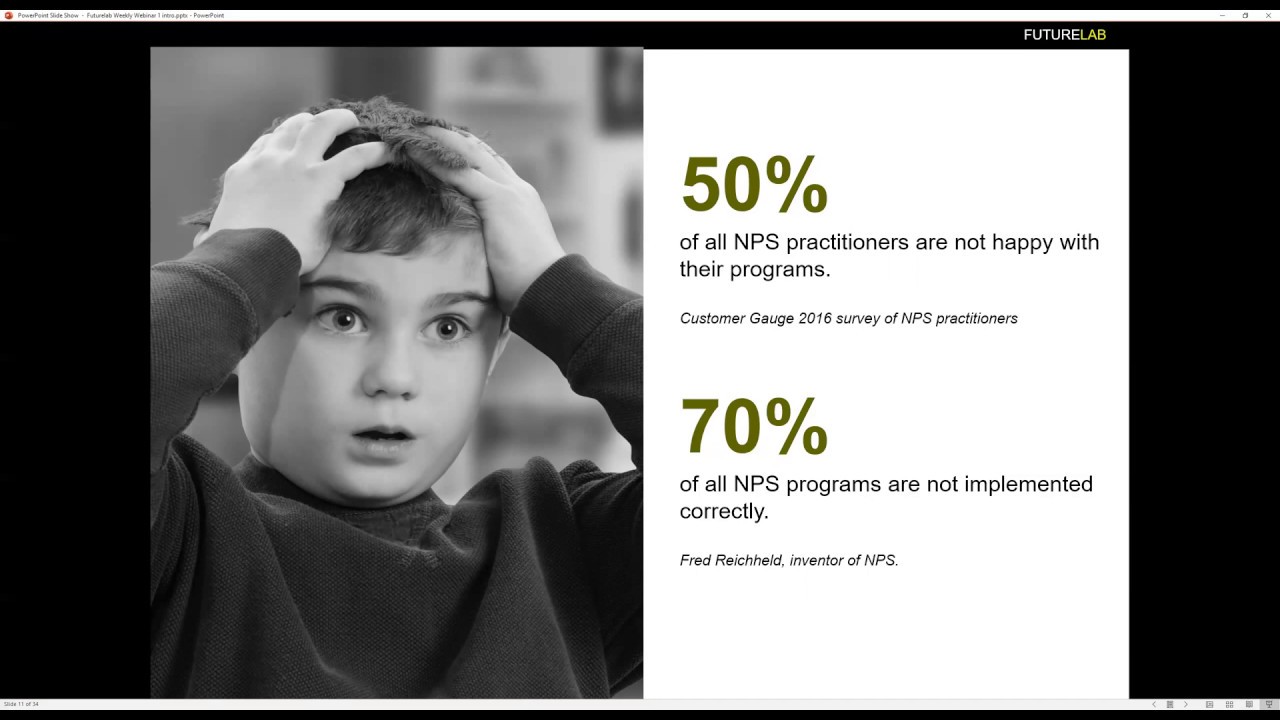
Stefan Kolle explains how to launch a Voice of the Customer program by mapping who to ask, when to ask, what to ask, and how to ask. About 90% of companies fail at VoC because they collect too little or low-quality feedback. He warns against exclusion rules that cut out 80% of your customer base and recommends short, adaptive surveys across channels like WhatsApp and QR codes.
Chapters
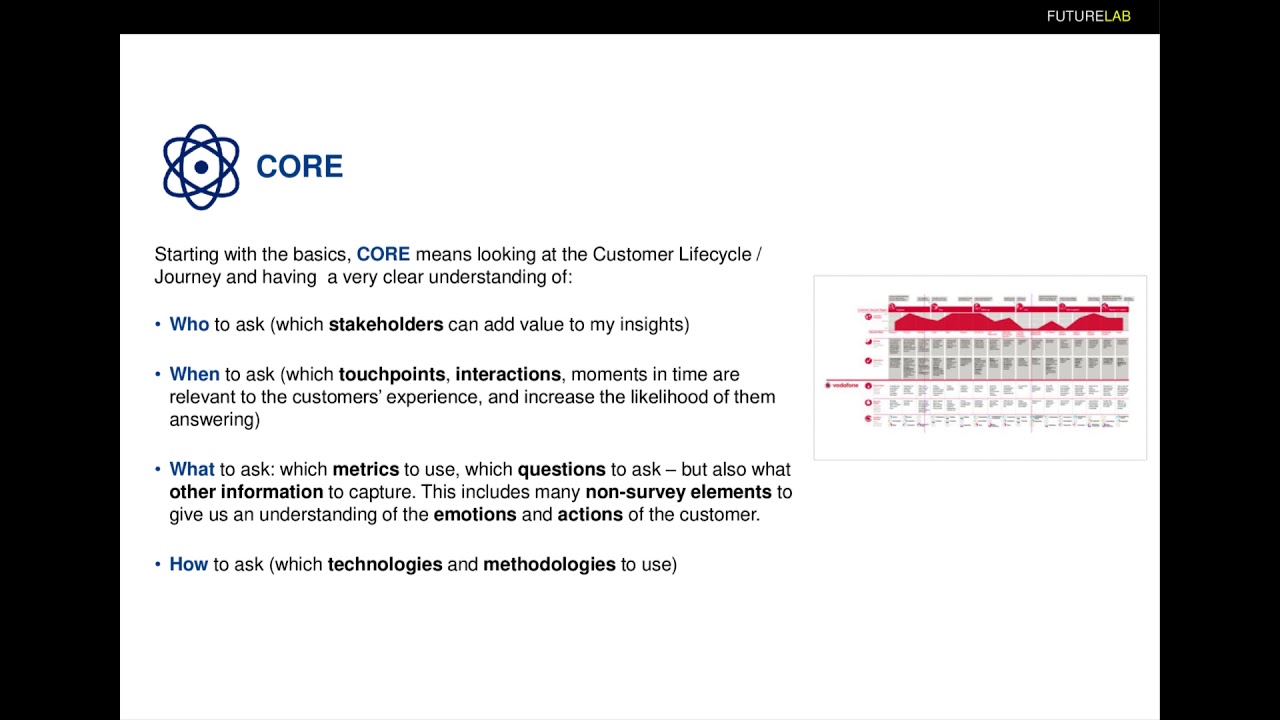
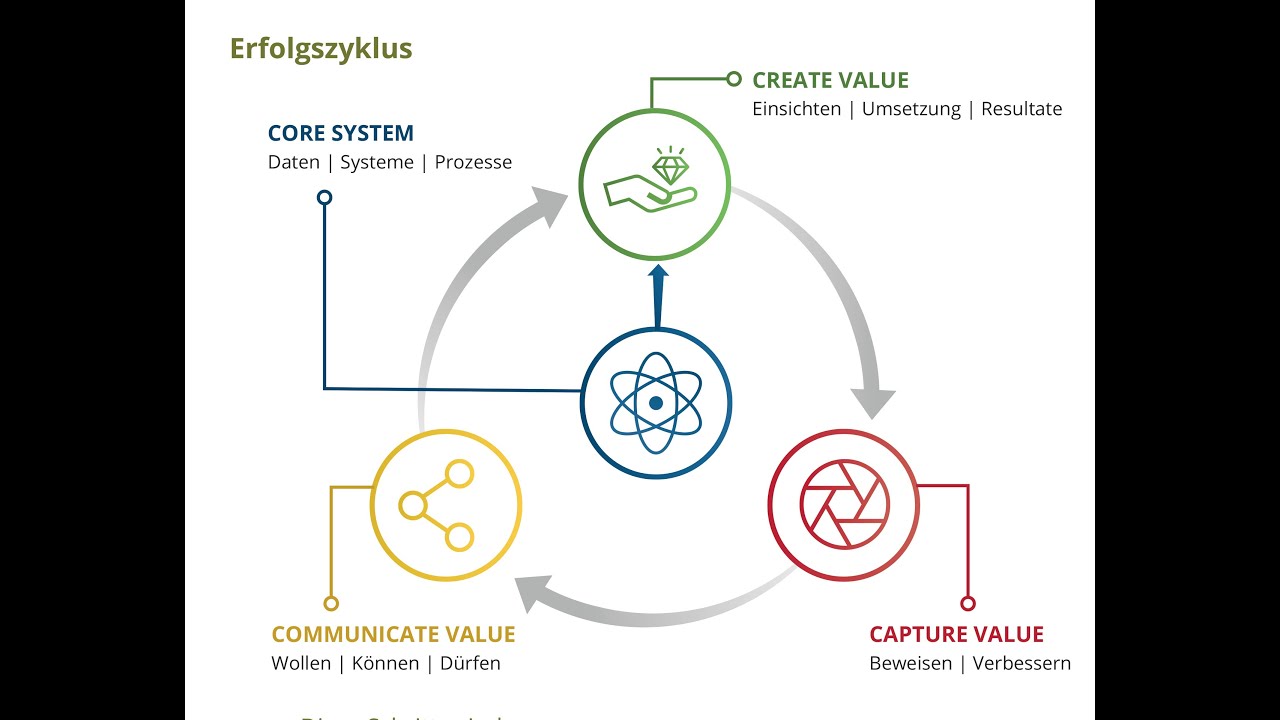
Hi, welcome to the Futurlab weekly webinar. Today we are at our second episode where we look at the core of our CCC model, how to start the process, basically establish your data strategy. Allow me to introduce myself. I'm Stefan Kolle. I'm one of the founders and now CEO of Futurlab. We've been a customer centricity, customer experience, and voice of the customer consultancy for over 17 years by now. So over those years, we've had the pleasure and the honor to work for a lot of the great brands of Europe, both in the B2B and the B2C space. And through those years, we've seen best practice, we've seen worst practice, but most of all, we've just experienced an awful lot and learned a lot. So we decided to turn all that learning into a series of weekly webinars. We are a full-service, one-stop shop. We take care from designing the customer experience through operationalizing it, making sure that we get the people on board, and to make the story complete, to actually benefit from the improved customer experience that you generate. Now, none of that, in our view, is possible without having a good voice of the customer program at the beginning. And as we introduced last week, many companies are currently not getting the full value out of their program. I dare say that 90% of the companies who have a voice of the customer program are not running it in the optimal way. So over the years, we have developed a framework which we have shared in our little white paper about the CCC program. And let me reintroduce it just very quickly. It is about first creating a core of the framework to deliver actionable insights by having a good data strategy, by measuring the right metrics, by having the right systems and processes in place to to create those actionable insights and to make sure that the organization creates value by actually acting upon those insights. Once you've done that, you need to capture the value, to prove it to the organization, and then communicate that value to inspire more people in the organization. Today, we're just going to look at the one point we're really going to deep dive a bit on the data strategy that you need to establish at the beginning of your program. Because many programs, if not most, suffer from some issues, and one of the key issues really is the overall low overall feedback amount and low feedback quality. And there's many, many different reasons for that, from too few clients to begin with, survey fatigue, I think we've seen it, for instance, now in the COVID period, in the lockdown period, everybody has been sending out a slew of surveys and people are getting tired with it. But also simply that you have exclusion rules, quarantine rules that reduce the number of potential respondents, that you're not asking the right stakeholders, that you're asking too few stakeholders, maybe in the wrong moment. The wrong moment in the journey, or literally the wrong moment in the day. You're asking the wrong questions, you're asking in the wrong channel, or you're not delivering actionable data. So to be able to solve this problem, you really need to look at 4 elements. First of all, who do you want to ask? Who do you want to talk to? Which stakeholders can add value to the insights that you need to generate. Secondly, when do you actually ask that? Which touchpoints, which interactions, which literally moments in time are the most relevant to the customer's experience and increase the likelihood of them answering? What do you need to ask? Which metrics to use? Which questions to ask? And we will deep dive on that in our next webinar, and we will also focus on the point that it's not just questions that we need to ask, it's not just surveys. There are non-survey elements that can give us an understanding of the emotions and the actions of the customer. So we need to look a little bit broader than just, here's 4 questions, please answer them. And finally, of course, based on all the above, we can decide what are the right technologies and the right methodologies to collect that voice of the customer. So first of all, the simple question, who do I want to ask? Who's the right person at the stage of the lifecycle, in that customer journey, who's likely to answer me and who has valuable insights to offer? To give you some very practical examples, maybe even slightly absurd examples, but these are really from our practice. Dayla, for instance, is a funeral insurance. And of course, when you have just sold the insurance, maybe immediately after the closing, you send a survey. Hey, how easy was it to, to close that policy? Did everything go as you expected? What can we do better? However, their product, at the end of the day, is delivering a funeral in kind. Once that funeral has taken place, it's, of course, even more important to engage with, well, not the customer, obviously. The customer, the policyholder, after all, is deceased. He is, or she is, the person that has just been buried. So, you need to engage with the family members. So it's a different stakeholder than the original policyholder. It may seem obvious, but I can tell you honestly, when we first engaged with this client, we were a little bit hesitant about the idea of people asking, so how was the funeral of your loved one? But very interestingly, the engagement rates are really high, and the will to answer in-depth is also very high. Or similarly, with ING, we worked in some countries with their life insurance and pension plans. Again, the policyholder, the original customer, is at some point not there anymore, so you need to engage with family members. Grant Thornton and several other companies, by the way, as well, we experienced interesting cultural differences, like on the left, that's the flag of India. On the Indian subcontinent, there's often a very hierarchical situation within companies, and more junior people feel that they cannot answer you because nobody would ever ask them for their recommendation or for their input. So on the one hand, you need to formulate your question very specifically, but also you may need to look for other stakeholders or I've given the flag of the UAE here, but it actually happens in Russia, in China, and in many other countries as well, that your respondents may not want to run the risk of embarrassing their counterparts, the account manager. So again, you need to look very closely at who do I ask and how do I ask them in a way that I get the insights from them. And on the right, we have 2 examples, for instance, in Shell. Well, one of the many things Shell does is operate or franchise gas stations. So if you want to find out how was the delivery of petrol that we did last week, who do I ask? And with whom does my email actually land? Is it with a cashier who has no personal engagement or personal value in that petrol delivery? Or, does it land with a manager who, however, is managing 5 different petrol stations? Who is the right person to answer those questions? And Sonepar is a beautiful example. It's a company that delivers components for electrical buildings, literally whatever an electrician needs to do his work. Now, many electricians are, of course, small companies, are independents, and it's often the wife that answers the emails or that answers the survey. And we're not being sexist here. It's the reality, of course, that 90% of electricians are male, and if it's a little family company, it happens to be the wife. Now, interestingly enough, we saw very different response rates and responses and scores coming from the wives, and you have to give that consideration. So think about who are the stakeholders, and if we're looking in the consumer space, we all know the fact that there's differences between the buyers, the influencers, and the decision-makers. One of my favorite examples is cars. Now, many car sellers still make the mistake when a family walks into the showroom to start talking to the man. However, the majority of cars is actually bought by women, either for themselves or they are the key decision maker within the family. But for instance, for the BMW brand, if there is a 14 to 16-year-old young male in the family, he may be the key decision maker on what brand car that family buys. So you need to know who are your decision-makers, who are your influencers, and whom of those can you actually engage with in surveys. In B2B, here's an example of a medical company, the decision-making unit is typically much more complex than people think at the first onset. Because they only have dealings with, let's say, the doctor, hospital administration, and in the worst— well, not worst case, but in some cases the insurance company. However, obviously the patients and their experience are very important, and the patient family who might observe suffering, or if the patient is a child, the parents want to make sure that their child goes through the procedure as happily as possible. The nurses who see what happens and who have a very strong influence on the doctors in the end. So yet again, it's very important to understand, because if you don't have a good mapping of your stakeholders, which of course you should also use outside of simply the context of survey, You may end up with unseen problems. Here we have a— this is a big steel company that we did a survey for last year, and it's a very typical pattern where we see the head of purchasing, in other words, the person who typically goes out for a lovely dinner and has a great personal relationship with the sales manager of the company, they are typically very happy. But the purchasing managers, the people who on a day-to-day base have to deal with our clients, are totally not happy. And even worse, the heads of production who identify major quality problems were less than happy. So having a good stakeholder mapping allows you to uncover unforeseen problems or potential upsides. And you can use a template like this. Here we are looking for a specific company operational in logistics, and we're looking at— so is it— who do we want to speak to in the raw materials and manufacturing, transport, wholesale, etc.? Make that mapping for yourself. It may also be a great way of uncovering new innovation insights, etc. So who do we want to talk to? What do we want to ask? When and how? Because the when, I already said it, it can be quite an interesting question. We had the Nationale Nederlanden, ING. They changed their logo and their name a few times. The NPS score we had across the journey really dropped off very much at the end, where they asked, how is— how would you recommend us? How was your experience with this administrative procedure? And we asked them, so what is happening there? Yeah, well, it's the contract termination, so we ask how That was— I dug a little bit further and contract termination was actually the death of the policyholder, but they took it as just another administrative procedure, even though the time of that happening was of course very critical. And they were speaking to the family of the deceased, but they spoke to the family, can you please deliver to us the papers within 24 hours or else? And turning that around really changed the perception of the customers. At one of the Vodafone units that we worked with over the years, we were not allowed to have the end of the relationship as part of the journey. I found that a little bit silly, because it's so important, particularly in an environment like a mobile operator, where you know that they will Many of your customers will leave after 2 to 3 years, and many of them will come back again. So managing that exit is just as important. So you want to make sure that you have exit interviews. And the when to ask is also about the time of day. I mentioned before the Sonapar, the small electricians, for instance. There we found out that the best moment to ask the question was at Sunday, 5 o'clock in the afternoon, because that's the time when they do their admin, look at the emails, look at everything else. That's when they have time to answer your survey, not Tuesday morning at 9 o'clock when they are basically doing the job on their knees somewhere installing some electrical, electrical equipment. While Tuesday morning 10 o'clock is a really good moment to send out surveys for everybody else, because that's the Monday rush is over, the week is starting to chug along. Tuesday 10 o'clock, 11 o'clock is a great moment. Now, just as an example, of course, there's also the element of What am I actually trying to establish here? When we're looking at NPS, we've got the relationship NPS. Now, the relationship NPS is measuring my overall relationship with the company, and I can do that once, maximum twice a year. Would you recommend us? Which is, of course, something completely different than a touchpoint NPS. Touchpoint is I have just completed a transaction. Now personally, I'm the biggest fan of relationship NPS. I'm not such a big fan of touchpoint NPS because it may not be the right question. I've been using an example recently, like many other people during the lockdown, we ordered a lot of stuff here, and so we got a daily delivery from Bpost. And that means that Bpost daily sends me an email asking You just received a package from us. Would you recommend us? And that's not the right question. First of all, they're asking me daily, and my likelihood to recommend will not change on a day-to-day basis. But it's also completely the wrong question to find out how I actually feel about their services at that moment. But we'll get back to that in the next, uh, one of the next 2 webinars. And based on the frequency, of course, we establish exclusions. It's very important how often— when we're looking into the when— how often am I asking that customer? If I've asked about the touchpoint, I should not be then 2 weeks later ask my relationship NPS. and I don't want to ask a relationship NPS every month. So I get exclusions, I get quarantine, etc. However, this happened at one of our companies where we had a 25% response rate, which as such is not bad, not bad at all. But then we saw that only 18,000 surveys were sent while the company had 90,000 customers. It turned out that over the course of 10 years, those rule-based exclusions, the quarantine rules, account managers saying, oh, now is not the right moment to talk to this customer, which I usually don't accept as an exclusion rule at all, had led to 80% of all customers being excluded from the survey. So it may sound obvious, but Make sure, because it happens every time again, that once we start looking, that the exclusion rules turn out to have been so strict that companies have— that potential respondents have not been added back into the database. And you saw a placeholder again. What to ask, which questions, which metrics, that's what we'll come back to next time. Once we've established all that, we need to look at how do we ask. And of course, we need to make sure that we look at all channels to ask our customers. And what all those channels are is a very broad topic. It goes from email, pop-ups on the website, QR codes in store on the on the cash receipt, after a contact with the contact center, through voice-activated robots, or any other interaction. But also, for instance, WhatsApp. WhatsApp is becoming a fantastic tool for companies to really engage with their customers. And for instance, we've recently done some surveys in countries where it's— most people don't have email addresses, like Nigeria and like Indonesia. Most of the customers don't have email addresses, but everybody has a mobile phone. So it's much easier to, for instance, send out a survey this way than through an email. And what really helps in that is that you can also give that tool to one of your account managers who goes out and helps people in answering this, because not everybody is fully literate and feels confident in typing in lengthy answers in an email environment. On the how to ask, it's also very important to keep an eye on what do we do automated and what do we do hand-paced. Yes, we want to have all kinds of automated surveys, of course, but make sure that you also have room for spontaneous and hand-paced surveying. In other words, if an agent has had a great interaction with the customer in a contact center, that agent should be able to send out a quick survey, because he or she knows this is a customer who's very likely to share some insights with us. And it's not about getting a high score, it's about getting feedback. And please make sure that your surveys are short, that they're interactive and adaptive. In other words, if the customer says in the first question, well, actually you didn't fulfill my expectations, then the comeback should not be Thank you for such a great answer. What else can we do for you? The answer should then be, we're very sorry that we didn't meet your expectations. How can we do better next time? And of course, beyond the pure survey, there are so many other methodologies. It's very important to really go through what are the right methods, what do we want to achieve, how do we want to achieve it? Purely validation of data points, or do we want to get insights? If we want to get insights, we may not want to be looking at KPIs. Is it surveys, or is it, for instance, quick pop-up yes/no questions that we want to ask? Is it maybe through the the voice of the employees that we want to get feedback? Your agents are your best source of customer insights. So go through a ranking of which methodologies you have and what you want to achieve and how the two might fit together. And keep in mind that, of course, COVID is impacting a lot of these methodologies and is having a big impact on your targets. Here's, for instance, for example, a voice of the stakeholder method mapping that we just did for a B2B customer where we're looking into supporting innovation. And if we're looking at how to ask, I've also written here VOCE, voice of the customer or the employee, soft data, behavioral— what are we hearing? The emotion tracking in, for instance, calls into the contact center is a by now well-established technology. So, what are we hearing? Is this a happy or an unhappy customer? Is this a more rational or more emotionally driven person? And, to underline the fact that how important it is to keep an eye on the different technological capabilities of the people you're trying to talk to, here on the left is a copy of that metal, that steel company I mentioned before. They sent out surveys by email, we sent out surveys by email for them, and not one but 3 people actually printed out the screenshot of the survey, then wrote their answer by hand on it and faxed the answer back. Now that was a new one for us as well after 17 years, but it's just a reminder, depending on the the region and the technology you're using. Not everybody is capable of dealing with the latest greatest in technology. So coming to the conclusions, again, it is essential to establish who do you want to talk to and keep— make that broader than maybe just your one contact you have. When do you want to talk? What time of the day? How often? At which touchpoints? By what interactions? To increase the likelihood of people answering. That has to be a very important underlying thing consistently. How do we increase the likelihood? And what to ask? Which metrics? Which questions? We'll come back on that in a next 2 weeks. And finally, how to ask, what technology, what methodology. To give you an example that underpins all of this, one of our customers, they had a client or a customer, Walmart. They delivered close to $1 billion in goods to Walmart every year. And they were very happy with the fact that every year, They sent Walmart the exact same survey as they sent to all of their other customers, and it was answered typically within an hour, and the score was pretty good. And then one time, the account manager actually asked, so who of you is it actually that's answering the survey? And they said, oh, we don't know, that's typically one of the temps that we have here. They're usually gone again within a couple of months. In other words, one of the biggest global customers of this company built a lot of their customer strategy—not all of it, of course—but it was influenced by the feedback they got out of their voice of the customer system, and it was completely the wrong person at the wrong time in the wrong channel with the wrong questions giving them feedback. So again, at the beginning, we need our data strategy. Then our metrics and our systems to get actionable insights. We need to make sure that the company acts upon those insights and creates value, proves that value that is captured, and communicates it into the rest of the organization. We are FutureLab. We help you to put the human in the middle, and we help you to just get it done. When it comes to customer experience. So next week, join us again for choosing the right system and approach for your voice of the customer program. And I will keep repeating this, if you want a private webinar, if you want to discuss a couple of very specific questions, I gladly take half an hour or an hour with you and your team. Also, if you have any questions, ask me. Look on our website, we have a huge amount of content there, 15,000 blog posts, many white papers, webinars from the past. There's a lot to share. And in the meantime, give us a call if you want to ask me anything specific. Thank you for your attention today and hope to see you again next week.
More from Stefan

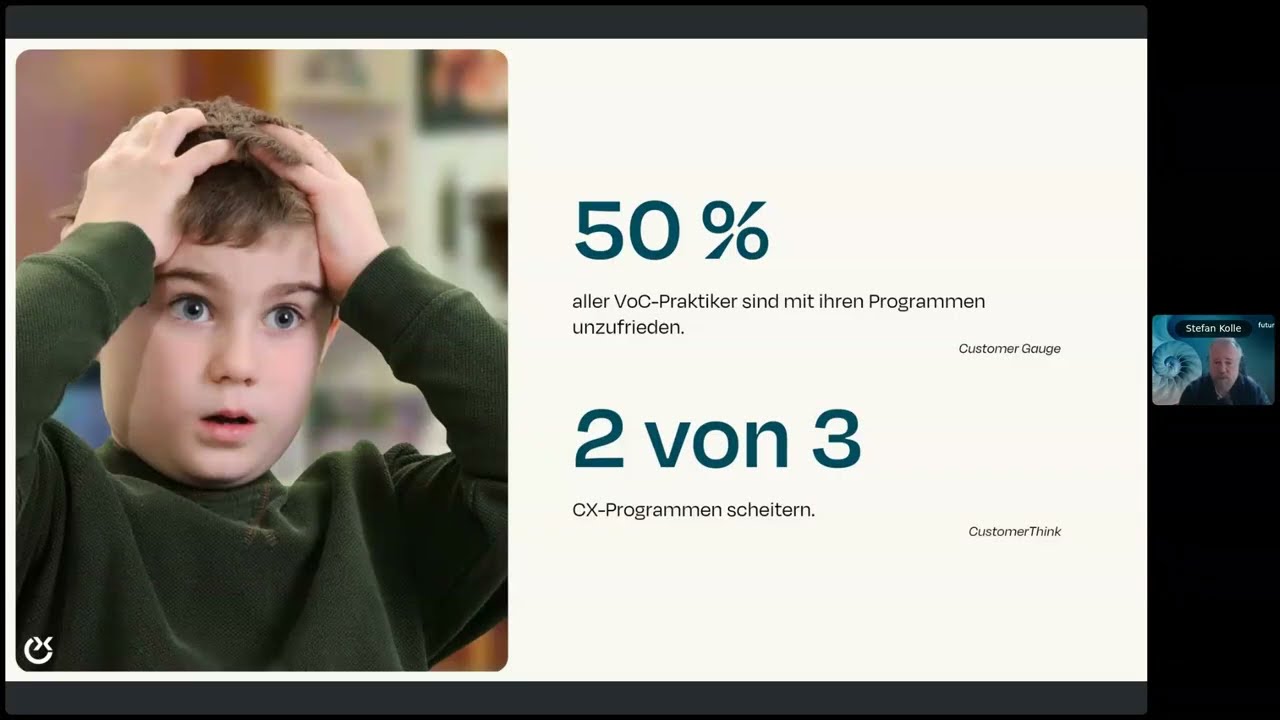

Voice of the Customer for our smallest customers - a presentation at the Toy Forum in Nürnberg, 2025

6 Herausforderungen beim Kundenfeedback – und wie man sie 2026 mit KI lösen kann