Maximize the ROI of your Net Promoter / Voice of Customer Programme

In this 60‑minute webinar Stefan Kolle, co‑founder of FutureLab, walks practitioners through a practical, end‑to‑end framework for turning Voice of the Customer (VOC) and Net Promoter Score (NPS) programmes into measurable ROI. He begins by highlighting the universal business case for VOC – happier, more loyal, higher‑spending customers – and then explains why many programmes fail (lack of actionable insights, poor stakeholder targeting, weak governance, and KPI mis‑alignment). Kolle introduces a four‑pillar model: (1) Core – the systems, metrics and processes that generate actionable insights; (2) Value Creation – closing the loop, driving sales and improving operational efficiency; (3) Proof – simple business‑case models and KPIs that quantify impact; (4) Communication – internal storytelling that inspires adoption and keeps the programme alive. Throughout he illustrates each pillar with real‑world case studies (petrol stations, Grant Thornton, Deyla funeral insurer, Vodafone, NN insurance, Toyota dealers, Weber barbecues, Mercedes, Sonepar, ING, Daimler, Philips). He also shares a self‑assessment checklist, practical advice on survey design (who, how, when, what), multimodal data capture, the distinction between relationship‑NPS and touchpoint‑NPS, and how to avoid common KPI traps (Goodhart’s law, unintended consequences). The session ends with a call to action: run the assessment, build a simple ROI model, and engage FutureLab for coaching. No explicit Q&A blocks are present beyond brief audience questions.
Chapters
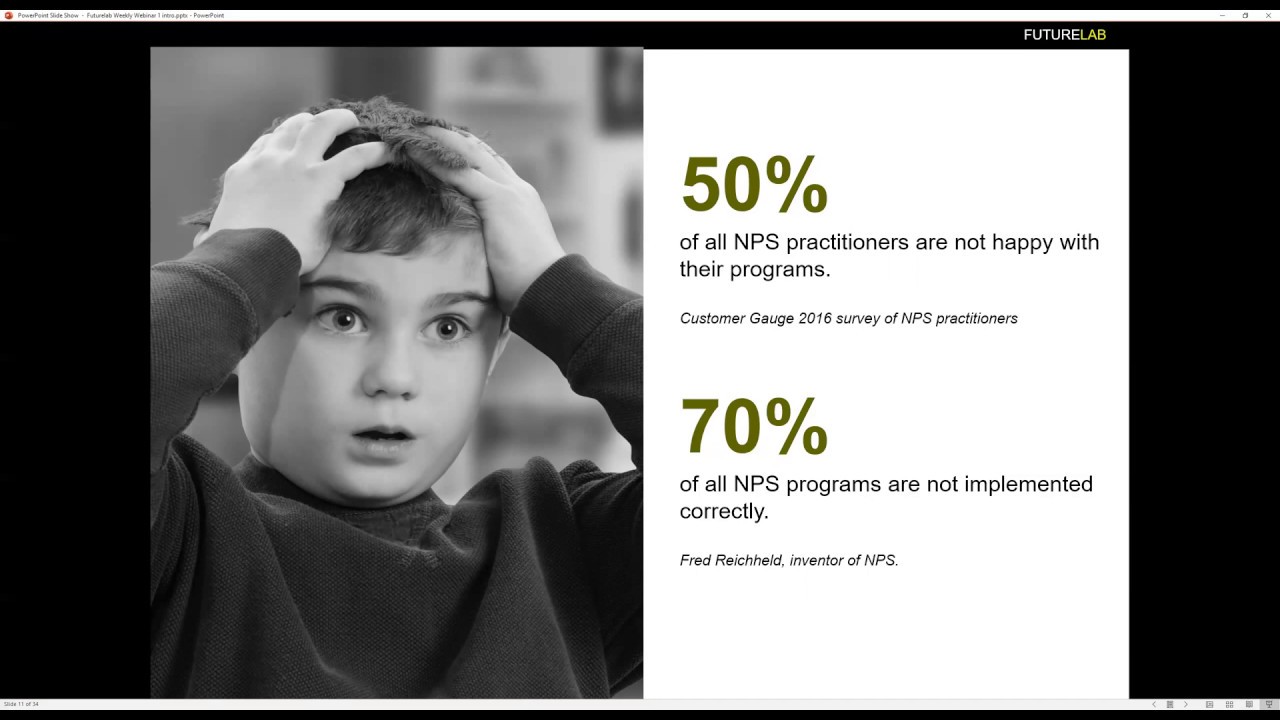
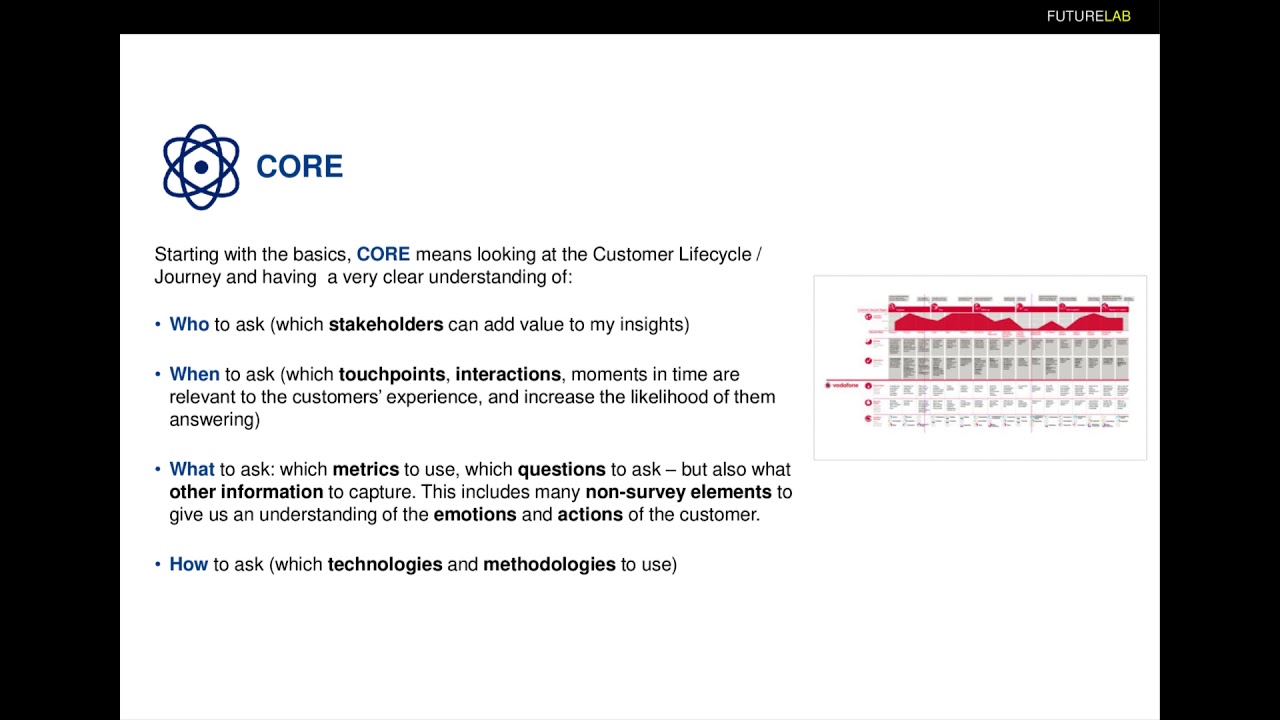
All right, let's get going. Very welcome, everybody. Thank you for joining us for our webinar of today, Maximizing the ROI of Your VOC Program. And as you will see, I often add the words NPS because for us, NPS is one of the key tools within the VOC toolbox. But we're looking at the broader picture of a total voice of the customer approach. Very quickly, who are we? We are FutureLab. We've been at the topic of customer centricity and customer experience for over 15 years. We're still relatively small, but we're quite internationally active and typically working I'm sorry, I'm stopping for a moment. I see some people don't hear me. Okay, it seems to be okay. Talking about myself for the moment, I'm one of the founders of FutureLab. Again, 15 years ago, we started on the topic of customer centricity and customer experience, and I've had the privilege to work for many, many big companies around the world. and learned a few things, also bumped my head a couple of times learning what not to do. And the purpose of today is, of course, also a little bit to share some of these stories, the good stories, what worked, but also the bad stories of what didn't work. I see there's quite a few attendants that I know personally. customers, current and past. So very welcome for everyone, very excited to share this webinar with you today. As FutureLab, what we do is a full-service customer experience service. I don't want to go into that too much today. It's not supposed to be a sales conversation, but to share information with you. And the focus today is basically on the problems that we have seen in many of the programs that we have run, and actually also the questions that you asked beforehand when we asked you why you participated in this webinar. And we see that the topics that move you seem to be fairly similar, whether you are just starting out or are an experienced practitioner. And it's typically, how do I make sure I get the good return on investment out of my program? Which basically comes down to how do we set up the program correctly? How do we drive action? Because return on investment is only going to come if we actually see action. How do we get buy-in from the rest of the organization? And what we call existence management— how do we make sure that the program stays alive, that we continuously are able to deliver insights, get people to act upon it, and that way deliver ROI. One of the challenges is often that this may take a couple of years to really pay off, while in a corporate environment, of course, often the focus is very much on the next quarterly numbers. So we want to address those pain points today, and let's start at the beginning. We all know that customer experience management brings value, and we also know that voice of the customer is an essential tool to drive a good customer experience. Simply put, that's why we're here. If we look at this picture, I think you all subscribe to this: customers who are so happy that they recommend us are more profitable, they spend more, they are more loyal, they stay longer as customers, they're easier to service. which also increases staff morale and they generate new business. I don't think anybody participating today does not believe in this. I don't think that many people in any of your companies disagree with this if you confront them with this directly. So how come that if we look at what is going on with our voice of the customer programs, that so many people are actually not happy and not getting out of these programs what they should. This survey is specifically about NPS, but I'm fairly sure that most of the findings are quite relevant to the broader topic of voice of the customer programs. 50% of those who run the programs are currently not happy because they can't convince the rest of the company, because they don't get actionable insights out of it, because they have trouble keeping the program alive. And Fred Reichhald himself actually pointed out that 70% of all NPS programs are not implemented correctly. That actually links back to the situation that we often get people saying, well, NPS, that doesn't work, it's nonsense, it doesn't give us actionable insights. And typically, if we then start looking at what they know about NPS or how they have implemented NPS, they are not actually doing it in the right way. So we want to look a little bit at what is the right way. For that, we actually do have a self-assessment, and I'm going to share this again later today. I really want to urge all of you to go into this. If you're already doing it, it's a great way to check whether you are getting the most out of your program by running it correctly. If you're not doing it yet, it gives you a lot of pointers on what to look for when you're setting up your program. But let's look at how do we get the value out of your program, not just set it up correctly, but actually get the value ROI. And to that end, we have developed a little framework that should help you in continuously driving ROI. And for that, we're looking at 4 elements. First of all, the core. The core means the systems, the metrics, the processes that you use which need to deliver actionable insights to the organization. If you deliver actionable insights, that's when the rest of the organization can create value by closing the loop, by driving concrete sales, and by improving operational efficiency. Obviously, we will dive a little bit deeper into each of these topics. Once we've created value, we must also prove it to the organization. Otherwise, the rest of the organization will not believe us, will not buy into the program, will not be convinced that what we're doing is delivering value. So we need to calculate what we're actually doing, turn it into a business model that we can share with the rest of the organization, and very importantly, make sure that we have the right KPIs to capture the value that we're creating. And finally, we need to communicate the value that we're creating by showing the rest of the organization what's going on, success stories, happy customers, great improved financials. That's how we inspire more people, and that's where we start creating a virtuous cycle where we continuously keep improving, and that in itself then helps us keep the program alive in the organization. So let's look a little bit deeper into the individual topics. At the core, are the systems, the metrics, the processes. And maybe we can simplify this or state it in 4 questions that we need to ask, or 4 ways in which we need to ask our questions. Who do we ask? Which are the stakeholders that can add value to my insights? How should we ask them? When should we ask them? At which touchpoints and which interactions, which moments of truth are relevant so that we can capture valuable insights? And what should we ask? Which metrics, which questions, and what non-survey elements should we capture? All of this consistently matching with a customer lifecycle mapping, which is basically the starting point for any good customer experience program, but also to help us guide our voice of the customer program. At the heart of whatever you do should be your customer lifecycle map. Here we can capture what is happening in the life of the customer, what are the expectations of that customer at the rational and at the emotional level, what is our promise, what is the customer experience we want to deliver, what is the value proposition, and how do we prove that we fulfill our promise to the customer? This, for instance, very much drives the metrics that we need to use. The metrics are linked to, are we fulfilling our promise? We can capture the touchpoints, we can capture the KPIs. In other words, this is the central piece where we capture all the information that we need, and thereby can determine who, how, when, and what we need to ask. So, to give you an example on the who to ask, it's very important that we ask the right person for that stage of the lifecycle who is actually likely to answer and has some valuable insights to offer. That sounds quite logical, but To give an example, on the left, we're working with a major global petroleum company at the moment. And for instance, one of the challenges we found is that, of course, they need to talk to their gas stations. Now, if you send a survey, how was our delivery, to a gas station, the chances are that this email will either land with a gas station manager who is managing 10 different stations, and has no idea what happened specifically about one particular delivery at one particular station last week, or it lands with a very young cashier who has no idea what these questions are about. So it's very important to make sure that we know who we want to talk to, but also what the way is to talk to that person. With Grant Thornton, we saw— Grant Thornton, one of the major global auditing companies— we saw, for instance, that in India, if the question went to a too junior person, they had the tendency to say, oh, but I'm just a junior, nobody cares about what I say, nobody cares whether I would recommend, nobody cares what I feel about the survey. So you need to make sure that you talk to the right person, but also craft the question in such a way that whoever is on the receiving end can bring back some value. Another problem we saw with Grant Thornton was in the UAE, the Emirates, where all the responses to the Voice of the Customer survey were extremely positive. People gave 10s all across the board. While in personal interviews, they indicated that they weren't necessarily happy about everything. This was because they didn't want to embarrass whoever their account manager was. So again, is the person who we're talking to in this channel giving actual valuable insights, or do we maybe need to use a mix of surveys and personal interviews? And to answer Dick's question about what are non-survey elements, by that we mean, for instance, capturing feedback from the employee that has engaged with the customer, capturing unstructured info from, for instance, social media. What are people talking about out there? Capturing the interaction as it has happened in the contact center. Was the person happy or unhappy? So the things that we're not asking specifically, but that we can capture through observations. The final example here is Deyla, which is in the Netherlands and Belgium, a funeral insurer and funeral services provider. And this is a good example of actually asking the right person, because we do survey the family members of the deceased. The deceased is the actual insured party, but we survey the family members, based on the recent funeral you experienced, would you recommend us? And I will share with you that I was very nervous about this in the beginning, but we're actually getting response rates close to 70%, and we're getting extremely high scores. It's the right person at the right time who has actually something to share. So an important thing is to understand What are your stakeholders? And in a B2B environment, that can be much broader than just that one person that signs the order. But in B2C, this may also be an important point. We typically focus on the person buying our product, while in reality, there may be, just like in B2B, a fairly complex decision-making unit, In this case, the family, where whatever mom decides to buy in the store, or dad if he does the shopping, if junior doesn't appreciate that, it will not be bought again. If we look at how to ask, it is important that we use all channels that we have available. So what we call multimodal surveying. So not just sending out a survey, but also using pop-ups on the website, using QR codes on our products, using URLs at the bottom of invoices and cash receipt— cash register receipts, allowing, for instance, agents to send out a survey dedicated Based on the interaction they just had with the person. And make sure that these surveys are short, interactive, and adaptive. In other words, that we're not sending out a static survey, but change the survey based on the answers the person gives. So if somebody says, hey, you really did not match my experiences here, The next question should be, well, we're really sorry about that. How can we do better next time? If he says, I'm super happy, you really exceeded my expectations, the follow-up question should be, we're so happy to hear that. Please do tell us, how can we make sure that next time we also hit your expectations, hit the mark? So make sure that you adapt your questioning. A big question is, a big topic is of course also, when should we ask? So look at your lifecycle mapping and review it for which touchpoints are important. And you see here, I mean, I'm constantly using the Vodafone example, which is a great example of a good lifecycle map, except for one thing. The organization refused to add the afterlife. stage to the journey. In other words, what happens once the customer leaves us? We want to make sure that we have exit interviews, but actually we want to make sure that we talk to the customer even after he has left us, to maintain the relationship and maybe in the future bring the person back to us. And talking about afterlife, one of the more interesting customer journey reviews we had was with NN, the Dutch Nationale Nederlandse insurance company. In one of their countries, not the Netherlands, where they were selling life insurances, we found that the NPS score at the end of the journey completely dropped. Customers were super happy throughout the whole experience, but at the end, they really were not happy. And we asked the organization, what happens at the end? And they said, yeah, well, it's the contract ends. And I said, come on, talk to me more. What does that mean, the contract ends? Yeah, well, we pay out and that's it. People, you are selling life insurances. Your customer has died. And that was the problem. They were not acknowledging the fact that the customer had actually died. They felt that was too emotional to deal with, internal and externally. Well, in reality, that is what they insure. And by turning around from a very bureaucratic process which they had to a very human and warm process, so moving from when people called, please send us the death certificate within 24 hours or there will be a problem, We're so sorry for your loss. Someone will be with you immediately to take care of all the paperwork. They massively increased their NPS and actually generated about $8 to $10 million more in revenue the next year— in profit, I should say. This is a good example of understanding what it means. When do we ask people along the customer journey. And for instance, in NPS, we often run into a mix-up where people see NPS as a singular tool. Well, in reality, there's a major difference on when you ask and what you ask. The original NPS is, for instance, based on the relationship, on an overall relationship of our— of you with our company, Would you recommend us? Secondly, there's a touchpoint NPS. This is something that's ongoing, and you decide, based on your customer journey, which are the important touchpoints, and where should I ask? That gives completely different outputs than the relationship NPS. For instance, individual touchpoints typically score much higher. So I've seen companies that lulled themselves into complacency, thinking that they had a fantastic NPS score, but they were only measuring the touchpoints, not the relationship. And particularly, for instance, in telcos, and we work a lot with telcos, you see that the individual touchpoint typically gets a fairly good score, up to sometimes 70%, while the relationship score tends to be relatively low, because they have so many touchpoints, and all it needs is for one of those touchpoints to really deliver a bad experience. And then there's also the benchmarking, which is yet again a completely different tool because it's a comparison to other companies, not an interaction directly with your customers. So we're saying, make sure that you look at who do you want to ask and when, at which touchpoint. And that also brings the question of what to ask. Very importantly, we have to make sure that we get a very clear understanding of our metrics. And I'm having a handout for you to download here. I don't want to go into the whole presentation right now, but First of all, see what metrics are out there and then decide which of these are relevant for you for this particular survey in this particular stage of the customer lifecycle for this particular person that you're talking to. And whichever you decide, focus on, can we act upon what we're learning out of this survey? If it's not actionable, don't ask it. What additional information do we want to capture? This is what I already mentioned as non-survey information. For instance, voice of the customer, or voice of the customer through the employee, this VOCE, and soft info. Ask the employee who's just had an engagement with the customer a couple of quick questions. Was this customer happy? Was he more emotional or more rational? How should we approach him next time? And if you're worried about GDPR, it's really just a matter of formulating the question correctly. In some cases, your legal department might not be comfortable if you ask, is this an emotional person? But if you ask, how should the next agent approach this customer with a more emotional or a more rational approach, that is actually suitable within GDPR. And very importantly, and I see it slipping even in the most developed programs, the successful programs that have been running for years, there is this constant pressure by the organization to ask more and more and more questions, while the ultimate key to success in Voice of the Customer is Keep it short. If you keep it short and you can genuinely tell the customer, we just need 1, maximum 2 minutes of your time, it really increases your response rates. We just had it with Mercedes, one of their units who were running a survey where they had about 0.6% response rate because it was one of the classical 14-page surveys. When we ran a pilot on NPS, in this case, very short, like the one on the right, it jumped to almost 20% response rate. And that is how you prove to the rest of the organization, look, our customers have some valuable feedback to share with us. If you do all this, then at some point you can really move to the next level and create a data lake, where all these data are pulled in and you can run predictive analysis, you can start looking at sales-relevant information, you can start segmenting things. But I'm really saying this is next level. This is not for the faint of heart. This is not when you start out, but this is where you want to move to. And that's where if you have the multimodal input, you capturing all the information along the customer journey, you can do your analysis and then start putting it back into your various CRM systems so that anyone acting with a customer or engaging with a customer sees immediately, this is where this customer is coming from. Now, This was all about setting up your core, setting up your systems. But again, it is about actions that create value, and we want to look quickly into 3 things: closing the loop, driving concrete sales, and improving operational efficiency. We cannot emphasize enough that closing the loop is the big secret to a voice of the customer program. Get back to your customer. Follow up immediately by saying, we heard you, we're dealing with what you told us, both in the negative and in the positive. If somebody says, hey, I love you, I'm giving you a 9 on NPS or on customer expectations or on customer effort score, get back to them and say, thank you very much, we really love that you're so happy with us. talk to us more, but also tell them what you learned from them, get back to them. At the same time, we can look from a strategic point of view. If we look at all the findings we get from our Voice of the Customer, what do we learn as an organization? What's our strategic closed loop, and what do we teach the rest of the organization? Now, that's a bit academic, this slide, so let's make it a bit more concrete. Why is closed-loop so important? First of all, it is about the direct voice of the customer versus blind averages. It's not that on average our customers are happy 4.4 out of 5, which doesn't mean anything to anybody. It is this particular customer is not happy. Right now, today, let's deal with it. We can solve their issues immediately. We saw great examples from Toyota, for instance, where even the worst comments that came out of the verbatims were addressed by general management and turned unhappy customers into happy customers and rebuying customers literally within a day. By sharing the feedback that we get to the people, the frontline, and let them close the loop, we give responsibility back, we empower them, we promote proactivity. It's very concretely helping us to pick up dropped leads and even upsell. If we have someone who dropped out and he tells us why, it gives us a tool, a handle to reapproach that person, and try to solve the issue. And of course, the simple fact that you tell people that you have heard them often gives them closure. I cannot emphasize this enough. A lot of the voice of the customer capture is really about letting people vent. Let them talk, let them communicate. So often it is about, you don't listen to me, nobody is hearing my complaint. By showing that you listen, by showing that you care, many problems can already be solved. And of course, if people tell you that they are really happy, that they would theoretically be willing to recommend you, you can go back to them and engage them to concretely recommend you. And for instance, the Toyota dealers, after we ran a pilot, They were so enthusiastic that they asked us, can we please keep on doing this? We will pay for it. And anybody who works in an environment like this knows how special it is if your retailers are actually willing to pay for something. And a beautiful example from Germany, from Sonepar. Some of the salespeople told me that when they get the feedback and they see that there's a great score, a 9 or a 10, they look at the actual share of wallet. If that share of wallet of that customer giving us a great score is below 50%, they literally pick up the phone and say, hey, thanks for the great score, so can we please now make sure that your share of wallet is in line with the score? And it really concretely and directly improves sales. It's a beautiful example of how sales is often your best friend once you bring them on board. And a big thing about this, I already mentioned it a couple of times, is about the verbatim. So on the left, you see a verbatim from a retail environment where somebody is really, really not happy, and we can use that input in 5 different ways. Now, very tactical, concrete, call that customer up and apologize and solve the problem. But there's also a management closed loop. Wait a minute, he's talking about a structural problem with this particular retail location. Maybe we need to look into that store a little bit closer. But there's also a strategic element where we see he's highlighting a couple of problems about potentially IT systems, about potentially people skill, Maybe we need a voucher system. And once we have— and we see that there's no proper confirmation system to let the customer know that he has an appointment. It's a real example from one of our retail customers, and it's a beautiful example of how to use verbatims. And I want to take this even further in a maybe my favorite case, Weber, the barbecues. I'm pretty sure most of you know them. And we had 2 great learnings, actually 3. First of all, a lot of the feedback we got from the initial NPS was along the lines of, would I recommend you? Wow, yeah, I already sold 3 grills for you. And you know why? Because the meat tastes so much better. Now, whether the meat actually tastes better, I don't know. But the learning we had here was that their current advertising campaign, which was not actually Gordon Ramsay, but a famous chef doing 30-second commercials on TV, was maybe not the best way to use what people really feel about the brand. So they switched entirely to experiential marketing in barbecue shops, in garden centers, in actually stimulating their happiest customers to invite their neighbors and friends and family. And that actually led to a doubling of sales in 3 years' time simply by understanding from the verbatims what drives customers and how we can use that. The second reason, and this is one of the reasons why I'm so in love with the NPS score, we asked them, would you recommend and why? And I showed you what a lot of the answers were about, but we also asked, what can we do better? Now, even without reading German, I think you pretty much get What they are talking about. They all mentioned price. However, they mentioned price with a smiley. They mentioned price while giving us a 10 in the recommendation score. They're mentioning the price while they said in the first question, I have recommended and I have convinced 3 people to buy your barbecues. In other words, price in this case is not an actual issue, it's a default. They cannot come up with anything better. That is, of course, incredibly valuable information for any marketing team. So what we did here, what we found here, helped to double sales in 3 years. It helped to keep the margins, and we also learned very strongly that 80% of all customer unhappiness is about communication shortcomings. So that's the ultimate quick and cheap win. You will see the same when you start your voice of the customer program, that a lot of the root causes are in not communicating properly to customers. Finally, I mentioned operational efficiencies. By understanding the needs of the customers, you can prioritize, you can find out where should you put your resources and where not. And also, and this is from a contact center where we found out that because the whole system was working towards unhappy customers, it also led to unhappy employees who did all kinds of inefficient things and quit early. So there was also a lot of extra training and recruitment cost. This is of course a much broader topic to look into, but I'll gladly share that with you in a later stage. We have actually made a presentation which you can find online on SlideShare on 8 ways in which NPS can add value to your business. So once we created the value, we need to capture the value. In other words, we need to prove to the organization that we're actually doing well. I'm not going to go into very complex, deep ROI models because the biggest thing about them is to be useful, not perfect. Too many organizations fail when they try to build the ultimate flying, swimming, rocketing business model. Well, at the end of the day, it can be relatively simple. We have the elements that we want to look at. And the model that we developed together with the Toyota dealers to convince their peers was ultimately simple. It was about the question, how many cars does a detractor buy over his lifetime, and how much value, how much margin does he generate? And how many cars does a promoter buy? That already gives you a starting point for a business model. But then we started featuring in the word-of-mouth impact. So how many customers did a detractor stop from buying from us? And how many new customers did a happy customer bring? When we feature this in and we take the lost business as the average, as the passive, suddenly we see that the detractor is not just lower in margin, he actually costs us money. And the differential between the detractor and the promoter gets really big. And I challenge you to sit down with a couple of colleagues and take 15 minutes, and I mean it very literal, 15 minutes to do this calculation for your business. I've done that at 40 companies, and every single time people fell off their chairs when realizing what the differential was between these 2 numbers. And it was a great starting point to then start looking at, okay, So how can we turn this now into a solid model that our CFO will love, that we can start using as a management tool? And here we have an example of the model that we built with a telco. I think the color is somewhat of a giveaway. And you can make it as complex as you want, but let's start with the simple elements. No. What is the intrinsic customer value? In other words, what is the direct revenue he or she brings us? What is the word-of-mouth value? What are other value drivers that are relevant? For instance, cost to serve. We see in telcos, we saw it with Vodafone Ireland, a very concrete number. Average cost to serve for the tractor customer was €14 per year, while that for a promoter company customer was €4. The differential of €9 a year across 1 point— almost 2 million customers, that's €18 million in difference just based on is our customer happy or not. So find out what is relevant for your company to put into your simple business model. And in B2B, it can often be even simpler. This is from a B2B retailer where we see that a typical detractor has $60,000 on average revenue per year and a promoter over $100,000. You can make an extremely simple slide to show to your senior management saying, look, if we move X number of customers from that level to that level, it generates this much additional revenue. This is not the be-all and end-all, but it's a starting point to start engaging with the rest of the company. KPIs are extremely important, and nothing is going to happen without the KPIs. It's often said culture eats strategy, but I dare say KPIs eat strategy. Culture. We see an awful lot of programs running into the wall because the KPIs have never been changed to match, or because the KPIs are incorrect. Let's put it very simple: nobody in an organization is ever going to act against the KPIs that they are given, and if your program is not in line with the KPIs, nothing will happen. There's a wonderful law, Goodhart's law. When a measure becomes a target, it ceases to be a good measure. If your measure is, or if your target, sorry, if your KPI is, we need 8.5 on average, everybody's only going to focus on, do we get to 8.5? They're not going to look at what's happening underneath, what happens with those people who give us a 9, are they happy, are they giving us good feedback. If it's one number, people will only focus on that one number. And from that same contact center, for instance, a classic case of unintended consequences, they saw that people got unhappier if resolution of their case lasted more than 8 days. So they put the KPI in, cases have to be closed within 8 days. So what happens? Agents close the case on day 7, whether it is actually resolved or not. So people get a mail at home saying, We resolved your case. And I say, no, I'm not. And they reopen the case, but now already much more angry and much more unhappy. So while the best of intentions were in the let's make that a KPI, the outcome was not particularly good. Mercedes-Benz Customer Assistance Center in Maastricht did a beautiful exercise of kill the KPIs. They let their agents sit down and identify the KPIs that did not Help them to deliver a good experience to the customer. It's also a great way, by the way, to really engage your staff and show them that you're serious. So what should you look for in good KPIs? They have to be customer-focused. Look at the download I gave you earlier, and there's a couple of good examples. They have to be action-oriented. They have to be outcome-based. So what happens if we use the output of the program, we create financial impact. We need to close the loop, we need to improve loyalty and reduce churn, but they also need to be integrated. It shouldn't be a singular number, and it has to link to whatever reporting the senior management has to deal with, and make sure that you really think it through and don't fall into the unintended consequences trap. So finally, if we have all of this, we need to make sure that we inspire more people within the organization to start acting. There will always be some that instinctively get it, that love it, that jump on it. 10 to 20% of your colleagues will say, oh, fantastic, I love all this, give me those feedbacks, I will use them. But the rest may need a bit more support. So we need to make sure that people are willing to be customer-centric, both in the head and in the heart. Then we need to make sure that they're skilled, and we need to enable or empower them, both with tools, but more importantly, with— yet again, here come the KPIs. So at the end of the day, every employee wants to act on the customer's voice, and Also, I haven't met an employee yet that got up in the morning and said, okay, today I'm really going to make a couple of customers miserable. The problem is, however, that often the cases, the results are presented in an endless list of PowerPoint slides. I know it sounds ironic for me throwing all these slides at you, but think of what it means for an agent who has 100 tasks that day to see All these slides are about percentages. Make it real, make it concrete, make it appealing. On the screen here, I've got the example from ING, who every week sent out a beautifully crafted newsletter to the organization. What have we learned this week? What can we do with that? Grant Thornton in Germany, they put verbatims gathered on the screensavers. So anybody coming to the company in the morning or whenever would see something their customers had said to confront them with reality. Daimler, for instance, shares verbatims on the screens that hang in every office. And sometimes you need to go really straight between the eyes. We did this at Philips 14 years ago with Timmer at the time. In a board meeting, we showed, look, this is what your customers think of you. We showed them a video, 10 seconds, 6 people, 10 seconds each, and the first customer said, Philips, you suck, and showed a middle finger. While everybody else froze, Timur really laughed and he said, okay, this video we need to share with all 400,000 employees next Monday. This is for real. This brings the story to life. And once you actioned it, tell it. It's also a really important part of closing the loop. Communicate both internally and externally. Those of your customers that didn't need an immediate feedback, send them 3 months later, hey, you participated in the survey, fantastic. This is what we've learned, this is what we've done with that feedback. And then you need to start a customer movement. We already said 20%, maybe only 10% of your colleagues will enthusiastically jump onto it. Unite them into a community, give them the tools to start communicating to their customers, their colleagues, give them information, help them to be successful. Make sure that you have a couple of fantastic cases where individuals really improve the customer experience and create success stories with that. And then put on the spotlights, show the rest of the organization what can happen if you create value, and you capture the value. That is the way that you start inspiring more people to start acting upon this. And one beautiful way, and this is again Mercedes, empower them. Create a team that has all the empowerment in the world to do anything to make the customer happy. We ran that as a test. And it was a great success story because not only did they create customer happiness, but they also created a lot of operational efficiency because it turned out that the total handling time, if you let a customer case be handled by a good agent, is much lower than if it is classically spread around, customer keeps calling back, etc. So it's a fantastic case and we're still running some follow-up tests, etc. So probably in a couple of months, I will be able to present this case in its entirety. So it's a beautiful case of showing how being customer-centric, having a good VOC program, acting upon that can create concrete value even for a customer contact center, which as those of you who have one know, often needs— has a hard time to defend its budget against the rest of the company. So to summarize, again, we need a great set of systems, metrics, and processes at the heart to output actionable insights to the organization. We need to stimulate the organization to create value by closing the loop, by driving sales, by creating operational efficiency. We need to prove to the organization that we're actually doing this. We need to give the senior management reportings. We need to give them a business model, a business case that they can work with, and we need to communicate what we're doing in a great way to inspire more people to start creating value. And that brings us back to creating an integrated approach and a full customer centricity strategy. So I already mentioned it before, we have a great assessment. I'm actually sharing that to you right here. You can open it in a separate window to quickly— it'll take you about 10 to 15 minutes to run through this assessment since you may need to think a little bit about a couple of questions. Have a look at it, do this, and then please come back to us and let's have a conversation. Let me skip that. We know you're under pressure. You're working in a lean and agile environment, which makes it very hard to focus on things. You're constantly being pushed with new topics by the rest of the organization. And whether you're in the middle of setting up your program or you want to take it to the next level, I really want to emphasize Please talk to us. This is not a sales conversation. It's really about brainstorming, talk about resources you may need to convince the rest of the organization. It's about sparring. How can you make a better setup? How can you improve your running program? Book a call, send me an email. I'm making time available in the next couple of weeks to just have a half hour or hour, as long as you need, a conversation about how to improve your program. Of course, we will send an email afterwards with the various links to the download material, to the assessment. We'll have the slide pack in there for you and recording. available online, so you can at any time look this back and see if there's any additional information or value in there for you. That brings me to the end of my presentation, and we have about 10 minutes left for additional questions. So first of all, did we manage to answer the questions you had beforehand, or is there anything that we didn't cover, or is there anything, any question that has come up to you during the webinar? Well, I guess Indeed, no questions, or everybody except for Dick has fallen asleep. That's entirely a possibility as well. Ah, there's a question from Andres. Let me first answer Andres' question. If you're dealing with 100 customers, I typically would start with the email, see how many responses you get. The thing is that email gives better, more reliable feedback than a call, for the simple reason that if you call, people typically hold back a bit. They don't want to be too negative. They don't want to vent. So I would always say start with sending out an email. If you're not getting sufficient feedback, then follow up with a call. The call might Hey, we sent you a survey. It would be great if you could answer that. If, however, they don't, if the response then is, I don't have time for that, then maybe ask the question quickly on the phone. Question from Rodrigo. Great question. How do you get management buy-in at the very beginning of the program? The starting point would be like setting up a simple business case like the one I showed from the automotive and go to management and say, A, do you believe this? And B, do you think we should start developing this further? I've not seen any management team that didn't answer yes to both of those questions. The next step is then to start proving it with some more hard numbers. And the third one is to then integrate it with the way they look at things. By the way, we have also tons of material to prove that being customer-centric is a great way of increasing revenue, increasing your share value, and generally doing better. So we can also gladly share some of those slides with you. There was a question from Dick, KPI eats culture. I don't think it's a typical EU observation. On the contrary, maybe. I think even within the EU, there are, of course, major differences. I think in the Netherlands, for instance, people are a little bit more likely to take liberties outside the KPI than, for instance, in Germany. So there are cultural differences here, but in the US, the KPI rules even worse than in the EU. What are the most common problems with existing VOC programs? That actually goes back a little bit to the the topics we saw at the very beginning, the questions that were also asked by people beforehand, how to prove ROI and how to prove ROI in an ongoing way so that the program doesn't get snowed under. And a very typical one we see in programs that have been long established is at some point the KPI takes on its own life. I'm seeing it in one major corporation where we're running a calibrate program at the moment that I already indicated it, the number, the 8.5 in their case, has become so important that nobody looks at what happens underneath. At DHL, I mentioned them earlier, because at the individual team level, they don't get so many feedbacks. They really focus on, oh, but wait a minute, this person has given us a 7, but if you read it, it actually sounds more like a 9. So the focus becomes on the number instead of the customer emotion and the action. So whatever you do, make sure that the focus is on the action, not on the number. And of course, one of the key issues is defending your program over the years, because if it doesn't show enough action and if it doesn't show enough ROI, there comes a point where somebody in the financial department will question whether they should still give you budget for this. Are there any other questions? Dick, is your raised hand an indication that you have another question? All right, I take this as the fact that we're done. Please again contact us, get in touch. to see if there's any other information we can help you with or any other topics we can help you with. Thank you all. I'm going offline.
More from Stefan


Voice of the Customer for our smallest customers - a presentation at the Toy Forum in Nürnberg, 2025

6 Herausforderungen beim Kundenfeedback – und wie man sie 2026 mit KI lösen kann


Futurelab Weekly Webinar: Core-How to start the process and establish who/when/what/how you will ask