Webinar Maximize the ROI of your VoC / NPS Programme

In this 60‑minute webinar, FutureLab founder Stefan Kolle walks practitioners through a practical, end‑to‑end approach for building, running and proving the value of Voice of the Customer (VoC) and Net Promoter Score (NPS) programmes. He introduces the CCC framework (Core‑Create‑Communicate) that stresses (1) building the right systems, metrics and processes; (2) closing the loop to turn insights into concrete actions that generate revenue, cost savings or operational efficiencies; and (3) capturing, proving and communicating the ROI to secure senior‑level buy‑in and long‑term program existence. Throughout the talk he shares dozens of real‑world case studies (Vodafone, Shell, Toyota, Weber, Daimler, etc.) that illustrate stakeholder selection, timing and channel choices, multimodal data capture, short adaptive surveys, the pitfalls of overly long questionnaires, the importance of open‑ended verbatims, and how to design KPI‑driven ROI models that are simple enough for finance yet powerful enough to drive cultural change. He also discusses common failure modes (poor metric choice, lack of closed‑loop, bad KPIs, survey fatigue) and offers concrete remedies such as multimodal data, employee‑voice integration, exit interviews, and visual communication of verbatims. The session ends with a Q&A covering NPS vs. other metrics, B2B weighting, response‑rate challenges and next‑step resources (VOC Calibrate assessment, follow‑up webinars).
Chapters
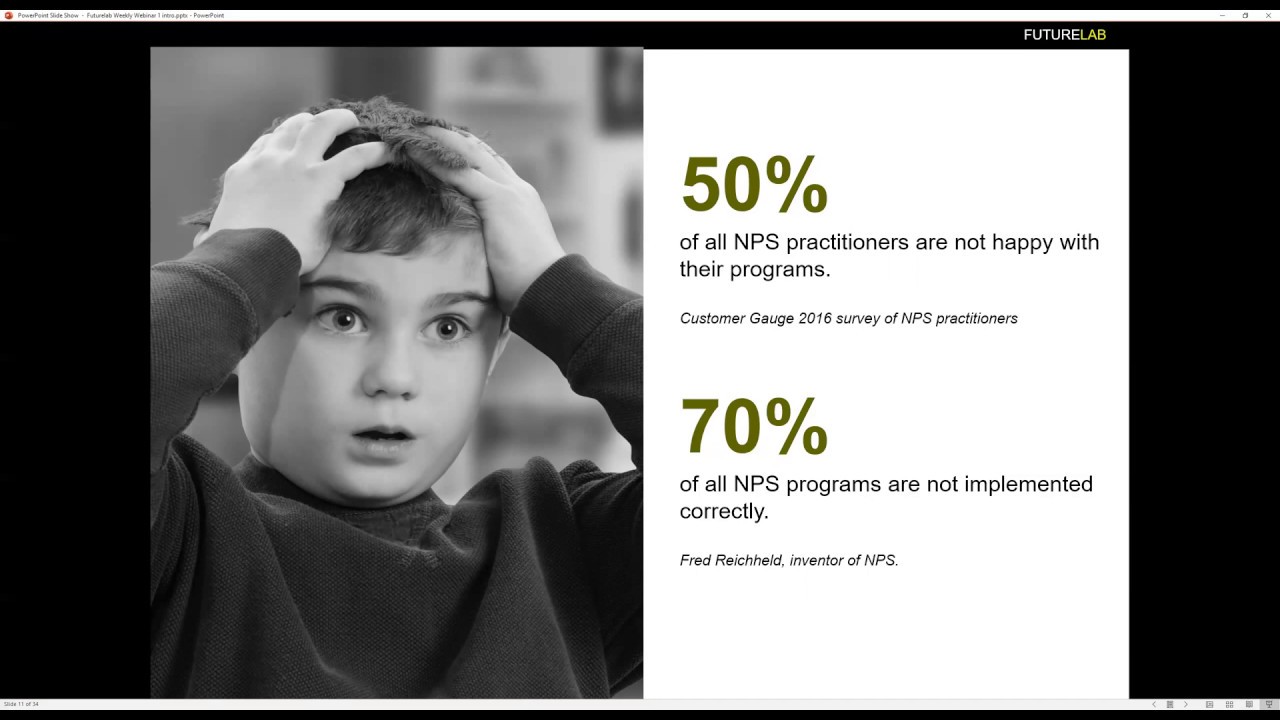
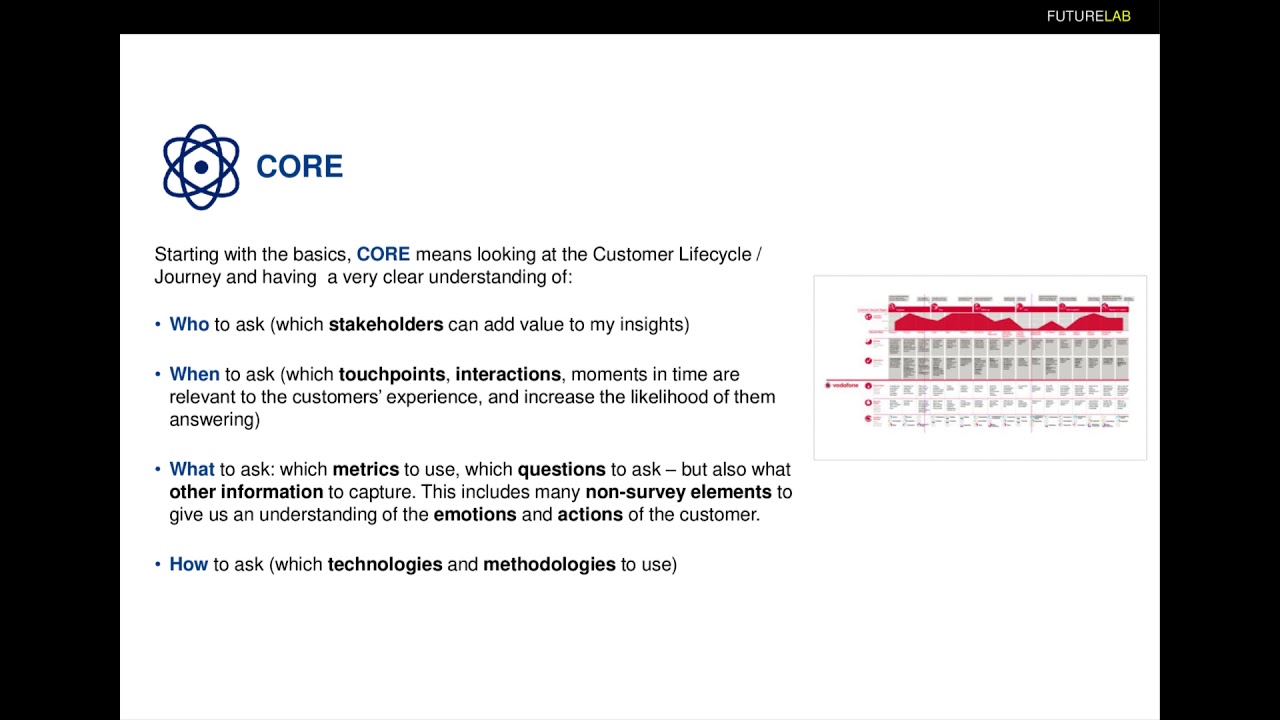
So welcome to this webinar on maximizing the ROI of your VOC and NPS program. We're going to look at a framework that we have developed and some practical tips. It's definitely not going to be a sales pitch, but we're going to share a lot of experience and stories from companies that we have worked with, learnings that hopefully are relevant for you as well. Please make it as interactive as possible. Ask your questions whenever they come up, and I will either answer them directly or answer them at the end. Just very quickly, who are we? Futurlab, we're a relatively small consultancy based in Belgium, but we're very active internationally and we're quite scalable with a big set of very experienced ex-C-level consultants. A word about myself: I'm one of the founders of FutureLab. We've been doing this for over 15 years. I dare say we maybe co-invented the whole terminology on customer centricity and customer experience, and I had the privilege to work with a lot of great and international companies. And from some of them, I will share some experiences. Our philosophy is that customer experience is a very holistic topic, but centered around customer journey management, understanding what is important to the customer, what do we want to deliver by way of experience, how do we fulfill our customer value proposition to the customer, And how do we manage all that? And of course, the first point in being able to do that is to have a good voice of the customer program. So that's what we're going to talk about today. Forgive me if sometimes I use the word NPS instead of voice of the customer. Obviously, the two are not the same, but we use a lot of NPS because we really like it. But there's plenty of other metrics, and I will get into that. a little bit later, how to decide which metrics are relevant at which stage of the journey. So what are we going to talk about today? First of all, we have a very interesting mix of people who are starting out or even just in the decision process on whether to start out on a Voice of the Customer program. We have people running their programs for many years, and we have some practitioners like ourselves. So we're going to try and add some value for each one of those groups. And the interesting thing is that from the questions you asked us beforehand and also from recent projects, we see that the topics that you're dealing with are pretty much the same all across the different levels of maturity. The questions are, how do we get ROI out of the program? How can we prove that ROI to the organization? But also, how do we get— before we start, convince the rest of the organization that we should be doing this, that this is a valuable exercise for the company? Obviously, there are always questions on how do we set up the program correctly, what technology to use, what channels to ask people through, at what time to ask them. What questions to ask, what metrics to use. A big question is, and it's actually one of the core topics that I will be focusing on today, is how to drive action. Because nothing happens if you don't push for action. There's no value to any kind of insights that we derive from the voice of the customer if we don't act upon it. Then, of course, how to get the buy-in from the rest of the organization, and that can be a budgetary element. How do we get support from senior management? But also, how do we convince the rest of the organization to take action based upon those insights? And finally, what we call existence management. How do we make sure the program keeps in existence? How do we make sure that we continuously convince the rest of the organization to keep participating. So all those topics we will go into, and along the way I will answer a few more questions that were dropped during the registration process. So just as the very quick background, I don't think we need to convince anybody about this, but at the end of the day, why are we here? Because we know that a good customer experience brings value to the company, and we need an understanding of the customer, and we need the voice of the customer to drive customer experience. At the end of the day, what we want is happy customers that are so happy that they recommend us, or whatever other measure you want to take. Because if they're happy, if they're so happy that they're likely to recommend us, They're willing to spend more, they negotiate less, they're more loyal, they're more open to upselling, they're easier to service. It's an often overlooked element. Just as an example, in Vodafone Ireland, we saw that there was a difference in cost to serve between detractors, those not willing to recommend us, costing on average €14 a year just to service them in the contact center, while promoters on average cost €4 a year. So that's €9 difference per customer, which for a company like Vodafone Ireland with close to 2 million customers is already a very substantial number. Dealing with happy customers increases staff morale, and we'll come back to that later very specifically because it's a very important point. And of course, they generate new business. Now, again, I don't think I need to convince any of you participating here today, but the question is, if we all believe in this, how come that 50% of all NPS practitioners are not happy with their programs? We don't have a specific number for the broader term of Voice of the Customer, but I'm fairly sure that we end up in the same territory. The answer is already a little bit in the second part. 70% of all NPS programs are not implemented correctly. And there's, of course, like with any tool that you use, if you use it incorrectly, it doesn't work. And this goes from me often when, when I'm talking, when I'm evangelizing NPS, people throw at me, oh, but we didn't get any kind of useful information out of it. Then I asked how they implemented it, and it turned out that it was question number 8 in a 12-question questionnaire, which is entirely against the methodology, or there was no open question, or there was no closed-loop program around it. So there's many ways in which a program can be faulty. We have set up a pretty broad assessment, the VOC Calibrate. I'm going to share that again with you later because it's the first step you can take to see whether the plan you have created for your VOC program is correct or whether there are improvement opportunities in your current program. Again, I will share this later so you can jump right in and have a look how your program is doing. But again, today the focus is more on the question, how do we get the value out of the program? How do we create ROI? To that end, we have developed a little framework that I want to share with you today. It's called the CCC framework. You know, as consultants, we love triplets, we love alliterative titles to programs. So the CCC framework it is. And it starts obviously with the core. The previous page, the assessment, that's all about the core. At the core of the framework, we need to make sure that it delivers actionable insights through the right systems, the right metrics, and the right processes. And obviously I will go into that in more detail in a few minutes. These actionable insights need to be acted upon. In other words, we need to create value. This is, of course, the magic bit. If we create value, then we can create ROI. If we don't act upon those insights, or if the insights are not actionable, we cannot create value, and the whole purpose of the program falls down. How can we create value? By closing the loop. By using direct insights or by using insights to directly drive sales and also to improve operational efficiency. Now, creating the value by itself is not enough. We need to actually prove it to the rest of the organization. We need to show the value of CX and recommendation. We need to develop a business model and we need to implement the right KPIs. And finally, if we have captured the value, if we have proven it to the organization, we need to communicate it. Because only by showing to the organization how those that have initially started to act upon the program have created value, we can inspire more people to also start acting. And this is how we create a virtuous cycle where we ensure that everybody within the company is willing, skilled, and able to drive CX, to act upon the insights, where we showcase success and we start bringing other departments and senior management on board. So let me go into each of these topics a little bit deeper. As I said, at the core of the framework, there's the systems, the metrics, and the processes. I see some questions on NPS. I will get to that when we look at the metrics overall. At the core, as I mentioned it before, we see a customer lifecycle or a customer journey. So we need to determine along that customer journey, what do we want to deliver? What is the way that we prove our value proposition, our promise to the customer through an experience that we deliver? Once we know that, we can decide who should we ask for their voice, which stakeholders can actually add value, which can help me understand how I can improve the relationship with the company. I also need to look at how to ask, which technologies with methodologies should I use. I need to look at when to ask, in other words, which touchpoints, which interactions, which moments of truth, which is an often used term, are taking place where I should engage with the customer to find out how am I doing at this moment. But when to ask also means very practically, if I decided on a touchpoint Should I ask immediately within 5 minutes, or should I wait for a week? These are important questions to ask, and to find the answers to this will build the core of your program. And of course, what to ask, which metrics to use, which questions to ask, but also which other information to capture. So for instance, are there non-survey elements that I can look at to give us an understanding of the emotions and actions of the customer? And by non-survey elements, I mean observations. What is actually happening? How is the financial health of a customer developing in— or how's the financial health of an account developing? Are there sentiment analyses that I can run based on the interactions that the customer has with our contact center. So let's go into that a little bit more. Again, our starting point is always the customer lifecycle map. It's the ultimate management tool, and it's a great way of capturing all the things that I need to know in one overview. I can bring in my data streams, I can bring in the capabilities I need to execute, I can define what are the KPIs. How do I measure that I'm actually fulfilling the customer promise that I'm making? At which touchpoints should I measure? And at this touchpoint, am I delivering at the hygiene level? In other words, am I doing the things that make sure my customer is not immediately upset and will leave? Am I delivering the basics? In other words, am I at least delivering the level of expectation of my customer? And do I have some advocacy moments, moments that drive my customer to say, hey, this was special, I can now start recommending you? And based on that, I can then decide, so who do I need to talk to at each of these stages? Because asking the right person who is likely to answer and has actual insights to offer is a very, very important and not always easy to answer questions. On the left, we're working with Shell at the moment, and for instance, in one of their departments, the gas stations, they're having the problem that they have very little grip on who is actually answering the questions. They're sending surveys a couple of days after fuel, a petrol delivery has been made, or lubricants have been delivered to the gas station. And then they send an email. And either it's a manager who handles 5 stations and a week later has no idea anymore about the transaction that happened, or it is the 17-year-old cashier who's just a school kid helping out. and has no real insight into the transaction. So we need to determine who are the stakeholders that I need to talk to and how do I get their information. Second bit, example that we had with Grant Thornton, where we found that in India, the nice flag on the left, they experienced a lot of problems with the counterpart being too junior and people saying, well, nobody listens to me, I'm not relevant, I don't give recommendations. Or in Dubai, and we hear the same, for instance, from Russia, where people tend to give very good scores because they don't want to embarrass their account manager. A nice example of how it does work is Adela, where— and Adela is a Dutch-Belgian funeral insurance company and also a funeral, a chain of funeral parlors. And there we actually ask the family of the deceased. So the deceased is the actual insured, but we're asking the family of the deceased, you recently experienced a funeral with us, would you recommend us based on that? And I have to tell you that beforehand, I was quite skeptical, but we're actually getting close to 70% response rates and an NPS of 70%. So, in a B2B environment, it's very important to understand the whole range of stakeholders that you're dealing with, but this can be relevant also in a B2C environment. environment? Who should we ask, the actual buyer or the decision maker? Because if that little decision maker on this page decides that Coca-Cola is really not the drink anymore because some people say so in the schoolyard, we need to adjust our approach. How do we ask? This is one of the big topics coming up recently. That response rates are dropping everywhere. The amount of information that we are getting from our customers is dropping primarily through general survey fatigue. So one of the things to look at is, can we start multimodal data capturing? Can we combine the surveys that we send out with observations, with indeed text analytics running through contact center interactions. Can we add in what our employees are saying about the interaction? Like, next time that somebody talks to this customer, they should be aware that she is very open to a rational approach, while this customer is much more emotional-driven. And very importantly, short, interactive, and adaptive surveys. I'll come back to that. So to give you an example, in a Vodafone environment, for instance, one of the major hindrances we see is that they are unwilling to recognize that there is an end to the relationship. At the end of the relationship, people leave, they switch to a different provider, you O2 in the UK example, but we need to maintain the relationship. We need to maintain an understanding how they feel about the leaving process. So there should be customer exit interviews. If you don't have that step in your customer journey, you cannot interact at that touchpoint. An example from the Nationale Nederlanden environment. Where in one Eastern European country some years ago, we saw a major drop at the end of the customer journey of the NPS results. When looking into it, we saw that they were treating the end like a very bureaucratic process. So we asked them, what happens at that end of the relationship? They said, well, the contract is terminated, so we pay out and that's it. But what really happens? What happens to your customer? Well, they're not customers anymore. Come on, people, what are you selling? You're selling life insurances. What is happening to the customer? Well, yeah, the customer dies. Yes, the customer dies. That is what you're selling. And the organization was up to that point not willing to recognize that reality and treated that touchpoint very incorrectly. By switching to a much more empathetic approach, they managed to increase profits by $10 million the next year. Now, when we're talking about, for instance, NPS, but this is just as relevant for any kind of voice of the customer, we really need to look at What are we asking at what stage? So, for instance, in the NPS, the starting point typically is a relationship question, looking at the overall relationship with us. Would you recommend us? Are you satisfied? Are you happy? Did we fulfill your expectations? That's a once or twice annually question, which typically scores much lower than the touchpoint questioning. So, at the touchpoint, We look at, based on the recent transaction or the recent interaction you had with us, how satisfied were you there? How did we manage to fulfill your expectations? Did we make it easy to do business with us? So we're asking different questions to different people in a different environment. However, I see in many companies that these two are mixed up. Well, in reality, I see at one of the telcos that we work with, their touchpoint NPSs are typically around the 60 to 70%, while their relationship NPS is in the low teens. Same customers, but it's the overall relationship versus the one touchpoint that gets improved. And now to get to your— to the little chat that's going on. In the chat box. We have a little handout which I'm going to send out to you, which is about which metrics to use. It's a topic that we will gladly do a whole webinar on separately, because what questions to ask drives a lot of value of the program and also drives the KPIs that you use. I've been mentioning NPS a lot because we think it's a great starting point. But as Elena, for instance, pointed out, it may not always be the best on its own. NPS in a B2B environment, for instance, is not suitable for a touchpoint questionnaire. It typically, as the touchpoint engagement is typically with much more junior, much more operational people within the organization, it doesn't give us as solid outputs as the relationship NPS, which happens at a senior level. So NPS is a good measure, but it's not the be-all and end-all. There are also questions, for instance, very important question to ask is the customer effort score. How easy was it to do in doing business with us? Or the customer experience— the customer expectations, sorry, customer expectation measurement. Did we manage to fulfill your expectations? Now, what question is the right one is different by the touchpoint, by the company, by the industry. But the key thing is, does this question help us to take action, because at the end of the day, it's only about action. So don't ask anything that you will not use. Don't ask anything that will not drive action within the company. Also, because it is essential to stick to the basics, which is we need short questionnaires. And it's interesting how many companies over the years, even the best implementations of a voice of the customer program over the years, start losing this basic element out of sight, and they start increasing and adding to the questionnaire. One of the key elements driving the typically high response rates of an NPS or a good VOC program is that we can say with confidence to the customers, 1 minute of your time, maximum 2. Example of one of the automotive companies we worked with, they had a 12-page questionnaire, which typically got 0.6% response rate, while switching to a 1-minute survey improved the response rate to 20%, more than 30 times as much. And the thing is that those people who have the time to answer the long survey may not always be the average customer. Also very important to have enough open questions in there, whether your first question is NPS or CES or customer expectations. Make sure that you ask open questions, not just closed questions, because that's where the value comes from. That's where the customer tells you how you can close the loop. So if you pull all of this together, if you have the who, how, when, and what thoroughly sorted, you can create a data lake where all this information is pulled together and allows you to do predictive analytics. How is this customer doing? How will he be doing in the future? Where do we need to jump in? And that's where the fully mature programs at the moment are moving to. It's a big topic again, It's a very far out there ultimate perfect system. I'll gladly do individual conversations to explain this a bit more. And looking at this multimodal input, we need outbound surveying, we need to capture soft and unstructured data, we need to capture the voice of the employee, and we need to observe what is happening. And at the end, we need to make sure that The data is put back into the frontline systems. That's one of the major breakdowns— unconnected systems and people not seeing the actual insights that we're generating. If we do all this, then we enable the organization to create value. We have a couple of core elements there, and I want to show you some examples. First of all, we keep emphasizing the closed loop, which is of course just a more extensive term for taking actions, is the key to any voice of the customer program. We're getting this feedback, and on the one hand, it allows us to immediately follow up with the customer, but also with the team. Somebody gives an answer in the open questions that allows us to immediately act. Just last week, we sent out a survey for a building materials company, and it came back. The first answer we got back was, Andy, pick up the bloody phone. It's of course a somewhat comical example, but it is the kind of answers that you get. You also get the, well, I'm not so happy about your ordering process, but what John and Mary in the location Basingstoke are doing is really fantastic. It's a great way to feedback to the team, you're doing great. On the other hand, there's the strategic closed loop, which is about identifying root causes. What is causing the problems that we're seeing? It spreads across multiple functions and departments, and it indicates where we need systemic change. But you see very big at the bottom, quick wins. There's always quick wins. That we get out of a good voice of the customer program because it triggers customers to tell us that they're about to leave, that they're unhappy. So closing the loop really drives the ROI. It's a direct voice of the customer instead of blind averages. We've all seen these reports, we're scoring 4.5 on average delivery happiness. That doesn't help anybody to improve the customer experience in any way. It allows us to solve issues immediately on the spot. It gives the responsibility to the people in the front end to solve things on the spot. We can pick up dropped leads and even upsell on the spot. We have many, many examples of that, and I'm going to share one with you a little bit later. Also very important, just to get back to people and say, we heard you, is one of the most powerful elements of a voice of the customer program, because many people feel that they're not being listened to by an organization. Simply listening to them and showing that you listened often solves half the problem, if not the whole. And of course, it also helps us identify those people who are so happy with us that they are willing to go out and recommend you and help us deal with that. So an example, when we rolled out a program for Toyota, we first ran a pilot in 3 countries, and after the pilot ended after 2 months, the dealers themselves said, please keep going, we're willing to pay for it. And anybody who's working with the dealership network will know how exceptional that is. They saw that they were selling more cars by closing the loop. And in B2B, a beautiful example, Sonnebraun Germany, where several salespeople, when they see that the customer gives them a 9 or a 10, but they also see that the share of wallet is below 50%, they really just pick up the phone and say, hey, Thanks for the great score. So how can we make sure that the share of wallet is equivalent? And they're actually cross-selling and upselling on the spot and have generated several millions more in sales. So I'm going to speed it up a little bit. I'm a little bit behind on timing. Please take your time afterwards to also look through these slides. The key thing is check out the verbatims and spread them through the company and see how everyone within the company can act upon those verbatims. The beautiful example from Weber, the barbecues, where in Germany we ran a pilot program a couple of years ago. What we got out of that was almost a third of the people Giving answers along the lines of, would I recommend you? Well, I did. I've already sold 3 grills to my friends and family. And why? Because the meat tastes so much better. Now, I'm leaving aside whether the meat does actually taste better, but that's the customer's perception. That's what drove them. And until then, Weber had a typical advertising program based on a celebrity chef, of Obviously a German celebrity chef, not Gordon, but everybody knows Gordon. But they dropped that and turned the saved money, which was millions, into experience programs. Rack up the number of grill nights at garden centers, allow people to run their own grill nights. And that helped double sales in 3 years' time because they focused on what are the customers telling us what they really appreciate. We also asked the second question here, what can we do better? And even if you don't understand German, I think you see the one word price coming up constantly. But you also see these were people who actually scored 9s and 10s, who said, I have recommended you. In other words, price was not a real issue. It was the default that they fell to. So see the difference between having a tick box where you say, should we improve price, delivery, quality, or whatever? Everybody ticking price could give you the idea that you're having a price problem, while the reality was they have no problem whatsoever and people are just joking about the price. So adapting your marketing and your sales to what people tell you is your real strength is a great output of a good voice of the customer program. And by the way, it's also about operational efficiencies, and I always emphasize this. It's about knowing what matters to the customer, and maybe you can stop doing certain things. Daimler stopped producing a very expensive guidebook that it turned out people were not appreciating at all. But also in contact centers, by having a better approach, you, for instance, reduce employee dissatisfaction. It's very, very unpleasant to be yelled at all day long, and I mean that very literally. We have this in an automotive call center where people got yelled at constantly, and it made them sick and unhappy. By reducing that, you reduce your staff turnover, increase and reduce a lot of associated costs. All in all, we have 8 ways, probably many more, but we have developed a nice 8 Ways white paper, 8 ways to use NPS or other voice of the customer to add value to your business. I'm sharing that as a handout again. So once we have created the value, we need to capture it. And the key thing is, if you use an ROI model in the company, make it useful. Don't strive for perfection. That's what I've seen most, that ROI models never were created and never landed because people try to make them perfect. The basics of the program are still customers are happy and are then willing to spend more and have more value for the company. So as an example, a little model that can be created by anyone in 10 minutes on the back of an envelope just to start the discussion is making a simple calculation on, and I'm using an example from the car industry, a luxury brand here, look at how many items somebody would purchase over a lifetime if they're extremely unhappy or extremely happy, how much margin is being created, and what additional margin drivers would trigger it. And what you see is, okay, wonderful, there's a basic business case here already where a promoter already creates 4 times as much customer value. However, if we look at the word-of-mouth impact, how many customers do unhappy customers stop, or how many new customers do happy customers bring, Suddenly we see a completely different number where there's a huge differential and the detractors actually cost us money. Do this, take 10 minutes and sit down with your colleagues and then go to the CFO and ask him whether this is wrong. It's not perfect. It might be 50% off, but you will see we've done this in 40 companies by now that the basics are A great way to start the conversation. Do we collectively believe that CX is good and that the value of a VOC program can be proven? Based on that, you can then start developing a real program. How that looks, of course, depends very much on your industry. Here's a little example from the telco industry, but we'll gladly give you some tips about what could work for your industry. For instance, we're developing a whole ROI model for a major B2B player at the moment. Talking about B2B, sometimes it can be very simple. One of our B2B customers, average detractor has $60,000 in turnover, the average promoter $100,000. So simply Look at what does it bring us if we start shifting customers from one category to the next. Don't make it too complex, make it such that anyone in the company can understand it, that the driver can understand it. And that's why we use that very simple model at the beginning, anybody gets that. Now, a very important element in proving the value is also challenging the KPIs. KPIs are the bane of my life, I would like to say, because if you don't change the KPIs, nothing will change within the company. Nobody acts against their own interest. The key problem is that when a measure becomes a target, as Goodhart's Law says, it ceases to be a good measure. People only start acting upon that target instead of what's underneath it. And a beautiful example of how KPIs can drive unintended consequences. We saw one of our customers had their contact center where the rule was a case needs to be closed within 8 days because otherwise customers will be unhappy. So what happened? Agents closed the case on the evening of day 7, whether it was actually closed or not. So a lot of customers came back. The next day, very unhappy, saying, but I still have a complaint, but now it was a new case. So a best practice example was the Mercedes-Benz CIC, the global contact center, where we actually did a round of kill the KPIs. We asked the agents to identify those KPIs that they felt were stopping them from delivering a good customer experience. And there were a lot of useless or unused or unhelpful KPIs in there which could be removed. And it was an incredibly strong signal to the agents, we're taking you serious. Good KPIs need to be customer-focused, they need to be action-oriented, and they need to be integrated. So finally, we need to communicate. the value to inspire more people. People need to want to be customer-centric. Now let's be clear, nobody is deliberately not customer-centric. Nobody gets up in the morning and says, look, I'm really looking forward to annoying a couple of customers today. But they need to be willing to take that extra step. We need to convince them in their heads and in their hearts. The heart bit is usually very difficult. relatively simple. But the head bit, that's where, for instance, we need a good business case. We need to make sure they're skilled, and we need to make sure they're able— that they are empowered to do what is the right thing for the customer. As I said, every employee wants to act on the customer's voice, but for instance, major problem in voice of the customer programs is that the communication around it is boring at best. Hundreds of slides with percentages. Make it practical, make it concrete, bring it to life. At ING, you see a slightly mangled visual there from ING, who every week highlighted one topic and really brought it to life to the employees. At Grant Thornton, They put verbatims from the customers onto the lock screens or the screensavers to continuously show the people within the company what the customers are saying. At Daimler, they're putting them on the customer verbatims on the big screens that are hanging everywhere in the company. And a beautiful example, it was the first NPS program we ever implemented at Philips. And we had a moment with the global board, including Mr. Timmer at the time, the CEO. And we took 6 NPS results, 6 verbatims of people who were really unhappy, and we did 10-second videos with them. And the first video we showed was a customer showing his middle finger and saying, Philips, you suck. And everybody froze and was afraid that Mr. Timmer would get angry, but he actually started laughing like mad and said, I want this video to be shown in the whole company. You have to bring it to life, and nothing brings things better to life than the real voice of the customer telling you what is wrong, or also telling you what is good. And if you've actioned it, tell it, both internal and external. A lot of companies completely forget to actually feed back to the customer what they've done with the feedback. You have the individual, The tactical, hey, we heard you, we're dealing with it, we have a solution. But you also have, for instance, all the customers who say, oh, you're really great. Now in the future, you could maybe improve your webshop a bit. Tell them if you did. Tell them, hey, you gave us some of your time and we acted upon it. We take you seriously. It's a really important element in closing the loop. And internally, You will find when you try to establish your program, there are ambassadors, there are people who say, oh, this is fantastic, give me this stuff, I want to act upon this, I want to make sure that we improve the customer experience. Bring them together, let them talk to each other, but also support them, make sure that they become successful. And based on that, switch on the spotlights, really focus on telling the world, telling the rest of your organization how great they did in acting upon the voice of the customer. That's the way you start inspiring more people within the organization to do this. And the best way is still empowering them. Example again from the Mercedes contact center where they set up a test lab where they put some experienced agents in and gave them all the freedom in the world to solve customer issues. That came out great, big customer experience improvement, customer happiness improvement, but also employee happiness improvement because it was much nicer to do this. It was such a success that they're now running it on a country basis because we see if you take a holistic view and actually look at how much the handling of a case costs the company as a whole, even the extra time spent by the individual agent pays itself back for the whole organization. It's also a business case we're building there, and if you want to know more, please contact us. So That was a lot of material I went through and a bit high-end at times, even though I tried to sprinkle as many individual stories through it. But I really want to make the case that if you connect all the elements of a well-set-up program with creating value through taking action, proving it to the organization through a good ROI model and adapting the KPIs and communicating that value. That's how you make sure that your program stays in existence and really delivers ROI. And when you're just setting up your program, think through these elements. At the end of the day, you need an integrated approach. Now, as I said, we have a beautiful program assessment that I'm sending the link to right now, and I would urge you to have a look at that. As we know, you are under pressure. You are way too busy. Too many things are being thrown at you. You probably work in an organization that's implementing lean and agile. It's hard to focus on these things. Please talk to us, book a call, send me an email. Um, I can— it will not be a sales call. I don't do that. Send me your questions and I'll gladly talk you through some answers, some approaches on the phone. Um, one of the companies that participated in the previous webinar said, look, it's all a bit high level. Can you make it very specific for us, a big B2B industrial? I said, sure, let's set up a separate webinar with you and a couple of colleagues where we can really talk through your specific situation. I'm very happy to do that with any of you. So that brings me to the end of my presentation. Let me look back at some of the previous questions while the platform is open for new questions right now. So a lot of discussion was at the beginning about NPS. I know there's a lot of criticism about NPS, and there are scientifically better methods to measure certain things. However, a major attraction point of the NPS is its simplicity, particularly to start off a voice of the customer program. There is no better way of doing that. Once you're mature, you can start adding other metrics in, maybe at some point even retire the NPS for parts of your program. But as a very simple starting point to create an awful lot of great customer feedback verbatim that you can really surprise the rest of the organization with, where you can, for instance, capture accounts at risk, capture, look, we're really losing customer satisfaction at these 2 or 3 big burning platforms. It is unsurpassed also because it's simple, fast, and relatively cheap. to initially implement. So I am a big believer in starting your pilot, starting your proof of concept with NPS, and then take it from there. A question about doing sessions with a room full of customers and doing voice of the customer directly. Yes and no. In a way, that is, of course, one of the typical things we do in folks groups, which have a bit of a downside that a loudmouth in there, someone like me, might be too dominant towards the group. However, I've seen fantastic examples. I already mentioned ING or Nationale Nederlanden. As they are now called, who actually did this in the sense of calling people. They got verbatims, they pulled together a group of 30 people within the company and started calling these people. And the 30 people were the ones who didn't believe in the value of voice of the customer. And they called up the customers who were, first of all, blown away that somebody listened to them and gave incredibly valuable feedback that convinced the people within the company that there was value to this. So again, having a lot of customers together has its downsides because not everybody might be willing to speak. But if you set it up well, and we've done, for instance, with Nokia at the time, great events, whole customer days where we brought in a lot of customers, Now, Nokia is maybe not such a great example because they didn't do much with the insights they were given, but the insights were very valuable. How to calculate NPS in a B2B context with lots of different contacts per customer and substantial difference between the value or size of customers? This is, first of all, An average NPS is a very hard calculation to do and often not the right thing to do. So for instance, in some of the B2B companies we're looking at right now, we're looking at a much more, much broader way of pulling together the metrics and in a way that we call an account health approach, which includes the NPS, but also the customer effort score, the actual transactions. Are they buying more? Are they buying less? to get a proper insight. Because the problem when you use a singular number, whether it's the NPS or another number, is that people start focusing purely on that number. Did we make the number? And they don't look at what's beneath. So the NPS as a score is a difficult topic, and particularly, as you say, in a B2B environment, It can be complex. So I see a lot of B2B companies actually moving away from the singular NPS as their measurement or as their metric. Secondly, there's indeed a major difference between value and size. So one of the things you may want to consider is indeed a weighting, weighting as in taking the different weight of the accounts into consideration. The problem is that you open up— opening up a can of worms of political interests where people start trying to manipulate the weighting to reduce their KPI requirements. That was a lot of words. Did I actually answer the question in a helpful way? And do we have any additional questions? 2 or 3 questions that were dropped previously in the registration process about response rates. I think I looked at that a little bit in a sense of Indeed, response rates are dropping, even though NPS and other short voice of the customer surveys do still give a pretty good response rate, sometimes up to 60-70%. We see them dropping, and particularly in the B2B environment, they're getting low. So we need to look at a broader way of assessing the customer's happiness. 2 more questions we have here. Thomas, yes, it's a very concrete paradox that you say if the focus becomes too single-minded on the score, that's where the value of the concept as a whole comes into gets into the danger zone. So we really emphasize, do not have this single-minded focus on this score. It's that simple. At one of the insurance companies we work with, the score is one element, but there's also the how many actions did you take? Literally, how many actions did you take with the recommendations on 3? It's very personal, very concrete, very practical for people to latch on to. In some of the automotive, because they have a bit of a tendency to start playing around with the score. I think all of us have experienced this moment that a car dealer shows you that it would be really good if you scored a 9 or a 10. So maybe the focus should be more on how many people actually responded, or how many loops did we close, or what results that we get out of the closing of the loop. In a B2B environment, do we have multiple stakeholder contact data and multiple stakeholder feedback? Maybe that's what we should reward account executives on. Well, that's actually quite literally— Peter gives a great example of what I just said. Ratio of senior customer contacts invited. And response rate. That is a perfect KPI to put in there because it does not put the pressure on getting false positive feedback, but allows for really getting valuable insights from as broad within the company as possible. Then there was also the question from Tatjana. We showed a simple ROI case. Is that simple case enough to establish the whole program structurally within the company? No, but it's a simple way of getting the conversation going because once people have seen this and ideally they have co-developed on the back of an envelope in 10 minutes these numbers, they start supporting them. And it's this underlying— yeah, how do you call it? The numbers so speak for themselves that everyone within the company starts latching on to that. Then you can start engaging with the financial department and say, okay, now everybody believes in this. Let's start generating first data and let's see how we can start strengthening this model and make it bigger. Now, Peter says, would be happy to discuss further. We're reaching the official end time. Obviously, we could go on, but let me emphasize again, please send me your questions, have a call, invite us for an additional direct webinar with the people within your organization. We have much more to share. We have much more concrete and practical things to share. And keep an eye on future webinars because many of the topics that we touched upon, we will dive deeper in a future webinar. So unless there are any other immediate urgent questions, I'll leave 10 seconds for that. I will end the webinar now, and thank you all for your participation and for your great questions.
More from Stefan


Voice of the Customer for our smallest customers - a presentation at the Toy Forum in Nürnberg, 2025

6 Herausforderungen beim Kundenfeedback – und wie man sie 2026 mit KI lösen kann


Futurelab Weekly Webinar: Core-How to start the process and establish who/when/what/how you will ask