How To Speak Like The Top 1% Closers
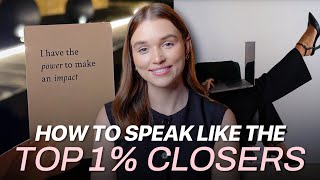
Shelley Young breaks down how top 1% sales closers talk differently: they control their emotions, speak less to stay authoritative, ask open diagnostic questions, and lead conversations instead of following. Four practical traits that improve closing rates.
Chapters
Hi guys. Welcome back to my channel. In this video today, I am going to teach you how the top 1% of sales reps speak. Because if you haven't guessed it, speaking is one of the most important parts of our job. It is super important to know how to communicate effectively, how to converse with other people, and how to really use your communication to close deals. So let's get into it. Number one, the top 1% of sales reps know how to control their emotions. This is very, very important that you can learn how to control and regulate your emotions. Without this, you're going to lose many deals, you're going to make prospects feel uncomfortable and just overall you're not going to be very successful in sales. And what I mean by this is if a prospect is not taking the call in the direction that you want it, that's okay. If they give you an objection that you're not expecting, that is okay. If they do not want your product or service, that is okay. If we try and fight, if we try and combat, if we get agitated at a prospect, that is not okay. We are having a human to human interaction. It's not always going to go how we want. It's not always going to go perfectly and to plan and we must, as sales reps learn how to regulate that emotion to actually gain success, to actually get the prospect to where they want to be, to make the prospect feel comfortable and to ultimately lead them on the path that they want to be on and to close the deal. So for example, if a prospect tells you that they want to think about it instead of going, but you told me you want to do this. You said you want to do it today. It's now or never. La la la. Instead of being emotional and combative, we would answer that such as, yeah, totally understand. I'm curious, what is it that you want to think about it? Just to see if I can help? There's a massive difference. There's combative and there's calm. We need to be calm. If you're someone who gets very chaotic very quickly, if you're someone who loses your cool very quickly, if you're someone who can't control their emotions and get very combative, then sales probably isn't for you. Unless you're prepared to change, unless you're prepared to unlearn those bad habits. Because if you want to be a woman in sales, you need to lead with that softness. Yes, we want to be the leader and we need to be a bit, I say slappy sometimes, but ultimately we want to lead in our feminine we want to be cool, calm and collected. That is how we build trust and close deals. The next thing the top 1% of sales reps do is they speak to lead. Remember, you are the leader, you're not the friend. You cannot go into these calls, giggly and chatty and very casual because you're going to lower your status, you're going to lower your authority. You are the leader. You are there to guide a prospect whether you know it or not. Whether it's B2C or B2B, that person has a problem and they're coming to you for help and they need your help and they need a leader. And it is your job to lead. If you can't do that, and if you're too busy trying to be the prospect's friend, you're not only doing yourself a disservice, but you're also doing them a disservice. In order to speak to lead, you need to have confidence and conviction in yourself. You need to know that you deserve to be there, that you are capable of doing the job. And I hear this far too often that the person doesn't have or the sales rep doesn't have the confidence. So they don't challenge and they don't lead because they don't think they're good enough. Or as women, as a young woman, we're speaking to maybe a 50 year old man, we think they have much more life experience than we do and we don't. We're not in a position to lead them. But that's totally wrong. I have closed many people who are double triple my age because I've led them. I've understood their problem and their pain and I have taken control and helped provide them with a solution. All anybody wants when they're not where they want to be is a solution. They're coming to you. So it is super important to remember that if you ever feel like you don't deserve to be there or you're not where you want to be, it's probably because you're not congruent. It's probably because you're not showing up for yourself. Maybe you haven't invested in sales training or maybe you have, but you're not making an effort, or maybe you're not not doing the reps that you promised yourself you would. Stick with your promises, give yourself a pep talk and I promise you, you will be more confident. Confidence leads to conviction and that will help you become the leader you want to be. The third trait that the top 1% of sales reps have is they have authority in their calls. Speak less but mean what you say. Again, speak less but mean what you say. Do not over explain yourself. That is the worst possible thing that you can do in a sales call. You should be the person speaking less and your prospect should be the ones who are over explaining themselves. If it is the other way around, there is a serious problem and that's probably the reason your calls are too long and you're not closing many deals. You need to learn how to say less. If you watch any of my sales calls as of recent as I've perfected and honed this, you are going to see I am very cool, calm and collected. I am casual and I let the prospect do the talking. I lead subtly, but I let the prospect take over and tell me their problem. That is the best way you can guide a prospect and keep your status and keep your authority. You need to ensure that you're having interesting, not productive conversation. That is super important when you're communicating. You don't need to finish off with I hope that makes sense. Or does that make sense? It does make sense. Instead use sound fair or fair enough. That is going to be a much, much better and clear cut way of ensuring that the prospect follows. So another example could be I hear a lot of people within their intros on a sales call say things like, hey, lovely to meet you, thank you so much for your time. Wrong. We should not be thanking them for our time or them for their time. Sorry, they booked a call, they need help. They should be thanking us for our time. That's how you should view it. You are the leader, you are the authoritative figure. Instead, just say, hey, lovely to meet you. The first part of this call is really just for me to spend a little bit of time getting to know each other, so on, so forth. I have a whole framework training that you can look to see how I would intro a call. But the point is we're getting straight to it. We're keeping authority, we're keeping leadership and service certainty so the prospect knows and feels confident that they're in the right place. And the final trait that the top 1% of sales reps have to communicate effectively is they learn how to ask the right questions. The way you ask a question will dictate whether you make a sale or whether you don't. Because if you're asking closed questions, you're going to get closed answers. I cannot stress this enough. You only have 45 minutes to take a prospect from a complete Stranger into buying a product. You need to learn why you're asking the questions, how you're asking the questions, in what order you're going to ask your questions, and how to effectively get the best answers. And the way you're going to do this is by open and closed questions. Closed questions are the worst possible questions that you can ask. And closed questions means you're typically getting answers like yes or no. When we actually want detailed description so we can uncover a problem quickly and solve it. So an example of this would be, how's it going in your business? That could be, oh, yeah, it's going good, or oh, it's not going great, that's it. That would be a normal answer. Whereas instead, if we say, so help me understand, like, what is the biggest problem in your business right now? That is going to give the prospect the space and the floor to open up, to communicate, to give you the answers that you need to help them. What I would heavily advise is to look over your script, look over your framework. If your questions are often yes and no questions, speak with your mentor and get them to help you create open questions, get them to absolutely be able to create that framework so you can get the prospect to open up. That is exactly what I do with the students inside my program. I help them create a script and a framework for the company that they're selling in so they can get the most effective answers to help close the deal and obviously make more money. And that is it, guys. They are my four tips to help you communicate more effectively, to help you close more deals. This will, by far, if implemented, give you a lot of confidence and a lot of conviction if implemented and obviously used correctly. If you've got any questions about any of these tips, as always, leave a comment down below. And if you are a woman looking to get into sales, or if you're already in sales and you're looking to take your career to the next level, I'll leave a form down below, fill it out, book a call with myself personally, we can get to know each other to see if I can help you and see if I can help you reach your, your goals. I'll see you in the next one. Bye, guys.
More from Shelley






The Girls Buying The Bags Aren't Influencers - This Is What They Actually Do.