How To Be Good Either Way in Relationships (Even With NO Boundaries)
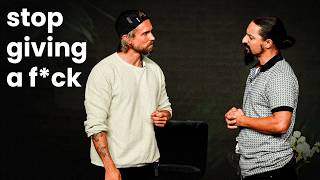
Aaron Doughty coaches Andrew through his relationship patterns: strict boundaries rooted in childhood neglect, fear of abandonment, and the need to be needed. They explore how these control mechanisms show up as tip-toeing or rigidity, and how meeting his inner child with love can shift him toward authentic presence instead of drama.
Chapters
Here's the boundary. No talking to other guys. Yeah, right. I don't— I'm not worried that they're going to talk to anybody else. I'm not worried. But you better not cross the boundary.
Well, what I mean is I'm not worried that they're going to leave me for somebody else.
But is that true?
Somebody and they think they're better, good for them.
Is that really true, though? Why do you need to set the boundary if that's true?
I guess because it's happened before.
Okay. Yeah. So it's happened before. Sure. Yeah. So the fear of cheating, you know, did you— so was it that you didn't set boundaries before? But now if you set the boundary, then it's not gonna happen?
Not necessarily, but that's—
Exactly.
Yeah.
Exactly. Is that interesting, right?
Right.
Because you can set the boundary and set the frame, and that may come off as control. You know, the key here, I believe, is the connection to vulnerability and actually being able to express what's coming up. Like in the moment, it's like, okay, I don't want the chance that you're going to "not be with me anymore because you're going to talk to some other guy and I'm not really worried about it, but don't talk to anybody else," right? So deep down there may actually be a fear there, but also if you were really cool either way, there could be still a level of vulnerability that comes up where you still express what you're talking about. I'm not saying that you have to have no boundaries in relationships or you can't express yourself. What I'm saying is the energy from which it comes from is important. Because if you could express it vulnerability-wise for what's coming up without the shame of like, better not do this— it's like, if I can control you, then you'll do what I want you to do. And you're trying— what are you avoiding?
Well, I guess part of it is, uh, investing so much in the relationship and investing so much time and energy, uh, money, you know, uh, and then to have that be, you know, for what is this also gonna be reciprocated, or am I really just wasting my time?
So are you really wasting your time? It's the energy that you're putting into the relationship and you don't wanna waste that time.
Yeah. And then there's the thing of having to go through this whole healing process and all this all over again, right? And you're like, okay, now we've done—
So can you feel though how a lot of this is just different mechanisms of control?
Sure.
Right. There's an avoidance of wanting to feel— maybe it's abandoned or rejected. Maybe it's— what is the fear there?
Well, forget abandoned, rejected. It's betrayal.
Betrayal. Interesting. So is it— is there— where does the energy of betrayal connect to earlier on in life?
I don't know.
So if it's coming up in your relationships, Is that right?
Yeah.
So it's coming up in your relationships. You know, with some of these patterns, by the way, you don't have to understand exactly where it comes from, from childhood. It can be beneficial to understand because then when you see it's a pattern, you stop trying to control the people because you realize that this isn't necessarily just about people, it's about a pattern, right? And betrayal. So betrayal is an interesting energy because betrayal is an energy that's a very heavy story. It's a very heavy story. I remember once watching Eckhart Tolle talk about this where somebody was asking Eckhart like, how do I get over betrayal? There's betrayal, I was betrayed. And he sat there and he goes, ooh, betrayal. I was betrayed. It's such a heavy story. That heavy story, "I was betrayed. This person did this." It's a very heavy thing that ultimately, if you break it down to the core, is a very neutral thing that we give lots and lots of weight to because we're avoiding the pain that comes from what the betrayal means. Do you guys see this? So the betrayal is also a very heavy story. It's a very heavy story. So there may be a story there, and maybe that story is, they better not betray me, so I'm going to do all of these things. I'm gonna set the boundaries, 'cause if I set the boundaries, that might be my breakthrough. And then if I do that, then this person will never leave. And if they never leave, then I can feel good. I don't have to do all that healing work. You know, I wanna do all that healing work off to the side. I've been doing lots of healing work. I don't wanna keep doing the healing work. But the thing is, is what we end up doing is we end up continuing to, we're just continuing to control. We're continuing to control. So what do you think is maybe the deeper thing here for you? We take this a layer deeper 'cause we could talk like all of this is a survival mechanism that the ego is using to control reality. Ultimately, when you're with the right, not the right person, but when you're integrated in yourself and you do attract a reciprocal relationship, there could be a level of trust there to where you really don't worry about that at all.
Yeah.
You see that?
Sure.
There could be, it could be that that boundary doesn't really need to be set because you feel certain within yourself and you feel certain within your relationship to someone else.
Well, and that makes sense. And it comes to meeting somebody with a similar amount of trust, right?
Yeah.
But yet that's not what I'm attracting.
Well, I wonder why. I wonder why do you think? Why do you think?
Well, it's interesting to me because, like, say in the most recent relationship, that I came in with a whole lot of trust. I did a whole— I did years of, you know, what do you call trust? Trust is that whatever happens happens. I'm okay. I'm okay with whether I have it. I'm okay. Yeah, I don't, you know.
Well, you're saying— you're saying that, but at the same time, there are these mechanisms in place that negate that.
Well, Well, I trust, and I've been like this most of my life, is that I trust first until you give me a reason not to, you know? And my heart is very open and I trust somebody even when I shouldn't, you know, even when people have told me, hey, don't trust this person, it's already like, you know, they've done this stuff. But that's not between me and them until it's something now I have a reason not to trust. And so then as the trust gets broken little by little—
If you're honest with yourself, is it normally that— can you normally like intuitively feel whether you can trust someone or not? And there's this energy where I'm just going to trust them because that's good. That's just a question to really reflect on. I think a lot of times we have like an intuitional thing about whether we can trust someone or not, whether things feel on or off, but then we kind of like gaslight ourselves into like, oh, well, I'm gonna give them, I'm gonna be very, really tolerant for this person until they give me a response or a reason.
By doing this, by saying like, okay, I've heard and I've talked and I've heard your story and I see that there's strong reasons to not trust because of the past, right? From what I've learned about you now, but yet I'm going to do this great thing and I'm going to give you trust and—
Wow.
That you didn't even earn. And I'm going to help you heal, right? By doing this, you're going to feel this level of, wow, I can be better and I am doing well.
And you're gonna be so amazing that they are never gonna leave. Do you see that? And you know, you're gonna be so awesome that your high level of trust is gonna help them. They're then gonna trust, and then they're gonna— they're never gonna leave you. How does that feel?
Like a fantasy.
Yeah, but yet when you ask the question, you're at— your question was around— what was your question initially around?
The need to be needed.
The need to be needed. The need to be needed. So the need to be needed, what is that connected to?
Ego.
Yeah, well, I'm at like, like the need to be needed. What part of you wants to feel needed? What part of you doesn't feel needed?
What part of me doesn't feel needed? I don't know.
Maybe dig a little deeper. You might not consciously know in this moment.
It doesn't feel—
What part of you feels not needed?
My heart, my love.
Okay. Your heart. What if right now you were able to give the awareness? If you all were to imagine right now, imagine you have a house and you're in this house and what happens? Is you get a knock at the door, you get knock, knock, knock. What happens is you come up to the door, you open it up, and what you see is a part of your own consciousness, a part of you, an inner child part of you that feels a certain way. And what happens is they may have the emotion, they may have shame, they may feel needy, they may feel not worthy, they may be people pleasing, something we were talking about earlier. And what happens is you open the door and you see them. And what do a lot of us do when we see that? Shut the door, right? How do I get rid of this inner child, this needy, pathetic inner child? How do I get rid of it? I'm gonna shut the door, go over to the neighbor's house, go play in the garden, but don't come here because you to me represent this part of myself I don't wanna look at. So what happens is we end up avoiding that emotion. We end up avoiding that part of ourselves. So what might be happening now for you is you are becoming aware of this need to feel needed. How do you relate to that part of yourself? If there's a part of you that has a need to be needed, how do you relate to it?
By self-care, taking care of myself.
How have you been, how have you been responding to that? Relating to it?
Like by doing that self-care type of stuff that I feel like I can relate to it with?
Yeah. You know, well, it sounds like it was a chat. You raised your hand asking the question about it. I imagine it's like everything's going well. I do the self-care for my needed child or whatever, or whatever this part of you is. But what I'm saying is, how do you relate to that part of you? Like if you were to imagine you open up the door and you see, is there a part of you that has the need to be needed from the past. Can you see where maybe that was a part of you that felt that way?
Sure.
Okay. Now imagine, imagine right in front of you right now. So what we're doing right now is we're connecting to our active imagination. Our subconscious mind speaks in the form of symbols. All right. So what happens is we can try to control our reality with our language. We can try to control it, which is powerful because certain language carries certain beliefs. We can consciously think thoughts, we can consciously visualize what we want, but it's all coming from the ego construct of trying to control. The subconscious mind, which runs 95% of our life or more, speaks in the language of symbols. So this inner child part of you, we're gonna play imaginary land right now, just like you did when you were kids. If you were to imagine there's a part of you that feels, The need to be needed. How does that feel? There's a need to be needed and maybe feels unwanted. Would you say that? Sure. So maybe there's a part of you that feels unwanted. Your sister had to take care of you growing up. Where was mom and dad?
Working, things like that.
Okay.
Just not present for their having their own.
They weren't present.
Their own stuff, yeah.
So they had their own stuff going on. They weren't present. Now my intention isn't to vilify the parents. No, but my intention is to become— is to help you become aware that maybe there's a part of you that felt not wanted. And what does this not wanted part of you— imagine right in front of you, we open up the door right now. Knock, knock, knock. We open up the door. And what do you see in front of you? What age? What age are you?
8.
8 years old. And how does that 8-year-old version of you feel?
Like he's learned to stuff his feelings down.
Interesting.
And yeah, not have to feel the feeling of hurt, not have to feel—
Yeah, yeah. And just, uh, how does he feel about that? He's got to put all of his energy— he's got to stuff his feelings down. Feels unwanted. What else do you notice right in front of you right now?
I guess Just using whatever distractions there can be to get outside of oneself or himself.
Mm-hmm. What if we were to say something to you? What would you say? We can talk as adults and we can have these concepts. It was like doing the best we could with where we were, but as an inner child, 8-year-old part of you, simple, you think about it almost like caveman terms, right? It's simple. What would that 8-year-old version of you say?
I need help. I need to be loved. Yeah.
Yeah. So can you breathe with him for a moment? You imagine he's there right now, needs help.
Well, I want to assure him that he has intrinsic value, that he doesn't need to please anybody to be—
Yeah.
Of value.
How would you say that in a way that an 8-year-old would understand? You could say, oh, you have intrinsic value. You have intrinsic value and you are worthy. A lot of times our inner child, all they want from us is they want us to be present with them. And they just want us to say, "It's okay. It's okay." You're to say to that part of you, "It's okay. It's okay." Taking a deep breath. If you imagine now, imagine that part of you in front of you goes into your body, goes into a certain part of your body, because it's within you, and you breathe into it. And if it had a voice and it could speak, what would it say?
Love me.
Love me. Love me. What else?
I love you.
Oh, could you take in a deep breath? You keep your eyes closed. If you imagine yourself now being present with that part of yourself, the part of you that wants to feel needed, ultimately saying, "Love me." "Have fun." "Enjoy." Yeah, have fun. Joy. What else?
Do what you want to do.
Hmm. Is there anything this inner child part of you wants to do?
Explore.
Explore. Okay, explore what? It's an 8-year-old part of you. What does this part of you want to explore?
Nature.
Nature. Imagine going out in nature with this 8-year-old part of you right now. Where'd you guys go? Where are you going?
In the forest.
Cool.
River.
Forest and river. Sounds like fun. What do you notice as you maybe take this part of you by the hand and you go to that of the forest and the river? You guys having fun?
Yeah.
Yeah.
Connection.
Connection.
Connection.
Yeah. What else? Is there anything else you want to do?
Laugh.
There you go.
Play.
Mm-hmm. Yeah. Laugh and play. Beautiful. Nice. Now go ahead and take a deep breath and just bring that energy in your heart. Let it go. And how does that 8-year-old part of you feel now?
Fun.
Yeah. Having more fun?
Yeah. Yeah, not so serious.
Not so serious. Now you're actually paying attention to him, right? What are ways in which you can love yourself more, that part of you, moving forward?
Meditation, prayer, taking time to connect spiritually.
Yep.
I've kind of gotten away from that for some time.
Yeah.
Maybe getting back to doing it like I used to do on a regular basis, every day, multiple times type of thing. You know, there's a story, is a personal thing is that I learned about myself that a memory came up doing this healing work of feeling the hurt. Ohoponopono is one thing, right? And then there's this practice of feeling the hurt. And this memory came up and I remembered being 7 years old I didn't remember this. I'd forgotten this. And I remember being 7 years old, and my mom and dad were in their last drag-out fight before they split up. And so they're screaming and fighting and shouting and things being thrown. And then eventually they moved into their room. And now there's more banging and stuff. And now it got more serious and all this, at least I heard. And my brother and my sister— I have a younger brother and older sister— they're standing in front of my sister's room, and they're just bawling crying, and my sister looks at me, and she says, aren't you even gonna cry? And there was a long pause, and I said, for what? That was it, you know, and that's the memory that came up, you know, and I acknowledged that by that age I had learned to stuff down my feelings. I mean, your parents are screaming and fighting and slamming and smashing and this or that. Of course any small child would be crying or having some sort of emotion, but I just looked at her and I said, for what?
Yeah.
And, uh, so that's that disconnect, you know. And, and I've heard certain things, uh, you know, about ADHD and different, you know, disorders, and, and, and that being a way of disconnecting, you know, and checking out of reality. Like, I'm not even here, this is going on, and, uh, you know what, I don't even know what time it is, I don't know what day it is, I don't know what's to, you know, yeah, and just finding a way of checking out. And that's where when we're sitting there for a moment, and I thought of the boy, the inner child, right, think finding distractions, right, just finding things. And, and that can become in that, that, yep, that abandoning myself, you know, type of thing up to where, well, this feels good. Now, let me just focus on this, because this is my distraction for right now. You know, this is, this, this feels good in this moment. And then when it doesn't, It's like, okay, well, we'll get past this because it'll feel good again, you know? And if I fix it, you know, now I can feel good again. You know, I just have to make sure I fix it real good this time. And if everybody's just, you know, complacent or everybody just adheres to the fixing that I can show them, you know, then I'll be okay. They'll be okay. And kind of like I've heard you mention, if I fix them, then they can love me.
Right.
Right.
Yeah, very, very often what we do is if we felt like mom or dad as a kid, or sister, whoever it is, feels like they weren't— they didn't— they were either emotionally unavailable or physically not available. What will happen is as a mechanism, we develop the ability or the belief that we must fix in order to get them to then love us in the way that we wanted to be loved. So it becomes this lifelong journey of mitigating tension, of abandoning ourselves, of this whole entire process because our sense of self-worth is connected to what we do, the value that we give, even being good. You're good if you can trust so much and have someone else trust as well, then you're a good person, right? And it's all these conditions. It's all these conditions instead of unconditional love. And for many times what happens is until we become aware of this energy under the surface, it kind of stays doing its thing. So what are you gonna do with the awareness of this pattern now? What do you think your area of breakthrough is moving forward? And I wouldn't discount that memory that came up as well. That memory is there for a reason. I had a memory come up once of me when I was a kid I've shared this a few times before, but this one time I had a memory when I was like deep on med— in like this meditation practice type thing. And what happened is I had this very clear memory of when I was like 6 or 7 years old and my mom and my dad were divorced and I would go home from my mom's house to my dad's house. And every time I went back, there'd be an action figure on my bed. My dad's love language was gifts. And what happened is one time I had this clear memory. And it popped up, I came home from my mom's house, go over to my bed, and then one day the action figures just stopped, which is so silly, right? It's like as a kid, what do you expect to just get gifts all the time? But there was an inner child part of me that was coming up for a reason. And there was a part of me that associated and was wondering, where did the love go? Where did the present go? Where did the love go? Does dad still love me? Because that was his primary love language. So these things as kids, as adults, we might look and we might judge it, we might think about it a certain way, but as a kid, there might be that part of us that's in the background that's either suppressing or stuffing up emotions. And why would you, what as a coping mechanism would be the benefit of stuffing down emotions as a kid?
Well, that's that, what would be the benefit? It makes me think of the walking on eggshells things, you know, that there's not confrontation or conflict, right? You know, the attention isn't being drawn on me that I'm a problem.
Interesting. So is attention considered bad?
I'm sorry?
Is attention considered bad?
Attention?
You said you don't want the attention on you.
Oh yeah, I did say that.
And you don't want tension on you.
Tension or attention? Is attention considered bad? No, I mean, But tension is bad, but negative attention, you know, as a child, I know that I didn't know the difference because I know at a young age I started getting into trouble, you know, in trouble in school. And, you know, it's in trouble outside of school.
Got it.
And so, yeah, frequently. And so then I feel like that was my way of getting attention.
Yes.
I can't get positive attention. And the only kind of attention I know how to get is negative attention. But I'll get plenty of that.
Isn't that interesting? There's like a study that they do where what happens is you have like somebody that's an interviewer person. So imagine going in for a job interview and imagine the person in front of you either has a positive expression where they're like wanting more and like they have a positive expression where it like encourages you to speak. Imagine that you go up and then there's a negative impression where they're like disapproved of what you're saying. They don't like what you're saying. And then imagine there is an expression, neutral. You don't know where you stand. Which do you think is the scariest and most uncomfortable? It's interesting, right? 'Cause you'd think, oh, the negative is much worse. But even with what he's mentioning right now, it's like, well, I don't care. I want some type of attention. If it's positive, that's what I want, but neutral, That's not what we want. We want some type of attention. So even because neutral is the scariest, you don't know where you stand. So it's kind of like as a litmus test, we're walking around wondering where we stand with people. And what happens is if you get a positive reaction or a negative reaction, you know where you stand. Now this, by the way, when you're around someone that is narcissistic or controlling, one of the things that feeds them is if you are around them and they are getting you to be reactive, even in a negative way, if you're being reactive and you are like triggered and being reactive to them and you're giving them negative attention, that still fuels them. Does this make sense?
Yeah.
It fuels them. Whether you're giving them positive reinforcement or negative reinforcement or you're fighting, it fuels them. If you were to come in and be completely neutral and present and not emotionally reactive one way or the other, that for them is the death of them being able to like influence you in that way because there's no hooks. There's no hooks. So that for them is the other side of like this intense pattern, obviously, that needs and starves from attention, right? But something to be aware of inside of yourself is where, Where are we subconsciously as a litmus test going around testing how people are responding to us? What is the part of us maybe as an inner child that has certain needs that maybe were or weren't met as a kid? Is this making sense? So something to be aware of. We don't need to figure out the conclusion to all of this right now, but it's like, it's an interesting play of energy. So to kind of close up what we're talking about here today, What do you think the biggest breakthrough for you is with— we kind of interwoven with many different things here, but what do you think's coming up that's ripe right now, like right moving forward for you to really embrace?
Well, what you were talking about right now makes me think of like the neutral, right?
Yeah.
Makes me think of peace, right? And because there's nothing up, there's nothing down. It's just in the middle. So that's peace, right? And yet if I was accustomed to chaos, yeah, and that was my way of feeling alive and knowing that something's happening, right?
Yeah.
And then that's what I'm attracting.
Yeah.
And even though I'm pursuing peace and I've had these times of peace to where, yeah, it's like, wait, what's going on? Something needs to happen. There's nothing happening here. Yeah, this must be bad. Like you said, it's neutral, right? There's nothing happening. I know it was good. There's some kind of good stuff and, well, there's some good stuff, but that's not like the chaos I'm used to. Yep. You know, so then where's my peace and what's more important to me?
Peace or drama?
Peace or drama?
How many of you, if you're honest with yourself, have had to deal with something like this in the past? Maybe relationship dynamics, right? Where there's a part of you that is aware that you feel really, really alive when you have to fight for to show your worth. You feel really, really alive when you're trying to fix somebody else. You feel really, really alive when there's like this game that you're playing of whatever it is, whether you're trying to prove yourself or whatever, anxious attachment avoidant. And the thing to become aware of is how much longer do you wanna play that game? And are you really connected to the person or are you connected to a pattern? That pattern may be representative of very high highs, very low lows, but guess what? You feel alive because you've started to associate relationships with that in the past. If your primary relationships or major relationships growing up were very chaotic with really, really high highs and really, really low lows, you in life will begin looking for partners to reflect back those high highs and those low lows because guess what? It feels familiar. And familiar is what you know. And what'll happen is you have the opportunity to find more peace like we're talking about. You might have the opportunity to be in reciprocal relationships where you don't have to fight. But those reciprocal relationships, what are you gonna think about it? Boring, right? This is boring. Oh my gosh. There's not these crazy, I don't have to fight for my worth. I don't have to play this game that I'm used to playing. It's kind of like if you imagine, and then people will say, why do I always attract these kind of people? Why do I always attract these kind of people? Imagine you go out into the world and there's like a specific dance move that you do and this specific dance move you do attracts people that wanna play that dance, wanna dance with you that way, right? And you say, oh my God, I just always attract these people where there's high highs and low lows. But you go around and you're really, really affected by the highs and the lows and you hook into it and you see it and you go, dang, that person's attractive, right? This person is so attractive. And what you're really attracted to is a pattern that is replaying the same dynamics as a kid. So something to become aware of here is, and let's be honest with this too, is that really connection? Is it really connection when there's drama like that? Right? It's not. We think it's connection because that's the game we learned growing up. And we wanna try to be, we wanna be validated. We wanna feel validated. So if I can replay and prove myself to this other person, then, but validation's not love. You guys get that? Validation is not love. I'm not saying you can't be loving and you can't have love for somebody else, but what I'm saying is instead of tapping in to the high highs and the low lows and the dopamine game and playing that game, there's a game, it's not really a game, but there's connection over here, but maybe this is a way of avoiding this over here. But to get to over here, you wanna know what it's gonna require? What do you guys think? Yeah, maybe exactly. Feeling uncomfortable for sure. Vulnerability, right? You can't be vulnerable if you've been through everything that you, you know, reasons we say we can't be vulnerable will keep us avoiding confrontation, keep us playing the game over here because this game feels familiar. So one of the important parts of this process is becoming aware that you get a payoff from being in this. And maybe that payoff is you get to play the game. You get to play the game, you know, you get to do the dance move that you like, and then somebody else does the dance move and you're like looking at them and you're like, yes, and you get to dance together. And you say, why do I keep attracting this? I just keep attracting these people, I don't get it. And you think it's them, it's them, it's them, but you are the one doing the dance move. Do you guys see that? You're the common denominator. So a big part of this is the owning of that pattern. Even in your situation, it's like, oh, I keep attracting these people. And by the way, the thing to look at, if you're attracting people that don't really trust, you're like, I bring trust to the part of it, but they don't. The relationships we attract into our life are reflections for ourselves. So there may be a deeper subconscious part of yourself where you feel like you trust, or you think that you trust, but maybe there's a subconscious part of you that really doesn't feel safe. And actual love as well, because a lot of what we were mentioning earlier is kind of like the eggshell game. You played this eggshell game with your sister growing up because she was your primary caregiver, right? At least that was the perceived. So you play that game. So now you're doing the dance move, you're walking around like this, and then you meet somebody that you're attracted to, and then you got your, geez, you know, this person is like on edge and you're like, okay, yeah, right? Interesting, right? If you imagine, if you imagine, if I like, what would the energy be of somebody that's like really kind of like on edge, right? Yeah. What would a move like that be? What would like the body language be? What do you guys think? Tense, kind of tense.
Maybe the robot.
Maybe, yeah, maybe very rigid. Right? Maybe very sharp, sharp things coming around. So you've got to, you've got to, well, you, you are on the other side of this. You're the one that's walking on eggshells, right? You're the one that's tiptoeing. So what are ways in which you can break out of that pattern? What are ways in which you can move so that you can embody a new energy?
Well, definitely not tiptoeing and definitely not doing the robot, right?
Which is, which is sometimes what we believe is, well, if I've been doing the opposite thing where I've been tiptoeing like this, The opposite of that is to be the robot, to be stiff, to be rigid. But that's not the answer either. That's the other side of the extreme that's also based on the trauma. Because by the way, the person that's the robot energy that is on edge, you wanna know why they're on edge? They're on edge because they also don't feel safe. Do you guys get that? They are on edge because they don't feel safe. Their mechanism is different, than the walking on eggshell mechanism. To control, I will stay out of the way, I will tiptoe, I will be good, I will not confront anybody, I will ease tension, and I am good, and then I can feel safe. On the other side of that, imagine somebody that didn't feel safe growing up and their mechanism was a little bit different. Because their needs weren't met, they may have decided, I must do something about this. If I'm reactive, if I demand, if I am assertive, I can then create safety. Even if the assertiveness affects other people and causes tension, it's a necessary component in their mind because that creates safety for them. Does this make sense? These are opposite sides of the same dance, right? People that are controlling that are like on edge, don't feel safe, most likely because something happened as a kid or growing up, they didn't feel safe inside their bodies. Their mechanism though is different than the person walking on eggshells.
And then maybe I have that same opposite, like, or like recently I was looking at, you mentioned the attachment thing, right? And taking the testing and learning about it that I've got the secure attachment style, right? But I've also got a secondary one, right? Which I'm not that familiar with, but I know that people that I've been with have the dismissive avoidant.
Interesting.
Right?
Yep.
And so maybe that's my secondary one is the dismissive avoidant to where I do the same thing of the, okay, well let me be assertive and do this thing. But then once I do that, it's like, okay, well let me tiptoe here now because now I've caused some tension. So let me try to, and now I'm being called manipulative.
If you, also if you understand these labels, and you know your label, there are other ways you can control this dynamic to understand more about yourself. What I'm saying is a lot of times we'll say, someone's the dismissive avoidant, I am this, I am that. These are all just labels we're giving for different coping mechanisms, right? Even if we say I'm secure, it's like we all, I believe we all have parts of ourselves that are secure. And if you want proof of that, there's probably some area of your life you're secure in. Probably if you're honest, it could be your security with a pet, It could be your security with your job in a certain way or your security with certain friendships that you have. There's something in your life you're secure around if you're really honest with yourself and you really look at it. At the same time, there's probably some things you get anxious about. There's probably some things you get avoided with. Do you ever feel confused trying to figure out which one am I, what label? Trying to figure it out and you're like, well, in this relationship I was this and then this relationship I was this. All these energies are within us. Right? So it can be powerful to be aware of, ooh, I'm secure, I'm anxious, I'm avoidant, all of this stuff. At the same time, it's just a mechanism we use for understanding the symbols of our subconscious mind. Your subconscious speaks in the form of symbols. So what I'd recommend with that is begin seeing where your next level of edge is, where your growth is. But before we go, but like before you do that, after you leave here today and you kind of like start that self-inquiry practice, What is a new way for you to move? How would you move in your own confident energy? Where if somebody else is doing, if somebody else is on edge, you can let them, you can let them just remember presence happens, healing happens in the presence of an empathetic witness. Even seeing, oh, they're on edge, I gotta do something about that, my responsibility. You can then carry that around, right? And we do that a lot often. If we feel like it was our responsibility to ease the tension in our household, you might be attracting to you people in your life that you are taking responsibility for their traumas, their emotions, et cetera. So the key to this is letting them be in their energy without needing to fix them. Carl Jung has a quote about this, and it has to do with when we are trying to fix someone else, we are robbing them from a natural part of their development. Think about that for a minute. How often do we try to, fix someone else and we say, "This is good, I'm helping," when you might actually be robbing them from actually learning whatever lesson it is they have. And the opportunity here today, maybe before we close out this encounter right now, what are ways in which you can walk around? What are energies? Embody that energy. What would that look like? Instead of the walking on eggshells, what is a balance to this that's not robot or walking on eggshells?
For me to get to that, um, challenge, get into that, because part of my thing, I guess, is that I'm fluctuating between the two of the, hey, fix, let me make this soothing and make this okay, and then also, well, let me give like a tough love and make sure that you can— yeah, let them have their own feelings, you know. I don't need to— it's not my job, and I can't—
is that tough love?
Heal them? Well, I'm just using as term or whatever, but okay, so the tough love.
But what's authentic?
They said authentic.
What's authentic?
Being yourself, not trying to change or do a different persona or something other than, okay, you know, than what naturally just flows.
Okay. Yeah, yeah.
And, and so maybe that's it too, is, is doing what naturally— but what naturally flows for me is, is to calm and soothe and teach and guide and say, hey, this is the way, you know, that I've learned that works for me.
Yeah.
And then if it's— if they're not receiving it or if it's not something, you know, in their actions, then it's like, okay, then I need to just back off. And that's the part where I'm like, okay, now I don't want to hurt them more. I don't want to abandon them. And they've already got their abandonment stuff. And so now I feel like, oh, well, that would be bad of me to just abandon them now after we've spent all this time and energy working together and healing together and doing all these things. And yet now they're going through a hard time.
Yeah.
And I'm trying to guide them through it. But then there's more negative stuff going on. And so, okay, now I'm just gonna abandon you.
Right.
You know? And so that's another thing of me where I'm like, oh, I start doing it.
I'm like, it's still connected to—
Go ahead.
It's still connected to trying to manage the situation though.
Right.
It's still connected to trying to manage how other people feel. It's not your thing to deal with or to worry about. You can express who you are in the moment. You can express what's coming up for you. You can express boundaries when you need to express boundaries. You don't have to be attached to outcome, but you can then let people do whatever they want with that and just be present and realize that healing happens in the presence of an empathetic witness. So you seeing them as broken needs, you know, like it might be a subconscious thing, but they're broken, they're feeling abandoned and all of this stuff that projects more into their space of that energy.
Well, then there's that part of them needing from me.
It doesn't matter.
And me giving it. And then there's the story as it gets bigger.
That's all a story though.
Now they really need it because I get it.
I get it. I hear you. Yeah, but that's— you're still, you're still in that realm.
As I'm saying, I keep giving my energy.
Yeah.
I'm going, well, shoot, I need to just, just either walk away or, you know, what do I do type of thing?
Yeah. And they're in that moment and then you'll play that game as long as you want to play it. Yeah, yeah, you're stuck in the game right now. You're trying to figure out the game. You can complete— you can keep playing it if you want. You played as long as you want. Imagine 10 years down the road, you're still playing that game.
Been there, done that.
Yeah, well, imagine 10, 20 more years of it. You see, when, when is now a good time to shift that pattern? When's a good time? You can keep the story going.
And, and that's the part where I'm, I'm in this place of, well, I'm supposed to know this, right? I was in a relationship for 10 years in that pattern, and then Walked away.
Still playing the game, right? 5 years later, you're still playing the game.
Worked on myself and I'm back in the same game again going—
You're choosing to play the game though, right? You're in the game.
Yeah.
You guys see what's happening? Yeah. And we all do it in our own ways, so we're not, we're not above it.
Sure. No, I get it. And it's funny to be being seen from the outside because when you're in it, you can't see— you know of it, you're aware of it.
You're like, yeah, but sometimes I hear that. But sometimes just to realize that that's, that's— it's your programming, your pattern, and everything's like projected out to the world and it's all this stuff that's happening that you have to figure out. But at the same time, there's an energy on the inside that you can begin to claim inside of yourself. And you just being honest, like if you could just be honest with yourself, this is the game that feels familiar. This is the game I just continue. You're trying to figure it out from the head, right? And there may be other ways of becoming aware of this pattern, this energy, whatever we wanna call it. We could go as deep as we want The inner child stuff. These are all powerful tools, but don't, the thing, the key that I like to become aware of is not getting too lost in the tools. 'Cause some of you might be watching this, you're like, well, I don't know exactly the memory that Aaron had, the memory of the action figure. He had his memory with his sister. What is my memory? Where's my fricking memory? I've got more work to do. I'm gonna go do some more work. I'm not as evolved as I thought or whatever, right? These are all the minds. Our mind's trying to do its job, just keeping us in the similar patterns. But that you'll shift that pattern when you make the choice to shift it. Every moment, you're a new version of you. There are 11 to 15 million bits of information around you at any given moment, but we only perceive of 100 bits per second. Isn't that crazy to think about? Which means literally the things that you want in your life, the relationships that are reciprocal, are already around you. They're just invisible to you because you literally believe that everything is on the external. Do you guys see this? Because there's a subconscious, you know, we get a lot of energy from being the victim, the rescuer, the perpetrator. We get a lot of energy from that. We don't have to take responsibility and we get to stay in our pattern. We get to stay playing the game and you'll continue to play the game because what's inside your energy field? Playing the game. It's the eggshell energy, it's the robot, it's these different patterns. You can keep playing it or you can become aware that this is a product of the ego trying to survive. And what you can do is what we are kind of doing today where you can like allow that part of you to feel, you can accept that part of you, you don't have to reject it and try to control it. That can be a very powerful thing to do. And then what you can eventually do is you can eventually realize, I'm done playing this game. I'm done. You're aware of it. If you are aware of a pattern that is subconscious, you're very aware of some of these patterns. You might fall into the game just like we all do in our own way, but you're aware of these patterns. If you continue these patterns and you continue to live in those patterns, Subconsciously, what's happening is it's not a pattern or a habit that's running you. It's something you are choosing. You are choosing it.
Sure.
Do you guys see this? Yeah. You're choosing it. It's no longer a pattern or a habit. It's a choice. Yeah. 'Cause you're aware of it. Now, be honest. You might continue to like playing that game. It's okay. You can continue playing the game as long as you want. Only thing I'm here to do, and with everyone else in the crowd, is holding the space for you. You can stop playing the game whenever you want, even though it's the game that you know and all these other stories. Every moment you're a new version of you. Every moment's new. You can let go of that game. It may be familiar, but a lot of times what we're really avoiding is the unknown. The unknown of setting a boundary or the unknown of trusting someone and letting go of that boundary. Or the unknown of actually being vulnerable with someone from our past, like our sister or our parent that we have yet to talk to about something that's been under the surface. We all have the pattern, we all have the ability to break these patterns from childhood. And part of it for many of us might just be the vulnerability, sharing what's coming up. So the thing to become aware of moving forward, what do you think the thing moving aware of, we're gonna finish this out right now, for the moment. So what do you think that the biggest takeaway is for you with this that you can take with you?
That I can, uh—
Do you want to continue playing the game? No. No. What would it look like for you to— Who are you without the game?
Free.
What's your name?
Andrew.
Andrew. Imagine Andrew without playing that game, without walking on eggshells. What is that Andrew like?
Fun and fun, enjoyable and enjoyable, confident, uh, ambitious.
And could you do me a favor? Yeah, I want you to walk down the aisle for a second, come back on eggshells. Okay, this is the old pattern, right? How does that look? Yes, right? There you go. Now you can come back. Give him a hand for that, by the way. And now if you were to think of the Andrew that no longer plays that game, like imagine that Andrew that just walked down, you were just kind of like playfully looking at it. It's kind of fun, right? Kind of fun to look at that pattern. Imagine that pattern just kind of like going off to the side, dissolving. It served its purpose for a long time.
Sure.
You've been a great person that's like a good person that's been doing You know, it's got you to where you are, so it served a purpose and there's a payoff that you got from playing it. It was funny, we all laughed, right? Payoff, yes, I'm funny, right? Now what does it look like for the Andrew that walks down the aisle? Doesn't mean you can't have fun, doesn't mean you can't be, you know, but what would that look like? What would that feel like to walk? What would that posture be like? How would you carry yourself? What would you be looking at? These are things I want you to look to think about right now or to feel into.
Yeah.
What comes to you right now?
I'm thinking of the word. It's—
doesn't matter what you think.
It will. No, it doesn't matter if it feels like this. It feels like giving myself a hug.
Okay.
And feeling that content, got it, of security within myself. And yeah.
Okay. So maybe walk down the aisle. And what else does that energy have? That's part of it, the love. Strength.
Strength.
And security. Yeah. Yeah, yeah.
Yeah.
Very, very. So the energy of being in your strength, right?
Yeah.
When you move, how would you move in that masculine energy? I imagine you're not tiptoeing, right?
Right.
So what would that look like? There we go. Yeah, there you go. Go all the way down and come back.
Sure.
Keep, keep it set. Keep it going. All right. And feel into it. Yeah, there you go. How does that feel?
Like me.
It was like you. Yeah, which is interesting because this may have actually never been you, right? Right? That— he looked more authentic the second time, right? Looks like you had a little swagger going, you know? And that was just you. That wasn't something that you had to try to do. It's not something we had to think about, intellectualize, and project into the field, and then like, how would people think? It's just— you just go.
It's who I already am, authentic.
Right?
And I feel more open now, you know? I don't have to keep my hands in my pockets.
Right.
Yeah, which I'm familiar with. I'm paying attention to my own body language, you know. Yeah, and I was noticing that with yourself, you know, that Aaron's free to just have his hands wherever, you know. And I, you know, the whole time I'm here, I had to have my hands somewhere, you know. I want to cross my arms. That's a bit much, you know. Yeah, but you know, I had to put my hands somewhere, and I'm aware of this, and I don't want to do that. But I even just at the moment, you know, having that interaction, I feel more like—
you look— how many see a difference with his energy now? Right? Awesome. Well, thank you, brother. I appreciate you. Thank you for coming out. Yeah, thank you.










