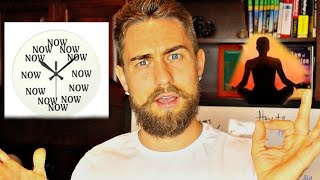
Aaron Doughty shows how to meditate during everyday moments like waiting for an elevator or exercising, using two steps: shift awareness into your body to slow mental chatter, then observe thoughts without judgment. You get meditation's benefits without needing 15-20 minute sessions.
Chapters
This video is going to be all about the idea of us understanding what some practical ways of things that we can use in our own life if we don't necessarily have 15 or 20 minutes a day to meditate. Now, these are going to be things that I found that if you do these things, you're going to get the similar benefits that you would get from, from meditating, and you can do that actively. You see, one of the things that we believe in society when it comes to the idea of meditation is we have these preconceived notions that it involves us maybe being in a room by ourselves or secluding ourselves off from the world. But what I believe is that we can mix that and we can integrate it into active doing, into actually doing things, and then turning it into a more active type style meditation, more like a meditative exercise, than it actually being something that has to be so isolated. Now, these things are gonna have— what I'm gonna do is I'm gonna take you along, I'm gonna show you exactly what I mean and show you how I do these in my own life. And before I do that, I want to talk about the components that have to do with both of them. And then what you can do is become creative, what you would do and how you would integrate that into your own life. Now there's two main components of this. The first one is becoming present. And the way that we do that is by bringing the awareness into our body rather than us being reactive from the mind. So the idea is that as we become more present and as we bring the awareness into our sense perceptions, it then allows us to slow down the thinking process. Even me, as I'm out here right now, one of the reasons I enjoy coming to the park is because then I get to walk on the grass. And when I walk on grass, there's more sense perceptions in my feet because I took off my shoes. The idea is that it automatically begins to ground me because I'm bringing that awareness into my feet and into my body. Now, that's what I'm going to be talking about, and I'll show you actually apply it in a practical way when I show you here in a couple seconds. But that's the first part of it. The second part of it is understanding how to observe the thoughts, how to observe what we're thinking in order for us to have the same level of benefits that we would get from meditation. And what this simply means is that we become observant of what we're thinking. We don't tag as things being good or bad. Everything is neutral. And when we become aware of what that is, when we simply observe what that is, what we do is we begin to not become so reactive. We become more present. We become more the cause rather than the effect, because then we can really choose what we think. We can choose where the momentum of our thoughts is going, and ultimately that's where all the power is anyways. So what I'm going to do is show you how both of those components are comprised into what I'm talking about, so that you can apply these practical ways towards being more present and towards having the same benefits of meditation in an active an integrative way.
So here we go.
One of the easiest things that we can actually do is understand that there are certain anchors every day that we can set ourselves towards if we want to be in the moment. For example, doing something as casual and as common as waiting for the elevator. Now this is something that normally when we do, we find ourselves in the tendency or the habit of getting on our phone. But rather than that, what we could do is decide that we're going to simply take a deep breath in Take a deep breath out, and then observe our thoughts. And simply doing this for a couple minutes a day, or just even a couple seconds a day while we wait for the elevator, will give us the ability to really become more present and understand that in the little actions every day, that's really where we can find and get the same benefits as meditation itself. Got you. Now, one of the easiest ways to become present is to simply do it while you're at the gym. Now, one of the reasons this is, is because when you're at the gym or when you're doing any type of physical activity for that matter, what you end up doing is becoming more present with your body because you're having more sense perceptions. You're either working out at some level or you're focused on whatever you're doing. The idea is that it, that anchors you into being more present. And I remember the first time I heard this, actually I was listening to an Eckhart Tolle and Oprah interview and she said that one of the ways that she becomes more present is she simply doesn't listen to her headphones while she works out. Now this is something that I'll do sometimes every now and And then what I'll do is I will wear my headphones if I'm listening to an audiobook. But the idea is that 70 or 80% of the time, what I decide to do is that I'm not going to listen to anything. I'm just going to focus on the sensation and whatever I'm doing. I find that that allows me to really focus and become present to the moment, but also I end up getting a more efficient workout anyways.
All right, so now what you guys have seen is you've seen the exact things that I'm talking about when it comes to being able to be more present. Do it interactively. Understand that you can actually do things. Bring the conscious awareness especially into the idea of activities that we think are like on autopilot. For example, you don't really have to think much when you're doing certain things, and that's why anchoring is so important. And anchoring really just means that you become aware that of what you're doing. You set it like a trigger for a way of something that you do. Like every time you push the button on an elevator, you can use that as a excuse or a reason to breathe in and then breathe out and then become aware of what you're thinking and observe your thoughts. But the idea is also I want to give you one or two other ideas of things that you can do towards bringing that awareness into your daily activities. And one of the other ones that I wanted to speak about is the idea of doing the dishes. For example, when you do the dishes, you can become really aware of the sensation of everything you're doing. Imagine yourself with the ability to pay attention and listen to the sound of the water and then feeling the sensation of the warmth of the water or the coldness of it, and then listening as you do the dishes and observing the sounds that the silverware make against the plates. For example, it could be a multitude of different things, but the idea is that as you pay attention to that, you bring awareness to it. You then allow yourself to really be in the moment. You can observe, and as you begin to observe what is going on, you then learn how to observe your thoughts in a new way. And ultimately that's the benefit of meditation anyways, being able to observe what you're thinking, bring awareness into your body. And the other one I wanted to talk about is the idea of observing ourselves while we drive. Now while we drive, a lot of times we're on autopilot, which simply means that we don't have to consciously think about the idea that we are, you know, going into this gear. We are, you know, doing this, turning our signal. We don't have to consciously think about it. We just do it. But the idea is that as we begin to do that, if we can bring awareness into that, maybe we didn't meditate in the morning, so this is part of that time that we're saving. As we do it, we can simply observe our thoughts. If somebody cuts you off, simply observe it. You don't have to become emotionally invested in it. Remember, every situation is 100% neutral. We give the meanings to to what things mean. Imagine that if they cut you off, you just simply may understand that they've rationalized it from their point of view. Maybe they have somewhere to go. They're not really thinking about other people. We can just observe that we don't need to be emotionally involved in everything that happens throughout our day. And because we do these little things of bringing this awareness into our daily activities, we're going to see that over time it can have an exponential effect on us if every day you dedicate yourself towards doing 2 or 3 things in a very conscious way, over time you're going to start to see that it makes you feel better. It makes you more present in your everyday awareness, and ultimately you start to reap the benefits of what you would get in meditation itself. So I hope you guys enjoyed this video today. Feel free to like this video if you liked it. Subscribe if you haven't already. And other than that, much love.