How to Set Boundaries without feeling guilty (and Why People DRAIN Your Energy)
Aaron Doughty explains why people drain your energy after spiritual growth: they attach to your higher vibration while you take responsibility for their emotions. Setting boundaries means recognizing guilt as a sign you're enabling rather than empowering them, then practicing no without needing their approval.
Chapters
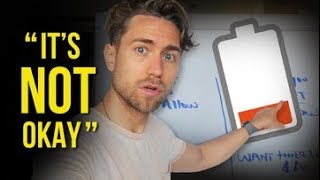
I swear, it's like everyone is just draining my energy. It's like, how much can they get out of me? And it leaves me feeling tired and like I just don't have energy for myself to take care of me. Aaron, what? Can I have some of your Motivation? There's like 4 of them in your fridge. Yeah, sure. Welcome back to another video. My name is Aaron and I help people expand their consciousness. Now in this video, you're going to learn exactly why people are draining your energy, plus how you can set boundaries without feeling guilty. The way that this works is a lot of people that go through a spiritual awakening will go through a part where, or just in general, people in general that are going through the process of doing their own work, of becoming aware of how like they can transform their own lives. You'll find, and these people will find that once they start doing that, many other people will start to attach themselves to their energy. They'll start to almost in a way get something energetically from the people that are doing the work or from just people in general. And what happens is then the people that are giving it, and a lot of times people that are giving it want other people to be happy, so they're doing it with great intentions. What ends up happening though is those people that are giving the energy end up feeling drained and like they don't have energy for themselves. I know that when I went through my awakening process and I started doing the inner work, I noticed that people started to really gravitate to me and in a way they would come to me for certain things. I remember I had some friends that would come to me anytime they were having relationship issues and then they would want me to talk them into feeling okay about it. And there were people that would come to me for advice, for motivation, things weren't working out. Even to this day, I'm becoming aware of how to have better boundaries. Because I find that sometimes I give too freely and I end up feeling drained and I need to be aware of filling up my own cup before I actually give it to other people. So this is something that I'm definitely becoming more aware of now as well. However, the thing that I've learned that's changed everything for me is learning why I feel drained in the first place. If you figure out why, it makes it so much easier to understand how you can reset these boundaries without feeling guilty. And I'll talk about as well, why do people feel guilty when they start to set boundaries? And as the intro that you saw, the metaphor of that is a lot of times people may come in and they may say, hey, can I have some of this? And what happens is we, out of politeness, we say yes. And then maybe they grab one of our cans of motivation or our bottles of motivation, but maybe They then get used to it and they continue to grab the different bottles of motivation until there's almost none left inside of your fridge. And that happens for a lot of people. They will give their energy freely and then find that they feel drained in the process and then ask, why do I feel drained? Well, why did you give away those bottles knowing that you needed those bottles for the next couple days? Now you got to go to the store and you got to get some type of bottle to fill back up your fridge rather than of keeping what you needed until the next time you went to the grocery store. So that's a metaphor for how this process works, but in general, it's, it's, that's, that's really the key to this. So let me share with you first off, what are boundaries? What are boundaries? And these are, is actually what boundaries are. I made this little thing right here. Boundaries is there is what you allow and then there is what you do not allow. These are the boundaries. If we have, there's a boundary, this is what we do allow, what we don't allow. Now here's the thing, you already have some type of boundaries. If somebody were to come into your house and start beating you up or beat up your dog or something like that, you'd be like, no, that, that is where I draw the boundary. I do not allow that. But for some reason, what happens is we get so used to people treating us a certain way that we allow that. We say no to this, but we say yes to this. And once we start to say yes to something, we then start to assume that that is what we are worthy of. We start to assume that that's what we must do in order to be loved. See, there's a deeper aspect here. There's a deeper aspect. And one of the reasons that we may allow people to walk on us is because we want their acceptance or their approval. We want our friends to like us. Have you ever felt guilty when your friends want you to come out and you find it hard to say no, even though you know you might not want to go out? For me, that— for a long time, that was something that I had to really learn to deal with, because when I went through my spiritual awakening, people were so used to having me around You know, before my spiritual awakening, I would drink a lot, I would smoke weed, and I'd have friends that I would go and do that with. And then I go through spiritual awakening and I start meditating, I start feeling completely different. Those things don't interest me the same, the way that they used to. And then people would ask me to come out and I'd be like out of pattern, out of expectation. I'd be like, okay, and I would go out and I would end up feeling drained even though I'm in the back of my mind while I'm there, I'm like, I don't really want to be out right now. But there's some type of obligation. In a way, I wanted to be accepted. I wanted to still be liked. They expected me to be a certain way, and I was doing my best to uphold that, even though deep down I didn't really feel like going out and doing that. You want to come to my house? We can do meditation and stuff. I'm down for that. But going out and drinking and stuff? No. And of course, there's always balance here. I'm not saying that that's even to this day, that's the only thing I like doing is sitting around meditating. Maybe it is, but in general, what do you allow over here? And then what do you not allow over here? And the thing is, is at a certain point we decided, okay, I guess I'm going to allow this. And then our friends are like, oh, they allow this, this is okay. And then what happens? Like, say a friend talks you into going once. Like, yeah, I don't know if I want to go. Like, just go, come on, you know you want to go. Or like deep down, like, it'll be like the old time. Just come have a beer with the boys, you know what I mean? Or something like that. And you're like, okay, I guess I'll go. And then you go. And then what happens is every single time after that, they're like, hey, they already agreed to go a couple times ago. I know I can get them to go again. And then they're on their phone with their friends later and they're like, yeah, this person might not go. And he's like, oh, you went last time. I'll talk him into it again. So then they see that it's the opportunity. And then what happens is the next time you say no, You're gonna feel rude, impolite, and you're gonna feel— and then you're not gonna want to let them down. And then if they let them down, what if they don't talk to you for 2 weeks or something? What if they don't like you the same way they used to like you? You see how that works? That's what happens when I'm talking about boundaries. What are your boundaries? And here's the crazy thing. You want to hear the crazy thing about boundaries? This is the part that's very hard to swallow. Okay? Like that bottle of motivation, you gotta swallow that. Here's something that's hard to swallow when it comes to boundaries. Do you wanna know whose fault this is? Do I know? We, it's our fault. It's your fault. It's my fault. It's the person that feels drained's fault because they agreed and said, yes, you can take this. You can have this. Until we realize that it's our responsibility to say no to someone else taking our bottles of motivation, until we realize it's our responsibility, we will remain in a story that says other people are doing this to me. I don't have to— I don't have free rein over my own energy, over my bottles of motivation. Other people do. And the moment we're in that frame and we're using that excuse or story is the moment we give our energy away even more. The hard The cold hard truth about this is that we must take responsibility for our own energy of what we allow versus what we don't allow. We must not allow others to take our energy if we aren't already 100% or willing deep down to do that. Deep down, you may have been thinking, hey Aaron, can I have these bottles of motivation? And I would have it in my mind like, well, I don't go to the store for another 3 days. I need one of those a day at least. I don't know if I'm— I don't want to, but yeah, I guess. Yeah, go ahead. And then they proceed to take 3 of them. Now I got to go to the store today. So that metaphor is exactly the way so many people do it. The reason people are draining your energy is because you're letting them. Because at a certain part in the past, you decided that it is okay for you to allow them to, and you didn't— you allow them to over here, and you didn't draw the line. And now if you draw the line, you're gonna look like a rude, rude person, and you don't want to be rude, and you don't want to be rejected. You don't want to lose their love and acceptance. Do you see how that works? So that is the key to this whole process. Now here, why do you feel guilty about setting boundaries? You want to know why you feel guilty about setting boundaries? Because you feel responsible for others. You feel responsible for their problems. They come to you with their relationship issues. I know people that, people, anytime they're having relationship issues, there's certain people they go to and they just want— and here's the thing, eventually you end up enabling people. I've realized this in my own life when it comes to sometimes, um, let's say some people in my life aren't good at finances. So they looked at me and like, Aaron's great at finances, look at him, he's successful. And like, hey Aaron, can I have some money? And I'm like, at first I'm like, well, I love you, of course, here you go. And then guess what happens? I give them money once, I give them money twice, guess what? They just keep coming to me. And now they feel like I become the source of their, security. And then eventually what I had to do is I had to set the boundary and say, you know what, I can't keep doing this because I'm enabling you. Instead of you having your own power to figure this out, I am taking away your power and I am giving you something that's making you feel better for a period of time, but then you have to come back to me. And now you have thought that I am the source of the abundance when you are actually the source of the abundance. I will teach you and show you how to tap into your own source, but I will not keep giving you from my source because then I end up feeling drained and used. You see, this is it. That's it. And why do I— when I was giving like that in the first place, you want to know what it was? I felt responsible. I'm like, oh, well, you know, I love you. I want you to be happy. I want to fix your problems. I'm also someone deep down that tries to fix things all the time. I get it from my dad. Thanks, Dad. I try to fix things. There's something wrong with people, I want to fix them. I want to help them. I want people to feel good too. This goes so far that I end up, that I end up like completely taking on other people's emotions and stuff. Other people feel negative emotion, what did I do? Did I— is there anything I can help you with? I didn't do anything wrong, but still I want to help you feel better. But what I'm realizing is I am not responsible for other people's pain. I am not responsible for other people's unresolved emotional issues. You are not responsible for your friend's relationship issues. You are not responsible for getting your other friends motivated. You are not responsible for helping other people to get some way to be like you. You're not responsible. And once you realize you're not responsible, you won't feel so guilty. When you realize that you are stealing from them, you are stealing their power and you are becoming the source and it's draining you, but also you're enabling them to continue to use you as their source. Let me share with you one quick example. I've shared this a couple of times before. This may be repetitive story. I do a lot of videos. It happens. So here it is. I went recently with a friend, with a couple of friends to Red Rock in here in Las Vegas. We went hiking and there was this, uh, there's this cave at the top of Red Rock. Once we got up there in this cave, you kind of had to jump to get to. It wasn't as easy to get to. Well, I was with some friends and what happened is I get up there and then one of my friends is kind of afraid to get up there because she's afraid of heights. And then what happens is she is, she's with her husband, who's one of my best friends. And she's like, oh, I'm scared. Like, this is, she started freaking out a little bit. I was like, hey, just take my hand. Just take my hand. I will get you up. And then she's like, no, I'm not going to take your hand. And I'm like, why won't she take my hand? I kind of felt rejected. Like, why wouldn't she take my hand? I don't get it. I just want to help her up and everything will be good. And she'll get her out of pain. And then she's like, no. And it becomes like a 5-minute thing where she's like, no, and like trying to get up. And then eventually she gets up and I'm like, why won't you just take my hand? I just wanted to pull her up. And then she said, if I didn't do it, I wouldn't have known that I can do it if I didn't do it myself, even though it was a pain and struggle to get there. And in that moment I realized that I had this selfish desire to pull her up so that I could get the emotional payoff of feeling like, yes, I just added value. I am worthy. Somebody needs me. I was the hero because there's a selfish motive there that gets off on giving and helping other people because I'm a fixer. I just get off on fixing, fixing little problems. There's a problem, let me fix it. But see, that's a pattern that I became— I'm starting to become aware of in my own life. Where I'm always trying to help people, I'm always trying to fix people. I wanted to become the source of her solution, subconsciously not knowing that it's because then I would feel more worthy. Why? Because I have somehow made a rule to myself that if I do something like that, then I can be worthy, instead of knowing I am worthy for just being me. I don't need to please other people to make them happy. I am worthy for just being me. I am worthy whether I give people relationship advice or not. I don't need to give it. I am worthy and loving whether I give people money or not. Actually, I'm probably even more powerful if I empower other people to create their own abundance from their own source within themselves instead of becoming their source. You see, this is how it works. So this is exactly what I share on this YouTube channel as well. By the way, if you haven't subscribed to the YouTube channel, Subscribe, turn on notifications. I got a lot more videos coming out that will show you these different shadow aspects of ourselves, videos that help empower you to become the best version of you. That's exactly what we do here. We let go of responsibility, realize you can draw the line of what you allow, what you don't allow. Do not allow people to walk on you, to take your energy. Understand that as you draw those boundaries, the only reason you would feel guilty at all is if you take responsibility for their energy, for their happiness, And once you realize that you just really want their love and acceptance, you can give yourself that love and acceptance you crave, and then you won't feel guilty. So the next time you do it, the first time you do it, that you draw that boundary, it may feel kind of weird. You may feel kind of guilty at first, but keep reminding yourself, no, this is my true power. This is what I'm worthy of. This is what I feel like doing. And don't feel guilty if people try to guilt trip you into it. If they try to guilt trip you, then that's on them. That's something they need to deal with, not you. You don't need to agree to it. But remember, the main key of this is knowing that you've allowed it. Once you know that, then you can take responsibility for it and then get rid of the story that people always do this as well. That's the other thing as well. Get rid of that story. So there's a lot that goes into this. A lot of people that watch videos on boundaries may get value out of understanding narcissists and people that like, kind of have control over you. I have a whole series on that. I'll go ahead and link it right here. Go ahead and check that out. It's on narcissists and sociopaths, how to— why they don't get their karma, and also how to take your power back. That'll help you just in life in general in many different ways. Go and check that out as well. And as always, peace, much love, and namaste.










