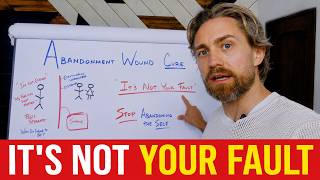
In this self‑help video Aaron Doughty explains what an abandonment wound is, how it forms when a child experiences physical or emotional unavailability from a parent, and why the resulting belief that "I'm not enough" is mistakenly blamed on the child. He shares personal stories of his own step‑mother’s control and a conversation with a friend that highlighted the power of hearing "it's not your fault," likening it to the iconic scene in Good Will Hunting. Doughty argues that recognizing the wound isn’t the child’s fault is the first step toward freedom. He outlines a healing process that involves (1) witnessing the shame, (2) connecting with and nurturing the inner child, and (3) expressing the authentic self without people‑pleasing. He explains how self‑abandonment leads to attracting relationships that mirror the original wound, and how choosing oneself creates healthier connections. The video concludes with calls to action: a free inner‑child meditation and a follow‑up video on the "Frame Technique" for feeling safe in one’s body.
Chapters
To have an abandonment wound is way more common than you think. An abandonment wound is where, as a kid, you felt like physically or emotionally some parent may have left. And when that happened, there was this part of you that felt like you weren't enough, your feelings don't matter. And as a result, you may then subconsciously abandon yourself to make other people happy, or you might find yourself normalizing relationships in which people don't choose you or are emotionally unavailable. And when you come back to yourself and you go through the process of healing that abandonment wound, your entire life will transform on the outside. I have not only seen this completely transform my life from the inside out, But I've seen thousands of people heal this wound inside of themselves and seen them on the other end. And in this video, what I want to do is to show you how to overcome and heal the abandonment wound that is subconsciously on the inside. I'm going to show you one key idea that will completely transform your life and how this can actually change, like, your ability to feel safe inside of your own body. The ability to be safe to be yourself. Now, first off, let's look at it right here. If you imagine your parents over here and you here, our parents and our relationship with our parents is very powerfully shaping our relationship and identity within ourself. So if as a kid, mom or dad was not physically or emotionally available, As a kid, we internalize everything. So it's like if mom and dad divorce, subconsciously as a kid, we may literally think, "Mom and dad divorced because I wasn't enough, because I wasn't worthy of keeping the family together. If I would have been different, then mom and dad would have stayed together." The same thing happens is if a parent physically leaves, Or if a parent is just physically or emotionally not there, we assume, "If I could do something different, there must be something wrong with me or mom and dad would physically show up for me." So what happens is we then normalize that energy, but deep down we've internalized a level of shame. I know for me, for example, something that I've had to heal through is not only having that of the ex-stepmom in my life that was controlling and manipulative from the age of like 7 to basically 17 when my dad divorced her, where I wasn't allowed to have freedom, had to like sneak, get enough food to eat, earning, going to school activities, like that energy, there was definitely a feeling of, my feelings don't matter. And at the same time, there was a subconscious energy that because my dad allowed it to happen in a way, it was something where I wasn't worthy of being protected. There's something wrong with me. And if something was different, then maybe that would have been the case. So I've had to look at that and to realize that that dynamic, that situation, even though as an adult, we logically can see like, okay, "Nothing wrong with you." That did— it wasn't 'cause you weren't worthy. As a kid, that's what we internalize. If mom or dad, or mom had a lot going on when you were a kid, you know, our relationship with our mom is many times our relationship with relationships because the feminine energy represents connection and our mom is our first relationship into this world. So it's like what— were the meanings, what were the stories and the subconscious energies that were born out of the relationship to our parents and whether our needs were met. So remember, as a kid, we internalize it. We think there must have been something wrong with me. Now, one of the biggest insights is realizing that it is not your fault. It's not your fault that mom and dad divorced. Or mom and dad didn't have the healthiest relationship. It's not your fault if a parent physically or emotionally was unavailable. It's not your fault. And realizing that is something where then you can really start to become more free in the sense that you can, in a way, come back to that part of yourself that thinks it was their fault. I remember a big transformation for me was actually with my best friend when we were talking about relationships and we were in this like, —this really reflecting, and I was reflecting things back to him, and he was reflecting back things to me. And there was a certain relationship that I had got out of recently, and it was really like weighing me down in a way, and I was really internalizing it. And in a moment, there was a realization that that relationship was a reflection of the relationship with my mother when I was young. And the thing my friend said was basically this thing. He's like, It's not your fault that— it didn't work out with her. And it's not your fault if, you know, as a kid, mom wasn't there. And there was something inside of that that really touched me. And I remember I started to cry, started to tear up. And it was this really emotional moment with my friend and I as we were like kind of reflecting on all of this. And even if you think of the movie, for example, Good Will Hunting. Good Will Hunting, there's this very powerful scene where Matt Damon and Robin Williams are basically going through this interaction where there's a lot of internalized shame that Matt Damon's character had in the movie. And then Robin Williams literally just stands there and basically says, "It's not your fault." And then at first Matt Damon's like, "What do you mean it's not my fault? Shh." He gets like anger, he's like brushes it off. And then Robin Williams just stands there and goes, "It's not your fault." Yeah. It's not your fault. It's not your fault. And he keeps saying it. And then he gets mad and more angry, Matt Damon does, his character. And then eventually he just starts crying. Why is that so powerful? Why is it so powerful to recognize that the internalized pressure we've been carrying as a kid of that shame, the belief that I'm broken, "I'm not enough. My feelings don't matter." Why is it that simply acknowledging that it's not our fault can be so relieving, so freeing? And think of how much more free you become when you recognize that someone else choosing you or not does not mean you're not worthy. It's not your fault. Not only have you done nothing wrong, but there's nothing wrong with you. Mm-hmm. So for me, one of the biggest insights here is that as you stop abandoning yourself, as a result of you not abandoning you and you expressing the real self, you then get to a place to where you begin coming back to you. You begin to express the real you and you no longer hold it in. And that people pleasing, that's an energy of holding energy in. People pleasing is like taking on other people's burden and energy and tension and trying to heal them subconsciously. But what happens is, as you get to a place to where you can hold that tension and express yourself, it's so much more freeing. So realize that with this abandonment wound, one of the first things to understand is that your ability to actually witness this energy, this shame, is the key to the cure. It's to connecting to this inner child part of you, this part of you that you may have been abandoning for so long. Because here's the thing, if you were to imagine, knock, knock, knock, on the door is your inner child, the inner child that may feel abandoned as a kid. And we open up the door and we see it. Hello. A lot of times we subconsciously are ashamed of it. So we tell it to go away. I don't wanna deal with you. Or I will deal with you until you transform and then you're no longer abandoned. But to see, hear, soothe, and nurture this part of ourselves is when we finally feel like we're coming back home. Because if we don't listen to this part of ourselves, this abandoned wound inner child, it will look for resolve in the external. That's exactly what happens is we project this unresolved energy between mom and dad onto outer reality. So it's like if you ask yourself this question, who do I— who did I need to be as a kid to receive mom and dad's love? And if you had to abandon you in any way, if you had to not have needs, if you had to be perfect, if you had to be quiet, if you had to ease the tension in the family, that may have meant you had to abandon you. So then you've started subconsciously a pattern of leaving you to make everybody else happy. And as a result, You then normalize people in your life not choosing you, and you normalize people in your life having that kind of relationship with you where you lose your frame around them. So one of the biggest insights you can have around this is that when you get to the core of this energy and realizing, acknowledging these emotions, you get to a place to where you realize that it's not your fault. Yeah. Whether people like you or not, whether people choose you or not. And as a result, you then can witness this part of you, and then you begin to become more free because from that point, you're— the cure is to then focus on expression. It's to focus on actually expressing the real you, expressing your authenticity, even your vulnerability, and knowing that if other people don't resonate with it, It's not your thing to manage. It's not your thing to like get them on board. You know, the funny thing is, is when people go through healing the abandonment wound, they're afraid that when they start to be authentic, certain people might leave their life, certain friends that have been there, and then they'll be left alone. What I found as a result is that when you get to a place of expressing the real you, that becomes a filter to which you can go deeper with the people that are already in your life if they have the capacity for it. Or it allows you to actually, in a way, weed out people that don't resonate with that deep you. As a result, you will then attract people to you that do resonate with that deep you. But you see, you've already lost yourself and abandoned you when you continue to stifle yourself for keeping people in your life that might not resonate with this next version you. So the key to not abandoning yourself is to begin to choose you and to even see, hear, soothe, and nurture the abandoned wound part of yourself. That inner child you that's knocking on the door, you open it up and there they are. Right now, if you are reclaiming the energy of connecting with your inner child, go ahead and like this video. Maybe declare it below. Declare it below that it's not my fault. It's not your fault, speaking to your inner child. Let that be a symbol for you. That you are moving into the era of no longer abandoning you. No longer abandoning you, which allows you to heal the energy of abandonment between you and other people, which then allows you to actually connect with people at a deep level. Because when you're connected to someone that's not choosing you and you abandon yourself for that, that's not true connection. That's you changing your frame and abandoning you. And then people reflect back that abandonment of you, of you not showing up for you. So for myself, one thing that I've had to learn to do over the years is how to stop abandoning myself, expressing myself anyways, whether people resonate with it or not. That's not my thing to manage. And if they don't choose it, it doesn't mean there's something wrong with me. That's where the growth is at this next level. That's where it becomes almost like this curious experiment of like, can I express myself most authentically, even in the energy of people not understanding it? And this next era for you, I believe it is going to be the era of you choosing you and the era— Yeah. Of you choosing connection with others. And one of the ways you create powerful connection with others is you created powerful connection with yourself. But if you abandon you, you attract people that reflect that abandonment back, and it's draining. You're tuning to everybody else. And as a result of tuning to everybody else, guess what happens? You end up feeling drained as a result of that. So what happens is you coming back to you, you feeling safe inside of your own body is the key to really coming back to you. So something that I do have, by the way, is an inner child meditation. It's completely free. You can begin to connect to your inner child in a powerful way. I'll go ahead and link that below and you can check out that meditation. I've had 50,000+ people, um, download it and it's one of the most powerful meditations I have. It's completely free. And then also, if you want a video on how to feel safe inside of your own body, This is really the next level of the journey. It's learning something called the Frame Technique. It will completely transform your life. It's what I learned from my shadow work coach a few years ago. I've shared it with literally millions of people, have learned this simple technique, and it's transformed so many people's lives. So if you wanna watch that video and listen to it, check this next one out right here.