She Got Her Confidence Back in 15 Mins (Don't Ignore This)
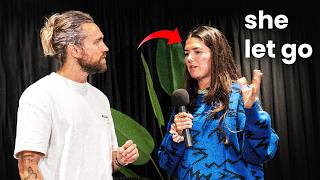
Aaron Doughty coaches a journalist stuck in self-sabotage about her career. He reframes failure as a label, not a fact, and guides her through embodied exercises to shift her energy. She explores three paths: talking to her boss, finding a new employer, or starting her own platform.
Chapters
How do you stop self-sabotaging? When I've tried to do like bigger things with my life, I always kind of like default back into something that is mediocre. How do you get the courage to kind of really be that person that I feel I kind of have to be, but it feels too big?
Who do you feel like you have to be? Because what self-sabotage is, is when you start being in a new identity What happens is it's like an old identity part of you that doesn't wanna be left behind, right? So the part of you that's used to everything being mediocre sees that you're getting ready to expand into a new level of self, a new level of expansion, and a new level of the unknown. And then you start to do that, and then there's a part of you that gets scared that wants you to come back. So what is that? Self-sabotage that's sabotaging you, what is the identity of that self that's afraid of being lost? And that's so used to mediocre.
That I'm not gonna be capable of doing that, that it's gonna be like disappointing. I'm not gonna, yeah.
Yeah, so you're gonna be, it's gonna be disappointing or you're not gonna be able to.
Yeah, for myself and others, yeah.
So is it fear of failure?
Yeah.
You wanna become aware of where you're putting your energy And what do you define as failure? Because failure is only failure if you deem it as failure. For example, if when I went to make YouTube videos in 2017 and I made my first video and it only got so many views, I could have said this was a failure. But then I came back again and I did it again. And then I came back and did it again. And then I did it for 30 days in a row. And then I did it for 45 days in a row. Then I did it for 60 days in a row. I just kept doing it.
Yeah.
But I never gave up and I never identified it as failure. So the difference between people that are afraid of failure, they're just quick to like call the shots to say, this is the judgment I have about it. See, it didn't work. Versus being able to acknowledge that you are the one that deems something as failure or not failure. But also if you're committed to the process, That's the courage. It's committing to the process and not allowing yourself to give up and to assume that something is a failure. Does that make sense?
Yeah.
So how can you fall in love with more of the process? Because it sounds like you've got all these moving parts, which, by the way, believing even in a town like Miami that rent is really hard to find, even though it is a— whatever the story is around finding houses, Even though it's a story where you can look around and talk to other people like Aaron doesn't understand Miami. Don't you guys know that our locals, it's so hard to find rent? At the same time, it's a belief that you're agreeing to.
It's a story.
It's a story that you're agreeing to. That's making it more complicated for you to take action.
Yeah.
It's making it more likely for you not to step into this new version of you. There are people that go to apply for a place and they don't have that baggage that comes with it's hard to find a place in Miami. And they'll find a place like that, perfect place that they'd be happy with. So what I would encourage you to begin looking at is more so falling in love with the process. And the process, it's not like one day you try and the next day you've made it. It's a constant evolution of a process. Even me, I'm constantly fine-tuning everything. Every event that we do, everything that I do, it's not a matter of like, You know, was it perfect or not? It's, did I learn something? If I learned something, it wasn't failure. There's even parts of this event where I'm like, oh, I learned from this, I learned from this, I learned from this. I could judge that and be like, we failed, I failed here, I could have done this differently. No, I learned something. So what if you putting yourself out there, quitting the job, what if that was part of your hero's journey? Have any of you ever heard of the hero's journey? We're all part of this hero's journey that we're on. And there are gonna be challenges. There are gonna be doubts. There are gonna be things that test you. It's a part of the hero's journey. And you're in the middle of your hero's journey right now. And you have a choice to make. You can make a choice to go on what is called the call of action, the call to action.
Yeah.
You can make the choice to go there, or you can stay from doing it because it's safe not to step into it. And you can let the self-sabotage run you. And it'll allow you to feel familiar emotions that you know, and it'll allow you to stay safe where you are.
Yeah.
And something to really start contemplating is what could that look like for you? When that self-sabotage comes up, how can you move through that anyways, knowing that it's just a part of the process?
Yeah, that it still feels like it's something really hard that I don't know if I'm like ready to do. It feels like I need to find more courage. I don't know where from. When I have time to devote to making this new life, I'm too tired from work.
Yeah. Where do you believe that courage is?
I guess it's inside me, but I just, I don't feel it. I can't find it. I don't know where to, how do I find it?
What if you could find it?
What if I could?
What if you could find it?
Then I would just do it, I guess. I don't know.
Well, what if that courage is inside you right now? What if you allowed yourself to tap into that?
Um, I don't know.
Can you come to the front for a moment? Give her a hand.
Awesome.
Let's come over here. Yeah. So in a similar fashion that we did a little bit ago, when you believe that the courage is maybe outside or maybe it's just not active right now, can you walk down the aisle in that state of low courage? What does it look like? Low courage, no courage in your body. Yeah, a little kind of like somber, like kind of like, yeah, like lethargic energy, right? Now, shake it out. Shake it out. Let me hold this for a second. Go and shake it out. Make some noise. There you go.
Yeah.
Now maybe jump up and down a little bit. So now, do you feel like you have a little bit more energy? Yeah? Now imagine, let's imagine I have a magic wand again. And imagine there's this magic wand that is able to look at this belief that courage is outside of you, the belief that you're so busy and you do so many things that you don't have the courage or the energy and you're tired or whatever. Let's imagine that's off to the side and it's going away, okay? Let's imagine I wave this magic wand I wave the magic wand and then we jolt a whole bunch of courage into your body. And now imagine, bring shoulders back, head up high, and now go ahead and strut back and forth with courage. Walk with purpose. Walk with purpose. Head up high. There you go. There you go. How does that feel?
Feels like, yeah, they're like, there's something, something like there's something pulling me.
Yeah.
Yeah. Like some energy or something that like, yeah.
Interesting. So there's energy that is pulling you, which is really cool because if you have to look for the courage inside of yourself, it's trying to find something. Maybe the courage is both inside of you and it's also in a mission that pulls you.
Yeah.
Which is kind of cool because you're not doing it alone. The courage is something that you align to. Just like me, when I had the courage to start putting myself out there with the intention of adding value and helping people, it started to pull me. It wasn't about like I was working a 9 to 5 job and making videos. For like 6 months before I quit my 9-to-5 job. I was working like probably 60, 70 hours a week doing, like making the vision possible. But you wanna know the funny thing? It wasn't hard. It was moments where it could have been deemed as challenging, but there was something pulling me.
I know what you mean. And I started doing that. I started 'cause—
How many of you can feel there's different energy in her now?
Yeah, right? Yeah. And I started doing that 'cause I wanna, part of it is kind of, yeah, like making videos and teaching about what I know and what I see like in the world. Um, so I'm a journalist actually.
That's awesome.
And but they— I started doing them and, and I had more energy and I was like, yeah, going to work like later, like making the videos and everything. But then they told me to stop.
Who told you to stop?
My bosses. Like, I'm not supposed to do that. It's like, because it's like, you know, they have— and I understand that from their perspective it makes perfect sense, you know, that like you have, um—
do they have— they have the power to tell you not to do something in your personal life?
Because it's like, because like as a, as a journalist, like you represent like the company as well. So I can't have like different views or show something else than from what they, you know, like the—
are there other jobs where you could work somewhere else and have the freedom to express yourself?
So that's what I've thought, but then finding another job, it would have to be something outside of journalism because why you can't do that.
Like, it has to be like they're not journalist companies that support you having your own perspectives?
No, I don't think like that. That's— no, because it— and it makes sense because you're as a journalist, you're supposed to be this kind of like very, like a clear, like crystal that just is like channeling something that is very objective. Like it can't be about like what you think of what you see. But now I realize that that's what I want to do, but that doesn't align with, with that, you know, that kind of work. So it would have to be like doing something else, and that means all the expertise that I have, the, the experience.
Is that really true though? Is that really like what I'm trying to challenge and like get you to look to see? And I don't know because I'm not in the journalist industry. But is it for sure really true that all companies do not allow you to make and do your own journaling pieces in your own free time? Because how do they even know? How do they know what you're, they like—
Sometimes they'll monitor your social media.
Okay.
And they'll tell you to like pull it down and you know what I mean? You're not supposed to even like, like other stuff.
Is this maybe also a good springboard to decide that maybe you do wanna do your own thing?
Yeah, yeah.
Right? I mean, this reminds me of yesterday when I talked about the story where at my 9 to 5 job, I got pulled back into the office to see a 5-minute video of me watching myself on my phone, scrolling on Instagram. And after 2 or 3 minutes, I'm like, I'm not gonna continue watching this in silence with 3 adults. That much pain got me to say, screw this, I'm gonna work for myself one day soon. So that pain motivated me. And it sounds like, I mean, I'm listening to you talk about that and it's frustrating me. But it's like—
Yeah, yeah, yeah, I felt very, when I heard you tell that story, that's how I felt too. They're like, oh yeah, we saw that. And like, we don't want to like cut your wings or anything, but you know, you— we all have to like cut your wings, cut your wings. But like, yeah, it's like, then yeah, like you're— no one's supposed to, to, to do that. And I was like, oh yeah, I understand. I didn't like, you know, put them down or anything like that. I kept them up. I'm proud of them. I was super proud of them. I got like really good feedback. People saying like, you know, I get like my news from you. Like, yeah. So that's what I want to do. But being independent, I could do that. But it would have to be like as an independent person finding some other kind of like income from something else.
Which did you do that?
Oh yeah, yeah, I guess. But it would be like, it would be really hard. And that's where I think like I could do it.
I, if it's only, how do I, it's hard if you believe you have to do it all. If you have something that's pulling you, yeah, there might be challenges that come up, but ultimately all of this might be happening to gear you in a different direction. It may be, it's your own self-inquiry practice. So I'm not gonna say, yeah, you gotta ditch this place. It could be also having vulnerable conversations with them. Like, listen, this is my intention. This is my perspective. If this is the values of this company, then I would like to continue doing this so I have some form of creative expression. There could be vulnerable conversations to be had that maybe just were being avoided. And then it could be looking at different companies. And then it could be, what if I started my own thing?
Yeah.
And I think many times when we see something in the marketplace that's like not the way we would do it, there's an opportunity for us to do it the way we would, to do it our own way.
Yeah.
And that could be— so either of these, do any of these resonate more for you? Or is there something I'm not mentioning that you could really go for?
I think that last one, the one that you're mentioning, like, yeah, doing something different in my own way.
Yeah.
But yeah, all of that feels very daunting. It just feels like I don't—
Yeah.
Yeah. Like it's like a mixture of so many things that—
Well, understand this.
Yeah.
If we try to figure everything out right this moment, it will feel overwhelming.
Yeah.
And you're not meant to have all the answers right now. You know where you are, you'd like it to be, you'd like to shift somehow energetically.
Yeah.
Right? You can either shift that within yourself by looking at some of these things differently, or you can have conversations to see if you can change the energy dynamic of it. Or you could start your own thing, which will require some courage, but you have it in you already. It's inside of you. You just have to, you just make the choice to go after and figure out and like kind of like try out these different energies and see which one pulls you most. And that can be moving forward. So how moving forward can you apply that energy? Even if you don't have the answers and you don't have to figure it all out right now, but what would be like a carrot on a stick? Like, I'm gonna follow this passion.
Yeah, um, I guess I could start, um, like writing more, like for myself and not publishing it, I guess.
That'd be awesome.
Um, yeah, maybe that. But I mean, yeah, there's something about like, um, publishing and being out like in the public eye that like pulls you, as you were saying, as you know. Um, so yeah, it's like, I don't know, it's like imagine if like you had started doing your videos but like just you in the mirror, you know what I mean? It would have been different, right?
What do you mean?
Like, if it's just you by yourself, like, it's— there's something about that work and like being out and like having, you know, listening to people, listening, getting feedback that like makes that work like more real instead of just like, you know, me by myself.
Well, I did start making videos by myself. Okay, you mean like just like me and the camera?
Yeah, yeah, like not publishing them, not being on YouTube, like just you. Oh, I see what you mean. Yeah, yeah, yeah.
Well, playing around with that energy could be a breakthrough for you.
Okay.
And then eventually publishing that energy could be another breakthrough for you. And then just trying out these different things and seeing which energy pulls you the most. And then falling in love with that process.
Yeah.
And letting it pull you.
Yeah, yeah.
Okay.
Yeah.
Awesome.
Thank you.
Well, thank you. Let's give her a hand. Awesome. Thank you so much.
Thank you.
I appreciate it.










