The 4 Step Letting Go of a Relationship, Attachment, or Outcome Process (life changing)
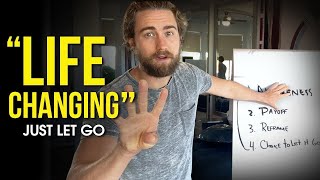
In this self‑help video, Aaron Doughty presents a four‑step method for releasing attachments to people, jobs, outcomes, habits, and identities. He opens with a Buddha‑inspired quote that frames the three essential aspects of a meaningful life: love, gentle living, and graceful letting‑go. Doughty argues that reality is a neutral canvas and that the meanings we assign to experiences create both attachment and suffering. He introduces the Power‑vs‑Force consciousness scale, locating attachment in the lower‑frequency zones and suggesting that raising vibration requires shedding meaning that no longer serves us. The core of the video is the four‑step process: (1) Awareness – recognizing the attachment and separating it from one’s sense of self; (2) Payoff – identifying the hidden benefit or certainty the attachment provides; (3) Reframing – changing the meaning of the attachment and the lesson learned; and (4) Choice – consciously deciding to let go, acknowledging that the process may need repetition. Doughty illustrates each step with personal anecdotes about daily video production, cannabis use, a recent breakup, and the death of his grandfather, showing how the steps apply to relationships, jobs, substances, and grief. He emphasizes that letting go is ultimately a choice, not a prolonged struggle, and that repeated practice rewires the mind into a higher‑vibration state. The video concludes with a call to view a related playlist on letting go and a typical YouTube sign‑off.
Chapters
Now there's a saying by Buddha that goes something like this. In the end, only 3 things matter. 1, how much you loved. 2, how gently you lived. And 3, how gracefully you let go of those things not meant for you. And in this video, I'm gonna show you how to actually let go in 4 simple steps that I think will completely change your life. And I honestly believe that you watching this video will completely transform your life if you stay to the end and if you just, you just absorb kind of what I share with you in this video because then you'll see why you hold on to certain things, why you feel attached, and you'll know exactly step by step, 4 simple steps, how to let go. Welcome back to another video. My name is Aaron and I help people expand their consciousness. Now in this video, I'm going to be showing you the magic and how to let go in 4 simple, easy steps. Now you'll notice that first off in that quote that I just said at the end, I said, how graceful you— how I was looking at the computer, by the way, I love that, that, uh, that quote and how graceful you, how gracefully you let go of things not meant for you. Now meant for you implies meaning, and that's what I want to share with you really in this video. All reality, everything you see around you is a complete neutral prop. It is completely neutral with no built-in meaning other than the meaning you give it. Now this is kind of trippy for a lot of people because it means that life is both meaningless because it's only the meaning we give it and it is completely meaningful depending on the meaning that we give it. So you'll, you'll look at like some people may be attached to something. They may be attached to a job they have, they lose the job, and then they feel a lot of negative emotion. Now somebody else may lose that same job, but because they gave it a different meaning, they're actually very excited. Maybe that meaning is now I can find a job that I'm actually passionate about. Maybe somebody moves out of a relationship and in the relationship they were in, someone would say, oh, this is horrible, this is very bad. It's the meaning they give it. Maybe they identified with being in that relationship as part of their identity. Somebody else gets out of a relationship and they think, whoa, I'm free now. I got a lot of freedom. And if I had this great connection with this person, then maybe there's even a better connection or a deeper connection out there somewhere. And, or they focus on their connection with themselves. You know, there's different meanings that we give to these things, but understand this, the only reason that we stay attached to things is because we think there is some type of payoff that we are getting. Or there's some sense of identity that we're getting as well. So when we look at the scale right behind me right now, this is the classic power versus force. This is the classic power versus force scale right here. You have fear, anger, neutrality at 250 where we learn how to observe our thoughts and have willingness. This is like willpower, Tony Robbins type stuff, acceptance, and then reason, reasoning of the mind, the intellect, and then love. Now in order for us to get into unconditional love where we love ourselves, what we must do is we must look at the reasoning, the meaning that we are giving to things in our life, because this and below is where we let go. The key to raising our vibration is actually letting go of the things that no longer serve us, and as we let go, we find that we then become free. So it's all meaning and it's all based on reason, and once we become aware of the meaning in our minds, This is when we become free because prior to that, we think that things are built in. Oh, this relationship that I had with this person, it was meant to be this way because this is the way reality works. And his job, same thing. I identified with this job. This is who I was. So the key to this whole process, understanding the meaning, and that, and with that, there are the 4 simple steps that I'm going to be sharing with you. And these 4 steps I kind of downloaded actually. I was at the creek here in Sedona and I was walking around and I was there for like 4 or 5 hours and this, it kind of just came to me and it's very obvious that this is 4 simple steps that when you apply in your life will completely transform your life. And for me too in my own life, just to be like transparent here, I'm going through a radical process of letting go right now. I'm letting go of old belief systems, old patterns, old way of being, letting go of outcome. Letting go of trying to control many different aspects in my life. And, and it's, it's for me been a big thing of realizing the mental aspect of it, realizing the reason, the meaning, because otherwise I find myself in kind of loops. And I've shared this same process with a couple other people, some people that were trying to let go of like a negative pattern. One of them was like a negative pattern of jealousy. Not knowing why it's there. And then this simple process of letting go makes it very obvious. And, um, yeah, so let me kind of share that with you. So first off, the 4 simple steps are this. First off, we have right here, we have awareness. The first step is when you become aware of something that you're attached to, what you end up doing is you then begin to separate what you are attached to to your thoughts. You're, you think you are your thoughts, but when you observe your thoughts, you then realize you may think thoughts, but they are not who you are. So awareness is always the first step. If you find yourself attached to a person that you were in a relationship with or a person you are in a relationship with, the first step is being aware that you are attached to something they do or some way they're being. That's awareness. Now the second step is payoff. What payoff are you getting? By being attached to that thing or person. Now that payoff may be something that is a little bit insidious. You're not quite aware of. Now, for example, awareness for me that, um, I was very attached to making daily videos. Many of you know, I know I've shared this many times, this analogy, but making videos daily on YouTube, going down to like 3, 4 days a week, for me, I was letting go. I was becoming aware of this need to keep this this kind of momentum going and that if I didn't do it, what would happen? Now, what is the payoff I get from that? The payoff I get from thinking I need to make daily videos is certainty. Because if I am certain that if I make those videos that then I'm going to keep growing and have everything keep doing what it's doing, then that's something positive that I'm getting out of it. Anything we're attached to, we're getting some type of payoff. It could be a payoff that's a little bit insidious. Or it could be a payoff that's just very obvious. If you find yourself being attached to an old relationship, maybe a buddy or someone from high school or a friendship that you've had for a long time, you find yourself drifting out and you find yourself, it's hard to let go of them. Well, what is the payoff that you're getting by being around them? Or maybe it's the certainty, maybe it's the comfort, maybe it's the fun of the past. It's remembering the past. Sometimes people will have a painful past but they will identify with it because it makes them significant or they feel significant or they feel like, you don't know what I've been through type thing. And that's the payoff they get. But once you become aware of the payoff, you can then begin to let it go. The key is you can apply this towards anything, by the way, too, even like alcohol. I used to smoke a lot of weed, not that there's anything wrong with it 'cause it's legal in a lot of places, but I was smoking it to numb myself of the past painful emotion that I had from growing up. but I realized I was becoming aware of that negative emotion, aware of that pattern I was feeling, of feeling unworthy, of feeling like I needed to escape. Then what was the payoff of me smoking a lot of weed? It was I was escaping from the emotion. That's what marijuana, like weed, is, is it helps numb pain. It was doing that emotionally for me, but I was using it as a crutch even though it could be a very powerful medicine. I think that a lot of people overuse it. And for me, I was doing that and that was the payoff I was getting with that sense of certainty that at the end of the day I could just do that and whoop, feel better. But you know what, you wanna know when it switched for me? When I started to flip the payoff. That's another thing. When you look at the payoff, you start to flip it. You start to see why it's not serving you anymore. And then you start to reframe it as well because otherwise you then judge yourself for the negative payoff. So what I did, for example, is I was awareness of the pain of my past and what I was doing to escape from it, the payoff of the certainty I was getting from smoking weed and, and having that sense of significance of how much I've been through. And then the third step is reframing it on both sides, reframing the payoff, and then also reframing that of the lesson that you learned from it. So for example, it could be that— because remember, this is all meaning, this is all meaning. It's like, oh, I was given it the meaning that my painful past was something that was there. And what happened when that transformed in my life. I simply gave it a new meaning. I realized that that pain of my past led me to my spiritual awakening years later, and it completely transformed everything. I realized that even me smoking weed for as long as I did was me becoming aware and led me to even more of learning meditation. So you see, when we change the meaning of these things, even at the payoff level, what we then do is we see that the payoff itself may have served us in some way, But then we give it a new meaning of something like now that we've learned it, this is how we make a new choice about who we are. And as we give it a new meaning, we then get a new effect in our life. And the third, the fourth is just the choice to let it go. It is just simply a choice. All, all letting go really is, is a choice. It's just that the choice, the time that it takes for us to make that choice sometimes is a little bit resistant because of the story we tell ourselves. So for example, let's apply this. Let's say you were in a relationship with someone who's very special, and then you break, you get out of a relationship with them, and there's this awareness there that you feel attached. You feel, you feel, um, it's hard for you to let go. Well, first off, what is the payoff of you not letting go? The payoff may be the certainty, the identification with that person. You may find yourself wanting to reach out. Or to get validation or to know that there's still potential and that payoff, that certainty is something you can become aware of. Oh, that's why it's the meaning I'm giving it. It's awareness. And then it's the payoff that I'm getting from it. That's why I stay attached to it. And then third, reframe it. Maybe you had a great relationship with someone and you're like, okay, this taught me so much more about myself. Now I can go within myself and begin to heal myself more. And then as I do that, I can also realize that there's a story I had about this person. What I could do is let go of that story and then realize that if I had just this, this kind of connection with this person, that maybe there's someone even out there with even a deeper connection. So you see, then you're able to reframe it. And now that you're giving it a new meaning, you can then make the choice to let it go because then you could see that it's not serving you anymore to hold onto it. So you see, that works for that. It works for a job that you had that you identified with. You can use this for just about anything. Even my, uh, the person that I was talking to recently who was having issues with letting go of jealousy. Well, what was the story? There was awareness of the feeling, awareness of the emotion, and then recognizing the payoff they were getting for that. Well, the payoff was that if they were jealous, then what they were then communicating to their partner is that by kind of holding back and being passive-aggressive when feeling like this person was when feeling jealous, they were then like kind of priming them to not want to say certain things, not want to be a certain way so that then they could just make this person feel happy that was feeling the jealousy. That was the payoff, a sense of certainty. The payoff was a sense of if I hold back and if I become distant, then maybe they'll associate pain with being that way that's making me feel jealous. And then what happens is that was the payoff. Then the key was reframing it. So then this person looked at that and said, oh, This is there because I have some type of belief, some type of story about it with the payoff, but it's helping me become aware that, you know, I really do have this great relationship with this person. It's becoming aware that I can let go of that now, that I no longer have to live in that emotion anymore. What did I learn from it? You can always reframe the lesson as well, and then making the choice to let it go, knowing that then there's going to come that awareness that that emotion is going to come back. And when that emotion comes back, you're gonna have to become aware of it again. And it's a process of doing it over and over and over again that then wires in a new state of being. So it's not always just a one-stop quick thing. It can be though. See, that's the thing too, is we believe that letting go is hard. We believe that there's this long process to it. Letting go is simply a choice. It is a choice that we make. It's just that to make that choice, we have to become aware of the reasoning in the mind, the meaning that we've given a past circumstance and how we identify with things. That's really what it is too. It's identity. How much do we identify with people? How much do we identify with the outcome? How much do we identify with the, the way that we are? That identity, even the control factor. Many of us may be attached to outcome, trying to control things. How much do I identify with the ability to control things? That identity is where the pain is. So to let go, it's the awareness that letting go is super easy. It's just a choice, but to make that choice, we have all these kind of like breaks in the mind of like, wait, you don't want to make— what about this? What about that? It's the intellect. So remember, when we look at the scale of consciousness right here, you've got reasoning, the intellect of the mind, the meaning, and if you can let go of meaning, that's where the power is. Think about it. Even when you have trouble letting go of someone else or even someone that just passed away, like my grandpa just passed away 2 days ago. The person I would— in a lot of my YouTube videos that I talked about who was very esoteric And what, what happened with that is when I look at that and when I could feel into that is first off, I have this awareness that we are eternal spiritual beings having temporary human experiences. So the meaning that I give, it's a little bit different than the meaning some other people may give. But also the thing that we're afraid to lose in life in general is a sense of meaning. It's, there's certain people in our life that mean something to us. So letting go is like we feel like we're letting go of the meaning. but we can still have that meaning because we can realize certain things about ourselves that we're all connected. Even if you move out of a past relationship, right? What are you afraid of losing? Is it the person? No, it's the meaning you give to that person and what that person was with you meant to you. It's meaning. If you become aware of the meaning and you become free of it, you then become free in general. So letting go is simply about becoming aware of the meaning and then understanding from a higher level of awareness who you really are. You are an eternal spiritual being having a temporary human experience. The key to raising your vibrational levels of consciousness is letting go of past prior reference experience, letting go of positionalities that keep you in lower states, and then realizing that and then making a new choice about who you are. And you can make the choice like this. That's all you gotta do. If you haven't seen yet, I have a playlist on the magic of letting go with some of the most powerful letting go videos that I've made. I'm gonna go ahead and link that right here. It's a playlist that I think is very powerful. Other than that, like this video if you liked it and subscribe if you haven't already. Make a lot of videos like this, so I'm excited to make more. With that being said, peace, much love, and namaste.
More from Aaron

If you can see this, you're about to become so magnetic you are unrecognizable









