The ancient secret to letting go instantly
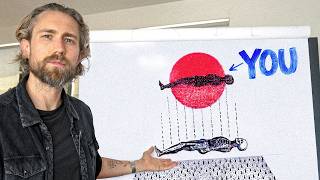
Aaron Doughty uses Japanese philosophy to explain how attachment creates suffering and how to release it. He teaches the frame technique, a breathing meditation that trains your attention to reduce anxiety and stop seeking others' approval. Practice it daily for 21 days to shift from contraction to flow.
Chapters
What if there was a secret to letting go that made it so much easier? What if there was a Japanese secret that's been known for hundreds of years that once you begin to apply in your life will completely transform you from the inside out, and you'll notice that reality begins to conform to a completely new you? Now, the first thing to understand about this is a fundamental truth about reality. And that is that everything changes. I remember a few years ago, I went to Japan and I actually was there for like a week and I experienced that of what a lot of people go to Japan for, and that is they go for the cherry blossoms. There's a certain 2 weeks out of the year where you can go and be around these beautiful cherry blossom trees. With their pink leaves, and they're just all throughout these parks. And I remember being there and learning about them. And one of the things I learned is that the cherry blossom trees are very highly respected and honored and appreciated from people all over the world, but especially obviously the Japanese culture. And one of the things that's celebrated about it is part of what this video is about. That is that all because it's only 2 weeks that the cherry blossoms have these beautiful colors and the rest of the year there's no leaves on these trees at all. That's not something to be sad about. It's not something to try to control. It's something that is actually celebrated. It's something that makes it beautiful. And the truth is everything in our life changes and what happens around attachment is attachment is our ability to try to actually control what is happening. Now, here's the interesting thing with attachment is subconsciously we think, if I attach to this thing or if I control this outcome, I'll get what I want. But in actuality, it's normally the opposite. The more you try to control, the more you push away. The more you try to cling, The more scarcity is there and the more that thing gets pulled out from under you. And that's because when you are in the energy of attachment, you are in the energy of resistance. So here's one of the first things to understand about this whole entire video that I think will help you to understand attachment at a deeper level. And that is, first off, the attachment itself has no built-in meaning. Other than the meaning you give it. This will help you let go of things that priorly you thought you couldn't let go of. Understand that your beliefs about this thing is what's creating the resistance. The belief about it is there's so much meaning given to it that what happens is that meaning is heavy. Now think about maybe some area of your life where it's easy for you to let go of something. Maybe there's some area of your life where you're like, oh, like, you know, if I lost this thing over here, it's not that big of a deal. I'll get another one. But if I lost this thing over here, no, because there's a lot of meaning given to it. And if you think about even a movie that we probably know in our collective consciousness of like, think of the movie of Toy Story. You got Woody, very beginning of the movie, right? And there's Buzz Lightyear. Now, Andy, the boy, used to value Woody. All of a sudden doesn't value Woody because he got some new toy. He's got Buzz Lightyear. All of a sudden, Woody, it's not important where Woody is. Woody kind of falls off to the side and that importance, that attachment was transferred from one toy to the other. And then of course there's a whole story behind that, that toy feeling not needed anymore, not, you know, appreciated. But the idea is that that attachment got transferred. And the idea is that there are times and attachments and things can change, but where resistance comes in is where when we resist that change, it's where we resist it. And what we end up doing is we end up creating that resistance, and that clinging causes us to stay in a contracted self. Now, the first point of this is that there is no self. This is something that ancient Japanese philosophy and different Zen principles have talked to. Question the self, even Eastern philosophy. Now, here's something very interesting and something that I always find very profound when I learn about it. The idea of the self is something that is created depending on our beliefs. And our attachments. Now, when you think about it, think of somebody with dissociative or personality disorders. There are times where they've shown this, where when certain people have a certain personality and they shift to another personality because they have multiple personality disorder, what can happen is from one personality to the other, literally, they may have certain characteristics in one personality They may have access to certain memories in that reality, and then when they shift to a different personality, it then shifts the way that they show up, their mannerisms, the memories they have access to, all shift because they've literally shifted their identity. They shift to a different version of themselves. And what happens is they've even shown this where there'll be moments where somebody has maybe one eye color. They shift to a different personality and their eyes slightly change. They've shown this where somebody might have some form of, some form of ailment, maybe a back issue or something like that, and they shift to another personality and it's gone within minutes. It's like, what is happening there? And could it be that who we are is actually fluid? This is something that the Japanese ancient philosophies knew. There is no self. The self is fluid. How you define yourself is fluid. When I think of myself and me becoming who I am today with making videos, I have completely shifted my identity, the way I identify myself over the years. Even back in 2017, I saw myself, I thought, I felt, I acted equal to the version of me That was a 9 to 5 job goer. Then I started to make videos on YouTube. I started to think like a YouTuber. I started to make videos like a YouTuber. I literally saw myself as a YouTuber. There was a lot more passion in that version of me within a very short period of time that became my dominant reality, but I had to let go of this version of me. I had to let go of the thoughts, the feelings, and the emotions and the actions of that version of me. And the space was the magic of the entire process, the space. And what I mean by this when I'm talking about this is first off, realize that how you see yourself is very important for what you experience because your identity is the attachment that's blocking you from the presence that's underneath the surface. So when you think of why it's maybe hard to detach, let's look at some of the reasons it might be hard to detach. Maybe there's certain patterns like people pleasing or overgiver, overgiving. Maybe even there's the, like, hyper-independence, which of course creates what? Very activated, contracted nervous system. Now what you'll find is that these patterns right here are patterns that were created because there was some form of attachment, some form of survival where the goal was to regulate your nervous system or to quote unquote feel safe. Now the interesting thing about feeling safe is that feeling safe many times can be the known, and this is where people get trapped because people pleasers that are trying to please other people know what it's like to try to please other people. They don't want the unknown of the tension that someone else could feel. Overgivers know what the patterns are of overgiving, overextending themselves, and they don't want to be rejected and their values caught up in that. Therefore, what ends up happening is that identity stays active. So this is where people stay trapped because they think that these is a part of their identity. This isn't a part of who you are. This is a survival strategy. And any survival strategy you have, you can shift out of, you can let go of. But what this means you're letting go of is you're letting go of what you know and you're beginning to embrace the unknown. So for me, back in the day, there was a time where I considered myself a people pleaser. And the thing that I had to learn to do is I had to learn how to express my true self I had to learn to let people be with tension, knowing it wasn't my thing to manage. And at first it felt very foreign for me to express myself. It felt very foreign for me to put myself out there and to hold my ground in certain ways. But what happened is that tension became the initiation into the unknown. So what this is really about is this is about your relationship to the unknown. Now, one thing I want to point out here too is if you identify with the pattern and you think it's who you are, then what happens is you will think thoughts, feel emotions, and take actions equal to this identity, equal to this, let's say, role. And what happens is many people have an old role that comes with it familiar energy. So your old role equals familiar energy. And remember, familiar is very similar to the word family, almost the same root. So what happens is the attachments can be hard if there's an old role that's there that's keeping us on autopilot. Now here's the cool thing. At any moment, you could start being more authentic and start being somebody that sets boundaries. But the reasons you can't do that is because maybe it's the unknown. You don't want people to feel tension because their tension might be your tension. But the part that's really important to understand here is that your identity is not fixed. Just like one day I decided no longer am I going to live according to the values of validation and approval under people pleasing. I'm going to let people be with their tension. I made a choice to shift that. Let go of that old identity, and therefore I wasn't attached to what other people think. I wasn't attached to their attention. You could think about that also with overgiving. Same thing, overgiving, attached to whether they like you or not, attached to whether they approve of you or not. You see, it's like attached to thinking that your worth is connected to you being able to overgive. And of course, if you overgive, what are you gonna attract? Overtakers, the other side of the coin, right? So at one moment I was thinking, feeling, and acting equal to a 9-to-5 job goer. And then I made a choice to become a YouTuber. And part of that YouTuber was somebody that was passionate about making videos and getting into this flow state. I literally started to do these videos every day and I started to get into flow state more and more. And what ended up happening is that became my dominant reality over time. But there was almost like I was moving from contraction into open. I had to become aware that the things that were blocking me was my nervous system was used to familiar, and the nervous system familiar energies were a 9-to-5 job I hated, corporate politics telling me what to do, staying inside people pleasing, overgiving, different type of energy patterns. But one of the first things to understand about the attach, what makes detaching effortless is when you let go of the role that you've been playing, thinking that you have some static identity. You don't have some static identity. You may even believe that attachment is something hard to let go of. So your beliefs about the process of letting go can actually create the process to be hard. Now, just like we know, if I have this marker here, This marker has no built-in meaning other than the meaning I give it. It just is. Now the challenge is when I infuse importance and meaning onto it, well, guess what ends up happening? I end up creating resistance. Now of course, it's easy for me to drop the marker. I could just drop it. Boop. It's on the floor. Easy to do. But what happens is if we believe that we're going to lose them, like if we believe that somebody special gave us the marker, there's a story to the marker, et cetera, we create a lot of importance. Now everything has no built-in meaning other than the meaning we give it. And what happens is when we begin to see that we can change the meaning we give things and we can let go of old meaning, that's when we'll start to free ourselves from what used to have so much weight. So think about it like the— as the things you put on a pedestal, you create resistance around. And the higher on the pedestal it is, the more important it is, the more resistance you create. Now, when you begin to see that what you're really clinging to is certainty, these all allow you to feel certainty. And what you wanna start becoming aware of is you wanna start becoming aware of where all magic happens is in the unknown. All magic happens in the unknown. Like in 2018 or 2017, I had to, I started making videos on YouTube. It was the unknown to put myself out there. There was resistance and blocks that came up. Am I worthy to be doing this? Like, all of that was natural. It came up, but it was the unknown. But guess what? In the unknown of me being this new version of myself, it was like there was a trust that happened, a trust that the energy would bring to me more alignment than the familiar energy that was very predictable. So this is first off about the awareness of the role that you might have of these labels, realizing you think thoughts, but you're not your thoughts. You feel emotions, but you're not your emotions. Now, just like a moment ago, I'm going to share another idea with you that I think will completely transform your life. Think of this idea that the more thoughts you think, the more you are in resistance and the more attached to the thoughts you think, you're in more resistance. I would actually say that thinking thoughts isn't negative, but attachment to thoughts is negative. The key to this is when you learn to observe thoughts and you let them come in and go. So often what they think is like, you'll hear things like, you know, if you're thinking of a certain low vibration thought, think a higher vibration thought. Don't think, don't think, like thinking creates resistance. And if you think about it, thinking is also a survival mechanism. When you are just being present to the moment, you have a level of presence about you that is magnetic. You trust and things come to you that you don't even know where they come from. And when you try to think, that's the analyzer mind that's coming in that's trying to survive. So then the attachment to thinking then creates that of a projection to the future, that's what we call anxiety, projection and thinking about what could happen, or worrying about the past, that's the guilt that we might feel or the regret. But either way, it's using thinking to do so. That will keep us trapped in familiar energy. And I'd say one of the major things that holds so many people back from letting go is they're in a survival mechanism where they think that thinking about it is going to bring it to them, but thinking creates more resistance. When you are in a flow state, you are thinking very little thoughts. When you think of someone like the Olympics was on recently, when you think of someone that's in a massive flow state, they're in the flow of it. There's, you know, figure skating was, I was thinking of like figure skating. They're in the flow of it. They're not like, I'm going to do this next and then this next, next step. That gets them in their head. And also, when do they mess up? Pressure. The pressure causes resistance. So one thing to understand is that when you get to a state of observing your thoughts and letting them be there, that's where there's so much power. And when you learn how to observe the meaning you give things, that's also where there is so much power. What happens is the meaning for many of us becomes this thing that we think is inherent. People's approval is something that means a lot. Why? Just because we believe so? The way that I view this too is like not everything is neutral, no built-in meaning in the sense that like worthiness is something a lot of times we'll fight for, for our attachments. We're fighting to be worthy. We're fighting to prove ourselves. But guess what ends up happening when we do that? We're trying to prove ourselves. We infuse that there's this good enough scale. Things are either good enough or really good or really bad. When there's an acceptance of what is, this is when you're actually free. Things aren't good or bad, they just are. The cherry blossom trees have moments of the year where the cherry blossoms are there. We give it the meaning and appreciate the beauty. And then when the trees, the leaves leave, some people may look at that and go, ew, ugly. That's a meaning. It's a part of the process. And in the same way, when we're talking about who we are, there's presence, there is an aliveness in the present moment, and then there is also the energy of control, which Eckhart Tolle calls like the pain body. The pain body activatedness is trying to control, it's trying to avoid uncertainty. That creates resistance. And the main part of this video that I really want to share with you that I think will really transform your life overall is understanding that when you look at your nervous system and the difference between contraction versus open, this is when you begin to bring that power back to you. Now, when you are in contraction, you're attached to outcome. You're in a survival strategy. And a survival strategy might be people pleasing, overgiving, hyper-independence. All of those survival strategies are mechanisms that allow you to avoid feeling a certain emotion, avoid feeling what is underneath the surface. And this is where we begin to bring it from the head and into the heart and to the somatic process of feeling. When you can allow yourself to feel the tension, or like, what if— this is where we talk about good either way. I think this idea can completely free you right here. If you let it be okay either way, whether you are good enough or not good enough, you become more free. Feel into this for a moment. Trying so hard to be good enough. Trying to prove, we create resistance, we create a better than energy. But what happens is if we bring it down to neutral, we will feel lighter and more free. Now, same thing with underneath. It's like, I feel not good enough. I need to overcompensate and try to bring it back up. If you let it be okay that you are not good enough, you then stop the resistance and you can just be. Think of it like a baby. Is a baby worthy? You would say maybe, yeah, Aaron, a baby's worthy. Don't you know that? And I've already said, okay, what about like this baby over here? More worthy than this baby? And you're like, Aaron, so offensive. Why would you even say that? All babies are worthy. Why are they worthy? Because they exist. Now, if you were to ask a baby if it's worthy, maybe it doesn't have language patterns yet, but, or the ability to speak, baby has no idea of the concept of worthy or not enough. It's a human concept that we fight for. It's a meaning that was generated normally in childhood where something happened and we decided that pain happened, therefore I must not be good enough. But in actuality, babies, I believe, are both at the same time worthy and not worthy at the same time. They just exist. They just are. This is a concept. So what happens is when we get to a state or an energy of neutrality, which is one of the most important parts of this process, learning how to be more neutral in observing what thoughts or emotions come up. Let it be okay that you are worthy enough and let it be okay that you're not worthy enough and you'll find yourself just being. You'll start questioning these thoughts, these beliefs, and what you think you need to fight to prove. And then what happens is in that neutrality, you are able to then feel the emotion underneath the surface. And allow yourself to then begin to open up, which is a process of opening, which is a process of presence, which is a process of trust. So often what happens for people is there is an energy where there's an attachment to not good either way, attachment to one thing, and a belief that if I attach to this thing, it will happen the way I want. But that attachment also creates an aversion to the opposite, which tethers you to it. So one of the truths of reality that I found so empowering— some people say is scary— it's simply recognizing that everything has no built-in meaning other than the meaning we give it. And when we realize that we're the ones that generate meaning, this is when we can begin to undo the past meaning. And when we begin to question our past thoughts or question our past meaning, guess what? We begin to feel more free. And when we feel more free, guess what? We're in more abundance. We're not trying to control. We're able to accept what comes in and we're able to allow things to happen much easier in a much more powerful way. So understand that becoming nothing is about more so realizing that there is no static self. Yourself is always shifting. Every moment you're a new you. Every moment you're a new you, and that's where we then begin to experience an aliveness in our life. This is something also that Japanese secrets have talked about. There's this one phrase, and it has to do with understanding that you can experience everything as new. Imagine everything is new for the first time, and this is what some people who have been enlightened have said. They have said that enlightenment itself is an experience of newness where you recognize that you can't stick your foot in the same river twice because by the time you take your foot out and put it back in, it's a completely different river. And it really is if you think about it. The molecules in the water are always moving. And if you were to take a snapshot of that river and you were to look at it and then take a snapshot of the river again when you put your foot in it, it's literally a completely different river. But what happens is we treat it as if it's the same river, and then we treat ourselves as if we are the same self. So something to realize for this process is the degree to which you realize that everything is new in every moment. You're a new you. Every moment there's a new moment that exists, and your ability to channel the presence into your body is the degree to which you allow the aliveness and the richness to life. To unfold. But the attachment to trying to control, the attachment to the river being a certain way that you want, controlling where the branches are, thinking you know what's best, you create resistance and you create a job for yourself that is extremely tiring. And what if now is the right time to actually begin letting go surrendering and letting yourself feel the energy underneath the surface from these roles and allowing yourself to start to connect to the space in between your thoughts and your identity. So when we talk about thinking less thoughts, remember thinking less thoughts, when you are in a flow state, you're not thinking, you're being. Thinking itself is a survival mechanism to try to figure things out. Yes, it's convenient to think in certain ways. And we use it, we have to use it in our society in order to even conversate and exist. But there's a level of subconscious presence that can envelop your whole beingness. And when you see people that are in a massive flow state, they're not thinking. When I'm making a video like this right now, I'm not thinking. I'm allowing the energy to flow through. When I'm on stage, same thing. When I'm speaking at a live event, it just happens. It's almost like the degree to which I try to pre-plan creates resistance. The more I can surrender to the moment and just be and trust what flows through, the more magnetic presence there is, the more energy flows through, and it happens even better than my ego could have even planned for. So it's learning to really trust the unknown, learning that the unknown is where the magic is. So this is about that awareness of your relationship with certainty versus uncertainty and your acceptance that just like the cherry blossoms leaves will fall, so will the awareness of these attachments you have. They will come and go. And if you can let it be okay that you have the attachment or don't, you will then feel more free. And when you feel more free, you are in more abundance. And funny enough, when you're in abundance, you're more likely to attract more of those things anyways. But you might find too that when you start to attract these things, you actually feel more free the more you can let go. The more you don't have those materialistic things. It's a very interesting paradox. Now, that Zazen practice that I was talking about, you know, if you've ever heard me talk about the frame technique before, the frame technique is where what you do is you stare at a candle flame. You feel the space on the in-breath between you and the flame. You have it about eye level, couple feet in front of you, and on the in-breath, you focus very intently on the flame and you feel the space between you and the flame. On the out-breath, you focus on the peripheral. You don't move your eyes though, you keep your eyes there, but you focus on the peripheral and you focus on becoming one with everything. So it's self versus other, self versus other. As you do this practice, you will start to feel more present to the moment, more safe inside of your own body, and you will find yourself relating to people in a new way. Relating to objects and materialistic things and goals and outcomes in a new way because you are starting to bring that presence more into your body, recognizing that you are both an individual and connected to everything at the same time. The frame technique was rooted in this understanding of this Zazen principle, and it's something that I've been applying every single day for years. I get people that I meet on the streets that know my work. So many people come out to me and say, "The frame technique changed my life." Such a simple practice, but it really allows you to detach from trying to control what people think of you. Your attachment to people allows you to feel more safe inside of your own body. It's especially beneficial for people that feel like they're sensitive to other people's emotions, but it allows you to really bring the energy back to your core. So do that principle, the frame technique. I'll link it at the end of this video. And I also have a training video that I will show you below. If you go ahead and click, there's a training that you can watch to learn more about the frame technique. I'll go ahead and link it below. You can watch that video and I have a YouTube meditation as well. If you just want like the easy YouTube meditation I made years ago, check out the frame technique right here. Do it for 21 days and watch what happens.
More from Aaron

If you can see this, you're about to become so magnetic you are unrecognizable









