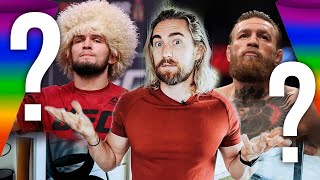
In this video, the presenter contrasts the mindsets, "vibrations," and identities of UFC champions Khabib Nurmagomedov and Conor McGregor, drawing lessons for personal development. Using Khabib’s appearance on Mike Tyson’s HotBoxin’ podcast as a primary source, the speaker highlights Khabib’s lifelong champion identity, disciplined humility, and connection to a higher source, noting how his father’s pressure and early self‑identification as a champion shaped his performance. The video then examines Conor’s trajectory, describing a shift from a passionate, growth‑oriented mindset to an ego‑driven, preservation‑focused energy that seeks to protect status rather than pursue mastery. The presenter cites examples such as TJ Dillashaw’s confidence after a comeback and Henry Cejudo’s humility in the same interview to illustrate the power of identity and mindset. The narrative ties these observations back to the creator’s own experience on YouTube, explaining how success can trigger a transition from authentic passion to ego‑based preservation, and urges viewers to adopt a champion’s identity, discipline, and humility to achieve lasting success. The video concludes with a call for audience engagement and suggestions for future analyses of other high‑consciousness figures.
Chapters
Connor McGregor versus Khabib Nurmagomedov. Nurmagomedov. I've been trying for a while to say it correctly just to pay respect, but Nurmagomedov. Khabib Nurmagomedov. But before I started this video, I literally tried saying that like 10 times and I'm getting there. So with them two and their energies, what is the biggest difference in their energies, their vibration, and what can what can we learn from each of them and how they go about what and who they are and how they carry themselves. We're going to learn exactly step by step how we can do what they have done and become a killing machine. I'm just kidding, but I'm going to show you how they've become champions in their own mindset, their own energy, how they carry themselves, and what we can learn from them to apply it. Because recently, Khabib Nurmagomedov, Nurmagomedov, Madoff was on Mike Tyson's podcast called Hotboxin', and it's, it's incredible how much global attention he has. And one day of that, like, full podcast episode or parts of that podcast episode being up, it had like 1.2 million views. And I was fascinated by watching it because his mindset is incredible. His discipline is incredible, but there's certain things that he said that go into why he was as incredible as he was. Because if you don't know, these are both UFC fighters. Conor was at one point a double champion in two different weight classes at the same time. And Khabib is considered one of the, like, the GOAT of pound-for-pound best fighter. He will go down in the Hall of Fame. He's an incredible fighter. Never lost, never really even lost a round. He may have lost one round that's debatable, But other than that, he's just incredible fighter and he's this guy from Russia that mauls people. He mauls people. I will smash. And, uh, he is, yeah, he's, he's an incredible fighter. Anyways, the mindset and what he talked about in Mike Tyson's podcast was that one of the things I thought was interesting and it's something we talk a lot about is your identity. How do you view yourself? Now, When Khabib was talking about his childhood, he had a dad that put a lot of pressure on him, and his dad recently passed away a couple years ago. And his dad put so much pressure on him, and you could tell that Khabib, for a good part of his life, wanted to make his dad proud. What his dad would do is interesting. He'd be out with his dad, uh, he like grew up wrestling bears is like the story, and he'd be like always wrestling. He's an amazing wrestler. He's got a grip like a bear, and he would, um, just maul people and smash. He would smash And one thing that his dad would do that he said on the Mike Tyson podcast is he'd be hanging out with, uh, he'd be with his dad and they'd be at like a party, a dinner party. And he knew that once his dad found somebody else that was about the same height and weight as Khabib, he was going to have to wrestle this person. So at any moment he would go out and he could have to wrestle somebody because his dad told him to. And what's interesting is when he, before he was champion, he was talking about how every person he would watch in his division on UFC, he would be like, that person champion? No, I'm champion. His identity from the onset was that I am the champion and I can beat this guy. I can beat this guy, I am champion. So he never really had to believe in himself. It was almost like he took on the identity of being a champion from the very beginning. And these people that he watched, he said he was watching Anthony Pettis against somebody else in his division. And it was for a title shot. And he's thinking, why are these guys fighting? I can— I would smash both these guys. I just— he just knew it. He just knew it. But what happens in UFC is there's a certain narrative in a certain way they build up certain fighters for their records to get more views or to get more people and more attention on it. So they wouldn't necessarily give Khabib to somebody that's like really good knowing that Khabib would beat him if they know that Khabib will win because they want to build up the story of all the fighters. So he kind of was talking about the politics of that, but he said it didn't matter. The whole entire time he has the champion mindset, very disciplined. He said this whole thing is mental. This whole thing is mental. This whole thing is discipline. I know. And he's like, right now I've been retired for a year and I know that I could beat anybody in the world at that in his weight class. And I believe him. I still believe him, but he's still training. But without a fight camp or anything, his mindset is at any moment he could fight anybody and beat them. He's a champion, and that's how he views himself, as a champion. So it wasn't like— and the other thing that I noticed about people that are champions is it's natural for them to win. It is not on this big pedestal. It's not amazing if they would win. There's not all this pressure because it's natural. They're just the best. Recently also watching in UFC, there's a guy named TJ Dillashaw. He was out of UFC for 2 years because he got in trouble for some, like, using something or steroids or some shit. And he came back and even though he used the steroids or whatever, he was like an intense fighter and he dominated, absolutely dominated. Well, he's been off of everything, comes back and wins, and people are asking him in the interview afterwards, just a couple of weeks ago, was, are you surprised by your win? Did you, are you surprised by it? How do you feel? He was like, I expected to win. I knew I would win. I didn't know if it'd be easy or hard, but I knew I would win. It's natural for him to win. He wasn't surprised at all. You see, the thing that I want you to understand is the identity piece of this. It's how do you view yourself? At any moment, you can give yourself permission to view yourself a certain way, but you also want to back that up with your energy and also your discipline. So for Khabib, that was what he did. He saw himself as that version of him. He would work hard every day. He would train every day. And he took that identity with him. And that is the key to this, is understanding pressure and making it natural. That's what really changes everything. And then you talk about Conor and Conor's energy, especially as of lately, his energy is all about ego. He's trying to defend. This is another thing that happens when somebody shifts their attention from being a champion to sometimes the side effects that comes with being a champion, like the money, the, um, the clout, the attention, the significance, the brand, whatever. It brings the energy away from who you naturally are as the champion, and it can many times bite you in the ass, which is what happened with Conor. Now there's something interesting that happens as you'll start to become more successful. So it's important that you realize this now because Even my journey of being on YouTube, I've experienced this. When you are passionate about what you are doing and you are in the vibration of it, like Khabib is when he's fighting, he's a champion, it is natural for him to win. When you, or Conor, when he, back in the day when he used to fight, he was passionate about fighting, he enjoyed the process, he was having fun, having fun smashing other, you know, it's an interesting idea, but people that do MMA generally, They're passionate about it. They think about it. They dream about it. It's a part of their identity. But when you start to become successful, if you start to get distracted from being the champion and you start focusing on all these other areas, things get more complex. And not only that, something interesting happens. You can sometimes move from that of being in a growth mindset and becoming the best you to moving to a preservation mindset. I need to preserve what I've created. So Conor McGregor on his buildup was growing, growing, growing, growing. Then he got there and then he got complacent. He got happy, he retired, and he now he's coming back and he's trying to preserve this status. But the preserve, the preservation of status is a very different energy than you being passionate about what you're doing and you seeing yourself as a natural champion. So part of his downfall of that vibration is that also he's also giving all the credit to the ego. For Conor, it's like he's trying really hard to maintain even though he's now lost twice to Poirier, Dustin Poirier. So he's like trying to maintain that image. And the interesting thing is when you look at Khabib, Khabib is a religious guy and he, when he walks up to go to fight for weigh-ins, he does something interesting. He'll go up, he'll do the little thing like this and he'll go like this. So go, me? No. This? Yes, this. He's talking about source energy, God, whatever name we want to give it. That is who he's allowing to flow through him even though he's fighting. I know it's a funny idea, but you'll see it in athletes a lot. A lot of athletes, they have this connection to source, this connection to that, and it's not just their ego, it's grace. It's allowing things to happen. It's trusting the universe, not just trusting the ego. So Conor, on one hand, has moved completely over to ego and a self-preservation mechanism where he is also putting his goal on a pedestal and making it very important that he wins because his ego is dependent on it. His status is dependent on it. Whereas Khabib is extraordinarily humble. This man is a very humble man, and that's why so many people watch him. That's why the Mike Tyson podcast got 1.2 million views on YouTube, and one day because he's such a humble guy. At one point, Henry Cejudo, who is the guy that's keeping the conversation afloat in that HotBoxin interview, he says to him, he's like, you know, you're the best in the world. And then you want to know what Khabib says? I have nothing on you to Henry, because Henry went to the Olympics and was a wrestler in the Olympics. So humble. If you would have said that to Conor or anybody else, they'd be like, yes, I am the best. They would not take the attention off of him and then say, you, what you do is fascinating, building Henry Cejudo up. That's what Khabib did. That is a humble man. So the fascination behind both Conor McGregor and Khabib is their energy is both fascinating in their own ways. But the thing that really fascinates me about Khabib more than anything is just how his mindset and his discipline is so set. For me to go daily on YouTube, there was a certain mentality and discipline that I had to create for myself. I was then making videos in the beginning to add value to other people. Once I hit the goal of 1 million subscribers on YouTube of influencing that many people, an interesting thing happened. I went from trying to make videos to add value to, I need to maintain what I've created. I need to get views. I need to do this. Am I as good as the old version of me? Like there's this, all this self-sabotage thoughts that come into play because then it's come back to the ego versus realizing that it's more about the energy flowing through. So the things we can learn about Khabib and the things we can learn about Conor are both very different, but humility is very important for Khabib's journey and understanding the discipline of a champion and the identity of a champion, viewing yourself as it already. Even Conor, before Conor was a champion, he would visualize himself being champion, having his arm raised, and he would feel it as if it happened now. There are many artists that talk about this. I've heard Kanye talk about this, talks about shopping and how he would imagine himself already being able to go on those shopping sprees and all that stuff. Now that also sometimes, I mean, it can be powerful, but when you're really tapped into you being passionate about what you're doing, it's a different energy than just the side effects of the passion, which is the money, the clothes. And he's also, he owns a billion dollar, uh, you know, Kanye owns a billion dollar company with Yeezys, uh, and or, or whatever that deal is. And he is probably passionate about shopping, you know? Fascinating. But is there— my question to you is, what have you learned about either Khabib's energy or Conor's energy or somebody else? Is there another person you'd like me to make a video on to look at their level of consciousness or their mindset or their energy to break down and to show what we could learn in this process? Comment below, let me know. Like this video if you like this style video. I know it's completely different than some of the other ones because I'm actually talking about people and like things in our pop culture. Let me know. Other than that, I hope you guys enjoyed this episode. As always, peace, much love, and namaste.