Watch Her Heal The Abandonment Wound in 27 Min
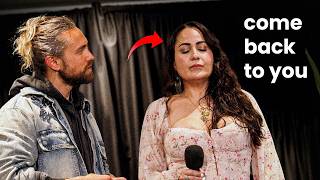
In this live coaching session, Aaron Doughty guides a participant (Speaker A) through a deep exploration of her abandonment wound. The conversation uncovers a pattern of self‑abandonment where fear of expressing herself leads to internal tension, especially in the throat and chest, and a tendency to hide. Writing is identified as her primary mode of self‑expression, yet a manuscript she has kept hidden for 15 years remains unpublished due to family religious expectations and fear of judgment. The coach links this avoidance to a broader self‑abandonment cycle, explaining how not expressing oneself reinforces how others may treat you. The participant recounts moving from Ecuador at 18, experiencing depression, cultural clash, and a loss of her earlier theatrical confidence, which deepened her protective beliefs. Through guided visualization, she reconnects with a 2‑year‑old inner child, offering it play, safety, and reassurance (“everything is going to be okay”). The session culminates in concrete action steps: publishing the hidden book, confronting limiting beliefs about the Latino community’s reception, and regularly nurturing her inner child. The coach emphasizes that blocks are part of the process and encourages moving forward despite them.
Chapters
I attract people that make me feel the want of the abandonment.
I see. And is that a pattern that keeps coming up in your life over and over again?
Yes, but I'm setting limits and boundaries, and I'm becoming— what you said, I really loved how you said to become conscious about it and like look at it, and then you take the power away from it. I think I've been doing that. I've been doing it. I've been reflecting on that and being vulnerable and being here.
So where that abandonment, when you feel that abandonment in your body, where do you feel it?
Oh my God.
Take a deep breath real quick. Let it go.
My throat and my chest and it locks down. Down, like it doesn't let me talk, doesn't let me be myself.
I see. So it doesn't let you be yourself. There's some form of tension. Is it tension?
Yeah, it's tension. It's basically I locked, like I locked and I'm like, I don't want— it's like I don't want to be myself anymore, like, and I hide again.
Right.
So that's the pattern.
Okay, so the pattern is you feel like there's some form of abandonment there or there's some form of tension in the throat. You can't express yourself. But the funny thing is, is that when you feel, when there's that fear of expressing yourself, isn't that sort of a form of abandonment to begin with? Self-abandonment?
Yes, absolutely.
Yeah. So in an interesting way, part of the cycle is that by not expressing yourself, you are also abandoning yourself, which then also leads to, because you, the way that you treat you, is the way that other people are then trained to treat you. Does that make sense? So if you don't choose yourself, or if you're afraid to express yourself and you're abandoning yourself by holding yourself back, what many times will happen is people will mirror that energy back to you. So what if this abandonment that is the fear of, what if the key is in the actual expression of that energy and by expressing it, you are then no longer abandoning yourself.
That's why I'm a writer.
Right. Yeah. So what is a way that you can express yourself?
Writing.
Writing.
I've been doing that for all my life.
Okay.
But I think I need a little— but see, that's the thing. I've been writing, but I have like 2, 3 books that are being hidden in my laptop for 15 years.
Okay.
Because I don't have, like, I don't want— first it was my grandfather is a pastor and I didn't want to publish it because I didn't want to get his feelings hurt.
And do you feel responsible for his feelings?
When I was a teenager, I did.
Yeah.
Yes.
What about now as an adult?
I think he knows me by now.
Yeah.
Yes. He can see me from everywhere.
It's interesting how many times to not hurt our family members by expressing the real us, we end up abandoning ourselves. But who's to say that you expressing the real you, even if certain people in your family have challenges with that or it brings stuff up for them, who's to say that that's not what they need in order to grow to the next level? Who's to say that by not doing so, you're literally holding back their next level of growth because you're not allowing yourself to go to your own level of growth?
Yes.
But what happens is you are enabling them. So another way to look at this is by not trying to hurt your family members, which on one hand, you don't wanna hurt your family members, but on another hand, what does that hurt represent?
Well, the ones that I care are already in heaven, so I don't care about the rest if I hurt them. So I'm good.
Yeah.
Yes.
But still, even if we look at that energy though, I think very often we hold ourselves back from really expressing ourselves and we're afraid what family members and friends are gonna think. So we abandon ourselves, but who's to say that that's not the medicine they need, even if it challenges their perception of you, maybe that's a good thing because what happens is they have the opportunity to level up and to either get to know the real you rather than them just continuing to be in the autopilot mind with the you that's not the real you anyways. Is this making sense? So ultimately, the opportunity, the reflection of life is that we get a reflection of how we treat ourselves. So by not writing, by not putting that writing out there, let's talk about that for a minute. So you've written how many books?
So far published 5, but there's one in particular that I've been holding on for 15 Why? Oof, 'cause it's the religious factor in my family going on. Yeah, my mom, my dad.
Is it more esoteric information and they may judge it because of how they—
It's me 100%. It's truly rebel. And that's how I've always been like the black sheep in my family, but the cute one. You know, that I did stuff and no one find out. But yeah, so it's a book that I truly love. Like, I just traveled back to Italy 15 years ago. I was there and I went back and it was like going back to the places. And when I opened my laptop and I saw the novel, I was like, whoa, where have— you know, it's like meeting an old friend and, It's like, I don't understand now. I don't understand why I waited so long. And I've published another one.
Why did you wait so long?
I didn't have the courage. I'm going to be honest.
Can I say something real quick? She's like, I didn't know why I waited so long. I said, why did you wait so long? And she said, I didn't have the courage. Isn't it funny how often we'll tell ourselves we don't know something? Very often in coaching, I'll say something, it's like, "I don't know." Okay, well, if you did know, and they just blurt it out. Sometimes we tell ourselves, "I don't know, I don't know this." And that "I don't know" keeps you not taking action. It keeps you in the known and the familiar, and it keeps you stuck. So we say, "I'm stuck." But really, part of the reason you're stuck is 'cause you've gotten so familiar with being stuck And it feels so known that to have the answer would also mean there's a certain level of responsibility.
Absolutely.
So what was the answer? It was to have the courage?
Courage, yes.
Okay, so what was the answer again? So why weren't you putting out that writing, that book, publishing it? Because— And what makes it different? You've got 5 other books you published. This one book, 15 years you're sitting on it. What was it about the book? It's that it represents something religious and The fear is around your parents and what they might think about it?
Yeah, I'm actually gonna dedicate it to them.
Oh, that's beautiful. Yeah. That might be a good symbol too for you individuating.
I was meditating one night and I saw it as a vision to my parents. I think less lovely, honestly.
Okay.
Yeah.
Well then what's the block? Is there a block there now or are you—
That's why I'm here.
Okay. Well, here you are.
To remove the block. And also because it's very hard for me to be public like you are. It's, for me, it's like very—
It's hard for you to be public?
Yes.
Why?
I don't know. I'm trying to figure it out.
Why do you— If you did know, if you did know—
I don't know. I just—
What is a— Here you are in front of 100 people in a crowd. And you're afraid of being public. You're doing a great job, by the way. Isn't she doing great? You're doing a great job. So you're telling— so you have a story that I'm not good at being in the public eye or whatever, like I am or whatever. Yet here you are with me in the front of 100 people, right? But what is that story? What would it mean if you were in the public eye? What would you be setting yourself up for? What are you afraid will happen?
I don't know. It's like I— I know it's also a limiting belief, but I'm like, and I said, like for this year, I said a goal that today, and I also like already spoke with my publicist and all, and like, I'm like, it's like I'm a kid who's, I don't know how to explain it. It's like I'm talking to myself as I'm a kid, and I'm like, that's it, no more hiding, this is the year. You know, I'm telling that to myself. And so—
What would you say, imagine a younger version of you—
Oh no, you're gonna make me cry.
Well, let yourself sit with this. This is where the gold is, by the way. The gold is in moments like this. Okay? So if you were in front of an inner child version of you, and that version of you was looking at you and was scared, Afraid of being in the public eye, afraid of really being seen.
Oh, she would love it. I was different when I was little.
So then, so that version of you would actually love it.
I did theater for everybody when I was—
When did you stop doing theater?
I don't remember.
Was it a moment you just stopped? Like you're doing theater, you're expressing yourself, you're okay to be seen, and then there's something that happened where then you said, I don't want to be in the public eye. I don't want to be seen.
This is awesome. You know what? Because I never thought about it. When I moved from Ecuador to here, and I was around 18, that's when I stopped.
And OK, what do you think the catalyst for stopping was? You moved from Ecuador to here. How did you feel when you moved from Ecuador to here?
Terrible. Depressed.
Yeah. Yeah. Horrible.
Because I moved to study because I didn't like how it was in Ecuador, the structure to study. I'm a nerd. I am a nerd. And the structure, I was always arguing with teachers and stuff like that. And they're like, that's it. And my dad, he's from Texas and my mom is from Ecuador. So I already had family here. And they're like, go with that side of the family, you know, because you're like, you're a rebel. And like here in Ecuador, everything is limited and you have to say this and you like, you had to stand up every time a teacher came in. I was like, I'm not standing up for you.
Yeah. So what was the energy though of moving from Ecuador to here? What would that— how did that version of you feel when you made that move?
I felt terrible. I felt terrible. Those were like my darkest last years, I was truly depressed. Because, you know, I didn't have—
Was it the new energy? Was it that you weren't around friends and family that you used to know?
Yeah, because I was, you know, back in Ecuador, I was just this sweet girl. And over here, like, I met really awful people. And it was like—
Which is interesting, right? Because she's in a cocoon.
Yeah.
Because she's protecting herself from other people. She was open, free, able to be seen, expressing herself, a theater kid, comes here, has this experience, and then decides people are awful.
Yes, basically.
So if people are awful, so what I want to look at though is that that experience has caused a form of belief, a belief, a story about reality, a story about reality that maybe feels safe, Because what is it protecting you from?
To get hurt again.
Right. So the fear is around opening yourself up to actually connect to other people. So instead, I'm just gonna play small, not express myself, right?
And hide.
So what do you think is really here for you? What is the core of this that you're working with right now?
Right now? To get out, to be myself again, to—
What is the core insight for— is there a part of yourself that you can begin to be present with?
Yeah, my inner child. Totally.
And the inner child part of you that moved from Ecuador to here, is that the inner child?
I think so. She was pretty awesome. She is pretty awesome. Yes.
So imagine— how old were you, that inner child part of you? What age?
Oh, 2.
2? Wow.
Yeah.
2 years old. So if you were to imagine a 2-year-old in front of you that's terrified, depressed, because they just moved from Ecuador to here. And maybe they feel like they— well, what are the emotions that that younger you felt? Terrified, depressed. What else happened to that part of you when I moved? Or yeah, when you moved over?
Yeah, numb, depressed. Yeah.
And what did that inner child part of you want and crave?
I know. Oh, this, this is like to be seen.
Mm-hmm. So real quick, what I'd like you to do is to close your eyes and to imagine that inner child in front of you. And everyone that's watching, you can also do this in your own way. Imagine that inner child in front of you right now, just moved from Ecuador to to the States. And maybe you're able to see what they're wearing. Maybe you're able to just tap into their energy, to look at their expression on their face. Focus on really seeing that part of you. Now take a deep breath in. Let it go. And look into the eyes of that inner child and connect your heart to theirs. What is happening right now? You can keep your eyes closed. What is happening right now as you look at that inner child? That part of you?
I feel that I can, I don't know, a lot of emotions. It's like I feel like she gives me strength.
Yeah.
And I give her protection.
What does she want from you? Ask her what she wants.
She just wants me to play.
Okay. Why don't you play with her in your mind right now? Imagine playing with her. What would she want to go do?
Play dress-up. That's what I used to do.
Okay. You imagine yourself playing dress-up with her?
Yes.
Wanna take a deep breath in and out? And what else? What else does she want from you?
She wants me to lay down and just stare at the sun.
Oh, that's beautiful.
That's something that I still do.
Imagine yourself lying next to her, looking up at the sun, maybe absorbing the sun rays. Maybe feel that comfort of your inner child next to you and that play energy, taking a break from playing, playing dress-up. What do you notice about her energy now?
She's in peace and harmony.
Yeah, she feels more in peace and harmony. Yeah, more at peace, maybe a little bit less depressed.
Yes.
Now, what would you say to your inner child?
That everything is going to be okay.
Hmm, beautiful. Why don't you tell that to her? Why don't you say that to her? Yes, say it.
Everything is gonna be okay.
Mm, beautiful. Now taking a deep breath with her. And imagine yourself hugging her. Let her know that whenever she wants, you'll play with her, you'll lay under the sun with her, you'll hug her, and you'll breathe with her so that she knows that she is special, connected, loved, protected, and all of those things. And anytime you want, you're able to connect with her because she's within you. So whenever you're ready, you can open up your eyes. Can we give her a hand? How do you feel? How do you feel now? We're not done yet. I wanna first off acknowledge you and your vulnerability for allowing yourself to feel that. It's very—
Thank you.
It's very inspirational to all of us here. And there's a part of our, like part of this energy, by the way, that we're doing this live event is when someone comes up here, they also represent other aspects of ourself. And you connecting to your own inner child puts an energy in the space that is allowing us to connect to our inner child. And maybe the sadness that wasn't allowed to be felt, maybe it was the not being seen, not being heard, not being nurtured. And that energy is just very powerful. So with what you've met, what we've been doing today, what will you, what is the big insight that you're gonna take with you? Moving forward?
It has to be one?
No, you can be more than one. But what is the one major— what is the one that sticks out to you that's relevant right now in this moment?
To meet with my inner child, to give her the attention.
Yeah.
That, you know, That she craves or craved.
What is a way that you can do that in daily life?
I think, to be honest with you, I think my inner child is pretty alive in my daily life because—
Oh, that's beautiful.
Because I'm a clown.
Yeah?
Yes.
That's that inner child energy wanting to come out?
It is very out.
So what was, besides the play though, what was that when you were, when it brought up emotion for you, what was it that you said to her?
That everything is gonna be okay.
Yeah. So maybe at moments throughout your week, you sit there and you connect to your inner child and you let her know that everything's okay. Even if you put out a book, everything's gonna be okay. That inner child part of us sometimes holds us back and we're not even aware of it. 'Cause it's a subconscious energy that's trying to stay safe. And the way to stay safe is to stay in your cocoon. It's not to express yourself. It's not to have your family members feel tension, but then we end up abandoning ourself in the process. So what is one way you can no longer, that you can stop the pattern of abandoning yourself? Obviously one is not abandoning their inner child by letting them know it's gonna be okay and being present with that part of you. And seeing that part of you. What's another way you could do it?
Another way? Not to hide from what I feel in my core is my destiny.
Yeah. Maybe publishing that book?
Yes, absolutely.
Are you gonna publish that book?
Yes.
Amazing. How are you gonna publish that book? What do you have to do to do that? This is like the spirit. So there's a spiritual component to the work that we're all doing. But then going home, there's a practical side of it as well. Right? So to follow up with this so that everything that we're doing today really has a lasting impact, the follow-through is the other aspect of this. So what does that mean? What is the missing key to just publishing the book?
It is a process actually. I have to republish a book that I already published and kind of like come out to my market that does not know me on the spiritual level, because I used to work in, um, in New York— in New York and New Jersey. I used to have my own magazine. I used to interview artists, and I was in a totally different market, and I had this different kind of books, and it was so hard for me to be taken seriously, especially on my community. Latino community are very hard.
And well, I want to point out that, that is a belief that you're allowing yourself to stay where you are.
I know, I know, I know, I know, I know, I know, I know.
You know. But you're going to say that. You say it and it's like, oh, in the Latino community, it's very hard to have these ideas. Okay.
Yes.
That is someone.
That is a limiting belief. I agree. After all, I'm talking to you. I cannot be limited.
You know, well, how about this? How about. How about understand that as you go to do this stuff will come up. Even as I— even I just mentioned it, like, just go publish the freaking book, and it's like, well, what about this? And what about this? As you go to do it, stuff may come up for you. Okay, okay. The key is to move forward anyways. You stop.
And that's what I receive in the meditation.
Beautiful.
Yes, the meditation, uh, when we connected to our higher self, was it? Yeah, yeah. The message was, go on.
There you go.
Yeah.
So Your homework is to go and to publish the book and to move forward. And if blocks come up, it's a part of the process. It's not this thing, not— doesn't mean you should stop. It doesn't mean that in Latino community, this is how it is. Those are all stories that reaffirm where you are and staying the same. That's a belief. Are there Latino authors?
Yes.
Well, obviously it didn't hold them back, did it? Right? It's like, oh, if that held back every Latino author, there'd be one Latino author. Doesn't that sound silly? Right? There's amazing, incredible authors that are Latino. They didn't let that belief hold them back. That story may have been in their family, may have been, if they were talking about something that maybe was outside the culture being brought up. But guess what? They did it anyways. Right?
Yes, absolutely.
Awesome. Let's give her a big hand. Give you a hug. Thank you very much for coming on.
More from Aaron

If you can see this, you're about to become so magnetic you are unrecognizable









