Watch her shift from BLOCKING love to finally RECEIVING it in 24 minutes
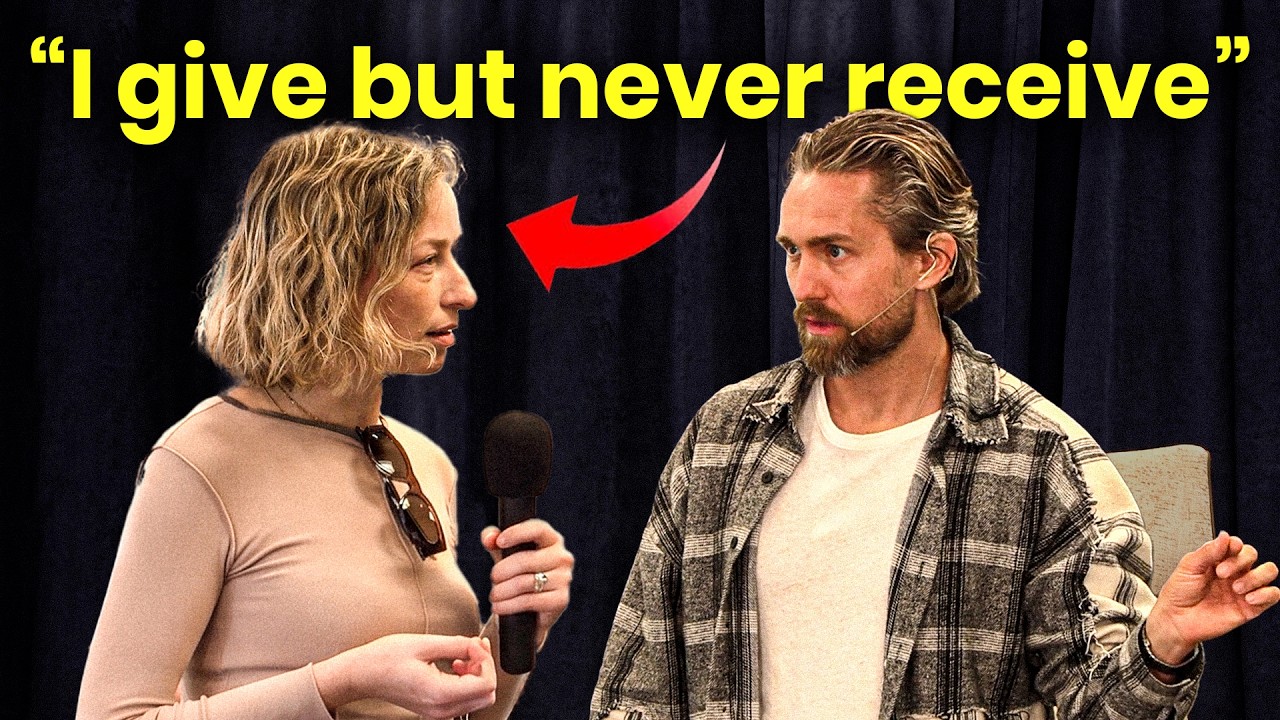
Aaron Doughty coaches a participant through why she blocks love and support, tracing it to a childhood where she had to emotionally support her mother. A protective part keeps her safe but prevents vulnerability. By thanking this protector instead of fighting it, she begins to receive.
Chapters
I still have trouble receiving.
What was your role as a kid?
My mother, she always wanted to become a mother. She couldn't.
Close your eyes for a moment. How does that feel? Your inner child might be angry. Well, to receive would mean all of this shit comes up, doesn't it?
What I'm interested in is actually receiving in itself. Like, sometimes I have this like worthiness issue that comes up.
Yeah.
And I feel like it's a roadblock to receiving.
Yes.
So basically, you were talking about receiving, receiving, but just how to be so open to that.
Yeah.
Like, I want to be vulnerable. I want to be seen. I want to give. I want to feel. I want to embody.
Yeah.
But I still have trouble.
Receiving. Yeah. So can I ask you a question?
Yeah.
Without getting too, like, uh, just a general curiosity thing for anybody that's also struggling with receiving. As a kid, were you— what was your role as a kid? Were you allowed to receive, or was it more of something— were you responsible for people in the family?
Yeah, it was unsafe to receive, and I also had this role of Providing my mother with her own sense of worth and purpose. And yes, like, she didn't have inherent worth. And then she always wanted to become a mother. She couldn't. And when she met my father, she said, I cannot have kids.
And she couldn't.
She wasn't lying. And then I happened. So she received me.
You were the miracle baby.
Yeah, exactly. But yeah, I had all kinds of different roles. I was like parentified. I had too much going on, basically. I had to survive out there. I had to get attuned to her own needs and emotions that she wasn't even in touch with.
Yeah.
So, yeah, you can follow along with the questions because it's a bit chaotic, but I understand.
Yeah. How many of you also feel something similar to what she's mentioning? Look around.
Yeah. Wow.
You're not alone. Yeah. Oh, interesting.
Thank you.
It's interesting that when, as a parentified kid who feels like it's their job to manage their parents' emotion, will have trouble receiving from other people, partially because to receive from other people may have been something as a kid that subconsciously you don't feel worthy to receive. It almost is like there's a subconscious belief that we and our role within the family system is I have to be the strong, responsible one. The strong, responsible one everybody else needs, but at the same time doesn't have capacity to have needs. So here you are in a relationship with mom and dad, and mom, whose role is to be able to shower you with unconditional love and acceptance. And as a kid, a part of you wasn't able to experience that because you took on that emotion, that energy, and it became your role to be the strong one to take care of your parent.
Yeah. And always be like one step or two steps in front of my body, which I think created this crust because I was so like a crab out of my shell.
Yeah.
And it did not create vulnerability.
Yep.
It just created this protection everywhere.
Yes. So when we talk about, when we talk about how do I learn to receive more, we're basically saying, how do I let go of the protective mechanism that I have?
Yeah.
And feel unsafe. Do you see?
Yeah.
You're like, I like, I, you need to receive more, but to receive more, feels not safe. What is that emotion underneath not safe for you?
Okay, wait a second.
Now, before you go deeper into the video, I want to invite you to experience this for free inside a community I have that's a free community called High Vibe Tribe. I run continual challenges in this community, as well as there are free resources that can show you how to transform your life from the inside out. This is also where I teach my signature SHIFT framework, S-H-I-F-T, seeing the pattern, healing the root, integrating the frequency, and transformation. And if you wanna experience it live for yourself, go ahead and click the link below, grab your spot, and I'll see you on the inside of the community. If you were to connect it in your body, you're like, okay, this is the pattern inside of my body.
Mm-hmm. I don't know. It's like you are asking me a direct question, but I have this coming up where there is so much resistance to weakness. To weakness. Like, I'm judging this weakness.
Yes.
I feel so weak.
Yes.
And yeah, this is just what's coming up.
Yeah. So there's a part of you that feels weak. Weak in having— weak in what?
It feels like just downloads that I'm having. Doesn't make much sense, but okay.
Allow yourself to connect to your body.
Yeah.
There's no need to understand this from the intellectual spot. And everyone else listening to this, you can connect to your own body as well if you share a similar pattern and see what this pattern inside of you—
so you asked weakness about what?
What is weak?
Oh, my God.
You said that there was a part of you that was weak. What is that?
I feel like this is just like the collapse. You said connect to your body. I feel like I get in front of me, I get out of body, and then I have no structure. I have no body because I'm in front of myself.
Well, why don't you just bring the awareness back inside of your body? 'Cause these are all terms that we're using to explain energy. But really that's why we say, what does this mean? Right? Like what does it mean to receive? What does it mean to be weak? Because our identity, we don't want to become something that doesn't feel safe. So we say, I wanna receive, but it wasn't safe as a kid to receive. It wasn't even— was it even an option for you to receive?
Great question.
Yeah.
No.
Okay.
Definitely not.
So did you receive— did you receive love at all from your mom?
No.
No love. Did you have a place? Did you have like shelter, a place to live?
Yeah, I have. I had myself. I had my room.
So you had a room?
I had. Yeah.
Yeah.
I had a room. I—
could we say that you received a room?
Yes.
Okay.
Yeah.
Interesting. So you received a room. Interesting. So you had a room, you had shelter.
Yeah.
So we're looking at the story right now around mom. Mom did not give you anything, right? Very powerful thing to do is to see where are ways in which mom did give you something.
Okay.
Yeah. As we're contemplating all of this inside of ourselves, what we'll find is a lot of times the people that we're going a little bit deeper with for a moment, those will reflect back to the room different things about ourselves. We might see ourself in what you're going through. We might see our mom or dad or friends that we know, but it becomes part of the group collective experience. Do you guys see that? So, thank you for your vulnerability. But what we're looking at now is, the parts of ourselves. So more— so if you were to just close your eyes for a moment, okay? Take a deep breath in. Let it go. There you go. What is this really about?
I think this is about me just feeling always like there is something deeply, deeply wrong with me. And that I'm not worthy of receiving love in the deepest sense. I do receive to a certain extent, but basically I firmly don't believe that I deserve everything. And there are parts of me that do believe that. But this really vulnerable, Part of me, like, yeah, doesn't believe that at all.
Yeah.
So this is what's going on.
So So if we were to imagine this is us, and we imagine that this is our parents, and this is our relationship to our parents, what can happen when we feel not worthy, there's a certain level of shame underneath the surface. Shame wants to hide in the dark. Shame does not wanna be seen. We will develop a whole bunch of protective mechanisms to not feel shame. And what happens is if mom or dad went through divorce, were emotionally unavailable, whatever it is, we interpret the meaning to say that there was something wrong with me. The meaning, the internalized meaning of mom not being present as a kid, not being able to receive as a kid becomes something that we think means something about our sense of worth. The reason being is because as a kid, we internalize everything. Mom and dad divorced was my fault. Mom or dad physically left or was emotionally unavailable, my fault. That's when we start to believe that there's something wrong with us. So what happens is then there's a certain level of shame there, a certain level of emotion there that says, "There is something wrong with me. I must protect this shame. Who do I need to be to manage the shame? I need to take care of mom. If I take care of mom, I will then be enough." So what happens is this pocket right here, is the pocket of unfelt emotion that wants to be felt. And if you imagine, it's almost like there's a little girl version of you that feels there's something wrong with me. So what if you right now were to take a deep breath in and let it go? I want you to imagine, everyone can do this as well in your own way if you'd like. Imagine that inner child you. Imagine that inner child you that feels like it's their fault, that feels like there's something wrong with them. Begin to connect to that part of you. And then, Allow yourself to be with them. Don't need to fix them. They just wanna feel seen and heard. And what if what you could say is, it's not your fault.
Like that scene in the movie.
Exactly.
Oh, I've been wanting to experience that my entire life.
Yeah, well, we can, so she's referring to, you're referring to Good Will Hunting?
Yeah.
How many of you seen Good Will Hunting? There's a segment in Good Will Hunting where Matt Damon is talking to Robin Williams. And what Robin Williams just keeps saying to him over and over again is, "It's not your fault." He says it over and over again. He says, "It's not your fault." And Matt Damon's like this edgy, cool guy who's like smart and then becoming aware. Of this unprocessed shame inside of his own body. And what happens, that is a certain point, he keeps resisting anger. He starts fighting because he can't be seen as—
Weak.
Exactly. Can't be seen as weak. So what happens is he starts fighting, then eventually, it's not your fault. Really connect to that energy. It's not your fault. Connect to that inner child part of you and let them know it's not your fault. You did nothing wrong. Mom and dad not being physically there, emotionally there for you the way you wanted to wasn't your fault. And as you connect to this energy, this emotion, As you connect to that inner child part of you, you can begin to allow your inner child to not feel alone. And vulnerability— do you believe vulnerability is a strength?
Yeah, absolutely.
Yeah.
Yeah.
Is vulnerability weak?
No, but there is a part of me that feels like this naked crab.
Yeah.
That could be killed like—
interesting. Yeah.
The second Yeah, my life gone. Yeah, it's like deep fear of death, basically. Like, I will cease to exist. Yeah, like something will just blow up inside of me and this void will swallow me.
Yeah, and I remember when I went through a certain transformation where I had a pattern of people pleasing and I wanted to overcome that pattern, and I was aware of it consciously aware of the pattern, but wanting to actually shift the pattern. And I'd find myself in moments where I would feel like if I had a vulnerable conversation with someone and express how I actually felt, I'd feel the same way. I'd feel like I was gonna be rejected. That rejection would feel like death, especially when you're talking to somebody that you're very close to, right? Friends or the few people that you might actually feel connected to. It will literally feel like death. And what happens is, for me, what I had to do was allow myself to feel the death and to realize that there is a part of me that is dying.
Oh yeah.
Would it be a bad thing of the manager part of you? 'Cause that's what we're asking. We're asking for that manager part of you to die.
The protector.
Yes.
Like, my protector part is the veteran.
Yeah.
He's like the spy. He's like the pro.
Yeah.
So I always have this internal tug of war between—
I get it—
my inner child and the protector. Yeah. Protector is so aggressive.
Yep. So, yeah, it's, it's, it's— if there's not a feeling that I can trust God or the universe, this protector is doing their job.
Yeah. I want to become God. I, I am this, like—
yeah.
I'm always a few steps ahead.
Yep.
I have everything figured out.
Yeah.
And I'm so empty and unhappy because of that.
Right. And it does take a lot of energy, isn't it, to have to keep that part of you alive?
Yeah.
And the interesting thing is, is when we become aware of these patterns, like protection, the protector part of us, the people pleaser part of us, the hyper-independent part of us, these patterns when we become aware of them, what do we normally try to do? What do we normally do when we see these patterns?
Change them.
Yeah, that's what we wanna do, right? We wanna change the patterns. If you have a protective part of you that has been protecting your entire life and you right now wanna get rid of that protector, it's pretty fucked up, isn't it?
Yeah, he's gonna fight you. Yeah.
What if instead, what if instead you thanked the protector? How does that feel inside of your body?
He likes that.
Yeah. Protection isn't the problem. Yeah. It's the fact that you're trying to get rid of the thing that has kept you safe your entire life that becomes the problem.
Yeah, always.
It's not a weakness to have that protective part of you. The challenge is that we're trying to change something. And when we try to change something, we're trying to get rid of something that is a part of us. That creates resistance. So what if instead you could accept the protector and allow the protector to be there and allow yourself to be aware of it when it comes up inside of yourself, to acknowledge it, but then you still have a choice whether you let it run the show or not.
Hmm. Yeah. So this is, I think, the part of inner child just growing and like getting the spine.
Yeah.
But I feel like this is a whole nother topic.
Well, let's stay here for a moment.
Okay.
Yeah. Let's stay here for a moment. Let's sit with this for a minute.
Okay.
'Cause sometimes what the mind wants to do is it wants to go somewhere else the moment that it's like we're really touching something deeper here. Can you feel that?
Yeah. Yeah. There's truth in that.
So how do you feel now if you connect to that deeper protector part of yourself? And why don't you thank them?
Thank you, protector veteran.
Yeah. Thank the protector veteran. How does that feel?
He's like, you know, hmm.
Yeah.
Girl.
Yeah. It's interesting. Even when we talk to our inner child, when we start talking or communicating to our inner child, one thing that can come up is as we do that, our inner child, the moment we may have been ignoring our inner child for 20-something years, all of a sudden we do an inner child meditation and we expect our inner child to be like, thank you, pick me up, this is great. Your inner child might be somewhat angry for you not paying attention to them for so long. This is a subconscious part of you that maybe has been abused quite a bit or felt like they were abused quite a bit. Of course, we're doing the best we can with where we are, but where we really begin to make— where we begin to really make the work is when we realize that as we become aware of the patterns, You don't change the pattern from the level of the pattern. The pattern, if you have a pattern of judgment, for example, I can be very judgmental of other people, right? I can be very, and I see the judge part of me. The first inclination is what? When you see that judge, what are you doing? You judging it. Exactly. So then you'll judge the judge and you'll say, you shouldn't be judging. Why are you judging? You're causing lots of pain in my life. You're helping. You're closing out connections. So then we judge the judger instead of recognizing and accepting that part of ourselves. So the patterns that we have are many times the gifts that allow us to really go deeper inside of ourselves. And the more we can see, hear, soothe, and nurture these part of ourselves, the more we begin to end the inner battle inside of us. And when there's a certain level of shame there and we've had a protective mechanism that has been protecting us from feeling the shame for so long, and then all of a sudden we wanna get rid of it, how, why can't I receive? Well, to receive would mean all of this shit comes up, doesn't it? And you don't want all that stuff to come up. But what we can begin to do is to develop a stronger connection with these parts of ourselves. So what, let me ask you this. What's your biggest insight from this? Kind of like working through this part of yourself and connecting to this protector part of you and accepting? What is that insight there that you could bring with you?
Um, the first thing that came up was I needed exactly this experience of people just saying, you're not alone in this, and like hearing them make sounds.
Yes.
And having, you know, body reactions to what I'm sharing.
Yeah.
Which makes my inner child heal from this complete isolation.
Yes.
And it's not even about protector part. It's doing its job.
Yeah.
And I don't have to give him, like, a lot of feminine energy or try to change it or whatever.
Yeah.
It just feels like I had my inner child stuck in growth. And the protector part being very responsible for making her feel safe and be safe in this world. So what I'm bringing home is this community of people that are all children that are feeling just vulnerable.
Yeah. So knowing you're not alone in the process. And knowing that when you express something, that is, that's a major part of healing is the expression of shame. Like, have any of you ever had the experience of something that you didn't tell anyone for a very long time, and then you finally share it with someone, and then you feel way lighter and way more free? Like, raise your hand if you've had that experience. Yeah. And all you did was express something that you thought nobody else could see. Remember, healing happens in the presence of an empathetic witness.
So many empathetic witnesses.
Yeah. So when we raise our hands, like, when we raise our hands and we realize that, like, oh, everyone that was a parentified child as a kid that had to take care of mom or dad or the family, raise your hand. And it's like a majority of the room. We recognize I am not alone in this, even though I thought I was alone for so long.
Yeah.
Right? And every one of you has probably a protector part of you, even though it might show up different. Protection is also people pleasing, overgiving.
Yeah.
It's a protective mechanism. It's not as overt in the sense that it's like, I will give to then receive, or I will ease the tension, but it's something that allows us to alleviate feeling shame because of what we believe it means about us. So someone else's tension and their disapproval means there's something wrong with me. And in fact, there's nothing wrong with you. There's nothing wrong with your protector part of you either.
Thank you for saying that.
Yeah. And as you begin to play with that energy, you might find that you start to feel like this energy comes up for you, but you start to feel more present inside of your body.
Yeah.
Okay.
Yeah.
Okay. Thank you so much for sharing.
Thank you guys also. Awesome. Thank you, Aaron Doughty.










