When you Accept Yourself you wont give a F*ck what people think... (live demonstration)
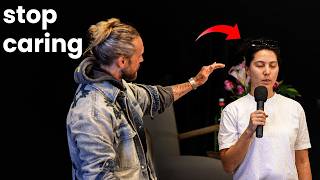
Aaron Doughty coaches Adriana through self-acceptance work, tracing her need for approval back to childhood rejection and codependent family patterns. They use breath work and mirror exercises to shift her from seeking external validation to building inner security, with Adriana realizing she funds her siblings partly to earn love.
Chapters
What's wrong with being weird?
Rejection from others.
Okay, and what does a rejection from someone else mean?
That they're not aligned with me.
And what if someone's not aligned with you?
Then they'll fall away and somebody else that is aligned will come in.
Oh, so it sounds kind of like a solution.
It does.
You guys see that? So many times we will have these patterns that are subconscious And we're afraid of being seen. And we think because as a kid, to be seen was a painful thing. If when we were seen, we were in trouble. If when we were really seen, there's something maybe bad that happened. And what ends up happening is we associate any form of rejection with bad. When in fact, rejection may be allowing redirection towards people that don't think it's weird and align more to who you are.
Yeah.
Okay, so let's look at that a little bit more. So what is the, I wanna, if we were to tap into the body, so let's go and take a deep breath in real quick. Let it go. There you go. Just shake it out a little bit. There you go. Where does this rejection sit inside of your body?
Here.
Okay. Like around you, around your chest, your heart, your arms.
Chest, like my arms start shaking. Yeah.
If that rejection or emotion had a voice, what would it say?
You're a failure. Yeah, yeah, you're a failure.
Then why would it laugh afterwards? You're a failure.
You are not doing what, what you were supposed to be doing, what you were doing before, which was super sexy.
To who? Who is it super sexy to?
To society.
And what were you doing before?
Film producing.
That is sexy.
Yeah.
Wow, compared to daycare, that is so sexy, right? Who, what, who, when did you decide it was So did someone tell you one time they're like, ooh, when you were a film producer, that it was sexy?
But no, just the people that were in my life before, which did not see me, you know, they're in their sexy world, which I love.
That industry tends to be a very sexy industry. Yes, right. It's an industry that's very much built on— doesn't have to judge it, but superficiality, right? Yeah, so not to say we have to judge them or anything, but there may be certain values of that industry. And if we put ourselves in a box where we have to live in these values, breaking out of it might feel like we're, you know, like we're doing something wrong.
Yeah.
Right. Okay. Could you elaborate a little bit more on that?
So just in, so the, the fear was this is a sexier thing, a sexier thing, that community that I used to be part of, maybe them judging me, not seeing me and being like, what are you doing? Doing? Like, why are you opening this? Um, you know, not seeing my vision or, you know, how it's going to— yeah, provide stability and give me the life that I want. And then I could write my books, and it doesn't mean that I'm renouncing film. Um, right, but they don't see that. So just getting—
and if they did see that, what would, what would happen to you? What would that allow you to do if they would see my vision? Yeah.
It would make me relax. It would be like a cool breeze.
Would it? Let's imagine, let's imagine there's like a whole row over here of people that are from the film industry days, and every single one of them is like, oh my God, what you're doing is so sexy. I see you. And then they just go to the next person, and then you're like, you know, you affirm it as well, and then you affirm it. Everyone's affirming you, right?
Yeah, I would love it.
You would love it?
Yeah.
And then what would happen?
I would be like, I'm still doing what I'm doing, but thank you.
So if they were to all approve of you, then you would feel worthy, you would feel enough. But then what happens is if my center of gravity of happiness and feeling enough is dependent on you and you and you and you and you and you and you and you approving of me, I'm putting my locus of control outside of myself. Right?
Yeah.
I'm literally giving other people, here's an approval stamp, can you stamp it? Here's an approval, can you please stamp it? And I'm going to each person asking for approval. But what happens is at a deeper level, what am I really wanting?
Approval from myself to feel safe in me.
Yeah. Let's give her a hand for that. Yeah. With this being said, so you're doing a great job, by the way.
Thank you.
So thank you for being vulnerable. It takes a lot of courage to come up here, even though she didn't know she was coming up here when she asked the question, but that's the fun of this experience. So what we're gonna do now is, what is something that maybe you've never said to yourself that you've always wanted to hear?
Wow, okay. Um, I don't know.
What is it that you want everyone else to see in you?
You're going to make a shit ton of money and it's already coming down for you.
Okay. And what else? What's deeper than money? What's an emotion of like a— that would really mean something to you?
Acceptance.
Yes. Yes.
Yeah. You're finding your community. Yeah.
Now we're going to do something else. Okay?
Okay.
One moment. So, how many of you— Okay. How many of you have ever done mirror work? Yes? It's very powerful. So when you're in front of a mirror right here, go ahead, right over here, and you can just look at yourself in the mirror. You can get a little closer. When you're looking at yourself in the mirror, your own energy is being reflected back at you. And what happens is it's a very intimate experience. And this is where you're able to connect to not only you, but also the other past parts of you that maybe in the past didn't feel accepted. So if you were looking in your eyes in the mirror right now, what is something you would say to yourself, the thing that you wanted to hear, and everyone else, what would that be?
Stop worrying. Um, everything's gonna be okay.
Beautiful.
Yeah.
And go and look in your eyes again and go and say it again.
Stop worrying. Everything's gonna be okay.
And then keep saying it.
Stop worrying. Everything's gonna be okay. You're going exactly where you're meant to go.
That's beautiful. Gotta take a deep breath in. Let it go. Now go ahead and say it, and then connect with yourself at a heart level. I'm looking into your eyes.
Stop worrying. Everything is going to be okay. Thank you.
Yeah. Have you ever told yourself, "I love you"?
Yeah. I love you. Sweetheart, you're so loved. You're so loved. Thank you.
Sit with that. No, come here. It was that emotion that's coming up right now. That's powerful gold. Very powerful experience to look at yourself and to say that I love you. And the first couple times you say it, you're kind of like, You're kind of getting the energy out there, but then after that, there's something that starts to sit in with you and you could feel it. You started to settle in with yourself and then there's like, uh, it's like that emotion comes up and it's like, I'm going to stop here. But the key is to just keep having the courage and the vulnerability to feel into that.
Okay.
So go ahead and allow yourself again just to connect to that energy. And as you do it for yourself, by the way, you're allowing all of us to tap into that aspect of ourselves.
Sweetheart, you're so loved. Yes, I love you. Don't worry, I love you. I love you.
Thank you. Beautiful. Give her a hand. Now you're not done yet. You're not done yet. Trying to hop away. So what was coming up for you in that moment when you were feeling that emotion come up?
Safety.
Yeah. So interesting. So as you started feeling safe, the crying, it was like the— was the crying coming on more or was it something trying to hold it back?
The crying was coming up more because I feel safe and loved, and I think feeling loved makes me cry.
Yeah, which is interesting. Is it a good cry?
Of course, yes.
Yeah, so it's interesting because the deeper we go inside of ourselves and the more we start to feel safe, whether that's in co-regulation with someone else or with a space like this, what happens is this energy can come up to be expressed. Because in the past, whether you look in the mirror or not, or been around people that accept you, there's like this acceptance that's coming inside of you. So moving forward, what do you think this is really about? What's at the core of this whole experience right now?
I think it's safety and acceptance within myself. Yeah, of my— of me.
Yeah. What are ways in which you can accept yourself more? Can you give me an example of when you don't accept yourself?
When I doubt what I'm doing.
Which is owning a daycare?
Or like, I sent the deal out and she hasn't gotten back, and I'm like, oh my God, what if she doesn't want to do this? I'm gonna have to do something else.
Yeah.
Um, like, I've already taken a year and a half sabbatical. I don't want to extend it, right? It took me this long to find this thing. Um, so then the worry comes in and the doubt comes in, like, what if? But I know that this is my next step. Yeah.
Um, so what's your next step? Your next step is to, I think, let go.
It's just let go and be like, whatever the universe is bringing down for me is coming, and I just need to let go and surrender. Yeah, that's what I need to do, um, which is easier said than done.
But well, what are ways in which then you can, you can surrender more and let go more? What is there— what is something you're holding on to? So it sounds like clients turning out a certain way might be one of them. And also, what is, what is expectation? Expectation, yeah. And many of us have expectations in our lives for certain people, how we want business or our career to go, etc. But what if instead of things going a certain way that you would normally allow to happen and thinking and interpreting that if it doesn't work out in one way, assuming something's wrong, what if instead you could let it be and understand that maybe something else is bringing itself— it's making room for something else to come into your life?
Yes.
Yeah.
Yeah. And what a beautiful way of seeing things. Yeah.
Well, because, because as well, if you can let somebody else that maybe is pulling out of a business deal, pull out of a business deal, then what that also shows energetically is a certain level of abundance you're putting out. It's a certain level of abundance because it's saying, I'm not in scarcity that this one thing needs to work out. Even if you've had prior communication with them, et cetera. But there is also the opportunity of realizing that whatever meaning you give situations in your life, you then perceive of what's in alignment with that meaning, right? So if when you're working with someone else and they reject or don't accept or something happens, you can say, oh, this means, you know, this deal fell through, I'm worried. That is a result of something you believe to be true about the experience. If you were to give it the meaning that maybe something else is aligning for me, you will literally find different, you'll experience a different reality, different people, different synchronicities.
Yeah.
It's like if someone loses a job that they maybe didn't even like, two people lose a job, one person recognizes, I didn't like this job to begin with. And that person then goes and starts a business or goes to a company they do like. The other person loses a job and says, "Oh my gosh, there's something wrong with me. This is the end of the world. What am I gonna do?" Do you see how they're gonna have different realities based on their energy and how they're gonna carry themselves differently? So let me ask you this. How would you carry yourself, your body language, if you were walking around and you accepted yourself? What would that look like? What would, 'cause we're here not to just intellectually learn ideas, right? We're here to actually embody that energy. So if we were to play out the pattern of trying to hide or the pattern of I don't want to be seen, right? Or whatever else, you know, the pattern of not accepting or the pattern of can you stamp my card? Can you stamp my card? You can stamp my card, right? That's a different energy gesture than maybe an energy where you accept yourself. So what is some form of expression of accepting yourself? Maybe that's intuitively, coming to you right now?
Joy. I would just naturally be super happy and I would feel safer, which, yeah, it's like warmth.
Yeah.
Yeah.
So warmth, warmth inside of your body and feeling safer and then joy.
Yeah.
What does that joy sound like?
Like, hi, I'm Adriana.
Say it with energy. Say it, say it like embody that energy fully. Let's—
hi, I'm Adriana.
You guys believe her? You guys believe her? Let's do a little more. See, like, this is the part of us that steps in is the part of us that's like afraid to be seen. What if you were to be very joyful, maybe even overly joyful, and you were to laugh really loud and express yourself in just a way that's out of character from like, what's your name?
Adriana.
Adriana. So maybe Adriana usually isn't that expressive. Adriana, normally she's, you know, maybe whatever way that is for you. However, what would it look like? What would something that's a little bit out of your comfort zone of expression for yourself, where you could really allow yourself to kind of go to that uncomfortable place of expressing yourself? So real quick, take a deep breath in. What does that look like?
Would be like, oh God.
Laughing is good. Laughing is good.
It'd be like, I love you. I love you all. Thank you.
I love that. I love that. Give her a hand. One sec. Can you— let's take it up just one more notch, okay? Here's the thing. She's breaking into it, but then she's kind of like— you do these— you're doing this— you're doing great, by the way. You're doing this amazing, like you could feel the energy, this beautiful voice just melodically came out of you. Nobody knew that there was like the singing ability. But what if you were to also bring movement into it and just go up and down the aisle? The old you would have never done this, right? The old you would have never done this. But see, we're not here to wire in the familiar. Okay, so all I'm saying is go all out. You took it, if that was 100%, go 120%. If that was 70%, go 100%. Just go all out and then go up, just go up and down the aisle once or twice until you feel into it.
Oh, great, okay, Jesus. Okay, all right.
Come on, give her a hand, give her a hand. Yeah, you got this, you got this. All right, now, 5, 4, 3, 2, 1, go!
Hi, I love you so much.
Oh, there we go.
Beautiful. Another one. Hi, you're so beautiful.
There we go.
I'm grabbing all the things. Therapist in the room. I love you. I love you as well. I love all of you. Beautiful.
Let's give her a big hand. Yeah, that's amazing.
Thank you.
You're almost done. We're just going to integrate now. You're not doing— you've done enough. So first off, congratulations on really stepping into this energy. I'm sure it feels somewhat unfamiliar.
Yes.
But also understand that unfamiliar doesn't have to be bad, right? You just had 4 or 5 beautiful interactions. It was beautiful, right? She came up to you, she interacted with you. It's a beautiful expression of energy. And even if, let's say you went up to one person and let's say he's like, I'm not going to get up and dance, right? You could interpret that as I did something wrong. Or you can realize that— what is another reframe for that?
Maybe I'll just give you a hug while you're sitting. It's okay.
What if they don't want a hug?
Then I will wave at your beautiful energy from far away.
Okay. And then how will you internalize that?
There's fear there, and I have a lot of compassion for that. Okay.
And it's okay to let people be in their energy. Yeah, right. Someone can be in fear. Someone could, you know, like, the, the perspectives are we could either, like, assume that there's something wrong with them. That's one option. Or we could assume that maybe there's a part of them that's fearful, which could or could not be true. But also, we could just acknowledge that it's okay. I don't need everybody to like me. And in fact, when you're being the real you and you're really expressing yourself, there'll be people that more resonate with you in a very beautiful way than would've if you just played it soft and played it quiet. But also, there will be more people that maybe are triggered by that. It's natural. When you're in business, when you're expressing yourself, there will be people that love what you do, the more people that find out about you, and there'll be people that don't like it. And now that you're really being the real you, that may trigger other people who are not being the real version of themselves. Does this make sense?
A lot, yeah.
So the thing is, though, is if we think that's a problem, that's where the challenge is. Because we think that it's our responsibility to get someone to come to process their fear or whatever it is. So are there— what is a way in which— what is a way in which you would internalize that I guess it's mainly that you recognize their fear, but is there anything you need to do about it if you just wave to them?
No, no, I think you're— I think it's just respecting, you know, everybody's space and what they— how they choose to exist in the world, so it shouldn't affect me.
Yeah, and look how powerful that statement is, because if you can let people be in their own energy and you don't need to control it, doesn't that feel like more burden off your back?
It's amazing.
Isn't that amazing that you could just let people do what they're doing? The people that will resonate with you may resonate with you and the people that don't, won't. And guess what? That's not a problem to be fixed.
Yeah.
Are there any other places in your life where there's an opportunity for you to let something go?
Yeah, with my family.
In what aspect?
Um, well, they don't, they don't see me in like this.
Yeah.
Um, and, um, what is like this? Well, more spiritual.
Okay.
And maybe they're suffering and I want to help them.
Why do you want to help them?
Um, because I don't want them to suffer and that they could be happy right now.
How do you know that not letting them— that, that letting them not suffer is actually what they really need?
Yeah, I don't. So I haven't.
Yeah.
Yeah.
I want everyone to take a second to pause at this understanding right here because we all do this in many ways. The idea is that if I can fix or help mom and dad, friends, etc., then I can take away their suffering. And what happens is if you believe you need to take away their suffering, what if that suffering is a necessary component of them making a choice to better themselves. So maybe in a certain perspective, what is it? So there's, there's a desire to fix or to help parents because then you could take away their suffering. What is another perspective there? Why, why do you— if we go back to childhood, we go a little bit deeper back to childhood. Is there a part of you that feels responsible?
Um, my mom is bipolar, um, and I felt, um, I felt bad for her the way that she suffered. I think there's just a lot of, like, I feel bad, or like my father, workaholic, and he suffers so much with like his business, and it's like, I feel bad for you. I, I wish you didn't— I, I wish you weren't suffering in whichever ways they're both suffering.
And what if they weren't suffering? What would happen then?
If they weren't suffering, I wouldn't need to do anything.
So you need to do something because they're suffering. And if they weren't suffering, then would you feel more whole? Would you feel more safe? What would you feel?
I would feel happy.
You'd feel happy. Is there a potential for you to feel happy within yourself while letting them go through and make their own choices?
Yes, I think acceptance, because, um, there—
we're all—
we're divine beings having a human experience, and they're their own souls that have their own journey.
Yeah.
And respecting that and just accepting that, that has helped me.
Yeah.
Yeah.
And what I love about what she's saying as well with acceptance— do you guys see the theme of when she first came up here? What was it on? Acceptance. She came up here saying into the mirror, I accept you, you talking to you. And at the same time, the breakthrough as well is accepting someone else like mom and dad for the choices that they've made and letting them sit with their energy. You can love people and let them go through what they're going through without fixing it or taking it on a burden of their own. And this is hard. This is really hard sometimes. I know this because I have family members that are in that kind of energy where they're having to figure things out by themselves, where I could very easily step in and pay and take care of some of their issues, but I know that that's not the answer. I know that they're never gonna learn, and I tried this for a long time, by the way. When my mom was alive, I was paying for my mom because she wasn't that great with money. I was paying for the place that she was living in, and the rule was for like a 2-year or a year and a half or something, I was gonna pay for it, and then eventually she was gonna pay for half of it just so she'd get on her feet. What happened is my brother and my sister moved in. They're like older, you know, they're 26, 27 years old. They moved in with her. And then when my mom passed away, what happened is my brother and sister were still in the house. So then I'm in houses under my name. I'm paying for a whole house, you know, for like the last 2 years. And I'm like having to get my family out. You know, it took me 6 months to get them out of the house because guilt was part of it. I'm the most successful one in the family. I'm responsible for this. But you also want to know what I realized? Every single time I gave them money and I fixed their problems, what do you think happened? They just came back, they came back all the way up until 3 days ago where I reconnected with one of my family members I haven't been talking to a while, my brother. And he, they basically, after I made a reconnection point with them, A week later, they call me because my sister felt horrible asking because I already kind of set the boundary with them. But they asked me again, we need $300 for rent. And in that moment, I could have said, yes, here's $300. I can give them $300 and let them pay their rent. But me giving them the $300, what that would have done is that would have set up the pattern that I had already broken out of. And they can figure it out. And even at the end of the conversation, she was like, I know we can figure it out. So by me no longer feeding that energy and taking away their pain, I'm also giving them the experience of growing through it, of taking accountability for their lives, because that also sometimes creates a certain level of codependency. So codependency, we'll talk more about this later, codependency of the victim, the prosecutor or the perpetrator, So the perpetrator, the victim, and the rescuer. You guys ever heard of this triangle? So it's the codependency triangle. So what happens is part of the fixer is I can fix someone else. Then someone else is the victim or the perpetrator. Dad was mean. You know, there's like these dynamics playing out, but we feel like it's our role to fix or to help. We're also staying in that codependent pattern where we're going to feel guilty. We're gonna stay living in those patterns. And I feel needed when my brothers and my sisters need me. I feel responsible, but at the same time, it was draining and it was not actually helping them. So instead of me seeing them as victims, what I had to do is I had to also be okay with being the villain, with being the, not the perpetrator necessarily, but when I stopped, the fun started, when the fun stopped going, There was like, Aaron's a dickhead. And I realized, why do I have, I had such a problem with being seen as a dickhead, of being mean because I wouldn't give my money up to help somebody, right? But what I realized is because I had an ex-stepmom growing up that was controlling and manipulative, I decided I don't wanna be a perpetrator. I don't wanna be the mean person. It's safer for me just to keep playing the rescuer. But what I realized is actually my breakthrough was around letting them think that I'm a bad guy. And when they asked me for money just a couple days ago, I said no, firmly, no. I said, and I actually was vulnerable. I said, you guys call me, the only time you guys call me is when you need money. I said that, and that landed because then one of my other siblings texted me like an hour later, this long thing explaining like they felt bad or like it got through to them because I'm like, the only time you guys reach out to me is when you need something. I'm reaching out to them to connect, but it's like, so the reason I'm sharing all of this is sometimes what people need is to go through their own experience and to reap what they've sown. And that's how they're gonna grow. And the part of us that we're sometimes afraid of shifting into is maybe this other aspect where I'm not becoming some narcissist dickhead by saying no, but I am allowing myself to be seen as the bad guy. To be seen as like not just the good fixer. And if I don't wanna be seen as a good fixer, I would rather be seen as like let somebody believe that I know who I am. I know that for 6 months I helped them out, but it wasn't really helping them. And that is allowing them to grow. So is there another aspect, just kind of closing this all out, is that there another aspect of you that maybe you can embrace more of? Kind of like I embraced the bad, kind of not the bad, like guy mentality necessarily, but just being seen as somebody that like, like letting my family members be mad at me, like not be like happy because I'm not enabling that pattern. That was a breakthrough for me. But is there an aspect of that that may be true for you?
Yeah, um, that's, that's actually really powerful and insightful. It's letting others see me the way that they see me because that's a reflection more of them than of me.
Yeah.
And being okay with with how I see myself.
Yeah.
Yeah.
Yeah. And if you can accept you, even if it's weird, as you said in the beginning, right? But if you think there's something wrong with weird, somebody sees me as weird, uh-oh, or somebody sees me as weird, whatever. You know what I mean? Like that's their, it's their perspective of me that I'm weird. But like, if you own it, it's a different energy, right? And if, and then they keep their judgment. It's their judgment, not yours. The only time it becomes a challenge is if you are self-judging, right?
Yeah.
So what is the— you've had a lot of like mini shifts in energy here. What is the biggest takeaway from this experience?
Closing up this, um, accepting myself and not judging myself and being okay that other people have— other people will have opinions of me and, and, um, I don't need to share it. Yeah, so yeah, that's so powerful. Thank you.
Yeah, and, and what is another aspect of yourself you're gonna embrace more?
My joy, my happiness, I think. I don't know.
Yeah, give us one more joy. Give us one more joy. Joy! Let's give her a big hand. Thank you so much for coming up. Thank you.
More from Aaron

If you can see this, you're about to become so magnetic you are unrecognizable









