When you’re too nice, you’re asking them to heal you
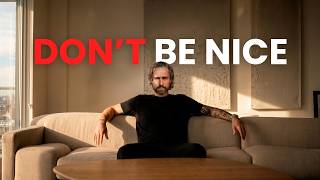
Aaron Doughty explains how being nice is a nervous-system survival response that trades your authenticity for others' approval, creating resentment and disconnection from yourself. He uses the SHIFT framework to break the pattern: become aware of the story, feel the emotions, set real intentions, and embody a new way of showing up.
Chapters
This video, I'm going to show you how to have a transformation so large you literally feel like you live in a new world. It's like in Aladdin on the carpet ride. It's a whole new world when you begin to integrate what I'm about to share with you. And it's something that if you watch the movie like The Lego Movie, for example, think of the movie The Lego Movie. Hello Kitty. Hello Kitty is nice. She's being very positive and everything's great. And then at the end of the movie, she can't hold it back any longer. She expresses it. And then all of a sudden she changed. She literally saves the day. That level of energy is the energy that is capable of being released out of the body of anybody that considers themselves nice. In this video, I'm going to show you how to transform that energy how I went through that transformation, how I've seen literally thousands of people over the last 10 years transform from being nice into being authentic. The first thing to understand about this is that being nice is a survival mechanism. That's right. Being nice is— looks like it's good, but being nice is you abandoning you to make other people happy. And imagine if it were really like what the— the belief is that if I'm nice, I will get what I want. A lot of men literally believe this. It's like a strategy towards attracting love. It's like, "Oh, I like that person. I'm going to be nice to them. And if I'm nice to them, I'm gonna get what I want." I remember one time I was in forensics debate in high school. And there was this type of debate called Congress where you're with like 20 or 30 other kids and you have to give these little speeches and it's like a mock Congress thing. And there was this one girl that I was attracted to and everyone, there were like 5 or 6 people that had to get up to like share their little speeches. And then we had to vote for which one we wanted to be like the headmaster. And this girl wasn't great, wasn't really that great at all. I was attracted to her. And here I am in like 9th grade or 10th grade. And when we went to vote to see who we wanted, I was the only one that raised my hand for this chick. I didn't— she wasn't even that good. But in my mind as a little 10— as in 10th grade, I'm like, "Ah, if I'm nice, she's gonna give me what I want. She's gonna date me or something." And subconsciously, it's so silly because people, like, when you see a nice guy, they subconsciously believe it's like, I'm nice to you, you will feel no tension, and then you're gonna be like, oh my God, just wanna ravish, I wanna be ravished by you. It doesn't work like that, right? People, especially women, are very tuned to authenticity. And even if a guy is a dickhead, The dickhead may be authentic and non-attached. That might be authentic, even though it might also be rooted in trauma or something like that. It's not attached. And it's— if it's done as a tactic, I guess there is a certain frame of that called negging, where people like say something mean because then it like puts somebody above somebody else. That's a manipulative thing as well. But the first thing to understand about this is let's be honest, when you're nice and you're giving something or easing someone's tension, do you actually get what you want? It doesn't work. And the reason it doesn't work is because it's not authentic. The reason it doesn't work is it actually avoids the very thing that creates authenticity. So first off, let's look at authenticity. OK? This one thing right here will completely boggle the— oodle the noodle and boggle the mind, okay? It is authentic. You being authentically you and being expressive is magnetic, it's attractive, and it feels good inside of your body. The word authentic, very similar to the word authority. Auth, the etymology. Authority, author. When you are being nice, It's not authentic and it is giving them the authority to approve of you or to disapprove of you. So you're in a way giving away your authority. You're giving away the ability to author who you are and how you show up. And when that happens, it's like you're giving the energy to someone else and saying, can you please meet my needs? Because think about it, to be nice to someone else is like, "I will be nice to you, I will ease your tension, and you will give me approval and validation." So, it's a means to get something. And it's not attractive to be trying to get something from other people, but also, it's very painful. Isn't it painful to feel like you're missing a part of yourself? And what it really is, by the way, that we'll talk about in a minute, is if you were to see, hear, and soothe that nurture— and nurture that inner child part of you, you would begin to heal and not need to change it, by the way. But realize that for this process of you becoming authentic, one of the things that really tripped up my mind when I learned this is if people actually feel tension by me being the most authentic me, It's good. It's good. Like, it feels expressive for me, and it actually gets more of a— it's a magnet to people that will really resonate with the real me. But imagine, as a nice person, your desire is to ease the tension, but the tension literally is attraction. Like, when you're being the real you, people can like you or not like you. If you let go of needing to manage that process, you become more free. And also, the thing is, is we think, "Oh, if I polarize people, that's bad." But if you polarize people, you will more powerfully actually attract the people that really resonate with the deeper you. So realize these— the problem you think, here's the problem, here's the challenge. You've taken on a burden and a responsibility to be the person in the room that mitigates tension. That's the challenge. So now in your relationship, you might find it hard in your relationships, or you feel burdened in your relationships because subconsciously you literally feel like their tension and negative emotion is your thing to manage. And if it's your thing to manage, it's like that's your burden. So you find yourself feeling heavy processing two people's energies at the same time. But you see, this is simply a survival mechanism. It is a way of regulating the nervous system because there's an avoidance of tension. But here's the scary thing. People that are nice— first off, nice is different than kind. Nice is I will give to then get. Kind is I will give, and if you don't give back, that's okay. Nice people tend to have quite a bit of resentment when it's not appreciated because there's an attachment. Now, when we talk about this energy around tension and we talk about you being able to express this real you, realize that it's not your job to manage other people's emotions, and you've simply believed that it was. You may have taken on the role as a kid of, who did I have to be to receive mom or dad's love? And it may have been, I need to manage the energy of the house, I need to fix them, etc. So that role was taken on. Now, you might think that you don't like tension. But here's the reframe. You love it. You already love it. You just love it packed away in the inside and not being really looked at. But to express it would mean to feel lighter. To express it would mean to be authentic. And then it's still there either way. It's just you realize, actually, I am comfortable with tension. Right now, I've just been comfortable with not expressing it. Because if I express it, I'm afraid someone's going to leave. Here's the sad thing though. Every time you're nice, you leave you to be managing somebody else. You leave you and therefore have already abandoned you. And this is why expressing the real you is so powerful. I remember the fear that I had when I started to like— I became aware of this. Here's the thing you have to do too. Embrace your dark side. What you think your dark side is, is where your power is. I think for me, part of it was growing up having a narcissistic controlling stepmom between like 7 to 17 or 9 to 17. It was like her power, she had power. It was maybe power that was used in a way that didn't feel good because it was manipulative. But she would, if she wanted something and she wanted to fight for something, she would freaking fight. She'd go after it. She'd express herself. She's very loud and overt. So subconsciously as a kid, it was like, I don't want to be like that. If I express myself at all or have tension, I'm going to be and turn into her. When in fact, what happened is I was able to in a way appreciate and see, wow, there's actually power in that. I don't have to use it. I am not her. But the emotion of anger is not something I need to be afraid of. Now, of course, it's easier said than done, but I remember the first time I started to express the real me when I learned about this. And I said, "From now on, I'm going to move from valuing— from valuing approval and validation. I'm going to begin to value vulnerability and authenticity." So what do you think I ended up doing? I ended up having to have some conversations with people. I ended up in moments where I would normally choose to be nice, and instead I would choose to be authentic. And what being authentic meant was I had to redefine certain friendships and relationships. Like, there were things that I realized I was kind of like suppressing or holding on to, and I reached out to a few people. It's like, hey, can we catch up? I've got something I want to share with you. Something's coming up for me. And there was 1 or 2 friends that I got on the phone with, and I remember being afraid to get on the phone call. I remember that when getting on the phone call, it was like I was afraid that it was going to make the friendship fall apart even more. I was afraid they were going to be mad at me. And what I did is I remember getting on the phone, thinking it was a phone call, and then I— one of my friends actually FaceTimed me, so it was even more intimate. I remember being firm. It felt uncomfortable, but I expressed myself authentically, vulnerably. And I remember as a result, one of my friends actually teared up. Emotion came up for them. And then I rubbed it in even more. I was like, "Haha, you're a little B." And I said that in their face. And then I hung up and I was like, "I'm embracing my dark side." And then I'd call other people and just start being mean. I'm just kidding. I'm just kidding about the whole being mean thing. But what I did do is he started crying and I was like— From that moment going forward, for the first time in our friendship, there was respect. And I remember at one point he asked me a question about something and I had the opportunity to tell him what he wanted to hear. It was about someone he used to date or something like that. And I was just brutally honest. I was like, I'm gonna be honest here. And I said, no, this is what I think. And he was kind of like, it was a lot for him to, you know, maybe hear the authenticity of that or like the truth of it. But he sat with it and that tension became the initiation. I remember years, years later, even like 2 years ago, I moved. I won't go into the whole story, but I moved out of a house and there was this interaction I had with the landlord, which is, of course, authority. I've always had kind of a thing with authority because Authority, authority, parents as a kid was authority and it wasn't fair. I had to fight for freedom. Landlord, a lord of land. They put down the stake and I live with lord of land. And I lived on this house for a year and there was this drama that happened because the owner of it was, it was so creepy how much I'm like, there's projection where we project our mom and dad stuff onto people. But in a weird way, this person, there were red flags there. I still decided to live in this house because it was nice. She, her husband's name is Michael. My dad's name is Michael. Her husband was extremely nice and just, I could tell, was just under her spell, very similar to my dad and my stepmom. And she was just extremely hard to please and had extremely high standards, was very mean, but she got away with it because she was the lord of land. Lord of land can say whatever. And what happened is there was a situation where as I was moving out, I moved everything to storage and she had that of this— there was a little speck of this drink that I used to drink in the bathroom counter on one of those granite countertops. And you can barely see it, but it was there. And she requested or demanded that that countertop get completely replaced. $3,500. Because there's a little speck on it. And I'm thinking to myself, listen, the house looks perfect except this one little thing and it's not good enough. And therefore, we've got to— Okay, but we couldn't just spend $3,500 on that one. The other one had to match. So, I had to spend $7,000 or it was like $5,500, whatever it was, $5,500 in order to replace that because of a little speck. And I'm thinking to myself, I could take this to court because it's like, I lived in the house for a year and paid a lot of money per month. Like, this is ridiculous. And but do I want to fight the lawyer fees and all of that? And even then, my dad would always say, I just don't want to deal with it. I just don't want to deal with it. Anytime he was dealing with my ex-stepmom and I was always like, fight, go from fond to fight, stand up for yourself. But I remember I had to have a phone call with this lady and express myself. I just need to express myself so I can have the breakthrough. The tension is the initiation. And what I did is I remember expressing myself and honestly, after about 5 minutes of this, I was like, okay, we're not getting anywhere 'cause we just start, she started arguing and it was this whole thing. But I had to sit with that tension and be like, I am not afraid of having these kinds of conversations. And remember, whatever kind of, whatever, my coach said this to me recently, my shadow work coach said that whatever emotion you exile becomes louder. So it's not okay to feel certain emotions. You will attract people that get those emotions out of you. Not allowed to feel angry. Here I am in a situation I had to express myself and I did. And then I reminded myself, I can have these uncomfortable conversations. I can be authentic. I don't have to be just nice and a pushover. So there are multiple times over the last couple of years where I've— and it gets easier and easier as you go. And you just learn that you can feel the fear, express it anyways, but then you feel lighter. Then you feel more authentic. You feel more free. So then you stop attracting kind of like the thing that you're afraid of because you get to a place to where you're kind of good either way. All right? So realize if you want to go from nice, stop telling yourself that you're nice. You're not nice. You're kind, maybe. Maybe you're kind, but you're not nice. One time I asked my dad about this. He goes, I'm just— He goes, "I'm just, it's who I am. It's who I am." And I say to myself, "You've taken on the identity of it and it's been your life for a long time, but deep down there's someone in there that's like, 'This freaking sucks and I want to express myself.'" But I could see that in me from my dad. I would almost be angry. I remember, okay, the first thing that'll happen, by the way, when you begin shedding this pattern is you're going to be really mad at yourself. You'll be like, "I said this when I didn't need to. I could have stood up more. I'm so mad at myself." And you might be mad at other people, but really you're mad that you keep saying yes when you really mean no. You get mad you can't say no. You get mad that you're not expressing yourself. So first off, see, hear, soothe, and nurture that inner child part of you. Instead of trying to change them, recognize you can connect to that. It's one thing that could be very powerful. The next thing is to realize you're doing the best you can with where you were, bro. All right? You're doing the best you could with where you're at. So it's like, okay, now you know. Now in the moments that you do catch yourself, you could be expressive. You could be authentic. You could choose to be real. So the thing that I would recommend you do is you begin to embrace, and the process that I use is called Shift. S-H-I-F-T stands for story, heal, intention and frequency, and then transformation. Okay? So it's like 3 steps. Awareness of the pattern, being aware of the story. I'm nice. No, you're not nice. It's a survival strategy. You are you. You are authentic. Okay? Heal. Feel the emotion under the surface. Feel the tension. Feel the desire to go into the protective pattern of, "Oh, I'll be nice. What do you want? I'll ease your tension." Sit with it. Let it be there. Feel it. Accept it. And from there, you then choose to express the real you. Intention and frequency is an expression. Intention to expand beyond the pattern. And in the expression of it, that is your initiation into authenticity. Now, a lot of times, like, you think guys that are nice guys that feel blocked with women— I had to learn years ago to actually express when I was attracted to someone, to actually express my true self, to actually share who am I really. And what's funny is the more that I did that, it— because it's who I choose to be as authentic— the more it was like I wasn't attached to whether they liked it or not. It was no longer a gimmick or like something to— nice wasn't the survival strategy. So realize you become more free the moment you begin to express more. But stop telling yourself you're nice and start leaning into tension, baby. Tension is your initiation. Comment that below. I embrace the tension. The tension of expression of the new you. The tension of sharing how you feel with someone else. The intention of sharing a boundary. And what's funny is the more you do this, the more normal it becomes. And then it's like you feel free because you're not harboring the emotion, the energy. And remember, their tension is their tension, not yours. That becomes more freeing when you realize it's not yo' job no mo'. It's not your job. So by the way, if you wanna learn how to let go of the stored energy inside of your body, I have a free video breathwork ceremony that you can download or basically listen to for free that will help you begin to release this energy. It's a free breathwork ceremony. I'm certified in it. It's very— it's the most powerful process I've ever found. You can click below, check that out. And the thing that I learned to do too, by the way, was go from fawn. Basically, people pleasing and being nice is a fawn nervous system response. Fawn is like, I will be nice, I will surrender to somebody of more authority. Fight is like, you think fighting is bad, but it's not that you need to fight to survive. Because eventually, like, I know that if I need to have a conversation again with somebody like the land— like, Lord of Land. I think of Will Ferrell when I say that. Lord of Land. But I don't— but like, I might not need to have that same conversation, but it served a purpose in that moment because that conversation was kind of meaningless in the sense that we didn't get anywhere. But I felt a little more free. I might as well have it. It was necessary in the moment. But you get to a place to where you're not afraid to fight for something, you know, fight for like, what do you believe in? Who are you really? What, what, what pees you off? You know, like, what are you really about? What kind of people do you not resonate with? That's okay. It's okay to have likes and dislikes. It's okay not to like everybody. You say, "No, Aaron, we're all one consciousness. We must love everybody." Yeah, but you can still have preferences. And expressing yourself in the world's what's authentic. So you wanna become aware, you wanna embrace the emotions underneath, and you want to value authenticity and expression above all, okay? If you do want to learn, by the way, step by step how to let go, one of the most powerful videos I have was over 2 million views showing you step by step some stories on how to let go How to release the emotion side of the body. Go ahead and watch this video right here.










