In this brief dialogue, Speaker A shares personal experience of having been in two consecutive narcissistic relationships, which led to deep inner work and a period of isolation for self‑exploration. Speaker B expands on the psychological dynamics between narcissists and empaths, describing how each party carries a disowned part of themselves that the other possesses. The narcissist is portrayed as having a false but strong sense of self, manifesting as charisma, confidence, and manipulative control, which masks underlying toxic shame. Conversely, the empath is characterized by heightened sensitivity to others’ energies, a tendency to abandon their own needs, and a subconscious drive to give in order to receive validation from the narcissist. The conversation highlights the cyclical pattern where the empath seeks to please the narcissist, and suggests that awareness of these disowned aspects is crucial for breaking the attraction cycle.
I went through two narcissistic relationships almost back to back, so that caused me to start doing a lot of inner work and just like, yep. So now I've just kind of been in the isolation mode where I'm like, yeah, digging really deep and just really going hard at what's in there.
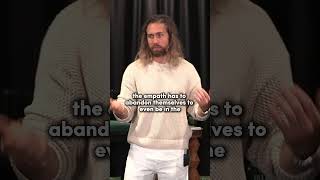
That's awesome. Yeah, both the narcissist and the empath has a disowned part of themselves that the other possesses. Now, on the narcissist side of it, they have a strong sense of perceived self. It's a false sense of self, but it's a strong sense of it. So when you meet a narcissist, they appear very charismatic and very confident, and they'll say things to you that get you to do what they want you to do. And there's a lot of manipulation that happens, but they carry this characteristic that feels safe to someone that is more of an empath. There's this disowned aspect of self. That is still, it's built in toxic shame, by the way, as well. And they have to cover that up by appearing a certain way and by controlling different people. But on the other side of that, the empath who feels everybody's energies tends to attract and who's very empathic is the opposite side of that. There is an energy that is also there that is getting something from the narcissist in the sense that the narcissist is supplying a certain level of frame. Now, the other side of this to become aware of too though, with the empath has to abandon themselves to even be in the relationship. This is the thing that sometimes it's hard to be aware of because what happens is the empath is giving to then get, it's a subconscious thing that they may not even be aware of sometimes, but there is something that you get out of it. Just like in a narcissist-empath relationship, the empath gets this constant game of trying to make the narcissist happy.
Yeah.
It gets these false, these promises that keep them kind of like a carrot on a stick going in that direction. But what happens is when you start taking your power back and you start being more in the middle, if you imagine like this side is the narcissist, this side's the empath, it's like they each have something they could integrate within each other that they can then learn. And then once you get into the middle of there, you no longer have to attract the narcissist as a reflection.