Your Nervous System Is Dimming Your Light (Without You Knowing It)
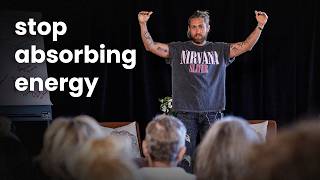
Aaron Doughty explores how being labeled "too much" or "not enough" becomes internalized shame that makes us dim our energy to fit in. He shares his own experience being prescribed Adderall for high energy at a 9-to-5 job, then finding meditation, and teaches breathwork and inner-child work to help people reclaim their authentic expression and stop shrinking themselves.
Chapters
Feeling too much is sort of like feeling not enough.
That is absolutely the other side of the coin. I've always been told I was not enough.
Okay, well, let me ask you this. Who else here feels like they're too much? All right, so we got some people raising their hands. Yeah. Let me ask you a question. Too much for what? Too much for what? I felt the same way when I was working that 9-to-5 job I didn't really care for because I had a lot of energy. From 7 to 17, I wasn't allowed to have freedom. 17 comes around, I have a whole bunch of freedom. I'm allowed to have friends, which I wasn't allowed to have. I work a job selling women's shoes. And at that job, I was very outgoing, very loud, because for so much of my life, I wasn't allowed to be myself. I wasn't allowed to express myself. So what happened? Other people there said, "Why do you have so much energy? What's wrong with you?" Right? "What's wrong with you? Why do you have so much energy?" So then what happened? Is feeling like I had too much energy. I then went to a doctor who said, oh, you can't focus? Here's Adderall. Ugh. I took Adderall for like a year and then had hard side effects of that, learned meditation, and that completely transformed my life. So turned out well in the sense that I eventually did meditation and got rid of that. However, if we look at the fundamental core here, what did I do? I allowed somebody else to say something to me that I then internalized as a part of myself. So if someone else tells you you're too much, that might be their belief and not something for you to internalize.
Yeah.
That could also be at the brim of their capacity. Yeah. So if you had an emotionally unavailable mom or dad as a kid and you had emotion and they're emotionally unavailable, You may have been too much. Do you guys see that? Oh yeah, sure. So it's simple because it's like, okay, that emotion maybe have made them uncomfortable. So in that moment we said, I'm too much. There's something wrong with me. And in a funny way, being too much is sort of like being not enough because shame is an emotion that says there's something wrong with me. And if you are too much or you are too much over here or not enough over here, there's something wrong. And what are you gonna, how are you gonna compensate for something that's wrong? What do you do?
I dim myself.
You dim yourself. Okay. So as a mechanism.
Like you were talking about with your family. I like make myself digestible.
Right.
Right. I can feel my authenticity like bubbling, right, to get out.
What would it be like if you just owned being too much?
Yeah, I would—
what if you owned who you are and we didn't label at too much, not enough? What if those were just ideas, ideas that were reflective of somebody else's capacity, not yours? It's not too much for you, right? Right.
And as I get more comfortable, like we were talking in the group today, as I get more comfortable With the amount of however much I am, I will stop creating the people telling me I'm too much because I will be more comfortable with it myself.
Yes, exactly. That's an interesting thing to think about, isn't it? The more you become okay with being too much, the less you will be attached to people that think you're too much. Like the less you'll, you won't be attached to it and you'll let them think what they think. So it's an interesting thing. So what is this really about then? This is really about—
I make money at this, right?
Well, looking at this though, the too much thing. Yeah, we want to get to the money. We'll get there.
I just want to be able to support myself and have to stop doing what I don't like to do.
Could you come around when we're doing this? We're doing the Q&A. Thank you. Jonathan is now gonna be seen. Off to the side.
Woo!
Yeah. Awesome, thank you, Jonathan. You just kind of over there, yeah. Thank you. Just so when people are asking questions, we can see. Awesome, thank you. So, okay, so the next question was, okay, so what is the, so closing out the too much thing. So what have you concluded about the too much thing?
Just be who I am.
Yeah.
And the more I do that, the more comfortable I will become.
Yeah.
Because that's already happening.
Yes.
I already feel that happening.
Yep.
And then I will not create the projections of people telling me I'm too much.
Right. And it could be if you fear you're too much and you believe you're too much, other people are reflecting that energy back to you.
Yes.
Because it's on the inside of your subconscious.
Right. I'm the only one here.
But if you, right, we're all reflections of each other. But the moment you own being too much, what ends up happening is you own it and maybe you don't even label it as too much. It just is what it is. Anyone else's belief of too much is theirs, not yours.
Yeah, I'm putting it up for sale.
Right. And then asking for other people, you know, so owning that energy, letting it come up, but realizing it's their, that's their stuff. It's their belief to deal with. One of the things that I used to, I maybe also, you're in the wrong place. I was in a 9-to-5 job selling women's shoes and I was told I was too much. I am now in front of a stage with all of you and I do what I do for a living. And I do have a lot of energy, but it's part of my zone of genius, I believe. Like how many of you connect to my energy more than just the words I say? Right? That's what I think. So I've learned to own That energy. I let myself, I was just in the wrong spot. If you're surrounding yourself with people who think you're too much, well then maybe you gotta get around other people that reflect back. Exactly, that reflect back your power, that reflect back your power instead of the weakness or instead of the judgment. If you attract emotionally unavailable people that think you're too much, and you were to then go around emotionally available people, they may not think you're too much because they have the capacity to be present with you. And then of course, you're still aware of the energy you're putting out. You're still aware of like your own projection, putting needs on other people. I mean, there's aspects of this, but nonetheless, owning it can be very powerful.
That feels really good.
Yeah. Awesome. Well, let's give her a round of applause. Now, one more thing, one more thing. She really, really, really wants to talk about abundance. Okay? So if I don't let her talk about abundance, we're gonna have a problem. I know it.
I know it will come.
Yeah.
I really am working on the trust.
Right.
In just your message, right? What you're saying. I believe it too. Putting out the value, really focusing on other people, really helping.
Yeah.
And how can I serve you? How can I— I have so much knowledge and experience, strength and hope. Yeah, I can share.
And that in of itself is abundance, right? That is abundance. So if we define abundance as just money, yeah, monetary money, and we want the money, and the money that we want to get because it's abundance is a reflection of our energy. So what happens a lot of people with abundance is they focus on abundance, they focus on quitting the job, they focus on letting go of the 9-to-5 job and doing what they love, and It's all as a mechanism to become abundant because if you're abundant, you'll have no problems or life will be a little bit easier.
Right. And I really don't see abundance as only money.
Right. I can, I feel that. I feel that with, but I really, I mean, look at where we are. I mean, right.
I'm so abundant.
It's ridiculous. Yeah. So where, where is the, you said something earlier, you said that your mom or dad, you had to get a real job.
Like I'm an artist too. Which is just really coming into fruition. So besides the coaching and the breathwork that I do with people and all this other stuff, I mean, I'm feeling this creativity surge, my inner child, right? And all she's done, when I used to first connect with her, she would just be standing still waiting for instructions.
Yeah, yeah.
Right? Couldn't do anything without permission.
Yeah, waiting for permission.
Waiting for permission.
So where, so I guess a powerful focus of this too that I've learned in my life is instead of focusing on the end result of the abundance, the YouTube subs, quitting my 9-to-5 job, focus on the energy, focus on the passion, focus on the value you can add people. If you focus on the passion and the value you can add to people, and you focus on getting better at communicating with everything that you do, you will be growing. And what'll then happen is that abundance becomes a reflection. The abundance is a reflection of that energy. And what happens is then you can become aware of the abundance blocks that comes up, the stories about abundance. I didn't learn about abundance growing up. I was told to get a real job. You were told to get a real job. I was encouraged to go to college to become a lawyer. Didn't choose it. I chose to, I wanted to own my own business. The most successful person in my family that was like abundant was my uncle who had no college degree. He owned a company. And that always inspired me. And that was something that like I knew I wanted to do. And I was going to school for political science to be a lawyer. And I was like this, even though I did forensics debate in high school, I was passionate about that. But now it's like, I get to do this in a different way. I get to speak, but also, I get to be abundant in just being me. And I think that's what's here for all of you is when you begin owning your own power, your energy, your passion, you follow the frequency or the energy and you let that be the primary focus. The interesting thing is that not only does the abundance eventually come as a result, but you enjoy the process along the way.
So much more than anything else.
Which is more abundant than anything, right?
Exactly.
'Cause if you don't love, you can make a lot, a lot of money in abundance doing something you hate. But would you say that that person is abundant?
No.
No. Would you say someone is abundant that has $100 billion, but they have 2 weeks to live? No. Would you say that person's abundant?
No.
Would you say somebody that's abundant that has lots of money, but no connections, no family, no one that they care for, no one that cares for, like, how are we gonna define abundance?
Doing what you want to do when you want to do it.
Yeah.
And connecting with the people you want to connect to. Yeah. So become aware of your definitions.
Yeah.
For everyone here, become aware of your definition of abundance. And every single one of you are more rich and abundant than any billionaire that has 2 weeks to live. Think about that. A billionaire has 2 weeks to live. You are more abundant than them because they're not gonna be here in 2 weeks. And God willing, we will all be here for at least 2 weeks, hopefully. But the idea is that we, like, we have health. We may have our health. That is abundant, right? Like, it depends on how we look at it. So then we stop saying, I'm not abundant, I'm not abundant, I'm not abundant. And if we keep telling ourselves we are not abundant, how are we gonna attract abundance? Because we're defining abundance as money. Instead of abundance as health, as connections, as passion, as doing what you love. So becoming aware of the definitions is powerful. Another way to look at this is there's an abundance of everything in reality. There's even an abundance of lack. Yep. Let that sit for a minute. There's no, this is something I heard from Bashar and it really resonated with me back in the day. There's an abundance of everything. And there's also an abundance of lack. Lack is like a noun, right? So if you believe in the noun of lack, if you believe in this idea and you believe it's all you're worthy of and it's what you learned growing up and it's what your parents talked about a lot and to be lack was at least you're a good person and to have money was evil. Well, guess what? You don't wanna be an evil person. Lack is what you know. Living paycheck to paycheck and survival mode may feel familiar. But the thing is to focus on, you get to decide what things mean. You are the author of your life and you choose what things mean. And a lot of times when we were doing inner child work over here, we're looking at old meaning, we're looking at what things mean and we're looking at ways of relating to it differently. Do you guys see that? We're looking at things from the past, we're reshuffling our interpretation of it. Because much of what happens in our past is based on an interpretation that we have. And every time we look at a memory from the past, we try, we change it. And by the time we've thought of something 100 times, 1,000 times, it's a completely different memory. But we think it's the same, which gets trippy because then we realize that reality is much more fluid than we thought. So does that work for now? We, on, on, uh, in 2 days from now, we will focus more on the business side of things and abundance, but I wanted to give you a little taste. Because I thought you were going to throw that mic at me if I didn't. Like, I want to talk about abundance, but you're talking about me too much. Yeah. All right, let's give her a hand.
Thank you.
All right. Let's go to another question.
I'm healing from being told that I'm too sensitive. What is a way that I can lean into expressing myself and know that I'm not stifling myself? Because of like these maladaptive coping mechanisms I had as a kid.
Yeah. So, so you've learned that you're sensitive is what you're saying?
Yes.
And is to be sensitive a problem?
Yes, it was, it was framed that way when I was younger. I was told that crying is— whoa, okay, sorry, my heart's beating so fast.
That's okay, that happens. Yeah. Breathe. It's like a theme of the day. Breathe and feel inside of your body instead of fawning or freezing.
I feel like whenever I would express my emotions as a kid— yeah, okay, the memory that popped into my head, my uncle, he was an asshole, whatever, um, he pushed me into the pool on Easter Day, and I remember being furious, like just screaming and like crying and just feeling so betrayed by an older figure in my life.
Yep.
And then everyone around me was like, you're— why are you reacting in this way? Like, why? Why did this upset you so much? And I remember just like shrinking into myself and being like, oh, I'm the problem, right? It's like, but yeah, it was someone outside of me who made me feel that way. I expressed it and then I got rejected. So I guess that That has been a recurring thing where even when I have expressed my sensitivities or my emotions, it still— it still feels like I'm in the wrong for having those emotions or needs. And then I think that lent into me just not kind of stifling my needs and being able to express myself.
Right.
And that's been a consistent pattern that I've noticed.
Yeah. Well, thank you for sharing. I think many people here probably feel like they're empaths, or you could feel other people's energies. How many of you feel sensitive? Yeah. Like sensitive to other people's emotions or energies. So you're not alone. It's a common thing that many people feel. And something that I found to be very powerful with this is to realize, like there was this one insight that I realized that as a kid, everyone else to us is kind of like a giant. Our mom, our dad are like these giant gods. Literally, we think of them as the ultimate authority. Whatever they say is golden because it's my way or the highway, or it's they just know more than me because they're gigantic beings who know everything. This is all subconscious, of course. But rather than thinking that our parents didn't have it figured out, rather than thinking that there's something wrong with them, not that we need to vilify them or perpetrate them, but what we do is we think there's something wrong with us. We internalize it. Kind of like we were talking about earlier. We internalize it and say, there's something wrong with me. We can be aware that we're sensitive. And what we can do is we can see that sensitivity as something to be shameful of and something that we have to hide from other people, or we can embrace it, do the inner work of feeling the separation between you and others and not feeling like you're, a leaf in the wind with trying to fix everyone or modifying your frame for other people, et cetera. There's that aspect of the work. But the other aspect is having the courage to express the real you, not attached to how people respond. That's where there's a big breakthrough because when you express it and they don't respond the way that you want, we're trying to infuse, I will do this thing if it's conditional and I get the result I want, right? So focusing instead on expressing the real you and sharing your emotions. And if other people have their perspectives about you, that's not your thing. You don't have to internalize that as there's something wrong with me. Does this make sense? So it's kind of like the too much thing, right? If you just own, yeah, I'm sensitive and I can feel people's energies or whatever, but you're also aware of your part in it, not to a place where you're just a leaf in the wind and you find yourself like in victim mode, 'Cause sometimes that can happen. People that feel other people's energies, what do they say? I go out in public and I'm so sensitive. I feel everyone's energy and everyone's emotions. And sometimes it creates this energy of powerlessness that comes from this story. And even though you might be able to feel everyone's energies and you say, well, that's true, Aaron, I can do that. And what I'm saying is you can begin bringing the energy back into your body and not take responsibility for their perspectives and what they label you as. And even thinking it's bad, right? What if sensitive was a good thing? What's something you deem as a good thing? Like, oh, if someone said you're this, you'd be like, oh, that's cool.
Kind.
Kind, okay. So if somebody says you're a kind person, what inner child work are you gonna do to avoid being kind?
Right? I'm gonna push a kid into a pool on Easter.
Right? Yeah. That's an interesting thing to think about, isn't it?
Yeah.
It's only because our definition of sensitive is bad is that we're trying to avoid people's perception of it. But also what perspective do they have that you need to live up to, that you need them to stamp their approval card into your folder?
Yeah.
Why do you need it? You don't, right? And in the same way, when it comes to being sensitive or being kind,
More from Aaron

If you can see this, you're about to become so magnetic you are unrecognizable









