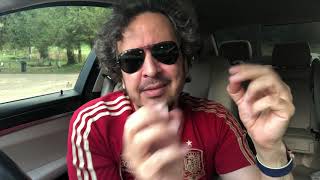
Aldo Sterone delivers a single-speaker YouTube monologue reacting to the killing of four French women in Niger, mixing graphic descriptions of the incident with broader commentary on immigration, national reputation (passports), and terrorism risk. He offers a simple risk model (local terrorist activity × a visitor’s visibility), critiques authorities' handling of migrants and hostage policies, and gives prescriptive travel warnings and political reflections (leftism, utopia).
Hello, my friends. First of all, I can't thank you enough for your loyalty to my channel. I know that when it comes to watching videos online, the choice is huge. So I thank you for stopping by and taking my opinion on things and others into account. You know, people have written to me from Belgium telling me that in order to avoid, so to speak, the scum, they have decided to ban what they call day tourists. People who arrive by train, by bus or by car to enjoy the beach or the city for a day are not welcome. Ah, that saddens me a little, because when I arrived in Europe, it was the European construction, freedom of movement and all that. And then today I see more and more of them. And it starts with small towns, right? At first it's anecdotal, like for trout in Switzerland, it's super anecdotal. Or the other one in Belgium, I don't even dare to mention the name. But as time goes on, we can end up with situations where people's freedom is reduced. So, uh, it's an integration. People have integrated that, for example, the Rakai is a protected species. We can't. We can't make anti Rakhale orders. We can, we can't. They are protected. Uh, they kill all the time. Uh, all you have to do is open the press. I didn't, I didn't look today. You tell me in the comments, uh, who was killed today? Was it for. Was it for a look? Was it because he reminded them to pay for a bus ticket or a train ticket? Or to wear a mask? Or to pay for entry somewhere? Or not to make noise at 3am? You tell me. I don't know. We know the classics. Or maybe for free. Maybe for a look, maybe for a cigarette, maybe for a stop sign, maybe for a parking space, maybe for a place in a queue, right? I wasn't there, okay? I wasn't there. I don't know. You can tell me. You can watch the news today, and then you tell me it was a crime. So this protection enjoyed by the scum, despite the very heavy toll in France alone, we are practically talking about 1747 crash per year. You know, that's the level. There are 747s 20 years later. We're talking about it. The victims in France, Navarre. We don't talk about them anymore. Strictly speaking, the family. The last communication from the family. You know what the last communication from the family is after they disappear? After they disappear, there's other news. There's another action from the family. It's. We don't want to stigmatize. We don't want the far right to take over, and we're in favor of living together. There you have it. Once they've said those words, they disappear. That's it. So I was telling you that despite the very heavy toll, the various local authorities have understood that the scum are untouchable. They have understood that these scum are protected. Nevertheless, I understand that the last time I criticized him very virulently in Switzerland. And you know, I don't blame any municipality for wanting to protect its residents, for wanting to allow people who come to the municipality or who live there to enjoy public infrastructure in peace and serenity. I don't blame them for that. Do I blame them for buying it? Okay, well, I was saying that I wasn't going to be virulent today, but here we go. No, I was saying that I was going to tell you what really scares me. Really, what scares me for you in the long term is the following. You know, in Algeria in the 80s, for example, I was a kid. I traveled all over the world without a visa. I visited many countries absolutely without a visa. The Algerian passport had the same value as the American or Australian or French passport today. It allowed you to go everywhere. But be careful. There was a corollary to traveling. I remember one day I wanted to go to France with my mother. Do you know what you had to do? You had to go to the prefecture in Algeria and get an exit visa. An exit visa? To get this visa, I don't know. I was too young. But probably you had to show your credentials. You had to show that you had a job. You had to show pay slips. I don't know. You had to show that you were a respectable person. An uncle of mine was turned away from the airport in Oran. The airport in Oran, Algeria was leaving for abroad. He left in the morning to catch a plane. By noon he arrived, he was back home. Why he was turned away from the airport? Do you know why? Wear jeans. Yes, wear jeans.
Okay.
A pair of jeans pants, huh? No, you see, I'm not like that. You're going home.
Okay? Okay.
Do you know what I mean? There was a desire to protect the country's reputation, if you will. We wanted to keep the value of passports high by ensuring that people who left must have valid reasons for leaving. And because Algerians at the time knew very well that if you start exporting thugs, sooner or later you'll end up degrading the value of your passport. It never ends, by the way, what happened after that? There were some. There was a relaxation. Ah, after that, many Algerians left from all sides. Many did not respect the conditions of their stay abroad. Many settled in, others applied for asylum, others overstayed their visas. There were no visas at the time. But in any case, they overstayed their visas and all that was authorized. So what happened? Gradually, they started getting visas, visas, visas. And the Algerian passport has fallen down the list of passports today. It must be too strong. It must be between the hereditary and the Somalian. I'm saying maybe, I don't know, maybe above, maybe below. And you see not far from Mauritania. About Mauritania. Not talking about Mauritania today, but I'm going to talk to you about Niger. You know what I was saying about passports? It can happen to the French passport, right? There you go. You see, that's the thing, right? Because by dint of exporting. So I'm telling you something. You protect the scum at home. You protect them. These are people, these are extremely hateful people. You protect them, you cover them up. On the other hand, you export them, right? They are in Thailand, they are in Belgium, they are in Switzerland. They are. Then after a while, it will end up doing its thing. It will end up lowering the reputation of the country as a whole. There you go. I'm just telling you like that as a friend, that's all. So I wanted to talk to you about Niger. Ah, this morning I woke up. A friend had sent me a Facebook message. Tuk, Tuk. Star, Star. Graphic. Star, Star. What am I doing this thing again? I'll open it. I'll show you some abominable photos. Young women. Young women. I thought I counted them, even though I didn't look at the photos in detail. They're not the kind of photos you want to look at, you know, they were the French women who were killed in Nigeria. Okay, they were. We see a photo. There's a photo where we can see the back of a vehicle, a 44 with license plates. Ah, the license plate has the letters ngo, Non Governmental Organization, followed by numbers, followed by the letters NY. I don't know. New York, I don't know. In any case, a Toyota 44 with bullet holes in the back. I imagine they were being chased, they were shot at to force them to stop. Then there's another photo. We see women on the side of the vehicle, we see a man. The scene was largely consumed by the fire. The man, a black man, a guide, was killed. Uh, the car burned. Then the women very quickly they look thin, young European type. Uh, they all have their heads blown off, huh? They shot them at point blank range, though. Important. And then there's one who was, uh, they cut open on the right side of the throat. They opened the veins and the jugular arteries and they let her bleed out. And you can see the mark on the sand. So, my friends, it seems that there were six dead in all. Four women, most probably the two local guides. Uh, you know, this is the last time I'm going to talk about this. Watch this video carefully. This is the last time I'm going to talk about this. Next time. When Westerners go and get themselves killed in dangerous places, I, uh, for me, it's on the same level as going to jump, I don't know, going to climb an extremely difficult mountain in the middle of bad weather and then dying. I mean, it's still one of the outcomes that is extremely likely. I won't talk about it anymore, okay? The risk, the risk of terrorism. Again, I'm going to tell you something, okay? You can listen to me. I'm going to tell you something your parents didn't tell you. I'm going to tell you the risk of terrorism. The risk of being hit by terrorists is two things. It's two factors. At least two factors. But I'll give you the simple multiplications. The simple multiplications are two factors. It's the terrorist activity in a region multiplied by your visibility.
Okay?
That gives you your own risk. So I want to understand that in a region, you ask the inhabitants, you ask the locals, is it dangerous? Are there terrorists in the area? Is there any activity like they said in Syria, are there moderate rebels? Uh, the answer will be no or very little. Average. In what way? As a European, you say, I'm going there. Well, it doesn't work like that. If I go to Niger, okay, with my Arab face and I dress like them and I stop at a gas station, I buy a few cans of 7op and I buy a shawarma from a kid who prepares them on a wheelbarrow, huh? Salaam al kum Salaam. I'm going to say no one is seen or known, ok? There is a terrorist risk, but my profile is extremely low, a very low profile. When you see, when you send young girls like that, like going out, going out of a club or having a bachelorette party in a place like that, their visibility to give you just one. I'm not exaggerating your visibility. Uh, it's about the same level as the explosion in Beirut, huh? Just so you can see, you arrive in places where the girls are all locked up, where they're not seen. There was no, in my opinion, there was no sexual attack on the girls. But just so you know, girls show up Europeans. You hear European speech, you see light hair, you see light skin, you see Western clothing. It goes off. It has the effect of a bomb. So you'll always come across nice people. There are nice people. The majority of people in Niger are nice.
Okay?
The majority, they're nice. On the other hand, that's not a vote there. We're not holding an election, right?
Okay.
If we let the people of Nigeria vote, if you see them die or live, the majority will vote for you to live. You'll be free. You'll go home. But we're not in a vote. All you need to do is bump into two or three guys who are part of a DA or Acme, Katiba or whatever. You're dead. So you're going to tell me. Yes, but the probability of bumping into them is that. That's. That. That's why I'm talking about visibility. I'm talking about visibility because you have a face that's visible. So you're going to bump into nice people. You're going to bump into guys, people who'll take selfies with you. You're going to bump into the guy who'll offer you a free coffee. You're going to bump into the mechanic who'll fix your tire and who won't take it. Yes, you're going to make out with people like that. Except, what's the matter? There's the radio going around. There's the radio. You know these people don't have Netflix, right? So it's going to spread. It's going to spread on Facebook, on social networks, everywhere. The information is going to spread. We've seen girls, we've seen, oh, there are Europeans who are walking around the area. And as the hours and days go by, the thousands and thousands of people know about you. If I come to Niger, three guys will see me. Three to four people will see me. They won't even remember that I was there. They won't even talk about me. But you, you'll be the center of conversations. Because quite simply, there's no one. There's nothing happening in these countries. And at some point, it'll come across very special people, like the ones who don't go into a FNAF to buy Merill Matthews cassettes. You know the kind.
Okay.
Very serious people. We tell them, yes, well, they were in such and such a city yesterday. We heard about them today. They took such and such a trail. They're heading towards such and such a place. Look at the time.
Okay?
We'll say noon prayer and then we'll go, guys.
Okay?
And at noon, with a bit of luck, we'll catch them at 4pm and we'll be back before sunset. Quote. That's the thing. Well, something that struck me. So your risk assessment is extremely low. Or rather extremely, extremely false. It's like those girls who went to Morocco last year. That was last year. They were slaughtered. They were beheaded. So the Moroccans were in shock. You. Yes. The killers will be punished. Yes, but even they will be punished when they die. Whatever you want. But the girl is still beheaded, okay? It doesn't matter if they're arrested and killed or whatever. It doesn't matter.
Okay?
So your visibility is huge in many countries. In many countries, when, when you talk to the locals, their perception of the terrorist risk is much lower than the terrorist risk that will be applied to your western face. That's the thing. It's the white privilege of being visible in places like that. So there's something that strikes me. The French authorities have a reputation for being scum, you know, The Algerians, for example. Take the Algerian authorities. Tomorrow I'll be arrested by terrorists no matter where. And they call the Algerian authorities. Yes, we have an Algerian. Look, we have his passport. We're going to screw his race. Give us some money. You know what they'll say? It doesn't matter. All the terrorists in the world know it. Everyone knows it. Kill him if you want. We won't pay. We've never paid for our history and we're not going to pay. Every terrorist knows that. Anyone with an Algerian passport on the terrorist market sees nothing. That's not the case for the French. France has transferred a lot of money, a lot of money into the slammer. Every time there's a jerk of a tourist who goes for a walk to see how things are going and who gets ripped off. France pays and gets it back. I'm being nice. Those are four girls, okay? If this terrorist group had kept them, tomorrow they would have sold them either to France or lets go for a million each. France would have paid. A million euros each. France would have paid. Or else if they didn't feel like they were up to it, when they felt they were not up to it and when it's a small business, like craftsmen, right? Huh? Like the kind of independent terrorists are small and medium sized terrorists. What they do is they call around to other groups and tell them, here we have four Westerners, we have British, American and French passports. We're not up to the task of doing business, but anyway, we'll sell them to you. And then the hostages are exchanged. There's a hostage market in Iraq. At one time there was a bear. There was a price for each passport. The Algerian passport is zero. Just to let you know. Well, what surprises me is that these guys don't value human life, but they value money a lot. They kill hostages on the spot for €4 million. Why? Why? Okay, so I personally think, I personally think. We'll see in time. I think this is a big scandal brewing. I think that one day something will come out about this. Something will come out. It's a message. I think it's a message to the French authorities. There must have been a misdeal somewhere, someone double crossed someone. And so I don't know if the French authorities paid previous hostages with counterfeit bills. Did they scam terrorists? Because there was something, I'm sure there was something that justifies today that we catch French people, we kill them right away, you see? Right away. No discussion. The goal was to go and kill them, not to arrest them and take them with us and sell them. You're there. Do you see what I mean? That's what surprises me. So that's it. Uh, I don't think those girls were beggars. That would be a bit like. I know that today we live in a world where there is, how should I say, parody in the professions. There is privileged access for women, especially in certain professions, and so on. However, I don't think that the French authorities, that the people on the street of the Rue Neliten, they are still on the Rue Neliten. Honestly, they have moved. I don't think that the people on the street either. Nez Litan, it was the dst. It was at the time, it was the interior. Finally. I don't think that the French spooks would be lucky enough today would be inclusive enough to send four girls, four young girls into a quasi lunar desert to go spy. I mean, there's nothing to spy on, right? Uh, you send me there, I stay for a week, I come back, I say, there's nothing. I'll bring back some sand if you want. But I mean, there's nothing. You look, you look, you take the photo on Google, you see it on Google map, you look, you zoom in a little, you spend three minutes, you're enlightened, you know, there's nothing. What you see is what you get, you know? Anyway, my friends, I'll leave you soon, won't I? I'll tell you something. Some people say, yes, Aldo was racist. I say, no, no, I'm not telling girls to avoid Niger because I'm racist. It's not a question of racism. It's because four girls had their throats slit. That's why I'm saying that. Well, to kill for girls. I'll tell you something. Well, there are countries, obviously, uh, like Pakistan, Afghanistan, India. India, where sometimes women are raped by an entire bus. Uh, they're going to report the rapes to the cops. Uh, I mean, India is something to avoid.
You're a girl.
I mean, it's nice. It's pretty. There are colors. There are all that stuff. Niger, there are giraffes. There are excellent reports on giraffes on YouTube. You look. Huh, I've seen reports on giraffes. I'm going to say you. You've seen one or two. You. You've seen them all, right? There's nothing left. Even if you get up close, there's nothing left. There's nothing more to learn, right? Uh, well, uh, Niger, and. And to show you, to really tell you that it's not really a question of racism, uh, there is an area, but a lot of people are surprised when I say it. Uh, Australia, outside the cities, outside the big Australian cities. Australia for single women, for particularly poor young girls who do a bit of routing and all that. This area of Australia, it's classified in my book at the same level as Afghanistan or Pakistan. Okay, Just to give you an idea, it's not a question of racism. It's really a question of risk. And there you have it. So I'll leave you. I'll leave you, my friends. I'm in a cemetery. I'm in a cemetery. It's. Yeah, it's super hot. 33 degrees, I think, last time I checked. Big clouds are getting ready. It's going to rain soon. It's going to rain a lot. I'd like to see that rain. I'm going to stay here for a while and then go home. Anyway, that's it. My friends, sometimes, you know, I think that it's terrorists who committed what they did. Their best hiding place would be in France, because very often, these terrorists mix. It's not the first time. There are cases. Mix with the flow, you know, mix with the flow of migrants, as they say. Europe today is one of the rare regions in the world that has A very special immigration system that allows people to enter without passports, without papers, without anything at all, distribute them in hotels and start regularizing them. That's a very nice system. It allows people with profiles like that to come and do a complete reset on their campus, their life, their profile. And it's not the first time that we've arrested war criminals or that we arrest people here too, huh? It's happened. War criminals are people with very serious cases, very serious profiles get arrested sometimes years later. Well, I don't know. I. I don't know. Uh. I sometimes say things that speak to me, obvious things. But when I see four girls go to Niger, pay guides get in a 44, go to Niger and start to start to brag. In the Nigerian desert of Nujirian. Well, Nujerian there, it's relative to Nugurian, my friend. It's. It's Nujerian. Yeah, but hey, it's not. It's not very critical for this video. H. Anyway, I'll leave you. I'll leave you, my friends. I'll never understand these leftists, you know, they were raised in the. Where everyone is nice. Everyone is nice, you know? I'll tell you something. You know, me, Me, I'm not me. I have a leftist side, to be honest. I would like to live in a world where I leave my car keys there, I leave the door open, I go anywhere in the world. I walk around with my money in my wallet like this. I put bills like this. I leave them out, clearly visible, and no one attacks me. No one attacks me. I leave my house, I leave the door open. That the entire planet has the right to go anywhere in the world, that there are no more borders, that we can all love each other and all that. And I would like to live in a world like that, except that it is a utopian world. The real world is not like that, okay? And here it is more a question of identification, because many people are angry with reality. By the way, a piece of advice to young people, stop studying psychiatry. Psychiatry is going to die, I assure you. Psychiatry is dead. Because today there are more mad people in our world. There are more mad people. When does madness begin? It's when we do disconnect from reality. If I start to take Napoleon, for example. Today, no, Today, no, there are no mad people, huh? If I take four, well, it's an identification. We have to. We have to. We have to respect, right? We have to respect. It's, it's. It's that there are more mental illnesses, there are states of Consciousness, no, conventional. There are alternative normalities, okay?
Okay.
In the west it works well. But if you take your utopia and you see, in countries where it doesn't work, they're not very inclusive.
Okay?
I'm telling you, it's very simple. It's leftist. You see that in countries where Mirei Mattu cassettes are sold. Here, I'll make things easier for you. You know where you need to go. And in the others there aren't those cassettes, so you don't go there. Ah, One thing I also wanted to say is that I really have a leftist side. Identify yourself with whatever you want in Europe. Identify yourself with a tree. Do you see the tree behind me? Identify yourself with a tree. You'll find people to defend you, okay? And I'll give you a challenge, okay? I'll give you a challenge. I'm going to give you a real challenge now, okay? And here, this is a leftist speaking. Ungachi, stay. Identify yourself with someone from the upper class. Identify yourself as a millionaire, okay? Then you'll see, okay? You'll see the real struggle. You'll see the. We're going to crush you. We're going to crush you. We're going to put you in a shredder and crush you, okay? Try it. To identify with a class higher than your own, okay? That's the real struggle. That's the real identification. You've been fooled like fools, just like your parents were fooled. But at least they didn't eat that bread, okay? They screwed you over completely. That's the reality, right? They've replaced the real struggle for you. The people, your lords, your masters, those who live off your back. The 1%. They told you. You know what? Identify yourself as a tree, a rock down there, a cloud, whatever you want, just leave us alone. Just not us. Just don't try to climb.
Okay?
Well, I'll leave you. I'll stop completely this time and I'll see you another day, mister.
More from Aldo



La FIN du Royaume-Uni ? L'Ecosse, l'Irlande du Nord et le Pays de Galles veulent partir !




Analyse Présidentielles 2027 : Marine le Pen remet ENCORE le voile sur la table !


Scandale "60 Millions de Consommateurs" : la France mange des pâtes contaminées au Cadmium !

2 dossiers : Accident d'autogyre en Italie & un pilote sauvé par le parachute du Cirrus