Accident Saurya Airlines : Pilote Trop BRUTAL (Rapport Final)
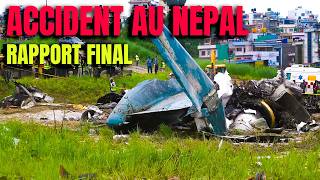
A French-language YouTube commentary analyzing the final report of a Saurya Airlines CRJ-200 accident at Tribhuvan Airport, Nepal. The flight was a non‑commercial repositioning/maintenance ferry under a special permit with 19 people aboard (no cabin crew); 18 died and the captain was the sole survivor. The speaker highlights a cascade of human and organizational failures: chaotic, unmanifested boarding (unknown weight, possible flammable items), the aircraft had been grounded for 34 days awaiting maintenance, and the airline supplied crews with incorrect takeoff performance cards (18.5 t card duplicated from 17.5 t). Pilots used an aggressive rotation technique (measured peak pitch rate ≈ 8.6°/s) and rotation speed was about 5 kt below the correct value; this combination produced an immediate stick‑shaker stall after liftoff, a large roll (bank reached ~94°), and impact. Emergency response was disorganized and access to the crash site was hindered by large rocks on the airport perimeter. The speaker frames the accident as primarily human‑factor driven and criticizes airline oversight and Nepalese aviation safety culture.
Questions this video answers
CRJ-200 (twin-engine regional jet)
Tribhuvan Airport, Nepal
19 on board; 18 fatalities (1 survivor — the captain)
34 days
About 5 knots (≈9 km/h)
Good morning, my friends. Last year, images of this accident went around the world. It was a CIRJ 200, a twin engine public transport jet that took off from Tribhuvan airport in Nepal. PO2. It attempted to take off and crashed a few seconds after leaving the ground. In fact, it didn't even leave the airport perimeter. There were 19 people on board. Eight. 18 of whom died instantly. At the time there was a lot of speculation. But today we know more because we have the report, the final report. Now, as the host of this channel, I'll start. I won't hide it from you. I'm starting to see a little bit of a problem. I'd like to tell you this just in parentheses before continuing. My concern is more and more accidents have been happening in recent years and they have happened to planes that were in perfect working order. There was no problem, There were no problems. It's 100% human factor and we're increasingly going down this path. We're sinking into this logic. So much so that I'm almost convinced today that the next major air accident will also involve a plane in perfect working order that will be crashed by pilots who do or don't do the right thing. In parenthesis. Closed. Well, that's what the accident report tells us. So we have a plane that's about to take off with 19 people on board. Who's on board? We have a co pilot, a captain. Okay. And 17 people. Who are 17 people. There are various employees of the company, by the way, that day there weren't even any cabin crew. No cabin crew. There weren't any other air tests, to put it simply, on that plane. Why? Because everyone works for the airline. The plane had to undergo a mechanical inspection check. And so it had finished, if you like, its flight hours before having to undergo this inspection, which involves a certain number of checks, changes and all that, as well as grounding the plane. So for 34 days before the accident, the plane was on the ground unable to fly. It had therefore completed its regulatory hours before the tck. On the other hand, on that day we had obtained a special holiday permit. That means we had to take it to another airport where it had to undergo maintenance operations. So it wasn't a commercial flight. That's the first point. Another very important thing is that normally on a holiday flight we have the minimum personnel necessary to operate the plane. So if we had had a co pilot, a captain, and God forbid, a mechanic on board, it would have been okay. That would have been enough, as the golfer said. Except that here we have a bit too many people, 19 people. The plane, well, it's not full. It can easily take its load of passengers. But why are there so many people? Secondly, this person boarded without a ticket, without check in, without security, without weighing their luggage, without anything at all. So it was done in a somewhat chaotic manner. So the pilots didn't have a very precise idea of the weight of the aircraft that day. It would also seem that given the chaotic manner in which boarding was done, flammable products were also loaded into the cabin. The proof is that later, when, when the plane crashed, I mean, everyone knows that it crashed. And well, we see a lot of metal skin scattered around the wreckage, don't we? And these are skins containing highly flammable products that were loaded just like that. So we are already in a flight that is quite chaotic in its organization. So what is going to happen? People are going to board when the doors close. It's around 11am towards the end of July. And then the plane starts to taxi for Runway O2. The pilots have made a speed calculation that means to take off, they have to make a speed calculation associated with takeoff. So typically we have what is called V1. V1, it's a decision, it's a takeoff decision speed. Typically, very roughly, I would say that in general, all or most problems that occur before V1 will cause emergency braking and the flight stops there. But everything that happens after V1, the takeoff is supposed to continue. So the slightly higher decision speed comes the rotation speed. This is the speed at which the pilot will start, will initiate the nose up movement of the aircraft. We will mainly talk about this movement today. And the aircraft noses up to leave the ground. Then there is the speed called V2, which is the safety speed for takeoff. I will define it another time. So I was saying that these three speeds are normally defined. How do you define it in this company? Well, they have a sort of binder with index cards and tables. You have to enter at the very top of the card you have the weight of the aircraft. So you enter the mass of the aircraft for all the details. So we have the weight of the aircraft in kilos, and then we look at it and we're going to determine its speeds. But what happened is that the pilots had roughly judged that they were slightly above 18 tons. So they started with the 18 and a half ton sheet. And how are the speeds calculated in this 18 and a half ton sheet? Well, they're calculated by interpolation between 18 tons and 19 tons. So it's greater than 18 tons it's less than 19 tons. We do an interpolation between the two. Here's the problem. The 18 and a half ton sheet was an exact copy of the 17 and a half ton sheet. This means that for years that the company operated the CRJ2, it provided its crews with false sheets. And no one ever noticed. No one noticed that. Look, you're looking at 18 and a half tons, 17 and a half tons. It's exactly the same figures. It didn't strike anyone. In fact, later on, the investigators asked the pilots questions and everything. Did you notice? No one noticed anything. So with this error, since we had taken speeds for a lower weight, we had reduced the margins. Look, very often in aviation, errors like the ones I just described, taken in isolation, will not cause accidents. The aviation system is very tolerant of errors, except that the accumulation of mandates, well, that's where the devil lies. Because if each small or large error takes away a margin, takes away a little room for maneuver. If we accumulate a lot, we arrive at a zone where we are completely out of luck. That's what will happen that day. So the pilots, I was saying, underestimated the weight of the plane to begin with and also underestimated the speeds. And that's not their fault. That's the airline's fault. Now, there's something else. Investigators have revealed by looking at the black boxes of other planes of this plane and of other planes on many flights so far, that the black boxes recorded very little. And they found that at Soria Airlines, the pilots had an overly aggressive technique during rotation. That means that they were taking off their planes instead of gradually pitching up as they reached rotation speed. So forget about going gently, roughly pitching up at 3 degrees per second, which is universally considered to be about right. So instead of gently pitching it up so that the plane pitches up, the wings take on an incident catch on the air, and then at the same time, the plane is accelerating again, and so it takes off safely. And well, the pilots of this company tended to pull back on the stick quite sharply. So this technique, which is a bad technique, has never been seen, has. Has never been sanctioned, has never been noticed, or anyone really has. And that is a big problem with this airline. But in aviation in general, it is not comfortable. Moreover, there is no company that is not comfortable that has the right to come and fly in the European Union. They are all banned in the European Union. It's a big problem for their aviation industry because in reality, even regional airlines that don't intend to take off from Nepal and land at Charles De Gaulle, for example, or in Rome, or in Geneva. Well, the fact that it's banned in the European Union, well, that already scares tourists, it scares investors, it scares a lot of people. And it's been over 10 years, it's even been a dozen years now. It's been since about 2013-24 that all Nepalese aviation has been banned in the European Union. So of course, there have been a lot of efforts to try to overturn this decision, except that they made a lot of efforts. They wrote letters, they had pilots testify for them, media articles that were written, all that. So there was quite a bit of lobbying, as they say. And then suddenly the fly in the ointment, suddenly, well, here we are in 2024 and there's a crash. Especially since when we look at the details, in the end, he's not arguing, it's. Is he for a turnaround or a reversal of the situation or of relations with the European Union? In any case, the pilots line up the plane, they put the throttle on, the plane starts to accelerate, it accelerates, it accelerates. The captain is the one who does the leg. And at one point he reaches a rotation speed that is once again underestimated. It's underestimated by five knots, roughly speaking. Five knots, that's nine kilometers per hour. Right? Right. That's, that's, that's a lot and not much. We're just like that. If there's a slow maneuver that's done gently and carefully, as they've often done, it's okay. Except that in this specific case, he will want to take off his plane literally, like a fighter. That means at some point, to tell you the pitch up, the pitch up of the elevator surfaces will go from almost zero to 10 degrees in one second. That means that he literally does this on the stick, ok? The plane pitches up and for a fraction of the time, for about a quarter of a second, we measured a pitch up speed, an angle, an angular speed of pitch up of around 8.6 degrees per second. So 9 degrees per second. That means we have a speed three times higher than the average. With this, the pilots feel no margin, because even if they had underestimated the speed, if they had made a graceful takeoff, that means they would have gently and gradually let the plane pitch up. What would the plane have done? Well, while it was pitching up, it would have picked up even more speed, it would have had time, and then it would have been caught in the air. But by doing that, by pitching up suddenly, it doesn't give itself the opportunity to do that, there, the wings become horizontal, arching sharply, and there it's simple, it's binary. Either there's speed, the plane will hesitate a little and then it will climb, or there's no speed and then it's the stall. That's the scenario that will occur. So the plane leaves the ground. I want to say that planes always leave the ground because there's something called the ground effect, which will provide a sort of boost in lift, even when aerodynamically we're bad. And so what happens is that the plane pitches up, it leaves the ground a little, it climbs. It climbs up to about a hundred feet. Anyway, that means it will go fast up to 50ft, then it will go slowly up to 100. And literally within two seconds of the wheels leaving the ground, the stick shaker will go off. That means suddenly there is a stall warning in the cockpit. The stick is vibrating to give a tactile feeling to the pilot that it is serious, that you are going to stall. So what the pilots could have done, the captain in particular, is to let go a little. I say that in quotation marks because potentially. And. And what the report also says is that potentially, even if it was not reproduced or in any other detailed way, but the report is not very long, by the way, between us. But was it recoverable? Because the cerg of blood, if you look at how it's made up, we have the wings, right? We have the two wings, we have the engines at the rear, we have the T tail, the T tail. These planes are known for deep stalls. That means there are situations where if the plane is stalled very slowly, very nose up, well, the entire horizontal part of the tail at the rear can be located in the aerodynamic shadow of the wings, right? So it sees even less speed than the plane. That already means the plane itself is not going to go slowly. But imagine, imagine, because if you look at the R vector as it flows, you can potentially. Let's just imagine you're standing behind the wings, potentially. You don't feel any air coming towards you because the wings being pitched up, create a sort of barrier around, right around the horizontal stabilizer, which is deprived of air. So it will lose a lot of its efficiency, effectively preventing recovery. So the aircraft, I was saying, leaves the ground, it starts to bank. So it banks to the right at the start, the pilot practically corrects by turning almost fully to the left. And the aircraft will do what? Go to the left, right? And this time it will end up literally on its side. So at one point, the bank had reached 94 degrees. So it went on its side, it slightly overshot, started to gently go backwards. The aircraft thus returns towards the ground and then it will hit and it will explode. The front part was cut off by a container. There was a container on the ground. It was cut off by this one, which meant that the pilot, or rather the captain, had the view, which is surprising because the captain, let's say, is. Is the one who was watching over the fate of this plane. The plane is there in a mess with a fire. Well, he's the only one who survived. He's been extracted, right? There are images where we see soldiers getting him out. The firefighters arrive at the plane, but then it's complete chaos. That means the first plane arrives, starts to fight the fire. The others, the other firefighters arrive, but they don't really know what to do. They don't even open the valves. They don't even throw extinguishing foam. Others find themselves trapped because where he fell, there's a sort of ravine, a sort of nice crevasse where he fell. But to access it from the airport, well, there are big rocks. There are big rocks there. We don't know where they came from, why they're there, but hey, the reality is that they're there. If this airport had conducted exercises, because airports very often conduct emergency exercises. So they'll simulate, for example, landing a plane and crashing during approach, or crashing during takeoff, or two planes colliding with it. So we do simulations and send in the firefighters, ambulances, rescue workers, all that stuff. And we see that these types of exercises are very useful on the one hand to keep everyone's reflexes sharp. But they're also very useful to know if there are any problems. And if they had conducted serious exercises, they would have realized that part of the airport perimeter was inaccessible because the path leading there is blocked by big rocks. So the net result is that apart from the captain who was saved, well, everyone else is dead. All the other people are dead. Some were probably killed instantly, others later. But the reality is that, well, that's a total. So there were 19 in all. Well, that's a total of 18 dead. And the company lost, as you can see, right? It lost a lot of its personnel because they were all people who worked for that company. So we are in a situation, as I was saying at the beginning of the video, of a purely human factor. That means we have pilots who, by the way, weren't trained in Nepal, they were trained in Spain, they were trained at Lufthansa. The co pilot, just to let you know, the co pilot was trained at Lufthansa, a Lufthansa school in Germany. He had a hard time. He had a hard time, it seems he failed the exams, he failed the simulator. He had to extend. We had to extend his training by three months so that he would be operational, so to speak. You see, he was in a lot of debt, it seems, because at one point the company didn't want to pay anymore, so. So he had to go out of his own pocket. He took out a loan to continue paying for his stay in Germany, a very expensive country after all. So you see, despite the fact that they were trained in Europe and all that, this ultimately didn't change their performance. As you can see, the performance is extremely, extremely poor, which meant that an aircraft in good condition ended up crashing. In any case, what more can I tell you? There's nothing more to say about this story except that here we have another accident that is 100% related to human factors and poor performance by the pilots and also poor performance by the company itself. What do you call a company that gives false speeds to its pilots and uses them for months, and then you have to wait for an accident for investigators to come and say it's okay? This is the thing. There's nothing weird about it. There you have it. And unfortunately, it seems to be the hallmark of aviation in this part of the world. Thanks for watching this video so far and I'll see you in the next one.
More from Aldo



La FIN du Royaume-Uni ? L'Ecosse, l'Irlande du Nord et le Pays de Galles veulent partir !




Analyse Présidentielles 2027 : Marine le Pen remet ENCORE le voile sur la table !


Scandale "60 Millions de Consommateurs" : la France mange des pâtes contaminées au Cadmium !

2 dossiers : Accident d'autogyre en Italie & un pilote sauvé par le parachute du Cirrus